
Reports
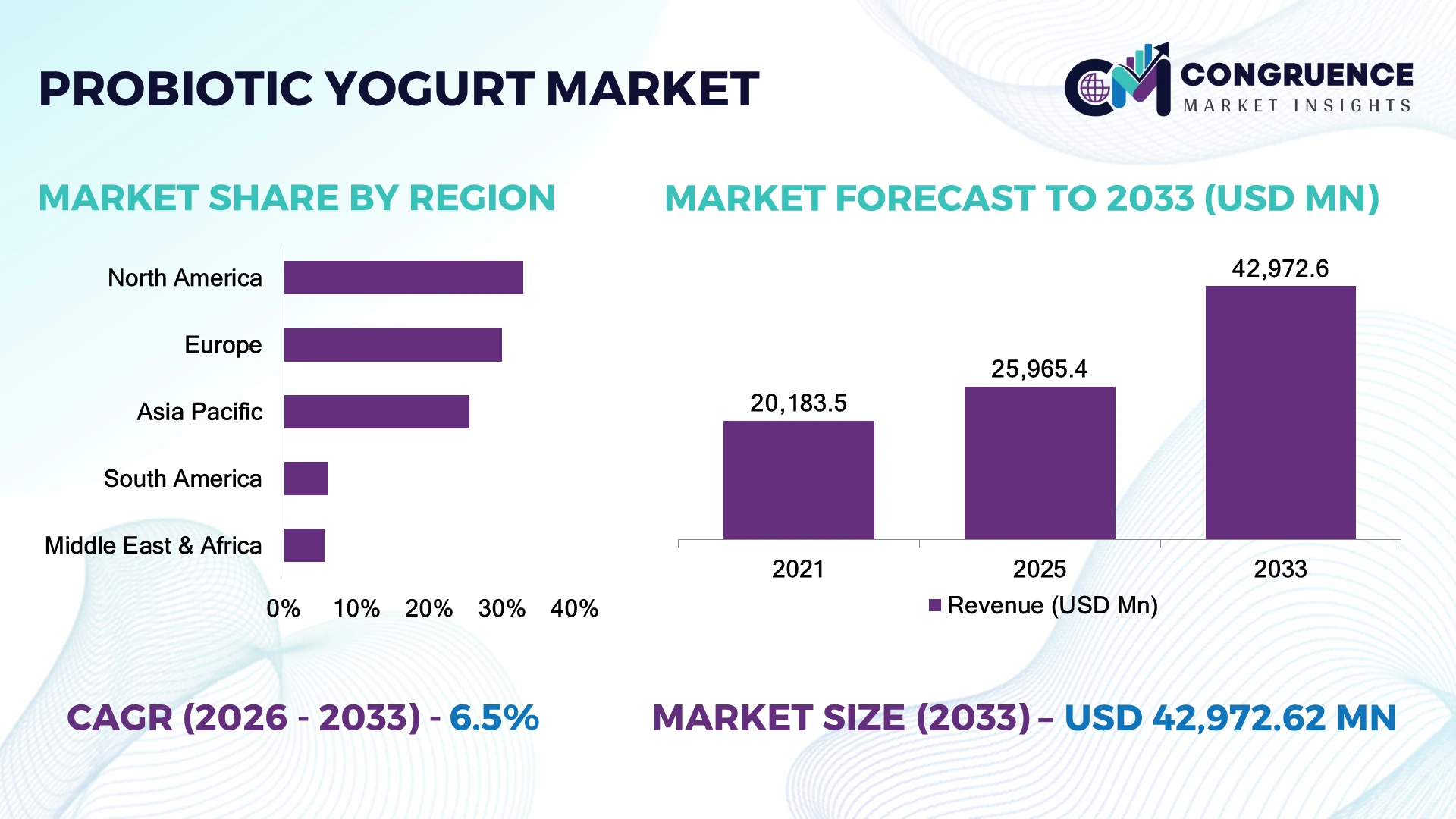
The Global Probiotic Yogurt Market was valued at USD 25,965.4 Million in 2025 and is anticipated to reach a value of USD 42,972.6 Million by 2033 expanding at a CAGR of 6.5% between 2026 and 2033. Growth is being driven by clinically positioned probiotic strains, reduced-sugar formulations, digestive-health claims, and premium functional dairy launches supported by refrigerated retail expansion.
The United States remains the dominant country market, accounting for approximately 28% of global probiotic yogurt consumption, supported by established cultured-dairy manufacturing, functional-food investment, and high penetration of refrigerated supermarket channels. Japan follows with roughly 12%, while U.S. premium product launches are advancing faster through strain-specific formulations and convenient single-serve formats. Geopolitical supply-chain pressures are encouraging manufacturers to localize cultures, packaging, and dairy inputs.
Strategically, manufacturers should prioritize strain differentiation, cold-chain resilience, and premium functional positioning in high-value markets.
Market Size & Growth: USD 25.97 billion in 2025 to USD 42.97 billion by 2033 at a 6.5% CAGR, supported by functional-food and digestive-health positioning.
Top Growth Drivers: Digestive-health claims 34%, reduced-sugar demand 27%, and premium functional formulations 22% drive category expansion.
Short-Term Forecast: By 2028, automated filling and cold-chain optimization are positioned to reduce processing losses by 8–12% and improve production efficiency by 10%.
Emerging Technologies: Microencapsulation, precision fermentation, and AI-assisted formulation are improving probiotic stability by 15–25% across advanced product pipelines.
Regional Leaders: North America is projected near USD 12.5 billion, Europe USD 10.8 billion, and Asia-Pacific USD 11.2 billion, with Asia-Pacific showing the fastest premium-product adoption.
Consumer/End-User Trends: Approximately 42% of frequent yogurt buyers increasingly prioritize digestive-health benefits, accelerating demand for strain-specific and low-sugar products.
Pilot/Case Example: In 2025, automated cultured-dairy production upgrades achieved approximately 12% lower processing losses while improving batch consistency and reducing manual intervention.
Competitive Landscape: Danone leads with an estimated 14% share, competing closely with Yakult, Nestlé, Chobani, General Mills, and Müller across functional positioning and retail reach.
Regulatory & ESG Impact: Reduced-plastic packaging initiatives are targeting 10–20% lower packaging material intensity, while tighter health-claim standards favor scientifically validated probiotic formulations.
Investment & Funding: More than USD 1.2 billion in recent category-related manufacturing, product-development, and capacity investments is shifting toward premium cultures, automation, and localized production.
Innovation & Future Outlook: Postbiotic combinations, precision-fermented ingredients, personalized nutrition, and shelf-life extension will shift competition toward clinically differentiated products and higher-margin functional formulations.
The probiotic yogurt market is increasingly concentrated around digestive health, immune-support positioning, reduced sugar, and convenient formats, with approximately 40% of new premium launches emphasizing functional or nutritional differentiation. In 2026, manufacturers are strengthening domestic culture supply and refrigerated distribution as dairy-input volatility and cross-border logistics reshape procurement strategies. This transition is making formulation capability and cold-chain execution central to competitive positioning.
Probiotic yogurt is becoming strategically important because dairy manufacturers are using functional nutrition to defend margins in a mature refrigerated-food category. The competitive shift is moving from conventional yogurt volume toward differentiated products built around validated probiotic strains, reduced sugar, protein enrichment, and targeted digestive-health benefits. This allows manufacturers to command premium pricing while expanding consumption occasions beyond breakfast.
Technology is reinforcing this shift. Microencapsulation can improve probiotic survival through processing and storage by approximately 15–25% compared with conventional incorporation, while automated dosing and filling can reduce production variability by around 10%. North American producers emphasize premium refrigerated products and high-value retail channels, whereas Japanese and South Korean manufacturers have stronger experience with daily probiotic consumption and functional positioning.
During 2026–2028, manufacturers are expected to increase investment in strain stabilization, automated fermentation control, localized culture sourcing, and smaller-format packaging. A practical deployment model is the integration of automated fermentation monitoring with cold-chain analytics, allowing producers to reduce batch deviations and improve inventory rotation. Companies that combine formulation science with resilient dairy procurement and differentiated claims will secure stronger shelf positioning and defend margins as functional yogurt competition intensifies.
Digestive-health positioning is shifting probiotic yogurt from a conventional dairy product toward a clinically differentiated functional-food category. Approximately 42% of frequent yogurt buyers prioritize digestive-health benefits, while reduced-sugar formulations account for roughly 27% of premium product development activity. In the United States, manufacturers are increasing investment in strain-specific formulations and microencapsulation to improve probiotic stability by 15–25% through processing and refrigerated storage. Supply-chain volatility affecting dairy inputs and imported cultures is also encouraging localized sourcing. Producers are responding through culture partnerships, automated fermentation controls, and portfolio expansion. The non-obvious advantage is that validated strain performance increasingly supports premium pricing, making formulation science a stronger competitive lever than conventional flavor innovation.
Probiotic yogurt profitability remains constrained by refrigerated logistics, culture stability, and dairy-input volatility. Cold-chain operations can represent approximately 10–15% of finished-product costs in distribution-intensive markets, while specialized probiotic cultures can add 5–12% to formulation expenses. In India and Southeast Asia, fragmented refrigerated retail infrastructure increases inventory exposure and limits distribution of highly perishable premium products. Regulatory scrutiny of health claims further raises formulation and compliance costs, particularly where evidence requirements differ across markets. Manufacturers are reducing exposure through regional culture sourcing, longer-life formulations, multi-supplier contracts, and optimized distribution hubs. A key operational pressure point is balancing probiotic viability with extended shelf life without increasing stabilizer usage or compromising clean-label positioning.
Precision fermentation, microencapsulation, and synbiotic formulations create an opportunity to improve probiotic survival while expanding premium product architecture. Encapsulation technologies can raise viable probiotic retention by approximately 15–25%, while protein-fortified and low-sugar formats are gaining stronger shelf differentiation. India offers a notable expansion opportunity as modern dairy processing and organized retail improve access to functional chilled products, while Japan provides a mature benchmark for daily probiotic consumption. Manufacturers are directing R&D toward multi-strain combinations, postbiotic blends, and controlled-release delivery systems. The strategic opportunity extends beyond yogurt cups: concentrated shots, high-protein tubs, and convenient single-serve formats can increase consumption frequency while reducing dependence on traditional breakfast occasions.
Maintaining clinically meaningful probiotic viability from fermentation through consumer consumption remains a technical execution challenge. Manufacturers target minimum viable counts that can decline by 10–20% during extended refrigerated storage if formulation, temperature, or packaging controls are poorly synchronized. Automated fermentation monitoring can reduce batch variability by approximately 10%, but integrating sensors, dosing systems, quality analytics, and cold-chain data requires capital and specialized personnel. In the United States and Europe, evolving health-claim expectations increase the importance of documented strain performance and traceability. Companies must therefore invest in stability testing, digital quality-control systems, validated packaging, and specialist partnerships. The critical competitive issue is not simply adding probiotics, but consistently delivering the claimed functional value at commercial scale.
Microencapsulation Improves Stability Microencapsulation is moving into mainstream premium formulations, with probiotic retention improvements of approximately 15–25% compared with conventional incorporation. Manufacturers are redesigning fermentation and filling workflows around protected cultures, reducing viability losses during refrigerated storage. The shift is particularly important as longer distribution distances increase exposure to temperature fluctuations and inventory delays.
Reduced-Sugar Formulations Accelerate Reduced-sugar products now represent roughly 27% of premium formulation activity, reflecting tighter nutritional positioning and changing consumer preferences. Producers are reformulating with alternative sweetening systems while protecting texture and probiotic stability. In 2026, portfolio restructuring is increasingly focused on maintaining clean-label credentials without sacrificing mouthfeel, helping brands defend premium shelf space.
Synbiotic Products Gain Traction Synbiotic yogurt combining probiotics with prebiotic fibers is expanding product differentiation, with approximately 18% of functional launches incorporating multi-component digestive-health positioning. Manufacturers are partnering with ingredient specialists and optimizing strain-fiber compatibility. The operational challenge is maintaining sensory quality while increasing functional density, making formulation expertise a stronger barrier than conventional dairy processing scale.
Smart Cold-Chain Control Expands Digital temperature monitoring is becoming more important as refrigerated distribution networks face energy costs and logistics disruptions. Advanced operators are targeting 8–12% lower cold-chain losses through sensor-based alerts, route optimization, and inventory analytics. The non-obvious shift is that cold-chain data is becoming a product-quality asset, allowing manufacturers to protect probiotic potency while reducing waste and improving distributor accountability.
Greek and Conventional Formats Lead, While Plant-Based Probiotic Yogurt Accelerates
Conventional probiotic yogurt remains the leading type, accounting for approximately 46% of global demand in 2025, supported by established cold-chain infrastructure, broad retail penetration, and comparatively efficient culture integration. Greek probiotic yogurt follows at around 27%, benefiting from its higher protein positioning and premium shelf economics. Drinkable probiotic yogurt represents nearly 15%, with single-serve formats gaining traction in convenience-led channels. Plant-based probiotic yogurt, although smaller at about 12%, is the fastest-growing type as oat, soy, coconut, and almond bases improve fermentation stability and texture consistency.
Manufacturers are reallocating product-development budgets toward differentiated cultures, reduced-sugar formulations, and longer shelf-life technologies. Plant-based variants require more formulation engineering than conventional products, but their ability to reach dairy-avoiding consumers is increasing strategic value. Companies are also expanding co-manufacturing partnerships and culture-supplier relationships to reduce development cycles and strengthen strain stability across formulations.
A 2026 Indian Journal of Dairy Science study of 1,112 urban Bengaluru dairy consumers found 53% awareness of probiotic dairy products, while 23% actively consumed them, indicating a substantial conversion opportunity for manufacturers.
Digestive Health Dominates as Functional Benefits Diversify
Digestive health is the leading application, representing approximately 42% of global probiotic yogurt demand in 2025, reflecting strong consumer association between live cultures and gut health. General wellness accounts for nearly 26%, while immunity-focused formulations hold about 18%. Weight management and other targeted applications collectively represent around 14%. Digestive-health products retain an advantage because manufacturers can integrate probiotic strains without substantially altering mainstream yogurt consumption habits.
Immunity and weight-management applications are developing faster as brands combine probiotics with protein, fiber, vitamins, and reduced-sugar formulations. Around 31% of new functional yogurt positioning increasingly emphasizes multiple benefits rather than a single digestive-health claim. Companies are responding through formulation partnerships, strain-specific product development, and differentiated packaging. The strategic shift is from basic probiotic inclusion toward benefit-led portfolios that support premium pricing, stronger shelf differentiation, and repeat purchase.
A 2026 Food Research International study involving 177 Brazilian yogurt consumers found probiotics and bioactive compounds were preferred functional additives, while price and taste remained key barriers to regular consumption.
Households Remain Core Buyers as Institutional Adoption Expands
Households represent the dominant end-user group, accounting for approximately 72% of global probiotic yogurt consumption in 2025, supported by supermarket, convenience, and direct-to-consumer purchasing. Foodservice contributes nearly 18%, while institutional and other buyers account for about 10%. Household demand is more sensitive to flavor, price, pack size, and promotional activity, whereas foodservice buyers prioritize consistency, portion control, shelf stability, and procurement efficiency.
Foodservice is the fastest-expanding end-user segment, supported by hotel breakfast programs, cafés, wellness-oriented menus, and prepared-food operators. Its share is approaching 20% in several developed urban markets, increasing the importance of bulk and single-serve formats. Manufacturers are adapting through contract supply agreements, customized pack configurations, and channel-specific pricing. The non-obvious opportunity lies in institutional procurement, where standardized probiotic formulations can create recurring volume commitments while reducing dependence on retail promotions.
A 2026 Scientific Reports study found 61.85% of surveyed participants preferred yogurt, cheese, or other dairy products as probiotic formats, reinforcing the importance of dairy-based delivery platforms in consumer adoption.
North America accounted for the largest market share at 32.9% in 2025 however, Asia-Pacific is expected to register the fastest growth, expanding at a CAGR of 8.0% between 2026 and 2033.

Premium functional dairy shifts from volume to formulation precision
North America maintains the strongest commercial position, supported by sophisticated cold-chain infrastructure, high supermarket penetration, and established probiotic brands. The region represented approximately 32.9% of the global probiotic yogurt market in 2025, with the United States accounting for the dominant share of regional consumption. Product development is shifting toward high-protein, reduced-sugar, lactose-free, and strain-specific formulations, while drinkable formats strengthen convenience positioning. U.S. dairy yogurt represented more than 91% of the broader yogurt category in 2025, reinforcing the importance of dairy processing capacity even as non-dairy alternatives expand. Manufacturers are prioritizing automated fermentation controls, proprietary cultures, and packaging optimization to protect margins amid milk-input volatility. Strategic investment is increasingly directed toward differentiated formulations rather than simple capacity additions.
United States Market Outlook: The United States remains the principal commercial hub, combining extensive refrigerated retail infrastructure with advanced dairy processing and strong brand competition. More than half of the population regularly consumes yogurt or smoothie products, creating a substantial installed consumer base for probiotic extensions. Manufacturers are emphasizing high-protein and low-sugar SKUs while expanding refrigerated distribution and premium functional formats.
Regulatory discipline is reshaping functional-yogurt formulation
Europe remains a major probiotic yogurt center, supported by mature dairy processing, established fermented-food consumption, and sophisticated private-label retail. The region represented roughly 30% of the global probiotic yogurt market in 2025. Germany, France, the United Kingdom, Italy, and Spain form the principal commercial markets, while stricter requirements around health claims and probiotic communication are increasing formulation and evidence requirements. European probiotic retail value across supplements, yogurts, sour-milk products, and dairy beverages reached approximately €10 billion in 2023, highlighting the depth of the functional-food ecosystem. Manufacturers are responding through strain validation, lower-sugar reformulation, plant-based extensions, and localized production. The strategic advantage is shifting toward brands able to combine scientific substantiation with scalable cold-chain execution.
Germany Market Outlook: Germany is the most strategically important European market, supported by large-scale dairy processing and powerful discount-retail channels. It represents approximately 20–25% of European yogurt and probiotic drink consumption by volume, while private-label penetration exceeds 35%. Producers therefore compete on formulation quality, price architecture, and reliable refrigerated availability, making Germany a critical testing ground for scalable probiotic product positioning.
Scale economics are accelerating localized functional-dairy deployment
Asia-Pacific combines expanding consumer penetration with substantial dairy-processing and packaged-food manufacturing capacity. The region represented approximately 25–26% of the global probiotic yogurt market in 2025, with China and Japan serving as major commercial centers. China alone represented about 5% of the broader global yogurt and probiotic drink market, while its probiotic category benefits from increasingly sophisticated refrigerated retail and e-commerce distribution. Manufacturers are localizing flavors, portion sizes, sugar profiles, and probiotic strains rather than transferring Western formulations unchanged. Automation in fermentation, filling, and cold-chain monitoring is improving production consistency while supporting shorter product-development cycles. Companies are also increasing partnerships with ingredient suppliers to secure validated cultures and improve strain stability across high-volume production environments.
China Market Outlook: China provides the strongest manufacturing and deployment platform in Asia-Pacific, combining large-scale dairy processing with advanced digital retail infrastructure. Its yogurt and probiotic drink market generated approximately USD 5.9 billion in 2025, while probiotic-focused manufacturers increasingly use differentiated cultures, convenient formats, and localized flavor profiles. Competitive advantage is moving toward rapid SKU adaptation and reliable cold-chain execution.
Brazil anchors regional dairy scale while functional formats broaden
South America remains smaller than North America, Europe, and Asia-Pacific but offers a concentrated opportunity through Brazil's established dairy industry and expanding functional-food portfolio. Brazil accounted for approximately 62.6% of South America's broader yogurt market in 2025, supported by substantial milk production and extensive retail distribution. Regional manufacturers are increasingly introducing high-protein, reduced-sugar, and probiotic formulations alongside conventional yogurt. Drinkable and convenient formats are gaining operational relevance as manufacturers seek higher consumption frequency and improved portability. Brazil's milk production was projected at approximately 25.4 million metric tons in 2025, providing a substantial domestic processing base. Companies are therefore emphasizing local sourcing, production efficiency, and targeted premiumization rather than relying heavily on imported probiotic formulations.
Brazil Market Outlook: Brazil is the region's principal dairy manufacturing and consumption hub, combining large milk-processing capacity with extensive supermarket and convenience distribution. Its yogurt market represented approximately 62.6% of South American volume in 2025, giving manufacturers scale advantages in fermentation, packaging, and procurement. Producers are increasingly using domestic dairy inputs and localized formulations to reduce exposure to imported ingredient costs.
Functional dairy investment is moving toward localized production
Middle East & Africa remains a developing probiotic yogurt market, with demand concentrated in urban centers and higher-income Gulf economies. The region's broader yogurt and probiotic drink market reached approximately USD 7.6 billion in 2025, while probiotic drinks represented about 65% of that category, demonstrating strong consumer acceptance of functional fermented formats. Saudi Arabia, the UAE, and South Africa provide the most strategically relevant commercial platforms, supported by modern retail, expanding food-processing infrastructure, and health-oriented product development. Regional producers are increasing local manufacturing, improving refrigerated logistics, and introducing reduced-sugar and fortified variants. The shift toward domestic production is particularly important because localized manufacturing reduces exposure to imported dairy ingredients and improves shelf availability in temperature-sensitive markets.
Saudi Arabia Market Outlook: Saudi Arabia provides the strongest commercial platform in the region, supported by substantial dairy-processing infrastructure, modern retail, and government-backed health and food-industry modernization. The country accounted for approximately 41.7% of the broader regional probiotics market in 2025. Local dairy manufacturers are investing in probiotic formulations, functional beverages, and refrigerated distribution, positioning the country as a strategic launchpad for premium functional dairy products.
Danone, Yakult, Chobani, Lifeway Foods, and regional dairy leaders compete across functional yogurt, with global brands challenging local producers on formulation credibility, price, and reach. The top five players are estimated to control about 35% of the probiotic-yogurt segment, leaving specialist labels. Price accounts for roughly 30% of purchase differentiation, while probiotic formulation and strain credibility influence about 25%; cold-chain availability contributes another 20% to conversion. Danone is expanding Activia through kefir, prebiotic, and high-protein formats, while Yakult strengthens distribution and localized variants. Chobani is investing in U.S. processing capacity and high-protein categories, whereas regional dairy groups compete through lower-cost sourcing and retailer relationships. The competitive shift is moving from basic live-culture claims toward quantified strains, sugar reduction, protein density, and multifunctional formulations. Entry barriers remain highest in culture stability, regulatory substantiation, cold-chain execution, and access. Winning requires proprietary formulation, scalable production, and superior shelf presence.
Danone S.A.
Yakult Honsha Co., Ltd.
Chobani, LLC
Lifeway Foods, Inc.
Grupo Lala, S.A.B. de C.V.
Sodiaal
Nestlé S.A.
Arla Foods amba
Fonterra Co-operative Group Limited
Meiji Holdings Co., Ltd.
FrieslandCampina
General Mills, Inc.
Morinaga Milk Industry Co., Ltd.
Kerry Group plc
Modern probiotic yogurt production is shifting toward precision fermentation, automated culture monitoring, and advanced microencapsulation. Inline sensors and automated pH control can improve fermentation consistency by 8–12%, while microencapsulation raises probiotic survival through processing and storage by 10–18%. Adoption is concentrated among large dairy processors, with advanced process monitoring deployed across roughly 35% of facilities. This gives integrated producers tighter batch control, lower waste, and stronger viable-count compliance.
Emerging platforms combine metagenomic screening, AI-assisted strain selection, and synbiotic formulation. AI-enabled formulation workflows can reduce screening cycles by 15–20%, while targeted strain combinations improve functional positioning without increasing package complexity. Compared with conventional free-cell addition, encapsulated cultures deliver approximately 12% better viable-cell retention at end-of-shelf-life. Premium brands and technically integrated dairy manufacturers benefit most because they can monetize strain performance, higher protein, reduced sugar, and differentiated gut-health claims.
Between 2026 and 2028, digital fermentation controls, predictive quality analytics, and precision microbial selection will move from specialist capabilities toward mainstream deployment. Producers are integrating laboratory data with plant systems to shorten development cycles and stabilize output. Companies that secure proprietary cultures, automated processing expertise, and validated cold-chain performance will gain competitive advantage as functional yogurt moves toward measurable, science-led product differentiation.
May 2026 PIM Brands introduced Welch’s Probiotic Yogofruits, delivering 2 billion probiotic cultures and 3 grams of fiber per serving. The launch extends probiotics into functional snacking, diversifying category exposure beyond refrigerated yogurt and strengthening PIM’s better-for-you portfolio. Source: pimbrands.com
October 2025 Chobani secured $650 million in funding while committing $1.2 billion to a new New York dairy plant and $500 million to Idaho expansion. The investment increases domestic processing capacity and supports broader U.S. high-protein product diversification. Source: reuters.com
July 2025 Danone launched Activia Proactive with 10 grams of protein and 3 grams of prebiotic fiber per serving, alongside recipes containing 25% less sugar. The reformulation strengthens functional positioning and targets consumers seeking gut-health and nutrition benefits. Source: prnewswire.com
July 2024 Yakult Danone India introduced Yakult Light Mango, expanding its probiotic beverage portfolio with a localized flavor. The launch strengthens product relevance and supports wider consumption occasions while leveraging a manufacturing and distribution network in India. Source: theprint.in
The Probiotic Yogurt Market Report evaluates the industry across product type, formulation, flavor, packaging format, distribution channel, application, and end-user positioning. Coverage spans conventional dairy, Greek, drinkable, low-fat, high-protein, lactose-free, plant-based, and specialized probiotic formulations, with analysis of retail, foodservice, institutional, and direct-to-consumer channels. Regional assessment covers North America, Europe, Asia-Pacific, South America, and Middle East & Africa, with country-level emphasis on major consumption and manufacturing hubs.
The report also assesses strain technologies, microencapsulation, fermentation automation, cold-chain optimization, AI-assisted formulation, synbiotic integration, and sustainable packaging. Competitive analysis profiles leading global dairy companies, specialist probiotic brands, regional processors, and private labels, while examining product launches, partnerships, capacity expansion, and portfolio diversification. Quantitative indicators covering segment shares, adoption patterns, deployment intensity, and company participation support investment planning, market-entry decisions, geographic expansion, competitive positioning, and strategic priorities through 2026–2033.
| Report Attribute/Metric | Report Details |
|---|---|
|
Market Revenue in 2025 |
USD 25,965.4 Million |
|
Market Revenue in 2033 |
USD 42,972.6 Million |
|
CAGR (2026 - 2033) |
6.5% |
|
Base Year |
2025 |
|
Forecast Period |
2026 - 2033 |
|
Historic Period |
2021 - 2025 |
|
Segments Covered |
By Type
By Application
By End-User
|
|
Key Report Deliverable |
Revenue Forecast, Growth Trends, Market Dynamics, Segmental Overview, Regional and Country-wise Analysis, Competition Landscape |
|
Region Covered |
North America, Europe, Asia-Pacific, South America, Middle East, Africa |
|
Key Players Analyzed |
Danone S.A., Yakult Honsha Co., Ltd., Chobani, LLC, Lifeway Foods, Inc., Grupo Lala, S.A.B. de C.V., Sodiaal, Nestlé S.A., Arla Foods amba, Fonterra Co-operative Group Limited, Meiji Holdings Co., Ltd., FrieslandCampina, General Mills, Inc., Morinaga Milk Industry Co., Ltd., Kerry Group plc |
|
Customization & Pricing |
Available on Request (10% Customization is Free) |




