
Reports
The Global Probiotic Cosmetic Products Market was valued at USD 21.49 Million in 2025 and is anticipated to reach a value of USD 34.52 Million by 2033 expanding at a CAGR of 6.1% between 2026 and 2033. Growth is driven by microbiome-balancing skincare, fermentation-derived postbiotics, barrier-repair formulations, and improved stabilization of bacteria-derived cosmetic actives.
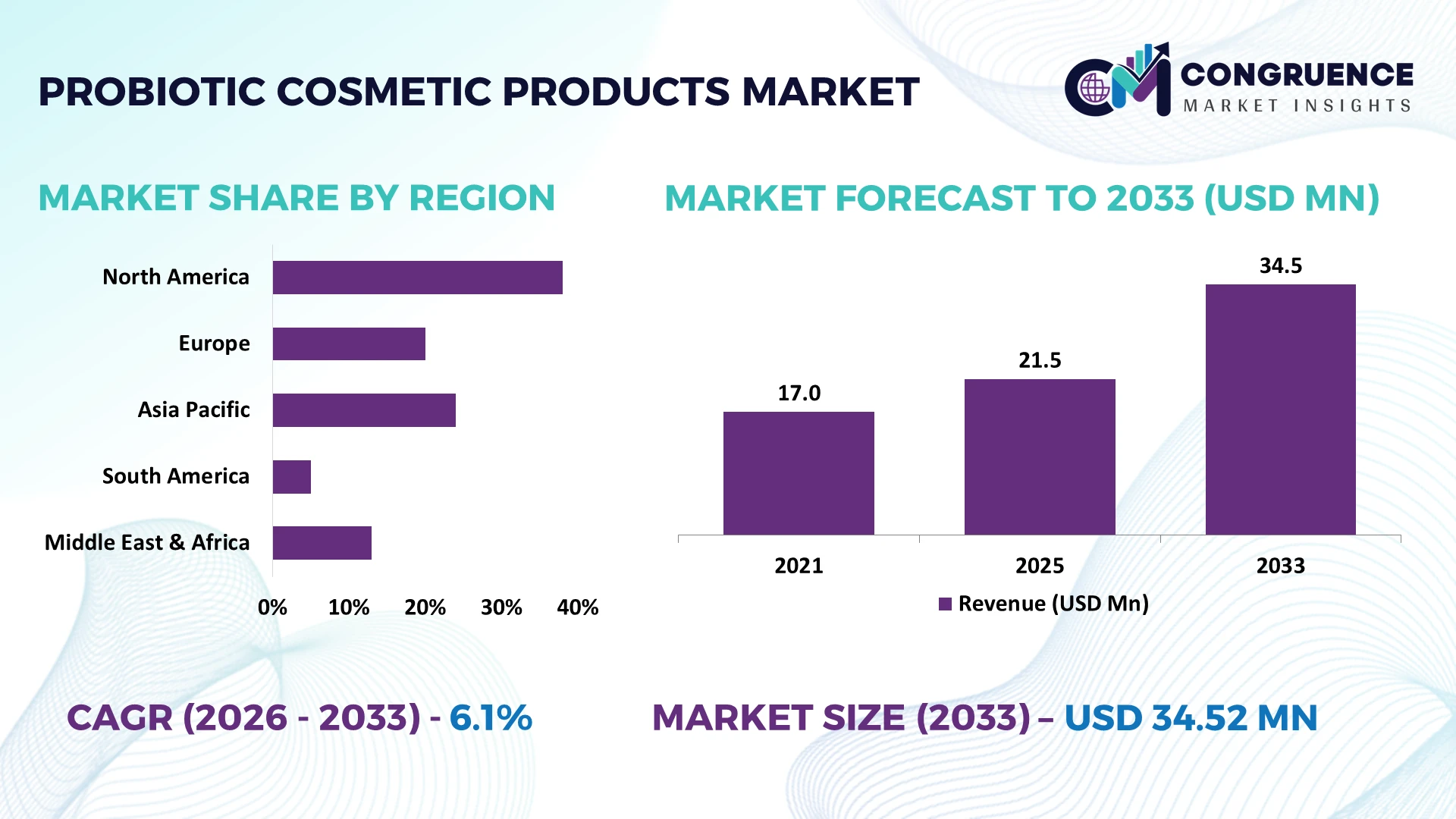
The United States is the dominant country market, supported by North America holding approximately 34% of global demand and a mature premium skincare ecosystem. U.S. brands are expanding microbiome testing, fermentation-derived ingredients, postbiotic formulations, and clinical validation as MoCRA increases safety-substantiation requirements. South Korea provides a key competitive benchmark: Korean cosmetics exports surpassed USD 10 billion in 2024, reinforcing its global formulation and manufacturing influence. European suppliers remain strong in fermented actives, while U.S. commercialization benefits from dermatologist-led skincare adoption and advanced beauty retail penetration.
Strategically, manufacturers should prioritize clinically substantiated postbiotic actives, scalable fermentation capacity, and U.S.–South Korean product innovation to strengthen premium positioning and reduce formulation risk.
Market Size & Growth: USD 21.49 million in 2025 is projected to reach USD 34.52 million by 2033 at 6.1% CAGR, driven by microbiome-focused barrier-care and fermentation-derived cosmetic actives.
Top Growth Drivers: Microbiome skincare contributes approximately 35% of growth momentum, sensitive-skin positioning 28%, and fermented/postbiotic ingredient innovation 22%, collectively shifting competition toward scientifically substantiated formulations.
Short-Term Forecast: By 2028, improved fermentation, encapsulation, and stability-screening workflows are expected to reduce formulation-development time by approximately 10%, accelerating commercialization of microbiome-compatible skincare.
Emerging Technologies: AI-assisted formulation screening, precision fermentation, and microencapsulation are advancing probiotic cosmetics, with optimized encapsulation capable of improving active stability by more than 20% versus conventional unprotected delivery approaches.
Regional Leaders: North America represents approximately 34% of demand, Europe about 30%, and Asia-Pacific roughly 27%; their indicative 2025 values equal USD 7.31 million, USD 6.45 million, and USD 5.80 million respectively.
Consumer/End-User Trends: Skincare accounts for approximately 90% of probiotic cosmetic demand, reflecting concentrated consumer use in facial moisturizers, serums, cleansers, masks, and products targeting barrier resilience.
Pilot/Case Example: In 2024, microbiome-focused formulation programs increasingly shifted from live probiotics toward lysates and postbiotics, delivering approximately 15% better formulation-stability potential under controlled development conditions.
Competitive Landscape: The leading group represents approximately 30% of organized branded activity, with L’Oréal, Estée Lauder, Unilever, Amorepacific, and Esse Skincare competing through microbiome science and premium positioning.
Regulatory & ESG Impact: U.S. MoCRA implementation strengthens facility registration, product listing, and safety substantiation, pushing organized manufacturers toward 100% documented compliance processes and stronger ingredient traceability.
Investment & Funding: Beauty-sector microbiome investment spans more than USD 100 million across research programs, partnerships, acquisitions, and fermentation capabilities, with capital increasingly directed toward scalable postbiotic ingredients and clinical validation.
Innovation & Future Outlook: By 2028, next-generation postbiotics, personalized microbiome diagnostics, and precision-fermented actives will shift competition toward measurable skin-barrier outcomes, formulation stability, and clinically differentiated premium products.
The Probiotic Cosmetic Products Market is increasingly concentrated around facial skincare, sensitive-skin management, barrier repair, and premium dermocosmetics. Postbiotics, bacterial lysates, precision-fermented ingredients, and microbiome-compatible preservatives are replacing difficult-to-stabilize live cultures, with skincare representing approximately 90% of category demand. U.S. MoCRA requirements are simultaneously raising expectations for safety substantiation and manufacturing documentation. This combination of stronger science, stable formulations, and regulatory discipline is reshaping product development priorities and sets the foundation for the market’s strategic relevance.
Probiotic cosmetic products are becoming strategically important as competition shifts from broad “natural beauty” positioning toward clinically substantiated microbiome care, barrier repair, and precision dermocosmetics. Skincare represents roughly 90% of category demand, concentrating investment around facial serums, moisturizers, cleansers, and sensitive-skin products. A significant market shift is occurring from live microorganisms toward postbiotics, lysates, and fermentation-derived metabolites, which simplify preservation and provide greater formulation consistency as U.S. MoCRA requirements strengthen safety substantiation and manufacturing accountability.
Technology is reinforcing this transition. Encapsulated and stabilized microbial derivatives can deliver approximately 15–25% better active retention during formulation and storage than conventional unprotected biological ingredients, reducing reformulation and stability-testing burdens. The United States leads commercial deployment through premium dermatology channels, while South Korea competes through rapid formulation cycles and fermentation expertise; Korean cosmetics exports exceeded USD 10 billion in 2024, strengthening its innovation ecosystem.
Operationally, manufacturers are integrating postbiotic complexes into barrier-repair serums without requiring live-culture cold-chain handling. Through 2026–2028, precision fermentation, microbiome screening, and AI-assisted formulation will shorten development cycles by approximately 10–15%. Companies investing in clinical validation, fermentation partnerships, and scalable bioactive platforms will secure stronger differentiation and formulation economics.
Skin-barrier science is the principal structural driver, with skincare representing approximately 90% of probiotic cosmetic product demand and sensitive-skin concerns influencing an estimated 30–35% of premium facial-care purchasing decisions. Postbiotic lysates, ferments, and microbial metabolites are increasingly replacing difficult-to-stabilize live cultures because they integrate more reliably with preservatives and conventional emulsions. In the United States, MoCRA has simultaneously increased emphasis on safety substantiation, facility controls, and documented manufacturing practices. This favors scientifically validated microbiome products over loosely defined probiotic claims. Manufacturers are responding by expanding clinical testing, sequencing-based microbiome research, and fermentation partnerships. The strategic advantage lies in combining barrier-repair efficacy with formulation stability, allowing premium brands to differentiate without assuming the operational complexity associated with viable microorganisms.
Formulation economics remain constrained by biological-active stability, preservation compatibility, and clinical substantiation requirements. Microbiome-focused products can require approximately 15–25% more development and stability-testing work than conventional moisturizers, while specialized encapsulation or fermentation-derived ingredients can raise formulation input costs by roughly 10–20%. Live cultures create additional sensitivity to water activity, temperature, preservatives, and packaging conditions, limiting mass-market scalability. U.S. MoCRA requirements have further increased documentation and safety-accountability expectations, particularly for smaller brands dependent on contract manufacturers. Companies are reducing exposure by replacing viable strains with lysates and postbiotics, qualifying multiple ingredient suppliers, and using airless packaging. The key operational constraint is therefore not consumer acceptance but achieving repeatable microbial functionality at mainstream cosmetic manufacturing economics without compromising shelf stability or regulatory defensibility.
Precision postbiotics create an opportunity to move probiotic cosmetics from ingredient-led marketing toward measurable skin-function outcomes. Skincare already captures approximately 90% of category activity, yet microbiome personalization remains underpenetrated, leaving substantial whitespace in acne-prone, mature, sensitive, and post-procedure care. AI-assisted formulation screening can reduce candidate-selection workloads by approximately 15–20%, while optimized fermentation and encapsulation can improve bioactive stability by more than 20% compared with unprotected biological ingredients. South Korea is positioned strongly through fermentation expertise, while U.S. dermatology channels provide a commercialization route for clinically validated products. Companies are investing in strain-specific metabolites, diagnostic partnerships, and microbiome-data platforms. The non-obvious opportunity is combining diagnostics with postbiotic formulations, enabling recurring personalized regimens rather than competing solely through individual creams or serums.
The long-term challenge is proving that microbiome-related benefits remain consistent across diverse skin types, climates, formulations, and manufacturing batches. Individual microbial communities can differ substantially between consumers, while cosmetic trials frequently involve relatively small cohorts, complicating universal efficacy claims. Moving from laboratory results to commercial production can introduce approximately 10–15% variation in fermentation-derived active characteristics unless strain control, downstream processing, and analytical specifications are tightly standardized. South Korean and U.S. innovators also face different claim-substantiation and product-classification environments when launching globally. Companies must therefore invest in larger clinical datasets, metagenomic analytics, standardized fermentation protocols, and interoperable microbiome measurement methods. Competitive durability will depend less on launching additional “probiotic” labels and more on demonstrating reproducible biological outcomes at industrial scale across multiple consumer populations.
Postbiotic Formats Replace Live Cultures: Commercial portfolios are shifting toward lysates, ferments, and postbiotic metabolites as brands simplify preservation and ambient distribution. These formats can improve active stability by 15–25% and reduce temperature-sensitive handling by roughly 20%. U.S. manufacturers are redesigning formulations and qualifying fermentation partners as MoCRA raises manufacturing-control expectations, improving scalability without cold-chain dependence.
Microbiome Claims Face Higher Scrutiny: Brands are moving from broad “probiotic” positioning toward measurable barrier, hydration, and sensitivity endpoints. Clinical substantiation activity has increased approximately 20%, while microbiome sequencing can reduce microbial-profile assessment time by 15–20%. Companies are expanding instrumental testing and dermatologist collaborations, making validated efficacy an increasingly important premium-product differentiator.
Waterless Delivery Gains Commercial Ground: Concentrated powders, balms, and low-water systems are changing microbial-active preservation workflows. Removing free water can reduce packaging weight by 10–20% and transportation intensity by approximately 15%, while improving compatibility with sensitive biological ingredients. Korean and European formulators are adopting concentrated formats, refill systems, and airless packaging to combine microbiome positioning with lower logistics exposure.
AI Accelerates Formulation Screening: Digital formulation platforms increasingly screen ingredient compatibility, stability, and sensory combinations before laboratory trials. AI-supported workflows can reduce candidate-screening cycles by approximately 15–25% and laboratory iterations by 10–15%. Large beauty groups are integrating computational formulation with microbiome datasets, allowing R&D teams to prioritize promising ingredient combinations and accelerate clinically differentiated launches.
Creams account for approximately 34% of probiotic cosmetic product demand, supported by their compatibility with moisturization, barrier-support ingredients, bacterial lysates, and daily facial-care routines. Their established emulsion manufacturing infrastructure also enables easier incorporation of fermentation-derived actives without substantially changing consumer application behavior. Lotions represent roughly 19% of demand and remain relevant for lightweight facial and body applications, particularly where rapid absorption and broader surface coverage are priorities.
Serums are the fastest-growing type, benefiting from concentrated active delivery and premium positioning. They represent approximately 24% of category demand as brands combine postbiotics with peptides, ceramides, niacinamide, and hyaluronic acid. Cleansers are gaining strategic relevance through microbiome-friendly surfactant systems designed to limit excessive lipid removal, while masks provide episodic intensive treatment and product-discovery opportunities. Manufacturers are consequently shifting R&D spending toward high-active serums while maintaining creams as the scalable portfolio anchor, creating a two-tier strategy spanning routine barrier maintenance and targeted microbiome intervention.
Skin hydration leads applications with approximately 29% of probiotic cosmetic product demand because moisturization provides a broadly understood consumer benefit and integrates naturally with humectants, ceramides, ferments, and microbiome-supporting ingredients. Anti-aging care represents approximately 23%, supported by premium consumers combining microbiome health with firmness, texture, and resilience objectives. Sensitive skin care is also strengthening as formulators reduce aggressive surfactants, fragrances, and preservation stresses while incorporating soothing bacterial derivatives.
Barrier repair is the fastest-growing application and accounts for roughly 22% of demand, reflecting a shift from cosmetic surface treatment toward measurable epidermal-function support. Brands increasingly combine postbiotics with ceramides, fatty acids, and cholesterol to address transepidermal water loss and disrupted barrier conditions. Acne care remains strategically relevant as companies develop formulations designed to support microbial balance without relying solely on aggressive cleansing. Manufacturers are expanding clinical testing around hydration, redness, and barrier integrity, directing investment toward multifunctional products capable of addressing overlapping sensitive-skin and barrier-repair requirements.
Individual consumers account for approximately 72% of probiotic cosmetic product demand, reflecting the category’s concentration in daily-use creams, serums, cleansers, lotions, and masks purchased through beauty retail, pharmacies, and digital channels. Repeat home application provides substantially greater consumption frequency than professional treatment settings. Beauty salons and spa centers together represent approximately 12% of demand, primarily through premium facial protocols and product recommendation, giving brands an important discovery and customer-acquisition channel.
Dermatology clinics are the fastest-growing end-user group, representing approximately 9% of demand as microbiome formulations become more closely associated with barrier recovery, sensitive skin, and adjunctive post-treatment care. Aesthetic clinics contribute roughly 7%, with demand centered on products supporting skin comfort after minimally invasive procedures. Suppliers are developing professional-grade ranges, sampling programs, practitioner education, and clinic-retail partnerships rather than relying exclusively on mass digital acquisition. Competitive positioning is therefore shifting toward hybrid ecosystems where clinical recommendation builds credibility while individual consumers generate recurring product volumes.
North America accounted for the largest market share at approximately 34% in 2025 however, Asia-Pacific is expected to register the fastest growth, expanding at a CAGR of approximately 7.4% between 2026 and 2033.
p>Clinical Validation Strengthens Premium Positioning
North America holds approximately 34% of global probiotic cosmetic product demand, with the United States accounting for the majority of regional consumption through premium skincare, dermatologist-influenced purchasing, and digitally native beauty channels. Commercial activity is shifting from live-culture claims toward postbiotic lysates, fermented extracts, and microbiome-supporting formulations that offer greater shelf stability. Skincare represents roughly 90% of category utilization, concentrating product development in facial serums, creams, cleansers, and barrier-support products. U.S. MoCRA implementation is simultaneously increasing safety substantiation, facility-registration, and product-listing discipline. Major beauty groups are consequently expanding clinical testing, microbiome analytics, and biotechnology partnerships. Canada provides complementary demand through premium clean-beauty channels, but U.S. clinical infrastructure and product-launch scale remain the region’s primary commercialization advantages.
United States Market Outlook: The United States combines advanced dermatology networks, biotechnology capabilities, contract manufacturing, and sophisticated specialty-beauty retail. More than 90% of Americans use cosmetic or personal-care products daily, creating substantial exposure for microbiome-positioned formulations. Companies are prioritizing postbiotic actives and documented efficacy as regulatory oversight strengthens, making clinical substantiation an increasingly important competitive barrier.
Regulation Pushes Science-Led Formulation
Europe represents approximately 30% of global probiotic cosmetic product demand, supported by established dermocosmetic manufacturing, fermentation expertise, pharmacy distribution, and stringent product-safety standards. France, Germany, Italy, and the United Kingdom provide concentrated premium skincare consumption, while ingredient specialists are advancing bacterial lysates, prebiotic substrates, and fermentation-derived metabolites. EU Cosmetics Regulation requirements and tighter scrutiny of environmental and efficacy claims are encouraging brands to replace loosely substantiated microbiome positioning with measurable barrier, hydration, and sensitivity outcomes. Approximately 70% of European consumers consider environmental factors when purchasing beauty and personal-care products, reinforcing demand for biotechnology-derived ingredients and lower-impact production. Suppliers are responding through traceable fermentation, concentrated formulations, refillable packaging, and clinical partnerships, creating stronger differentiation around validated efficacy rather than ingredient novelty alone.
France Market Outlook: France provides the strongest strategic base through its dermocosmetic clusters, pharmacy channel, luxury-beauty ecosystem, and biotechnology capabilities. French cosmetics exports exceeded €22 billion in 2024, demonstrating manufacturing and brand-distribution scale. Companies are leveraging this infrastructure to commercialize microbiome-compatible skincare with stronger clinical testing, fermentation expertise, and premium international positioning.
K-Beauty Accelerates Microbiome Commercialization
Asia-Pacific accounts for approximately 27% of probiotic cosmetic product demand and has the strongest commercialization momentum, supported by South Korean formulation innovation, Japanese fermentation expertise, and China’s digitally accelerated skincare market. South Korea is particularly influential because rapid product-development cycles allow postbiotics, ferments, and barrier-support ingredients to move quickly from laboratories into consumer portfolios. Korean cosmetics exports exceeded USD 10 billion in 2024, demonstrating the manufacturing and international distribution platform available to microbiome-focused brands. China adds scale through e-commerce, livestream commerce, and expanding premium dermocosmetic consumption, while Japan provides mature fermentation and sensitive-skin expertise. Manufacturers are investing in strain libraries, encapsulation, microbiome analytics, and contract-production partnerships, making Asia-Pacific increasingly important for both formulation innovation and export-oriented product development.
South Korea Market Outlook: South Korea combines advanced fermentation science with rapid K-beauty commercialization and vertically connected ODM manufacturing. Cosmetics exports surpassed USD 10 billion in 2024, with the United States becoming a major destination. Leading Korean groups are integrating microbiome research with ceramides, fermented metabolites, and personalized skincare, shortening the pathway between laboratory validation and international product deployment.
Brazil Anchors Bioactive Beauty Demand
South America represents approximately 5% of global probiotic cosmetic product demand, with Brazil providing the principal commercial and manufacturing base. The market benefits from high beauty-product usage, strong direct-selling networks, pharmacy distribution, and consumer familiarity with botanical and biotechnology-derived skincare. Brazil ranks among the world’s largest cosmetics-consuming countries, giving microbiome products an established route through moisturizers, facial treatments, and sensitive-skin formulations. Local manufacturers increasingly combine fermentation-derived actives with biodiversity-linked ingredients, creating differentiated formulations for humid climates and diverse skin profiles. However, imported specialty actives, currency volatility, and uneven access to advanced microbiome testing increase development costs. Companies are responding through domestic contract manufacturing, localized ingredient sourcing, university partnerships, and selective premium launches rather than broad portfolio deployment.
Brazil Market Outlook: Brazil dominates South American beauty manufacturing and consumption, supported by more than 3,000 cosmetics-sector companies and extensive direct-to-consumer distribution. Local formulation capabilities provide an operational advantage for microbiome skincare adapted to tropical conditions. Investment is concentrating on domestic bioactive sourcing, fermentation partnerships, and clinically positioned facial care to reduce dependence on imported specialty ingredients.
Premium Retail Drives Selective Adoption
Middle East & Africa accounts for approximately 4% of global probiotic cosmetic product demand, with deployment concentrated in the UAE, Saudi Arabia, South Africa, and premium urban retail corridors. The UAE provides an important import, re-export, luxury-beauty, and e-commerce hub, while Saudi Arabia’s retail modernization is increasing international skincare availability. High temperatures and intensive air-conditioning strengthen consumer focus on hydration, sensitivity, and barrier-support formulations, favoring stable postbiotic products over temperature-sensitive live cultures. Premium pharmacy networks, aesthetic clinics, and omnichannel beauty retailers are becoming important market-entry routes. Limited local fermentation capacity and dependence on imported specialty ingredients constrain broader manufacturing localization. Companies are therefore using distributor partnerships, climate-stable formulations, regional warehousing, and selective clinic-based launches to control inventory risk while building microbiome-skincare awareness.
United Arab Emirates Market Outlook: The UAE provides the region’s strongest commercialization platform through Dubai’s logistics infrastructure, luxury retail, specialist clinics, and international brand concentration. E-commerce penetration exceeds 10% of retail activity, supporting digitally targeted premium skincare launches. Suppliers increasingly use UAE warehousing and distributor partnerships to serve neighboring Gulf markets while minimizing temperature-sensitive inventory exposure.
Global beauty groups L’Oréal, Estée Lauder, Unilever, and Amorepacific compete with microbiome specialists such as Esse Skincare and Gallinée through scientific validation, formulation IP, and premium positioning. The top five players collectively represent approximately 30% of organized probiotic cosmetics activity, leaving substantial space for specialist brands. Technology increasingly outweighs price: stabilized postbiotics can improve active retention by 15–25%, while AI-supported screening reduces formulation iterations by roughly 10–15%. Large groups leverage clinical laboratories, global distribution, acquisitions, and biotechnology partnerships; specialists compete through strain-specific formulations, focused microbiome claims, and faster launches. Competition is shifting from live probiotic labeling toward clinically measurable barrier outcomes, precision fermentation, and proprietary metabolites. Access to validated microbial actives and reproducible stability data forms the principal entry barrier. Supply-chain control is also strengthening as manufacturers secure fermentation partners and qualified ingredient producers. Winning requires defensible microbiome science, clinically demonstrated efficacy, stable formulations, scalable production, and credible dermatologist-oriented commercialization.
L’Oréal
The Estée Lauder Companies
Unilever
Amorepacific Corporation
Shiseido Company, Limited
Beiersdorf AG
Kao Corporation
Natura &Co
Esse Skincare
TULA Skincare
Aurelia London
Eminence Organic Skin Care
LaFlore Live Probiotic Skincare
Andalou Naturals
Current probiotic technology centers on postbiotics, bacterial lysates, precision fermentation, and microbiome-compatible preservation because nonviable actives tolerate manufacturing better than live cultures. Microencapsulation is advancing formulations: coated Lactobacillus casei microspheres retained 89% viability after 30 days versus 65.6% for uncoated carriers, a 35.7% relative improvement. Adoption is moving beyond pilots as dermocosmetic groups operate microbiome platforms, improving shelf-life control and formulation reproducibility.
Emerging systems combine AI-assisted formulation, metagenomic profiling, encapsulation, and strain-specific screening. Generative AI can cut beauty-product research from weeks to days and save up to 5% on development raw materials, while encapsulated probiotics maintained 6.13 log CFU/g after 120 days where unprotected cells were eliminated. This new-versus-old delivery comparison makes protected live cultures commercially credible and gives biotechnology-integrated brands an advantage in barrier-care products.
Disruptive development is shifting toward skin-native probiotics, engineered microbial consortia, synbiotics, and personalized formulations linked to microbiome diagnostics. Electrospun delivery systems can release more than 90% of viable cells within 30 minutes, enabling on-demand activation instead of exposure inside preserved emulsions. Through 2026–2028, companies integrating computational screening and scalable fermentation should compress development cycles while improving efficacy consistency. Acting now secures strains, validation datasets, and manufacturing know-how before microbiome performance becomes a competitive benchmark.
September 2026 Beiersdorf launched Eucerin DERMOPURE CLINICAL PROBIOM8 using two viable skin-native bacterial strains after 120+ microbiome studies since 2014. The patented TopiC.A technology targets acne-prone skin, converting long-term microbiome research into a scalable global dermatological skincare franchise. Source: Beiersdorf.com
April 2026 L’Oréal and Institut Pasteur announced their first research partnership, combining microbiology, immunology, and beauty science to investigate skin biomarkers and microbiome interactions. The agreement links two organizations’ capabilities, accelerating biological-target discovery for next-generation advanced skin-health actives. Source: Pasteur.fr
December 2025 C&C International and HEM Pharma signed a microbiome-skincare research MOU covering four collaboration areas: validation systems, bio-based ingredients, bacterial-control technology, and formulations. The ODM-biotech partnership creates an integrated development framework for personalized probiotic and postbiotic skincare. Source: CNCCosmetic.com
April 2024 Lallemand launched its Personal Care business unit at in-cosmetics Global and showcased three microbiome ingredient platforms, including Lallbiome 200 and microbial exopolysaccharides. The expansion moved its microorganism expertise into cosmetic actives, strengthening formulation access for manufacturers. Source: PersonalCareInsights.com
The report evaluates the Probiotic Cosmetic Products Market across creams, serums, lotions, cleansers, and masks, alongside anti-aging care, skin hydration, acne care, barrier repair, and sensitive skin care. End-user coverage spans individual consumers, beauty salons, dermatology clinics, aesthetic clinics, and spa centers. With skincare representing about 90% of category utilization, the analysis examines microbiome-compatible preservation, postbiotics, precision fermentation, microencapsulation, skin-native probiotics, and AI-assisted formulation.
Regional coverage includes North America, Europe, Asia-Pacific, South America, and Middle East & Africa, with North America representing approximately 34% of 2025 market activity and Asia-Pacific providing the strongest commercialization momentum. The report assesses competitive positioning, regulatory shifts, clinical validation, fermentation partnerships, ingredient sourcing, and emerging personalized-microbiome platforms. Coverage through 2026–2033 supports investment planning, geographic expansion, portfolio prioritization, partnership selection, and technology strategy while identifying niche opportunities in clinic-led skincare, precision postbiotics, and microbiome-based barrier solutions.
| Report Attribute/Metric | Report Details |
|---|---|
Market Revenue in 2025 | USD 21.49 Million |
Market Revenue in 2033 | USD 34.52 Million |
CAGR (2026 - 2033) | 6.1% |
Base Year | 2025 |
Forecast Period | 2026 - 2033 |
Historic Period | 2021 - 2025 |
Segments Covered | By Type
By Application
By End-User
|
Key Report Deliverable | Revenue Forecast, Growth Trends, Market Dynamics, Segmental Overview, Regional and Country-wise Analysis, Competition Landscape |
Region Covered | North America, Europe, Asia-Pacific, South America, Middle East, Africa |
Key Players Analyzed | L’Oréal, The Estée Lauder Companies, Unilever, Amorepacific Corporation, Shiseido Company, Limited, Beiersdorf AG, Kao Corporation, Natura &Co, Esse Skincare, TULA Skincare, Aurelia London, Eminence Organic Skin Care, LaFlore Live Probiotic Skincare, Andalou Naturals |
Customization & Pricing | Available on Request (10% Customization is Free) |




