
Reports
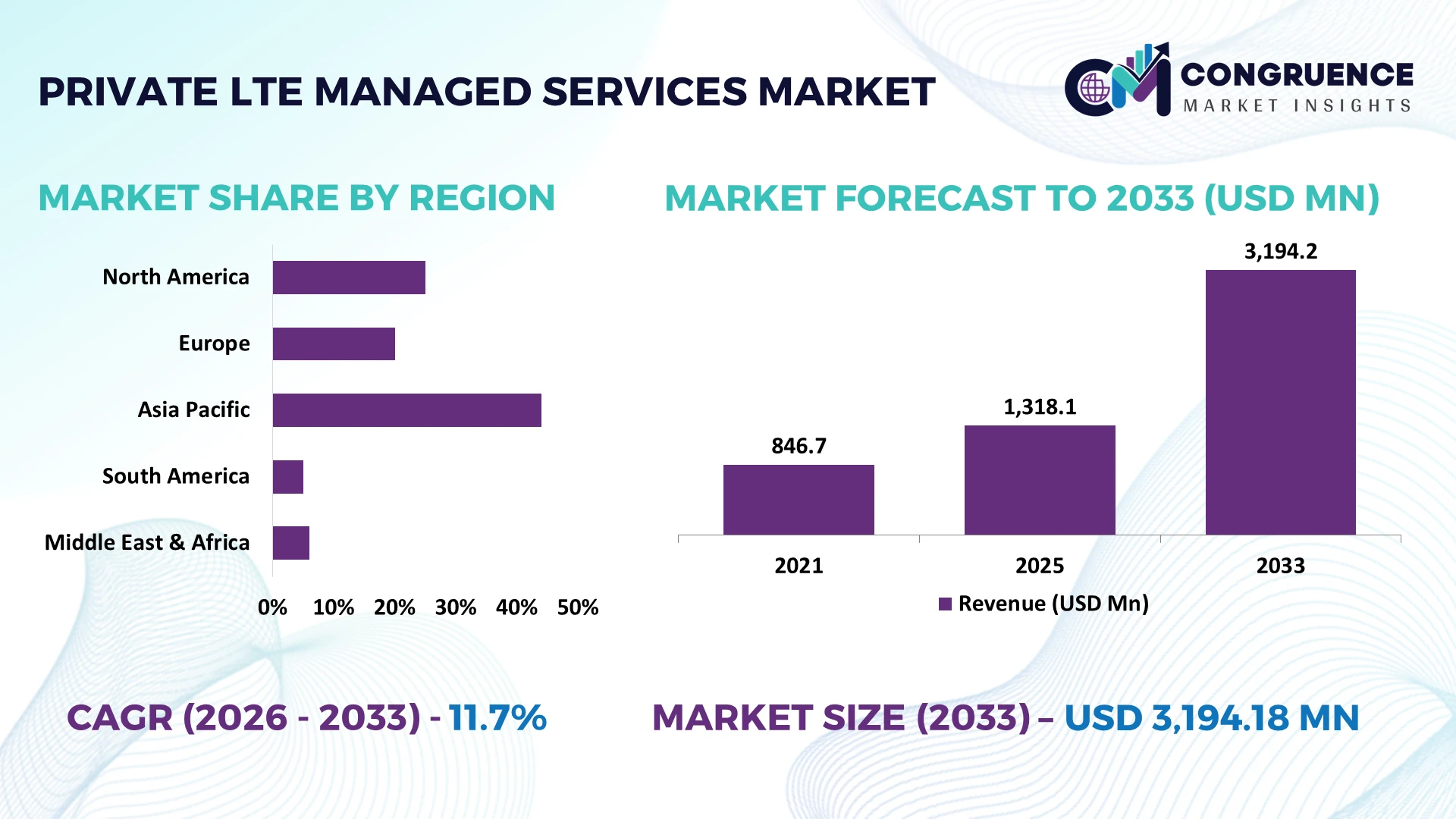
The Global Private LTE Managed Services Market was valued at USD 1318.06 Million in 2025 and is anticipated to reach a value of USD 3194.18 Million by 2033 expanding at a CAGR of 11.7% between 2026 and 2033. Growth is driven by industrial enterprises outsourcing private LTE network design, spectrum management, cybersecurity, device connectivity, and continuous network operations to managed service providers as mission critical applications expand across manufacturing, mining, utilities, and logistics.
The United States leads private LTE deployment, accounting for 513 identified enterprise organizations, representing 25% of global private mobile network customers, compared with 152 organizations in Germany. Its competitive advantage stems from the FCC's Citizens Broadband Radio Service (CBRS), covering 3.55–3.70 GHz spectrum, with the 2020 spectrum auction generating USD 4.5 billion. Manufacturing, utilities, mining, and logistics drive enterprise adoption through dedicated connectivity, operational technology integration, and secure industrial IoT infrastructure. US spectrum policy and Department of Defense reallocation discussions reinforce the importance of regulatory planning.
Strategic implication: Managed service providers should prioritize US industrial accounts while expanding delivery partnerships across Germany and Asia Pacific to capture enterprise network outsourcing opportunities.
Market Size & Growth: USD 1,318.06 million in 2025, reaching USD 3,194.18 million by 2033 at 11.7% CAGR, driven by outsourced industrial network operations.
Top Growth Drivers: Manufacturing automation accounts for 19%, mining 7%, and education 8% of identified private network organizations globally.
Short Term Forecast: By 2028, managed network deployments prioritize 90%+ site connectivity, strengthening uptime and remote asset monitoring.
Emerging Technologies: AI network optimization, edge computing, and IoT device management strengthen real time industrial connectivity and cybersecurity.
Regional Leaders: North America USD 1,117.96 million, Europe USD 862.43 million, and Asia Pacific USD 958.25 million in illustrative 2033 allocation estimates, supported by CBRS, industrial digitization, and manufacturing expansion, respectively.
Consumer/End User Trends: Manufacturing leads adoption with 387 identified organizations, followed by education at 171 and mining at 146.
Pilot/Case Example: Northern Star Resources achieved over 90% mine connectivity against its previous 40% equipment connectivity, enabling real time operational monitoring.
Competitive Landscape: Nokia leads the broader private LTE market with approximately 9.4% share; Ericsson, Huawei, Cisco, and Verizon strengthen competition.
Regulatory & ESG Impact: US CBRS provides access to 150 MHz of shared spectrum, while private LTE enabled a 3–5% fuel reduction in an agricultural deployment.
Investment & Funding: OneLayer secured USD 28 million in Series A funding in 2025, highlighting investment in private cellular security and device management.
Innovation & Future Outlook: AI driven network orchestration, LTE to 5G migration, zero trust security, and managed edge infrastructure reshape enterprise connectivity strategies.
The Private LTE Managed Services Market is gaining traction across manufacturing facilities, mining operations, power utilities, transportation hubs, and large industrial campuses where uninterrupted connectivity directly influences operational performance. Managed offerings increasingly combine network monitoring, spectrum administration, cybersecurity, IoT integration, and remote infrastructure maintenance. Manufacturing represents a significant deployment opportunity, with 387 identified private mobile network organizations globally. Recent innovations in AI enabled network orchestration and edge computing are strengthening predictive maintenance and real time equipment visibility. An emerging trend is the integration of private LTE with 5G infrastructure, encouraging enterprises to outsource increasingly complex network operations and lifecycle management, creating new opportunities for specialized service providers.
Private LTE managed services are becoming strategically important because network reliability, cybersecurity, and operational control increasingly determine industrial competitiveness. With 1,846 identified private mobile network customers across 80 countries by August 2025, enterprises are shifting from internally maintained connectivity toward outsourced network lifecycle management. This shift reflects industrial infrastructure modernization, connected asset deployment, and the need for predictable network performance across geographically dispersed facilities.
Technology selection is also reshaping investment priorities. Private LTE provides mature industrial coverage, while 5G introduces greater bandwidth and lower latency. In mining, LTE networks can cover a 20 × 10 km open pit using 5–10 access points, compared with more than 200 Wi-Fi access points, substantially reducing infrastructure complexity.
Regional strategies differ considerably. The United States benefits from CBRS spectrum availability and a broad enterprise ecosystem, whereas Germany emphasizes industrial integration and advanced manufacturing. Over the next 2–3 years, managed providers will prioritize multi-site connectivity, AI-based network monitoring, and LTE-to-5G migration. Northern Star Resources' Australian mining deployment increased equipment connectivity from 40% to over 90%, demonstrating the operational value of dedicated networks.
Industrial automation is accelerating demand for managed private LTE as enterprises require dedicated connectivity across production lines, mining sites, and remote utility infrastructure. Manufacturing accounted for 359 identified private mobile network customers in August 2025, followed by education with 164 and mining with 134. The expansion of connected machinery, automated guided vehicles, and industrial IoT increases network monitoring and cybersecurity requirements. In Australia, Northern Star Resources improved minewide equipment connectivity from 40% to over 90% through private LTE deployment. Managed providers are responding through industrial network integration partnerships, remote operations centers, and specialized service contracts. The strategic advantage lies in converting network reliability into measurable production visibility rather than simply selling connectivity.
Spectrum availability and infrastructure compatibility constrain the scalability of managed private LTE services. The United States benefits from the 150 MHz CBRS allocation, while enterprises in other countries face different licensing conditions and spectrum access frameworks. Technology transition adds another complexity: 51.1% of identified private mobile network customers initially deployed LTE, 28.5% deployed 5G, and 19% adopted combined LTE and 5G configurations in August 2025. Supporting multiple architectures increases integration, maintenance, and technical staffing requirements. Providers are mitigating these pressures through modular network designs, multi-vendor agreements, and phased migration contracts. Standardized service architectures offer a stronger margin advantage than competing primarily on equipment pricing.
AI driven network orchestration and private LTE to 5G integration create opportunities for managed providers to deliver higher-value industrial services. By August 2025, private mobile networks had reached 1,846 identified customers across 80 countries, demonstrating an expanding addressable deployment base. The opportunity extends beyond initial installation into predictive maintenance, device authentication, edge computing, and continuous network optimization. India's manufacturing industry offers attractive potential through connected production facilities and automated material handling. Providers are positioning through partnerships with equipment manufacturers, cloud platforms, and industrial automation companies. A particularly valuable opportunity is managing hybrid LTE and 5G environments under unified service agreements, reducing the need for enterprises to maintain separate network operations teams.
Integrating private LTE with legacy operational technology creates execution challenges involving device authentication, network segmentation, application compatibility, and continuous threat monitoring. Mining operations illustrate the complexity: Agnico Eagle's underground private LTE deployment extends 3.2 kilometers below ground through hundreds of kilometers of tunnels. Such environments require resilient radio coverage, redundant backhaul, and uninterrupted connectivity for worker safety and equipment monitoring. Expanding managed services across multiple industrial facilities also increases configuration and cybersecurity responsibilities. Providers must strengthen zero trust architectures, conduct continuous vulnerability assessments, and develop specialized industrial engineering teams. Long-term competitiveness will depend on delivering consistent service availability across legacy equipment, connected machinery, and increasingly autonomous industrial operations.
Multi Site Network Expansion: Enterprise deployments are shifting from isolated pilots to multisite private cellular infrastructure. Global private mobile network references reached 1,846 across 80 countries in 2025, with quarterly additions of 74 large deployments. Providers are expanding centralized network operations centers and standardized service agreements to reduce site management complexity and accelerate industrial rollouts.
LTE to 5G Migration: Technology adoption is becoming more diversified, with LTE accounting for 51.1% of identified deployments, standalone 5G for 28.5%, and hybrid LTE and 5G configurations for 19%. German and South Korean manufacturers are advancing 5G integration, while mining operators retain LTE for established coverage. Vendors are prioritizing interoperable migration rather than immediate infrastructure replacement.
Spectrum Access Diversification: Spectrum policy is reshaping deployment economics. US enterprises benefit from 150 MHz of CBRS spectrum, while national licensing frameworks create different access conditions elsewhere. Growing demand for localized spectrum access is encouraging operators to develop shared spectrum, private network hosting, and neutral host partnerships, improving deployment flexibility and reducing dependence on conventional public network coverage.
Production Grade Deployment: Industrial buyers are prioritizing operational networks over technology demonstrations. Manufacturing represented 359 identified deployments in September 2025, while mining recorded 127. This concentration reflects demand for reliable machine connectivity and remote equipment control. Providers are strengthening industrial integration, cybersecurity support, and service level agreements to convert initial installations into recurring managed operations.
Network Management Leads as Security Services Gain Importance
Network Management Services represent the largest type, with an estimated 26% share of managed service demand, reflecting the complexity of coordinating radio access networks, core infrastructure, connected devices, and service level agreements. Their dominance comes from continuous configuration, capacity optimization, and multivendor integration across industrial facilities. Network Deployment Services and Network Planning Services remain essential for site engineering, spectrum assessment, and infrastructure commissioning. However, their commercial contribution is more closely linked to initial installation cycles than recurring operational contracts. Network Monitoring Services support real time fault detection and performance visibility, strengthening service continuity.
Security Management Services are the fastest growing type, with an estimated 18% share of service demand, as enterprises prioritize device authentication, network segmentation, and industrial cybersecurity. Maintenance and Support Services retain importance through equipment lifecycle management and technical assistance. With 51.1% of identified private network customers using LTE and 47% incorporating 5G, providers are shifting investment toward integrated monitoring, security orchestration, and hybrid network management capabilities.
Industrial Automation Anchors Enterprise Connectivity
Industrial Automation represents the leading application, with an estimated 29% share of managed private LTE application demand, supported by machine connectivity, automated material handling, industrial robotics, and production control. Smart Manufacturing follows closely as factories integrate connected equipment, production analytics, and real time process monitoring. Asset Tracking supports inventory visibility and equipment utilization, while Connected Logistics connects warehouses, ports, and distribution facilities through secure mobile infrastructure. These established applications benefit from predictable connectivity requirements and measurable operational outcomes. An estimated 38% of enterprise respondents identified manufacturing among their leading private 5G application interests, reinforcing industrial demand concentration.
Remote Monitoring is the fastest growing application, with an estimated 19% share, driven by distributed infrastructure supervision and reduced dependence on onsite personnel. Public Safety remains strategically important for resilient communications and emergency coordination. Companies are integrating private LTE with industrial IoT platforms, edge computing, and centralized control systems. Investment is increasingly directed toward remote asset visibility and automated incident response rather than connectivity installation alone.
Manufacturing Dominates Industrial Network Adoption
Manufacturing represents the largest end user, with an estimated 32% share of managed private LTE service demand, reflecting extensive production infrastructure, connected machinery, and requirements for uninterrupted operational communication. Automotive, electronics, machinery, and process manufacturing facilities require dedicated connectivity for robotics, automated guided vehicles, and industrial monitoring. Energy and Utilities follow through distributed power infrastructure, substations, and remote equipment supervision. Transportation and Logistics operators use private networks for warehouse automation, port operations, and fleet coordination. Mining maintains established demand because underground and remote operations require dependable communications where conventional wireless coverage remains difficult.
Energy and Utilities represent the fastest growing end user, with an estimated 18% share, as grid modernization and distributed infrastructure increase requirements for secure remote connectivity. Government and Defense prioritize controlled communications, while Healthcare facilities pursue connected equipment and reliable clinical infrastructure. Companies are developing sector specific service packages, combining network security, device management, and infrastructure maintenance. Providers targeting utilities and mining are strengthening specialist engineering partnerships, while manufacturing focused vendors emphasize scalable multisite contracts and integration with existing operational technology.
North America accounted for the largest market share at 38.2% in 2025; however, Asia Pacific is expected to register the fastest growth, expanding at a CAGR of 14.6% between 2026 and 2033.
CBRS Infrastructure and Industrial Network Outsourcing Strengthen Regional Leadership
North America leads through established private spectrum frameworks, enterprise technology investment, and demand for managed connectivity across manufacturing, mining, energy, and logistics. The United States anchors regional deployment through its Citizens Broadband Radio Service (CBRS), which provides 150 MHz of shared spectrum in the 3.5 GHz band. This framework enables enterprises to deploy dedicated networks without acquiring traditional exclusive spectrum licenses. Canada's mining, energy, and transportation industries add demand for remote network management and industrial cybersecurity. Providers are expanding managed network operations, integrating edge computing, and partnering with industrial automation vendors. The strategic advantage lies in combining accessible spectrum with mature enterprise IT infrastructure, making North America an important market for recurring network management and security contracts.
United States Market Outlook: The United States dominates national demand through CBRS adoption, advanced manufacturing infrastructure, and extensive industrial technology investment. The FCC's spectrum framework supports private LTE deployment across manufacturing campuses, ports, warehouses, and utilities. Managed service providers benefit from established telecom ecosystems and enterprise demand for outsourced network monitoring, spectrum coordination, and cybersecurity. Industrial customers increasingly prioritize integrated LTE and 5G management rather than standalone connectivity installation.
Industrial Spectrum Access and Factory Modernization Drive Deployment
Europe represents the largest private mobile network deployment base, accounting for 36.0% of identified global customer references in 2025. Germany, the United Kingdom, and France anchor demand through advanced manufacturing, automotive production, transportation infrastructure, and industrial automation. Germany's locally licensed 3.7–3.8 GHz spectrum supports enterprise networks, reducing dependence on conventional public mobile infrastructure. The country recorded 49 publicly documented private 5G deployments by March 2025, including 18 manufacturing installations. European service providers are combining network engineering, industrial cybersecurity, and ongoing performance management. The commercial opportunity increasingly lies in managing complex factory connectivity across multiple production locations rather than supplying individual network installations.
Germany Market Outlook: Germany leads European industrial private wireless adoption through its automotive, machinery, chemicals, and advanced manufacturing industries. Local spectrum allocation between 3.7 and 3.8 GHz enables enterprises to operate dedicated networks within industrial facilities. Automotive manufacturers are integrating private connectivity with robotics, machine vision, and production monitoring. Managed providers are strengthening relationships with industrial equipment manufacturers and systems integrators to deliver customized network operations and lifecycle support.
Manufacturing Scale and Industrial Digitization Expand Enterprise Deployments
Asia Pacific accounted for 16.1% of identified private mobile network customer references in 2025, with Australia, China, Japan, and South Korea representing important deployment markets. Manufacturing contributes substantially to demand through electronics production, automotive assembly, industrial robotics, and connected logistics. The region recorded 314 identified private network customer references in an earlier GSA regional assessment, including 79 manufacturing organizations. Japan and South Korea emphasize advanced industrial connectivity, while Australian mining operators prioritize wide area coverage and remote equipment supervision. India's expanding industrial automation ecosystem creates additional opportunities for managed network services. Providers are developing localized deployment partnerships, integrating LTE with 5G infrastructure, and extending network monitoring capabilities to geographically dispersed industrial facilities.
China Market Outlook: China benefits from extensive electronics, automotive, machinery, and industrial equipment manufacturing capacity. Its industrial connectivity ecosystem supports demand for dedicated wireless infrastructure, production monitoring, and connected logistics. However, public network based industrial deployments must be distinguished from independently operated private networks when evaluating addressable managed service demand. Suppliers are prioritizing industrial customers requiring dedicated network control, cybersecurity, and customized operational support.
Mining and Energy Projects Create Specialized Connectivity Demand
South America accounted for 6.3% of identified global private mobile network customer references in 2025, with Brazil, Chile, Peru, and Colombia representing important industrial markets. Mining operations generate demand for reliable underground communications, autonomous equipment connectivity, and remote asset monitoring. Chilean copper producers and Peruvian mining operators are adopting dedicated networks to improve operational visibility across geographically extensive sites. Brazil offers a broader opportunity through manufacturing, agriculture, energy, and port infrastructure. Private network customer references across Latin America and the Caribbean increased 11.5% year on year in the second quarter of 2025. Providers are forming partnerships with telecom operators and mining technology specialists to overcome spectrum access, backhaul, and infrastructure constraints.
Brazil Market Outlook: Brazil holds a strategically important position through its industrial manufacturing base, large mining operations, agricultural technology ecosystem, and port infrastructure. Siemens deployed private 5G equipment at its Jundiaí facility using locally available 3.7–3.8 GHz spectrum. The country's industrial diversity supports managed LTE requirements extending beyond mining into manufacturing and utilities. Service providers are targeting multisite enterprise contracts and partnerships with domestic systems integrators to improve deployment economics.
Energy Modernization and Industrial Infrastructure Investment Accelerate Adoption
The Middle East and Africa represented 4.9% of identified private mobile network customer references in 2025, with oil and gas, mining, utilities, ports, and government infrastructure driving specialized deployments. Saudi Arabia and the United Arab Emirates are prioritizing industrial digitization, connected infrastructure, and secure enterprise communications. South Africa adds demand through mining, mineral processing, and energy operations. Private network customer references across the region increased 11.1% year on year in the second quarter of 2025, indicating stronger deployment activity from a relatively small installed base. Managed service providers are pursuing partnerships with telecom operators, industrial automation suppliers, and infrastructure developers. Their competitive advantage depends on delivering secure connectivity across remote facilities and operationally demanding environments.
Saudi Arabia Market Outlook: Saudi Arabia offers substantial opportunities through its industrial diversification programs, mining expansion, energy infrastructure modernization, and smart industrial developments. Vision 2030 initiatives are encouraging connected manufacturing, logistics facilities, and digitally managed industrial zones. Oil and gas operators require dedicated wireless connectivity for equipment monitoring, worker communications, and remote operational control. Providers are positioning through local telecom partnerships, industrial cybersecurity integration, and managed network support contracts.
The Private LTE Managed Services Market combines global network infrastructure leaders, telecom operators, IT integrators, and specialist private wireless providers. Nokia, Ericsson, and Huawei compete through integrated radio access, core networks, and industrial connectivity platforms, while Verizon and Deutsche Telekom leverage spectrum access and managed operator services. The top five infrastructure suppliers collectively hold an estimated 30.9% share, indicating moderate concentration and substantial opportunities for specialist providers. Competition increasingly centers on lifecycle management, cybersecurity, interoperability, and deployment speed. Integrated vendors prioritize end to end contracts, while specialists differentiate through customized industrial solutions. Approximately 47% of identified private network deployments incorporate 5G, increasing pressure to support hybrid architectures. Nokia's extensive enterprise deployment base reinforces its competitive position, while Ericsson expands through industrial partnerships. Entry barriers include spectrum expertise, integration capabilities, security certifications, and long term service commitments. Winning requires combining reliable infrastructure, localized delivery, and measurable operational performance.
Nokia Corporation
Ericsson
Huawei Technologies
NEC Corporation
Verizon Communications
AT&T Inc.
Vodafone Group
Deutsche Telekom
Orange S.A.
NTT DATA
Cisco Systems
Hewlett Packard Enterprise
Kyndryl Holdings
Tech Mahindra
Current deployments rely on LTE radio access, virtualized packet cores, software defined networking, and centralized network operations centers. These technologies provide predictable coverage for industrial devices, mobile workers, and operational technology systems across sites. Nokia's 2025 industrial digitalization survey found 94% of industrial enterprises deployed edge with private wireless, with 70% supporting AI applications. Edge processing reduces backhaul dependence and improves response consistency for machine control, video analytics, and asset tracking.
Emerging architectures combine private LTE with 5G, cloud orchestration, AI assisted fault prediction, and zero trust device security. Hybrid LTE and 5G configurations support gradual migration rather than wholesale replacement. Automated monitoring and remote configuration reduce manual intervention; Nokia's 2025 survey found 86% of adopters reported lower ongoing costs. Providers integrating network management with cybersecurity and edge platforms gain recurring service relationships.
Disruptive progress comes from AI agents coordinating connectivity with robotics, machine vision, and autonomous equipment. Compared with legacy Wi Fi, Nokia's Husky Terminal deployment used 91% less network hardware for equivalent 115 acre yard coverage, demonstrating infrastructure efficiency. From 2026 to 2028, NTT DATA, Ericsson, and industrial integrators are positioned to benefit by packaging connectivity, edge AI, and IT/OT security as managed outcomes rather than standalone networks.
February 2026: NTT DATA and Ericsson formed a multi year partnership to deliver fully managed private 5G with edge AI and physical AI. Four workstreams target global operations, industrial solutions, unified delivery, and faster enterprise scaling for enterprise network customers. Source: nttdata.com
May 2025: Nokia contracted to equip Maersk's fleet of 450 vessels with private wireless, integrating Shikra small cells and MantaRay network management. The deployment strengthens real time cargo tracking and supply chain visibility across maritime operations for fleet wide visibility. Source: nokia.com
January 2025: Federated Wireless secured a 42 month, USD 6 million sustainment contract for the US Marine Corps' private 5G logistics network. The installation covers one million square feet and delivers 40 Gbps wireless capacity at Albany, Georgia logistics hub. Source: lightreading.com
June 2025: Ericsson won a multi year managed services contract from Bharti Airtel to operate its pan India network through a centralized operations center. Scope spans six service areas, including private networks and network slicing, strengthening automated operations across India. Source: airtel.in
The Private LTE Managed Services Market Report covers Network Planning Services, Network Deployment Services, Network Management Services, Network Monitoring Services, Security Management Services, and Maintenance and Support Services. Applications include Industrial Automation, Smart Manufacturing, Asset Tracking, Public Safety, Connected Logistics, and Remote Monitoring. End users include Manufacturing, Energy and Utilities, Transportation and Logistics, Mining, Healthcare, and Government and Defense. Technology assessment examines LTE and 5G convergence, edge computing, AI based network operations, industrial IoT, spectrum management, and cybersecurity.
Regional analysis spans North America, Europe, Asia Pacific, South America, and the Middle East and Africa, evaluating industrial demand, spectrum frameworks, and infrastructure readiness. Competitive analysis compares network vendors, telecom operators, systems integrators, and specialist providers. Adoption and deployment indicators support investment prioritization, market entry, partnership selection, service development, and competitive positioning while assessing hybrid networks and managed edge services through 2033.
| Report Attribute/Metric | Report Details |
|---|---|
Market Revenue in 2025 | USD 1318.06 Million |
Market Revenue in 2033 | USD 3194.18 Million |
CAGR (2026 - 2033) | 11.7% |
Base Year | 2025 |
Forecast Period | 2026 - 2033 |
Historic Period | 2021 - 2025 |
Segments Covered | By Type
By Application
By End-User
|
Key Report Deliverable | Revenue Forecast, Growth Trends, Market Dynamics, Segmental Overview, Regional and Country-wise Analysis, Competition Landscape |
Region Covered | North America, Europe, Asia-Pacific, South America, Middle East, Africa |
Key Players Analyzed | Nokia Corporation, Ericsson, Huawei Technologies, NEC Corporation, Verizon Communications, AT&T Inc., Vodafone Group, Deutsche Telekom, Orange S.A., NTT DATA, Cisco Systems, Hewlett Packard Enterprise, Kyndryl Holdings, Tech Mahindra |
Customization & Pricing | Available on Request (10% Customization is Free) |




