
Reports
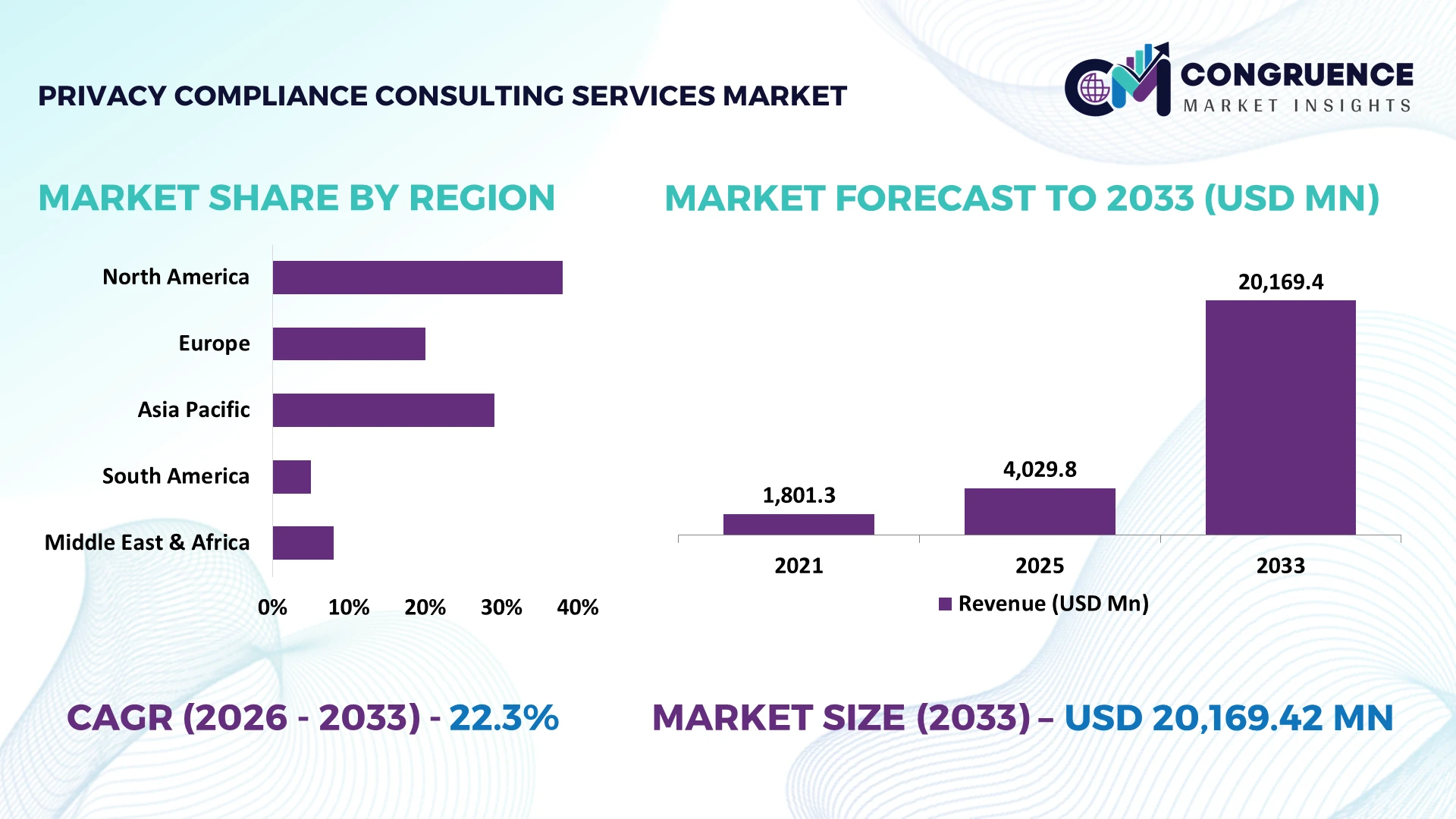
The Global Privacy Compliance Consulting Services Market was valued at USD 4029.78 Million in 2025 and is anticipated to reach a value of USD 20169.42 Million by 2033 expanding at a CAGR of 22.3% between 2026 and 2033. Growth is being driven by expanding U.S. state privacy statutes, intensified GDPR cross-border transfer enforcement, AI-governance mandates, third-party risk audits, and rising personal-data breach notifications.
The United States accounts for an estimated 34–36% of global consulting activity, anchored by technology, financial services, healthcare, and cloud-intensive enterprises; average U.S. breach costs reached USD 10.22 million in 2025 versus USD 2.51 million in India. Meanwhile, 77% of surveyed organizations are already working on AI governance, increasing demand for privacy impact assessments, model governance, and vendor compliance.
Transatlantic data-transfer scrutiny and Europe’s 22% increase in reported personal-data breaches reinforce the strategic value of consultants capable of integrating privacy, cybersecurity, AI governance, and multinational regulatory controls.
Market Size & Growth: USD 4,029.78 million in 2025 reaches USD 20,169.42 million by 2033 at 22.3% CAGR, driven by AI governance and expanding privacy regulation.
Top Growth Drivers: AI governance adoption reaches 77%, European breach notifications increased 22%, and 80% of privacy professionals have gained additional governance responsibilities.
Short-Term Forecast: By 2028, automated privacy assessments and compliance orchestration can reduce repetitive evidence-gathering workloads by approximately 25–35%.
Emerging Technologies: AI governance platforms, automated data mapping, privacy-enhancing technologies, and continuous control monitoring are replacing spreadsheet-led compliance across advanced enterprises.
Regional Leaders: By 2033, North America approaches USD 6.7 billion, Asia-Pacific USD 6.2 billion, and Europe USD 4.6 billion, led respectively by AI governance, localization, and GDPR modernization.
Consumer/End-User Trends: Nearly 90% of organizations already using AI are working on AI governance, intensifying consulting demand across privacy, legal, IT, and security teams.
Pilot/Case Example: In 2025, organizations placing privacy functions in AI-governance leadership reported 67% confidence in EU AI Act compliance, demonstrating governance maturity benefits.
Competitive Landscape: Accenture holds an estimated high-single-digit share, competing with Deloitte, PwC, EY, KPMG, and specialized privacy advisory firms for multinational transformation mandates.
Regulatory & ESG Impact: Europe recorded 443 personal-data breach notifications daily, up 22%, accelerating demand for breach readiness, accountability documentation, and cross-border compliance reviews.
Investment & Funding: Large enterprises increasingly allocate multimillion-dollar privacy budgets, while consulting investment shifts toward AI risk assessments, privacy automation, and integrated digital-governance programs.
Innovation & Future Outlook: More than 50% of privacy professionals now carry AI-governance responsibilities, positioning integrated privacy-AI advisory services as the next competitive battleground.
Privacy compliance consulting is expanding beyond GDPR readiness into AI governance, data mapping, cross-border transfer controls, vendor risk, healthcare privacy, and automated compliance operations. With 77% of surveyed organizations already developing AI-governance programs, advisory demand increasingly centers on integrating legal requirements with technical controls. Intensified European enforcement and geopolitical scrutiny of international data flows are pushing enterprises toward continuous, technology-enabled privacy management, setting up the next strategic discussion.
Privacy compliance consulting is becoming strategic infrastructure as enterprises connect generative AI, cloud platforms, customer data, and international suppliers across increasingly fragmented regulatory jurisdictions. More than 80% of privacy professionals report responsibilities extending beyond privacy, while 77% of organizations are developing AI-governance programs. The EU AI Act and expanding U.S. state privacy laws are shifting advisory spending from periodic legal reviews toward continuous governance.
Technology is changing delivery economics. Automated data discovery, control mapping, and evidence collection can reduce repetitive compliance workloads by approximately 25–35% versus spreadsheet-led assessments. European enterprises prioritize GDPR, AI governance, and cross-border transfer controls, while U.S. organizations face a state-by-state compliance environment. India combines rapid digitalization with expanding obligations under its Digital Personal Data Protection framework, creating localization-intensive advisory requirements.
A multinational deploying generative AI, for example, now requires model inventories, privacy impact assessments, vendor reviews, retention controls, and jurisdiction-specific documentation before scaling applications. Consulting firms are consequently investing in AI-governance specialists, privacy engineering, managed compliance platforms, and cybersecurity partnerships. Through 2028, continuous monitoring and machine-readable control frameworks will become more prevalent, rewarding advisers that combine legal interpretation, technical implementation, and multinational execution within one governance architecture.
Regulatory fragmentation is converting privacy compliance from periodic assessment into continuous enterprise governance. Approximately 77% of organizations are developing AI-governance programs, more than 80% of privacy professionals carry responsibilities beyond traditional privacy, and European breach notifications increased 22%. The EU AI Act, India’s Digital Personal Data Protection framework, and expanding U.S. state privacy laws require organizations to reconcile overlapping consent, profiling, transfer, retention, and accountability requirements. This increases demand for regulatory mapping, privacy impact assessments, data inventories, and governance operating models. Consulting firms are expanding multidisciplinary teams combining lawyers, privacy engineers, cybersecurity specialists, and AI-risk professionals. A critical shift is occurring in procurement: multinational clients increasingly value advisers capable of translating multiple regulatory regimes into one operational control framework rather than producing separate jurisdiction-specific compliance documents.
Limited budgets and fragmented internal ownership constrain consulting penetration, particularly among smaller enterprises. Around 63% of privacy professionals report increased workloads, while approximately 40% identify inadequate resources as a barrier to effective privacy programs; specialist talent shortages further raise implementation costs. In the United States, organizations must monitor an expanding patchwork of state requirements while simultaneously maintaining cybersecurity and sector-specific controls, increasing duplicated legal and operational effort. Smaller clients therefore prioritize mandatory assessments over comprehensive transformation programs, limiting project scope and consultant utilization. Advisory providers are responding with fixed-fee assessments, managed privacy services, standardized control libraries, and automated compliance platforms. The non-obvious constraint is internal execution capacity: even well-funded recommendations lose value when clients lack data owners capable of implementing remediation, pushing consultants toward longer-term managed-service models.
AI governance is opening a high-value consulting category that extends privacy expertise into model risk, automated decision-making, data provenance, and algorithmic accountability. About 77% of organizations are already developing AI-governance programs, nearly 90% of organizations using AI are working on governance, and more than 50% of privacy professionals now hold AI-related responsibilities. EU AI Act implementation is accelerating demand for AI inventories, risk classification, impact assessments, training-data controls, and continuous monitoring. India also presents an opportunity as enterprises align rapidly expanding AI deployment with emerging personal-data obligations. Consultancies are building responsible-AI practices, partnering with governance-software providers, and developing automated assessment frameworks. The strongest opportunity is not standalone regulatory interpretation: firms that connect privacy controls directly with model development pipelines can establish recurring governance relationships with technology, banking, healthcare, and digital-commerce clients.
Execution becomes harder as privacy controls spread across cloud environments, AI models, SaaS vendors, employee systems, and global data pipelines. Third parties are implicated in roughly 30% of reported data breaches, while human involvement remains associated with approximately 60% of security incidents; meanwhile, more than 80% of privacy professionals carry expanded governance responsibilities. These conditions make accurate data lineage, vendor oversight, and control ownership difficult to maintain across multinational organizations. Generative AI intensifies the challenge because datasets and model outputs can move faster than conventional approval processes. Consulting firms must invest in privacy engineering, automated discovery, technical assurance, and specialist training while forming partnerships with cybersecurity and governance-platform providers. Competitive durability depends on solving the implementation gap: advisers must prove that designed controls remain operational after engagement teams leave, not simply demonstrate regulatory conformity during assessment.
Managed Privacy Services Gain Ground: Consulting delivery is shifting from project-based assessments toward continuous managed compliance as privacy teams shrink. Median team size fell from eight professionals in 2025 to five in 2026, while 43% report underfunded budgets and 36% are increasing outside-consultant usage. Providers are scaling subscription-based monitoring, outsourced DPO support, and standardized control testing to give enterprises broader coverage without equivalent internal headcount.
Privacy Automation Moves Into Production: Enterprises are embedding AI into privacy workflows rather than limiting automation to experimentation. AI use for privacy tasks reached 24% in 2025, up from 18%, while 36% planned adoption within twelve months. Consultants are deploying automated data discovery, assessment generation, and policy mapping, reducing manual evidence handling and enabling smaller teams to manage larger data estates.
Privacy-by-Design Faces Execution Pressure: Embedded privacy controls are becoming a measurable operational differentiator, yet implementation remains uneven. Frequent privacy-by-design practice declined from 62% in 2025 to 58% in 2026, while training failures reached 51% and privacy-by-design failures 50%. Advisory firms are restructuring engagements around engineering checkpoints, developer training, and control validation instead of end-stage compliance reviews.
Data Localization Reshapes Architecture Advice: Cross-border data strategies are becoming infrastructure decisions. Around 90% of organizations favor local data storage, although 88% acknowledge added cost, while 86% support privacy legislation. Consultants are consequently combining regulatory interpretation with cloud-region selection, transfer mechanisms, and vendor architecture reviews, creating demand for advisory teams spanning legal, procurement, security, and cloud engineering.
Regulatory Compliance represents the leading service type with an estimated 30% share, reflecting the recurring requirement to interpret changing privacy statutes, establish control frameworks, and demonstrate accountability across jurisdictions. Data Privacy Consulting follows as enterprises redesign governance structures around cloud, AI, and international data processing. Compliance Audits remain mature and assessment-oriented, particularly among regulated financial, healthcare, and technology organizations where documented evidence is essential for assurance and procurement.
Privacy Impact Assessments are the fastest-growing type as organizations embed assessments earlier in AI, analytics, and digital-product development. With 58% of organizations frequently practicing privacy by design in 2026 and 52% identifying new-technology risk management as a privacy-program obstacle, assessment demand is moving closer to engineering workflows. Data Protection Advisory remains strategically important for retention, transfers, incident response, and controller-processor obligations. Consulting providers are expanding technical privacy teams, automating assessment workflows, and integrating regulatory expertise with security architecture, shifting investment from episodic interpretation toward operational implementation.
GDPR Compliance remains the largest application at an estimated 31% share because multinational organizations require established processes for lawful processing, data-subject rights, breach response, international transfers, and processor governance. CCPA Compliance remains concentrated among companies handling California consumer information, while Risk Assessment supports both frameworks through control testing and exposure prioritization. Mature compliance programs increasingly connect these applications instead of maintaining separate regulatory workstreams.
Privacy Program Management is the fastest-growing application as constrained internal teams transfer recurring governance activity to consultants and managed-service providers. Median privacy team size declined from eight professionals in 2025 to five in 2026, while 36% of organizations increased their use of contractors or external consultants. Data Governance is simultaneously strengthening as organizations classify datasets and establish ownership across AI and cloud environments. Providers are responding with managed privacy offices, automated compliance monitoring, centralized control libraries, and integrated governance platforms. Demand is therefore shifting from one-time readiness exercises toward persistent operational management spanning multiple legal frameworks.
Banking & Finance represents the leading end-user segment with an estimated 27% share, reflecting extensive personal and transactional datasets, third-party ecosystems, cross-border processing, and stringent supervisory expectations. Healthcare follows closely because clinical and identity information requires specialized governance, while Retail & E-Commerce faces intensive consent, profiling, advertising, and customer-data obligations. Government Agencies remain significant buyers where citizen information, digital services, and procurement requirements create formal accountability needs.
IT & Telecommunications is the fastest-growing end-user segment as cloud platforms, digital communications, AI applications, and internationally distributed data infrastructure multiply privacy dependencies. Approximately 42% of Indian organizations had policies for managing AI or detecting shadow AI in 2025, illustrating the governance gap accompanying rapid technology deployment. Consultants are responding with sector-specific assessments, privacy engineering, vendor-risk programs, and governance automation. Financial institutions prioritize defensible controls and auditability, whereas technology enterprises increasingly require scalable frameworks that can govern product releases without slowing development cycles.
North America accounted for the largest market share at 38% in 2025 however, Asia-Pacific is expected to register the fastest growth, expanding at a CAGR of 25.6% between 2026 and 2033.
State-Level Regulation Reshapes Enterprise Governance
North America represents approximately 38% of global privacy compliance consulting activity, anchored by large technology, financial services, healthcare, retail, and cloud enterprises managing extensive consumer datasets. The United States is shifting from sector-specific privacy management toward multi-jurisdictional compliance as state comprehensive privacy laws expand. Organizations increasingly require consent architecture, data inventories, automated rights management, vendor assessments, and AI-governance controls that work across multiple states. Canada adds established PIPEDA-based advisory requirements alongside provincial obligations and AI-related governance modernization. U.S. organizations also face the world's highest average data-breach cost, reaching approximately USD 10.22 million in 2025, strengthening executive attention toward preventive privacy engineering. Consulting firms are responding with managed privacy offices, regulatory intelligence platforms, cybersecurity partnerships, and multidisciplinary teams integrating legal interpretation with technical implementation.
United States Market Outlook: California remains the operational benchmark through the CCPA/CPRA framework and dedicated enforcement infrastructure, while additional state laws create increasingly complex compliance matrices. Enterprises are expanding privacy engineering and automated control mapping as 87% of U.S. organizations reported having AI governance structures, creating strong demand for advisers connecting privacy requirements with model deployment and enterprise risk controls.
Enforcement Shifts Compliance Toward Continuous Assurance
Europe accounts for approximately 28% of global privacy compliance consulting activity, with GDPR enforcement maintaining strong demand for regulatory assessments, cross-border transfer reviews, privacy engineering, breach preparedness, and processor governance. The EU AI Act adds another operational layer by connecting personal-data controls with model inventories, risk classification, transparency, and human oversight. European organizations reported an average 443 personal-data breaches daily during the latest measured period, a 22% increase, reinforcing the requirement for continuous compliance rather than annual reviews. Germany, France, the Netherlands, Ireland, and the United Kingdom host concentrated financial, technology, pharmaceutical, manufacturing, and digital-service operations requiring sophisticated governance. Advisory firms are integrating privacy, cybersecurity, responsible AI, and cloud-risk practices while automating evidence collection and regulatory mapping. The structural advantage belongs to consultancies capable of operationalizing multiple EU digital regulations through common enterprise controls.
Germany Market Outlook: Germany combines a large industrial economy with strict privacy expectations and extensive enterprise digitization across automotive, manufacturing, banking, healthcare, and software. Its federal and state-level supervisory structure increases governance complexity. Companies increasingly require privacy-by-design controls for connected products, industrial IoT, cloud migration, employee data, and AI deployments, strengthening demand for technically specialized advisory capabilities.
Localization and AI Adoption Expand Advisory Scope
Asia-Pacific represents approximately 22% of global privacy compliance consulting activity, shaped by rapid cloud migration, AI adoption, digital payments, e-commerce, and increasingly formalized data-protection regimes. India’s Digital Personal Data Protection framework is creating implementation requirements around consent, processor oversight, breach response, and data lifecycle management, while Singapore, Australia, Japan, and South Korea maintain mature privacy regimes affecting multinational operations. China adds extensive cybersecurity, personal-information, and cross-border data-transfer obligations, making architecture and localization decisions central to compliance strategy. Approximately 42% of Indian organizations had policies addressing AI or shadow-AI management in 2025, exposing a sizeable governance implementation gap. Consulting firms are expanding local regulatory teams, responsible-AI practices, data-mapping capabilities, and cloud partnerships. Multinationals increasingly require country-specific operating models rather than standardized global privacy templates.
India Market Outlook: India combines enormous digital-service scale with accelerating regulatory formalization. More than 950 million internet subscribers create extensive personal-data processing across financial services, telecommunications, healthcare, e-commerce, and technology outsourcing. Enterprises are aligning consent systems, vendor contracts, retention practices, and incident-response processes with new obligations, positioning India as a major privacy implementation and managed-compliance services hub.
LGPD Enforcement Professionalizes Data Governance
South America accounts for approximately 6% of global privacy compliance consulting activity, with Brazil representing the principal center of regulatory implementation and enterprise demand. Brazil’s LGPD has pushed banks, retailers, healthcare organizations, telecom operators, and digital platforms toward structured data inventories, DPO functions, processor controls, and incident-response frameworks. Approximately 90% of Brazilian households now have internet access, expanding the volume of consumer information processed through digital channels. Chile and Colombia are also strengthening privacy frameworks, creating additional requirements for multinational compliance mapping. Consulting demand nevertheless faces uneven enterprise maturity and constrained specialist availability outside major commercial centers. Providers are responding through Portuguese- and Spanish-language advisory teams, standardized assessment methodologies, virtual delivery, and partnerships with cybersecurity firms. Brazil increasingly acts as the operational base from which international advisers scale privacy services across neighboring markets.
Brazil Market Outlook: Brazil combines the region’s largest digital economy with an established national data-protection authority and extensive financial-technology infrastructure. LGPD compliance increasingly intersects with Pix, open finance, cloud adoption, and digital retail. Financial institutions and technology platforms are prioritizing vendor governance, automated data discovery, privacy impact assessments, and defensible incident-management processes as their data ecosystems become more interconnected.
Digital-State Investment Elevates Privacy Governance
Middle East & Africa represents approximately 6% of global privacy compliance consulting activity, led by digitally intensive Gulf economies and increasingly formalized African privacy regimes. Saudi Arabia’s Personal Data Protection Law and the UAE’s federal privacy framework are embedding governance requirements into cloud, financial services, healthcare, tourism, and smart-government investments. South Africa provides a mature African compliance anchor through POPIA, while Kenya and Nigeria are strengthening institutional privacy enforcement alongside digital-service expansion. Saudi Arabia reached approximately 99% internet penetration, creating extensive data-processing exposure across public and private platforms. Consulting providers are expanding Arabic-language regulatory capabilities, data-transfer assessments, managed DPO services, and cybersecurity partnerships. Sovereign-cloud investment is creating a non-obvious advisory requirement: organizations need privacy specialists who can align localization decisions with cloud architecture, vendor contracts, AI governance, and multinational information flows.
Saudi Arabia Market Outlook: Saudi Arabia is the region’s strongest transformation center because Vision 2030 is accelerating cloud, fintech, healthcare, tourism, and government digitization. The Personal Data Protection Law places privacy directly within these modernization programs. Enterprises increasingly require data inventories, transfer assessments, consent governance, processor oversight, and privacy-by-design controls integrated with rapidly expanding digital infrastructure.
Deloitte, PwC, EY, KPMG, Accenture, and specialist privacy advisers compete for enterprise governance mandates, with multidisciplinary firms challenging technology-led providers through regulatory depth and implementation scale. The top five hold an estimated 28% combined share, leaving specialist firms strong in complex jurisdictions and technical privacy engineering. Competition centers on regulatory coverage, automation, delivery speed, and sector customization; automated assessments can reduce repetitive compliance effort by 25–35%, while managed services can lower internal administration workloads by roughly 20%. Deloitte and PwC emphasize integrated risk transformation, Accenture combines technology implementation with governance, while specialists compete through focused privacy expertise. Firms are expanding responsible-AI practices, acquiring cyber capabilities, partnering with governance-software vendors, and building managed compliance platforms. AI regulation is shifting competition from document-heavy advisory toward continuous technical assurance. Entry barriers include specialist talent, multinational regulatory expertise, enterprise trust, and implementation capability. Winning requires combining legal interpretation, privacy engineering, automation, and measurable control effectiveness across jurisdictions.
Deloitte
PricewaterhouseCoopers (PwC)
Ernst & Young (EY)
KPMG
Accenture
IBM Consulting
Capgemini
Protiviti
TrustArc
Securiti
Coalfire
FTI Consulting
BDO
Grant Thornton
Privacy compliance consulting is becoming technology-enabled through automated data discovery, consent management, regulatory mapping, and continuous control monitoring. Privacy-management platforms outperform internally developed systems by about 11% on governance maturity, while measured privacy programs score 31% higher than unmeasured programs. Consultants increasingly integrate these platforms with cloud, cybersecurity, GRC, and enterprise data architectures, converting periodic assessments into continuous compliance operations.
Emerging capabilities combine generative AI, privacy-enhancing technologies, automated DPIAs, synthetic data, and AI-governance platforms. AI-assisted evidence collection and control mapping can reduce repetitive assessment effort by approximately 25–35%, while privacy-management solutions deliver roughly 6% stronger maturity than broader GRC tools. Compared with spreadsheet-led reviews, automated workflows can improve assessment throughput by around 30%, allowing advisers to manage larger multinational compliance portfolios.
Disruptive technology is moving toward agentic compliance, machine-readable regulation, confidential computing, federated learning, and real-time data lineage. With 74% of companies planning agentic AI deployment within two years but only 21% reporting mature autonomous-agent governance, consulting firms combining legal expertise with privacy engineering gain a decisive advantage. Between 2026 and 2028, continuous AI-risk monitoring, automated rights orchestration, and policy-as-code will become procurement priorities, rewarding technology-integrated advisers that act now across banking, healthcare, technology, retail, and government environments globally.
January 2024 EY expanded its ServiceNow alliance with AI Governance and Compliance capabilities, including AI discovery, inventory, risk tiering and automated monitoring, while deploying Now Assist across 400,000 professionals. This strengthened scalable GenAI compliance delivery and enterprise privacy. Source: servicenow.com
March 2025 KPMG India partnered with Privado to deliver real-time privacy monitoring, automated data mapping, proactive risk management and streamlined assessments as India prepared DPDP Rules 2025. The integration moves privacy consulting toward continuous product-level governance for clients. Source: kpmg.com
August 2025 Accenture agreed to acquire CyberCX, adding approximately 1,400 cybersecurity professionals across Australia, New Zealand and international operations. Its largest cybersecurity acquisition strengthens adjacent privacy, resilience and regulatory capabilities amid escalating data-protection exposure for regulated enterprise clients. Source: reuters.com
August 2026 Deloitte expanded end-to-end AI Controls and Assurance services as 74% of companies planned agentic AI deployment within two years but only 21% had mature autonomous-agent governance, strengthening demand for integrated governance and assurance for privacy clients. Source: deloitte.com
The Privacy Compliance Consulting Services Market report evaluates Data Privacy Consulting, Compliance Audits, Privacy Impact Assessments, Data Protection Advisory, and Regulatory Compliance services. Application coverage includes GDPR Compliance, CCPA Compliance, Data Governance, Risk Assessment, and Privacy Program Management across Banking & Finance, Healthcare, Retail & E-Commerce, IT & Telecommunications, and Government Agencies. Regulatory Compliance represents an estimated 30% of service demand.
Regional analysis covers North America, Europe, Asia-Pacific, South America, and Middle East & Africa, alongside emerging AI-governance, privacy-engineering, managed compliance, and privacy-enhancing technology opportunities. The study examines automated data mapping, consent orchestration, continuous controls, regulatory intelligence, and agentic governance, with 74% of companies planning agentic AI deployment within two years. Covering 2026–2033, the report supports investment prioritization, geographic expansion, partnership selection, technology strategy, competitive benchmarking, and identification of compliance services gaining strategic enterprise relevance.
| Report Attribute/Metric | Report Details |
|---|---|
Market Revenue in 2025 | USD 4029.78 Million |
Market Revenue in 2033 | USD 20169.42 Million |
CAGR (2026 - 2033) | 22.3% |
Base Year | 2025 |
Forecast Period | 2026 - 2033 |
Historic Period | 2021 - 2025 |
Segments Covered | By Type
By Application
By End-User
|
Key Report Deliverable | Revenue Forecast, Growth Trends, Market Dynamics, Segmental Overview, Regional and Country-wise Analysis, Competition Landscape |
Region Covered | North America, Europe, Asia-Pacific, South America, Middle East, Africa |
Key Players Analyzed | Deloitte, PricewaterhouseCoopers (PwC), Ernst & Young (EY), KPMG, Accenture, IBM Consulting, Capgemini, Protiviti, TrustArc, Securiti, Coalfire, FTI Consulting, BDO, Grant Thornton |
Customization & Pricing | Available on Request (10% Customization is Free) |




