
Reports
The Global Printed Electronics Market was valued at USD 3309 Million in 2025 and is anticipated to reach a value of USD 8796.79 Million by 2033 expanding at a CAGR of 13% between 2026 and 2033. Growth is driven by rapid commercialization of flexible OLED displays, printed RFID antennas, wearable sensors, and smart packaging, where additive manufacturing reduces material waste and enables thinner, conformable electronic architectures.
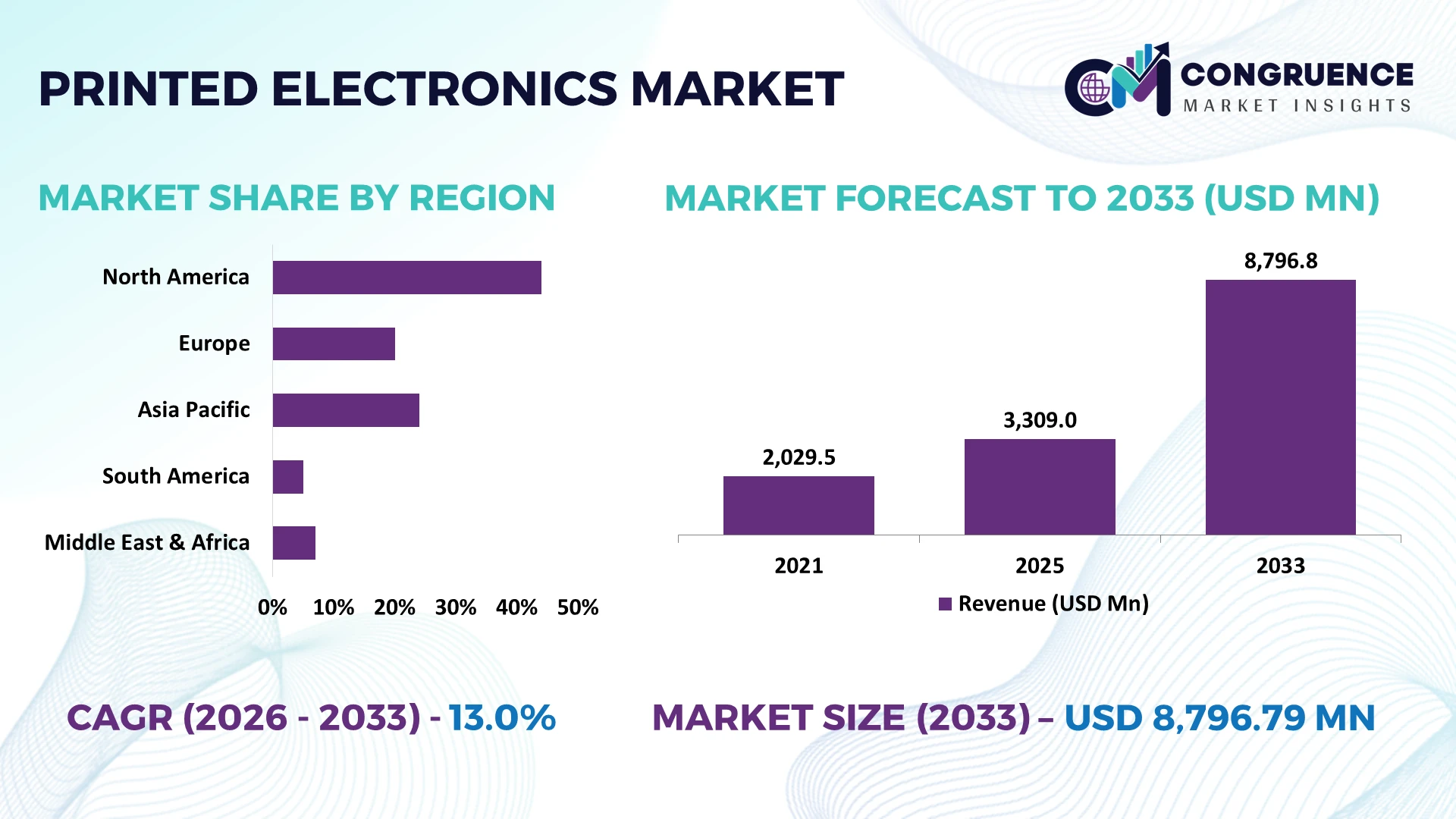
China remains the dominant country hub, supported by Asia Pacific’s 34.41% market share in 2025, extensive consumer-electronics manufacturing, flexible-display production, and large-scale advanced-material investment; China’s 2025 semiconductor-equipment investment was projected at USD 38 billion, versus USD 21.5 billion in South Korea, reinforcing its manufacturing depth. Geopolitical pressure from U.S. technology restrictions is further accelerating China’s domestic electronics supply-chain localization.
Strategically, manufacturers should prioritize China-centered supply ecosystems while diversifying toward South Korea, Japan, and emerging Asian production bases to secure printed-display, sensor, and conductive-material capacity.
Market Size & Growth: USD 3,309 million in 2025 to USD 8,796.79 million by 2033 at 13% CAGR, driven by flexible displays, printed sensors, RFID, and additive electronics manufacturing.
Top Growth Drivers: Flexible electronics adoption 18%, smart packaging integration 16%, wearable-device penetration 14%.
Short-Term Forecast: By 2028, production efficiency is projected to improve 12%, while material waste declines 10% through roll-to-roll processing.
Emerging Technologies: AI-enabled sensors, automated printing, conductive nanomaterials, and advanced silver inks are accelerating high-performance electronic integration.
Regional Leaders: Asia Pacific, North America, and Europe lead adoption, supported by flexible displays, healthcare sensors, automotive interfaces, and smart-packaging deployment.
Consumer/End-User Trends: Wearable and connected-device applications are recording approximately 15% adoption growth across healthcare, consumer electronics, and industrial monitoring.
Pilot/Case Example: 2025 smart-packaging pilots using printed RFID and sensors achieved approximately 20% faster item-level tracking while reducing manual identification requirements.
Competitive Landscape: E Ink leads with an estimated 12% company-level share, competing with Ynvisible Interactive, TactoTek, Molex, and Thin Film Electronics across displays, sensors, and smart surfaces.
Regulatory & ESG Impact: Lightweight printed components reduce material consumption by approximately 10–15%, supporting stricter sustainability targets and low-waste manufacturing.
Investment & Funding: More than USD 1 billion in combined industry investment is supporting flexible displays, printed sensors, conductive inks, and manufacturing-scale expansion.
Innovation & Future Outlook: AI, advanced materials, automation, and flexible architectures are shifting competition toward intelligent packaging, embedded sensing, and next-generation smart surfaces.
The global printed electronics market is gaining momentum across flexible displays, RFID-enabled packaging, automotive interfaces, medical wearables, and smart sensors, with approximately 34.4% of market activity concentrated in Asia Pacific. Recent supply-chain localization and conductive-material development are strengthening manufacturing resilience, while automated printing and flexible substrates improve scalability. These shifts establish a strong foundation for the strategic discussion.
Printed electronics is becoming strategically important because it allows manufacturers to embed sensing, connectivity, displays, and conductive functions directly onto flexible or irregular surfaces while simplifying assembly. This is reshaping competition across automotive, healthcare, consumer electronics, packaging, and industrial automation. Roll-to-roll printed electronics can reduce material waste by approximately 20% and shorten production cycles by 15% compared with conventional subtractive fabrication, strengthening the business case for scalable manufacturing.
Supply-chain restructuring is also accelerating localization of conductive inks, substrates, sensors, and flexible-display components. China maintains the largest manufacturing scale, while South Korea and Japan emphasize high-value display materials, precision printing, and advanced semiconductor integration. Over the next 2–3 years, automated inspection and digital printing are positioned to lift production consistency by roughly 10–15%, while smart-label and RFID deployments expand across logistics and retail.
A practical deployment example is printed RFID and sensing layers in intelligent packaging, where automated identification can reduce manual scanning requirements by approximately 20%. Companies are responding through material partnerships, localized production, and joint development programs targeting automotive interfaces and healthcare wearables. Strategically, competitive advantage will increasingly depend on controlling materials, process automation, design integration, and application-specific manufacturing ecosystems.
Flexible-display integration, printed sensors, and RFID adoption are strengthening the industry's structural growth. Automotive manufacturers are increasing embedded-interface applications, while healthcare-device producers are targeting approximately 15% greater sensor integration and consumer-electronics manufacturers are pursuing 10–12% thinner component architectures. China's electronics manufacturing base is accelerating localized conductive-ink and substrate production as supply-chain restructuring reduces dependence on imported components. Companies are responding through R&D partnerships, automated printing lines, and application-specific material development. The non-obvious advantage is manufacturing flexibility: printed electronics enables electronic functions to be placed across curved, lightweight, or disposable surfaces without conventional rigid-board constraints, improving design freedom while reducing assembly complexity.
Conductive silver inks, specialty substrates, and precision coating equipment remain significant structural constraints, with material costs in some printed applications running 15–25% above conventional alternatives during early-scale production. Supply disruptions can increase procurement lead times by 10–20%, particularly when specialized materials depend on concentrated supplier networks. Japan and South Korea retain strong positions in advanced materials, but manufacturers increasingly face pressure to diversify sourcing. Companies are responding through copper and carbon-based conductive alternatives, multi-year procurement contracts, and localized material qualification. The critical operational issue is not simply material pricing; inconsistent substrate and ink specifications can disrupt print quality, yield, and downstream integration, directly limiting scalable production economics.
Next-generation opportunities are emerging around AI-enabled sensors, printed batteries, electronic skin, smart packaging, and embedded automotive interfaces. Digital printing can increase design iteration speed by approximately 30%, while advanced conductive materials can improve functional density by 15–20% compared with earlier printed architectures. India is becoming an attractive development base for cost-sensitive smart labels, healthcare devices, and electronics assembly as manufacturers diversify production footprints. Companies are increasing R&D spending and forming partnerships across materials, software, and device engineering. A distinctive opportunity lies in combining printed sensing layers with edge AI, enabling packaging and surfaces to interpret conditions locally rather than simply transmit data, creating higher-value intelligent products.
Commercial-scale deployment remains challenged by process uniformity, integration complexity, workforce specialization, and evolving compliance requirements. Yield variations of 5–10% can materially affect production economics when printed components are incorporated into high-volume automotive or medical products. Manufacturers in Germany and the United States are therefore investing in automated optical inspection, digital process monitoring, and closed-loop printing controls. Cybersecurity also becomes more relevant as connected printed sensors increasingly interface with industrial and consumer networks. Companies must combine process engineering with software validation, workforce training, and standardized interfaces. The strategic challenge is achieving repeatable performance across high-volume production without sacrificing the flexibility that makes printed electronics commercially attractive.
Flexible Display Production Accelerates: Flexible OLED and printed-display manufacturing is shifting toward thinner architectures, with production workflows targeting 10–15% lower material consumption and approximately 10% faster processing. South Korean manufacturers are expanding advanced display capabilities as automotive and consumer-electronics companies integrate curved and conformable interfaces.
RFID Deployment Moves Upstream: Printed RFID is moving from basic identification toward item-level inventory and supply-chain monitoring, with deployment efficiency improving approximately 15–20% and manual scanning requirements declining near 20%. Retailers and packaging manufacturers are embedding antennas directly into labels to improve traceability and workflow automation.
Conductive Materials Diversify Rapidly: Manufacturers are reducing dependence on silver-based formulations as copper, carbon, graphene, and nanoparticle inks gain attention, with alternative formulations targeting 15–25% lower material costs. U.S. and Japanese suppliers are expanding material qualification programs to strengthen supply resilience and reduce exposure to concentrated sourcing.
Automated Printing Gains Priority: Digital inspection, machine-learning process controls, and automated registration systems are entering production lines, improving print consistency by roughly 10–15% and reducing rework by 8–12%. European manufacturers are prioritizing closed-loop automation to address skilled-labor shortages and stabilize high-volume printed-electronics production.
Printed Displays leads the type segmentation with an estimated 35–40% market share, supported by scalable manufacturing, flexible architectures, and integration across smartphones, vehicle interfaces, and consumer devices. Printed Sensors follows at approximately 25–30%, benefiting from embedded monitoring and lightweight sensing requirements. Printed Batteries remains an emerging segment focused on thin-film power sources for compact, low-energy electronic systems.
Printed RFID is the fastest-growing type, with adoption increasing approximately 18–22% as retailers and logistics operators move toward item-level identification and automated inventory workflows. Unlike mature display applications, RFID integrates directly into labels and packaging with comparatively low structural complexity. Companies are expanding antenna-printing capacity, forming application partnerships, and improving conductive formulations. Investment is consequently shifting toward scalable RFID and sensing platforms that generate recurring deployment opportunities across high-volume applications.
Wearable Electronics leads applications with an estimated 30–35% share, supported by integration of flexible sensors, conductive traces, and lightweight electronic interfaces. Flexible Displays remain established in smartphones and vehicle interiors, while Automotive Electronics is expanding through printed heaters, antennas, touch controls, and sensing layers. Healthcare Devices are gaining traction for conformable monitoring and compact diagnostic applications.
Smart Packaging is the fastest-growing application, advancing approximately 18–22% as RFID, NFC, and printed sensors become embedded into labels and packaging workflows. These technologies can reduce manual identification requirements by roughly 15%, improving inventory visibility and authentication. Companies are moving from pilot projects toward scaled deployments, particularly across retail logistics, product authentication, and temperature-sensitive supply chains. The strategic shift is toward packaging functioning as an active data interface rather than a passive container.
Consumer Electronics remains the leading end-user, representing approximately 38–42% share due to high-volume deployment across smartphones, wearables, displays, and electronic interfaces. Automotive follows at approximately 22–26%, driven by increasing electronic content and demand for lightweight sensing and interface technologies. Healthcare represents a specialized but expanding buyer group, emphasizing flexible patches, continuous monitoring, and compact diagnostic electronics.
Packaging is the fastest-growing end-user, with adoption increasing approximately 20–25% as retailers, logistics operators, and consumer-goods manufacturers deploy printed RFID, NFC, and sensor-enabled labels. Retail buyers prioritize automated inventory visibility, while healthcare customers emphasize customized and skin-compatible electronics. Companies are responding through application-specific partnerships, localized manufacturing, customization, and integrated electronics-software solutions. Competitive positioning is shifting toward suppliers capable of embedding printed components into existing customer workflows while maintaining consistent high-volume production.
Asia Pacific accounted for the largest market share at 34.41% in 2025 however, Asia Pacific is expected to register the fastest growth, expanding at a CAGR of 23.8% between 2026 and 2033.
North America represented approximately 24.5% of the global printed electronics market in 2025, supported by strong research infrastructure, semiconductor investment, and commercialization of flexible sensors, RFID, and printed displays. The United States concentrates major enterprise activity, particularly across automotive electronics, healthcare wearables, and intelligent packaging. More than USD 400 billion in announced semiconductor and electronics manufacturing investment is strengthening domestic supply-chain infrastructure, creating downstream opportunities for printed components. Companies are increasingly combining printed electronics with IoT platforms, edge computing, and automated inspection. The region’s competitive advantage lies less in high-volume fabrication and more in technology commercialization, specialized materials, and high-value application development.
United States Market Outlook: The United States remains the region’s technology and investment anchor, supported by advanced R&D laboratories, automotive innovation, medical-device manufacturing, and expanding domestic electronics capacity. Companies are prioritizing printed sensors, flexible interfaces, and smart-label solutions where customization and rapid prototyping command stronger commercial value.
Europe accounted for approximately 22.4% of the global printed electronics market in 2025, with Germany, the United Kingdom, France, and Finland providing strong research and commercialization capabilities. Automotive manufacturing remains a major deployment channel, while healthcare and industrial automation are expanding demand for lightweight, flexible components. European manufacturers are increasingly targeting material efficiency, recyclable substrates, and low-waste printing processes, with advanced production systems reducing material waste by approximately 10–15%. Regulatory pressure around sustainability is accelerating qualification of environmentally efficient materials. Companies are responding through university partnerships, automotive development programs, and localized manufacturing, positioning printed electronics as an enabling technology for lower-material industrial design.
Germany Market Outlook: Germany holds the strongest industrial position in Europe through automotive engineering, industrial automation, specialty chemicals, and advanced manufacturing. Its large automotive supplier ecosystem creates substantial demand for printed heaters, sensors, antennas, and flexible interfaces, while Industry 4.0 infrastructure supports automated quality control and high-precision production.
Asia Pacific held the dominant 34.41% market share in 2025, supported by concentrated electronics manufacturing, flexible-display production, advanced materials, and large-scale consumer-device supply chains. China, Japan, South Korea, and Taiwan form the region’s principal technology and manufacturing hubs. China invested approximately USD 24.7 billion in chipmaking equipment during the first half of 2024, reinforcing the broader electronics production ecosystem supporting printed components. South Korea maintains strong capabilities in flexible displays, while Japan contributes advanced conductive materials and precision manufacturing. Companies are expanding localized production, forming cross-border technology partnerships, and integrating printed electronics into automotive, wearable, and smart-packaging platforms. The region’s key advantage is the ability to combine material development, component production, and downstream assembly within closely connected supply networks.
China Market Outlook: China remains the largest country-level manufacturing base, with printed electronics benefiting from extensive consumer-electronics production, flexible-display capacity, packaging automation, and domestic material development. Its integrated electronics ecosystem enables rapid scale-up, while supply-chain localization is increasing the strategic importance of domestic conductive inks, substrates, printing equipment, and sensor technologies.
South America remains an emerging printed electronics market, with Brazil representing the principal commercial and manufacturing hub. Demand is concentrated in consumer electronics, retail identification, packaging, healthcare monitoring, and automotive supply chains. Brazil’s large consumer base and expanding digital commerce ecosystem support RFID and smart-packaging deployment, while industrial modernization is creating opportunities for printed sensors. Adoption remains constrained by specialized-material availability and limited high-volume local production, making import diversification important. Companies are therefore emphasizing partnerships with international technology suppliers, regional assembly, and application-specific deployment rather than building broad manufacturing footprints. RFID and connected packaging applications can reduce manual inventory processes by approximately 15%, creating a practical near-term business case for retailers and logistics operators.
Brazil Market Outlook: Brazil offers the strongest commercial opportunity through its large retail, food, beverage, logistics, and automotive ecosystems. Companies are prioritizing RFID-enabled packaging, authentication labels, and sensor applications where improved traceability directly supports operational efficiency. Local partnerships remain important for reducing imported-component exposure and accelerating customer deployment.
The Middle East & Africa market is developing through smart-infrastructure programs, industrial modernization, healthcare digitization, and advanced logistics. The United Arab Emirates and Saudi Arabia are emerging as important deployment hubs because of large-scale technology investment and connected-infrastructure initiatives. Smart packaging, RFID, healthcare wearables, and industrial sensors represent the most commercially practical applications, while local manufacturing remains comparatively limited. Technology-enabled logistics programs are increasing demand for automated identification and condition monitoring, with connected tracking systems capable of reducing manual handling by approximately 15–20%. Companies are responding through international partnerships, regional distribution agreements, and application-specific pilot programs rather than broad production expansion. The strongest opportunity lies in integrating printed electronics into existing smart-city, logistics, and healthcare infrastructure.
United Arab Emirates Market Outlook: The UAE provides the region’s strongest technology deployment environment through smart-city infrastructure, digitally enabled logistics, advanced retail, and healthcare modernization. Companies can use the country as a regional demonstration and commercialization hub, particularly for RFID, intelligent packaging, flexible displays, and connected sensing applications.
The competitive landscape pits global technology leaders such as E Ink, DuPont, Molex, Ynvisible Interactive, and TactoTek against specialized material, printing, and application innovators. The top five players collectively account for an estimated 25–30% share, leaving substantial room for specialist suppliers. Competition centers on technology performance, supply reliability, customization, and manufacturing speed, with advanced formulations improving functional performance by 10–15% and automated printing reducing production-cycle time by roughly 10%. Players are competing through R&D partnerships, regional capacity expansion, vertical integration, and application-specific development. Supply-chain control is becoming more important as manufacturers localize conductive inks, substrates, and precision printing capabilities. Entry barriers remain high around material qualification, process consistency, customer certification, and scalable production economics. Winning requires combining proprietary materials, reliable manufacturing, application engineering, and rapid customer integration rather than competing on price alone.
E Ink Holdings
DuPont
Molex
Ynvisible Interactive
TactoTek
Thin Film Electronics
NovaCentrix
Agfa-Gevaert
Optomec
Elephantech
Canatu
Nissha
LG Display
BASF
Printed electronics now combines screen printing, inkjet deposition, conductive inks, flexible substrates, and roll-to-roll processing. Digital printing improves material utilization by 10–15% versus subtractive fabrication, while automated inspection can raise production consistency by 8–12%. Adoption is strongest in sensors, RFID, flexible displays, and smart interfaces, where manufacturers gain lightweight designs and faster customization. This shift improves operational economics as production moves beyond laboratory-scale prototyping at scale.
Emerging platforms integrate graphene, copper nanoparticles, organic semiconductors, AI-enabled sensing, and laser-induced graphene. Advanced printed sensor architectures can improve analytical accuracy by 7.5%, while additive laser fabrication reaches 50-micrometer patterning. These technologies reduce integration steps and support lighter products. Companies are combining material partnerships with equipment integration to shorten qualification cycles and stabilize throughput. Adoption is expanding across automotive, healthcare, packaging, and consumer electronics commercially.
Disruptive convergence is moving printed electronics toward neuromorphic circuits, soft robotics, smart surfaces, and multifunctional automotive components. E-LIG supports electronics up to 100 square centimeters, while printed neural architectures demonstrate major reductions in area and power. Through 2026–2028, suppliers prioritizing scalable materials, automated process control, and application partnerships will gain advantages in speed, customization, and resilience globally. Early investment therefore strengthens competitive positioning before qualification standards become entrenched.
June 2026 Henkel partnered with Brilliant Matters to develop screen-printable silver inks for roll-to-roll organic photovoltaic production, targeting defect-minimized high-throughput metallization. The collaboration strengthens scalable printed-electronics manufacturing and improves material-process integration for industrial OPV production at scale. Source: henkel.com
March 2026 Epson and Manz Asia launched a collaboration combining high-precision inkjet technology, automation, and semiconductor equipment expertise to build scalable manufacturing platforms. The initiative bridges laboratory development and high-volume production, strengthening printed-electronics process commercialization and sustainable manufacturing. Source: epson.com
April 2026 OE-A released its tenth printed-electronics roadmap, incorporating contributions from more than 100 industry and research experts. The roadmap expands coverage across automotive, healthcare, packaging, IoT, defense, and aerospace, giving manufacturers a structured technology-planning framework. Source: oe-a.org
March 2025 MIT researchers introduced E-LIG, a laser-enabled process for flexible double-sided printed electronics with 50-micrometer patterning and 100-square-centimeter formats. The streamlined method integrates sensors and actuators, improving manufacturing flexibility and supporting scalable multifunctional electronic systems. Source: media.mit.edu
The Printed Electronics Market Report covers four core types—Printed Sensors, Printed Displays, Printed Batteries, and Printed RFID—alongside five applications: Wearable Electronics, Flexible Displays, Smart Packaging, Automotive Electronics, and Healthcare Devices. End-user analysis spans Consumer Electronics, Automotive, Healthcare, Retail, and Packaging, enabling comparison of mature deployment bases with emerging demand pockets.
Geographic coverage evaluates North America, Europe, Asia-Pacific, South America, and Middle East & Africa, with country-level emphasis on major manufacturing and adoption hubs. The report assesses screen printing, inkjet, conductive inks, flexible substrates, roll-to-roll processing, advanced materials, and emerging AI-integrated architectures. More than 10 profiled companies are evaluated across technology positioning, partnerships, production expansion, and application focus. These insights support investment planning, capacity decisions, market-entry strategies, competitive positioning, and technology prioritization through 2026–2033.
| Report Attribute/Metric | Report Details |
|---|---|
Market Revenue in 2025 | USD 204 Million |
Market Revenue in 2033 | USD 894.86 Million |
CAGR (2026 - 2033) | 20.3% |
Base Year | 2025 |
Forecast Period | 2026 - 2033 |
Historic Period | 2021 - 2025 |
Segments Covered | By Type
By Application
By End-User
|
Key Report Deliverable | Revenue Forecast, Growth Trends, Market Dynamics, Segmental Overview, Regional and Country-wise Analysis, Competition Landscape |
Region Covered | North America, Europe, Asia-Pacific, South America, Middle East, Africa |
Key Players Analyzed | TE Connectivity, Amphenol Corporation, Aptiv PLC, Yazaki Corporation, Molex, Hirose Electric, Sumitomo Electric Industries, Phoenix Contact, LEAR Corporation, Rosenberger, HUBER+SUHNER, Japan Aviation Electronics Industry, ITT Inc., TE Connectivity Automotive Solutions |
Customization & Pricing | Available on Request (10% Customization is Free) |




