
Reports
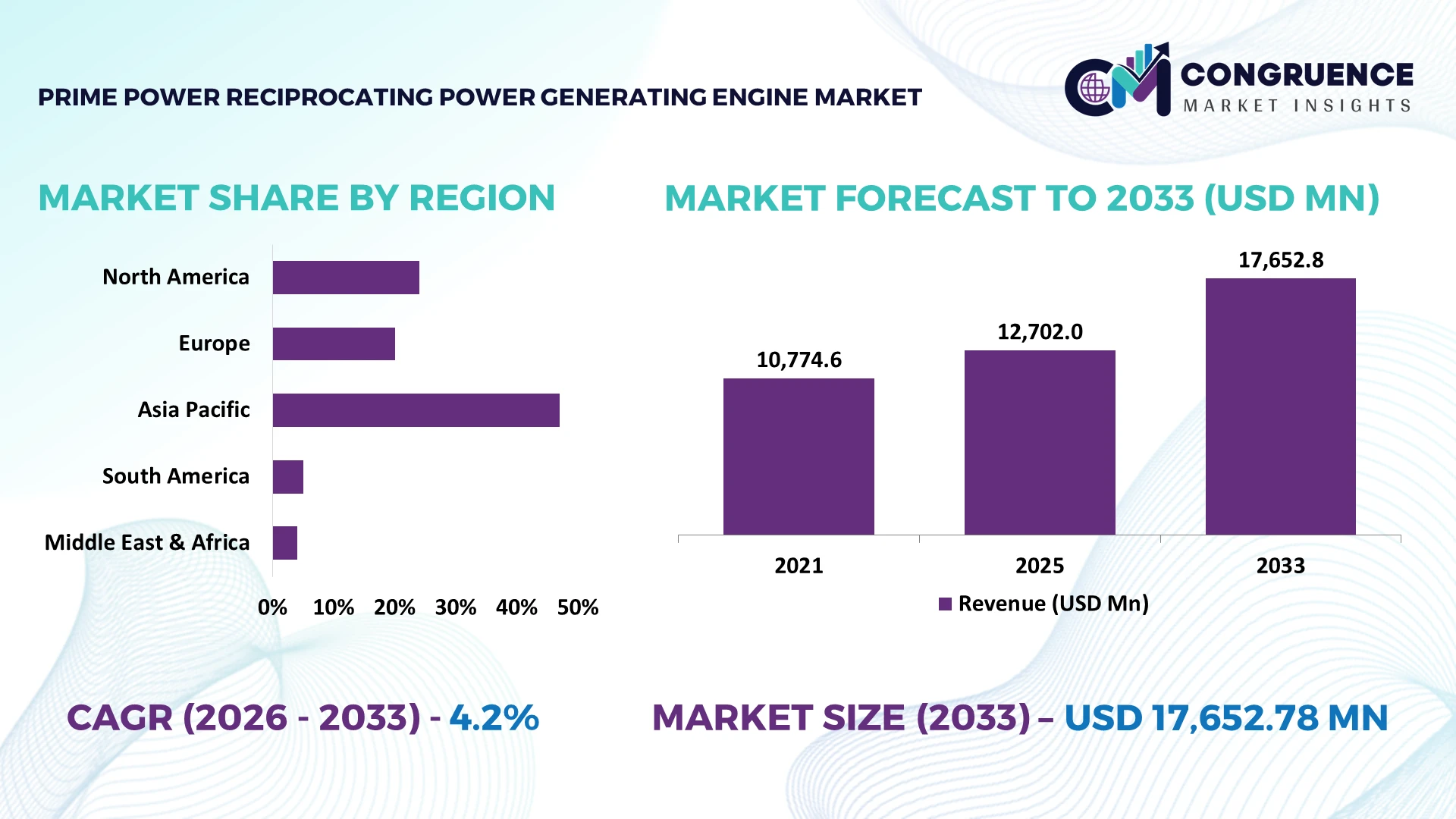
The Global Prime Power Reciprocating Power Generating Engine Market was valued at USD 12701.98 Million in 2025 and is anticipated to reach a value of USD 17652.78 Million by 2033 expanding at a CAGR of 4.2% between 2026 and 2033. Expansion of industrial facilities, grid resilience investments, mining operations, and hybrid microgrid deployment is accelerating procurement of advanced prime power reciprocating generating engines with higher fuel flexibility and digital monitoring capabilities.
The United States leads the global market with approximately 24% installed prime power engine capacity, supported by energy infrastructure investments, data centers, oil and gas production, and resilient backup-to-prime applications. India is recording faster deployment across manufacturing and commercial projects, with industrial captive power installations expanding by over 8% annually. Continued energy security initiatives following global fuel supply disruptions and regional geopolitical uncertainty are strengthening localized power generation investments across multiple industries.
For manufacturers and investors, prioritizing fuel-flexible, digitally connected, and low-emission engine platforms in high-investment industrial regions remains the strongest competitive strategy.
Market Size & Growth: USD 12701.98 Million in 2025, reaching USD 17652.78 Million by 2033 at 4.2% CAGR, driven by advanced distributed power infrastructure and industrial electrification.
Top Growth Drivers: Industrial expansion (+18%), microgrid deployment (+21%), and energy resilience investments (+16%) continue accelerating global installations.
Short-Term Forecast: By 2028, digital engine controls reduce maintenance costs by 12% while operational efficiency improves by 8%.
Emerging Technologies: AI-based predictive maintenance, hybrid microgrids, and advanced combustion systems improve asset utilization by approximately 15%.
Regional Leaders: North America exceeds USD 5.1 Billion, Asia Pacific approaches USD 6.2 Billion, and Europe surpasses USD 3.8 Billion, supported by localized energy projects and grid modernization.
Consumer/End-User Trends: More than 46% of industrial facilities prioritize continuous on-site power generation with remote monitoring integration.
Pilot/Case Example: In 2026, an industrial microgrid deployment improved fuel efficiency by 11% while reducing unplanned downtime by 18%.
Competitive Landscape: Leading manufacturers collectively account for approximately 38% market share, with Caterpillar, Cummins, Wärtsilä, MAN Energy Solutions, and Rolls-Royce maintaining strong global positions.
Regulatory & ESG Impact: Low-emission engine upgrades reduce regulated exhaust emissions by approximately 20%, supporting compliance with stricter industrial standards.
Investment & Funding: More than USD 2.8 Billion supports manufacturing expansion, localization initiatives, and strategic partnerships amid global supply-chain diversification.
Innovation & Future Outlook: Next-generation hydrogen-ready engines, digital twins, and multi-fuel platforms strengthen long-term competitiveness across high-growth industrial power markets.
The Prime Power Reciprocating Power Generating Engine Market is witnessing stronger demand from data centers, mining operations, manufacturing plants, and remote infrastructure projects requiring continuous power reliability. Digital diagnostics, hydrogen-ready engine platforms, and advanced fuel-management technologies improve operational performance by nearly 15%. Supply-chain localization and tightening industrial emission standards are accelerating technology upgrades, setting the foundation for the strategic market analysis that follows.
The Prime Power Reciprocating Power Generating Engine Market has become strategically important as industries prioritize energy resilience, decentralized generation, and uninterrupted operations. Infrastructure modernization, expansion of industrial parks, and supply-chain restructuring are increasing investment in reliable on-site power assets. Manufacturing facilities, mining operations, and hyperscale data centers are integrating continuous prime power systems to reduce exposure to grid instability while improving operational continuity and energy security.
Modern digitally controlled reciprocating engines deliver approximately 10% higher fuel efficiency and reduce maintenance intervals by nearly 18% compared with conventional mechanically governed systems through predictive diagnostics and optimized combustion. The United States emphasizes large-scale industrial and data center deployments, while India is expanding installations across manufacturing clusters and commercial infrastructure, with captive power adoption rising by around 8% annually. Over the next two to three years, remote asset monitoring is expected to exceed 55% deployment among newly commissioned industrial prime power installations.
A mining project integrating multi-engine synchronized power modules achieved approximately 14% lower fuel consumption while improving equipment availability during continuous operations. Manufacturers are expanding localized production, strengthening technology partnerships, and investing in multi-fuel engine platforms to address changing customer requirements. Companies securing advanced digital capabilities, localized supply networks, and flexible fuel solutions will establish stronger competitive positioning and long-term operational advantage.
Industrial electrification and the growing preference for distributed power systems continue to reshape procurement priorities across manufacturing, mining, and critical infrastructure. More than 42% of new industrial facilities now evaluate on-site generation during project planning, while digital engine management improves asset utilization by approximately 13% and reduces maintenance downtime by nearly 15%. India is accelerating captive power investments to strengthen manufacturing competitiveness, while the United States continues expanding resilient energy infrastructure for data-intensive industries. In response, manufacturers are increasing localized assembly capacity, developing fuel-flexible engine platforms, and forming technology partnerships with automation providers. The strategic outcome extends beyond equipment sales, creating long-term service contracts and lifecycle management opportunities that strengthen customer retention and operational profitability.
Engine manufacturers continue facing structural pressure from fluctuating prices of steel, electronic control modules, and precision casting components, increasing production costs by approximately 9% in recent procurement cycles. Stricter industrial emission regulations require advanced after-treatment technologies that raise system integration expenses by nearly 12%. Germany and Japan have intensified compliance expectations for industrial equipment, requiring continuous engineering upgrades. These cost pressures affect deployment economics, particularly for medium-sized industrial operators seeking rapid capacity expansion. To reduce exposure, companies are diversifying supplier networks, expanding localized sourcing strategies, negotiating long-term procurement agreements, and redesigning engines with modular architectures that improve manufacturing flexibility while supporting regulatory compliance without significantly affecting operational efficiency.
Growing adoption of hydrogen-ready engines, renewable fuel compatibility, and AI-enabled energy optimization is creating differentiated opportunities beyond conventional diesel applications. Hybrid energy management platforms improve fuel utilization by approximately 16%, while predictive analytics reduce unplanned maintenance events by nearly 20%. Australia is expanding remote mining operations using integrated microgrid solutions combining reciprocating engines with renewable generation and battery storage. Equipment manufacturers are accelerating research partnerships, investing in intelligent control software, and developing integrated energy ecosystems rather than standalone engine products. A key strategic opportunity lies in providing complete power management platforms that generate recurring digital service revenue while strengthening customer dependence on integrated operational solutions.
Long-term execution depends on integrating advanced engines with digital infrastructure, industrial automation platforms, and skilled operational teams across diverse deployment environments. Nearly 34% of industrial operators report shortages of qualified technicians for advanced engine diagnostics, while cybersecurity investment for connected industrial assets has increased by approximately 18%. The United States and South Korea are strengthening industrial cybersecurity requirements for connected operational technology, increasing implementation complexity. Companies must simultaneously modernize software architecture, expand workforce training, and standardize communication protocols across mixed equipment fleets. Businesses investing early in secure digital platforms, remote diagnostics, and ecosystem partnerships will achieve stronger deployment consistency, improved operational resilience, and sustainable competitive differentiation in increasingly connected industrial power networks.
Advanced Digital Fleet Management Connected engine platforms are becoming standard across industrial installations, with remote diagnostics deployed in over 56% of newly commissioned systems and predictive maintenance reducing unplanned downtime by nearly 18%. Rising labor shortages and stricter asset-performance targets are accelerating automation. Manufacturers are expanding cloud monitoring partnerships and integrating AI-driven control systems that improve maintenance scheduling, equipment availability, and fleet-wide operational visibility.
Fuel-Flexible Engine Deployment Multi-fuel configurations capable of operating on natural gas, diesel, and alternative gaseous fuels have increased by approximately 22% in new industrial procurements, while fuel optimization improves operating efficiency by nearly 11%. Industrial decarbonization policies and fuel-security concerns are reshaping procurement decisions in Germany and India. Engine suppliers are expanding hydrogen-ready product portfolios, strengthening technology alliances, and redesigning combustion systems to support long-term operational flexibility.
Localized Manufacturing Expansion More than 27% of component sourcing has shifted toward regional supplier networks as companies reduce exposure to logistics disruptions and geopolitical uncertainty. Production lead times have declined by nearly 14% following localized assembly investments. Manufacturers are establishing regional engineering centers, expanding supplier qualification programs, and restructuring procurement strategies to improve delivery reliability while maintaining consistent product quality across industrial markets.
Microgrid Integration Acceleration Industrial facilities increasingly deploy reciprocating engines alongside battery storage and renewable generation, with integrated microgrid projects improving energy utilization by approximately 16% and reducing fuel consumption by nearly 12%. Growing grid modernization initiatives in the United States and Australia are reinforcing this transition. Equipment providers are partnering with energy management software firms to deliver synchronized control platforms that strengthen resilience, optimize dispatch decisions, and lower lifecycle operating costs.
Diesel Engines remain the dominant segment, accounting for approximately 52% of installations due to proven reliability, high power density, and rapid deployment across mining, utilities, and manufacturing operations. Their ability to sustain continuous heavy-load applications with established maintenance infrastructure supports long-term operational confidence. Gas Engines represent the fastest-growing segment, with adoption increasing by nearly 17% as industries prioritize lower-emission operations and stable natural gas availability. Manufacturers are expanding gas-engine portfolios through advanced combustion technologies and digital control integration to improve efficiency and compliance.
Dual-Fuel Engines are strengthening their strategic position by providing operational flexibility across variable fuel environments, particularly in remote industrial sites. Fuel-switching capability reduces supply risks while improving asset utilization by approximately 13% compared with single-fuel configurations. Companies are investing in modular engine platforms, expanding localized engineering support, and forming technology partnerships to accelerate commercialization. Investment priorities are steadily shifting toward fuel-flexible solutions capable of balancing operational resilience, emission performance, and long-term lifecycle economics.
Prime Power remains the leading application, representing approximately 41% of market deployment because industries require uninterrupted electricity for manufacturing, mining, and energy-intensive operations. Industrial Power is the fastest-growing application, expanding with increasing factory automation and industrial park development, while digital monitoring improves operating efficiency by nearly 10%. Peak Shaving applications continue gaining relevance as enterprises optimize electricity costs and strengthen energy resilience during grid demand fluctuations.
Remote Power maintains strategic importance across isolated mining sites, infrastructure projects, and off-grid facilities where dependable electricity remains essential. Backup Power continues evolving from emergency support toward integrated resilience planning with intelligent energy management. Companies are scaling integrated control platforms, expanding service networks, and deploying hybrid operating solutions that combine reciprocating engines with battery storage to improve operational flexibility. Demand is increasingly concentrating in facilities requiring continuous production with minimal operational disruption.
Manufacturing represents the largest end-user segment with approximately 34% of installations, supported by continuous production processes, high electricity consumption, and expanding industrial automation. Oil & Gas is the fastest-growing end-user as upstream facilities, LNG infrastructure, and processing plants require reliable on-site generation in remote environments. Digital engine management has improved equipment utilization by nearly 14%, encouraging broader investment in intelligent power systems tailored to industrial workloads.
Utilities continue deploying reciprocating engines to strengthen distributed generation capacity and grid reliability, while Mining remains a major purchaser for remote operations requiring uninterrupted electricity. Commercial Facilities are increasing adoption to improve business continuity and reduce operational disruptions during grid instability. Equipment manufacturers are introducing customized service agreements, sector-specific engine configurations, and strategic partnerships with industrial EPC firms to strengthen customer retention. Competitive positioning increasingly depends on delivering integrated lifecycle support rather than standalone engine equipment.
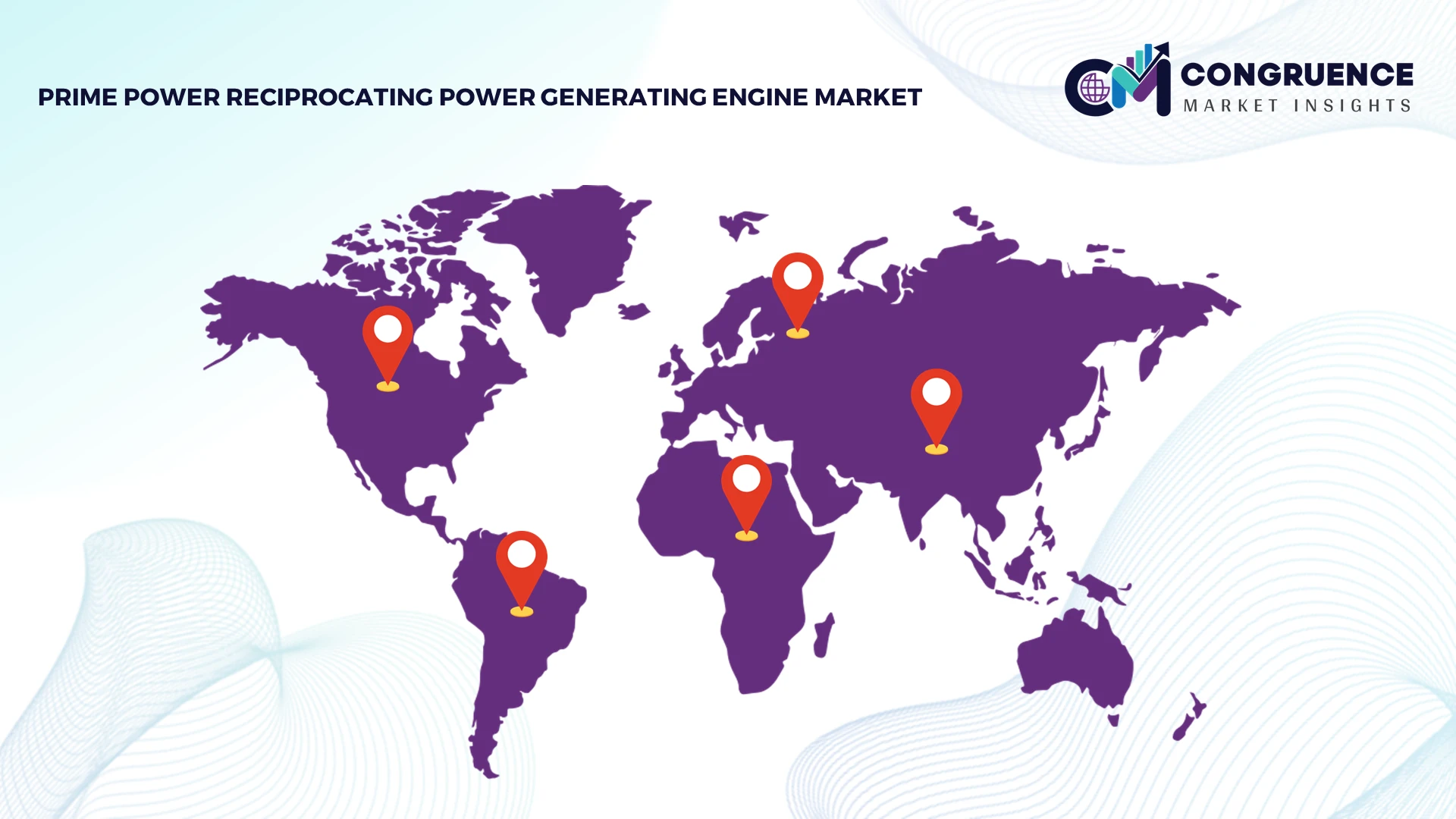
North America accounted for the largest market share at 36.4% in 2025 however, Asia-Pacific is expected to register the fastest growth, expanding at a 5.3% between 2026 and 2033.
Industrial Resilience and Digital Power Infrastructure Drive Deployment
North America remains the largest regional market due to extensive industrial infrastructure, expanding data center investments, and strong adoption of distributed energy systems. Approximately 36.4% of global installations are concentrated across the region, with the United States and Canada leading deployment in manufacturing, utilities, mining, and commercial facilities. More than 58% of newly installed industrial prime power systems incorporate remote diagnostics and digital performance monitoring, improving operational efficiency and reducing maintenance interruptions. Growing investments in grid resilience and energy security continue accelerating replacement of aging equipment with high-efficiency reciprocating engine platforms. Manufacturers are expanding localized service capabilities, strengthening aftermarket networks, and collaborating with automation providers to deliver integrated lifecycle solutions that improve asset reliability and operational flexibility.
United States Market Outlook: The United States represents the regional center for industrial deployment, supported by large-scale manufacturing, energy production, and hyperscale data center expansion. Captive power installations continue increasing across industrial corridors, while digital engine management adoption exceeds 60% among new enterprise projects. Equipment suppliers are expanding service agreements, investing in domestic assembly capabilities, and integrating intelligent monitoring technologies to strengthen long-term customer retention.
Decarbonization and Industrial Modernization Reshape Procurement
Europe continues strengthening its market position through industrial modernization, stricter environmental regulations, and investments in resilient distributed power infrastructure. The region accounts for approximately 24% of global deployment, supported by advanced manufacturing, utilities, and commercial infrastructure requiring dependable continuous power. More than 40% of newly specified industrial systems now prioritize lower-emission gas and dual-fuel engine technologies. Industrial operators are integrating intelligent energy management platforms to optimize fuel utilization while meeting evolving compliance requirements. Equipment manufacturers are expanding engineering partnerships, improving emission-control technologies, and localizing selected component production to strengthen supply-chain resilience across strategic industrial sectors.
Germany Market Outlook: Germany remains the region's technological leader through its advanced industrial manufacturing base and engineering capabilities. Industrial facilities increasingly deploy gas-compatible reciprocating engines supporting energy transition objectives, while smart factory integration continues accelerating. More than 45% of new industrial power projects incorporate digital monitoring and predictive maintenance functions, encouraging suppliers to strengthen automation partnerships and high-efficiency engine development.
Manufacturing Expansion Accelerates Large-Scale Deployment
Asia-Pacific is the fastest-expanding regional market, driven by rapid industrialization, infrastructure construction, and manufacturing capacity growth. The region contributes approximately 31% of global deployment, supported by expanding industrial parks, mining projects, and commercial developments. More than 52% of new manufacturing facilities across major industrial economies evaluate captive power generation during project planning. Large investments in industrial infrastructure, logistics hubs, and export-oriented production continue increasing demand for reliable prime power systems. Engine manufacturers are expanding regional production facilities, strengthening local distribution partnerships, and introducing fuel-flexible product portfolios tailored to diverse industrial operating environments.
India Market Outlook: India continues recording strong deployment across manufacturing clusters, commercial infrastructure, and industrial corridors supported by government-led industrial expansion initiatives. Captive power installations are increasing by approximately 8% annually, while digital engine monitoring adoption continues expanding among large enterprises. Global manufacturers are increasing localized production, engineering support, and channel partnerships to serve rising industrial demand efficiently.
Mining and Industrial Expansion Support Demand
South America continues expanding prime power deployment through mining, agriculture, oil production, and infrastructure development. The region represents approximately 5% of global installations, with remote industrial projects creating sustained demand for dependable off-grid generation. Mining operations have increased investment in continuous power systems by nearly 12% to improve operational reliability across isolated production sites. Infrastructure constraints remain a limiting factor in selected markets; however, equipment suppliers are strengthening regional service centers, improving spare-parts availability, and forming strategic partnerships with engineering contractors to enhance deployment efficiency and lifecycle support.
Brazil Market Outlook: Brazil remains the largest national market due to its mining, agribusiness, and oil production sectors requiring continuous power generation. Industrial operators increasingly adopt digitally managed engine systems to improve fuel efficiency and operational uptime. Manufacturers are expanding distributor networks and localized technical support while strengthening partnerships with industrial EPC companies serving remote infrastructure projects.
Energy Infrastructure Investment Strengthens Market Expansion
The Middle East & Africa market is supported by major investments in oil and gas, mining, utilities, and industrial infrastructure requiring dependable continuous electricity. The region contributes approximately 3.6% of global deployment, with large-scale industrial developments increasing procurement of high-capacity reciprocating engines. More than 30% of new industrial projects integrate distributed generation as part of long-term infrastructure planning. Equipment suppliers are expanding regional maintenance facilities, strengthening engineering partnerships, and deploying advanced monitoring platforms that improve equipment availability in demanding operating environments. Modernization initiatives continue supporting adoption of fuel-efficient and digitally connected engine technologies.
Saudi Arabia Market Outlook: Saudi Arabia leads regional deployment through industrial diversification, energy infrastructure modernization, and expanding manufacturing investment. Large industrial projects increasingly specify integrated prime power solutions supporting continuous production. Digital asset monitoring adoption continues rising across energy-intensive facilities, encouraging global manufacturers to expand local partnerships, technical training programs, and lifecycle service capabilities.
The competitive landscape is led by Caterpillar, Cummins, Wärtsilä, MAN Energy Solutions, and Rolls-Royce, competing directly with regional manufacturers and specialized engine suppliers for industrial, utility, and infrastructure contracts. The top five companies collectively control approximately 38% of the global market through extensive product portfolios, service networks, and engineering expertise. Competition increasingly centers on fuel flexibility, digital diagnostics, lifecycle support, and delivery speed, with intelligent engine platforms improving maintenance efficiency by nearly 15% and localized manufacturing reducing lead times by approximately 12%. Global OEMs strengthen market positions through capacity expansion, technology partnerships, software integration, and vertical supply-chain optimization, while regional competitors compete through pricing, application customization, and faster project execution. The market is shifting toward integrated energy solutions rather than standalone equipment, increasing technology differentiation. High certification requirements, advanced engineering capability, and aftermarket service infrastructure remain key entry barriers. Sustainable competitive success depends on combining digital innovation, localized support, flexible fuel capability, and dependable lifecycle performance.
Caterpillar Inc.
Cummins Inc.
Wärtsilä Corporation
MAN Energy Solutions
Rolls-Royce Holdings plc
Mitsubishi Heavy Industries Ltd.
Kawasaki Heavy Industries Ltd.
Yanmar Holdings Co., Ltd.
Doosan Enerbility Co., Ltd.
INNIO Group
Baudouin
DEUTZ AG
Kohler Energy
Kirloskar Oil Engines Limited
Digital engine management systems, advanced electronic fuel injection, and predictive maintenance platforms define the current technology landscape. More than 58% of newly deployed industrial prime power engines incorporate remote monitoring, improving equipment availability by approximately 14% while reducing maintenance costs by nearly 10%. High-pressure common-rail fuel systems and intelligent governor controls optimize combustion under variable loads, enabling better fuel utilization across mining, manufacturing, and utility applications. These technologies strengthen operational continuity and reduce lifecycle costs for asset-intensive industries.
Emerging technologies are centered on hydrogen-ready combustion systems, dual-fuel architectures, AI-driven diagnostics, and hybrid microgrid integration. Compared with legacy mechanically controlled engines, digitally managed reciprocating engines improve fuel efficiency by approximately 11% and lower unplanned downtime by nearly 18%. Around 35% of large industrial projects now evaluate integrated battery storage and engine synchronization for resilient distributed generation. Manufacturers are accelerating software integration, digital twin deployment, and modular engine platforms to improve scalability while supporting evolving industrial decarbonization requirements.
Between 2026 and 2028, intelligent energy management, automated dispatch optimization, and multi-fuel flexibility will become the principal competitive differentiators. Global OEMs with advanced control software, localized manufacturing, and connected service ecosystems will outperform cost-focused suppliers by delivering faster commissioning, stronger uptime, and lower operating expenses. Companies investing immediately in digital platforms, cybersecurity, and flexible-fuel technologies will secure long-term industrial contracts and strengthen market leadership.
August 2025 Caterpillar launched a new 1.5 MW diesel generator set with a reduced installation footprint, improving space efficiency for industrial and prime power applications while maintaining high reliability for continuous-duty operations. Business impact: faster deployment in constrained sites.
August 2025 Caterpillar and Hunt Energy signed a long-term strategic agreement to deliver independent power solutions for data centers, strengthening prime power deployment through scalable distributed energy infrastructure. Business impact: accelerated expansion of mission-critical energy projects.
March 2026 Caterpillar, OnePWR Solutions, and Vero3 announced collaboration on a 500 MW integrated prime power project combining natural gas generation, battery storage, and carbon capture. Business impact: expanded large-scale low-carbon prime power capability. Source: cat.com
June 2026 Wärtsilä secured an order for the Pecos Power Plant in Texas featuring 24 Wärtsilä 1850SG reciprocating engines under a long-term service agreement. Business impact: strengthened lifecycle service leadership and rapid project execution for utility-scale power generation. Source: wartsila.com
The report provides comprehensive assessment across Diesel Engines, Gas Engines, and Dual-Fuel Engines, covering applications including Prime Power, Peak Shaving, Industrial Power, Remote Power, and Backup Power. It evaluates demand across Utilities, Oil & Gas, Mining, Manufacturing, and Commercial Facilities while analyzing competitive positioning of more than 10 leading global manufacturers. The study further examines deployment trends, digital engine adoption, fuel-flexibility strategies, and distributed power integration across North America, Europe, Asia-Pacific, South America, and the Middle East & Africa.
The analysis supports strategic planning between 2026 and 2033 through detailed evaluation of regional deployment patterns, technology adoption exceeding 55% for connected engine monitoring, evolving end-user purchasing behavior, and competitive product differentiation. It delivers actionable insights for investment prioritization, capacity expansion, localization strategies, partnership opportunities, technology benchmarking, supply-chain optimization, and long-term competitive positioning across established industrial markets and emerging distributed power applications.
| Report Attribute/Metric | Report Details |
|---|---|
Market Revenue in 2025 | USD 12701.98 Million |
Market Revenue in 2033 | USD 17652.78 Million |
CAGR (2026 - 2033) | 4.2% |
Base Year | 2025 |
Forecast Period | 2026 - 2033 |
Historic Period | 2021 - 2025 |
Segments Covered | By Type
By Application
By End-User
|
Key Report Deliverable | Revenue Forecast, Growth Trends, Market Dynamics, Segmental Overview, Regional and Country-wise Analysis, Competition Landscape |
Region Covered | North America, Europe, Asia-Pacific, South America, Middle East, Africa |
Key Players Analyzed | Caterpillar Inc., Cummins Inc., Wärtsilä Corporation, MAN Energy Solutions, Rolls-Royce Holdings plc, Mitsubishi Heavy Industries Ltd., Kawasaki Heavy Industries Ltd., Yanmar Holdings Co., Ltd., Doosan Enerbility Co., Ltd., INNIO Group, Baudouin, DEUTZ AG, Kohler Energy, Kirloskar Oil Engines Limited |
Customization & Pricing | Available on Request (10% Customization is Free) |




