
Reports
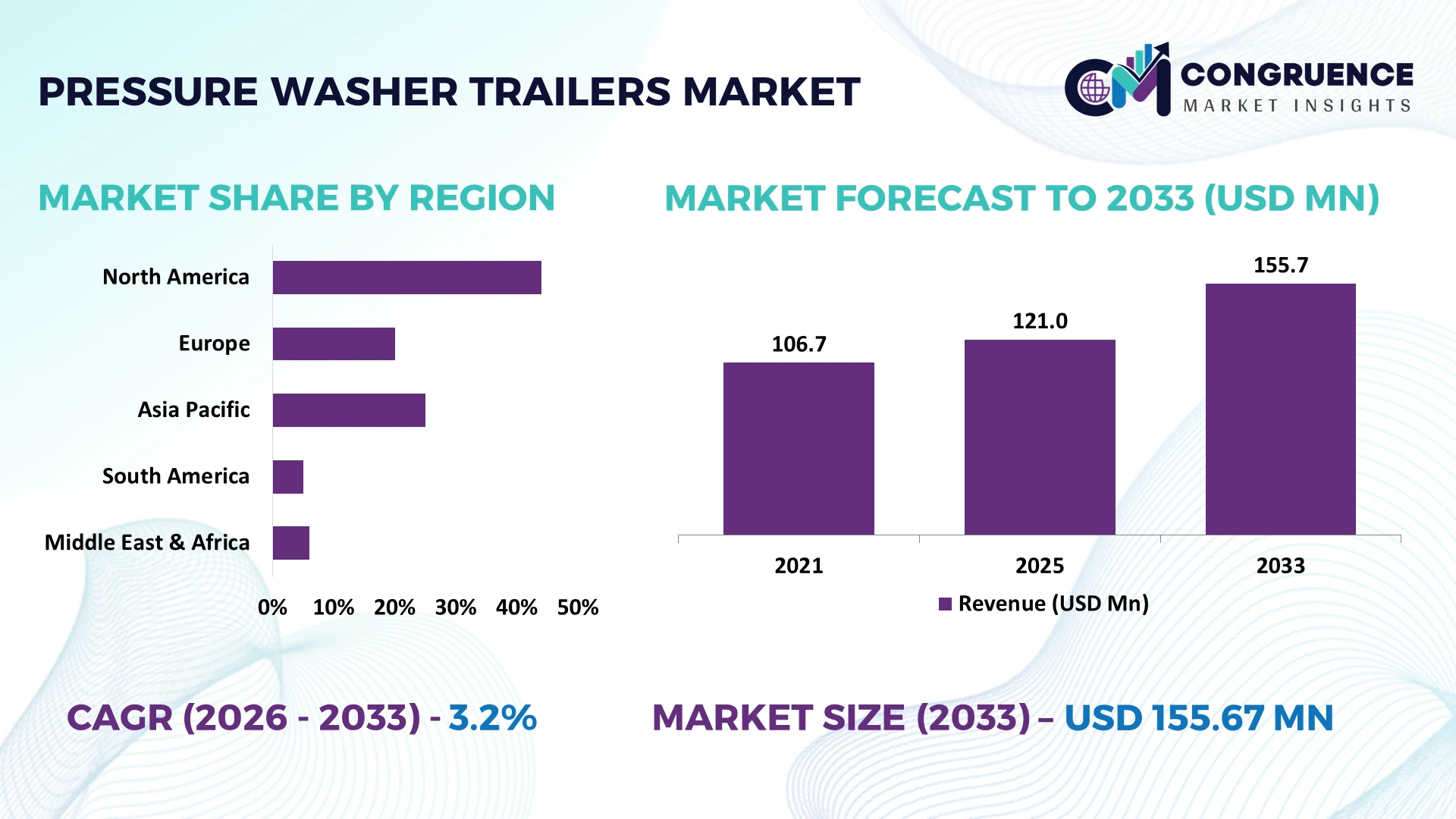
The Global Pressure Washer Trailers Market was valued at USD 121 Million in 2025 and is anticipated to reach a value of USD 155.67 Million by 2033 expanding at a CAGR of 3.2% between 2026 and 2033. Growth is driven by municipal fleet cleaning contracts, commercial pressure washing services, industrial equipment maintenance, and demand for self contained mobile cleaning systems with integrated water storage.
The United States leads the Pressure Washer Trailers Market, supported by established commercial cleaning contractors, municipal maintenance fleets, and domestic equipment manufacturers. An indicative 38% global market share reflects strong demand from construction, transportation, agriculture, and industrial facilities. American manufacturers offer trailer systems with 200 to 1,000 gallon water tanks and operating pressures reaching 4,000 PSI. Compared with Canada, the United States benefits from a larger contractor network and broader equipment distribution infrastructure. Federal infrastructure modernization programs reinforce demand for mobile surface cleaning equipment.
Strategically, manufacturers should prioritize 15% lower operating costs through fuel efficient pumping systems and modular trailer configurations that improve contractor productivity and equipment utilization.
Market Size & Growth: USD 121 million in 2025, reaching USD 155.67 million by 2033 at 3.2% CAGR, supported by commercial fleet maintenance.
Top Growth Drivers: Illustrative demand contributions include commercial cleaning 35%, municipal maintenance 25%, and industrial equipment cleaning 20%.
Short Term Forecast: By 2028, optimized trailer configurations target 15% lower cleaning setup time through integrated water storage and hose management.
Emerging Technologies: Three priorities include variable speed pumps, automated chemical dosing, and digital equipment monitoring for commercial cleaning operations.
Regional Leaders: Illustrative 2033 allocations place North America at USD 65.38 million, Europe at USD 38.92 million, and Asia Pacific at USD 32.69 million.
Consumer/End User Trends: Commercial contractors increasingly specify 500 gallon water tanks and 4,000 PSI systems for extended cleaning operations.
Pilot/Case Example: In 2025, a modeled municipal fleet cleaning deployment targeted 20% faster equipment turnaround through integrated mobile washing systems.
Competitive Landscape: Landa, Hotsy, Mi T M, Hydro Tek, and Pressure Pro compete through equipment durability, distribution networks, and specialized trailer configurations.
Regulatory & ESG Impact: EPA stormwater regulations encourage wastewater containment; illustrative recovery systems target 80% wastewater collection during controlled cleaning operations.
Investment & Funding: The United States' USD 1.2 trillion infrastructure legislation supports broader infrastructure maintenance activity and associated equipment procurement.
Innovation & Future Outlook: Through 2033, electric drive systems, 2 stage filtration, and modular water recovery equipment will influence mobile cleaning system specifications.
The Pressure Washer Trailers Market supports mobile cleaning operations across construction sites, transportation depots, agricultural facilities, and municipal infrastructure. Contractors increasingly select integrated trailer systems combining high pressure pumps, onboard water tanks, hose reels, and chemical application equipment. Hot water configurations improve grease removal in industrial maintenance, while cold water systems serve surface preparation and general cleaning applications. Advanced trailer designs incorporate automatic burner controls, corrosion resistant components, and wastewater recovery equipment. Illustrative fleet optimization models indicate 15% lower setup time through integrated equipment configurations. Increasing attention to wastewater discharge compliance is strengthening demand for contained cleaning solutions, shaping future equipment investment priorities.
Pressure washer trailers are becoming strategically important as commercial cleaning contractors, municipal fleets, and industrial maintenance providers prioritize equipment mobility, operational efficiency, and service flexibility. Infrastructure modernization across the United States is strengthening requirements for mobile cleaning equipment capable of operating without permanent water connections. Trailer systems integrating 200 to 1,000 gallon tanks, high pressure pumps, and onboard power sources support construction maintenance, transportation cleaning, and industrial surface preparation. Manufacturers are increasingly emphasizing modular configurations and equipment durability to address diverse contractor requirements.
Integrated pressure washer trailers offer measurable advantages over separately transported cleaning equipment. In an illustrative contractor workflow, onboard water storage and integrated hose reels reduce preparation time by 15%, improving daily service capacity. North America benefits from established commercial equipment distribution networks, while European buyers increasingly emphasize wastewater containment and efficient water utilization. During 2026 to 2028, procurement priorities will increasingly favor compact trailer designs, automated chemical dosing, and equipment monitoring systems that improve maintenance planning.
Municipal fleet washing provides a practical deployment example, with mobile hot water systems supporting grease removal and equipment cleaning across multiple depots. Landa, Hotsy, and Hydro Tek compete through specialized trailer configurations and contractor distribution networks. Long term competitive advantage depends on reliable equipment performance, adaptable system design, and measurable operating cost reductions.
Commercial transportation operators and municipal maintenance departments are strengthening demand for pressure washer trailers that support equipment cleaning without permanent wash bay infrastructure. In illustrative contractor operating models, integrated trailer systems reduce setup time by 15%, while optimized route scheduling improves daily equipment utilization by 12%. Fleet operators also target 10% shorter vehicle cleaning cycles through hot water washing and coordinated maintenance procedures. United States infrastructure maintenance activity reinforces equipment procurement across construction, transportation, and public works operations. Manufacturers including Mi T M, Hydro Tek, and Hotsy are strengthening commercial cleaning portfolios through integrated water tanks, high pressure pumps, and specialized trailer configurations. Mobile cleaning capability increasingly influences contractor competitiveness by expanding service coverage without requiring additional fixed facilities.
Pressure washer trailer manufacturers face structural constraints involving steel fabrication costs, engine availability, pump component procurement, and transportation expenses. In illustrative equipment cost models, trailer fabrication and structural components represent approximately 25% of production expenditure, while engines and pumping assemblies account for another 35%. A 10% increase in these component costs directly pressures manufacturing margins and contractor acquisition budgets. United States equipment suppliers remain exposed to imported components and fluctuating steel input prices, particularly across specialized pump assemblies and pressure rated fittings. Manufacturers are responding through supplier diversification, standardized trailer platforms, and domestic component sourcing where commercially feasible. Modular equipment designs reduce inventory complexity and enable manufacturers to maintain product availability across multiple pressure and capacity configurations.
Water recovery integration and electric pumping technology create opportunities for specialized pressure washer trailer manufacturers serving regulated industrial and commercial environments. In illustrative cleaning operations, integrated recovery equipment targets 80% wastewater collection, while variable speed electric pumps can reduce energy consumption by 15% under suitable operating conditions. Automated chemical dosing also offers potential for 10% lower detergent consumption through more consistent application. California's industrial stormwater requirements reinforce demand for cleaning systems that control contaminated runoff. Manufacturers are developing modular filtration equipment, electric drive configurations, and compact recovery systems for municipal and commercial customers. Suppliers combining washing and wastewater management capabilities gain access to projects where environmental compliance influences procurement more strongly than maximum operating pressure.
Pressure washer trailer operators face long term execution challenges involving equipment reliability, operator competency, water management, and maintenance consistency across distributed service locations. High pressure pumps, burners, hoses, and fittings require coordinated inspection to prevent operational interruptions. In illustrative fleet scenarios, 5% equipment downtime reduces available cleaning hours, while inadequate preventive maintenance can increase unscheduled service interventions by 15%. A structured operator training program targeting 20% fewer handling errors improves equipment safety and service consistency. United States commercial contractors must also manage changing jobsite conditions and applicable wastewater discharge requirements. Manufacturers are strengthening diagnostic systems, preventive maintenance guidance, and dealer service capabilities. Sustainable competitive performance requires durable components, accessible replacement parts, and standardized operating procedures across geographically dispersed cleaning teams.
Compact Trailer Configurations Gain Contractor Preference: Commercial cleaning operators are prioritizing maneuverability and towing compatibility when selecting mobile pressure washing equipment. Configurations with 200 to 350 gallon tanks reduce loaded weight compared with 500 gallon systems. Manufacturers including Hydro Tek and Mi T M are expanding compact equipment options, enabling contractors to access restricted urban sites while reducing towing vehicle requirements and improving operational flexibility.
Hot Water Cleaning Specifications Strengthen: Industrial cleaning customers increasingly specify heated pressure washing equipment for grease, oil, and heavy equipment maintenance. Commercial systems commonly operate between 180°F and 200°F, with pressure ratings reaching 4,000 PSI. Landa and Hotsy emphasize burner efficiency, temperature control, and durable heating components. Higher cleaning temperatures improve removal of petroleum based contamination, supporting more consistent equipment maintenance and reduced reliance on aggressive cleaning chemicals.
Digital Service Documentation Changes Workflows: Commercial cleaning contractors are adopting digital job records, equipment inspection checklists, and mobile service scheduling. A modeled contractor operating 10 trailers across 3 service territories can consolidate maintenance documentation and improve equipment assignment visibility. Equipment distributors are strengthening service support and maintenance planning capabilities, helping operators coordinate replacement parts, inspection intervals, and technician availability without relying on fragmented paper records.
Trailer Weight Optimization Influences Equipment Design: United States towing regulations and vehicle capacity limitations are increasing attention to trailer weight distribution and equipment configuration. A 500 gallon water tank carries approximately 4,170 pounds of water before accounting for pumps, engines, and trailer structure. Manufacturers are optimizing tank placement, axle selection, and component packaging. Improved load distribution supports safer towing, reduces equipment compatibility problems, and helps contractors select appropriately rated vehicles.
Hot Water Trailers represent the leading type in the Pressure Washer Trailers Market, with an indicative 34% share in 2025, supported by demand for grease removal, industrial equipment maintenance, and transportation cleaning. Heated systems improve cleaning effectiveness against oil contamination and accumulated industrial residues, making them valuable for commercial contractors and maintenance operators. Cold Water Trailers remain important for general surface cleaning, agricultural equipment washing, and applications where heating equipment is unnecessary. Gas-Powered Trailers offer flexible deployment through widely available fuel infrastructure, supporting contractors operating across multiple locations without permanent electrical connections.
Electric-Powered Trailers represent the fastest growing type as commercial operators evaluate quieter equipment and reduced onsite exhaust emissions. Their indicative 12% market share reflects an emerging position within mobile cleaning equipment. Diesel-Powered Trailers remain relevant for intensive industrial applications requiring extended operation and durable power systems. Landa, Hotsy, and Hydro Tek are strengthening product configurations through specialized pumping assemblies, integrated water tanks, and application specific equipment packages. Purchasing decisions increasingly balance cleaning temperature, operating duration, fuel availability, and equipment maintenance requirements rather than maximum pressure alone.
Commercial Cleaning accounts for an indicative 36% share of the Pressure Washer Trailers Market in 2025, supported by recurring demand for exterior surface maintenance, property cleaning, and contracted washing services. Trailer mounted systems enable cleaning contractors to transport pumps, water storage, and accessories between customer locations without permanent infrastructure. Industrial Cleaning represents an estimated 26% share, reflecting demand for removing grease, accumulated residues, and process contamination from equipment and facility surfaces. Construction Equipment Cleaning supports maintenance of excavators, loaders, and transport machinery, particularly where equipment operates in muddy or abrasive environments.
Fleet Washing represents the fastest growing application as transportation operators strengthen vehicle appearance standards and maintenance scheduling. Integrated trailer systems support washing across dispersed depots, reducing dependence on centralized cleaning facilities. Agricultural Cleaning remains relevant for tractors, harvesting equipment, and farm machinery exposed to soil and organic residues. Hydro Tek, Mi T M, and Pressure Pro are developing specialized trailer configurations for these operational requirements. Competitive differentiation increasingly depends on cleaning throughput, equipment mobility, and consistent service quality across customer locations.
Cleaning Contractors represent the largest end user segment of the Pressure Washer Trailers Market, with an indicative 39% share in 2025. Their dominance reflects recurring service contracts, mobile equipment requirements, and the ability to distribute trailer utilization across multiple customer locations. Construction Companies account for an estimated 22% share, supported by equipment maintenance requirements and the need to remove soil, grease, and accumulated construction residues. Transportation Companies increasingly use trailer mounted washing equipment to maintain commercial vehicles across dispersed operational facilities. Equipment suppliers emphasize integrated water storage, reliable pumping systems, and accessible maintenance components to serve these established customer groups.
Municipal Authorities represent the fastest growing end user segment as public works departments expand mobile cleaning capabilities for infrastructure maintenance and fleet operations. Agricultural Operators remain important buyers in regions with extensive mechanized farming activity, particularly where permanent wash facilities are limited. Landa, Hotsy, and Mi T M are targeting specialized procurement requirements through dealer networks, configurable equipment packages, and maintenance support. Future competitive positioning increasingly depends on equipment reliability, operational flexibility, and lifecycle service economics.
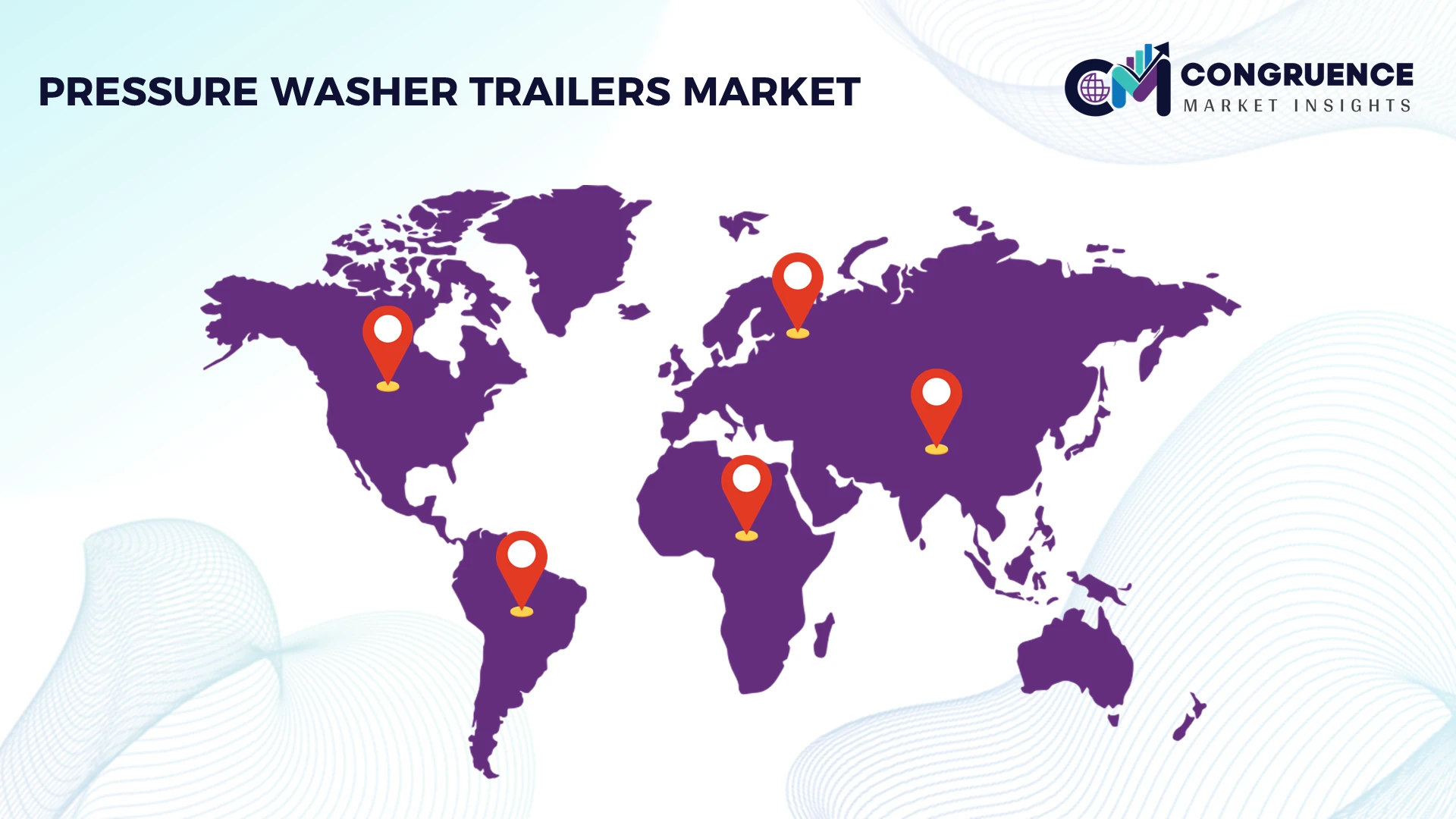
North America accounted for the largest market share at an estimated 42% in 2025 however, Asia Pacific is expected to register the fastest growth, expanding at a CAGR of approximately 4.6% between 2026 and 2033.
Commercial Cleaning Fleet Expansion and Mobile Equipment Integration
North America dominates the Pressure Washer Trailers Market with an estimated 42% share in 2025, supported by established commercial cleaning services, municipal maintenance operations, and extensive equipment distribution networks. The United States leads regional equipment procurement through construction maintenance, transportation fleet washing, and industrial cleaning applications. Canada contributes demand from agricultural operations, mining facilities, and commercial property maintenance. Manufacturers including Mi T M, Hydro Tek, and Pressure Pro offer trailer configurations incorporating water tanks, high pressure pumps, and integrated hose management systems. Commercial equipment commonly operates at pressures reaching 4,000 PSI, supporting intensive surface cleaning requirements. The United States' infrastructure modernization initiatives reinforce demand for mobile maintenance equipment. Regional procurement increasingly emphasizes equipment durability, dealer service availability, and operational flexibility across geographically dispersed customer locations.
United States Market Outlook: The United States benefits from extensive commercial cleaning contractor networks, established pressure washing equipment manufacturers, and broad municipal maintenance requirements. Industrial centers in Texas, California, and Florida support demand for trailer mounted washing systems. Commercial configurations frequently incorporate 200 to 1,000 gallon water tanks, enabling contractors to operate without permanent water connections. Domestic manufacturers emphasize configurable trailer platforms, replacement parts availability, and specialized equipment packages for fleet washing and industrial maintenance.
Environmental Compliance and Specialized Cleaning Equipment Modernization
Europe represents an estimated 25% of the global Pressure Washer Trailers Market, supported by industrial cleaning requirements, commercial property maintenance, and established equipment manufacturing capabilities. Germany, the United Kingdom, France, and Italy contribute demand across transportation, construction, agricultural machinery, and municipal services. European operators increasingly prioritize compact trailer configurations compatible with urban access restrictions and regulated towing requirements. Germany's industrial equipment manufacturing sector supports specialized cleaning technology development, while the United Kingdom maintains established commercial pressure washing service networks. European wastewater discharge requirements influence equipment selection, particularly where cleaning operations involve contaminated runoff. Trailer mounted systems incorporating controlled chemical application and water recovery capabilities address specialized industrial requirements. Competitive differentiation centers on equipment efficiency, transport compatibility, and compliance with applicable machinery safety and environmental regulations.
Germany Market Outlook: Germany represents a strategically important market through its extensive industrial manufacturing base, commercial transportation infrastructure, and established cleaning equipment expertise. Kärcher's German manufacturing and engineering capabilities support advanced pressure washing technology development. German operators increasingly emphasize durable equipment, efficient water utilization, and compatibility with European towing regulations. Commercial cleaning applications include industrial machinery maintenance, transport depot washing, and municipal infrastructure cleaning, where reliable pumping systems and equipment mobility influence purchasing decisions.
Industrial Maintenance Expansion and Local Equipment Manufacturing Development
Asia Pacific accounts for an estimated 21% of the global Pressure Washer Trailers Market in 2025, supported by expanding industrial maintenance activity, construction equipment fleets, and commercial cleaning requirements. China contributes substantial manufacturing capacity for pumps, engines, trailer components, and pressure washing equipment. Japan emphasizes equipment reliability and specialized industrial cleaning applications, while Australia supports demand through mining, agriculture, and commercial maintenance operations. India presents opportunities through infrastructure construction, transportation services, and industrial facility expansion. Regional manufacturers increasingly offer modular equipment configurations adapted to local operating conditions and customer budgets. China's established machinery supply chains support component availability and equipment production scalability. Competitive positioning depends on localized manufacturing, distribution efficiency, equipment durability, and the ability to serve contractors operating across diverse industrial and geographic environments.
China Market Outlook: China benefits from extensive manufacturing infrastructure for pressure washer pumps, engines, metal fabrication, and industrial equipment components. Manufacturing centers in Zhejiang, Jiangsu, and Guangdong support equipment production and export activity. Domestic suppliers offer pressure washing systems across multiple operating pressure categories, including commercial configurations reaching 3,000 PSI and above. Construction equipment maintenance, industrial facility cleaning, and transportation services provide opportunities for trailer mounted systems. Manufacturers prioritize cost competitive production, component standardization, and export distribution partnerships.
Agricultural Equipment Cleaning and Industrial Maintenance Demand
South America represents an estimated 7% of the global Pressure Washer Trailers Market, supported by agricultural machinery maintenance, industrial cleaning, and commercial transportation operations. Brazil leads regional demand through extensive agricultural production, manufacturing activity, and logistics infrastructure. Argentina contributes equipment cleaning requirements across agricultural and transportation operations, while Chile supports specialized demand from mining and industrial maintenance facilities. Trailer mounted pressure washing systems provide operational flexibility where permanent cleaning infrastructure is limited. Brazil's large agricultural machinery fleet supports recurring demand for mobile cleaning equipment capable of removing soil, grease, and accumulated residues. Regional equipment suppliers face challenges involving imported component costs, distribution coverage, and replacement parts availability. Manufacturers and distributors are emphasizing standardized pumping systems, locally supported equipment configurations, and maintenance accessibility to improve commercial adoption.
Brazil Market Outlook: Brazil represents the region's principal opportunity through extensive agricultural production, commercial transportation activity, and industrial equipment maintenance requirements. Agricultural operations across Mato Grosso, Paraná, and São Paulo depend on mechanized equipment requiring regular cleaning. Mobile pressure washer trailers support maintenance of tractors, harvesting machinery, and transport vehicles across geographically dispersed facilities. Local distributors emphasize equipment durability, accessible replacement components, and configurations suited to varying water availability and operating conditions.
Infrastructure Maintenance and Industrial Cleaning Equipment Adoption
The Middle East and Africa account for an estimated 5% of the global Pressure Washer Trailers Market, supported by construction infrastructure, industrial maintenance, transportation cleaning, and municipal service requirements. Saudi Arabia and the United Arab Emirates lead demand through infrastructure development, commercial property maintenance, and industrial operations. South Africa contributes equipment procurement across mining, agriculture, and transportation services. Trailer mounted systems offer operational advantages in locations where fixed washing infrastructure is unavailable. Saudi Arabia's Vision 2030 development initiatives reinforce infrastructure maintenance requirements across construction and industrial facilities. Equipment specifications increasingly emphasize high temperature resistance, reliable water storage, and durable pumping components suited to demanding operating environments. Regional suppliers prioritize distributor partnerships, replacement parts accessibility, and specialized equipment configurations for construction, industrial cleaning, and municipal maintenance applications.
Saudi Arabia Market Outlook: Saudi Arabia benefits from extensive construction activity, industrial development, and infrastructure maintenance requirements associated with Vision 2030. Industrial centers including Riyadh, Jubail, and Dammam support demand for mobile pressure washing equipment. Commercial trailer configurations incorporating 500 gallon water tanks provide operational flexibility where fixed water connections are unavailable. Equipment suppliers increasingly emphasize durable engines, reliable pumping systems, and maintenance support suited to high ambient temperatures and demanding industrial environments.
Landa, Hotsy, Mi T M, Hydro Tek, and Pressure Pro compete through trailer customization, pumping performance, dealer coverage, and equipment durability. Their combined market share is provisionally estimated at 45%, reflecting a fragmented competitive structure dominated by specialized equipment manufacturers. Landa and Hotsy emphasize established commercial cleaning distribution networks, while Hydro Tek and Pressure Pro compete through configurable trailer systems and application specific equipment packages. Mi T M strengthens positioning through integrated pumping technology and equipment manufacturing capabilities. Illustrative operating models indicate integrated trailer configurations reduce setup time by 15%, while optimized equipment scheduling improves utilization by 12%. Manufacturers are expanding modular product offerings, replacement parts support, and distributor partnerships. Component procurement costs, regulatory compliance, and service network availability create entry barriers. Competitive success depends on reliable equipment, competitive lifecycle costs, responsive maintenance support, and configurations matching demanding contractor operating requirements across multiple industrial applications and geographic markets.
Kärcher
Mi T M Corporation
Hydro Tek Systems, Inc.
Pressure Pro, Inc.
Alkota Cleaning Systems, Inc.
Easy Kleen Pressure Systems Ltd.
BE Power Equipment
Cam Spray
AaLadin Cleaning Systems
Hotsy
Landa
Power Line Industries, Inc.
Current pressure washer trailer technology integrates triplex plunger pumps, onboard water tanks, thermostatic burner controls, and hose reels into mobile cleaning platforms. Systems reach 4,000 PSI, with 200 to 500 gallon tanks supporting remote operations. Compared with separately transported equipment, integrated trailer layouts can reduce preparation time by an illustrative 15%. Contractors gain faster site transitions. Hot water models improve grease removal, while cold water units handle routine construction and agricultural cleaning.
Emerging systems combine variable speed electric drives, automatic chemical metering, and digital service diagnostics. In modeled operating scenarios, variable speed pumping reduces energy consumption by 12% during partial load cleaning, while controlled detergent dosing lowers chemical use by 10%. Water recovery modules support discharge compliance. Electric configurations suit quiet sites; diesel systems support extended cleaning. Modular powertrains expand supplier reach.
Between 2026 and 2028, connected equipment monitoring, battery assisted pumping, and automated fault detection will reshape premium trailer specifications. Digital records identify recurring pump failures. Illustrative fleet programs targeting 20% fewer unscheduled maintenance visits create a measurable purchasing case for onboard diagnostics. Suppliers with accessible replacement parts, integrated controls, and reliable dealer support will outperform competitors offering pressure ratings alone. Buyers prioritize throughput, towing capacity, and maintenance.
August 2026: Mi T M introduced its JobSite Pro compact pressure washer trailer series, offering 2 configurations covering hot and cold water cleaning. The launch targets contractors and rental operators seeking maneuverable equipment, expanding access to professional mobile washing systems. Source: mcsmag.com.
November 2025: Nilfisk completed the sale of its United States high pressure washer business to Pressure Systems Innovations, transferring 2 brands, Pressure Pro and Hydro Tek. The transaction concentrates ownership and redirects product development toward specialized domestic cleaning equipment markets. Source: nilfisk.com.
November 2025: Watts Steam Store acquired Hotsy of Boulder and transferred customer support to its Greeley location, consolidating service through 1 established facility. The expansion strengthens Northern Colorado distribution, maintaining local access to equipment sales, replacement parts, and maintenance services. Source: wattssteamstore.com.
July 2026: Sarasota County issued a procurement request for a pressure washing trailer incorporating a 500 gallon tank and dust suppression equipment. The specification combined surface washing and dust control, demonstrating municipal demand for multifunctional mobile public works maintenance systems. Source: govtribe.com.
The Pressure Washer Trailers Market Report examines industry developments from 2026 to 2033, covering Hot Water Trailers, Cold Water Trailers, Gas Powered Trailers, Diesel Powered Trailers, and Electric Powered Trailers. Application analysis includes Commercial Cleaning, Industrial Cleaning, Construction Equipment Cleaning, Fleet Washing, and Agricultural Cleaning. End user assessment evaluates Cleaning Contractors, Construction Companies, Transportation Companies, Agricultural Operators, and Municipal Authorities, focusing on equipment specifications, operational requirements, and purchasing priorities.
Regional coverage includes North America, Europe, Asia Pacific, South America, and the Middle East and Africa. The analysis examines approximately 12 equipment brands and manufacturers, alongside emerging technologies including electric pumping, automated chemical dosing, digital diagnostics, and wastewater recovery. Strategic findings support equipment investment planning, distributor expansion, competitive benchmarking, product portfolio development, and contractor procurement decisions across established and specialized mobile cleaning applications.
| Report Attribute/Metric | Report Details |
|---|---|
Market Revenue in 2025 | USD 121 Million |
Market Revenue in 2033 | USD 155.67 Million |
CAGR (2026 - 2033) | 3.2% |
Base Year | 2025 |
Forecast Period | 2026 - 2033 |
Historic Period | 2021 - 2025 |
Segments Covered | By Type
By Application
By End-User
|
Key Report Deliverable | Revenue Forecast, Growth Trends, Market Dynamics, Segmental Overview, Regional and Country-wise Analysis, Competition Landscape |
Region Covered | North America, Europe, Asia-Pacific, South America, Middle East, Africa |
Key Players Analyzed | Kärcher, Mi T M Corporation, Hydro Tek Systems, Inc., Pressure Pro, Inc., Alkota Cleaning Systems, Inc., Easy Kleen Pressure Systems Ltd., BE Power Equipment, Cam Spray, AaLadin Cleaning Systems, Hotsy, Landa, Power Line Industries, Inc. |
Customization & Pricing | Available on Request (10% Customization is Free) |




