
Reports
The Global Press Forging Machinery Market was valued at USD 9411.73 Million in 2025 and is anticipated to reach a value of USD 12489.57 Million by 2033 expanding at a CAGR of 3.6% between 2026 and 2033. Automotive lightweighting, aerospace-grade forged components, heavy-equipment localization, and replacement of conventional presses with automated closed-die systems are directly accelerating investment in advanced press forging machinery.
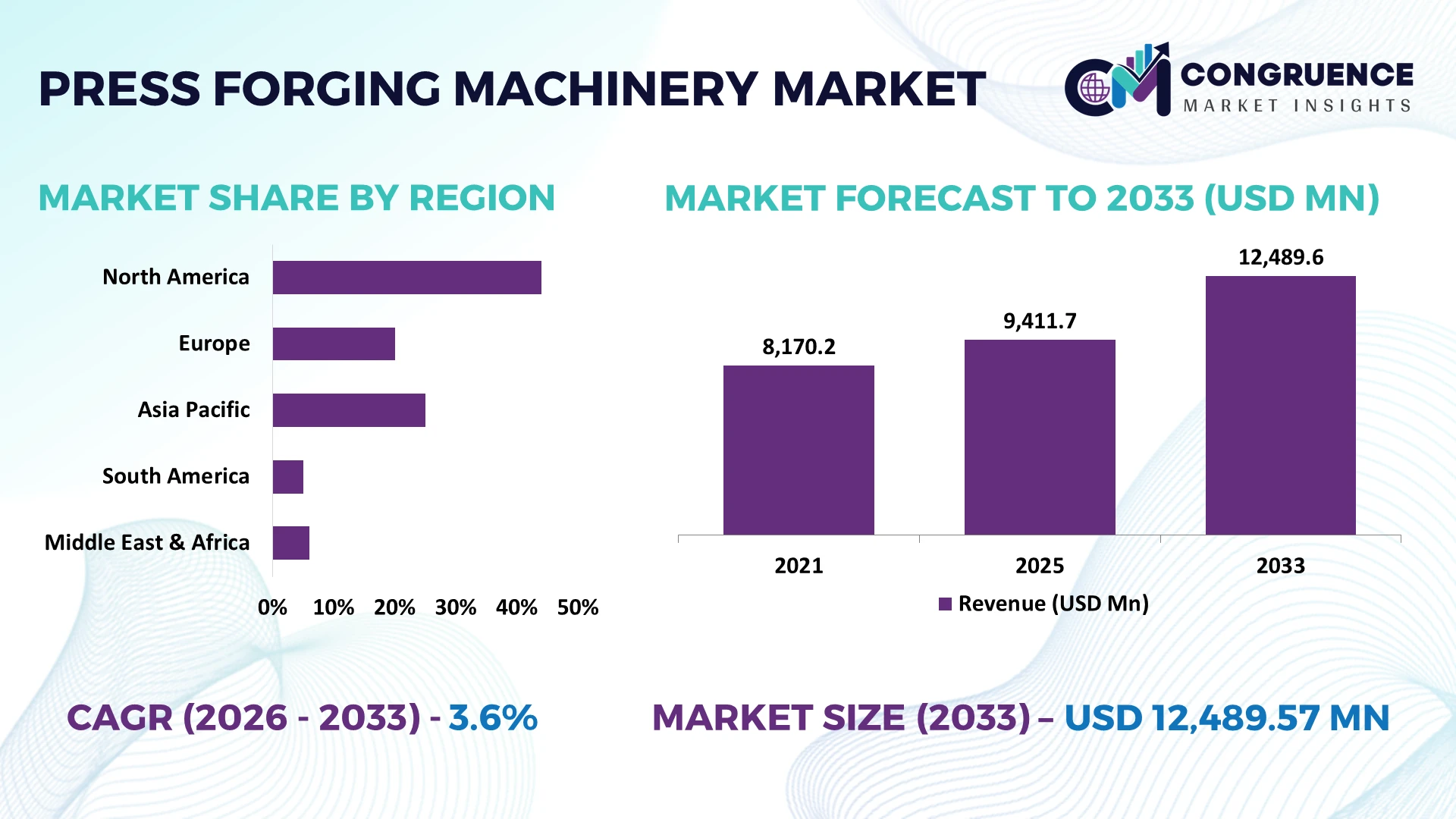
China anchors global press forging machinery demand within Asia-Pacific, which accounts for approximately 45–48% of industry consumption, supported by automotive, construction equipment, rail, energy, and aerospace manufacturing. Chinese industrial installations include ultra-heavy hydraulic forging presses exceeding 80,000 tons, while automated closed-die systems can achieve approximately 30 strokes per minute. India is expanding automotive, defense, and infrastructure forging capacity, whereas Japan maintains a stronger position in precision and specialty-alloy forging. Global supply-chain localization following trade disruptions is reinforcing regional machinery investment.
Strategically, manufacturers should prioritize Asia-Pacific capacity expansion while differentiating through automation, precision controls, energy efficiency, and lifecycle productivity rather than competing primarily on press tonnage.
Market Size & Growth: USD 9,411.73 million in 2025 is projected to reach USD 12,489.57 million by 2033 at 3.6% CAGR, supported by automated forging capacity for automotive, aerospace, energy, and industrial components.
Top Growth Drivers: Automotive applications represent approximately 39% of equipment demand, Asia-Pacific contributes roughly 45–48%, and hydraulic systems capture about 46%, concentrating investment around high-tonnage, automated production platforms.
Short-Term Forecast: By 2028, predictive maintenance, automated lubrication, digital monitoring, and servo-controlled handling are positioned to reduce unplanned production interruptions by approximately 10–15% across advanced forging operations.
Emerging Technologies: AI-based process optimization, digital twins, robotic billet handling, induction heating, and sensor-driven condition monitoring are enabling automated forging cells to achieve approximately 8–12% higher operational efficiency.
Regional Leaders: Asia-Pacific represents approximately USD 6.0 billion of potential 2033 demand, compared with about USD 2.85 billion for Europe and USD 2.62 billion for North America, with Asia leading capacity expansion and Western markets emphasizing modernization.
Consumer/End-User Trends: Automotive applications account for approximately 39% of comparable forging machinery demand, keeping crankshafts, gears, axles, suspension components, and lightweight structural parts central to equipment purchasing decisions.
Pilot/Case Example: In 2026, an automated 3,150-ton closed-die forging press installation in China demonstrated production capability of up to 30 strokes per minute for high-volume excavator track-link manufacturing.
Competitive Landscape: Asia-Pacific controls approximately 45–48% of global demand; SMS group, Schuler, Komatsu, Mitsubishi, and major Asian machinery manufacturers compete through automation, press reliability, integrated handling, and digital process controls.
Regulatory & ESG Impact: Advanced induction heating, energy monitoring, near-net-shape forging, and flash reduction can lower material or energy requirements by approximately 5–15%, strengthening compliance with industrial decarbonization and manufacturing-efficiency targets.
Investment & Funding: The market adds approximately USD 3.08 billion in value between 2025 and 2033, reflecting sustained capital allocation toward replacement presses, automated forging lines, regional manufacturing expansion, and supply-chain localization.
Innovation & Future Outlook: Digital forging platforms increasingly integrate databases covering 200+ material grades with automated recipe control, positioning connected presses, adaptive parameters, predictive maintenance, and high-mix production as core next-generation competitive capabilities.
Press Forging Machinery Market demand is increasingly concentrated in automotive powertrain and chassis components, aerospace structures, construction equipment, railway hardware, energy systems, and defense-grade forgings. Automated billet handling, servo-controlled transfer systems, digital twins, induction heating, and condition-monitoring sensors are improving consistency while reducing manual intervention. Advanced forging cells can deliver approximately 10–15% productivity improvement through shorter handling cycles and predictive maintenance. Manufacturing localization across Asia, particularly in China and India, is also strengthening demand for high-tonnage domestic capacity as companies reduce dependence on geographically concentrated industrial supply chains. These shifts establish the foundation for evaluating strategic market opportunities.
Press forging machinery is becoming strategically important as automotive, aerospace, defense, rail, and heavy-equipment manufacturers secure localized capacity for high-strength components. Supply-chain restructuring is shifting procurement toward automated, flexible forging cells capable of processing multiple alloys and geometries. China’s extensive heavy-forging infrastructure supports volume production, while India’s localization programs are strengthening domestic requirements for automotive and defense forgings. Equipment availability increasingly influences supplier qualification, production resilience, and component lead times.
Technology is simultaneously changing operating economics. Modern servo-hydraulic presses with automated billet handling can improve cycle efficiency by approximately 10–15% versus manually operated legacy lines, while condition monitoring reduces avoidable stoppages. Japan and Germany emphasize precision, process control, and specialty-alloy applications; China prioritizes production scale, and India combines capacity expansion with automation upgrades. Through 2028, digitally monitored equipment is expected to penetrate more replacement projects as manufacturers target higher utilization and lower energy intensity.
A practical example is automated 3,150-ton closed-die equipment operating at up to 30 strokes per minute for excavator track links in China. Machinery suppliers are consequently investing in integrated handling, controls, predictive maintenance, and localized service partnerships. Competitive advantage will increasingly depend on delivered productivity and process intelligence, not press tonnage alone.
Automotive, aerospace, defense, and heavy-equipment localization is creating sustained requirements for high-capacity press forging systems. Automotive applications account for approximately 39% of comparable forging-machine demand, while Asia-based manufacturing represents roughly 45–48% of equipment consumption. Automated closed-die lines can increase operational efficiency by around 10–15% through synchronized billet handling, transfer, and process control. India’s push to localize defense platforms, vehicle components, and industrial equipment is encouraging forging companies to expand domestic machining and forming capacity rather than depend on imported components. Suppliers are responding with higher-tonnage hydraulic presses, automated transfer systems, and local service networks. The strategic advantage is production sovereignty: integrated forging capacity shortens component lead times while reducing exposure to cross-border supply disruptions.
High upfront equipment requirements and volatile operating inputs constrain modernization, particularly among small and mid-sized forging companies. Large automated presses can require 20–30% higher initial investment than conventional configurations once robotic handling, controls, furnaces, dies, and monitoring systems are integrated. Energy can represent approximately 10–20% of hot-forging conversion costs, making electricity and gas volatility directly relevant to utilization economics. European manufacturers face additional pressure from elevated industrial energy costs, while specialty steel and nickel-alloy availability remains exposed to concentrated upstream supply chains. Extended die and component lead times can also delay commissioning. Operators are reducing exposure through long-term electricity contracts, localized tooling, multi-supplier alloy procurement, and staged automation. The operational priority is therefore total lifecycle cost control rather than simply minimizing equipment purchase price.
Digitally connected forging cells create an opportunity to extract more output from installed press capacity without proportional factory expansion. Sensor-based condition monitoring, automated die lubrication, robotic transfer, digital twins, and AI-assisted process control can raise equipment utilization by approximately 8–15% and reduce unplanned maintenance interventions by around 10–20% in well-integrated operations. India offers particular potential as automotive, railway, aerospace, and defense suppliers upgrade from semi-automated equipment while expanding domestic capacity. By 2028, connected controls and predictive-maintenance packages are positioned to become standard specifications in a growing share of premium press installations. Machinery companies are strengthening controls R&D, retrofit portfolios, and automation partnerships. A particularly attractive opportunity lies in retrofitting existing high-tonnage presses, allowing customers to capture digital productivity gains without replacing mechanically viable assets.
The long-term challenge is integrating sophisticated automation without sacrificing process stability across changing alloys, dies, temperatures, and production batches. Automated lines can contain dozens of interconnected press, furnace, lubrication, robotic, inspection, and safety-control functions; a failure at one station can constrain the entire cell. Advanced automation can reduce direct manual intervention by 20–30%, yet it simultaneously increases demand for controls engineers, metallurgists, maintenance specialists, and data-capable technicians. India and other rapidly industrializing manufacturing locations face uneven availability of these multidisciplinary skills, while older plants often operate legacy controls that complicate interoperability. Manufacturers must invest in standardized control architectures, workforce training, remote diagnostics, simulation, and OEM partnerships. Sustainable competitiveness depends on converting automation complexity into repeatable uptime rather than merely installing additional digital hardware.
Energy-Recovery Presses Move Mainstream: High-tonnage forging plants are shifting from constant-power hydraulic architectures toward variable-speed drives and kinetic-energy recovery. A 6,500-ton installation commissioned in 2025 uses energy recovery capable of cutting peak power demand by up to 40%. Servo-electric configurations are targeting approximately 20–30% lower electricity consumption. German and Japanese operators are prioritizing these upgrades as industrial electricity costs make energy per forged component a procurement metric; equipment manufacturers are integrating regenerative drives directly into new press platforms.
Retrofits Extend Installed Asset Life: Forgers are modernizing mechanically sound 15–30-year-old presses instead of automatically replacing complete lines. PLC modernization, servo controls, digital sensors, and automated transfer retrofits can lower energy consumption by approximately 20–30% while improving repeatability and reducing obsolete-component exposure. European and U.S. operators are restructuring maintenance budgets around modernization packages, prompting press OEMs to expand retrofit engineering, controls integration, and lifecycle-service capabilities.
Operator-Free Cells Gain Traction: Automated billet tracking, manipulators, furnace synchronization, die lubrication, and line-level control are replacing disconnected workflows. Modern closed-die installations can operate at up to 30 strokes per minute, while predictive monitoring targets downtime reductions approaching 20–30%. Skilled-labor constraints are accelerating adoption. Suppliers are consequently integrating presses, furnaces, robots, and production software into turnkey cells rather than selling standalone machinery.
Specialty-Alloy Control Becomes Critical: Aerospace forging is shifting equipment specifications toward programmable force, velocity, and position control for titanium and nickel-based alloys. Hydraulic systems provide continuously adjustable penetration speed versus the constrained profiles of conventional mechanical drives, while automated process tracking can cover 100% of critical forging sequences. Manufacturers are combining radial forging, open-die presses, manipulators, and digital recipes, making metallurgical consistency—not maximum tonnage—the emerging differentiator.
Hydraulic Presses lead the Press Forging Machinery Market with an estimated 40–45% share, reflecting their ability to deliver controlled force throughout the stroke and accommodate large billets, difficult alloys, and variable component geometries. Their adjustable ram velocity makes them particularly valuable for aerospace, energy, and heavy-machinery forgings. Mechanical Presses remain important for high-volume automotive parts where rapid cycling and repeatability outweigh forming flexibility, while Eccentric Presses retain relevance in repetitive warm-forging operations requiring predictable stroke profiles.
Servo Presses represent the fastest-developing type as programmable motion profiles, energy recovery, and synchronized automation improve high-volume manufacturing economics. Modern servo configurations can reduce electricity consumption by approximately 20–30% against conventional architectures in suitable duty cycles. Screw Presses remain strategically relevant for impact-intensive closed-die work because they deliver concentrated forming energy without complex multi-stage motion. OEM investment is consequently dividing between scalable hydraulic platforms for difficult materials and servo-controlled machinery for precision, flexibility, and energy-sensitive production.
Closed-Die Forging represents the leading application, accounting for an estimated 40–45% of press forging machinery demand because automotive, industrial equipment, and aerospace manufacturers require repeatable near-net-shape components at production scale. Automated closed-die installations can reach approximately 30 strokes per minute in high-volume applications, strengthening economics for gears, track links, connecting components, and structural parts. Hot Forging remains essential for steels and high-strength alloys requiring substantial deformation, while Open-Die Forging serves large shafts, rings, energy components, and low-volume specialty work.
Precision Forging is the fastest-expanding application as manufacturers seek tighter dimensional control, lower machining requirements, and improved material utilization. Near-net-shape workflows can reduce downstream material removal by roughly 10–20% for suitable geometries, increasing the value of integrated process monitoring. Cold Forging remains strategically important for high-volume smaller components requiring surface finish and dimensional consistency. Suppliers are responding with automated transfer, programmable controls, thermal monitoring, and integrated inspection, shifting capital toward application-specific forging cells rather than standalone presses.
Automotive remains the largest end-user, representing approximately 35–40% of press forging machinery demand because transmission parts, axles, gears, suspension components, wheel-related parts, and structural forgings require repeatable high-volume production. Electrification is changing the component mix rather than eliminating forged content, increasing attention on aluminum components and lightweight structural designs. Heavy Machinery and Industrial Equipment sustain demand for durable gears, shafts, couplings, and load-bearing parts, while Energy applications require large forgings for turbines, generators, oil-and-gas equipment, and power infrastructure.
Aerospace is the fastest-developing end-user segment as titanium, nickel-based superalloys, landing-gear components, turbine parts, and structural forgings demand exceptionally controlled deformation. Aerospace and defense together account for a growing high-value equipment base, with advanced hydraulic systems targeting precision rather than maximum throughput. Defense procurement adds requirements for localized critical-component capacity. Machinery suppliers are targeting these buyers through customized presses, metallurgical process control, automated manipulators, digital traceability, and long-term service partnerships, while automotive customers remain focused on cycle speed and energy-per-part optimization.
Asia Pacific accounted for the largest market share at approximately 46% in 2025 however, Middle East and Africa is expected to register the fastest growth between 2026 and 2033.
Aerospace Capacity and Domestic Manufacturing Modernization
North America accounted for approximately 21% of global press forging machinery demand in 2025, supported by aerospace, defense, automotive, energy, and heavy equipment production. The United States concentrates advanced installations around Ohio, Michigan, Pennsylvania, California, and other manufacturing centers where titanium, aluminum, nickel alloy, and high strength steel forgings require precise force control. Aerospace manufacturing investment is strengthening requirements for hydraulic presses, automated manipulators, thermal management, and digital inspection. In 2025, GE Aerospace committed nearly USD 1 billion to United States factories and supply chain improvements across more than 16 states, almost doubling its previous commitment. This manufacturing expansion strengthens the equipment ecosystem supporting advanced forged engine and structural components. Canadian demand remains more selective, emphasizing aerospace components, energy equipment, and specialized industrial production. Buyers increasingly prioritize equipment availability, process traceability, domestic servicing, and lifecycle modernization.
United States Market Outlook: The United States remains North America's strategic center because its aerospace, defense, automotive, and energy industries require high specification forgings with stringent metallurgical consistency. Foreign direct investment expenditures reached USD 232.2 billion in 2025, increasing 49.5% from 2024. This broader manufacturing investment environment supports domestic equipment renewal, supplier localization, advanced material processing, and modernization of established forging operations.
Precision Manufacturing Drives Equipment Modernization
Europe represented approximately 24% to 25% of global press forging machinery demand in 2025, with Germany, Italy, France, Spain, and the United Kingdom supporting substantial automotive, aerospace, machinery, and industrial equipment production. Germany remains particularly influential through advanced press engineering, automotive forging, servo technology, and integrated automation. European manufacturers are directing capital toward energy efficient hydraulic drives, programmable motion control, digital condition monitoring, and modernization of existing presses. Retrofitting established machinery with updated PLC systems and servo controls can reduce electricity consumption by approximately 20% to 30% in suitable operations. The European Union Machinery Regulation becomes applicable in January 2027, reinforcing requirements around machinery safety and digital systems. Equipment suppliers are therefore integrating safety architecture, energy monitoring, automated handling, and predictive maintenance while helping established forging plants preserve productive mechanical assets.
Germany Market Outlook: Germany combines a mature forging base with globally significant machinery engineering capability. Automotive suppliers increasingly deploy programmable servo systems to coordinate forming and transfer operations more precisely. Installations reaching approximately 2,000 tons demonstrate how manufacturers are combining substantial forming force with controlled slide movement, improved die utilization, flexible setup, and automated component transfer for sophisticated drivetrain and industrial parts.
Manufacturing Scale Supports Automated Forging Deployment
Asia Pacific commands approximately 46% of global press forging machinery demand, supported by extensive automotive, construction machinery, rail, shipbuilding, aerospace, and industrial equipment capacity in China, India, Japan, and South Korea. China provides the strongest scale advantage through dense forging supply chains and extensive domestic machinery production, while Japan emphasizes precision equipment and difficult alloy processing. India is expanding automotive, railway, defense, and infrastructure manufacturing, increasing requirements for higher capacity presses and automated production cells. In China, a fully automated 3,150 ton eccentric forging press commissioned during 2026 achieved up to 30 strokes per minute and targeted four seconds per component for excavator track links. Such installations demonstrate the transition from standalone machinery toward synchronized presses, transfer systems, lubrication, tooling, sensors, and production dashboards. Suppliers are expanding local engineering and lifecycle service capabilities accordingly.
China Market Outlook: China combines equipment manufacturing depth with exceptional downstream consumption across vehicles, excavators, rail systems, energy equipment, and industrial machinery. Automated forging installations now integrate 3,150 ton forming capacity with sensor controlled transfer and digital production monitoring. This integration gives Chinese operators an important cost advantage by connecting material utilization, throughput, tooling performance, and energy measurement within a single production workflow.
Automotive and Mining Demand Shape Investment
South America accounts for approximately 4% to 5% of global press forging machinery demand, with Brazil providing the principal industrial base and Argentina contributing selective automotive and machinery requirements. Brazilian purchasing centers on automotive components, agricultural machinery, mining equipment, energy systems, and industrial replacement capacity. Vehicle production exceeding 2 million units annually sustains demand for forged gears, shafts, suspension components, transmission parts, and structural hardware. Mining operations create additional requirements for wear resistant and high strength components used in extraction and material handling equipment. Investment remains constrained by imported machinery costs, currency exposure, financing conditions, and uneven local availability of specialized controls and service expertise. Manufacturers are therefore prioritizing modular automation, press modernization, localized tooling, and equipment capable of serving multiple component programs rather than committing exclusively to highly dedicated production lines.
Brazil Market Outlook: Brazil provides South America's strongest opportunity because automotive production, agricultural machinery, mining, and energy equipment create diversified forging requirements. Vehicle output above 2 million units provides recurring component volumes, while mining equipment requires heavy duty forged parts. Suppliers that combine adaptable presses with local tooling, technical support, and modernization services gain stronger positioning than equipment vendors dependent entirely on imported service capabilities.
Industrial Localization Redirects Forging Investment
Middle East and Africa represents approximately 4% of global press forging machinery demand, but industrial localization is changing the region's equipment requirements. Saudi Arabia and the United Arab Emirates are expanding metals, defense, shipbuilding, energy equipment, and industrial manufacturing capabilities, while South Africa maintains established mining, automotive, and engineering activity. Saudi industrial planning includes opportunities for stainless steel casting and forging facilities with approximately 50,000 tons of annual production capacity. Localization initiatives are increasing interest in hydraulic presses, automated handling, heat treatment integration, and locally supported maintenance capabilities. Unlike mature manufacturing centers, deployment depends heavily on developing complete supplier ecosystems covering dies, alloys, skilled operators, inspection, and engineering support. Equipment manufacturers are consequently pursuing local partnerships and integrated production packages rather than supplying isolated presses, improving commissioning reliability and customer operating readiness.
Saudi Arabia Market Outlook: Saudi Arabia is emerging as the region's most strategically significant forging equipment destination through industrial diversification and localization. Proposed stainless steel casting and forging capacity reaches approximately 50,000 tons annually, while national steel policy targets substantial production expansion. Energy equipment, shipbuilding, defense manufacturing, and infrastructure programs create a diversified foundation for advanced forging installations supported by domestic service and technical partnerships.
Global specialists SMS group and Schuler compete with Japanese engineering groups such as Komatsu and AIDA, while Macrodyne, Beckwood Press, and regional machinery builders target customized applications and localized service. The top five participants account for approximately 18% of the broader press machinery market, indicating fragmented purchasing power despite strong technology leadership. Schuler holds roughly 6% to 7%, while leading Japanese suppliers maintain strength in automotive and precision forming. Competition increasingly centers on automation, energy efficiency, lifecycle service, and customization rather than initial equipment price. Modern servo controls can reduce energy consumption by 20% to 30%, while automated forging cells achieve cycle rates approaching 30 strokes per minute. Suppliers are expanding digital controls, retrofit programs, engineering partnerships, and local service capacity. The competitive shift favors integrated production systems over standalone presses. High engineering complexity, tooling expertise, metallurgical knowledge, and service infrastructure remain substantial entry barriers. Winning requires proven uptime, application engineering, automation integration, and dependable lifecycle support.
SMS group
Schuler
Komatsu
AIDA Engineering
LASCO Umformtechnik
Fagor Arrasate
Siempelkamp
Macrodyne Technologies
Beckwood Press
Isgec Heavy Engineering
Stamtec
Yangli Group
Sutherland Presses
Shieh Yih Machinery Industry
Servo controlled hydraulic presses, programmable motion systems, automated manipulators, and digital process monitoring define current forging technology. Variable speed hydraulic drives can lower energy consumption by 20% while automated billet handling can improve line productivity by 10% to 15%. Adoption is strongest in automotive, aerospace, and heavy equipment plants where repeatability, operator safety, and controlled deformation influence component quality and equipment utilization.
Emerging systems combine artificial intelligence, thermal cameras, force sensors, digital twins, and predictive maintenance with centralized press controls. Connected monitoring can reduce unplanned downtime by approximately 15% to 20%, while adaptive lubrication and temperature control improve die consistency. Compared with legacy mechanically controlled lines, modern servo hydraulic configurations can deliver about 15% better operating efficiency through programmable force, speed, and dwell profiles. Large forging companies benefit most because higher utilization spreads automation investment across production volumes.
Disruptive development is moving toward autonomous forging cells linking furnaces, presses, manipulators, inspection, and production software. By 2026 to 2028, digitally integrated lines should become standard specifications for premium aerospace and specialty alloy projects, with automated traceability covering nearly 100% of critical process steps. Suppliers investing now in software integration, energy recovery, remote diagnostics, and retrofit capability gain stronger lifecycle service positions.
February 2024 Aubert & Duval ordered an SMS group hydraulic forging press for Pamiers, backed by EUR 75 million project investment and 60 MN force. The installation strengthens European aerospace, energy, and defense forging capability for precision components.
July 2025 ANDRITZ Schuler reported Maxiforja started production using a 6,500 ton forging press in Brazil. Its Kinetic Energy Recovering System cuts power demand by up to 40%, improving heavy truck and agricultural component production overall efficiency significantly.
January 2026 Nakamura Iron Works completed acceptance of an SMS group 12.5 MN open die press in Japan, reaching 205 strokes per minute. Its compact hydraulic drive uses 50% less installation space, strengthening specialty alloy production throughput substantially.
May 2026 Happy Forgings reported commissioning a 10,000 ton forging press line after installing a 6,300 ton press during 2025. Additional capacity supports rising industrial and commercial vehicle volumes while expanding large component production capability across India domestically.
The Press Forging Machinery Market report evaluates Hydraulic Presses, Mechanical Presses, Screw Presses, Eccentric Presses, and Servo Presses across Closed Die Forging, Open Die Forging, Hot Forging, Cold Forging, and Precision Forging applications. Coverage extends across Automotive, Aerospace, Defense, Energy, Heavy Machinery, and Industrial Equipment users. Hydraulic equipment represents approximately 40% to 45% of demand, while automotive applications account for roughly 35% to 40%, providing clear visibility into equipment concentration and purchasing priorities.
Regional assessment covers North America, Europe, Asia Pacific, South America, and Middle East and Africa, with Asia Pacific representing approximately 46% of deployment. Technology coverage includes servo controls, automated manipulators, energy recovery, predictive maintenance, digital twins, and integrated inspection. The report evaluates competitive positioning, modernization priorities, capacity expansion, localized manufacturing, retrofit opportunities, and specialty alloy forging, supporting investment planning and strategic market direction between 2026 and 2033.
| Report Attribute/Metric | Report Details |
|---|---|
Market Revenue in 2025 | USD 9411.73 Million |
Market Revenue in 2033 | USD 12489.57 Million |
CAGR (2026 - 2033) | 3.6% |
Base Year | 2025 |
Forecast Period | 2026 - 2033 |
Historic Period | 2021 - 2025 |
Segments Covered | By Type
By Application
By End-User
|
Key Report Deliverable | Revenue Forecast, Growth Trends, Market Dynamics, Segmental Overview, Regional and Country-wise Analysis, Competition Landscape |
Region Covered | North America, Europe, Asia-Pacific, South America, Middle East, Africa |
Key Players Analyzed | SMS group, Schuler, Komatsu, AIDA Engineering, LASCO Umformtechnik, Fagor Arrasate, Siempelkamp, Macrodyne Technologies, Beckwood Press, Isgec Heavy Engineering, Stamtec, Yangli Group, Sutherland Presses, Shieh Yih Machinery Industry |
Customization & Pricing | Available on Request (10% Customization is Free) |




