
Reports
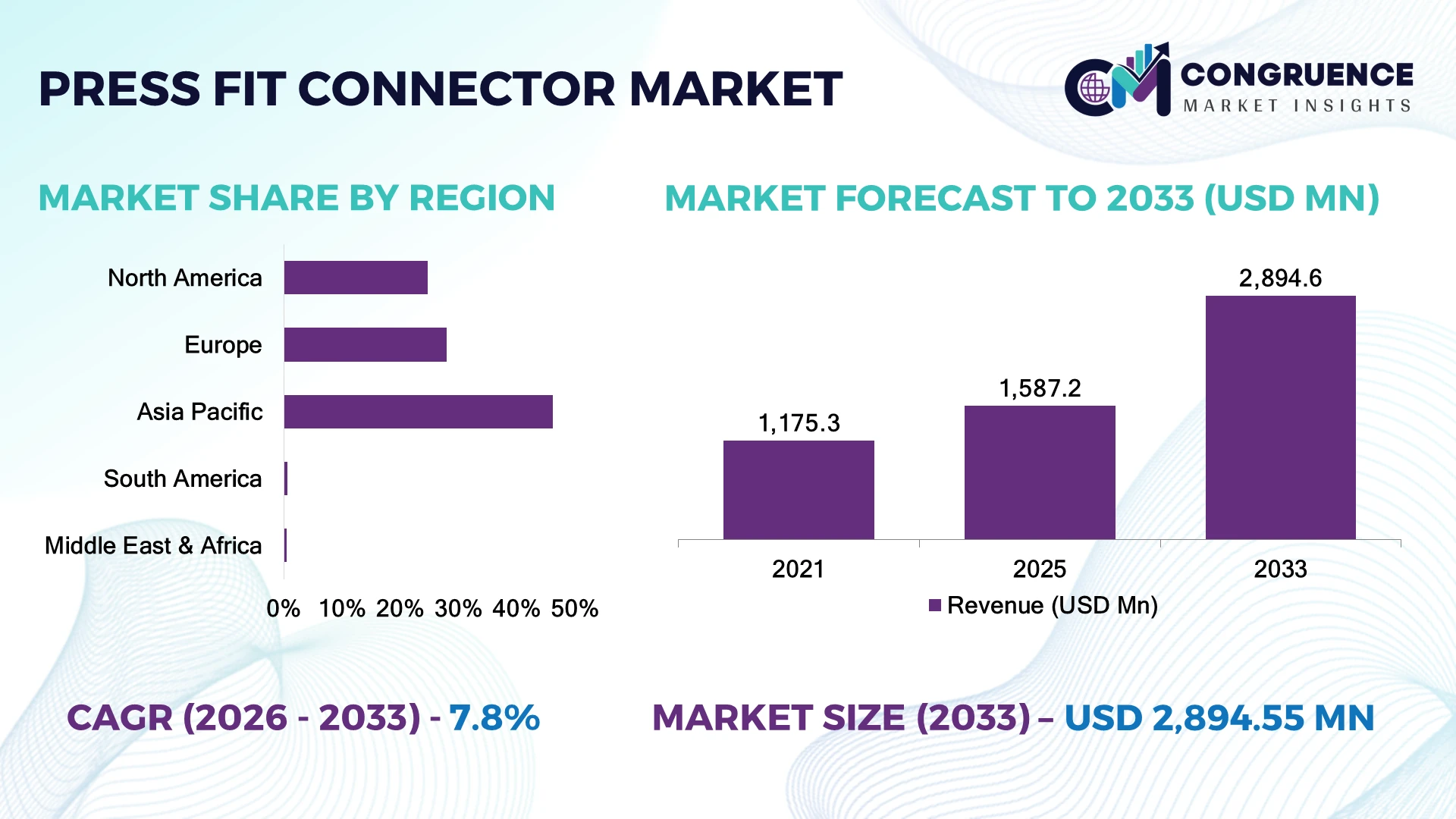
The Global Press Fit Connector Market was valued at USD 1,587.2 Million in 2025 and is anticipated to reach a value of USD 2,894.6 Million by 2033 expanding at a CAGR of 7.8% between 2026 and 2033. Growth is driven by rising adoption of solderless PCB interconnection technologies in electric vehicles, industrial automation, telecommunications infrastructure, and high-reliability electronic control systems.
China leads the Press Fit Connector market with approximately 34% of global connector manufacturing capacity, supported by large-scale automotive electronics production, telecom equipment manufacturing, and expanding EV supply chains. Compared with Germany, which focuses on premium industrial and automotive connector engineering, China dominates volume production, with nearly 72% of newly assembled EV control units utilizing press fit interconnection technology. Ongoing electronics supply-chain diversification following geopolitical trade realignment continues accelerating regional connector manufacturing investments.
Manufacturers investing in high-density connector platforms, automated assembly technologies, and localized production networks are securing stronger long-term competitive positioning.
Market Size & Growth: USD 1,587.2 million (2025) to USD 2,894.6 million (2033) at 7.8% CAGR, supported by EV electronics and industrial automation expansion.
Top Growth Drivers: Electric vehicles (+31%), industrial automation (+24%), telecom infrastructure (+19%).
Short-Term Forecast: By 2028, connector assembly time declines 17% while production efficiency improves 20%.
Emerging Technologies: AI-assisted quality inspection, automated insertion systems, and high-density connector miniaturization accelerate deployment.
Regional Leaders: Asia-Pacific, Europe, and North America expand adoption through automotive electronics and advanced manufacturing investments.
Consumer/End-User Trends: Approximately 68% of automotive control modules increasingly utilize solderless press fit connector technology.
Pilot/Case Example: A 2026 automated connector assembly project improved production throughput by 18% while reducing assembly defects by 16%.
Competitive Landscape: Leading manufacturers collectively control approximately 47% market share through engineering expertise and diversified product portfolios.
Regulatory & ESG Impact: Solder-free assembly reduces manufacturing energy consumption by approximately 14% during PCB production.
Investment & Funding: More than USD 2.4 billion supports connector manufacturing expansion, automation, and regional supply-chain localization.
Innovation & Future Outlook: High-speed data connectors and miniaturized press fit solutions are reshaping next-generation electronic architectures.
The Press Fit Connector market is advancing across electric vehicles, industrial automation, telecommunications equipment, aerospace electronics, and data infrastructure where durable solder-free electrical interconnections are essential. Approximately 64% of newly designed automotive electronic control units now incorporate press fit technology for improved assembly reliability. Continued electronics manufacturing localization and resilient supply-chain strategies are reinforcing investment in advanced connector technologies, creating a strong foundation for the strategic discussion below.
Press fit connectors have become strategically important as automotive manufacturers, industrial equipment suppliers, and electronics companies prioritize highly reliable, solder-free interconnection technologies capable of supporting increasingly complex electronic architectures. Supply-chain restructuring and regional manufacturing expansion are encouraging greater investment in localized connector production, automated assembly systems, and application-specific engineering capabilities across critical electronics industries.
Modern press fit connector technology improves assembly efficiency by approximately 23% while reducing thermal stress on printed circuit boards by nearly 20% compared with conventional soldered interconnections. Germany continues leading precision connector engineering for industrial and automotive applications, while China maintains larger manufacturing capacity supporting consumer electronics and electric vehicle production. During the next two to three years, adoption of automated insertion systems, AI-assisted inspection, and high-density connector platforms is expected to accelerate across advanced electronics manufacturing.
Connector manufacturers are expanding production facilities, strengthening partnerships with automotive OEMs and semiconductor companies, and investing in next-generation miniature connector designs for high-speed electronic systems. Electric vehicle battery management systems increasingly utilize press fit connectors to improve assembly consistency and long-term reliability under demanding operating conditions. Organizations combining advanced connector engineering, manufacturing automation, and localized supply capabilities will establish stronger competitive differentiation as electronic systems become denser, faster, and more reliability-focused.
The rapid electrification of vehicles and increasing electronic content per platform are accelerating adoption of press fit connectors across powertrain control units, battery management systems, and advanced driver assistance systems. Approximately 71% of new EV control modules now incorporate solder-free connector technology, while automated press-fit assembly improves manufacturing productivity by nearly 21% and reduces PCB thermal stress by approximately 19%. Germany's continued investment in next-generation automotive electronics and localized semiconductor production is strengthening demand for high-reliability interconnection solutions. Connector manufacturers are expanding precision stamping capacity, investing in automated insertion technologies, and strengthening OEM partnerships. A critical strategic advantage now lies in supplying application-specific connector platforms qualified for high-vibration and high-temperature operating environments.
Press fit connector manufacturing remains exposed to fluctuations in copper alloy, precision plating, and specialty resin availability, increasing production costs and procurement complexity. Raw materials represent nearly 49% of connector manufacturing expenditure, while precious metal plating costs have increased by approximately 16% due to supply constraints. Japan's dependence on imported critical raw materials has intensified procurement challenges during global logistics disruptions. These pressures compress margins, complicate pricing strategies, and extend production planning cycles for connector manufacturers. Companies are responding through supplier diversification, localized sourcing agreements, recycled alloy utilization, and long-term procurement contracts that improve cost predictability while strengthening operational resilience.
The transition toward high-speed data transmission, zonal vehicle architectures, and industrial digitalization is creating new opportunities for advanced press fit connector platforms. High-density connector designs improve signal integrity by approximately 23%, while miniaturized contact systems reduce PCB space requirements by nearly 18%. South Korea's investment in next-generation electronics manufacturing is accelerating demand for connectors supporting AI hardware, industrial networking, and intelligent mobility systems. Manufacturers are expanding R&D in fine-pitch contacts, advanced plating technologies, and modular connector ecosystems while collaborating with semiconductor and PCB developers. A key strategic opportunity lies in supplying unified connector platforms capable of supporting both power distribution and high-speed data communication.
Sustained market competitiveness depends on maintaining consistent insertion force, contact reliability, and dimensional accuracy across increasingly miniaturized connector designs. Approximately 33% of electronics manufacturers identify connector qualification as a major production challenge, while tighter PCB tolerances have increased assembly validation requirements by nearly 22%. Taiwan's advanced electronics manufacturing ecosystem continues raising quality expectations for high-density connector assemblies used in semiconductor and communication equipment. Companies must invest in automated inspection, precision tooling, digital quality control, and advanced material engineering to ensure deployment consistency. Strengthening process standardization and manufacturing traceability has become essential for supporting increasingly complex electronic architectures.
Connector Miniaturization Accelerates: Manufacturers are introducing compact press fit connector designs that reduce PCB footprint by approximately 24% while increasing contact density by nearly 20%. Higher electronic integration in automotive and industrial control systems is driving this transition, prompting suppliers to expand precision manufacturing capacity and automated assembly processes.
Automated Inspection Expands: AI-enabled optical inspection now improves connector defect detection by approximately 27% while reducing manual quality verification by nearly 18%. Labor shortages across electronics manufacturing are encouraging greater factory automation. Connector suppliers are integrating machine vision and digital process monitoring to strengthen production consistency and reduce rework.
High-Speed Signal Designs Advance: Advanced contact geometries and optimized plating technologies improve signal transmission performance by approximately 21% while reducing electrical resistance by nearly 15%. A non-obvious shift is the growing integration of simulation-driven connector validation before physical prototyping. Manufacturers are strengthening engineering partnerships to accelerate product qualification for next-generation electronic systems.
Regional Manufacturing Localizes: Supply-chain diversification is encouraging localized connector production, reducing procurement lead times by approximately 19% and logistics costs by nearly 13%. Electronics manufacturers are expanding regional assembly operations and qualifying additional material suppliers to improve resilience, while connector companies continue investing in flexible manufacturing platforms supporting faster customer response.
Compliant pin press fit connectors account for approximately 58% of the global Press Fit Connector market due to their superior mechanical retention, vibration resistance, and solder-free assembly advantages in automotive, industrial, and telecommunications electronics. Their compatibility with automated PCB assembly lines and long-term electrical reliability makes them the preferred choice for high-volume manufacturing. Solid pin connectors continue serving niche applications requiring customized mechanical configurations, while hybrid press fit designs are gaining strategic relevance in compact, high-density electronic architectures where mixed power and signal transmission is required.
Hybrid press fit connectors represent the fastest-growing type as electric vehicles, industrial automation, and AI-enabled computing platforms require higher connector density and improved electrical performance. Advanced compliant pin geometries reduce insertion force by approximately 18% while increasing contact reliability by nearly 21% under continuous vibration conditions. Connector manufacturers are expanding precision stamping capabilities, introducing advanced plating technologies, and collaborating with automotive OEMs to accelerate product qualification. Investment priorities are shifting toward miniaturized connector systems capable of supporting both power distribution and high-speed data communication within increasingly compact electronic assemblies.
According to a 2026 industry assessment published by IPC, solder-free compliant pin connector technologies continue expanding across automotive and industrial electronics as manufacturers prioritize automated assembly, higher reliability, and improved long-term PCB performance.
Automotive electronics account for approximately 41% of global Press Fit Connector demand, driven by widespread deployment across battery management systems, power distribution units, engine control modules, and advanced driver assistance systems. Telecommunications infrastructure remains a mature application supporting network switches and high-speed communication equipment, while industrial automation continues generating stable demand for programmable controllers, robotics, and motion control systems. Consumer electronics maintain strategic relevance through compact PCB assemblies requiring reliable, high-density electrical interconnections.
Electric vehicle battery systems represent the fastest-growing application as increasingly complex electrical architectures require vibration-resistant, solder-free connector solutions. Automated press fit assembly improves manufacturing efficiency by approximately 20% while reducing PCB thermal stress by nearly 18%. Connector manufacturers are expanding automated production capacity, integrating AI-assisted inspection systems, and strengthening partnerships with automotive electronics suppliers. Demand is becoming increasingly concentrated in mission-critical electronic systems where connector reliability directly influences product safety, operational performance, and manufacturing scalability.
A 2025 enterprise survey released by the International Electronics Manufacturing Initiative (iNEMI) highlighted increasing adoption of press fit connector technologies within automotive electronics to improve assembly automation, product durability, and manufacturing consistency.
Automotive manufacturers represent approximately 44% of global press fit connector procurement due to large-scale deployment across electric vehicles, commercial vehicles, and increasingly sophisticated electronic control systems. Industrial equipment manufacturers remain a major buyer group integrating press fit connectors into automation platforms, robotics, and factory control equipment, while telecommunications companies continue supporting demand through advanced networking infrastructure. Consumer electronics manufacturers are steadily adopting compact connector platforms for higher-density PCB designs requiring reliable mechanical performance.
Data center infrastructure providers represent the fastest-growing end-user segment as AI computing, cloud platforms, and high-speed networking require compact, thermally stable connector solutions capable of supporting higher current densities. Advanced connector platforms improve assembly productivity by approximately 19% while reducing maintenance-related failures by nearly 16%. Suppliers are responding through customized connector portfolios, collaborative engineering programs, flexible manufacturing, and application-specific product development. Competitive positioning is increasingly shifting toward companies capable of delivering high-speed, high-density connector ecosystems tailored to evolving digital infrastructure requirements.
According to a 2026 enterprise study released by the Electronic Components Industry Association (ECIA), manufacturers increasingly prioritize press fit connector technologies for high-reliability automotive, industrial automation, and next-generation digital infrastructure applications because of their durability and automated assembly compatibility.
Asia-Pacific accounted for the largest market share at 46.2% in 2025 however, Middle East & Africa is expected to register the fastest growth, expanding at a CAGR of 8.6% between 2026 and 2033.

Automotive Electronics and Data Infrastructure Accelerate Connector Innovation
North America accounts for approximately 24.7% of the global Press Fit Connector market, driven by expanding electric vehicle production, industrial automation, aerospace electronics, and hyperscale data center investments. Manufacturers continue replacing conventional soldered interconnections with press fit technologies to improve production efficiency and long-term reliability in mission-critical electronics. Nearly 63% of newly developed automotive electronic control modules within the region now incorporate press fit connector architectures. Connector manufacturers are strengthening automated production capabilities, expanding engineering partnerships with automotive OEMs, and increasing localized manufacturing to support resilient electronics supply chains. Continued investment in semiconductor packaging and high-speed networking equipment is reinforcing demand for advanced connector systems capable of supporting higher data transmission speeds and compact PCB designs.
United States Market Outlook: The United States leads regional demand through its extensive automotive electronics ecosystem, semiconductor manufacturing expansion, aerospace engineering, and cloud infrastructure investments. Manufacturers continue integrating advanced press fit connector technologies into electric vehicles, industrial controllers, and communication hardware. Approximately 69% of next-generation automotive electronic platforms developed domestically utilize solder-free connector systems, strengthening production quality while improving manufacturing scalability and long-term operational reliability.
Precision Engineering Supports High-Reliability Electronics
Europe remains a major market due to its leadership in automotive engineering, industrial automation, and precision electronic manufacturing. Approximately 28% of premium press fit connectors supplied globally support European automotive and industrial applications where vibration resistance and long-term electrical reliability are essential. Manufacturers continue modernizing connector production through advanced automation, precision stamping, and sustainable manufacturing initiatives while strengthening collaboration with vehicle manufacturers and industrial equipment suppliers to accelerate technology deployment.
Germany Market Outlook: Germany dominates the European market through its globally recognized automotive manufacturing sector, industrial automation expertise, and advanced electronics production capabilities. Connector manufacturers continue investing in miniature, high-density interconnection systems supporting electric mobility and industrial digitalization. Around 65% of newly introduced automotive control modules in Germany utilize advanced press fit connector technologies, reinforcing the country's leadership in high-performance electronic interconnection solutions.
Large-Scale Electronics Manufacturing Strengthens Regional Leadership
Asia-Pacific leads the global Press Fit Connector market with approximately 46.2% share, supported by large-scale electronics manufacturing, electric vehicle production, telecommunications equipment, and semiconductor assembly. China, Japan, South Korea, and Taiwan continue expanding automated connector manufacturing while increasing domestic production of advanced electronic components. Approximately 71% of newly established electronics assembly lines across major manufacturing hubs integrate automated press fit connector insertion technologies to improve production consistency and throughput. Manufacturers are expanding precision tooling, plating technologies, and connector miniaturization capabilities to address rapidly evolving electronic architectures.
China Market Outlook: China remains the largest regional market through its integrated electronics manufacturing ecosystem, dominant EV production capacity, and extensive PCB assembly infrastructure. Connector suppliers continue expanding localized production while strengthening partnerships with automotive, telecommunications, and industrial equipment manufacturers. More than one-third of global connector manufacturing capacity is concentrated within China, providing sustained demand for advanced press fit interconnection technologies across multiple industries.
Industrial Modernization Expands Electronics Manufacturing
South America is steadily increasing adoption of press fit connector technologies across automotive assembly, industrial automation, renewable energy equipment, and telecommunications infrastructure. Brazil continues leading investment in localized electronics manufacturing while industrial automation projects improve demand for high-reliability PCB interconnection systems. Approximately 41% of recently upgraded electronics production facilities now utilize automated connector insertion technologies to improve assembly quality and operational efficiency. Although imported connector components remain significant, regional manufacturing partnerships are gradually strengthening production capabilities and improving supply resilience.
Brazil Market Outlook: Brazil remains the region's primary market through its automotive manufacturing base, expanding industrial electronics sector, and continued investment in automation technologies. Manufacturers are integrating press fit connectors into electric mobility platforms, industrial control systems, and communication equipment to enhance product reliability. Growing adoption of automated electronics assembly is improving manufacturing productivity while supporting domestic production of increasingly sophisticated electronic systems.
Industrial Diversification Creates Electronics Manufacturing Opportunities
The Middle East & Africa market is expanding through investment in industrial automation, defense electronics, renewable energy infrastructure, and digital transformation initiatives. Demand for high-reliability press fit connectors is increasing as manufacturers establish localized electronics assembly and industrial equipment production capabilities. Approximately 36% of newly commissioned electronics manufacturing facilities now integrate automated connector assembly technologies to improve production quality and reduce manufacturing variability. Governments continue encouraging industrial diversification through technology investments, localized manufacturing incentives, and strategic partnerships supporting advanced electronics production.
Saudi Arabia Market Outlook: Saudi Arabia is emerging as the region's most significant market through industrial diversification strategies, electronics manufacturing initiatives, and expanding investment in advanced industrial infrastructure. Connector technologies are increasingly deployed across energy systems, defense electronics, industrial automation, and telecommunications equipment. Continued localization of electronic component manufacturing and investment in advanced production facilities are strengthening demand for reliable press fit interconnection solutions supporting long-term industrial development.
TE Connectivity, Amphenol, Molex, HARTING, and Hirose Electric compete directly in premium automotive, industrial automation, and high-speed electronics, while regional connector manufacturers challenge primarily on pricing and localized supply. The top five companies collectively control approximately 51% of the global market. Competition is driven by insertion reliability, miniaturization, automated assembly compatibility, and supply resilience rather than price alone. Advanced compliant-pin technologies improve PCB reliability by approximately 20%, while automated connector production reduces manufacturing defects by nearly 16%. Leading manufacturers are expanding regional production, co-developing products with automotive OEMs, investing in high-speed connector platforms, and vertically integrating precision stamping and plating operations. The competitive landscape is shifting toward application-specific, high-density connector ecosystems as vehicle electrification and AI infrastructure demand increase. Precision tooling, qualification cycles, and automotive certification remain major entry barriers. Winning requires engineering leadership, localized manufacturing, rapid customization, and deep OEM partnerships rather than competing solely on cost.
TE Connectivity Ltd.
Amphenol Corporation
Molex LLC
HARTING Technology Group
Hirose Electric Co., Ltd.
Japan Aviation Electronics Industry, Ltd. (JAE)
Yamaichi Electronics Co., Ltd.
Samtec Inc.
ERNI Electronics GmbH
Würth Elektronik eiSos GmbH & Co. KG
Phoenix Contact GmbH & Co. KG
Smiths Interconnect
Press fit connector technology is advancing through compliant-pin engineering, high-density contact architectures, precision plating, and automated insertion systems that improve assembly quality without soldering. Modern connector platforms increase PCB assembly efficiency by approximately 22% while reducing thermal stress by nearly 19% compared with conventional soldered interconnections. Around 68% of newly developed automotive electronic control modules now incorporate compliant press fit technologies, improving manufacturing consistency, long-term reliability, and production throughput across automotive, industrial, and communication equipment.
Emerging technologies include AI-assisted optical inspection, digital force monitoring, nano-scale surface treatments, and simulation-driven connector validation. Compared with legacy manual insertion methods, automated press-fit systems improve placement accuracy by approximately 27% while reducing assembly defects by nearly 18%. Automotive OEMs, industrial automation suppliers, and hyperscale data infrastructure manufacturers benefit most through faster qualification cycles, lower maintenance requirements, and improved production scalability, strengthening competitive differentiation in mission-critical electronics.
Between 2026 and 2028, high-speed signal connectors, miniature compliant-pin geometries, and intelligent manufacturing platforms will reshape connector production. Companies investing in automated inspection, advanced materials, and localized manufacturing will reduce lead times, improve operational resilience, and strengthen competitive positioning as electronic architectures become denser, faster, and increasingly automation driven.
January 2025 TE Connectivity announced its MULTIGIG HD connector was selected as the next-generation VPX standard by the VITA Standards Organization, delivering 112 Gb/s data rates with doubled pin count for defense systems, strengthening high-performance interconnect leadership. Source: TE Connectivity
August 2025 HARTING introduced three new industrial connectivity product lines, including Single Pair Ethernet solutions, expanding smart factory connectivity and supporting higher automation efficiency across industrial applications while strengthening its Industry 4.0 portfolio. Source: HARTING
February 2026 TE Connectivity acquired Phoenix Contact's EV charging inlet assets, expanding its electric mobility connectivity portfolio and strengthening vertically integrated charging solutions for global vehicle manufacturers, reinforcing its strategic position in electrification infrastructure. Source: TE News Center
March 2026 TE Connectivity launched 56G MezzaWave connectors and cable assemblies supporting data rates up to 56 Gbps PAM4, enabling higher signal integrity for AI infrastructure, advanced computing, and next-generation networking platforms. Source: TE News Center.
This report provides a comprehensive evaluation of the Press Fit Connector market across connector types, applications, end-user industries, and major geographic regions. It examines compliant pin, solid pin, and hybrid connector technologies used in automotive electronics, industrial automation, telecommunications, consumer electronics, aerospace, and data infrastructure. The analysis also assesses manufacturing trends, connector miniaturization, automated assembly technologies, material innovations, and deployment patterns across mature and emerging electronics ecosystems.
The report further evaluates high-density interconnection technologies, AI-enabled quality inspection, automated insertion systems, and next-generation signal transmission platforms shaping industry competitiveness. More than 65% of advanced automotive electronic platforms now utilize press fit interconnection technologies, reflecting accelerating adoption across high-reliability applications. Strategic intelligence supports investment prioritization, manufacturing expansion, product portfolio optimization, competitive benchmarking, supply-chain planning, and regional market positioning while identifying the technology and operational trends expected to influence business strategy and market direction between 2026 and 2033.
| Report Attribute/Metric | Report Details |
|---|---|
|
Market Revenue in 2025 |
USD 1,587.2 Million |
|
Market Revenue in 2033 |
USD 2,894.6 Million |
|
CAGR (2026 - 2033) |
7.8% |
|
Base Year |
2025 |
|
Forecast Period |
2026 - 2033 |
|
Historic Period |
2021 - 2025 |
|
Segments Covered |
By Type
By Application
By End-User
|
|
Key Report Deliverable |
Revenue Forecast, Growth Trends, Market Dynamics, Segmental Overview, Regional and Country-wise Analysis, Competition Landscape |
|
Region Covered |
North America, Europe, Asia-Pacific, South America, Middle East, Africa |
|
Key Players Analyzed |
TE Connectivity Ltd., Amphenol Corporation, Molex LLC, HARTING Technology Group, Hirose Electric Co., Ltd., Japan Aviation Electronics Industry, Ltd. (JAE), Yamaichi Electronics Co., Ltd., Samtec Inc., ERNI Electronics GmbH, Würth Elektronik eiSos GmbH & Co. KG, Phoenix Contact GmbH & Co. KG, Smiths Interconnect |
|
Customization & Pricing |
Available on Request (10% Customization is Free) |




