
Reports
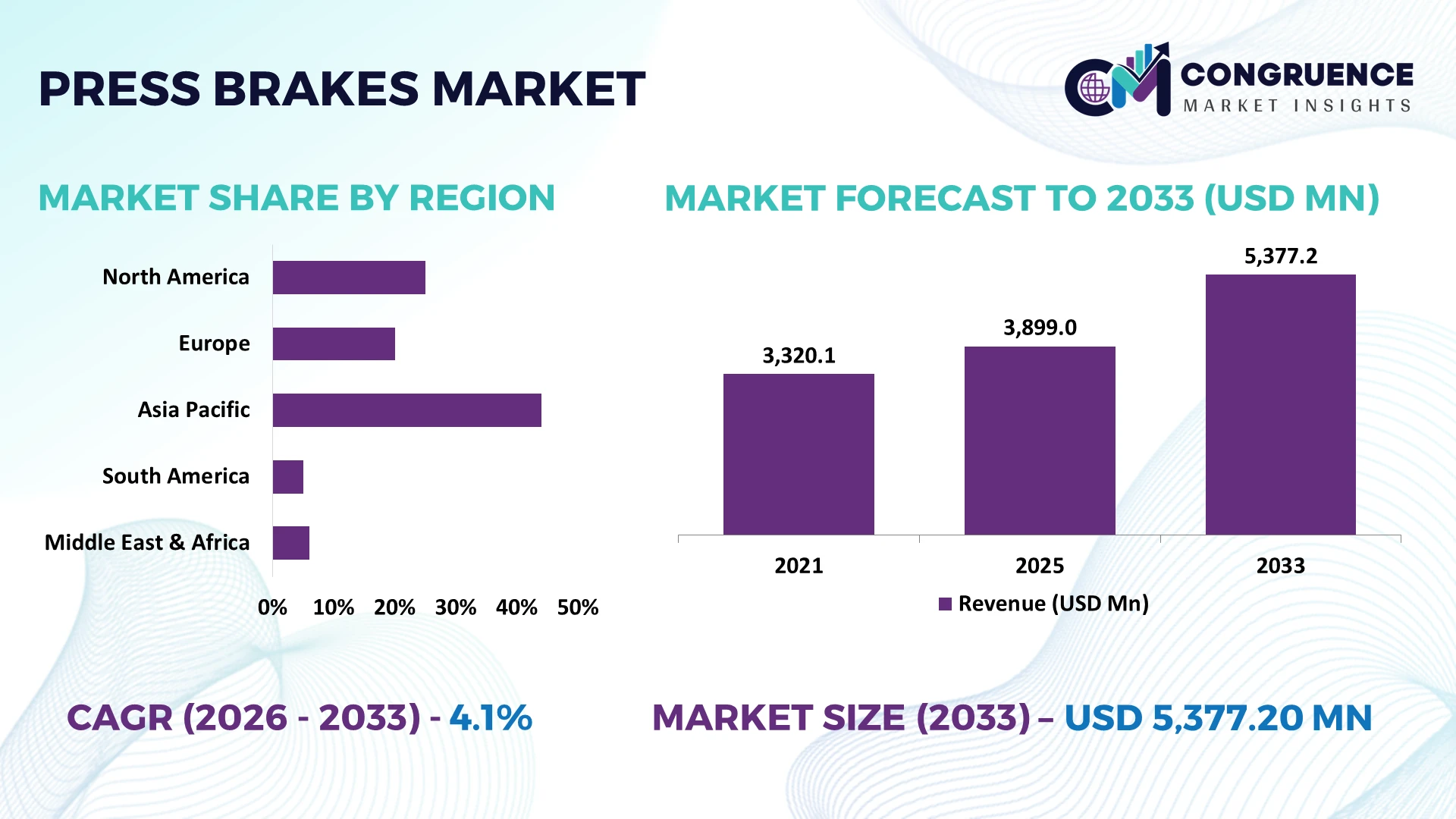
The Global Press Brakes Market was valued at USD 3899 Million in 2025 and is anticipated to reach a value of USD 5377.2 Million by 2033 expanding at a CAGR of 4.1% between 2026 and 2033. Growth is driven by CNC bending automation, robotic sheet metal handling, electric servo drive integration, and precision forming requirements across automotive manufacturing, aerospace components, and industrial fabrication.
China holds a leading position in press brake manufacturing, supported by its extensive sheet metal fabrication ecosystem, machinery production, and industrial automation investments. The country accounted for more than 30% of global manufacturing value added in 2023, compared with approximately 16% for the United States. China's industrial modernization programs emphasize CNC machinery, robotic handling, and automated production lines, while Germany maintains technological strength in high-precision bending systems. Chinese suppliers compete through manufacturing scale and equipment affordability, whereas European manufacturers emphasize accuracy, software integration, and specialized forming applications.
Strategically, manufacturers combining 3D bending simulation, robotic loading, and electric servo technology are positioned to improve precision fabrication competitiveness amid US–China industrial supply chain realignment.
Market Size & Growth: USD 3,899 million in 2025, reaching USD 5,377.2 million by 2033 at 4.1% CAGR, supported by CNC bending automation.
Top Growth Drivers: TRUMPF reports 40% shorter throughput, 30% faster bending operations, and 30% faster panel bending in specified equipment comparisons.
Short-Term Forecast: By 2028, modeled market value reaches USD 4,398.3 million; TRUMPF's automated bending technology delivers 40% shorter throughput time.
Emerging Technologies: AI-assisted programming, robotic handling, and 3D bending simulation transform production; TRUMPF reports 30% time savings per bend with Flex Cell.
Regional Leaders: Illustrative 2033 allocation: Asia-Pacific USD 2,150.9 million, Europe USD 1,613.2 million, and North America USD 1,075.4 million, emphasizing automation, precision, and reshoring.
Consumer/End-User Trends: Automotive, aerospace, and machinery fabricators increasingly prioritize 3 capabilities: automatic tool changing, angle correction, and offline programming.
Pilot/Case Example: In 2025, BVS Blechtechnik deployed AMADA's electric EGB-1303 ATCe, featuring 30% greater automatic tool changer capacity.
Competitive Landscape: TRUMPF, AMADA, Bystronic, LVD, and Prima Power compete through CNC integration; an illustrative leading-player share of 15% requires market validation.
Regulatory & ESG Impact: AMADA's EGB-e electric servo technology achieves up to 20% lower CO₂ emissions and approximately 90% lower oil consumption.
Investment & Funding: AMADA's electric press brake portfolio spans 600–1,300 kN, directing manufacturing investment toward servo drives, automation, and precision control.
Innovation & Future Outlook: Bystronic's advanced bending technology delivers up to 20% faster ram retraction and 40% lower energy consumption through efficiency optimization.
The Press Brakes Market is undergoing significant technological restructuring as manufacturers modernize sheet metal forming operations across automotive components, electrical enclosures, aerospace structures, and industrial machinery. Advanced CNC systems increasingly integrate automated backgauges, laser angle measurement, robotic material handling, and digital production programming. Bystronic's Fast Bend M technology offers up to 30% faster operating cycles through optimized ram approach movements, strengthening production efficiency in high-mix fabrication environments. Meanwhile, European manufacturers are accelerating electric servo adoption, while Asian equipment suppliers expand cost-competitive CNC production. These developments establish the foundation for evaluating technology investment, competitive positioning, and manufacturing modernization strategies through 2033.
Press brakes are becoming strategically important as automotive, aerospace, electrical equipment, and precision fabrication manufacturers prioritize production flexibility, dimensional accuracy, and reduced dependence on skilled manual bending operations. China's manufacturing sector accounts for more than 30% of global manufacturing value added, reinforcing its equipment production advantages, while Germany emphasizes high precision CNC bending and digitally connected fabrication systems. Supply chain restructuring and industrial reshoring are accelerating investments in automated sheet metal processing, particularly where manufacturers require shorter production runs and faster engineering changeovers.
Technology differentiation increasingly centers on electric servo drives, robotic handling, and adaptive angle correction. Bystronic reports energy consumption reductions reaching 40% in specified equipment configurations, while TRUMPF identifies throughput improvements reaching 40% through automated bending workflows. Compared with conventional hydraulic systems, digitally controlled equipment reduces setup interruptions and improves production consistency. European manufacturers emphasize software integration and energy efficiency, whereas Chinese suppliers compete through production scale and equipment affordability.
Between 2026 and 2028, manufacturers are expected to prioritize offline programming, automated tool changing, and connected production monitoring. AMADA's EGB series demonstrates practical deployment through servo electric bending and automatic tooling configurations. Equipment suppliers are strengthening automation partnerships and application engineering capabilities to serve high mix fabrication operations. Competitive advantage increasingly depends on measurable bending productivity, reliable process integration, and reduced operator intervention.
CNC automation is transforming press brake utilization as manufacturers prioritize repeatable bending accuracy, shorter setup cycles, and reduced manual intervention. TRUMPF reports throughput improvements reaching 40% in specified automated bending configurations, while advanced bending solutions deliver approximately 30% faster processing under defined operating conditions. Servo electric systems also demonstrate energy savings reaching 40% compared with selected conventional hydraulic configurations. Germany's automotive and machinery manufacturers increasingly integrate offline programming, automatic angle correction, and robotic material handling into sheet metal fabrication cells. Companies including TRUMPF, AMADA, and Bystronic are expanding software integration and automated tooling capabilities. The strategic advantage lies in reducing nonproductive setup time, particularly for high mix, low volume manufacturing environments.
High equipment acquisition costs and dependence on specialized components constrain press brake modernization among smaller fabrication businesses. CNC controllers, precision linear guides, servo drives, and hydraulic assemblies increase initial investment requirements compared with conventional mechanical systems. China's share of global manufacturing value added exceeds 30%, highlighting the concentration of industrial production capacity and associated sourcing exposure. For a fabrication workshop, a 15% increase in imported component costs combined with a 10% rise in installation expenses would materially weaken equipment investment economics. These percentages represent procurement sensitivity scenarios rather than observed market averages. European manufacturers face additional exposure to electricity prices and imported electronics. Equipment suppliers are responding through localized component procurement, modular machine configurations, leasing arrangements, and multiyear service agreements to protect customer affordability.
Robotic bending integration creates opportunities for manufacturers serving customized electrical enclosures, aerospace brackets, and short batch automotive components. TRUMPF's automated bending configurations demonstrate throughput improvements reaching 40%, while specified servo electric systems achieve energy reductions approaching 40% compared with conventional hydraulic alternatives. A fabrication facility operating at 60% machine utilization could increase productive capacity by 25% through optimized programming and material handling, assuming sufficient downstream demand. This modeled improvement highlights opportunities beyond equipment replacement. India's expanding industrial manufacturing ecosystem and Germany's precision engineering sector provide deployment environments for connected bending cells. Manufacturers are investing in digital twins, automatic tool changers, and robotic handling partnerships. Competitive differentiation increasingly depends on integrating complete fabrication workflows rather than supplying standalone machines.
Integrating advanced press brakes into connected manufacturing environments requires CNC programming expertise, robotic commissioning capabilities, and reliable production data management. Germany's manufacturing sector faces persistent skilled labor shortages, increasing pressure on equipment suppliers to simplify programming and operator training. A factory implementing robotic bending across 20 machines must coordinate controller communication, safety interlocks, and production scheduling. If programming errors affect 5% of jobs and integration downtime consumes 8% of scheduled operating hours, utilization losses become commercially significant. These figures illustrate operational risk scenarios rather than verified industry averages. Cybersecurity exposure also increases when CNC controllers connect with enterprise manufacturing systems. Companies must strengthen technician training, standardized communication protocols, simulation based commissioning, and remote diagnostics to maintain consistent production performance.
Adaptive Bending Sensors Improve First-Pass Accuracy: Manufacturers are integrating laser angle measurement and real-time springback compensation into CNC press brakes. Systems operating at 0.1° angular resolution support precision forming, while correction targets below 0.5° reduce manual inspection requirements. German equipment suppliers including TRUMPF and Bystronic are refining sensor feedback and controller integration, improving dimensional consistency across stainless steel and aluminum components while reducing scrap exposure.
Automatic Tool Changers Restructure Setup Operations: High-mix fabrication workshops increasingly prioritize automated punch and die positioning. AMADA's EGB series incorporates automatic tool changing, while selected configurations offer 30% greater tooling capacity than preceding systems. Tool libraries containing more than 100 tooling positions support varied bending sequences. Manufacturers are expanding automated tooling portfolios to reduce manual setup dependency and improve machine availability across frequently changing production orders.
Digital Inspection Strengthens Production Traceability: Automotive and aerospace suppliers are connecting CNC bending records with manufacturing execution systems. Digital inspection workflows capture bending angles, material thickness, and machine parameters across 100% of programmed production batches when configured for full traceability. Manufacturers are integrating barcode identification, digital quality records, and automated inspection interfaces. This shift improves defect investigation, reduces paperwork, and supports customer documentation requirements without increasing manual inspection staffing proportionately.
Connected Maintenance Changes Equipment Service Models: Press brake manufacturers are expanding remote diagnostics, condition monitoring, and controller connectivity. Hydraulic systems operating above 200 bar require continuous attention to pressure stability, while connected sensors monitor oil temperature, machine cycles, and component condition. Predictive maintenance programs targeting 15% lower unplanned downtime provide measurable operational benchmarks. Equipment suppliers are developing remote service partnerships and digital support platforms, converting maintenance responsiveness into a competitive differentiator.
Hydraulic Press Brakes Maintain Leadership as Electric Systems Gain Ground
Hydraulic press brakes account for an indicative 58% of the global market in 2025, supported by established industrial deployment, high tonnage capability, and compatibility with heavy gauge sheet metal processing. Their dominance reflects widespread installation across automotive components, industrial machinery, and structural fabrication. Hydraulic systems commonly operate across 100–400 tonnes of bending capacity, making them suitable for demanding production environments. Mechanical press brakes retain relevance in repetitive forming applications where standardized stroke characteristics and established equipment infrastructure support economical operation. Manufacturers including AMADA, TRUMPF, and LVD continue refining hydraulic equipment through CNC controls, energy management, and precision backgauge integration.
Electric press brakes represent the fastest expanding type, supported by demand for energy efficient production and reduced hydraulic maintenance requirements. Selected servo electric configurations demonstrate energy consumption reductions reaching 40% compared with conventional hydraulic systems under specified operating conditions. Hybrid press brakes combine hydraulic force capability with electronically controlled drive systems, offering flexibility for manufacturers transitioning toward electrification. Equipment suppliers are expanding electric product portfolios, developing servo drive partnerships, and integrating advanced motion controls. Investment priorities increasingly emphasize lifecycle operating costs, bending precision, and maintenance accessibility rather than maximum tonnage alone.
Sheet Metal Bending Anchors Industrial Equipment Demand
Sheet Metal Bending represents an indicative 42% of the global press brakes market in 2025, supported by extensive utilization across equipment housings, industrial panels, machinery components, and precision assemblies. Its leading position reflects the versatility of CNC bending equipment across different material thicknesses and production volumes. Metal Fabrication accounts for an estimated 28% share, supported by contract manufacturers supplying customized brackets, frames, and structural components. Automotive Parts applications require repeatable forming accuracy for reinforcement elements, body components, and specialized assemblies. Manufacturers increasingly deploy programmable backgauges, automatic crowning systems, and material compensation software to reduce dimensional variation and support complex bending sequences.
Electrical Enclosures represent the fastest expanding application in this analytical allocation, supported by industrial electrification, data center infrastructure, and power distribution equipment manufacturing. Enclosure production requires repeatable bends, consistent panel dimensions, and rapid configuration changes. Manufacturers including Bystronic, TRUMPF, and AMADA are expanding automated bending solutions suited to variable batch sizes. Advanced systems supporting angular correction within 0.5° improve dimensional consistency during precision forming. Investment increasingly targets offline programming, automated inspection, and tooling flexibility, enabling fabricators to serve diversified enclosure specifications while limiting setup interruptions.
Automotive Manufacturing Leads Precision Bending Equipment Utilization
Automotive represents an indicative 38% of global press brake demand in 2025, reflecting extensive requirements for structural brackets, reinforcement components, battery housings, and precision metal assemblies. Vehicle manufacturers and component suppliers prioritize dimensional repeatability, production traceability, and automated quality assurance. Aerospace accounts for an estimated 18% share, supported by specialized forming requirements involving aluminum alloys, stainless steel, and high strength materials. Industrial Machinery remains a substantial equipment buyer, particularly for customized housings, structural assemblies, and fabricated machine components. Manufacturers including TRUMPF, AMADA, and Bystronic are strengthening automotive production capabilities through CNC integration, automated handling, and digital process monitoring.
Aerospace represents the fastest expanding end-user category in this analytical scenario, driven by aircraft production modernization, complex component geometries, and stringent quality documentation requirements. Precision bending systems capable of maintaining angular tolerances within 0.5° support specialized manufacturing applications when appropriately configured. Construction applications remain relevant through structural fabrication, architectural panels, and building equipment components. Equipment suppliers are expanding application engineering, simulation capabilities, and customized tooling portfolios to address industry-specific requirements. Competitive investment increasingly emphasizes process validation, material handling automation, and consistent forming performance across demanding production environments.
Asia-Pacific accounted for the largest market share at an estimated 40% in 2025 however, Asia-Pacific is expected to register the fastest growth, expanding at an estimated CAGR of 5.2% between 2026 and 2033.

Manufacturing Reshoring Accelerates Precision Bending Modernization
North America represents an indicative 23% of global press brake demand in 2025, supported by automotive manufacturing, aerospace production, industrial machinery, and electrical equipment fabrication. The United States leads regional equipment procurement, while Mexico strengthens sheet metal processing capacity through automotive and electrical component manufacturing. The US manufacturing construction pipeline reflects sustained investment in domestic production facilities, supporting opportunities for CNC bending systems. Advanced press brakes equipped with automatic crowning, laser angle measurement, and programmable backgauges improve repeatability across complex fabrication operations. Equipment suppliers including Cincinnati Incorporated, AMADA, and TRUMPF compete through automation integration and technical service coverage. Industrial customers increasingly prioritize systems delivering bending accuracy within ±0.5° under controlled conditions. Investment decisions emphasize equipment utilization, reduced setup dependency, and compatibility with connected manufacturing infrastructure.
United States Market Outlook: The United States maintains a substantial precision fabrication ecosystem serving aerospace, defense, transportation, and industrial equipment manufacturers. The country's manufacturing sector employs more than 12 million workers, supporting extensive metalworking operations. Cincinnati Incorporated strengthens domestic equipment availability through established machinery manufacturing capabilities. Fabricators increasingly prioritize automated tooling, digital inspection, and responsive maintenance services to improve production reliability and reduce dependence on specialized manual bending skills.
Servo Electric Technology Reshapes Precision Fabrication
Europe accounts for an indicative 27% of global press brake demand in 2025, supported by Germany, Italy, France, and Switzerland. Regional manufacturers emphasize precision engineering, energy efficiency, and digitally integrated sheet metal processing. TRUMPF, Bystronic, LVD, and Prima Power compete through CNC software, automated tooling, and advanced bending cell configurations. Selected servo-electric press brakes demonstrate energy consumption reductions reaching 40% compared with conventional hydraulic alternatives under specified operating conditions. European industrial buyers increasingly evaluate lifecycle energy requirements, equipment maintenance, and production traceability alongside bending capacity. Germany's automotive and machinery industries sustain demand for high-precision forming, while Italy supports specialized machine tool manufacturing and fabrication automation. Equipment suppliers are expanding robotic integration, remote diagnostics, and application engineering services to strengthen customer retention and improve operational performance.
Germany Market Outlook: Germany remains a strategic center for precision machine tool development and industrial automation. Its automotive industry produced approximately 4.1 million passenger cars domestically in 2024, supporting extensive metal component manufacturing requirements. TRUMPF's established engineering capabilities strengthen Germany's position in CNC bending technology, automated tool handling, and digital fabrication integration. Industrial manufacturers prioritize dimensional accuracy, process documentation, and efficient changeovers across complex production programs.
Industrial Manufacturing Scale Reinforces Equipment Leadership
Asia-Pacific holds an indicative 40% share of the global press brakes market in 2025, reflecting China's extensive metalworking infrastructure, Japan's precision machinery capabilities, and India's industrial manufacturing expansion. China accounts for more than 30% of global manufacturing value added, strengthening demand for sheet metal forming equipment across automotive components, electrical cabinets, construction machinery, and industrial enclosures. Domestic manufacturers compete through CNC equipment affordability, localized components, and large-scale production capabilities. Japan emphasizes advanced servo controls and high-precision bending systems, supported by established machinery engineering expertise. India's expanding automotive and industrial fabrication ecosystems create opportunities for automated equipment modernization. Regional suppliers increasingly invest in controller integration, robotic handling, and export-oriented manufacturing. Competitive differentiation centers on machine reliability, production flexibility, and access to technical service infrastructure.
China Market Outlook: China combines extensive sheet metal fabrication capacity with established machinery manufacturing clusters in Jiangsu, Anhui, and Guangdong. Its industrial equipment ecosystem supports CNC controller production, hydraulic components, precision tooling, and machine assembly. Domestic manufacturers including Yawei and Accurl compete through automated bending equipment and export distribution. China's electric vehicle production exceeded 12 million units in 2024, reinforcing industrial requirements for battery enclosures, fabricated structures, and precision metal assemblies.
Automotive Fabrication Sustains Industrial Equipment Replacement
South America represents an indicative 6% of global press brake demand in 2025, with Brazil accounting for the largest regional manufacturing concentration. Automotive production, agricultural machinery, industrial equipment, and structural fabrication support equipment procurement. Brazil manufactured approximately 2.55 million vehicles in 2024, sustaining demand for formed metal components and fabrication machinery. Argentina contributes automotive and machinery applications, while Chile supports specialized equipment manufacturing for mining and infrastructure maintenance. Regional workshops increasingly evaluate CNC hydraulic press brakes offering programmable backgauges and improved bending repeatability. Imported machinery dependence exposes buyers to currency volatility, customs expenses, and replacement component availability. Equipment suppliers are strengthening distributor relationships, technical training, and spare parts inventories. Investment priorities favor durable equipment configurations capable of supporting multiple fabrication applications without extensive automation expenditure.
Brazil Market Outlook: Brazil's manufacturing clusters in São Paulo, Minas Gerais, and Paraná support automotive components, agricultural machinery, and industrial equipment fabrication. The country benefits from established metalworking expertise and regional machine tool distribution networks. Domestic suppliers and international manufacturers compete through equipment financing, service availability, and CNC modernization. Fabricators increasingly prioritize bending capacities between 100 and 300 tonnes for varied industrial applications, balancing equipment flexibility with acquisition costs.
Infrastructure Investment Expands Metal Forming Requirements
The Middle East & Africa represents an indicative 4% of global press brake demand in 2025, supported by construction infrastructure, industrial diversification, energy equipment manufacturing, and structural metal fabrication. Saudi Arabia and the United Arab Emirates concentrate substantial industrial investment, while South Africa maintains established machinery and mining equipment manufacturing capabilities. Saudi Arabia's Vision 2030 industrial strategy supports manufacturing localization and downstream metal processing. CNC press brakes operating across 100–400 tonnes serve structural assemblies, electrical enclosures, and industrial equipment components. Regional fabricators increasingly prioritize durable hydraulic systems, programmable controls, and accessible maintenance services. Equipment suppliers are expanding distributor partnerships and technical support capabilities to address import dependence and limited specialist servicing infrastructure. Procurement decisions emphasize operational reliability, tooling availability, and equipment versatility across infrastructure and industrial applications.
Saudi Arabia Market Outlook: Saudi Arabia's National Industrial Development and Logistics Program supports domestic manufacturing capacity and industrial supply-chain development. The country's industrial modernization agenda includes machinery, metal products, and equipment manufacturing. Planned industrial infrastructure under Vision 2030 strengthens opportunities for CNC press brakes used in electrical cabinets, structural assemblies, and fabricated machinery components. Suppliers offering local commissioning, operator training, and replacement tooling gain procurement advantages as industrial facilities expand.
The global press brakes market features competition between TRUMPF, AMADA, Bystronic, LVD, and Prima Power, whose combined share is provisionally modeled at 45%, reflecting an indicative rather than verified concentration estimate. TRUMPF and AMADA compete through CNC integration, automated tooling, and precision control, while Bystronic emphasizes connected fabrication systems. LVD targets flexible manufacturing applications, whereas Prima Power differentiates through integrated sheet metal processing. Selected servo-electric configurations deliver energy reductions reaching 40% compared with conventional hydraulic equipment. TRUMPF reports throughput improvements reaching 40% in specified automated bending applications, strengthening productivity differentiation. Chinese manufacturers challenge European suppliers through equipment affordability and localized production. Strategic partnerships increasingly connect machine builders with robotics integrators and software developers. High-precision tooling, controller interoperability, and technical service infrastructure create entry barriers. Competitive advantage requires demonstrable bending accuracy, lower lifecycle costs, and dependable automation support across diverse fabrication environments and customer production requirements.
TRUMPF SE + Co. KG
AMADA Co., Ltd.
Bystronic AG
LVD Company nv
Prima Industrie S.p.A. (Prima Power)
Salvagnini Italia S.p.A.
Durma Machinery
Cincinnati Incorporated
Accurl CNC Machine Tools
Jiangsu Yawei Machine Tool Co., Ltd.
Ermaksan Makina Sanayi ve Ticaret A.Ş.
Baykal Makina Sanayi ve Ticaret A.Ş.
SafanDarley B.V.
Haco Group
CNC controlled hydraulic press brakes remain essential for heavy gauge fabrication, while servo electric drives increasingly improve energy efficiency and positioning accuracy. Selected electric systems achieve up to 40% lower energy consumption than conventional hydraulic configurations under specified operating conditions. Laser angle measurement, automatic crowning, and multiaxis backgauges support bending tolerances within ±0.5° when materials and tooling are controlled. Manufacturers including AMADA, TRUMPF, and Bystronic integrate these technologies to reduce scrap, stabilize production quality, and improve equipment utilization across automotive and machinery manufacturing.
Emerging technologies combine robotic sheet handling, automatic tool changing, and offline bending simulation. TRUMPF reports throughput improvements reaching 40% in specified automated workflows, demonstrating advantages over manually coordinated operations. Digital twins validate bending sequences before production, while connected controllers synchronize tooling and material movement. High mix fabrication facilities benefit from shorter changeovers and reduced operator intervention. Equipment suppliers are expanding automation partnerships and application engineering services to strengthen differentiation.
Between 2026 and 2028, AI assisted programming, adaptive springback compensation, and predictive maintenance will influence investment priorities. A modeled 15% reduction in programming time and 10% improvement in machine availability would strengthen production economics. Manufacturers integrating secure machine connectivity, automated inspection, and configurable bending cells will gain competitive advantages through repeatability and deployment flexibility.
March 2025: TRUMPF introduced its TruBend 1000 press brake in the United States and Canada, offering bending forces from 66 to 353 tons. The launch expanded access to CNC bending technology for smaller fabrication businesses seeking affordable, programmable equipment. Source: trumpf.com
September 2025: TRUMPF unveiled its redesigned TruBend 3000 series at Blechexpo, achieving 40% shorter throughput times than its predecessor. The upgraded system incorporates automatic angle measurement, strengthening bending precision and improving productivity for sheet metal fabricators handling varied components. Source: trumpf.com
October 2025: Prima Power premiered its Express Robot Cell at Blechexpo, integrating a 50-ton servo-electric press brake with a six-axis robot and automated loader. The compact configuration strengthened unattended bending capabilities while reducing equipment footprint requirements for manufacturers. Source: primapower.com
April 2025: Manufacturing News highlighted Bystronic's ByBend Smart enhancements, including 20% faster ram retraction and 40% lower energy consumption with its Energy Saver option. These improvements strengthened forming productivity and reduced operating costs for precision fabrication businesses worldwide. Source: mfgnewsweb.com
The Press Brakes Market Report examines equipment technologies, manufacturing applications, competitive dynamics, and industrial modernization between 2026 and 2033. Segmentation covers Hydraulic, Electric, Hybrid, and Mechanical press brakes, alongside Sheet Metal Bending, Automotive Parts, Metal Fabrication, and Electrical Enclosures applications. End-user analysis evaluates Automotive, Aerospace, Construction, and Industrial Machinery industries. Technology coverage includes CNC controls, servo electric drives, robotic handling, automatic tool changing, and digital bending simulation. Equipment comparisons assess bending forces from 50 to 400 tonnes and precision requirements across different production environments.
Regional analysis covers North America, Europe, Asia-Pacific, South America, and Middle East & Africa, emphasizing manufacturing capacity, automation deployment, and procurement conditions. Competitive assessment examines 14 major manufacturers, emerging robotic bending cells, and specialized equipment suppliers. The report supports capital investment planning, production modernization, geographic expansion, supplier evaluation, and long-term competitive positioning.
| Report Attribute/Metric | Report Details |
|---|---|
Market Revenue in 2025 | USD 3899 Million |
Market Revenue in 2033 | USD 5377.2 Million |
CAGR (2026 - 2033) | 4.1% |
Base Year | 2025 |
Forecast Period | 2026 - 2033 |
Historic Period | 2021 - 2025 |
Segments Covered | By Type
By Application
By End-User
|
Key Report Deliverable | Revenue Forecast, Growth Trends, Market Dynamics, Segmental Overview, Regional and Country-wise Analysis, Competition Landscape |
Region Covered | North America, Europe, Asia-Pacific, South America, Middle East, Africa |
Key Players Analyzed | TRUMPF SE + Co. KG, AMADA Co., Ltd., Bystronic AG, LVD Company nv, Prima Industrie S.p.A. (Prima Power), Salvagnini Italia S.p.A., Durma Machinery, Cincinnati Incorporated, Accurl CNC Machine Tools, Jiangsu Yawei Machine Tool Co., Ltd., Ermaksan Makina Sanayi ve Ticaret A.Ş., Baykal Makina Sanayi ve Ticaret A.Ş., SafanDarley B.V., Haco Group |
Customization & Pricing | Available on Request (10% Customization is Free) |




