
Reports
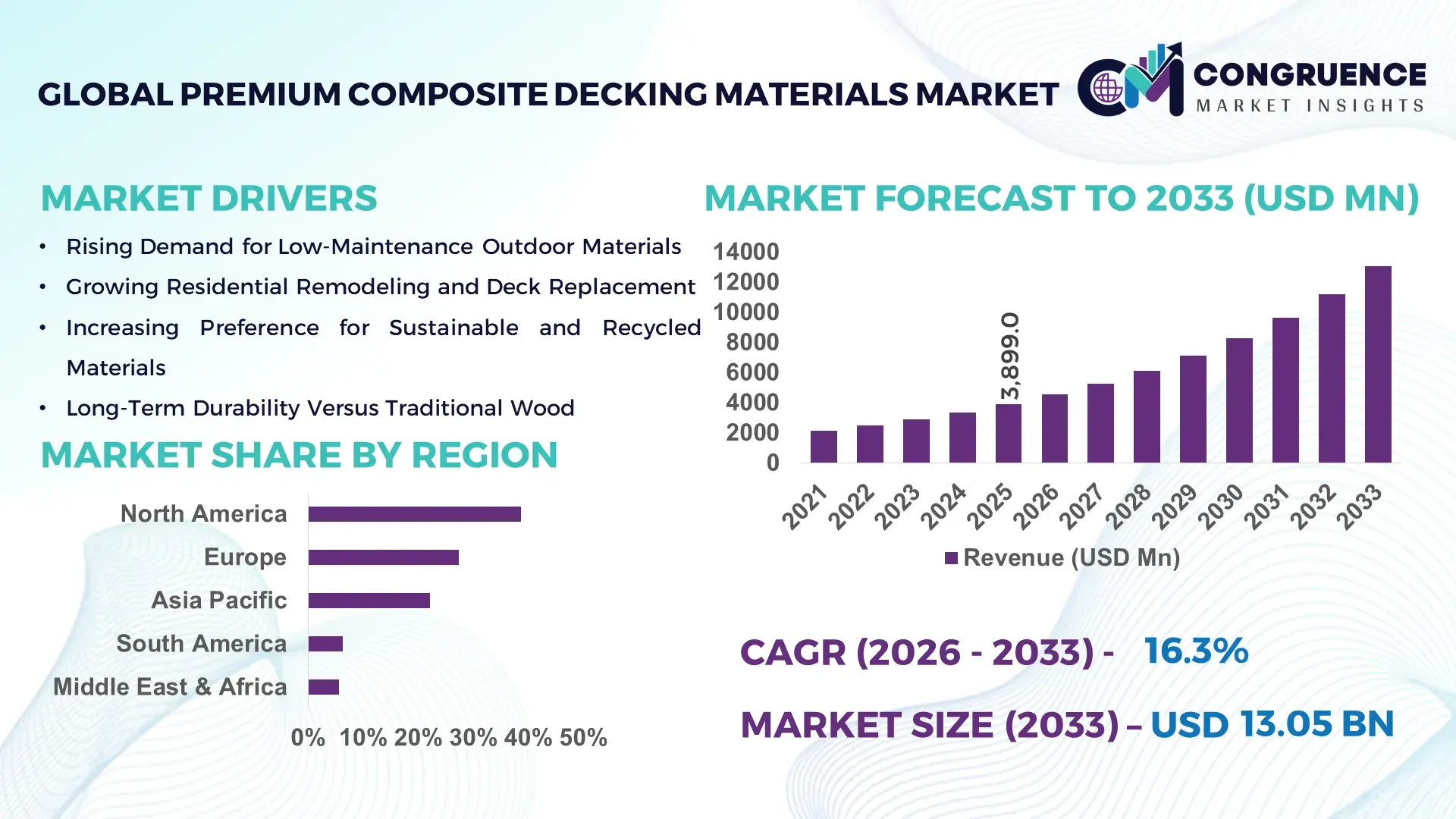
The Global Premium Composite Decking Materials Market was valued at USD 3,899 Million in 2025 and is anticipated to reach a value of USD 13,049.4 Million by 2033 expanding at a CAGR of 16.3% between 2026 and 2033, according to an analysis by Congruence Market Insights. This growth is primarily driven by rising investments in high-end residential and commercial outdoor infrastructure coupled with increasing preference for low-maintenance, long-life building materials.
The United States represents the most advanced and industrially mature ecosystem for premium composite decking materials. The country hosts over 45 large-scale composite decking manufacturing facilities with an estimated annual production capacity exceeding 1.6 million metric tons. Capital investment in advanced extrusion, co-extrusion, and recycled polymer processing exceeded USD 1.2 billion between 2021 and 2024. Premium composite decking is widely applied across residential outdoor living spaces, hospitality decks, marine boardwalks, and commercial terraces, accounting for over 60% of high-end decking installations nationwide. Technological adoption is strong, with over 70% of manufacturers using capped composite technologies and UV-stabilized polymer blends, significantly extending product lifespans beyond 25 years.
Market Size & Growth: Valued at USD 3,899 Million in 2025, projected to reach USD 13,049.4 Million by 2033, growing at a CAGR of 16.3% due to accelerated outdoor renovation and premium housing investments.
Top Growth Drivers: Residential outdoor renovation adoption (62%), durability-driven material replacement (48%), recycled material usage growth (39%).
Short-Term Forecast: By 2028, installation efficiency is expected to improve by 22% through modular decking systems.
Emerging Technologies: Co-extruded capped composites, AI-assisted extrusion control, high-recycled-content polymer blends.
Regional Leaders: North America (USD 4,950 Million by 2033, strong residential upgrades), Europe (USD 3,420 Million by 2033, sustainability-led adoption), Asia-Pacific (USD 2,310 Million by 2033, urban infrastructure expansion).
Consumer/End-User Trends: Homeowners and hospitality operators account for over 58% of premium decking demand, prioritizing lifespan and aesthetics.
Pilot or Case Example: In 2024, a U.S. commercial housing project reduced decking maintenance costs by 31% using capped composites.
Competitive Landscape: Trex Company leads with ~32% share, followed by AZEK, Fiberon, TimberTech, and Eva-Last.
Regulatory & ESG Impact: Green building codes promoting recycled content above 50% are accelerating adoption.
Investment & Funding Patterns: Over USD 2.4 billion invested globally since 2022 in capacity expansion and automation.
Innovation & Future Outlook: Smart-textured, slip-resistant, heat-reflective composite surfaces are shaping next-generation products.
Premium composite decking materials serve residential construction (41%), commercial buildings (34%), and marine & public infrastructure (25%). Recent innovations include capped polymer shells, heat-mitigating pigments, and boards with over 70% recycled content. Regulatory focus on plastic reuse and deforestation reduction supports adoption, while North America and Europe lead consumption. Emerging trends include AI-driven manufacturing optimization and modular deck systems designed for rapid urban deployment.
The Premium Composite Decking Materials Market holds strong strategic relevance within the global construction and building materials ecosystem due to its alignment with durability, sustainability, and lifecycle cost optimization objectives. As construction stakeholders increasingly prioritize long-term asset performance, premium composite decking has emerged as a preferred alternative to treated wood and tropical hardwoods. Advanced capped composite technologies deliver up to 45% higher fade resistance compared to traditional uncapped composites, significantly reducing maintenance cycles and replacement frequency.
From a strategic standpoint, AI-enabled extrusion monitoring systems now deliver 18% efficiency improvement compared to conventional manual quality inspection standards. North America dominates in production volume, while Europe leads in adoption, with over 54% of new commercial decking projects specifying premium composite materials. By 2028, digital twin-based manufacturing optimization is expected to reduce material waste by 26% across large-scale decking plants.
Compliance and ESG considerations are becoming central to strategic planning. Manufacturers are committing to recycled polymer usage targets, including 60% recycled content by 2030 and landfill diversion rates exceeding 90%. In 2024, a leading U.S. manufacturer achieved a 29% reduction in production scrap through closed-loop recycling initiatives.
Looking ahead, integration of modular construction methods, smart surface coatings, and low-carbon polymers positions the Premium Composite Decking Materials Market as a pillar of resilient, regulation-compliant, and sustainable growth within the global building materials industry.
The Premium Composite Decking Materials Market is shaped by evolving construction practices, material innovation, and sustainability mandates. Demand is increasingly driven by lifecycle performance requirements rather than upfront cost considerations. Premium-grade boards offer extended durability, resistance to moisture, UV exposure, and biological degradation, making them suitable for high-traffic and climate-exposed environments. Manufacturing dynamics are influenced by polymer price volatility, recycling infrastructure availability, and technological advancements in co-extrusion processes. The market also benefits from urban densification trends, where compact outdoor living spaces require long-lasting, visually appealing decking solutions. Regulatory emphasis on deforestation reduction and plastic reuse further reinforces the transition toward composite materials in premium construction projects.
Investment in outdoor residential and commercial infrastructure has grown steadily, with over 57% of new high-income housing projects incorporating premium decking materials. Hospitality developments increasingly specify composite decking due to its ability to withstand foot traffic exceeding 3 million cycles without structural degradation. Public infrastructure upgrades, including boardwalks and waterfront promenades, have increased composite decking usage by 44% over five years. These investments favor premium materials due to reduced maintenance shutdowns and lower long-term operational disruptions.
Premium composite decking materials typically cost 35–50% more than pressure-treated wood at installation. This price differential limits adoption in cost-sensitive residential segments and emerging markets. Additionally, fluctuations in polymer resin prices have increased raw material procurement costs by up to 28% in certain regions. Limited installer familiarity in developing markets further adds to perceived project risk, slowing adoption despite long-term benefits.
The integration of recycled plastics presents significant growth opportunities. Over 9 million tons of post-consumer plastic waste are suitable for decking-grade composites annually. Manufacturers using high-recycled-content formulations have achieved material cost reductions of up to 18% while meeting ESG benchmarks. Government incentives for recycled-content construction materials further enhance commercial viability, particularly in Europe and North America.
Compliance with fire resistance, slip resistance, and structural load standards varies across regions, increasing certification costs by up to 22%. Smaller manufacturers face challenges in meeting multi-region compliance requirements, delaying product launches. Additionally, evolving environmental labeling standards require continuous reformulation and testing, adding operational complexity.
Expansion of Modular Decking Systems (42% Adoption Growth): Modular composite decking systems have reduced on-site installation time by 38%, with 42% of commercial projects now specifying pre-engineered board and fastening systems.
High-Recycled-Content Product Innovation (65% Material Utilization): Premium boards incorporating over 65% recycled polymers now account for 47% of new product launches, supporting circular economy objectives.
Heat-Reflective and Comfort-Focused Surfaces (31% Temperature Reduction): Advanced pigment technologies have lowered surface heat absorption by up to 31%, enhancing user comfort in warm climates.
Automation and AI in Manufacturing (27% Defect Reduction): AI-driven quality control systems have reduced production defects by 27% and improved yield consistency across large-scale facilities.
Rise in Modular and Prefabricated Construction: The adoption of modular construction is reshaping demand dynamics in the Premium Composite Decking Materials Market. Research suggests that 55% of new projects achieved cost benefits through prefabrication, with off-site automated cutting and bending reducing labor demand and accelerating project timelines, particularly in Europe and North America.
The Premium Composite Decking Materials Market is segmented by type, application, and end-user, each reflecting distinct performance requirements, adoption patterns, and purchasing behaviors. By type, differentiation is driven by material composition, surface protection technologies, and sustainability attributes. Applications vary across residential, commercial, and public infrastructure settings, where durability, aesthetics, and lifecycle performance influence material selection. End-user segmentation highlights how homeowners, commercial developers, and institutional buyers prioritize premium decking differently based on maintenance cycles, regulatory compliance, and long-term asset value. Across all segments, demand is increasingly shaped by low-maintenance expectations, recycled material integration, and compatibility with modular construction practices, making segmentation insights critical for strategic positioning and product development.
Premium composite decking materials are primarily categorized into capped composite decking, uncapped composite decking, and eco-friendly/recycled-content composite decking. Capped composite decking leads the market, accounting for approximately 46% of total adoption, due to its enhanced resistance to moisture, UV exposure, staining, and surface wear. These products feature a protective polymer shell that significantly improves color retention and structural integrity, making them the preferred choice for high-traffic residential decks and commercial outdoor spaces.
Eco-friendly and high recycled-content composite decking represents the fastest-growing type, expanding at an estimated 18.9% growth rate, driven by regulatory pressure on plastic reuse and growing consumer preference for sustainable building materials. Boards incorporating over 60–70% recycled polymers are increasingly specified in green building projects and government-backed infrastructure programs.
Uncapped composite decking, while still relevant for cost-sensitive applications, now accounts for a smaller portion of demand. Together with niche specialty composites (such as fire-rated or marine-grade variants), these remaining segments represent a combined share of about 29%, serving specific environmental or budget-driven requirements.
In 2024, a national public infrastructure program deployed capped composite decking across multiple coastal boardwalks, reporting over 30% lower maintenance interventions compared to traditional wood decking within the first two years of installation.
By application, residential outdoor living spaces dominate the Premium Composite Decking Materials Market, representing nearly 41% of total usage. Homeowners increasingly favor premium composites for private decks, patios, and rooftop terraces due to their long service life, visual consistency, and minimal upkeep requirements. Renovation and remodeling projects contribute significantly, particularly in high-income urban and suburban housing developments.
Commercial and hospitality applications—including hotels, resorts, restaurants, and mixed-use developments—are the fastest-growing application segment, expanding at an estimated 17.4% growth rate. This growth is supported by rising investments in experiential outdoor spaces, where slip resistance, aesthetic customization, and compliance with safety standards are critical.
Public infrastructure, marine walkways, and institutional projects form the remaining application base, together accounting for a combined share of approximately 34%. These applications emphasize durability under heavy foot traffic and exposure to harsh environmental conditions.
Consumer adoption trends indicate that over 52% of urban homeowners prefer composite decking over wood for new installations, while nearly 44% of hospitality operators report using premium composites to reduce annual maintenance downtime.
In 2025, a large-scale urban redevelopment initiative incorporated premium composite decking across mixed-use public spaces, achieving a 28% reduction in annual surface refurbishment requirements.
From an end-user perspective, residential homeowners represent the largest segment, accounting for roughly 43% of total demand. This group prioritizes aesthetic appeal, longevity, and reduced maintenance, with premium composite decking increasingly viewed as a long-term home value enhancement rather than a discretionary upgrade.
Commercial developers and hospitality operators form the fastest-growing end-user segment, growing at an estimated 16.8% rate, driven by expanding leisure, tourism, and mixed-use real estate developments. These users value standardized performance, compliance with safety regulations, and predictable lifecycle costs, making premium composites a strategic material choice.
Other end-users—including municipal authorities, educational institutions, and marine infrastructure operators—collectively contribute a combined share of about 31%. Adoption rates in municipal projects exceed 35% for new boardwalk and public plaza developments, reflecting confidence in composite durability under intensive use.
Adoption data shows that nearly 48% of commercial construction firms have standardized premium composite decking specifications for outdoor projects, while over 40% of property managers report improved asset lifecycle planning after transitioning away from wood-based decking.
In 2024, a national coastal management authority implemented premium composite decking across public access zones, resulting in a reported 33% reduction in long-term maintenance interventions compared to previous materials.
North America accounted for the largest market share at 38.6% in 2025 however, Asia-Pacific is expected to register the fastest growth, expanding at a CAGR of 18.1% between 2026 and 2033.
The regional landscape of the Premium Composite Decking Materials Market reflects clear differences in maturity, adoption drivers, and construction practices. North America leads due to widespread residential outdoor renovation activity, with over 64% of new single-family homes integrating composite decking solutions. Europe follows with a market share of approximately 27.4%, driven by sustainability mandates and recycled-material construction standards. Asia-Pacific holds around 22.1% share but demonstrates the strongest expansion momentum, supported by rising urban infrastructure spending exceeding USD 1.8 trillion annually across major economies. South America and the Middle East & Africa together contribute nearly 11.9%, where tourism infrastructure, mixed-use real estate, and climate-resilient materials are shaping adoption. Across regions, premium composite decking penetration is highest in residential and hospitality segments, while public infrastructure usage is increasing steadily.
This region accounts for nearly 38.6% of global demand, reflecting its advanced housing and renovation markets. Residential construction and remodeling represent over 52% of regional usage, followed by hospitality and commercial outdoor spaces at 31%. Regulatory emphasis on building durability and recycled plastic utilization has encouraged composite alternatives, with several states mandating minimum recycled content in exterior construction materials. Technological advancements such as AI-enabled extrusion monitoring and capped composite innovations are widely adopted, improving board consistency and lifespan. A major local player has expanded automated production lines capable of producing over 200 million linear feet annually, focusing on premium capped boards. Consumer behavior shows a strong preference for low-maintenance solutions, with more than 58% of homeowners willing to pay a premium for products offering warranties beyond 25 years.
Europe represents approximately 27.4% of the Premium Composite Decking Materials Market, with Germany, the UK, and France accounting for more than 61% of regional consumption. Stringent environmental frameworks promoting recycled plastics and forest conservation have accelerated composite decking adoption, particularly in public infrastructure and multi-family housing. Over 46% of new commercial outdoor projects specify materials with recycled content above 50%. Emerging technologies such as low-emission polymer processing and surface heat-reduction coatings are gaining traction. A leading regional manufacturer has invested heavily in bio-based composite formulations to align with circular economy goals. Consumer behavior reflects strong regulatory influence, with buyers prioritizing certified, eco-labeled decking products even at higher upfront costs.
Asia-Pacific ranks third by volume but is the most dynamic region, accounting for around 22.1% of global demand. China, Japan, and Australia are the largest consuming countries, together representing over 68% of regional installations. Infrastructure expansion, smart city developments, and high-rise residential projects are key growth enablers. Manufacturing trends include localized production hubs integrating recycled plastics from municipal waste streams. Technological innovation is concentrated in automated extrusion and modular decking systems tailored for dense urban environments. A regional manufacturer recently commissioned a high-capacity composite plant producing decking for mixed-use developments. Consumer behavior varies widely, with demand increasingly driven by real estate developers rather than individual homeowners.
South America holds close to 6.3% of the global market, led by Brazil and Argentina. Demand is primarily linked to hospitality, resort construction, and coastal infrastructure projects. Government-backed tourism investments and urban redevelopment programs are encouraging the use of weather-resistant composite decking in public and private developments. Trade incentives supporting recycled material imports have improved supply chain access. A regional supplier has expanded distribution networks across coastal cities to meet rising resort demand. Consumer behavior is closely tied to commercial usage, with adoption driven more by developers and municipalities than individual homeowners.
The Middle East & Africa region accounts for approximately 5.6% of global demand, with the UAE and South Africa as key markets. Large-scale construction, luxury hospitality projects, and waterfront developments drive adoption. Premium composite decking is favored for its resistance to heat, moisture, and sand abrasion, critical in extreme climates. Technological modernization includes the use of heat-reflective pigments reducing surface temperatures by over 30%. Local regulations promoting durable materials in public infrastructure further support uptake. Consumer behavior is skewed toward commercial and luxury residential buyers, prioritizing aesthetics and long-term performance.
United States – 32.1% Market Share: High production capacity and strong residential renovation demand support leadership in the Premium Composite Decking Materials Market.
Germany – 11.4% Market Share: Strict sustainability regulations and widespread adoption of recycled-content construction materials drive consistent demand in the Premium Composite Decking Materials Market.
The Premium Composite Decking Materials Market exhibits a moderately consolidated to dynamic competitive structure with over 50 active competitors worldwide ranging from established multinational manufacturers to mid-sized specialized producers. The top players leverage product differentiation, sustainability credentials, and global distribution networks to secure competitive advantage. The combined share of the top 5 companies—Trex Company, The AZEK Company (TimberTech), Fiberon, UPM Biocomposites, and Barrette Outdoor Living—exceeds approximately 60% of overall market activity, reflecting significant leadership yet remaining space for challengers. Competitors vary in scale: global multinationals dominate core markets, while numerous regional firms compete in niche, high-performance segments.
Strategic initiatives are shaping the competitive environment. In 2024, Trex entered a strategic co-development partnership with a structural fastening provider to integrate decking and attachment solutions across North America, enhancing bundled offerings and installer adoption. Kibony collaborated to expand distribution and co-develop sustainable decking products across broad geographies, strengthening eco-focused portfolios. Premium product launches, such as enhanced UV-resistant decking lines with advanced warranties, are increasingly common, underlining the importance of innovation in materials and finishes. Mergers and acquisitions also influence market dynamics; major consolidation activity is set to alter competitive scales with the integration of outdoor products makers into larger building material portfolios.
Innovation trends include smart manufacturing automation, advanced capping technologies, heat-reducing surface formulations, and eco-centric composite blends, all aimed at improving performance and sustainability while differentiating product lines. For decision-makers, understanding these competitive drivers is essential for strategic positioning and investment prioritization in a market where R&D and distribution scaling directly affect long-term market success.
UPM Biocomposites
Barrette Outdoor Living
Fortress Building Products
MoistureShield
DuraLife Decking & Railing Systems
Evergreen Composite
Zuri Premium Decking
Nexgen Decking
Deckorators
TAMKO Building Products
AERT (Advanced Environmental Recycling Technologies)
Technology is a cornerstone of competitive advantage and value innovation in the Premium Composite Decking Materials Market. Advanced material science is transforming product performance, with capped composite technologies improving surface durability, moisture resistance, UV protection, and long-term color retention. More than 62% of new composite boards launched globally between 2023 and 2025 incorporate co-extruded capped formulations that elevate hardness and environmental resilience compared to traditional composites. Hollow-core boards, which now constitute around 37% of commercial installations, enhance strength-to-weight ratios while reducing raw material usage and shipping costs.
Automation and smart manufacturing are significant enablers of quality control and cost efficiency. Robotic extrusion systems and AI-assisted process controls have improved consistency and reduced defect rates, enabling customized textures and color profiles at scale. This digital transformation extends into virtual design configurators and online simulation tools, currently deployed by over 33% of leading decking brands, allowing customers to visualize custom deck layouts and materials in real time before purchase.
Integration of temperature-regulating elements, such as cool surface pigments, has yielded surface temperatures that are up to 18°C lower in high-heat regions, expanding premium composite use in warm-climate outdoor projects. Anti-microbial and anti-slip surface technologies address safety and hygiene requirements, particularly in hospitality, healthcare, and public installations where health and regulatory compliance are critical.
Emerging technologies like embedded LED lighting and solar integration are enhancing functionality and value perception, creating “smart deck” systems that provide both ambiance and energy capture capabilities. The adoption of biocomposite materials—such as flax-fiber composites—has achieved up to 47% lower carbon footprint compared to conventional polymer variants, appealing to ESG-focused developers and consumers.
In supply chain and design, modular decking systems with integrated fasteners and clipless assembly are becoming increasingly prevalent, reducing installation times and labor costs. Digital tools for color/texture customization and configuration are improving buyer engagement and conversion rates, reflecting how technology now shapes both product excellence and market growth strategies.
• In August 13, 2025, Trex Company expanded its Western U.S. distribution footprint by partnering with International Wood Products, LLC to stock and distribute Trex decking and railing products at its Salt Lake City, Utah facility and six other distribution centers, enhancing product accessibility in key Western states ahead of peak outdoor living season. Source: www.trex.com
• In July 30, 2025, Trex Company launched the Trex® Deck Railing Designer, an interactive digital platform that provides real-time 3D visualization and instant material estimates for railing specifications, aimed at improving design accuracy and installer productivity. Source: www.trex.com
• In April 2024, TimberTech® Composite Terrain+ decking from The AZEK Company was recognized with industry awards for performance, innovation, and sustainability, including Green Builder’s Sustainable Product of the Year and placement on HGTV Magazine’s Green List, highlighting elevated aesthetics and up to 85% recycled content in premium boards. Source: www.businesswire.com
• In June 3, 2025, Fiberon’s Astir Collection earned a 2024 Green Good Design Award for sustainable composite decking built with approximately 94% recycled material, reinforcing industry recognition for high recycled-content performance products and signaling strong demand for eco-centric decking innovations. Source: www.deck-specialist.com
The Premium Composite Decking Materials Market Report provides a comprehensive, multi-dimensional view of this evolving sector, covering product types, applications, end-users, regional dynamics, technology trends, competitive landscape, and strategic growth opportunities. It dissects key material categories, including capped composites, eco-friendly recycled blends, and specialty formulations, highlighting distinctive performance attributes, usage contexts, and adoption patterns. The report maps application segments across residential outdoor living spaces, commercial developments, public infrastructure, hospitality projects, and marine environments, clarifying how performance requirements, durability considerations, and maintenance expectations vary among them.
Extensive end-user insights focus on homeowners, commercial developers, institutional buyers, and municipal planners, with detailed breakdowns of usage behaviors and procurement criteria. Geographic analysis spans North America, Europe, Asia-Pacific, South America, and Middle East & Africa, offering market volume, demand drivers, industrial trends, technology adoption, and regulatory influences unique to each region. The report also profiles competitive intensity, with concise evaluations of major players’ positioning, strategic initiatives, product portfolios, distribution networks, and innovation investment.
Technological chapters emphasize manufacturing automation, process digitalization, advanced material science, and sustainability innovations like recycled and bio-based composites, modular decking systems, and integrated configurators. Emerging and niche segments—such as heat-reflective boards, smart deck systems with embedded lighting, and plug-and-play railing solutions—receive specific attention. The report’s structured insights enable decision-makers to understand market breadth, identify growth avenues, benchmark competition, and anticipate future shifts in materials performance, construction practices, and consumer preferences, enhancing strategic planning and investment decisions.
| Report Attribute / Metric | Details |
|---|---|
| Market Revenue (2025) | USD 3,899.0 Million |
| Market Revenue (2033) | USD 13,049.4 Million |
| CAGR (2026–2033) | 16.3% |
| Base Year | 2025 |
| Forecast Period | 2026–2033 |
| Historic Period | 2021–2025 |
| Segments Covered |
By Type
By Application
By End-User Insights
|
| Key Report Deliverables | Revenue Forecast, Market Trends, Growth Drivers & Restraints, Technology Insights, Segmentation Analysis, Regional Insights, Competitive Landscape, Regulatory & ESG Overview, Recent Developments |
| Regions Covered | North America, Europe, Asia-Pacific, South America, Middle East & Africa |
| Key Players Analyzed | Trex Company, The AZEK Company (TimberTech), Fiberon, UPM Biocomposites, Barrette Outdoor Living, Fortress Building Products, MoistureShield, DuraLife Decking & Railing Systems, Deckorators, Zuri Premium Decking, Nexgen Decking, TAMKO Building Products, Evergreen Composite, AERT |
| Customization & Pricing | Available on Request (10% Customization Free) |




