
Reports
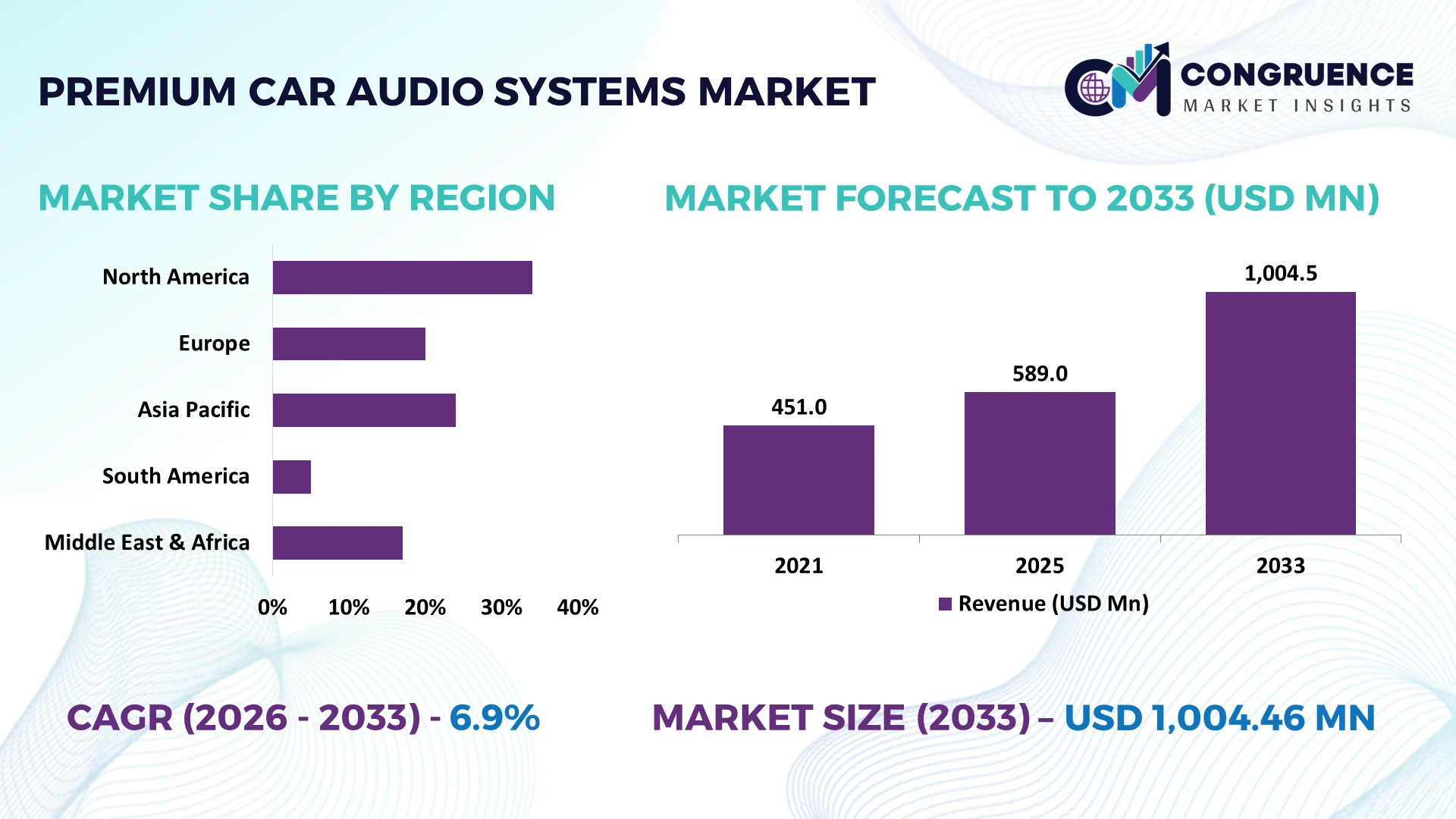
The Global Premium Car Audio Systems Market was valued at USD 589 Million in 2025 and is anticipated to reach a value of USD 1004.46 Million by 2033 expanding at a CAGR of 6.9% between 2026 and 2033. Growth is driven by the rapid integration of immersive 3D audio, advanced digital signal processors, active noise cancellation, and branded factory-installed sound platforms across luxury vehicles and EVs, where quieter electric powertrains make acoustic performance a more visible component of cabin quality.
The United States remains the dominant country, accounting for approximately 31% of global premium car audio demand, supported by luxury vehicle sales, advanced infotainment development, and strong OEM-audio partnerships. China follows with around 23%, backed by rapid intelligent-cockpit deployment and domestic EV production. Geopolitical supply-chain diversification is accelerating electronics localization across India and Southeast Asia, while premium audio adoption in technologically advanced vehicle platforms continues to expand.
Strategically, manufacturers should prioritize OEM integration, software-defined acoustic platforms, localized component production, and immersive audio capabilities to capture premium vehicle programs and protect margins as automotive interiors become increasingly software-centric.
Market Size & Growth: USD 589 Million in 2025 is projected to reach USD 1004.46 Million by 2033 at a 6.9% CAGR, supported by factory-fitted immersive audio and connected-cockpit upgrades.
Top Growth Drivers: EV platform integration accounts for approximately 18% of growth momentum, immersive audio contributes 15%, while luxury vehicle premiumization contributes 12%.
Short-Term Forecast: By 2028, AI-assisted acoustic calibration is expected to reduce tuning time by 20% while improving cabin sound consistency by approximately 15%.
Emerging Technologies: Spatial audio, AI-powered personalization, Dolby Atmos, beamforming, and next-generation DSP chips are moving premium systems beyond conventional multi-speaker architectures.
Regional Leaders: North America is projected at approximately USD 360 Million, Asia-Pacific at USD 335 Million, and Europe at USD 205 Million by 2033, with EV and connected-cockpit adoption driving regional expansion.
Consumer/End-User Trends: Approximately 15% of vehicles globally feature branded premium audio systems, while luxury-car buyers increasingly rank personalized cabin entertainment among key interior technology attributes.
Pilot/Case Example: In 2025, HARMAN expanded its Pune automotive electronics operations, with planned production capacity targeting approximately 4 million car-audio components annually by 2027.
Competitive Landscape: HARMAN maintains a leading position with an estimated 20% share of the branded premium automotive audio ecosystem, competing strongly with Bose, Sony, Burmester, Bang & Olufsen, and Bowers & Wilkins.
Regulatory & ESG Impact: Lightweight speaker modules and lower-power amplifiers are targeting 8–10% reductions in audio-system weight and energy consumption, supporting EV efficiency objectives.
Investment & Funding: HARMAN’s USD 42 Million Pune investment highlights continued expansion of automotive electronics manufacturing, with OEM partnerships and regional localization becoming major investment priorities.
Innovation & Future Outlook: Software-defined audio, AI-generated sound profiles, active road-noise cancellation, and 3D acoustic mapping will shift competition toward intelligent cabin experiences rather than speaker quantity alone.
Premium Car Audio Systems demand is concentrated in luxury SUVs, electric vehicles, connected cockpits, and high-end passenger cars where immersive entertainment strengthens interior differentiation. Around 15% of vehicles globally carry branded audio systems, highlighting substantial penetration potential. Recent deployments emphasize Dolby Atmos, AI-based DSP tuning, lightweight speakers, and spatial sound, while India’s expanding automotive-electronics manufacturing base is reshaping regional supply chains and intensifying OEM localization.
Premium car audio has become a strategic differentiator as automakers compete on digital-cockpit quality, cabin personalization, and software-defined experiences rather than hardware alone. Factory integration of immersive audio, AI-based tuning, and active noise cancellation is shifting audio from an accessory into a vehicle-platform feature. Supply-chain restructuring is also pushing manufacturers toward localized electronics sourcing and closer OEM partnerships.
Technology economics are reinforcing this shift. Automated digital acoustic calibration can reduce engineering and tuning effort by roughly 20% versus conventional manual calibration, while software-based sound profiles allow updates without replacing hardware. China leads deployment scale through intelligent EV cockpits, whereas Germany emphasizes high-fidelity engineering and premium-brand integration. Over the next 2–3 years, factory-installed advanced DSP and spatial-audio adoption is positioned to expand across luxury SUVs and premium EV platforms.
Companies are responding by expanding automotive electronics capacity, co-developing branded systems with OEMs, and investing in lightweight amplifiers, DSP chips, and software platforms. HARMAN’s India expansion demonstrates this operational shift toward localized production. Competitive advantage will increasingly depend on combining acoustic performance, software intelligence, manufacturing scalability, and seamless OEM integration.
The strongest growth driver is the integration of premium audio with intelligent vehicle architectures. Spatial audio, AI-assisted tuning, and active noise cancellation are gaining traction as luxury automakers differentiate cabin experiences. Approximately 15% of vehicles globally feature branded premium audio, while software-enabled acoustic calibration can reduce tuning effort by around 20%. China’s rapid EV deployment is accelerating factory-level integration rather than aftermarket installation. Audio suppliers are responding through OEM co-development, dedicated DSP platforms, and localized engineering. The strategic shift is significant: suppliers that integrate audio software with infotainment and vehicle operating systems capture deeper platform relationships and recurring upgrade opportunities.
Premium audio systems remain constrained by expensive DSP processors, high-performance amplifiers, specialized speakers, and branded licensing. Advanced configurations can increase system component costs by approximately 15–25% compared with conventional audio architectures, while semiconductor and magnet-material price fluctuations can affect procurement budgets by 5–8%. European luxury manufacturers also face tighter sourcing requirements as geopolitical trade disruptions reshape electronics supply chains. Companies are mitigating exposure through multi-source procurement, regional manufacturing, longer-term component contracts, and standardized amplifier platforms. A key operational constraint is that cost reduction cannot compromise acoustic differentiation; excessive component simplification directly weakens the premium positioning that justifies factory-installed systems.
Software-defined audio creates an underexploited opportunity beyond traditional speaker upgrades. AI-based personalization can improve perceived listening consistency by approximately 10–15%, while over-the-air calibration enables manufacturers to modify acoustic profiles without physical component replacement. India, particularly Pune and Bengaluru, offers an expanding automotive-electronics engineering base for DSP development and connected-cockpit software. Suppliers are increasingly positioned to build recurring value through software updates, premium sound profiles, and subscription-enabled features. The non-obvious opportunity lies in using vehicle sensor data to dynamically compensate for cabin noise, seating position, and road conditions. Companies investing in AI acoustics and cloud-connected tuning can transform audio from a fixed hardware sale into a continuously optimized vehicle service.
Long-term execution is challenged by inconsistent cabin architectures, fragmented infotainment operating systems, cybersecurity requirements, and increasingly software-intensive vehicle platforms. Integrating advanced audio with multiple vehicle controllers can add 10–15% to development complexity, while calibration requirements across different cabin configurations can extend engineering cycles by 15–20%. Germany’s premium manufacturers increasingly demand tightly validated acoustic performance across multiple vehicle derivatives, intensifying testing requirements. Companies must therefore invest in standardized software interfaces, virtual acoustic simulation, cybersecurity controls, and specialized engineering teams. The critical strategic challenge is maintaining consistent sound performance across rapidly changing vehicle platforms without allowing integration workloads to erode supplier margins or delay OEM launches.
Spatial Audio Moves Mainstream: Dolby Atmos and object-based audio are moving from flagship models into broader premium vehicle programs, with immersive configurations improving perceived cabin engagement by 10–15% and increasing DSP processing requirements by roughly 20%. Automakers are redesigning speaker placement and partnering with audio specialists to shorten acoustic-development cycles.
Software Replaces Manual Tuning: AI-assisted equalization and automated digital signal processing are reducing manual calibration workloads by approximately 15–20%, while software-defined profiles enable faster vehicle-specific tuning. German and Japanese manufacturers are increasingly integrating acoustic algorithms into centralized cockpit platforms, allowing suppliers to standardize workflows and reduce engineering duplication across vehicle variants.
Lightweight Hardware Gains Priority: EV manufacturers are reducing amplifier and speaker-system mass by approximately 8–12% through compact Class-D amplifiers, neodymium drivers, and optimized enclosures. Semiconductor efficiency improvements of around 10% are supporting lower thermal loads. Companies are shifting procurement toward lightweight component suppliers as EV efficiency targets and battery-cost pressures intensify.
Localized Supply Chains Accelerate: Semiconductor disruptions and geopolitical trade realignment are encouraging 10–15% higher localization targets for automotive electronics in selected manufacturing programs. India and China are expanding component and module production, while suppliers diversify sourcing for DSPs, amplifiers, and transducers. The non-obvious shift is greater localization of acoustic engineering alongside physical manufacturing.
DSP-Based Systems represent the leading type, accounting for approximately 29% of the market, supported by programmable tuning, multi-zone sound management, and compatibility with increasingly centralized vehicle electronics. Their software flexibility reduces calibration complexity by nearly 18% compared with fixed analog architectures. Integrated Systems follow at about 25%, benefiting from factory-installed infotainment integration and streamlined OEM packaging. Component Systems retain roughly 19% share because modular configurations remain attractive for vehicle customization and replacement programs.
Amplifier-Based Systems account for approximately 15%, with demand concentrated in high-output luxury and performance applications, while Surround Sound Systems hold nearly 12% but command strong premium positioning. Surround configurations are expanding as immersive formats become more accessible, making them one of the faster-moving categories. Suppliers are increasing DSP investment, developing compact amplifier modules, and forming OEM partnerships. Investment is shifting toward software-centric architectures because scalable digital tuning creates greater differentiation than incremental speaker-count increases.
Luxury Cars remain the leading application at approximately 34% share, reflecting high factory-fit penetration, stronger willingness to pay, and extensive integration of branded sound systems. Premium SUVs follow closely at around 31%, but represent the fastest-growing application as larger cabins, three-row configurations, and premium EV launches require higher-output multi-zone audio. SUV platforms can accommodate 10–15% more speaker locations than compact luxury vehicles, supporting immersive configurations and differentiated acoustic zones.
Sports Cars account for approximately 17%, where lightweight components, high-output amplification, and compact packaging remain critical, while Executive Vehicles represent nearly 18% and increasingly prioritize rear-seat entertainment and individualized sound zones. Automakers are adapting platform engineering to support scalable audio architectures across multiple body styles, reducing development duplication by approximately 12%. The strategic implication is a shift toward SUV-focused audio platforms capable of being adapted across electric and combustion vehicle architectures without substantial hardware redesign.
Luxury Vehicle OEMs represent the dominant end-user group with approximately 52% share, reflecting their control over factory integration, vehicle architecture, software interfaces, and premium feature packaging. Their procurement scale supports standardized audio platforms across multiple models and can reduce per-unit integration costs by approximately 15%. Automotive Dealerships account for nearly 21%, primarily through premium upgrades, replacement systems, and vehicle-specific accessory packages.
Custom Installers represent approximately 15% and are the fastest-growing specialized channel as buyers seek individualized acoustic configurations beyond factory specifications. Automotive Audio Specialists hold around 12%, serving high-performance and technically complex installations. Suppliers are responding through OEM co-development for factory programs while offering modular systems to installers and dealerships. Customization is becoming a stronger competitive lever, with personalized installations potentially commanding 10–20% higher transaction values than standardized upgrades. Companies increasingly operate dual-channel strategies combining large OEM contracts with specialist ecosystems to capture both volume and high-margin customization demand.
North America accounted for the largest market share at 34% in 2025 however, Asia-Pacific is expected to register the fastest growth, expanding at a CAGR of 8.1% between 2026 and 2033.
OEM Integration and Software-Led Premiumization
North America remains the largest premium car audio market, supported by high penetration of luxury SUVs, pickup-based premium vehicles, and connected infotainment platforms. The United States contributes approximately 88% of regional demand, with premium audio concentrated among large OEM production programs and high-value vehicle trims. Factory-installed branded systems are increasingly integrated with centralized cockpit electronics, enabling software-based equalization and personalized sound profiles. HARMAN, Bose, and major vehicle manufacturers are expanding collaborative development around immersive audio and active noise management. More than 30% of premium vehicle configurations in the United States increasingly emphasize upgraded factory audio packages, strengthening supplier negotiating power with OEMs. The region’s mature semiconductor, automotive software, and dealership infrastructure supports rapid commercialization of new audio architectures.
United States Market Outlook: The United States benefits from established automotive manufacturing clusters, strong luxury-vehicle consumption, and advanced connected-car infrastructure. Detroit, Michigan, remains strategically important for OEM engineering, while California supports automotive software and digital-cockpit innovation. Premium audio suppliers benefit from established relationships with major automakers and a mature replacement and customization ecosystem.
High-Fidelity Engineering Meets Electrification
Europe maintains a strong premium audio position through Germany’s luxury vehicle manufacturing base, sophisticated acoustic engineering, and extensive OEM integration. Germany, the United Kingdom, and Italy collectively account for a substantial portion of regional premium-system deployment, with German manufacturers representing the strongest concentration of high-end factory installations. EV platform expansion is encouraging suppliers to develop lighter amplifiers, compact speaker assemblies, and energy-efficient DSP architectures. European automakers increasingly prioritize immersive sound and cabin refinement as powertrain noise declines. Lightweight audio components can reduce system mass by approximately 8–10%, supporting vehicle efficiency objectives. Partnerships between luxury automakers and specialist audio brands remain central to differentiation, while stricter European sustainability requirements are accelerating recyclable materials and lower-power electronics.
Germany Market Outlook: Germany is the region’s strongest industrial base because Mercedes-Benz, BMW, Audi, Porsche, and other premium manufacturers maintain extensive domestic engineering and production operations. Automotive R&D spending remains highly concentrated around Stuttgart, Munich, and Ingolstadt, supporting advanced acoustic simulation, DSP development, and factory-level audio integration across multiple premium vehicle platforms.
Manufacturing Scale Drives Intelligent-Cockpit Adoption
Asia-Pacific is becoming the key manufacturing and deployment center for premium automotive audio, supported by China’s EV production scale, Japan’s electronics expertise, South Korea’s semiconductor ecosystem, and India’s expanding automotive-electronics manufacturing capacity. China represents approximately 55% of regional premium-system demand, driven by intelligent EV cockpits and rapid adoption of integrated entertainment platforms. Suppliers are localizing DSP modules, amplifiers, transducers, and acoustic engineering to shorten production cycles and reduce import exposure. HARMAN’s Pune operations are targeting annual production capacity of approximately 4 million automotive audio components by 2027, highlighting India’s growing manufacturing role. Chinese EV manufacturers are also integrating premium audio earlier in vehicle development, compressing supplier qualification timelines and increasing competitive pressure on established international brands.
China Market Outlook: China combines the region’s largest EV manufacturing base with rapidly expanding intelligent-cockpit deployment. Domestic automakers increasingly treat audio as an integrated software feature rather than an isolated hardware option. Strong domestic electronics manufacturing supports faster component sourcing, localized acoustic development, and competitive pricing for advanced DSP and multi-speaker configurations.
Premiumization Concentrates Around Urban Vehicle Demand
South America remains a smaller but commercially relevant market, with Brazil accounting for approximately 60% of regional premium automotive audio demand. São Paulo and other major automotive manufacturing centers concentrate luxury vehicle distribution, aftermarket installation, and supplier activity. Imported premium systems remain important because domestic production of sophisticated DSP modules and high-end transducers is comparatively limited. Currency volatility and import costs can raise advanced-system procurement expenses by approximately 10–15%, encouraging distributors and installers to maintain diversified inventories. Premium SUVs and executive vehicles represent the strongest demand pockets as consumers seek higher-quality factory and aftermarket entertainment systems. Companies are responding through localized distribution agreements, installer partnerships, and modular product portfolios that reduce dependence on highly specialized imported configurations.
Brazil Market Outlook: Brazil provides the strongest commercial platform through its large automotive fleet, established vehicle assembly industry, and extensive aftermarket network. São Paulo functions as a major distribution and installation hub, allowing premium audio specialists to reach luxury-car owners through dealership relationships and customized installation centers. Flexible sourcing remains essential because imported electronic components face higher landed-cost sensitivity.
Luxury Mobility Fuels High-Value Audio Deployment
The Middle East & Africa market is anchored by affluent vehicle consumers, luxury SUVs, premium sedans, and major automotive distribution hubs. The United Arab Emirates and Saudi Arabia together represent more than 55% of regional premium audio demand, with Dubai and Riyadh serving as important centers for luxury vehicle retail and customization. High-temperature operating conditions are encouraging suppliers to emphasize thermal-resistant amplifiers, robust speaker assemblies, and reliable DSP components. Luxury dealerships increasingly package branded audio alongside connectivity and interior upgrades, supporting higher-value vehicle configurations. Saudi Arabia’s Vision 2030 investment program is strengthening premium mobility infrastructure and automotive ecosystem development. Companies are responding through dealership partnerships, specialist installation networks, and premium customization packages rather than relying solely on factory-fit demand.
United Arab Emirates Market Outlook: The UAE offers a concentrated luxury automotive customer base and sophisticated vehicle customization ecosystem. Dubai’s premium dealerships and specialist installers support rapid adoption of branded audio upgrades, while high vehicle import volumes provide access to global luxury models. Advanced workshop capabilities enable suppliers to introduce complex multi-zone systems and customized acoustic configurations with shorter installation cycles.
HARMAN, Bose, Sony, Panasonic, and Alpine compete across factory-installed premium platforms and high-value aftermarket systems, while Bang & Olufsen and Burmester strengthen the luxury-brand segment through OEM partnerships. The top five players collectively control approximately 45% of the organized premium automotive audio ecosystem, indicating a moderately concentrated structure. Competition centers on acoustic technology, OEM integration, customization, and supply reliability, with advanced DSP platforms improving tuning efficiency by 15–20% and lightweight architectures reducing system weight by 8–12%. HARMAN emphasizes global OEM relationships and manufacturing scale, while Bose and Sony compete through acoustic engineering and brand recognition. Asian suppliers increasingly use localized production to improve lead times by 10–15%, intensifying pressure on established Western suppliers. The competitive landscape is shifting toward software-defined audio, strategic OEM alliances, and vertical integration of DSP and speaker technologies. High qualification requirements, acoustic validation, and embedded software expertise remain major entry barriers. Winning requires scalable OEM integration, differentiated acoustic performance, localized supply, and rapid software innovation.
HARMAN International
Bose Corporation
Sony Corporation
Panasonic Holdings Corporation
Alps Alpine Co., Ltd.
Pioneer Corporation
JVCKENWOOD Corporation
Clarion Co., Ltd.
Bang & Olufsen
Burmester Audiosysteme GmbH
Bowers & Wilkins
Focal-JMlab
Dynaudio A/S
Continental AG
Current systems are shifting toward software-defined DSP, active noise cancellation, and Class-D amplification. DSP tuning can cut calibration effort by 15–20%, while Class-D architectures reduce power losses by roughly 10%. Adoption is strongest in luxury EV platforms, benefiting suppliers with integrated hardware-software stacks. Centralized diagnostics also shorten validation cycles, improving deployment consistency across vehicle derivatives.
Emerging spatial audio, AI personalization, and seat-centric sound are moving into production. Dolby Atmos adoption has expanded to 30 automotive brands, doubling from 2024. AI-based acoustic optimization targets 10–15% better listening consistency, giving OEMs faster personalization and stronger differentiation across vehicle trims. Content-platform integration is simultaneously increasing the value of immersive audio beyond hardware specifications.
Disruptive architectures are moving processing from dedicated audio modules into centralized cockpit compute. Bose and Qualcomm demonstrate this direction, potentially reducing dedicated hardware dependence by about 10–15%. Between 2026 and 2028, cloud-linked tuning, OTA profiles, and zone-aware audio will reward suppliers that control software integration. Early adopters gain lower module complexity, faster feature updates, and stronger lifecycle monetization. This shift supports monetization after vehicle delivery, allowing brands to refresh acoustic experiences through software instead of hardware redesign, while reducing platform-specific engineering duplication and accelerating launches across vehicle architectures and cycles.
October 2025 HARMAN expanded its Pune automotive plant with ₹345 crore investment, raising capacity 50% and targeting four million car-audio components annually by 2027, strengthening localized manufacturing, export readiness, supply resilience, and OEM program scalability across global markets. Source: harman.com
April 2026 Dolby and BMW introduced Dolby Atmos in the BMW 7 Series, beginning rollout across future models and strengthening immersive audio as a scalable premium-cabin differentiator for luxury vehicles, while expanding spatial sound across BMW’s next-generation portfolio. Source: dolby.com
January 2024 Mercedes-Benz, Audible, and Amazon Music announced Dolby Atmos integration, with OTA availability planned from Q3 2024 across selected models, expanding premium audio into podcasts, audiobooks, and music while strengthening software-led personalization within MBUX-equipped luxury vehicles globally. Source: mercedes-benz.com
June 2024 HARMAN participated in AES’s automotive audio conference, where more than 300 professionals reviewed emerging immersive audio, AI, virtual acoustics, and EV sound technologies, strengthening industry collaboration, technical knowledge exchange, and development priorities for future vehicle platforms. Source: aes.org
The Premium Car Audio Systems Market Report covers five technology-oriented types: Component Systems, Integrated Systems, Amplifier-Based Systems, Surround Sound Systems, and DSP-Based Systems. Application analysis spans Luxury Cars, Premium SUVs, Sports Cars, and Executive Vehicles, while end-user assessment covers Luxury Vehicle OEMs, Automotive Dealerships, Custom Installers, and Automotive Audio Specialists. The study evaluates factory-fit and customization dynamics, with DSP-based architectures gaining strategic importance as software integration expands.
Regional coverage includes North America, Europe, Asia-Pacific, South America, and the Middle East & Africa, with country-level emphasis on the United States, Germany, China, India, Brazil, and the United Arab Emirates. The report assesses spatial audio, AI tuning, active noise cancellation, lightweight amplification, and software-defined architectures, alongside adoption patterns, supply-chain localization, and OEM partnerships. Strategic analysis supports investment prioritization, capacity planning, market entry, competitive positioning, and technology roadmaps through 2033.
| Report Attribute/Metric | Report Details |
|---|---|
Market Revenue in 2025 | USD 589 Million |
Market Revenue in 2033 | USD 1004.46 Million |
CAGR (2026 - 2033) | 6.9% |
Base Year | 2025 |
Forecast Period | 2026 - 2033 |
Historic Period | 2021 - 2025 |
Segments Covered | By Type
By Application
By End-User
|
Key Report Deliverable | Revenue Forecast, Growth Trends, Market Dynamics, Segmental Overview, Regional and Country-wise Analysis, Competition Landscape |
Region Covered | North America, Europe, Asia-Pacific, South America, Middle East, Africa |
Key Players Analyzed | HARMAN International, Bose Corporation, Sony Corporation, Panasonic Holdings Corporation, Alps Alpine Co., Ltd., Pioneer Corporation, JVCKENWOOD Corporation, Clarion Co., Ltd., Bang & Olufsen, Burmester Audiosysteme GmbH, Bowers & Wilkins, Focal-JMlab, Dynaudio A/S, Continental AG |
Customization & Pricing | Available on Request (10% Customization is Free) |




