Global Predictive Quality Assurance Equipment Market Report Overview
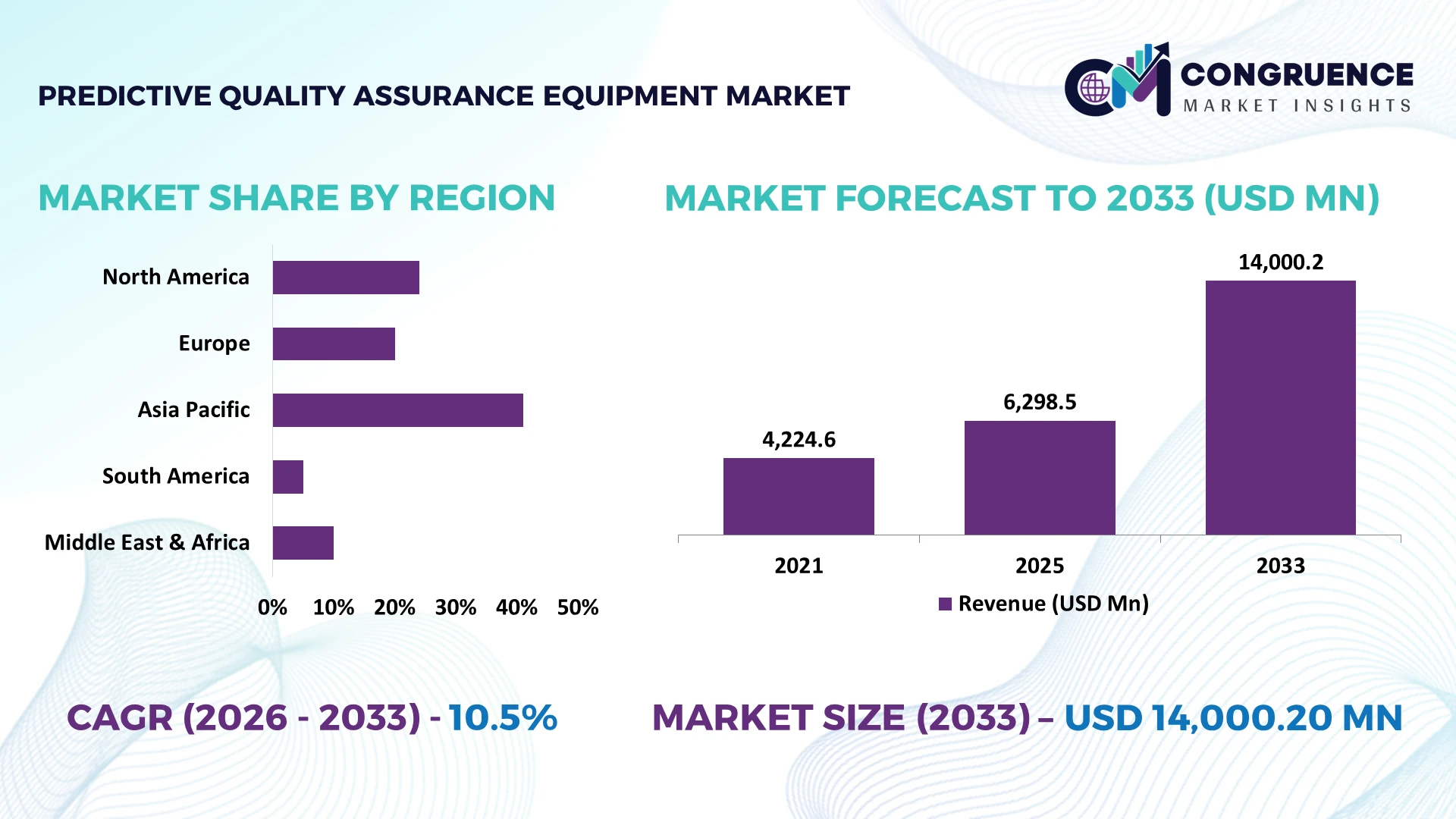
The Global Predictive Quality Assurance Equipment Market was valued at USD 6298.5 Million in 2025 and is anticipated to reach a value of USD 14000.2 Million by 2033 expanding at a CAGR of 10.5% between 2026 and 2033. Growth is driven by AI-powered defect prediction, inline machine vision inspection, semiconductor yield optimization, and integration of real-time process analytics with industrial automation systems.
China represents a major manufacturing-driven market for predictive quality assurance equipment, supported by extensive electronics, automotive, semiconductor, and industrial machinery production. The country accounted for approximately 32% of global manufacturing value added in 2023, compared with roughly 16% for the United States. China's industrial robot installations exceeded 295,000 units in 2024, strengthening the installed infrastructure for automated inspection and process monitoring. Government-supported manufacturing modernization and semiconductor localization are encouraging investment in machine vision, industrial sensors, and AI-enabled quality control systems.
Equipment manufacturers should prioritize semiconductor-grade inspection accuracy, scalable edge analytics, and integration with automated production lines to strengthen competitive positioning in high-volume manufacturing.
Key Highlights of the Global Predictive Quality Assurance Equipment Market
-
Market Size & Growth: USD 6,298.5 million in 2025, reaching USD 14,000.2 million by 2033 at 10.5% CAGR, supported by AI-enabled inspection and manufacturing digitalization.
-
Top Growth Drivers: AI-driven quality systems have demonstrated 35% defect reductions, 41% lower defects in solar manufacturing, and 45.9% fewer finished-product defects in automotive electronics.
-
Short-Term Forecast: By 2028, advanced inspection deployments will target 10%–20% scrap reductions through automated defect classification and closed-loop process correction.
-
Emerging Technologies: Three critical technologies—deep-learning vision, edge AI analytics, and digital twins—are transforming inspection accuracy, defect prediction, and production traceability.
-
Regional Leaders: Asia accounts for 74% of industrial robot installations, Europe 16%, and the Americas 9%, indicating regional differences in automation infrastructure supporting quality inspection.
-
Consumer/End-User Trends: AI-enabled use cases represented 61% of 67 digital manufacturing applications deployed at Beijing Shougang Cold Rolling, demonstrating industrial adoption.
-
Pilot/Case Example: In 2025, Tongwei Solar's digitally transformed Meishan facility reported 41% fewer defects and 37% lower conversion costs through advanced manufacturing technologies.
-
Competitive Landscape: Siemens, Cognex, Keyence, Hexagon, and ZEISS compete through inspection automation, metrology precision, industrial software, and AI integration.
-
Regulatory & ESG Impact: Digitally transformed Lighthouse factories demonstrated average material waste reductions of 30%, supporting resource-efficient production and stronger process control.
-
Investment & Funding: Freudenberg outlined €200 million in AI-supported research investment through 2028, reflecting increasing industrial investment in digital engineering and intelligent manufacturing.
-
Innovation & Future Outlook: Siemens reports 5–10 times faster commissioning for advanced AI inspection deployments, accelerating the shift from customized vision systems toward scalable quality platforms.
The Predictive Quality Assurance Equipment Market is gaining operational importance across semiconductor fabrication, automotive component manufacturing, pharmaceutical production, and precision electronics assembly. Advanced machine vision, hyperspectral imaging, AI-based anomaly detection, and inline metrology are enabling manufacturers to identify process deviations before defective products reach final inspection. Siemens reports scrap reductions of 10%–20% from AI-powered quality inspection, highlighting the economic advantage of continuous monitoring. Semiconductor supply-chain localization and increasingly complex production processes are strengthening demand for traceable inspection data, predictive analytics, and automated corrective actions, establishing quality intelligence as a strategic manufacturing investment priority.
What Is the Strategic Relevance and Future Pathways of the Predictive Quality Assurance Equipment Market?
Predictive quality assurance equipment is becoming strategically important as manufacturers shift from detecting defective products to preventing process deviations before production losses occur. Semiconductor localization, electric vehicle manufacturing, and increasingly complex electronics assembly are accelerating investment in AI-enabled inspection infrastructure. China accounted for approximately 54% of global industrial robot installations in 2024, demonstrating substantial automation capacity for integrated quality monitoring. Equipment manufacturers including Cognex, Keyence, and Siemens are developing intelligent vision platforms that combine process analytics, defect classification, and automated corrective feedback.
Compared with conventional rule-based inspection, AI-driven quality systems offer greater adaptability to variable defect patterns and changing production conditions. Siemens reports that AI-powered inspection applications can reduce manufacturing scrap by 10%–20%. Germany emphasizes precision metrology and industrial software integration, while China concentrates on high-volume electronics and automotive production. The United States prioritizes semiconductor process control and advanced manufacturing traceability.
Between 2026 and 2028, manufacturers will increasingly integrate edge inference, digital twins, and predictive analytics into production equipment. Tongwei Solar's Meishan facility demonstrated a 41% reduction in defects through digital manufacturing improvements, illustrating the value of connected process intelligence. Suppliers are expanding software partnerships and modular inspection architectures. Competitive advantage will depend on validated prediction accuracy, integration flexibility, and measurable reductions in manufacturing losses.
Predictive Quality Assurance Equipment Market Dynamics
DRIVER:
AI-Enabled Manufacturing Quality Transformation
Manufacturers are replacing isolated end-of-line inspection with continuous quality monitoring across automated production systems. China's industrial robot installations represented approximately 54% of global deployments in 2024, strengthening the infrastructure available for integrated machine vision and predictive process analytics. Advanced manufacturing deployments have demonstrated defect reductions of 35%–41%, while Siemens identifies potential scrap reductions of 10%–20% through AI-supported inspection. Semiconductor manufacturing localization and electric vehicle component complexity are increasing demand for real-time dimensional verification, anomaly detection, and traceability. Cognex and Keyence are advancing deep-learning vision systems, while Siemens integrates quality analytics with industrial automation platforms. Early defect prediction reduces downstream rework and enables manufacturers to stabilize yields before final inspection.
RESTRAINT:
High Integration Costs and Inspection Infrastructure Fragmentation
Predictive quality assurance equipment adoption faces structural limitations from expensive precision sensors, fragmented production data, and dependence on specialized computing hardware. Legacy factories frequently operate disconnected programmable controllers, inspection cameras, and manufacturing execution systems, increasing integration expenditure. Semiconductor supply concentration compounds procurement exposure, with Taiwan accounting for more than 90% of advanced semiconductor manufacturing capacity in widely cited industry assessments. China's approximately 54% share of global industrial robot installations also illustrates uneven automation infrastructure distribution. AI inspection can deliver 10%–20% scrap reductions, but realizing these benefits requires compatible data pipelines and calibrated equipment. Suppliers are responding through modular inspection stations, edge-processing architectures, and standardized industrial communication interfaces. Reducing commissioning complexity remains essential for profitable deployment among smaller manufacturers.
OPPORTUNITY:
Predictive Metrology and Closed-Loop Process Optimization
Integrating predictive metrology with automated process correction creates opportunities beyond conventional defect detection. Semiconductor fabrication, battery cell production, and precision electronics manufacturing require continuous monitoring of dimensional variation, coating uniformity, and material defects. Siemens identifies potential scrap reductions of 10%–20% through AI-enabled quality applications, while digitally transformed manufacturing facilities have demonstrated material waste reductions approaching 30%. India's semiconductor manufacturing initiatives and expanding electronics production infrastructure are creating opportunities for inline inspection and locally supported metrology systems. Equipment manufacturers are investing in hyperspectral imaging, self-learning defect classification, and digital twin integration. Between 2026 and 2028, closed-loop inspection platforms will strengthen production yield optimization, enabling suppliers to differentiate through predictive control software and application-specific analytics.
CHALLENGE:
Model Reliability and Industrial Cybersecurity Complexity
Scaling predictive quality assurance across multiple factories requires consistent AI model performance, secure data exchange, and reliable calibration under changing production conditions. Industrial inspection algorithms must distinguish genuine defects from acceptable process variation, particularly in semiconductor fabrication and high-speed electronics assembly. Digitally advanced factories have reported defect reductions exceeding 40%, but transferring trained models between production lines introduces differences in lighting, materials, equipment settings, and defect distributions. China's industrial automation infrastructure represents approximately 54% of global robot installations, increasing the scale of potential deployment and model governance requirements. Manufacturers must strengthen dataset validation, cybersecurity controls, edge-device monitoring, and automated model retraining. Siemens, Cognex, and industrial systems integrators are expanding connected quality platforms, where maintaining prediction consistency across facilities becomes a decisive competitive requirement.
Predictive Quality Assurance Equipment Market Latest Trends
-
Edge AI Accelerates Inspection Decisions: Manufacturers are moving defect classification closer to production equipment, reducing dependence on centralized computing infrastructure. Siemens reports AI inspection commissioning speeds improving by 5–10 times and potential scrap reductions of 10%–20%. Cognex and Keyence are expanding embedded inference capabilities, enabling production engineers to adjust inspection parameters without interrupting high-speed assembly operations.
-
Semiconductor Metrology Becomes More Complex: Advanced chip packaging and heterogeneous integration require tighter dimensional tolerances and multidimensional defect analysis. Taiwan accounts for more than 90% of leading-edge semiconductor manufacturing capacity, concentrating demand for sophisticated inspection infrastructure. KLA and ZEISS are advancing optical metrology and high-resolution imaging to address increasingly complex chip structures and production yield requirements.
-
Quality Traceability Moves Across Production Networks: Automotive and electronics manufacturers are connecting inspection records with manufacturing execution systems to improve supplier accountability. Industrial robot deployments reached approximately 542,000 units globally in 2024, with Asia accounting for 74% of installations. Siemens and Hexagon are strengthening digital quality workflows, enabling manufacturers to associate inspection results with individual components and production batches.
-
Pharmaceutical Inspection Prioritizes Data Integrity: Pharmaceutical manufacturers are upgrading automated inspection systems to meet increasingly demanding traceability and validation requirements. EU GMP Annex 1 became applicable in 2023, while the United States' 21 CFR Part 11 governs electronic records and signatures. Equipment suppliers are incorporating audit trails, validated image analysis, and electronic batch documentation, improving inspection consistency and regulatory readiness.
Segmentation Analysis
By Type
Machine Vision Systems Lead Installed Inspection Infrastructure
Machine Vision Systems represent the established equipment category within the Predictive Quality Assurance Equipment Market, supported by widespread deployment in automated assembly, dimensional verification, and surface defect inspection. Their integration with industrial cameras, lighting systems, and programmable controllers supports high-speed inspection across automotive and electronics manufacturing. Global industrial robot installations exceeded 542,000 units in 2024, demonstrating the scale of automation infrastructure supporting machine vision integration. Cognex and Keyence compete through camera performance, inspection software, and industrial connectivity. Automated Testing Equipment remains essential for electrical, mechanical, and functional verification where repeatable measurements determine product acceptance.
AI-Based Inspection Systems are positioned for rapid adoption as manufacturers replace fixed inspection rules with adaptive defect recognition. Siemens reports that advanced AI inspection solutions can reduce commissioning time by 80%–90% compared with conventional customized implementations. Predictive Analytics Software complements these systems by identifying process deterioration through historical inspection patterns and equipment operating data. Manufacturers are prioritizing integrated hardware-software platforms, enabling recurring analytics services and stronger customer relationships.
- In 2025, the International Federation of Robotics reported approximately 542,000 industrial robot installations worldwide during 2024, highlighting the extensive automation infrastructure available for machine vision integration and intelligent inspection upgrades.
By Application
Defect Detection Dominates Industrial Quality Workflows
Defect Detection represents the most established application within predictive quality assurance equipment, supported by extensive deployment across semiconductor fabrication, automotive assembly, and electronics manufacturing. Manufacturers use automated optical inspection, surface imaging, and anomaly classification to identify production defects before components enter subsequent manufacturing stages. AI-supported quality systems have demonstrated scrap reductions of 10%–20%, strengthening the economic case for continuous defect identification. Product Inspection remains important for final acceptance testing, dimensional compliance, and batch release verification. Companies including Cognex and ZEISS are developing inspection solutions that improve defect classification consistency while reducing manual review requirements.
Failure Prediction is emerging as an important application as manufacturers increasingly analyze inspection results alongside process conditions and equipment behavior. Process Monitoring supports this transition by capturing dimensional drift, thermal variation, and abnormal operating patterns. Digitally transformed manufacturing facilities have demonstrated defect reductions reaching 41%, illustrating the value of coordinated quality analytics. Siemens and Hexagon are integrating inspection information with industrial software environments, enabling production teams to investigate deviations earlier and improve process stability.
- The World Economic Forum's 2025 Global Lighthouse Network expansion highlighted industrial facilities deploying advanced analytics and artificial intelligence to improve manufacturing performance, demonstrating how connected production data supports defect prevention and more consistent quality management.
By End-User
Automotive Manufacturing Anchors Industrial Inspection Demand
Automotive Manufacturers represent a major established customer group for predictive quality assurance equipment, supported by automated assembly operations, complex supplier networks, and strict component traceability requirements. Electric vehicle production increases inspection requirements for battery cells, power electronics, welded structures, and safety-critical components. China produced more than 31 million vehicles in 2024, illustrating the manufacturing scale requiring automated verification infrastructure. Electronics Manufacturers also represent a significant demand center, particularly in semiconductor packaging, printed circuit board assembly, and precision component production. Cognex, Keyence, and KLA compete through high-resolution inspection, production-line integration, and specialized defect classification capabilities.
Pharmaceutical Companies represent an increasingly important adoption segment because automated inspection supports product consistency, batch documentation, and regulatory compliance. Aerospace Manufacturers prioritize precision metrology and traceability for safety-critical components, while Food and Beverage Companies focus on packaging integrity, contamination identification, and high-speed product verification. Advanced manufacturing facilities have demonstrated defect reductions exceeding 40% through digital transformation initiatives. Equipment suppliers are developing sector-specific inspection algorithms, validated software, and modular testing platforms to address different operational requirements.
- In 2025, the International Organization of Motor Vehicle Manufacturers reported that global vehicle production reached approximately 92.5 million units in 2024, demonstrating the extensive manufacturing base requiring repeatable component inspection, dimensional verification, and automated quality assurance.
Region-Wise Market Insights
Asia-Pacific accounted for the largest deployment concentration in 2025, supported by approximately 74% of global industrial robot installations, however, the region is also positioned for accelerated adoption of predictive quality assurance equipment between 2026 and 2033.

North America Predictive Quality Assurance Equipment Market
Semiconductor Reshoring and AI-Driven Manufacturing Quality Modernization
North America represents a technologically advanced market for predictive quality assurance equipment, supported by semiconductor fabrication, aerospace manufacturing, automotive electronics, and precision industrial production. The United States leads regional investment in AI-enabled metrology, automated optical inspection, and manufacturing process analytics. The CHIPS and Science Act provides approximately USD 52.7 billion for semiconductor research, manufacturing incentives, and related initiatives, strengthening the industrial infrastructure requiring advanced inspection systems. Intel, Micron, and other semiconductor manufacturers are expanding domestic production capabilities, increasing demand for wafer inspection and process monitoring. Cognex, KLA, and Rockwell Automation support industrial customers through machine vision, semiconductor metrology, and connected factory technologies. Canada contributes aerospace engineering and automotive manufacturing expertise, while Mexico supports automotive component production. Regional procurement increasingly emphasizes traceability, precision measurement, and integration with existing manufacturing execution systems.
United States Market Outlook: The United States benefits from established semiconductor equipment suppliers, advanced research institutions, and extensive industrial automation capabilities. The country installed approximately 34,200 industrial robots in 2024, demonstrating continued investment in automated manufacturing infrastructure. Arizona's semiconductor manufacturing expansion and Michigan's automotive engineering ecosystem support demand for intelligent inspection systems. Equipment suppliers are emphasizing AI-based defect classification, advanced packaging metrology, and integration with digital manufacturing platforms to strengthen domestic production quality.
Europe Predictive Quality Assurance Equipment Market
Precision Manufacturing and Regulatory Quality Compliance Integration
Europe's predictive quality assurance equipment industry is supported by precision engineering, automotive manufacturing, pharmaceutical production, and advanced industrial automation. Germany represents a major technology center, while France, Italy, and Switzerland contribute aerospace, machinery, and pharmaceutical manufacturing capabilities. European manufacturers increasingly integrate optical metrology, industrial imaging, and predictive analytics with established production control infrastructure. Approximately 85,000 industrial robots were installed across Europe in 2024, reflecting substantial automation investment supporting inline quality monitoring. Siemens, ZEISS, Hexagon, and other industrial technology providers compete through inspection precision, software interoperability, and application-specific engineering. The European Union's AI Act introduces additional governance requirements for certain industrial AI applications, strengthening attention to algorithm validation and documentation. Automotive electrification and increasingly complex component specifications are accelerating demand for dimensional verification, automated defect recognition, and digital quality records across manufacturing supply chains.
Germany Market Outlook: Germany combines advanced industrial automation infrastructure with established automotive, machinery, and precision metrology industries. The country installed approximately 27,000 industrial robots in 2024, reinforcing its position among Europe's largest automation markets. Stuttgart's automotive manufacturing ecosystem and Bavaria's industrial engineering clusters support inspection equipment deployment. Siemens and ZEISS provide technologies for connected quality management, coordinate metrology, and automated inspection. German manufacturers increasingly prioritize production traceability, dimensional accuracy, and software integration to maintain quality standards across complex supplier networks.
Asia-Pacific Predictive Quality Assurance Equipment Market
High-Volume Manufacturing Accelerates Intelligent Inspection Deployment
Asia-Pacific dominates industrial automation deployment supporting predictive quality assurance equipment, driven by concentrated electronics manufacturing, semiconductor production, automotive assembly, and advanced machinery industries. China, Japan, South Korea, and Taiwan represent important centers for precision inspection, machine vision integration, and semiconductor process control. Asia accounted for approximately 74% of global industrial robot installations in 2024, demonstrating the scale of automated production infrastructure. China contributes extensive automotive and electronics manufacturing capacity, while Taiwan specializes in advanced semiconductor fabrication and packaging. Japan maintains strong capabilities in industrial sensors, machine vision, and precision manufacturing equipment. South Korean semiconductor and battery producers increasingly require automated dimensional inspection and defect traceability. Manufacturers including Keyence, Omron, and KLA are developing high-resolution imaging, inline measurement, and intelligent inspection platforms. Regional competition increasingly emphasizes inspection throughput, manufacturing yield stability, and integration with high-speed production equipment.
China Market Outlook: China represents a major deployment center for predictive quality assurance technologies, supported by electronics manufacturing, automotive production, and industrial automation investment. The country installed approximately 295,000 industrial robots in 2024, accounting for more than half of global installations. Guangdong's electronics manufacturing clusters and Jiangsu's industrial production facilities support demand for automated optical inspection and intelligent process monitoring. Domestic equipment suppliers are strengthening machine vision capabilities, while international manufacturers compete through advanced sensors, precision metrology, and specialized inspection software.
South America Predictive Quality Assurance Equipment Market
Automotive Production Modernization and Industrial Quality Digitalization
South America's predictive quality assurance equipment market is concentrated in automotive manufacturing, food processing, mining equipment production, and pharmaceutical manufacturing. Brazil represents the principal industrial demand center, supported by automotive assembly operations and established manufacturing clusters around São Paulo and Minas Gerais. Argentina contributes automotive components and agricultural machinery production, while Chile supports specialized industrial inspection requirements associated with mining equipment and materials processing. Brazil produced approximately 2.5 million motor vehicles in 2024, demonstrating the manufacturing scale requiring dimensional inspection, component testing, and production traceability. Industrial manufacturers are gradually replacing manual sampling with automated vision inspection and connected measurement systems. However, imported precision sensors, specialized software, and limited systems integration capacity increase deployment costs. Equipment suppliers are responding through regional distribution partnerships, modular inspection configurations, and technical service networks that support incremental factory modernization.
Brazil Market Outlook: Brazil offers significant opportunities for predictive quality assurance equipment through automotive manufacturing, industrial machinery, and food processing operations. São Paulo's manufacturing corridor supports automated component inspection and quality monitoring installations. Brazil's automotive production increased by approximately 10% in 2024, strengthening production-related inspection requirements. Manufacturers are prioritizing machine vision systems, dimensional verification, and integrated testing equipment. Local systems integrators play an important role in adapting imported technologies to existing production infrastructure and maintenance capabilities.
Middle East & Africa Predictive Quality Assurance Equipment Market
Industrial Diversification and Advanced Manufacturing Infrastructure Investment
The Middle East & Africa market is developing through industrial diversification, pharmaceutical manufacturing expansion, automotive assembly, and investments in digitally connected production infrastructure. Saudi Arabia and the United Arab Emirates are advancing industrial modernization programs emphasizing automation, local manufacturing, and quality compliance. Saudi Arabia's National Industrial Strategy targets approximately 36,000 factories by 2035, expanding the potential industrial base for automated inspection and predictive quality monitoring. The UAE is investing in advanced manufacturing capabilities through its Operation 300bn industrial development strategy. South Africa contributes automotive production and mining equipment manufacturing, while Morocco has established automotive assembly and component export capabilities. Regional equipment adoption increasingly concentrates on automated testing, production traceability, and machine vision inspection. International technology suppliers are developing partnerships with local industrial integrators to address technical support requirements and specialized workforce availability.
Saudi Arabia Market Outlook: Saudi Arabia is strengthening its manufacturing infrastructure through industrial localization, automotive production investment, and advanced industrial technology programs. The National Industrial Development and Logistics Program supports manufacturing modernization across strategic industries. The Kingdom's industrial strategy targets 36,000 factories by 2035, creating substantial opportunities for automated testing and intelligent quality systems. Industrial developments in Riyadh, Jubail, and emerging automotive manufacturing facilities are strengthening requirements for inspection accuracy, equipment reliability, and production data integration. Technology providers are prioritizing local engineering partnerships and industrial automation services to support deployment.
Market Competition Landscape
The Predictive Quality Assurance Equipment Market features established inspection leaders Cognex, Keyence, and KLA competing with integrated automation providers Siemens and Rockwell Automation, while ZEISS and Hexagon specialize in precision metrology. The top five suppliers command substantial influence through installed equipment bases, although their combined market share remains unverified. Competition centers on inspection accuracy, commissioning speed, software integration, and lifecycle support. Siemens reports AI inspection commissioning improvements of 80%–90% and potential scrap reductions of 10%–20%, while advanced digital manufacturing deployments have demonstrated defect reductions exceeding 40%. Cognex expands deep-learning vision capabilities, KLA advances semiconductor inspection, and Hexagon integrates metrology with manufacturing intelligence. Chinese equipment manufacturers challenge established suppliers through localized production and competitive pricing. The shift toward edge AI and integrated analytics increases pressure on proprietary inspection architectures. Precision calibration, validated datasets, and semiconductor-grade engineering remain entry barriers. Winning requires measurable yield improvements, scalable software, and dependable industrial integration capabilities.
Companies Profiled in the Predictive Quality Assurance Equipment Market Report
Technology Insights for the Predictive Quality Assurance Equipment Market
Current predictive quality assurance equipment integrates industrial machine vision, optical metrology, automated testing, and statistical process control with manufacturing execution systems. High-resolution cameras and precision sensors identify dimensional deviations, surface defects, and assembly inconsistencies during production. Siemens reports that AI-powered inspection can reduce manufacturing scrap by 10%–20%, improving material utilization and reducing downstream rework. China's approximately 54% share of global industrial robot installations in 2024 demonstrates the extensive automation infrastructure supporting inline quality monitoring. Cognex and Keyence benefit from established inspection hardware and software integration capabilities.
Emerging technologies combine deep-learning defect classification, hyperspectral imaging, edge computing, and digital twin simulations. Compared with conventional customized inspection workflows, Siemens reports AI-based commissioning can be 80%–90% faster, enabling shorter production changeovers. Predictive analytics identifies deterioration patterns before products fail final inspection, while hyperspectral sensors detect material variations invisible to standard cameras. KLA and ZEISS strengthen differentiation through advanced semiconductor metrology and high-resolution inspection technologies.
Between 2026 and 2028, autonomous quality control platforms will increasingly connect inspection results with process adjustments, digital traceability, and predictive maintenance. Manufacturers investing in validated AI models, secure industrial connectivity, and modular inspection architectures will gain advantages in production consistency, deployment speed, and customer retention.
Recent Developments in the Global Predictive Quality Assurance Equipment Market
-
March 2025: Siemens and Audi expanded their industrial AI partnership, deploying vision inspection to identify weld spatter on vehicle bodies. The system combines 2 technologies, high-resolution imaging and customer-trained AI, strengthening automated defect detection in automotive production. Source: siemens.com
-
May 2025: ZEISS introduced METROTOM 800, featuring a 320 kV X-ray source for industrial computed tomography. The system reduces scanning times by up to 75% against earlier METROTOM configurations, accelerating inspection of dense components and improving metrology throughput. Source: zeiss.com
-
June 2025: Hexagon launched Autonomous Metrology Suite, integrating cloud-based inspection programming with digital twins of coordinate measuring machines. The platform reduces programming time from days to hours, supporting standardized measurement workflows and reducing dependence on specialist programmers. Source: hexagon.com
-
February 2025: Cognex documented its In-Sight 8900 machine vision platform, offering image acquisition rates reaching 142 frames per second. The configurable system supports automated defect inspection and industrial connectivity, enabling equipment manufacturers to integrate high-speed visual quality checks. Source: cognex.com
Scope of the Predictive Quality Assurance Equipment Market Report
The Predictive Quality Assurance Equipment Market Report evaluates industry structure, manufacturing adoption, technology development, and competitive positioning from 2026 to 2033. Type coverage includes Machine Vision Systems, AI-Based Inspection Systems, Predictive Analytics Software, and Automated Testing Equipment. Applications encompass Defect Detection, Process Monitoring, Failure Prediction, and Product Inspection. End-user analysis examines Automotive Manufacturers, Electronics Manufacturers, Pharmaceutical Companies, Aerospace Manufacturers, and Food and Beverage Companies. Geographic coverage includes North America, Europe, Asia-Pacific, South America, and Middle East & Africa.
The report examines edge AI, hyperspectral imaging, optical metrology, digital twins, and industrial data integration. Asia's approximately 74% contribution to global industrial robot installations provides an infrastructure benchmark for regional deployment analysis. Competitive assessment evaluates equipment performance, supplier differentiation, inspection automation, and emerging semiconductor packaging applications, supporting investment allocation, manufacturing expansion, and technology procurement strategies.
Predictive Quality Assurance Equipment Market Report Summary
| Report Attribute/Metric | Report Details |
|---|
Market Revenue in 2025 | USD 6298.5 Million |
Market Revenue in 2033 | USD 14000.2 Million |
CAGR (2026 - 2033) | 10.5% |
Base Year | 2025 |
Forecast Period | 2026 - 2033 |
Historic Period | 2021 - 2025 |
Segments Covered | By TypeAI-Based Inspection Systems Predictive Analytics Software Automated Testing Equipment
By ApplicationBy End-UserElectronics Manufacturers Food and Beverage Companies
|
Key Report Deliverable | Revenue Forecast, Growth Trends, Market Dynamics, Segmental Overview, Regional and Country-wise Analysis, Competition Landscape |
Region Covered | North America, Europe, Asia-Pacific, South America, Middle East, Africa |
Key Players Analyzed | Siemens AG, Cognex Corporation, Keyence Corporation, KLA Corporation, Hexagon AB, Carl Zeiss AG, Rockwell Automation, Inc., Omron Corporation, ABB Ltd., Advantest Corporation, Teradyne, Inc., National Instruments (NI), Mitutoyo Corporation |
Customization & Pricing | Available on Request (10% Customization is Free) |





