
Reports
The Global Predictive Maintenance Market was valued at USD 3223.3 Million in 2025 and is anticipated to reach a value of USD 10787.96 Million by 2033 expanding at a CAGR of 16.3% between 2026 and 2033. Growth is driven by rapid deployment of AI-powered condition monitoring, Industrial IoT sensors, edge analytics, and digital twin platforms that reduce unplanned equipment downtime while improving asset utilization across manufacturing, energy, transportation, and process industries.
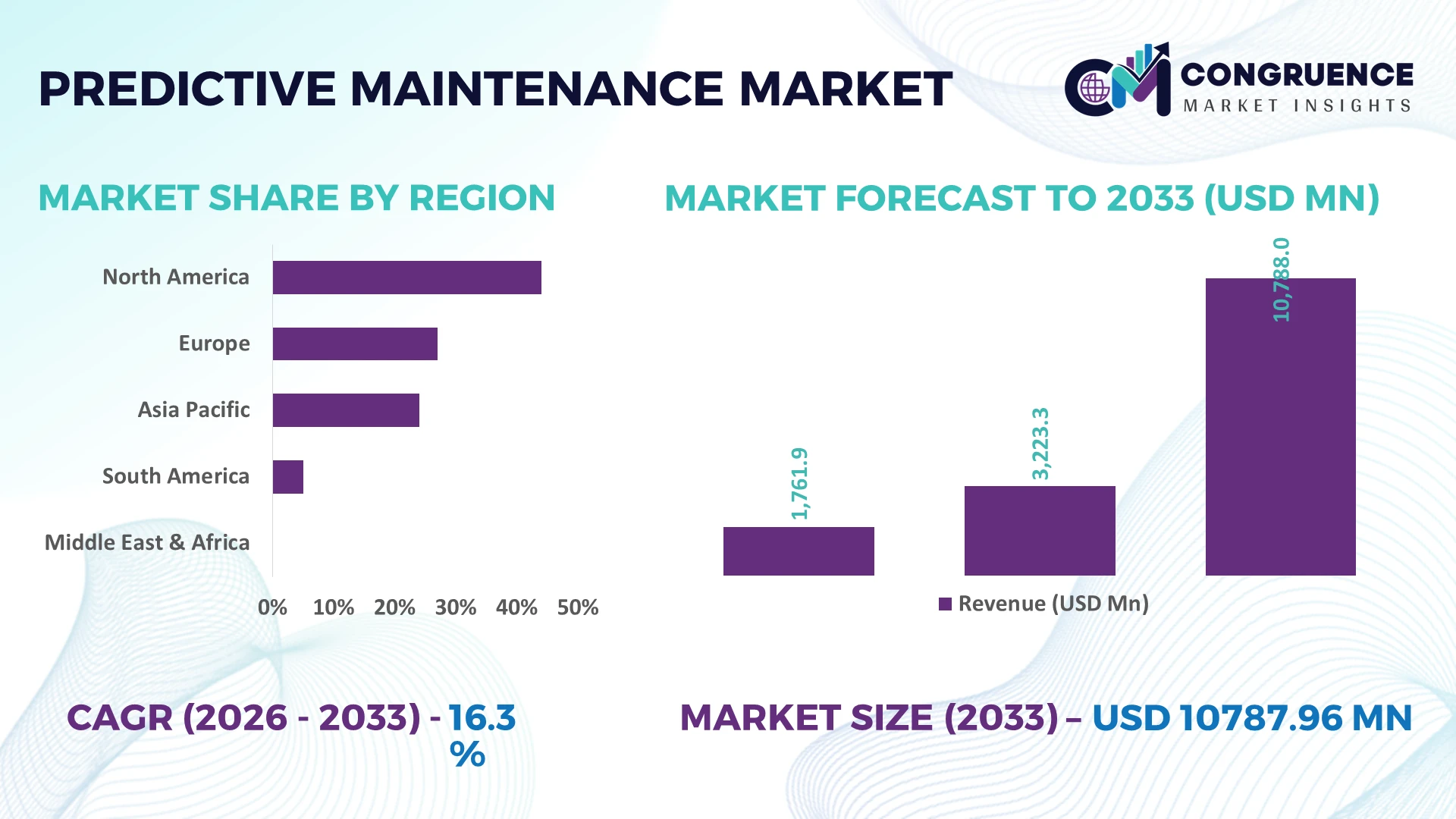
The United States leads the global predictive maintenance market with approximately 34% market share, supported by large-scale industrial digitalization, over 75% smart manufacturing adoption among major manufacturers, and sustained investments in AI-enabled asset management across aerospace, automotive, and energy sectors. Compared with Germany's highly automated industrial base, U.S. enterprises demonstrate broader enterprise-scale deployment, strengthened by domestic manufacturing initiatives and resilient supply-chain modernization following global geopolitical disruptions.
The market increasingly rewards organizations that integrate predictive analytics with enterprise asset management platforms, making scalable, data-driven maintenance capabilities a decisive competitive advantage.
Market Size & Growth: USD 3223.3 Million (2025) to USD 10787.96 Million (2033) at 16.3% CAGR, fueled by AI-driven asset optimization and Industrial IoT expansion.
Top Growth Drivers: AI analytics (+42%), connected sensor deployment (+38%), and industrial automation investment (+31%) accelerate global adoption.
Short-Term Forecast: By 2028, predictive maintenance programs reduce unplanned downtime by up to 35% while increasing equipment availability by nearly 20%.
Emerging Technologies: AI, digital twins, edge computing, and advanced vibration analytics improve fault detection accuracy beyond 90% across critical assets.
Regional Leaders: North America exceeds USD 3.9 Billion, Europe approaches USD 2.8 Billion, and Asia-Pacific surpasses USD 3.2 Billion through accelerated factory modernization.
Consumer/End-User Trends: More than 68% of large industrial enterprises prioritize predictive maintenance within enterprise digital transformation programs.
Pilot/Case Example: A 2026 smart manufacturing deployment improved maintenance efficiency by 28% and reduced unexpected equipment failures by 32%.
Competitive Landscape: IBM holds approximately 11% market presence alongside Siemens, ABB, Schneider Electric, and Honeywell through advanced industrial AI portfolios.
Regulatory & ESG Impact: Energy-efficiency initiatives lower maintenance-related energy consumption by up to 15% while supporting industrial sustainability targets.
Investment & Funding: Global investments exceed USD 8 Billion, driven by industrial software partnerships, cloud expansion, and intelligent manufacturing initiatives amid supply-chain transformation.
Innovation & Future Outlook: Autonomous maintenance, generative AI diagnostics, and digital asset intelligence redefine next-generation predictive maintenance strategies across high-growth industries.
Predictive Maintenance Market demand continues expanding across manufacturing, utilities, transportation, and oil and gas as enterprises prioritize intelligent asset reliability and operational resilience. AI-enabled diagnostics, wireless sensing, and cloud-native maintenance platforms improve maintenance planning, with predictive accuracy exceeding 90% in advanced deployments. Rising adoption of edge intelligence alongside stricter industrial reliability requirements is reshaping maintenance strategies, setting the stage for deeper strategic market analysis.
Predictive maintenance has become a strategic capability as manufacturers, utilities, transport operators, and energy companies shift from reactive maintenance toward data-driven asset management. Industrial digitalization, infrastructure modernization, and resilient supply-chain strategies are accelerating enterprise investments in connected equipment and real-time monitoring platforms. Organizations increasingly view maintenance intelligence as a competitive differentiator because minimizing unplanned downtime directly improves production continuity, inventory planning, and operational efficiency across high-value assets.
AI-enabled predictive maintenance platforms identify equipment anomalies with more than 90% diagnostic accuracy while reducing maintenance costs by approximately 25% compared with conventional preventive maintenance programs. The United States leads large-scale enterprise deployments through advanced industrial software integration, whereas Japan emphasizes precision manufacturing and robotics-driven maintenance optimization with faster edge computing adoption. Over the next two to three years, connected asset coverage across large industrial facilities is expected to exceed 70%, supported by broader Industrial IoT implementation and expanding digital twin deployment.
A practical example is the deployment of predictive maintenance across automotive assembly plants, where continuous machine monitoring improves production scheduling and minimizes unexpected line stoppages. Companies are expanding cloud partnerships, strengthening AI capabilities, and investing in industrial analytics ecosystems to enhance lifecycle asset performance. Businesses that combine predictive intelligence with enterprise-wide operational platforms will establish stronger competitive positioning, higher asset productivity, and greater long-term operational resilience.
Enterprise adoption of AI, Industrial IoT, and edge analytics is transforming maintenance operations into strategic business functions. More than 72% of large manufacturers now prioritize predictive asset monitoring, while connected industrial equipment utilization has increased by nearly 40% across digitally advanced facilities. The United States continues investing in smart manufacturing initiatives that encourage intelligent factory modernization and real-time operational visibility. These developments reduce unexpected equipment failures, improve maintenance scheduling, and optimize workforce productivity. In response, technology providers are expanding AI software portfolios, establishing industrial cloud partnerships, and integrating digital twin capabilities into enterprise asset management platforms. The strongest competitive advantage increasingly belongs to organizations that combine operational technology with enterprise analytics to maximize equipment availability and production continuity.
Fragmented industrial infrastructure continues limiting predictive maintenance deployment across many established production facilities. Nearly 58% of industrial plants operate mixed-generation equipment, while integration costs increase implementation budgets by approximately 20–30% where proprietary control systems remain prevalent. Germany and other mature manufacturing economies face interoperability challenges when connecting legacy automation platforms with modern Industrial IoT architectures. These constraints delay deployment timelines, complicate data standardization, and reduce analytics effectiveness across multi-vendor environments. Companies are responding through phased modernization programs, localized software integration, standardized communication protocols, and long-term technology agreements that minimize operational disruption while improving compatibility across industrial assets and enterprise maintenance systems.
Digital twins, generative AI, and autonomous inspection technologies are creating high-value opportunities beyond traditional condition monitoring. Predictive maintenance deployments integrated with digital twins improve maintenance planning efficiency by approximately 30%, while remote diagnostics reduce field inspection requirements by nearly 35%. India is rapidly expanding industrial digital infrastructure, encouraging manufacturers to integrate intelligent maintenance platforms into new production facilities. Companies are increasing R&D spending, forming software-hardware partnerships, and developing subscription-based maintenance services that deliver continuous operational intelligence. A particularly valuable opportunity lies in extending predictive maintenance to medium-sized industrial enterprises, where cloud-native platforms significantly lower implementation complexity and accelerate digital transformation.
Scaling predictive maintenance across multiple production sites requires consistent cybersecurity, workforce capability, and enterprise data governance. More than 60% of industrial organizations report shortages of advanced industrial analytics specialists, while connected operational technology environments experience cybersecurity incidents approximately 25% more frequently than isolated legacy systems. Japan and the United States continue strengthening industrial cyber resilience requirements as connected manufacturing expands. Companies must balance real-time connectivity with secure infrastructure, standardized data architectures, and skilled workforce development. Strategic investment in zero-trust security frameworks, industrial AI training, interoperable software ecosystems, and cross-industry partnerships will determine long-term deployment consistency and sustainable competitive advantage.
AI Expands Maintenance Intelligence: AI-enabled maintenance platforms are moving from pilot deployments to enterprise-wide operations, with predictive accuracy exceeding 90% and maintenance planning time reduced by nearly 35%. Labor shortages across the United States and Europe are accelerating automated diagnostics, while manufacturers integrate AI with enterprise asset management systems through strategic software partnerships to improve operational continuity.
Edge Analytics Gains Momentum: Industrial facilities are shifting analytics from centralized cloud environments to edge devices, reducing fault detection latency by approximately 45% and lowering network traffic by nearly 30%. Germany's advanced manufacturing sector is expanding edge-enabled production lines to support continuous operations. Technology providers are redesigning monitoring architectures with distributed processing to improve response speed and minimize production interruptions.
Digital Twins Reshape Workflows: Digital twin deployment has increased by over 40% across asset-intensive industries, enabling simulation-driven maintenance scheduling and reducing unnecessary inspections by nearly 25%. Infrastructure modernization and stricter reliability requirements are encouraging utilities and transportation operators to synchronize operational data with virtual asset models. Companies are expanding digital engineering partnerships to optimize lifecycle performance and workforce planning.
Integrated Sensor Networks Scale: Enterprises are replacing isolated monitoring devices with integrated multi-sensor platforms combining vibration, thermal, and acoustic diagnostics, improving fault detection coverage by approximately 30% while reducing manual inspections by over 20%. Japan's precision manufacturing sector is accelerating standardized sensor deployment, prompting equipment suppliers to deliver interoperable monitoring ecosystems that simplify plant-wide implementation and improve maintenance consistency.
Vibration Monitoring remains the leading segment because of its proven effectiveness in detecting mechanical failures across rotating equipment, motors, pumps, compressors, and industrial machinery. More than 45% of predictive maintenance deployments incorporate vibration monitoring as the primary diagnostic technology due to its scalability, relatively low implementation cost, and compatibility with existing industrial automation systems. Oil Analysis and Thermal Monitoring continue serving mature industrial environments where lubrication quality and temperature stability directly affect equipment reliability. Ultrasound Monitoring is gaining relevance for compressed air systems and electrical inspections, providing complementary diagnostic capabilities that improve maintenance precision.
AI-Based Monitoring represents the fastest-growing segment as enterprises combine machine learning with multi-sensor data to improve anomaly detection by approximately 35% while reducing false alarms by nearly 25%. Technology providers are expanding AI-enabled monitoring portfolios through industrial software partnerships and cloud integration, allowing predictive insights across distributed assets. Investment priorities increasingly favor intelligent monitoring platforms that unify traditional diagnostic methods with autonomous analytics, enabling more scalable enterprise maintenance strategies.
Equipment Monitoring remains the dominant application because continuous visibility into critical production assets directly reduces downtime and extends equipment life. Approximately 48% of enterprise predictive maintenance deployments prioritize equipment monitoring across manufacturing, utilities, and process industries. Asset Management continues strengthening as organizations integrate maintenance intelligence into enterprise planning systems, improving maintenance scheduling efficiency by nearly 30%. Energy Management is expanding steadily as industrial facilities seek better operational efficiency and optimized equipment performance through continuous condition assessment.
Production Optimization is the fastest-growing application as manufacturers increasingly connect predictive insights with production scheduling and operational planning. Fleet Management is also gaining momentum across logistics and transportation through connected vehicle diagnostics and remote asset monitoring. Companies are expanding Industrial IoT deployments, integrating maintenance data with manufacturing execution systems, and automating maintenance workflows to improve productivity while reducing maintenance-related disruptions. Demand is increasingly concentrated in applications delivering measurable operational performance rather than standalone equipment diagnostics.
Manufacturing remains the largest end-user segment because production-intensive environments depend on continuous equipment availability and predictable maintenance schedules. Nearly 50% of predictive maintenance implementations are concentrated within manufacturing facilities where automation, robotics, and connected production lines require continuous condition monitoring. Energy & Utilities maintains strong adoption due to critical infrastructure reliability requirements, while Oil & Gas continues investing in remote asset monitoring for high-value production equipment operating under demanding environmental conditions.
Transportation represents the fastest-growing end-user segment as connected fleets, rail infrastructure, and aviation maintenance increasingly rely on predictive analytics to reduce service interruptions and optimize asset utilization. Healthcare and Mining are expanding deployments through specialized monitoring solutions for medical equipment and heavy industrial machinery. Companies are responding with industry-specific software platforms, customized analytics, strategic ecosystem partnerships, and flexible deployment models that address sector-specific operational requirements. Competitive positioning increasingly depends on delivering tailored predictive maintenance capabilities for asset-intensive industries with complex operational environments.
North America accounted for the largest market share at 38.4% in 2025 however, Asia-Pacific is expected to register the fastest growth, expanding at a 17.9% CAGR between 2026 and 2033.

Industrial AI Integration Strengthens Enterprise Asset Performance
North America maintains its leadership through widespread adoption of Industrial IoT, AI-driven analytics, and enterprise asset management platforms across manufacturing, aerospace, utilities, and transportation. The region represents nearly 38.4% of global deployments, supported by advanced digital infrastructure and high automation maturity. More than 72% of large industrial facilities have implemented connected condition monitoring across critical assets. Enterprises continue expanding cloud-based maintenance ecosystems, while strategic partnerships between industrial software providers and equipment manufacturers accelerate deployment speed, improve maintenance planning, and reduce operational downtime across complex production environments.
United States Market Outlook: The United States remains the regional growth engine due to extensive smart manufacturing investments, advanced industrial software capabilities, and large-scale digital transformation initiatives. More than 75% of major manufacturers utilize connected maintenance technologies within production operations, while automotive, aerospace, and energy sectors continue integrating predictive analytics with enterprise resource planning systems. Ongoing factory modernization, expanding semiconductor production, and strong AI adoption strengthen long-term deployment opportunities across industrial infrastructure without relying solely on greenfield investments.
Smart Manufacturing Modernization Accelerates Digital Operations
Europe continues strengthening predictive maintenance adoption through Industry 4.0 initiatives, energy-efficiency programs, and advanced manufacturing modernization. Approximately 27% of global implementation activity is concentrated across industrial production hubs where connected machinery and digital engineering support operational reliability. More than 65% of newly modernized manufacturing facilities integrate predictive monitoring into automated production systems. Companies increasingly deploy interoperable maintenance platforms to improve equipment utilization while complying with stricter industrial sustainability and operational efficiency standards.
Germany Market Outlook: Germany leads the European market through its highly automated manufacturing ecosystem and advanced engineering expertise. Automotive, industrial machinery, and process manufacturing companies continue integrating predictive maintenance with digital factory platforms to optimize production performance. Over 70% of large industrial enterprises have accelerated Industrial IoT implementation, while equipment suppliers increasingly collaborate with software developers to strengthen intelligent maintenance capabilities across both domestic and export-oriented manufacturing operations.
Manufacturing Expansion Drives Large-Scale Deployment
Asia-Pacific is experiencing the fastest operational expansion as manufacturers accelerate factory automation, industrial connectivity, and digital production initiatives. Rapid infrastructure development and growing adoption of intelligent manufacturing technologies support deployment across electronics, automotive, heavy machinery, and semiconductor industries. More than 40% of newly commissioned smart manufacturing facilities incorporate predictive maintenance capabilities from the initial deployment stage. Technology vendors continue expanding regional engineering centers and industrial cloud partnerships to meet rising enterprise demand for scalable maintenance intelligence.
China Market Outlook: China dominates the regional market through its extensive manufacturing base, industrial automation investments, and smart factory initiatives. Large electronics, automotive, and heavy equipment manufacturers increasingly deploy AI-enabled maintenance platforms to improve production efficiency and equipment reliability. More than 60% of major industrial enterprises have expanded digital manufacturing capabilities, while national industrial modernization policies continue encouraging enterprise investment in connected production technologies and intelligent asset management solutions.
Industrial Modernization Supports Operational Efficiency
South America is steadily increasing predictive maintenance adoption across mining, energy, manufacturing, and logistics industries as companies prioritize equipment reliability and operational continuity. Approximately 6% of global deployment activity originates from the region, with industrial operators investing in connected monitoring solutions for high-value assets. Mining companies are expanding remote equipment diagnostics by nearly 25% to improve maintenance scheduling in geographically dispersed operations. Technology providers are strengthening regional partnerships to improve implementation capabilities despite infrastructure and digital integration challenges.
Brazil Market Outlook: Brazil represents the largest market within South America because of its diversified industrial base and expanding mining, manufacturing, and energy sectors. Large enterprises are integrating predictive maintenance into production facilities and utility infrastructure to reduce operational disruptions. Industrial automation projects continue increasing across manufacturing clusters, while growing investment in digital operations enables broader adoption of cloud-based maintenance platforms and intelligent equipment monitoring technologies.
Infrastructure Investment Accelerates Digital Asset Management
The Middle East & Africa market is advancing through industrial diversification, energy infrastructure modernization, and digital transformation initiatives across asset-intensive industries. Oil and gas operators, utilities, and transport infrastructure developers increasingly deploy predictive maintenance platforms to maximize equipment availability. Nearly 30% of new industrial digitalization projects incorporate connected maintenance technologies during implementation. Strategic investments in industrial automation and smart infrastructure continue strengthening enterprise demand for intelligent asset management across critical operational environments.
Saudi Arabia Market Outlook: Saudi Arabia leads regional adoption through extensive industrial diversification, smart manufacturing initiatives, and modernization of energy infrastructure. National industrial development programs encourage deployment of AI-enabled maintenance technologies across petrochemical complexes, utilities, and logistics facilities. Large industrial operators continue investing in intelligent monitoring platforms to improve equipment reliability, while integrated digital infrastructure projects strengthen enterprise readiness for predictive maintenance across expanding industrial ecosystems.
The competitive landscape is led by IBM, Siemens, ABB, Schneider Electric, and Honeywell, competing directly against industrial software innovators, automation OEMs, and specialized predictive analytics providers. The top five players collectively account for approximately 46% of the global market, while regional system integrators compete through industry-specific customization and localized deployment expertise. Competition centers on AI accuracy, platform interoperability, deployment speed, cybersecurity, and lifecycle service capabilities rather than hardware pricing alone. AI-enabled diagnostics improve fault detection by over 30%, while cloud-native deployment shortens implementation time by nearly 25%, creating measurable differentiation. Leading companies are expanding through industrial cloud partnerships, digital twin integration, acquisitions, and vertical software ecosystems that strengthen recurring enterprise engagement. The competitive shift increasingly favors intelligent software platforms over standalone monitoring hardware, accelerating consolidation around integrated asset management solutions. High integration complexity and extensive industrial datasets create significant entry barriers. Winning requires scalable AI, seamless enterprise integration, strong cybersecurity, and proven operational outcomes across multiple industrial environments.
IBM
Siemens
ABB
Schneider Electric
Honeywell
Emerson Electric
Rockwell Automation
SAP
PTC
Cisco Systems
Hitachi
GE Vernova
Microsoft
SKF
Artificial intelligence, Industrial IoT, edge computing, and cloud-native analytics define the current technology foundation of predictive maintenance. More than 70% of enterprise deployments combine connected sensors with AI-driven analytics to improve asset visibility, while advanced anomaly detection reduces unplanned equipment failures by approximately 35%. Integration with enterprise asset management and manufacturing execution systems enables continuous operational intelligence, allowing manufacturers, utilities, and transportation operators to optimize maintenance scheduling and equipment utilization with greater consistency.
Digital twins, generative AI diagnostics, and multimodal sensor fusion are emerging as the next competitive technologies. Compared with conventional preventive maintenance programs, AI-enabled predictive platforms improve maintenance planning efficiency by nearly 30% while lowering unnecessary maintenance interventions by approximately 25%. Large industrial enterprises benefit most because integrated digital engineering environments support real-time simulation, remote diagnostics, and enterprise-wide decision automation. Adoption of digital twin technology has exceeded 40% among newly modernized smart manufacturing facilities, reflecting a clear transition toward intelligent lifecycle asset management.
Between 2026 and 2028, autonomous maintenance agents, federated industrial AI, and edge-based machine learning will reshape industrial maintenance operations. Companies investing early in interoperable software architectures, cybersecurity, and scalable analytics ecosystems will achieve faster deployment, stronger operational resilience, lower maintenance costs, and a sustained competitive advantage as intelligent maintenance becomes a core enterprise capability.
March 2025: Siemens expanded its Industrial Copilot with new generative AI capabilities for Senseye Predictive Maintenance, introducing Entry and Scale packages. Pilot deployments reduced reactive maintenance time by an average of 25%, strengthening enterprise maintenance automation and accelerating AI-driven industrial asset management. Source: press.siemens.com
November 2025: ABB extended its long-standing strategic partnership with Tata Consultancy Services to modernize global digital infrastructure using AI-powered Zero Ops capabilities, enabling predictive operations and faster service restoration across enterprise IT environments. The initiative builds on an 18-year collaboration, improving operational resilience and digital transformation. Source: tcs.com
February 2026: Honeywell partnered with Tata Consultancy Services to integrate Honeywell Forge with enterprise IT modernization, enabling AI-powered autonomous industrial operations and predictive intelligence. The collaboration combines operational technology with cloud capabilities to improve decision-making and operational efficiency across integrated IT and OT environments. Source: honeywell.com
April 2026: Schneider Electric launched the TeSys™ Tera intelligent motor management system featuring predictive diagnostics, connectivity, and energy monitoring. The platform is designed to reduce motor downtime by up to 80%, helping industrial operators improve asset reliability while lowering maintenance costs through intelligent monitoring. Source: se.com
This report delivers comprehensive analysis of the global Predictive Maintenance Market between 2026 and 2033, covering technology evolution, competitive positioning, deployment strategies, and enterprise adoption patterns. The assessment evaluates five core technology segments, five major application areas, and six primary end-user industries while examining operational trends across North America, Europe, Asia-Pacific, South America, and the Middle East & Africa. More than 70% of current enterprise implementations are assessed through technology adoption, deployment maturity, and digital transformation indicators.
The report further examines competitive benchmarking, innovation strategies, industrial AI integration, digital twins, edge analytics, and Industrial IoT adoption alongside regional investment priorities and enterprise expansion trends. It provides actionable insights supporting product development, market entry, partnership evaluation, capacity planning, and long-term competitive positioning. Coverage also extends to emerging deployment models, cloud-native maintenance platforms, sector-specific adoption patterns, and evolving enterprise requirements that are reshaping predictive maintenance across asset-intensive industries.
| Report Attribute/Metric | Report Details |
|---|---|
|
Market Revenue in 2025 |
USD V2025 Million |
|
Market Revenue in 2033 |
USD V2033 Million |
|
CAGR (2026 - 2033) |
C111% |
|
Base Year |
2025 |
|
Forecast Period |
2026 - 2033 |
|
Historic Period |
2021 - 2025 |
|
Segments Covered |
T1 |
|
Key Report Deliverable |
Revenue Forecast, Growth Trends, Market Dynamics, Segmental Overview, Regional and Country-wise Analysis, Competition Landscape |
|
Region Covered |
North America, Europe, Asia-Pacific, South America, Middle East, Africa |
|
Key Players Analyzed |
mplayers |
|
Customization & Pricing |
Available on Request (10% Customization is Free) |




