
Reports
The Global Predictive Dialer Software Market was valued at USD 4416 Million in 2025 and is anticipated to reach a value of USD 58084.7 Million by 2033 expanding at a CAGR of 38% between 2026 and 2033. Growth is driven by AI-powered customer engagement platforms, cloud contact center migration, and automation adoption across banking, insurance, healthcare, and telecom operations.
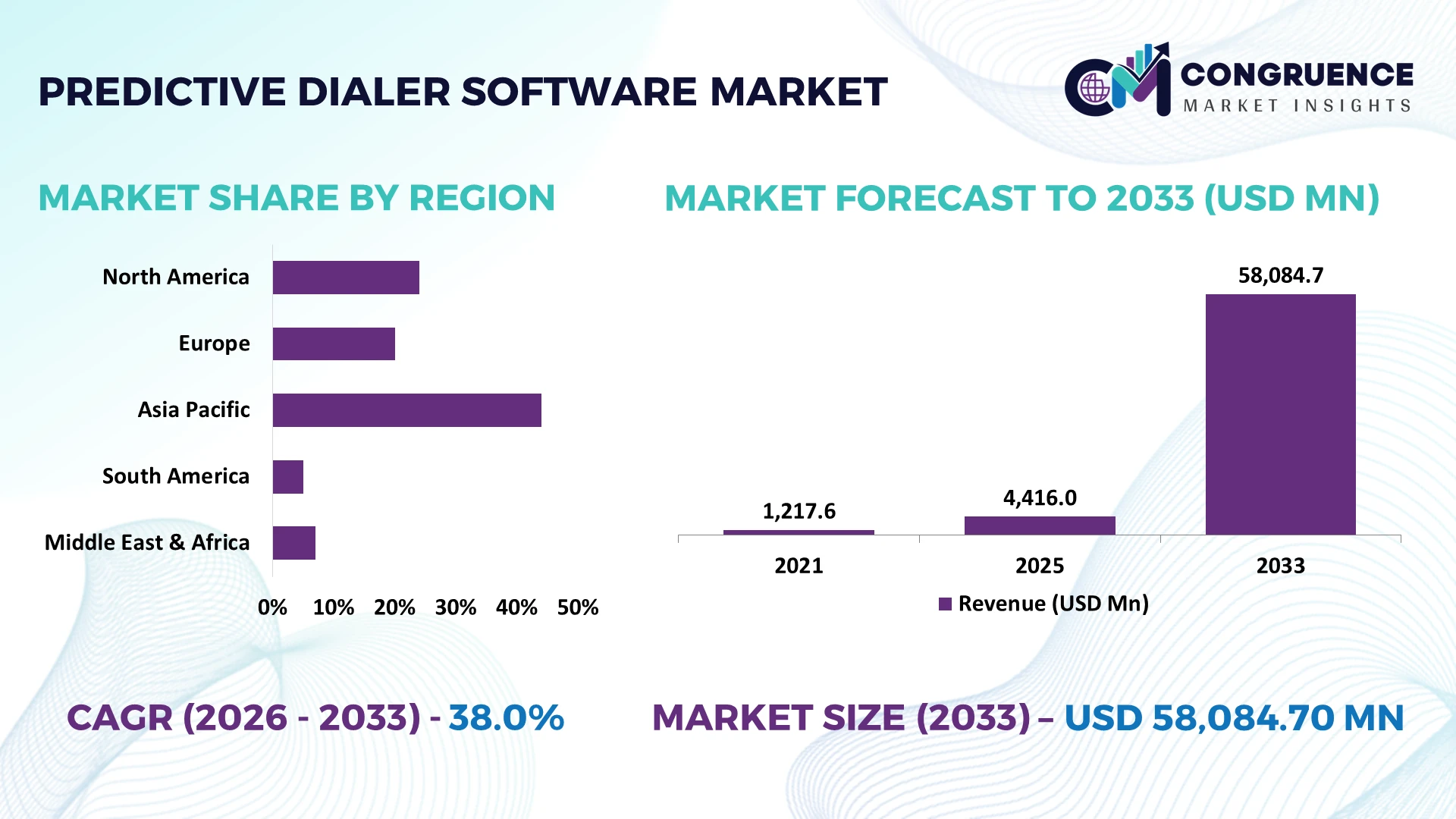
The United States leads market adoption with nearly 35% share, supported by enterprise AI investments, contact center modernization, and over 70% cloud-based customer service deployments across large organizations. India follows with strong expansion, driven by outsourced customer support operations and digital service exports exceeding 50% automation adoption. Compared with Europe’s approximately 25% enterprise adoption rate, North America maintains faster AI integration, accelerated by evolving data governance requirements and post-pandemic remote service models.
Strategic implication: Businesses investing in predictive dialer platforms are prioritizing AI-driven efficiency, compliance readiness, and scalable customer interaction models to strengthen competitive positioning.
Market Size & Growth: USD 4416 Million in 2025 to USD 58084.7 Million by 2033 at 38% CAGR, driven by AI automation, cloud migration, and omnichannel contact center transformation.
Top Growth Drivers: AI adoption (45%), cloud contact centers (40%), and automated customer engagement platforms (35%) are accelerating predictive dialer software deployment.
Short-Term Forecast: By 2027, enterprises using predictive dialers achieve 25% lower call handling costs and 35% higher agent productivity through workflow automation.
Emerging Technologies: AI voice analytics, machine learning-based lead scoring, conversational bots, and real-time sentiment detection are reshaping advanced predictive dialing solutions.
Regional Leaders: North America reaches USD 22 billion, Asia Pacific USD 18 billion, and Europe USD 13 billion by 2033, supported by cloud expansion and digital customer service adoption.
Consumer/End-User Trends: Over 60% of enterprises prioritize automated customer interactions, increasing demand from banking, insurance, healthcare, and telecom sectors.
Pilot/Case Example: In 2025, AI-enabled contact center deployments improved agent connection rates by 30% and reduced idle calling time by 20% through predictive algorithms.
Competitive Landscape: Leading vendors capture nearly 40% combined market influence, with major players including NICE, Genesys, Five9, Cisco, and Talkdesk driving innovation.
Regulatory & ESG Impact: Data privacy frameworks and responsible AI practices reduce compliance risks by approximately 25% while improving customer trust across regulated industries.
Investment & Funding: More than USD 5 billion has flowed into AI customer experience technologies, supporting partnerships, platform expansion, and automation-focused acquisitions.
Innovation & Future Outlook: Next-generation predictive dialers are shifting toward autonomous AI agents, real-time analytics, and intelligent customer journey orchestration.
The Predictive Dialer Software Market is gaining traction as enterprises seek faster customer engagement, higher agent utilization, and automated sales operations. AI-based dialing systems now improve contact efficiency by nearly 30%, while cloud infrastructure expansion and stricter customer data regulations are influencing platform upgrades. The market is also witnessing stronger adoption among global outsourcing centers as businesses optimize operational costs and service scalability, creating a foundation for strategic growth opportunities.
The Predictive Dialer Software Market has become strategically important as companies compete through faster customer acquisition, automated engagement, and higher agent productivity. Enterprises are shifting from traditional call systems toward AI-enabled platforms that optimize contact timing, lead prioritization, and customer analytics. Increasing data privacy regulations and cloud infrastructure modernization are also reshaping deployment strategies across global contact centers.
Advanced predictive dialers deliver measurable advantages compared with legacy manual dialing systems, improving agent utilization by nearly 35% and reducing inactive calling periods by over 25%. The United States continues leading innovation with large-scale AI contact center deployments, while India demonstrates faster operational adoption through outsourcing hubs and digital service providers. European markets are emphasizing compliance-focused solutions due to stricter customer data protection requirements.
Over the next 2–3 years, businesses are prioritizing AI integration, workflow automation, and ecosystem partnerships to improve customer interaction efficiency. Financial institutions, healthcare providers, and telecom operators are deploying predictive dialers to manage high-volume communication operations while controlling costs. Strategic investments in intelligent automation will determine competitive positioning, operational resilience, and long-term customer experience leadership.
The primary growth driver is the rapid adoption of AI-based customer engagement technologies across enterprise communication systems. Organizations using automated dialing platforms report up to 40% improvement in agent productivity and nearly 30% faster customer connections compared with manual processes. The expansion of cloud contact centers in the United States, India, and the Philippines is accelerating demand for scalable solutions. Regulatory pressure for transparent customer interactions is also encouraging businesses to upgrade legacy systems. Companies are responding through AI partnerships, platform enhancements, and investments in predictive analytics to improve lead conversion, reduce operational waste, and strengthen customer relationship management capabilities.
A major restraint is the complexity of integrating predictive dialer platforms with existing enterprise systems while meeting evolving data protection requirements. Around 30% of organizations identify compliance management and system compatibility as key implementation barriers. Countries such as Germany and Canada are increasing scrutiny on customer communication practices, creating additional operational requirements for vendors. Legacy infrastructure in some enterprises increases deployment costs and slows modernization timelines. Companies are reducing exposure through modular cloud platforms, regional data hosting strategies, and contractual partnerships with technology providers. The ability to balance automation efficiency with regulatory compliance remains a critical operational challenge.
The strongest opportunities are emerging from AI-driven personalization, conversational analytics, and expansion into developing digital service markets. Predictive dialer platforms integrated with machine learning can improve customer targeting accuracy by approximately 35% while reducing inefficient outreach activities. India, Brazil, and Southeast Asian economies are creating new demand through expanding business process outsourcing and digital customer support industries. The adoption of real-time analytics and generative AI assistants is opening opportunities for next-generation communication platforms. Companies are strengthening market positions through research investments, cloud partnerships, and localized solutions designed for multilingual customer engagement environments.
Long-term market expansion faces challenges related to cybersecurity risks, complex integrations, and maintaining consistent performance across large-scale deployments. More than 40% of enterprises prioritize stronger security controls before expanding automated communication systems. Increasing cyber threats and evolving privacy frameworks require continuous investment in encryption, monitoring, and compliance infrastructure. Large organizations operating across multiple countries face difficulties standardizing workflows and maintaining data governance. Companies must address these barriers through advanced security architectures, technology partnerships, and workforce training programs. Operational reliability and secure scalability will remain essential factors influencing adoption success in competitive customer engagement environments.
AI Workflow Optimization Shift: Enterprises are integrating AI-driven predictive dialers with CRM platforms, increasing agent productivity by 30–40% and improving contact accuracy by nearly 25%. Financial service providers in the United States are restructuring outbound operations through automation, while companies are investing in intelligent routing and real-time analytics to reduce inefficient calling cycles.
Cloud Deployment Acceleration: Cloud-based predictive dialer adoption is expanding as businesses modernize contact centers, with deployment rates increasing by approximately 35% among large enterprises and reducing infrastructure maintenance costs by 20–30%. Labor shortages and remote workforce models are pushing companies toward flexible platforms with faster scaling capabilities and centralized management.
Compliance-Focused Automation: Regulatory changes around customer communication are driving adoption of compliant dialing technologies, with enterprises reporting nearly 25% improvement in monitoring efficiency and 30% faster audit preparation. European companies are prioritizing consent management, while vendors are enhancing security controls, data governance features, and automated compliance workflows.
Omnichannel Integration Expansion: Businesses are combining predictive dialers with voice analytics, messaging platforms, and customer engagement tools, increasing cross-channel interaction efficiency by around 35%. A notable shift is occurring as companies move beyond call volume optimization toward customer journey management, leading technology providers to develop integrated communication ecosystems and strategic partnerships.
Cloud-Based predictive dialer software represents the leading segment, accounting for approximately 60% of market adoption due to lower infrastructure requirements, faster deployment, and improved scalability across distributed contact centers. Enterprises in the United States and India are increasingly shifting from traditional systems toward cloud environments, with adoption improving operational flexibility by nearly 35% and reducing maintenance complexity by around 25%. Hybrid solutions are emerging as the fastest-growing type as organizations balance cloud efficiency with existing enterprise infrastructure requirements.
On-Premises platforms continue serving industries requiring strict control over customer data and customized security frameworks, particularly regulated financial and government operations. However, their slower upgrade cycles limit expansion compared with cloud and hybrid models. Companies are increasing investments in hybrid architectures, API integrations, and flexible deployment models to support modernization while maintaining operational control.
Customer Service is the dominant application segment, contributing approximately 35% of predictive dialer software adoption due to high-volume customer interactions across banking, telecom, healthcare, and retail sectors. Organizations are using automated dialing systems to improve response efficiency by nearly 30% and reduce agent idle time by approximately 25%. Telemarketing and lead generation remain important applications, but businesses are increasingly shifting toward personalized engagement rather than volume-based outreach.
Lead Generation is emerging as the fastest-growing application, supported by AI-based customer scoring, sales automation, and improved targeting capabilities. Companies are expanding predictive dialing use in competitive markets where faster prospect qualification creates measurable sales advantages. Debt collection and survey applications continue adopting these platforms for workflow automation, compliance tracking, and cost optimization.
BFSI remains the leading end-user segment, representing nearly 30% of predictive dialer software adoption due to high customer communication volumes, collections requirements, and regulatory-driven monitoring needs. Banks and financial institutions are improving outreach efficiency by approximately 35% through automated calling workflows while reducing manual processing requirements by nearly 20%. Telecommunications and BPOs also represent significant users because of large-scale customer support operations.
BPOs are emerging as the fastest-growing end-user group as outsourcing providers expand AI-enabled service capabilities and manage increasing international customer workloads. Healthcare and retail organizations are adopting predictive dialers for appointment management, customer retention, and personalized communication strategies. Companies are developing industry-specific solutions, pricing models, and integration partnerships to capture demand across diverse operational environments.
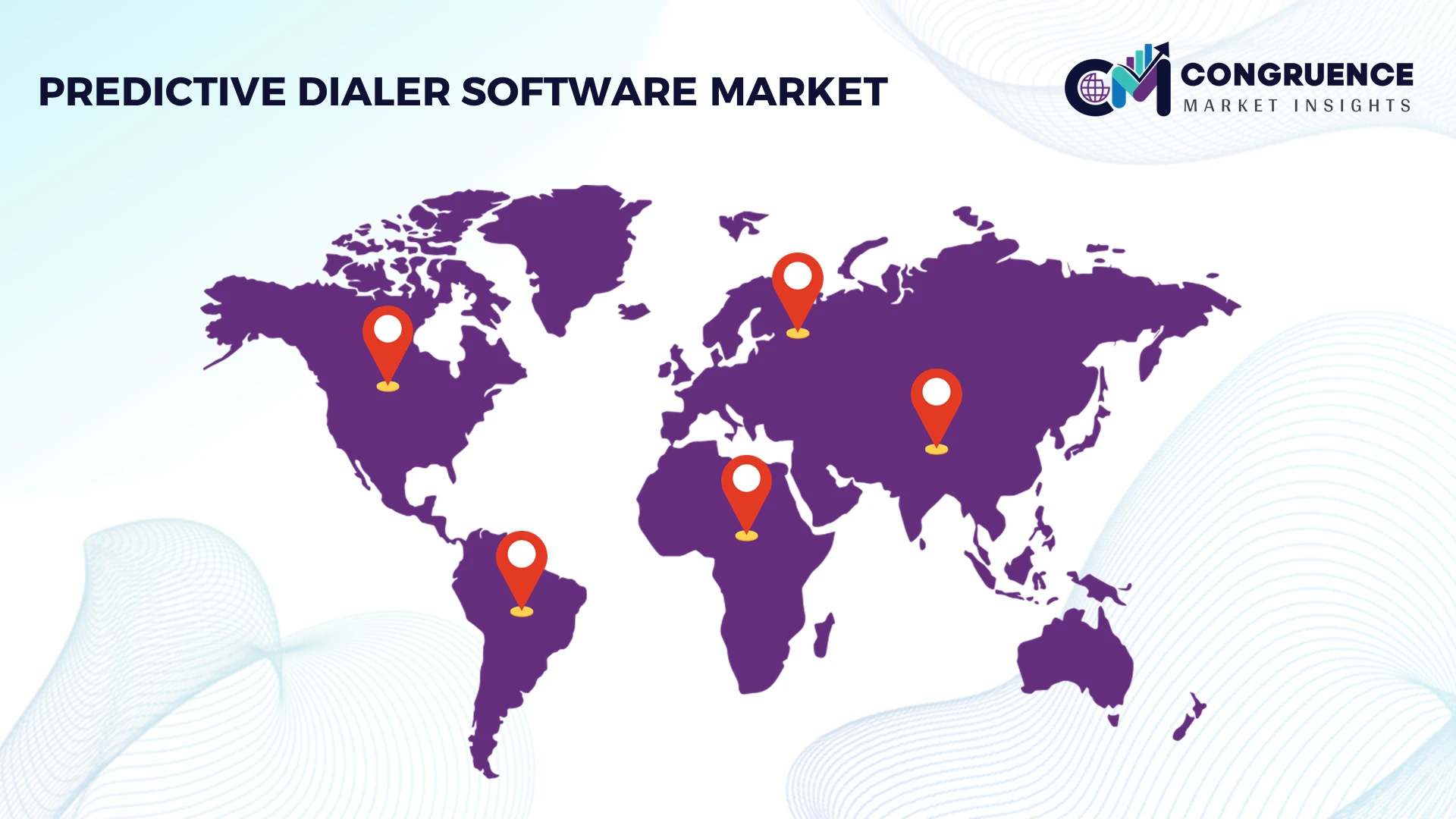
North America accounted for the largest market share at 38% in 2025 however, Asia-Pacific is expected to register the fastest growth, expanding at a CAGR of 42% between 2026 and 2033.
AI-Led Contact Center Modernization Drives Enterprise Adoption
North America maintains market leadership due to advanced cloud infrastructure, high enterprise automation penetration, and strong adoption across banking, insurance, healthcare, and telecom industries. The region contributes approximately 38% of global predictive dialer deployments, supported by large-scale contact center operations in the United States. More than 65% of major enterprises have integrated AI-supported customer engagement tools to improve workflow efficiency. Rising investments in conversational AI, data security, and omnichannel platforms are accelerating modernization. Companies are expanding partnerships with cloud communication providers and enhancing predictive analytics capabilities to support personalized customer interactions and operational efficiency.
United States Market Outlook: The United States remains the primary adoption hub due to its mature enterprise technology ecosystem and high AI investment activity. Over 70% of large contact centers are adopting cloud-based communication solutions, with financial services and healthcare organizations leading deployment through automation-focused transformation programs.
Compliance-Driven Automation Reshapes Customer Communication
Europe is experiencing steady predictive dialer software adoption as enterprises focus on secure automation, customer experience improvement, and regulatory-compliant communication systems. The region represents nearly 27% of market adoption, supported by advanced digital infrastructure in Germany, the United Kingdom, and France. Data protection regulations are influencing platform selection, encouraging vendors to develop stronger consent management and security features. Approximately 45% of European enterprises are prioritizing AI-enabled customer interaction technologies to improve service efficiency. Companies are increasing investments in compliant cloud platforms and localized solutions to address diverse language requirements and operational standards.
Germany Market Outlook: Germany leads European adoption through strong industrial digitization and enterprise automation capabilities. Nearly 50% of large organizations are integrating advanced communication platforms to optimize customer operations. Strict data governance requirements are encouraging businesses to invest in secure predictive dialing systems with enhanced monitoring capabilities.
Outsourcing Expansion and Digital Transformation Accelerate Deployment
Asia-Pacific represents the fastest-expanding market due to large-scale business process outsourcing operations, growing cloud adoption, and increasing enterprise digitization. Countries including India, China, Japan, and the Philippines are becoming major deployment centers for predictive dialer solutions. The region contributes around 22% of current adoption, with outsourcing providers using automation to manage increasing customer interaction volumes. India’s contact center industry has achieved more than 50% adoption of AI-supported workflow tools among major service providers. Companies are expanding partnerships, establishing regional delivery centers, and investing in multilingual automation capabilities to improve global customer support efficiency.
India Market Outlook: India is a key growth center due to its large IT services workforce, expanding BPO ecosystem, and digital infrastructure development. More than 60% of leading outsourcing providers are adopting cloud-based communication platforms, supporting scalable customer engagement operations for international enterprises.
Digital Customer Service Expansion Creates New Demand
South America is gradually adopting predictive dialer software as enterprises modernize customer service operations and expand digital communication channels. Brazil and Argentina represent major demand centers due to growing financial services, telecom, and outsourcing activities. The region contributes approximately 8% of market adoption, with companies focusing on cost-efficient automation solutions. Cloud deployment is increasing as businesses overcome infrastructure limitations, with adoption among medium and large enterprises improving by nearly 25% in recent years. Organizations are forming technology partnerships and selecting flexible platforms to support multilingual communication, customer retention, and operational cost control.
Brazil Market Outlook: Brazil dominates South American adoption due to its large consumer market and expanding financial technology sector. Around 40% of major customer service organizations are implementing automated communication platforms to improve customer outreach efficiency and manage increasing service volumes.
Infrastructure Modernization Supports Enterprise Automation
Middle East & Africa is emerging as a developing market for predictive dialer software through digital transformation programs, telecom expansion, and enterprise modernization initiatives. The region accounts for nearly 5% of global adoption, with stronger deployment activity in the United Arab Emirates, Saudi Arabia, and South Africa. Investments in smart infrastructure and cloud technologies are encouraging businesses to automate customer engagement processes. Approximately 35% of large enterprises in leading Gulf economies are increasing spending on AI-based operational tools. Companies are partnering with technology providers to improve communication efficiency, strengthen customer experience management, and support digital service expansion.
United Arab Emirates Market Outlook: The UAE is positioned as a regional technology hub due to strong cloud infrastructure investment and government-led digital transformation initiatives. Over 45% of large enterprises are adopting AI-enabled business solutions, creating opportunities for predictive dialer platforms across banking, telecom, and government service operations.
The Predictive Dialer Software Market features competition between global customer experience technology leaders, cloud communication providers, and specialized automation vendors. Major players such as NICE, Genesys, Five9, and Cisco compete through advanced AI capabilities, while regional providers challenge with customization and cost-focused solutions. The top five companies collectively account for approximately 40% market influence, creating a moderately concentrated structure. Competition is driven by AI accuracy, platform integration, pricing flexibility, deployment speed, and security compliance, with automation improving agent efficiency by 30% and reducing operational costs by nearly 20%. Companies are expanding through cloud partnerships, CRM integrations, and industry-specific solutions for banking, healthcare, and telecom sectors. The market is shifting toward AI-driven platforms as traditional dialing systems lose relevance. High integration complexity, data compliance requirements, and enterprise trust create entry barriers. Winning players must combine intelligent automation, scalable infrastructure, and deep industry customization to outperform established providers.
NICE
Genesys
Five9
Cisco
Talkdesk
RingCentral
Vonage
Avaya
Twilio
CloudTalk
Dialpad
Aircall
Nextiva
Predictive dialer technology is rapidly evolving through artificial intelligence, machine learning, cloud platforms, and real-time analytics integration. AI-based call prioritization and predictive algorithms enable enterprises to improve agent utilization by nearly 35% compared with traditional manual dialing methods. More than 60% of large contact centers are adopting cloud communication tools, allowing faster deployment, centralized management, and improved operational flexibility. Integration with CRM systems, customer data platforms, and workflow automation tools is becoming essential for personalized engagement.
Modern AI-powered predictive dialers outperform legacy systems by reducing idle agent time by approximately 30% and improving customer connection accuracy by nearly 25%. Speech analytics, sentiment recognition, and automated quality monitoring are providing competitive advantages to technology-focused providers. Global vendors benefit by combining automation capabilities with industry-specific solutions, while smaller providers compete through customization and lower deployment complexity.
Between 2026 and 2028, autonomous AI agents, conversational intelligence, and real-time decision engines will reshape contact center operations. Companies adopting these technologies early are expected to gain advantages through faster response cycles, reduced operational pressure, and improved customer experience management. The strategic focus is shifting from automated calling volume toward intelligent customer interaction optimization.
March 2025 Cisco introduced new Webex AI Agent capabilities for contact centers, expanding autonomous customer support and workflow automation features. The platform improved high-volume query handling through AI assistance and supported enterprise scaling across industries. The development strengthened Cisco’s position in AI-driven customer engagement transformation.
September 2025 Cisco expanded Webex Contact Center availability in India through dedicated data centers in Mumbai and Chennai. The expansion increased localized cloud infrastructure coverage with AI-powered communication capabilities, helping enterprises improve compliance readiness, deployment flexibility, and customer interaction management across Indian operations.
October 2024 Genesys advanced its AI-focused contact center strategy as the company confidentially filed for a U.S. IPO, reflecting increased investor interest in AI customer experience platforms. The company’s cloud platform growth exceeded 35%, supporting broader enterprise adoption and strengthening competitive positioning. Source: https://www.reuters.com
September 2025 Cisco enhanced Webex Contact Center with AI quality management and expanded integrations with Salesforce, AWS, and Epic. The initiative introduced unified AI and human-agent monitoring capabilities, supporting enterprise productivity improvements through advanced analytics and strengthening ecosystem-based customer service deployments. Source: https://newsroom.cisco.com
The Predictive Dialer Software Market Report covers detailed analysis across deployment types including Cloud-Based, On-Premises, and Hybrid solutions, along with applications such as Customer Service, Telemarketing, Debt Collection, Lead Generation, and Surveys. The study evaluates adoption patterns across BFSI, Healthcare, Retail, Telecommunications, and BPO sectors, highlighting enterprise requirements, technology integration, and operational transformation trends.
The report examines regional dynamics across North America, Europe, Asia-Pacific, South America, and Middle East & Africa while analyzing AI integration, automation platforms, CRM connectivity, and emerging communication technologies. With more than 10 major technology providers shaping market competition, the analysis supports investment planning, expansion decisions, competitive benchmarking, and strategic positioning from 2026 to 2033.
| Report Attribute/Metric | Report Details |
|---|---|
Market Revenue in 2025 | USD 4416 Million |
Market Revenue in 2033 | USD 58084.7 Million |
CAGR (2026 - 2033) | 38% |
Base Year | 2025 |
Forecast Period | 2026 - 2033 |
Historic Period | 2021 - 2025 |
Segments Covered | By Type
By Application
By End-User
|
Key Report Deliverable | Revenue Forecast, Growth Trends, Market Dynamics, Segmental Overview, Regional and Country-wise Analysis, Competition Landscape |
Region Covered | North America, Europe, Asia-Pacific, South America, Middle East, Africa |
Key Players Analyzed | NICE, Genesys, Five9, Cisco, Talkdesk, RingCentral, Vonage, Avaya, Twilio, CloudTalk, Dialpad, Aircall, Nextiva |
Customization & Pricing | Available on Request (10% Customization is Free) |




