
Reports
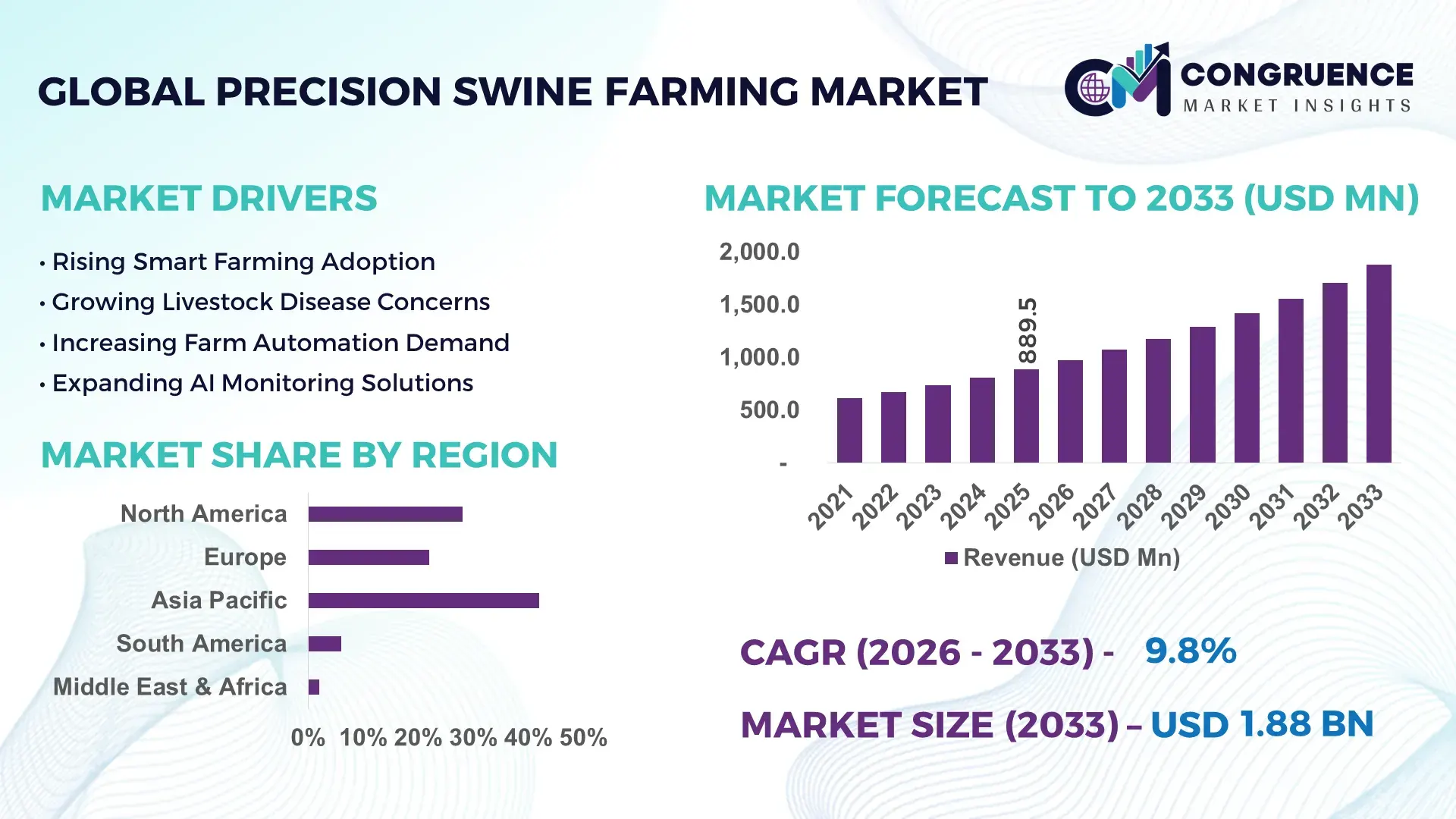
The Global Precision Swine Farming Market was valued at USD 889.5 Million in 2025 and is anticipated to reach a value of USD 1,876.4 Million by 2033 expanding at a CAGR of 9.78% between 2026 and 2033. Rising deployment of AI-enabled livestock monitoring systems, automated feeding platforms, and sensor-based health analytics is accelerating operational efficiency across commercial pig farms, reducing feed waste by over 18% while improving mortality management accuracy by nearly 22%. The market is further reshaping due to tightening biosecurity regulations across Asia and Europe following recurring African Swine Fever outbreaks, forcing large-scale producers to accelerate digital livestock management investments between 2024 and 2026.
China dominates the global precision swine farming landscape with nearly 34% market share, supported by its large-scale commercial pork production infrastructure and aggressive smart agriculture modernization initiatives. More than 62% of newly established industrial pig farms in Eastern China integrated automated ventilation, RFID-based tracking, and intelligent disease detection systems in 2025, compared to less than 39% adoption across several Latin American markets. Government-backed agricultural digitization programs exceeding USD 1.2 billion, combined with vertically integrated pork processing giants, continue strengthening domestic deployment capacity. In comparison, North America leads in predictive livestock analytics sophistication, while China maintains unmatched operational scale and production throughput.
As labor shortages, disease risks, and feed optimization pressures intensify globally, precision swine farming is rapidly becoming a strategic operational necessity rather than a discretionary technology upgrade.
Market Size & Growth: USD 889.5 Million in 2025 reaching USD 1,876.4 Million by 2033, driven by AI-powered livestock analytics and automated feeding optimization.
Top Growth Drivers: Automated monitoring adoption rose 31%, smart feeding systems 27%, and disease surveillance integration 24% globally.
Short-Term Forecast: By 2028, precision feeding systems are projected to reduce feed costs by 16% and improve herd efficiency by 21%.
Emerging Technologies: AI imaging, IoT livestock sensors, and robotic cleaning systems improved operational productivity by over 28% in advanced farms.
Regional Leaders: Asia-Pacific holds USD 356 Million market demand, North America leads predictive analytics adoption, while Europe accelerates ESG-compliant livestock automation.
Consumer/End-User Trends: Over 58% of large commercial swine farms prioritized real-time animal health monitoring deployment in 2025.
Pilot/Case Example: In 2025, a Danish smart farming deployment reduced disease detection response time by 34% through AI-based monitoring.
Competitive Landscape: Top players control nearly 41% market share, led by Zoetis, Fancom, Big Dutchman, Nedap, and DeLaval.
Regulatory & ESG Impact: Emission-focused livestock regulations reduced antibiotic dependency by 19% across digitally monitored European swine farms.
Investment & Funding: Global investments surpassed USD 920 Million, fueled by automation partnerships and smart agriculture infrastructure expansion.
Innovation & Future Outlook: Edge analytics, autonomous livestock tracking, and precision nutrition platforms are redefining high-efficiency commercial swine operations.
Commercial pork production facilities account for nearly 49% of overall precision swine farming technology deployment, followed by integrated livestock management operations at 33% and veterinary monitoring applications at 18%. AI-enabled disease detection systems improved livestock response efficiency by over 26%, while automated feeding platforms reduced nutrient wastage by approximately 17% across industrial farms. Asia-Pacific continues leading production-scale deployment, whereas Europe is accelerating compliance-driven smart livestock adoption amid tightening animal welfare regulations and sustainability targets. Simultaneously, supply chain digitization and biosecurity modernization are reshaping procurement strategies, positioning intelligent livestock management systems as a long-term competitive differentiator heading into the next phase of agricultural automation.
Precision swine farming is rapidly transforming from an operational enhancement tool into a core competitive infrastructure layer for global livestock producers. Rising biosecurity threats, labor shortages, feed cost volatility, and stricter livestock welfare regulations are accelerating the shift toward data-driven farm automation across industrial pork production ecosystems. Large commercial producers are increasingly prioritizing predictive analytics, automated health surveillance, and intelligent feeding optimization to secure production continuity, improve herd performance, and stabilize operating margins in a highly volatile agricultural environment.
Global supply chain restructuring following recurring disease outbreaks and feed inflation pressures has intensified investment into digitally integrated livestock systems. AI-enabled monitoring platforms now improve disease detection efficiency by 32% while reducing manual labor dependency by nearly 24% compared to legacy visual inspection systems. Similarly, automated precision feeding technologies reduce feed wastage by approximately 18% while improving weight consistency across herds by more than 21%, creating measurable operational advantages for large-scale producers. Asia-Pacific leads in production scale and deployment volume with over 42% of global implementation activity, while North America leads in predictive analytics sophistication and cloud-based livestock management adoption with nearly 37% penetration across industrial farms. Europe continues reshaping the competitive landscape through stringent ESG and animal welfare compliance frameworks, forcing producers to modernize monitoring infrastructure and antibiotic tracking systems.
Within the next three years, intelligent ventilation and real-time livestock health platforms are projected to reduce disease-related operational losses by over 27% across technologically advanced swine farms. ESG-linked precision farming systems are also creating measurable compliance advantages by reducing antibiotic usage intensity by nearly 19% and improving environmental reporting accuracy. In Denmark, one AI-powered livestock monitoring deployment improved early disease detection rates by 33% while reducing veterinary intervention delays by 29%. Major agritech providers and livestock equipment manufacturers are aggressively shifting capital allocation toward integrated automation ecosystems, cloud-connected farm intelligence platforms, and sensor-driven biosecurity infrastructure. Companies optimizing operational visibility, traceability, and predictive herd management are securing long-term competitive positioning as precision swine farming rapidly becomes the defining productivity benchmark for industrial livestock production worldwide.
The Precision Swine Farming Market is undergoing rapid transformation as commercial livestock operators increasingly prioritize automation, predictive analytics, and digital herd management to improve operational efficiency and disease resilience. Rising pressure to optimize feed utilization, reduce labor dependency, and strengthen biosecurity controls is reshaping investment priorities across industrial pig farming ecosystems. Advanced technologies including IoT-enabled livestock sensors, AI-driven health monitoring platforms, and automated environmental control systems are becoming standard infrastructure within large-scale swine operations. Global livestock production volatility, recurring disease outbreaks, and tightening sustainability regulations are further accelerating technology deployment across both developed and emerging agricultural markets. More than 57% of industrial swine facilities are actively integrating real-time monitoring systems to improve mortality management and production consistency. Simultaneously, agritech providers are expanding partnerships with commercial pork producers to scale cloud-based analytics, intelligent feeding systems, and automated waste management solutions. The market is increasingly defined by operational digitization, production traceability, and data-centric livestock optimization strategies that directly influence profitability, compliance, and long-term scalability.
AI-powered livestock analytics and automated herd management systems are becoming the primary growth engine for precision swine farming as producers confront rising feed costs, labor shortages, and disease management pressures. Automated precision feeding platforms are reducing feed wastage by nearly 18%, while real-time health monitoring systems improve disease detection speed by over 30%, significantly enhancing operational consistency across large-scale farms. Following recurring African Swine Fever disruptions across Asia and Europe, commercial producers accelerated biosecurity digitization investments by approximately 26% between 2024 and 2025. The direct operational impact is forcing livestock companies to modernize legacy farm infrastructure through sensor deployment, predictive analytics integration, and automated environmental control systems. In response, major equipment manufacturers and agritech firms are expanding production capacity, forming strategic partnerships, and accelerating cloud-based livestock platform development. Large integrated pork producers are increasingly prioritizing vertically connected digital ecosystems capable of optimizing mortality rates, feed conversion efficiency, and traceability performance simultaneously. This structural technology shift is redefining productivity benchmarks across global industrial swine production.
Despite accelerating adoption, high upfront infrastructure costs and fragmented farm connectivity remain major barriers limiting precision swine farming scalability, particularly among small and mid-sized producers. Advanced automated feeding systems, AI monitoring platforms, and sensor-based livestock analytics can increase initial facility upgrade costs by nearly 28% to 35%, creating affordability constraints across emerging agricultural economies. In several rural livestock regions, less than 46% of commercial farms maintain stable digital infrastructure capable of supporting real-time monitoring systems. Operational complexity is further intensified by incompatible software ecosystems and limited interoperability between livestock hardware platforms. Delayed integration timelines and rising maintenance expenses are increasing operational transition risks for producers attempting full-scale automation deployment. In response, companies are diversifying supplier networks, introducing modular technology packages, and negotiating long-term software support agreements to improve adoption flexibility. Several agritech providers are also prioritizing subscription-based livestock analytics models to reduce capital expenditure burdens. However, inconsistent infrastructure readiness and data standardization gaps continue constraining broader market penetration and long-term deployment scalability.
The next major opportunity within precision swine farming is emerging from predictive biosecurity intelligence, automated disease surveillance, and integrated livestock analytics ecosystems. AI-based herd monitoring systems are improving early disease identification accuracy by nearly 33%, while smart ventilation technologies reduce livestock stress-related productivity losses by over 20%. Demand for cloud-connected farm management platforms increased by approximately 29% in 2025 as producers seek centralized operational visibility across multi-site livestock facilities. A major future signal reshaping the market is the integration of edge computing and machine vision technologies capable of delivering real-time behavioral analytics without heavy manual intervention. This shift is creating non-obvious operational advantages through reduced veterinary costs, lower antibiotic dependency, and improved production forecasting precision. In response, technology providers are aggressively investing in R&D, expanding AI partnerships, and building integrated livestock automation ecosystems targeting industrial pork production networks. Companies establishing scalable predictive farming infrastructure today are positioning themselves to dominate future smart livestock management markets driven by traceability, sustainability, and biosecurity optimization requirements.
Execution complexity, workforce capability gaps, and system scalability challenges remain critical long-term risks for the precision swine farming industry. Although automated livestock systems improve efficiency, nearly 39% of commercial producers report difficulties integrating AI-driven platforms into existing farm operations due to limited technical expertise and fragmented equipment compatibility. In several emerging markets, fewer than 44% of livestock operators possess advanced digital management capabilities required for fully automated farm environments.Real-world pressures including rising energy costs, rural connectivity limitations, and fluctuating agricultural input prices are further constraining operational consistency. High-performance monitoring systems increase energy consumption by approximately 14%, forcing producers to balance productivity optimization against infrastructure cost pressures. Additionally, maintaining cybersecurity protection across connected livestock ecosystems is becoming increasingly critical as cloud-based farm management adoption expands. To remain competitive, companies must invest aggressively in workforce training, interoperable system architecture, strategic technology partnerships, and resilient infrastructure capable of supporting large-scale digital livestock operations without compromising operational continuity or profitability.
34% Faster Disease Detection Through AI Vision Deployment Advanced AI imaging systems are reshaping livestock health monitoring across industrial swine farms. More than 52% of newly digitized facilities integrated machine-vision disease surveillance in 2025, reducing manual inspection dependency by 31%. Producers are restructuring operational workflows around predictive health alerts and automated anomaly detection to minimize livestock mortality and improve intervention speed amid rising biosecurity pressure following recurring global disease outbreaks.
27% Increase in Automated Feeding System Integration Across Large Farms Precision feeding platforms are rapidly replacing manual nutrient management processes as producers optimize feed conversion efficiency and reduce operational waste. Automated feeding deployment expanded across 48% of commercial farms, lowering feed wastage by nearly 18% while improving herd growth consistency by 22%. Companies are scaling integrated feeding analytics platforms to counter feed price volatility and labor shortages impacting global livestock operations.
41% Expansion in Cloud-Connected Multi-Site Livestock Management Swine producers are increasingly centralizing operational oversight through cloud-based farm intelligence platforms capable of monitoring multiple production facilities simultaneously. Real-time environmental monitoring adoption rose 29%, while centralized production analytics improved operational response efficiency by 24%. Agritech firms are aggressively forming software partnerships and subscription-based deployment models to accelerate scalable adoption among vertically integrated pork producers.
19% Reduction in Antibiotic Dependency Through Smart Monitoring Systems Regulatory pressure and ESG-driven procurement standards are forcing producers to shift toward sensor-based livestock wellness tracking and automated environmental optimization. More than 44% of advanced farms deployed intelligent ventilation and stress-monitoring systems in 2025, improving animal welfare compliance while reducing treatment intervention frequency. A non-obvious shift emerging across Europe and Asia involves retailers prioritizing digitally traceable pork supply chains, redefining competitive positioning for commercial producers.
The Precision Swine Farming Market is segmented across technology-driven livestock management types, operational applications, and diversified end-user groups, reflecting the growing complexity of modern commercial swine production ecosystems. Demand remains heavily concentrated in automated monitoring and feeding technologies, which collectively account for over 58% of total deployment activity due to their direct impact on productivity optimization, disease management, and operational efficiency. Application demand is increasingly shifting toward real-time herd analytics and biosecurity management as commercial producers prioritize traceability, compliance, and predictive livestock intelligence. Large-scale commercial farms continue dominating end-user adoption with nearly 61% market participation, driven by higher infrastructure capacity and faster digital transformation capabilities. However, integrated livestock cooperatives and mid-sized producers are accelerating investments in modular automation systems to improve production scalability and reduce operational risk exposure. Companies across the ecosystem are strategically expanding cloud-based analytics, AI-enabled monitoring, and precision nutrition platforms to capture evolving demand patterns tied to efficiency, sustainability, and livestock health optimization.
Automated feeding systems dominate the Precision Swine Farming Market with approximately 36% share due to their direct influence on feed efficiency, livestock growth consistency, and operational cost optimization. Large-scale swine producers increasingly prioritize precision nutrition platforms capable of reducing feed wastage by nearly 18% while improving weight management accuracy across industrial herds. Environmental monitoring systems remain the second-largest segment, benefiting from rising demand for automated ventilation control and real-time livestock condition tracking. AI-driven livestock health monitoring systems represent the fastest-growing type segment, expanding adoption by nearly 29% as producers intensify investments in predictive disease surveillance and automated anomaly detection. Compared with conventional environmental monitoring platforms, AI-based health analytics deliver significantly faster disease identification and reduce manual inspection dependency across high-density livestock operations. Meanwhile, RFID tracking solutions, automated waste management systems, and smart breeding platforms collectively account for nearly 27% of market demand, maintaining strategic importance for compliance, traceability, and operational scalability. Demand is clearly shifting toward integrated, cloud-connected automation ecosystems rather than standalone farm technologies. In response, agritech providers are expanding AI capabilities, increasing sensor interoperability, and prioritizing modular deployment strategies to capture long-term smart livestock infrastructure investments. Businesses focusing on predictive herd intelligence and automated precision feeding technologies are securing the strongest competitive positioning within the evolving commercial swine production landscape.
Livestock health monitoring remains the leading application segment with approximately 34% market share, driven by the rising need for real-time disease detection, mortality reduction, and biosecurity management across industrial swine operations. Commercial producers increasingly depend on AI-enabled monitoring systems to improve herd surveillance accuracy and accelerate intervention response times during disease outbreaks. Precision feeding applications follow closely, benefiting from strong adoption among large-scale farms seeking to reduce feed costs and optimize nutrient allocation efficiency. Biosecurity management applications are emerging as the fastest-growing segment, recording nearly 28% adoption growth as producers strengthen containment protocols and traceability systems following global disease-related supply disruptions. Compared with mature feeding optimization applications, biosecurity-focused deployments are expanding faster due to regulatory pressure and retailer demand for digitally verifiable livestock management practices. Environmental control, reproductive management, and livestock traceability applications collectively contribute nearly 38% of total implementation activity, maintaining critical operational relevance across integrated swine production networks. Usage patterns are shifting from isolated farm-level applications toward centralized, multi-functional livestock intelligence platforms. Companies are responding by scaling integrated cloud ecosystems, expanding sensor connectivity, and repositioning product portfolios around predictive farm management capabilities. Demand is increasingly moving toward applications that combine operational automation, compliance visibility, and measurable productivity optimization within a single digital infrastructure framework.
Large commercial swine farms dominate the Precision Swine Farming Market with nearly 61% share due to their higher production scale, greater automation capacity, and stronger financial ability to modernize livestock infrastructure. These operators depend heavily on integrated monitoring systems, automated feeding technologies, and predictive analytics platforms to optimize herd productivity and reduce operational volatility. Their demand concentration is reinforced by growing pressure to improve traceability, strengthen disease prevention, and stabilize large-scale pork production consistency. Integrated livestock cooperatives represent the fastest-growing end-user group, recording adoption growth of approximately 26% as regional producers increasingly pool infrastructure investments to access advanced precision farming technologies. Compared with established industrial producers, cooperatives prioritize scalable, cost-efficient automation platforms capable of supporting multi-site livestock coordination and shared operational visibility. Meanwhile, veterinary service providers, research institutions, and mid-sized independent farms collectively account for nearly 24% of market demand, primarily focusing on specialized monitoring, health analytics, and breeding optimization applications. Buying behavior is increasingly shifting toward subscription-based analytics, modular deployment models, and integrated cloud ecosystems that reduce upfront infrastructure burdens. In response, technology providers are introducing flexible pricing strategies, strategic partnerships, and customizable livestock management solutions targeting varied operational scales. Future demand is clearly concentrating around intelligent, interoperable farm ecosystems that combine productivity optimization, compliance management, and real-time operational intelligence.
Asia-Pacific accounted for the largest market share at 42% in 2025 however, North America is expected to register the fastest growth, expanding at a CAGR of 10.4% between 2026 and 2033.

Asia-Pacific continues dominating global precision swine farming demand due to its massive pork production infrastructure, expanding commercial livestock operations, and accelerating smart agriculture investments across China, Vietnam, and South Korea. North America accounts for nearly 28% market share and leads in AI-based livestock analytics deployment, cloud-connected farm intelligence systems, and predictive herd management technologies. Europe contributes approximately 22% share, driven by strict animal welfare regulations, sustainability compliance requirements, and advanced environmental monitoring adoption. Meanwhile, South America and the Middle East & Africa collectively represent 8% of market activity, supported by gradual infrastructure modernization and localized commercial farming expansion. Supply chain digitization, disease prevention mandates, and labor optimization pressures are increasingly reshaping regional investment priorities, forcing global agritech providers to expand strategic partnerships and scalable automation ecosystems across high-growth livestock production markets.
North America holds approximately 28% of the global Precision Swine Farming Market, driven by large-scale commercial pork production, advanced livestock automation infrastructure, and strong adoption of predictive herd analytics. The United States and Canada continue expanding AI-enabled disease surveillance, automated feeding systems, and cloud-based livestock management platforms to reduce operational inefficiencies and improve traceability compliance. More than 54% of industrial swine farms integrated real-time livestock monitoring technologies in 2025, while automated feeding deployment improved feed conversion efficiency by nearly 19%. Rising labor shortages and stricter biosecurity expectations are accelerating digital farm transformation strategies. Major agritech companies are expanding sensor deployment partnerships and intelligent livestock analytics capabilities, positioning North America as a high-priority investment hub for scalable, technology-driven swine production modernization.
Europe accounts for nearly 22% of the global Precision Swine Farming Market, supported by aggressive sustainability mandates, advanced animal welfare regulations, and strong smart agriculture adoption across Germany, Denmark, the Netherlands, and Spain. Stricter ESG compliance frameworks reduced antibiotic dependency across digitally monitored farms by approximately 19%, accelerating investments in automated health monitoring and environmental optimization systems. More than 47% of large commercial swine facilities implemented intelligent ventilation and welfare tracking platforms to align with evolving livestock sustainability requirements. European producers increasingly prioritize traceability-focused operations and precision nutrition systems to improve compliance efficiency and export competitiveness. Agritech providers are strategically expanding AI-driven biosecurity platforms and sensor-integrated monitoring ecosystems as regulatory pressure continues forcing operational innovation across industrial livestock production networks.
Asia-Pacific leads the Precision Swine Farming Market with approximately 42% share, driven by large-scale pork production capacity, aggressive agricultural modernization, and rapid smart farming adoption across China, Vietnam, Japan, and South Korea. China alone contributes more than 34% of global precision swine deployment activity due to expanding industrial livestock infrastructure and government-backed agricultural digitization programs. More than 62% of newly developed commercial pig farms integrated automated feeding, RFID tracking, and intelligent disease monitoring systems in 2025. Regional producers prioritize scalability, production speed, and operational resilience amid recurring disease-related disruptions and supply chain volatility. Agritech firms are rapidly expanding localized manufacturing partnerships and cloud-based livestock intelligence platforms, making Asia-Pacific the most critical region for production-scale deployment and long-term market expansion.
South America contributes nearly 6% of the global Precision Swine Farming Market, led by Brazil, Argentina, and Chile through expanding commercial pork production and gradual livestock automation adoption. Rising feed price volatility and export-focused livestock production are driving demand for precision feeding and environmental monitoring technologies across industrial farms. However, inconsistent rural connectivity infrastructure and higher equipment import dependency continue constraining large-scale digital deployment across several agricultural zones. Approximately 31% of advanced swine operations implemented sensor-based monitoring systems in 2025, while automated feeding adoption improved production efficiency by nearly 15%. Producers remain highly cost-sensitive and prioritize modular, scalable technologies with measurable operational returns. The region presents strong long-term expansion potential but requires infrastructure investment and localized technology adaptation to sustain competitive growth.
The Middle East & Africa accounts for approximately 2% of the global Precision Swine Farming Market, supported by gradual agricultural modernization initiatives, expanding food security investments, and rising adoption of digital livestock management systems in South Africa and selected Gulf economies. Large commercial farming operators are increasingly deploying automated environmental monitoring and precision feeding platforms to improve production consistency under resource-constrained conditions. Nearly 24% of technologically advanced livestock facilities implemented sensor-based operational systems in 2025, while infrastructure modernization programs improved farm automation capacity by approximately 13%. Enterprise buyers prioritize efficiency optimization, operational visibility, and long-term cost control through scalable smart farming deployments. Strategic partnerships between agritech firms and regional agricultural investors are accelerating technology transfer, positioning the region as an emerging transformation market within precision livestock management ecosystems.
China – 34% Market share: Dominates through massive industrial pork production capacity, aggressive agricultural digitization, and large-scale deployment of automated livestock management systems.
United States – 21% Market share: Leads in AI-enabled herd analytics, cloud-connected farm intelligence platforms, and high adoption of predictive livestock monitoring technologies across commercial swine operations.
The Precision Swine Farming Market is dominated by competition between global livestock automation leaders such as Zoetis, Big Dutchman, DeLaval, Nedap, Fancom, and Merck Animal Health, alongside fast-scaling regional agritech integrators focused on cost-efficient smart farming deployment. Global technology leaders compete aggressively on AI-driven livestock analytics, predictive monitoring accuracy, and integrated automation ecosystems, while regional suppliers compete primarily on customization speed, lower installation costs, and localized service networks.
The top five players collectively control approximately 41% of global market activity, reflecting a semi-consolidated competitive structure driven by technology differentiation and infrastructure scale. AI-enabled monitoring systems improve livestock detection efficiency by nearly 32%, while automated feeding platforms reduce feed waste by approximately 18%, making performance optimization the primary basis of competition. Additionally, cloud-connected farm intelligence platforms have improved operational response speed by over 24%, forcing suppliers to prioritize interoperability and real-time analytics capabilities.
Competition is rapidly shifting toward vertically integrated smart livestock ecosystems combining health analytics, biosecurity, feeding automation, and traceability management within unified digital platforms. Companies are accelerating expansion through sensor technology partnerships, localized manufacturing, and software-driven subscription models. However, high infrastructure costs, interoperability complexity, and biosecurity compliance requirements remain major entry barriers. Winning in this market increasingly depends on delivering scalable, AI-integrated livestock intelligence systems capable of optimizing productivity, compliance, and operational resilience simultaneously.
Big Dutchman
DeLaval
Nedap
Fancom
Merck Animal Health
Elanco Animal Health
GEA Group
SKOV A/S
Osborne Industries Inc.
AgriHub Inc.
PigTek
RoboAgri
Hotraco Agri
Precision swine farming technologies are rapidly evolving from isolated automation tools into fully integrated livestock intelligence ecosystems. Current deployments are heavily centered around AI-powered disease detection, IoT-enabled environmental monitoring, and automated precision feeding systems that optimize herd productivity in real time. More than 58% of advanced commercial swine farms now utilize connected sensor platforms capable of tracking animal movement, temperature, ventilation, and feeding behavior simultaneously. These systems improve disease detection speed by nearly 32% while reducing feed wastage by approximately 18%.
A major technology shift reshaping the industry involves the transition from rule-based livestock management toward predictive AI analytics and machine vision systems. Compared with legacy manual monitoring processes, AI-enabled behavioral analytics platforms improve operational response accuracy by over 29% and reduce labor dependency by nearly 24%. Companies benefiting most from this transition are large integrated pork producers and agritech platform providers capable of scaling cloud-connected multi-site monitoring infrastructure.
Emerging technologies including edge computing, RFID-linked traceability systems, autonomous robotic cleaning platforms, and digital twin livestock modeling are redefining execution-level farm optimization. Nearly 44% of newly modernized swine facilities integrated smart ventilation automation in 2025 to improve animal welfare compliance and environmental efficiency. Simultaneously, machine-learning-based breeding optimization systems are gaining traction among high-volume producers focused on herd consistency and productivity stabilization.
Between 2026 and 2028, predictive livestock intelligence platforms and interoperable farm automation ecosystems are expected to become the operational benchmark across industrial pork production. Companies acting early on integrated analytics, biosecurity automation, and scalable cloud infrastructure are securing long-term competitive advantages in efficiency, traceability, and regulatory readiness.
November 2024 – Big Dutchman launched the “SmartCounting” AI-powered livestock counting system for swine operations, delivering 99.9% counting accuracy across automated barn environments. The deployment significantly reduced manual inventory verification time and improved operational tracking precision for large commercial pig farms. [AI Livestock Tracking] Source: www.bigdutchman.com
November 2024 – Big Dutchman introduced the DR 6500 dry-feed conveying system capable of transporting up to 6,500 kg/h of feed within industrial livestock facilities. The innovation improved feed distribution efficiency while minimizing contamination risks and supporting large-scale automated swine nutrition management. [Feed Logistics Upgrade]
August 2025 – Zoetis announced 8% organic operational growth and accelerated investment into advanced livestock health technologies, including predictive monitoring and precision animal care systems supporting commercial swine production. The expansion strengthened the company’s position in integrated digital livestock management infrastructure. [Predictive Health Expansion]
December 2025 – Zoetis highlighted its next-generation animal health innovation pipeline featuring 12 potential blockbuster candidates and expanded R&D initiatives targeting advanced livestock care technologies. The strategic push accelerated intelligent disease prevention and precision livestock monitoring capabilities across global agricultural markets. [R&D Acceleration Push]
The Precision Swine Farming Market Report delivers comprehensive coverage across core livestock automation technologies, operational applications, end-user ecosystems, and regional deployment dynamics shaping industrial swine production modernization. The report analyzes critical technology segments including AI-enabled livestock monitoring, automated feeding systems, environmental control platforms, RFID-based traceability solutions, and predictive herd analytics infrastructure. Application-level evaluation covers livestock health management, biosecurity optimization, feeding automation, breeding intelligence, and cloud-connected farm operations across commercial and integrated farming environments.
The report provides detailed assessment across North America, Europe, Asia-Pacific, South America, and the Middle East & Africa, incorporating comparative demand concentration, deployment intensity, operational maturity, and infrastructure readiness insights. More than 58% of large-scale commercial farms currently prioritize intelligent livestock monitoring deployment, while nearly 44% of newly modernized facilities are integrating automated environmental control systems. The analysis further profiles leading agritech providers, livestock automation companies, and animal health technology developers competing across predictive farming ecosystems.
Strategically, the report supports investment planning, geographic expansion, technology prioritization, partnership evaluation, and competitive benchmarking for stakeholders across the livestock value chain. It also captures emerging opportunities tied to edge analytics, AI-driven disease surveillance, cloud-connected multi-site management, and ESG-focused livestock optimization trends expected to reshape smart farming adoption patterns between 2026 and 2033.
| Report Attribute / Metric | Details |
|---|---|
| Market Revenue (2025) | USD 889.5 Million |
| Market Revenue (2033) | USD 1,876.4 Million |
| CAGR (2026–2033) | 9.78% |
| Base Year | 2025 |
| Forecast Period | 2026–2033 |
| Historic Period | 2021–2025 |
| Segments Covered |
By Type
By Application
By End-User Insights
|
| Key Report Deliverables | Revenue Forecast; Market Trends; Growth Drivers & Restraints; Technology Insights; Segmentation Analysis; Regional Insights; Competitive Landscape; Regulatory & ESG Overview; Recent Developments |
| Regions Covered | North America; Europe; Asia-Pacific; South America; Middle East & Africa |
| Key Players Analyzed | Zoetis; Big Dutchman; DeLaval; Nedap; Fancom; Merck Animal Health; Elanco Animal Health; GEA Group; SKOV A/S; Osborne Industries Inc.; AgriHub Inc.; PigTek; RoboAgri; Hotraco Agri |
| Customization & Pricing | Available on Request (10% Customization Free) |




