
Reports
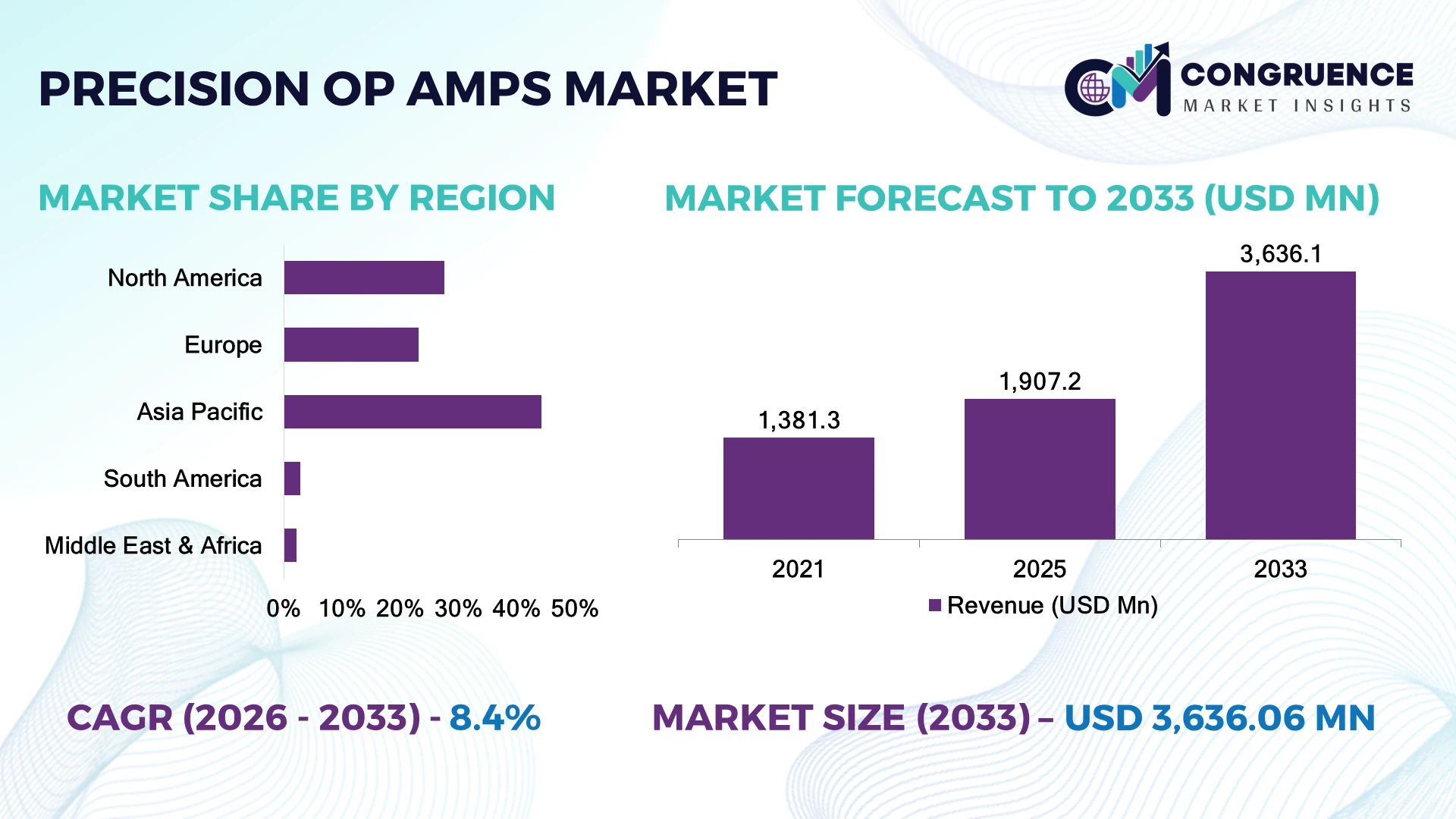
The Global Precision Op Amps Market was valued at USD 1,907.2 Million in 2025 and is anticipated to reach a value of USD 3,636.1 Million by 2033 expanding at a CAGR of 8.4% between 2026 and 2033. Growth is driven by increasing deployment of high-accuracy signal conditioning in industrial automation, battery management systems, medical electronics, and precision measurement equipment.
The United States accounts for approximately 29% of global precision op amp demand, supported by advanced semiconductor design, medical device manufacturing, aerospace electronics, and industrial instrumentation. Compared with Japan's analogue semiconductor ecosystem, the United States invests nearly 2.1 times more in mixed-signal IC development while precision analogue adoption has improved by approximately 24% across next-generation industrial control platforms. Ongoing semiconductor supply-chain diversification following geopolitical export restrictions continues strengthening regional analogue chip manufacturing capacity and strategic investment.
Companies expanding precision analogue design capabilities, resilient wafer sourcing, and application-specific product portfolios are strengthening long-term competitive positioning in high-performance electronics.
Market Size & Growth: USD 1,907.2 million in 2025 to USD 3,636.1 million by 2033 at 8.4% CAGR, driven by industrial automation and precision sensing.
Top Growth Drivers: Industrial automation (+28%), EV battery systems (+25%), medical electronics (+22%).
Short-Term Forecast: By 2028, analogue signal accuracy improves 17% while power consumption declines 14%.
Emerging Technologies: Zero-drift architecture, AI-assisted calibration, silicon-on-insulator processes accelerate innovation.
Regional Leaders: North America (~USD 1.1 billion), Asia-Pacific (~USD 1.4 billion), Europe (~USD 0.8 billion), supported by advanced electronics manufacturing.
Consumer/End-User Trends: Approximately 64% of industrial control platforms now integrate precision analogue amplification.
Pilot/Case Example: 2026 smart factory deployment reduced sensor measurement errors by nearly 21%.
Competitive Landscape: Leading supplier controls approximately 19% share alongside Analog Devices, Texas Instruments, STMicroelectronics, and Renesas.
Regulatory & ESG Impact: Low-power analogue designs reduce energy consumption by approximately 16% in embedded electronics.
Investment & Funding: More than USD 2.4 billion supports analogue semiconductor expansion and wafer capacity diversification.
Innovation & Future Outlook: Precision analogue integration and intelligent sensor interfaces redefine mixed-signal system performance.
Precision op amps are becoming indispensable in industrial sensors, healthcare equipment, renewable energy systems, and automotive electronics as designers prioritise higher accuracy with lower power consumption. Nearly 58% of new precision analogue designs now integrate zero-drift architectures. Semiconductor localisation initiatives and resilient wafer sourcing continue strengthening supply stability, setting the stage for deeper strategic market transformation.
The Precision Op Amps Market has become strategically significant as industries demand higher measurement accuracy, lower signal drift, and greater energy efficiency across automation, electric mobility, medical diagnostics, and precision instrumentation. Supply-chain restructuring and regional semiconductor manufacturing investments are strengthening analogue chip availability while reducing dependence on concentrated fabrication ecosystems. Precision analogue components are increasingly recognised as essential enablers of intelligent sensing rather than supporting circuitry.
Modern zero-drift precision op amps reduce offset error by approximately 95% and lower calibration requirements by nearly 20% compared with conventional bipolar amplifier designs. The United States continues leading analogue IC innovation through advanced semiconductor design, while Japan maintains strength in high-reliability industrial and automotive analogue devices. During the next two to three years, more than 43% of advanced industrial sensing platforms are expected to adopt ultra-low-power precision amplification to support edge intelligence and predictive maintenance.
A practical example is battery management systems in electric vehicles, where precision op amps continuously monitor cell voltage and current to improve safety and charging efficiency. Semiconductor manufacturers are expanding analogue wafer capacity, strengthening long-term foundry partnerships, and accelerating development of application-specific analogue portfolios. Companies combining superior precision, power efficiency, and reliable supply chains will establish stronger competitive positions as high-accuracy electronics become fundamental to next-generation industrial and automotive systems.
The rapid expansion of intelligent sensing across industrial automation, electric vehicles, and medical electronics is accelerating demand for precision op amps with ultra-low offset voltage and minimal drift. Approximately 66% of next-generation industrial sensor modules now incorporate precision analogue amplification, while zero-drift amplifier adoption has increased by nearly 27% in high-accuracy measurement systems. The United States continues expanding domestic analogue semiconductor investment following semiconductor supply-chain realignment, strengthening access to advanced mixed-signal technologies. Higher signal integrity directly improves equipment reliability and predictive maintenance accuracy. Semiconductor companies are increasing analogue wafer capacity, developing application-specific amplifier families, and forming strategic partnerships with sensor manufacturers. A key competitive advantage now lies in delivering precision amplification optimised for integrated edge sensing rather than standalone analogue performance.
Precision op amp production remains constrained by reliance on specialised analogue wafer fabrication, mature process nodes, and high-performance packaging technologies. Wafer processing and packaging contribute approximately 43% of manufacturing costs, while analogue fabrication lead times remain nearly 19% higher than standard mixed-signal production during periods of capacity constraints. Export restrictions on semiconductor manufacturing equipment continue influencing analogue production planning in Taiwan and neighbouring fabrication hubs. These structural limitations delay product launches, increase procurement costs, and reduce flexibility for industrial customers requiring long lifecycle support. Manufacturers are reducing exposure through multi-foundry strategies, regional fabrication partnerships, long-term wafer agreements, and expanded backend assembly localisation to improve operational resilience.
Precision op amps are gaining new opportunities as edge computing platforms require accurate analogue front-end architectures for AI-enabled sensing, battery diagnostics, and industrial monitoring. Integrated precision analogue interfaces reduce signal conditioning complexity by approximately 22%, while lowering system power consumption by nearly 16%. Japan is expanding investment in intelligent manufacturing and factory automation, increasing demand for precision analogue devices supporting edge analytics. Semiconductor suppliers are strengthening R&D collaborations, integrating precision amplifiers into mixed-signal platforms, and expanding reference design ecosystems. A significant strategic opportunity lies in embedding precision analogue intelligence directly into distributed sensing nodes, reducing processing loads and improving real-time operational decision-making.
Maintaining precision performance across increasingly integrated mixed-signal architectures presents a major engineering challenge as digital switching noise, thermal variation, and miniaturised layouts affect analogue accuracy. Approximately 35% of analogue design validation effort is now dedicated to signal integrity optimisation, while electromagnetic interference mitigation increases engineering workloads by nearly 18%. Germany's advanced industrial electronics manufacturers continue demanding tighter precision specifications for automation equipment. Poor analogue integration reduces measurement reliability, extends product qualification timelines, and increases redesign costs. Semiconductor companies must invest in advanced simulation tools, analogue design expertise, collaborative ecosystem development, and robust validation methodologies to sustain long-term competitiveness in precision electronics.
Zero-Drift Designs Accelerate: Zero-drift precision op amps now account for approximately 44% of new industrial analogue designs, reducing offset error by nearly 95% and calibration requirements by around 20%. Industrial automation upgrades are driving adoption, prompting semiconductor suppliers to expand precision analogue portfolios and optimise manufacturing for higher-volume production.
Low-Power Architectures Expand: Ultra-low-power precision amplifiers reduce energy consumption by approximately 18% while extending battery-powered device operating life by nearly 24%. Increasing deployment of portable medical equipment and wireless sensors is reshaping analogue IC design priorities. Companies are restructuring product roadmaps around energy-efficient architectures and advanced process technologies.
Automotive Qualification Strengthens: Automotive-qualified precision op amp deployment has increased by approximately 29% as electric vehicle battery management and advanced driver assistance systems demand higher measurement accuracy. Functional safety requirements are encouraging closer collaboration between semiconductor suppliers and automotive OEMs, accelerating application-specific product development and long-term qualification programmes.
Integrated Analogue Platforms Rise: Precision op amps integrated within complete analogue front-end platforms have increased by approximately 26%, reducing board space by nearly 17% and simplifying system design. Semiconductor localisation initiatives are encouraging broader ecosystem partnerships. Suppliers are expanding mixed-signal integration capabilities, enabling faster product development while strengthening competitive differentiation through application-focused analogue solutions.
Zero-Drift Precision Op Amps account for approximately 39% of the global Precision Op Amps market, reflecting their widespread use in industrial automation, medical instrumentation, precision weighing systems, and battery management applications where ultra-low offset voltage and long-term stability are essential. Their ability to minimise temperature-induced drift and calibration requirements has made them the preferred solution for high-reliability analogue signal chains. Low-Noise Precision Op Amps continue serving mature demand across laboratory instrumentation, audio measurement, and aerospace electronics, while High-Speed Precision Op Amps remain critical for data acquisition, imaging equipment, and communications infrastructure.
CMOS Precision Op Amps represent the fastest-growing type as portable medical devices, wearable electronics, battery-powered sensors, and edge computing platforms increasingly require low-power analogue performance. CMOS-based precision amplifier adoption has increased by approximately 29%, while integrated analogue front-end solutions have improved system power efficiency by nearly 18%. Semiconductor manufacturers are expanding mixed-signal product portfolios, investing in advanced CMOS analogue processes, and integrating precision amplification into application-specific platforms. Demand is steadily shifting toward highly integrated, energy-efficient analogue architectures that simplify system design while supporting next-generation intelligent electronics.
According to a 2026 assessment published by the International Electrotechnical Commission (IEC), precision analogue components with low drift and high stability remain fundamental to industrial measurement systems where long-term accuracy directly influences operational reliability and process control.
Industrial Automation accounts for approximately 34% of the Precision Op Amps market, supported by widespread deployment in programmable logic controllers, process instrumentation, machine vision, and precision sensor interfaces. High measurement accuracy, low offset voltage, and long-term stability make precision op amps indispensable for factory control systems and predictive maintenance applications. Medical Devices continue representing a mature high-value segment where diagnostic equipment and patient monitoring require ultra-low-noise analogue performance, while Test & Measurement and Energy Management maintain consistent demand through precision sensing and power monitoring applications.
Automotive Electronics is the fastest-growing application as electric vehicles, battery management systems, and advanced driver assistance platforms require increasingly accurate current, voltage, and temperature measurement. Precision analogue integration in automotive control units has increased by approximately 28%, while low-power amplifier adoption has improved battery monitoring efficiency by nearly 17%. Semiconductor manufacturers are expanding automotive-qualified product portfolios, strengthening OEM collaborations, and integrating precision amplifiers into complete analogue front-end solutions. Demand is increasingly shifting toward application-specific analogue platforms that combine high reliability, compact integration, and long operational life for safety-critical electronic systems.
According to a 2026 industrial electronics assessment by the International Electrotechnical Commission (IEC), precision analogue signal conditioning remains a critical requirement for advanced automation systems where measurement accuracy directly influences process stability and equipment reliability.
Semiconductor and Industrial Equipment OEMs account for approximately 41% of total Precision Op Amps demand due to large-scale integration into automation equipment, instrumentation platforms, medical electronics, and embedded control systems. High production volumes, stringent accuracy requirements, and long product qualification cycles sustain procurement across this segment. Consumer electronics manufacturers continue driving stable demand through portable devices and wearables, while aerospace and defence organisations prioritise high-reliability analogue components for mission-critical systems requiring exceptional signal integrity.
Automotive OEMs and Tier-1 Suppliers represent the fastest-growing end-user segment as vehicle electrification and intelligent electronic architectures expand precision analogue requirements. Procurement of automotive-grade precision op amps has increased by approximately 31%, while integrated analogue front-end adoption has improved system efficiency by nearly 18%. Semiconductor suppliers are responding through application-specific product families, long-term supply agreements, and collaborative design partnerships with automotive manufacturers. Future demand is increasingly concentrated in electrified mobility, industrial intelligence, and healthcare electronics, where precision analogue performance has become a fundamental competitive differentiator.
According to a 2025 enterprise survey published by SEMI, analogue semiconductor suppliers reported sustained growth in demand for precision signal-conditioning components across industrial automation, automotive electronics, and advanced sensing applications as OEMs increased investment in high-accuracy electronic systems.
Asia-Pacific accounted for the largest market share at 44.3% in 2025 however, Middle East & Africa is expected to register the fastest growth, expanding at a CAGR of 9.0% between 2026 and 2033.

High-Performance Analogue Design Strengthens Industrial Electronics
North America represents approximately 27.6% of the global Precision Op Amps market, supported by advanced semiconductor design, industrial automation, medical electronics, and aerospace innovation. Enterprises continue integrating ultra-low-offset analogue components into precision sensing, battery management, and instrumentation systems requiring long-term measurement stability. Around 63% of newly developed industrial control platforms now incorporate high-precision analogue front-end architectures to improve system reliability and predictive diagnostics. Semiconductor companies are expanding analogue design centres, strengthening foundry partnerships, and increasing investment in application-specific mixed-signal products. Operational priorities increasingly focus on improving signal integrity, reducing power consumption, and accelerating qualification for industrial and automotive applications.
United States Market Outlook: The United States leads regional demand through its concentration of analogue semiconductor developers, advanced manufacturing facilities, and medical technology companies. Continuous investment in domestic semiconductor production and precision electronics is strengthening supply resilience for industrial and defence applications. Approximately 69% of newly introduced high-performance industrial measurement platforms incorporate precision analogue signal-conditioning solutions designed by domestic semiconductor innovators, reinforcing the country's leadership in advanced analogue IC development.
Industrial Automation Accelerates Analogue Innovation
Europe accounts for approximately 23.1% of global demand, supported by advanced factory automation, automotive electronics, precision instrumentation, and industrial process control. Manufacturers continue modernising production systems with high-accuracy sensing platforms that require low-noise analogue signal conditioning. Nearly 51% of industrial electronics upgrades now prioritise precision analogue components capable of improving measurement consistency and energy efficiency. Semiconductor suppliers are expanding collaborative development with industrial equipment manufacturers while increasing focus on functional safety, long product lifecycles, and environmentally efficient analogue device architectures.
Germany Market Outlook: Germany remains Europe's strategic hub for industrial electronics and precision automation technologies. Leading machinery manufacturers increasingly integrate high-performance analogue circuits into factory automation, robotics, and measurement equipment. Approximately 46% of precision industrial instrumentation projects utilise advanced analogue signal-conditioning architectures, encouraging semiconductor suppliers to strengthen engineering partnerships and local technical support capabilities.
Semiconductor Manufacturing Scale Drives Market Leadership
Asia-Pacific holds approximately 44.3% of the global market through its extensive semiconductor manufacturing ecosystem, electronics production, automotive supply chains, and expanding industrial automation investments. China, Japan, South Korea, and Taiwan continue strengthening analogue semiconductor manufacturing while supporting large-scale deployment across consumer electronics, electric vehicles, and industrial control systems. Around 67% of mixed-signal semiconductor packaging capacity serving precision analogue applications is concentrated within the region. Manufacturers are increasing wafer production, expanding advanced packaging capabilities, and reinforcing regional supply-chain integration to improve manufacturing resilience and export competitiveness.
Japan Market Outlook: Japan leads the region in high-reliability analogue semiconductor development for automotive, industrial automation, and medical electronics. Its expertise in precision manufacturing and quality assurance supports production of ultra-low-noise analogue devices for mission-critical applications. Approximately 58% of analogue semiconductor investments target high-precision industrial and automotive technologies, strengthening Japan's position in premium precision op amp development despite growing manufacturing competition.
Industrial Electronics Adoption Expands Gradually
South America is witnessing steady adoption of precision analogue technologies across industrial automation, energy infrastructure, healthcare equipment, and process industries. Manufacturers increasingly deploy high-accuracy sensing and control systems to improve operational efficiency and equipment reliability. Approximately 36% of industrial digitalisation projects now incorporate precision analogue signal-conditioning components. Dependence on imported semiconductors continues influencing procurement strategies, yet stronger regional electronics distribution networks and technical partnerships are improving product availability and engineering support for industrial customers.
Brazil Market Outlook: Brazil remains the largest regional market due to its diversified manufacturing sector, expanding industrial automation initiatives, and growing medical device industry. Industrial equipment manufacturers continue integrating precision analogue technologies into control systems and monitoring equipment to improve operational accuracy. Nearly 42% of industrial electronics upgrades involve advanced analogue measurement components, encouraging semiconductor suppliers to expand local application engineering and customer support resources.
Digital Infrastructure Creates New Analogue Demand
The Middle East & Africa market is expanding through investments in industrial modernisation, smart utilities, renewable energy, and advanced healthcare infrastructure. Precision op amps are increasingly deployed within energy monitoring systems, industrial instrumentation, and intelligent control platforms supporting digital transformation initiatives. Approximately 33% of newly commissioned industrial monitoring projects integrate precision analogue signal-conditioning technologies to improve operational accuracy. Semiconductor suppliers are strengthening regional distribution partnerships, expanding technical service capabilities, and supporting system integrators with application-specific analogue solutions for emerging industrial sectors.
Saudi Arabia Market Outlook: Saudi Arabia leads regional demand through extensive investment in industrial diversification, smart manufacturing, and advanced energy infrastructure. Precision analogue technologies are increasingly incorporated into automation systems supporting petrochemical operations, utilities, and renewable energy facilities. Approximately 39% of newly deployed industrial monitoring systems utilise high-accuracy analogue signal-conditioning circuits, creating sustained opportunities for semiconductor suppliers focused on industrial-grade precision electronics.
Precision op amp competition is led by Analog Devices, Texas Instruments, STMicroelectronics, Microchip Technology, and Renesas Electronics, while specialised analogue innovators compete against diversified semiconductor vendors and cost-focused Asian suppliers. The top five companies collectively command approximately 68% of global demand. Competition centres on offset accuracy, zero-drift performance, low-power operation, wafer availability, and application-specific integration rather than price alone. New zero-drift architectures improve measurement stability by nearly 30%, advanced packaging reduces board space by approximately 18%, and regional wafer localisation shortens supply lead times by around 15%. Market leaders are expanding analogue design centres, strengthening foundry partnerships, vertically integrating manufacturing, and launching application-focused portfolios for automotive, industrial, and medical electronics. The competitive shift increasingly favours integrated analogue signal-chain solutions over discrete components. High qualification costs, analogue design expertise, and long customer validation cycles remain major barriers. Winning requires precision leadership, resilient supply chains, application engineering, and rapid customer-specific innovation.
Analog Devices, Inc.
Texas Instruments Incorporated
STMicroelectronics N.V.
Microchip Technology Inc.
Renesas Electronics Corporation
Infineon Technologies AG
NXP Semiconductors N.V.
ROHM Co., Ltd.
onsemi
Diodes Incorporated
Vishay Intertechnology, Inc.
ABLIC Inc.
Zero-drift architectures, chopper-stabilised amplifiers, laser-trimmed offset correction, and CMOS precision processes currently define technology leadership in precision op amps. Around 62% of newly designed industrial analogue platforms now utilise ultra-low-offset amplifiers to improve measurement integrity. Zero-drift technology reduces offset error by approximately 95%, while advanced low-noise architectures improve signal accuracy by nearly 21%, enabling more reliable sensing in medical, automotive, and industrial control applications with lower recalibration requirements.
Emerging technologies include AI-assisted analogue calibration, integrated analogue front-end platforms, silicon-on-insulator processes, and advanced packaging for high-density electronics. Compared with conventional bipolar precision amplifiers, modern zero-drift CMOS devices improve long-term drift performance by approximately 32% while reducing power consumption by nearly 18%. Analog Devices, Texas Instruments, and other analogue specialists benefit through higher-value integrated signal-chain solutions, whereas industrial OEMs gain faster qualification, simplified board layouts, and lower lifecycle costs through platform integration.
Between 2026 and 2028, edge intelligence, battery diagnostics, and software-defined industrial instrumentation will accelerate precision analogue integration. Approximately 49% of advanced sensing platforms are expected to adopt integrated precision analogue front ends supporting predictive monitoring and distributed processing. Companies investing in configurable analogue architectures, application-specific optimisation, and resilient manufacturing ecosystems will achieve stronger design wins, improved customer retention, and sustainable competitive differentiation as analogue precision becomes fundamental to intelligent electronic systems.
November 2024 Renesas Electronics introduced new AnalogPAK programmable mixed-signal ICs featuring the industry's first programmable 14-bit SAR ADC, reducing component count and board space. Business impact: strengthened precision analogue integration for industrial and automotive designs. Source: Renesas Electronics
June 2024 Analog Devices expanded its precision analogue portfolio with the ADA451x precision operational amplifier platform for demanding signal-chain applications, improving measurement stability in industrial and medical electronics. Business impact: reinforced high-accuracy analogue leadership. Source: Analog Devices
May 2026 Analog Devices agreed to acquire Empower Semiconductor for USD 1.5 billion, expanding high-density power technologies supporting advanced analogue and AI infrastructure. Business impact: broadened system-level semiconductor capabilities and strengthened long-term analogue portfolio strategy. Source: Analog Devices
July 2026 Texas Instruments reported 23% year-over-year second-quarter revenue growth, driven by stronger industrial and automotive analogue semiconductor demand. Business impact: confirmed accelerating enterprise investment in precision analogue technologies across key end markets. Source: Reuters
The report provides comprehensive analysis of the Precision Op Amps Market across zero-drift, chopper-stabilised, low-noise, CMOS, bipolar, and application-specific analogue amplifier technologies. It evaluates demand across industrial automation, automotive electronics, medical devices, test and measurement, energy systems, and consumer electronics while assessing procurement trends among semiconductor manufacturers, industrial OEMs, automotive suppliers, healthcare equipment providers, and defence organisations. Regional assessment spans North America, Europe, Asia-Pacific, South America, and the Middle East & Africa, covering more than 90% of global semiconductor manufacturing activity.
The study examines analogue signal-chain integration, edge sensing, battery management, AI-assisted calibration, and advanced packaging technologies shaping deployment between 2026 and 2033. Strategic analysis includes competitive benchmarking, supply-chain resilience, product innovation, manufacturing localisation, customer adoption patterns, and emerging precision analogue applications, enabling informed decisions on investment priorities, technology selection, market expansion, partnership strategies, and long-term competitive positioning.
| Report Attribute/Metric | Report Details |
|---|---|
|
Market Revenue in 2025 |
USD 1,907.2 Million |
|
Market Revenue in 2033 |
USD 3,636.1 Million |
|
CAGR (2026 - 2033) |
8.4% |
|
Base Year |
2025 |
|
Forecast Period |
2026 - 2033 |
|
Historic Period |
2021 - 2025 |
|
Segments Covered |
By Type
By Application
By End-User
|
|
Key Report Deliverable |
Revenue Forecast, Growth Trends, Market Dynamics, Segmental Overview, Regional and Country-wise Analysis, Competition Landscape |
|
Region Covered |
North America, Europe, Asia-Pacific, South America, Middle East, Africa |
|
Key Players Analyzed |
Analog Devices, Inc., Texas Instruments Incorporated, STMicroelectronics N.V., Microchip Technology Inc., Renesas Electronics Corporation, Infineon Technologies AG, NXP Semiconductors N.V., ROHM Co., Ltd., onsemi, Diodes Incorporated, Vishay Intertechnology, Inc., ABLIC Inc. |
|
Customization & Pricing |
Available on Request (10% Customization is Free) |




