
Reports
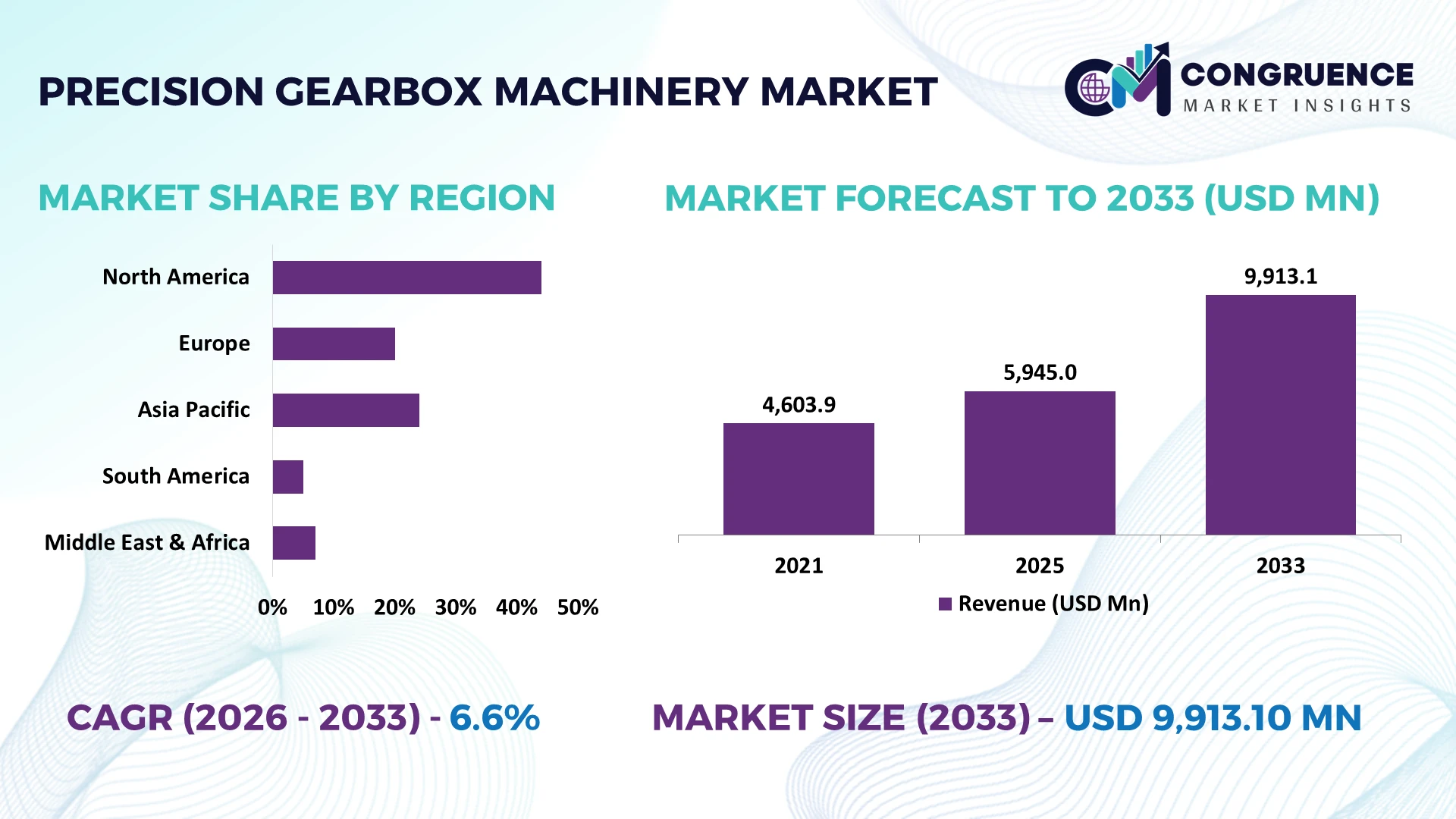
The Global Precision Gearbox Machinery Market was valued at USD 5945 Million in 2025 and is anticipated to reach a value of USD 9913.1 Million by 2033 expanding at a CAGR of 6.6% between 2026 and 2033. Growth is driven by the expansion of industrial robotics, CNC machine tools, semiconductor equipment, and automated material-handling systems requiring high positioning accuracy, low backlash, and compact torque transmission.
China holds a dominant manufacturing position, accounting for 54% of global industrial robot installations with 295,000 units deployed in 2024, while its operational industrial-robot stock exceeded 2 million units. Japan installed 44,500 robots during the same year, highlighting China’s significantly larger automation base. U.S.-China tariff tensions are also accelerating localized manufacturing and supply-chain diversification.
Strategically, manufacturers should prioritize robotics-oriented precision systems, localized production capacity, and resilient component sourcing.
Market Size & Growth: USD 5945M in 2025 to USD 9913.1M by 2033 at a 6.6% CAGR, supported by robotics, CNC modernization, and automated manufacturing.
Top Growth Drivers: Industrial robotics 54%, CNC automation 31%, advanced manufacturing 22%.
Short-Term Forecast: By 2030, AI-assisted gearbox monitoring can reduce unplanned maintenance costs by 8% and improve equipment efficiency by 12%.
Emerging Technologies: AI condition monitoring, digital twins, advanced planetary designs, harmonic drives, and high-strength alloys are reshaping precision motion systems.
Regional Leaders: Asia-Pacific remains the largest machinery market region; Europe holds 34.1% of the broader precision gearbox market, while North America accounts for 36.4%, reflecting strong automation adoption.
Consumer/End-User Trends: Robotics represented 18.4% of precision gearbox application demand, reinforcing automation as a major end-use priority.
Pilot/Case Example: In 2025, optimized planetary gearbox actuator designs demonstrated application-specific improvements in weight and torque efficiency across 5:1–11:1 gear-ratio configurations.
Competitive Landscape: Nabtesco leads the Asia-Pacific precision gearbox market with more than 16% share; Sumitomo Heavy Industries, Harmonic Drive Systems, WITTENSTEIN, and Nidec are among the leading competitors, with the top five holding about 48% collectively.
Regulatory & ESG Impact: Energy-efficiency requirements are increasing demand for lower-loss gearbox architectures, while longer service intervals support measurable reductions in maintenance-related resource consumption.
Investment & Funding: Industrial automation investment is shifting toward smart factories, localized manufacturing, semiconductor facilities, and robotics capacity as geopolitical supply-chain risks intensify.
Innovation & Future Outlook: Sensorized gearboxes, predictive diagnostics, digital twins, compact high-torque architectures, and AI-enabled motion control will drive the next competitive phase of precision gearbox machinery.
The Precision Gearbox Machinery Market is gaining traction across robotics, CNC machine tools, semiconductor equipment, packaging, material handling, and automated manufacturing. Planetary, harmonic, and cycloidal architectures are increasingly selected for compact designs, torque density, and positioning accuracy. China’s 54% share of global robot installations reinforces Asia’s manufacturing strength, while supply-chain diversification linked to U.S.-China trade tensions is accelerating regional production strategies.
Precision gearbox machinery is becoming strategically important as robotics, CNC automation, semiconductor production, and advanced material-handling systems compete on positioning accuracy, cycle time, and energy efficiency. China accounted for 54% of global industrial robot installations in 2024, creating a concentrated industrial base for high-precision motion systems. This automation shift is also encouraging manufacturers to localize critical transmission components.
Modern precision planetary and harmonic systems deliver approximately 60–80% mechanical efficiency, while optimized designs can reduce transmission losses by 10–15% compared with older configurations. During the next 2–3 years, adoption of sensorized gearboxes, predictive diagnostics, and digitally monitored actuators is expected to increase as manufacturers target higher uptime and lower maintenance intervention. Japan’s mature automation ecosystem contrasts with China’s larger deployment scale.
Companies are responding through localized machining, robotics partnerships, modular gearbox platforms, and investments in smart monitoring capabilities. In robotic joints, compact harmonic and planetary architectures improve torque density while controlling backlash and weight. The strategic priority is shifting from standalone gearbox manufacturing toward integrated motion solutions, making precision, digital connectivity, and supply-chain responsiveness critical competitive differentiators.
Industrial robotics is the strongest structural driver for precision gearbox machinery, with China accounting for approximately 54% of global robot installations in 2024 and Asia representing about 74% of new deployments. China’s electronics industry installed roughly 83,000 robots, while metal and machinery applications reached approximately 54,600 units, reinforcing demand for compact, low-backlash transmissions. Manufacturers are responding through localized gearbox production, higher-torque planetary architectures, and partnerships with robotic actuator developers. The non-obvious advantage is faster co-development: domestic robotics manufacturers increasingly require gearbox suppliers to customize torque, stiffness, and reduction ratios instead of purchasing standardized units. This shift is strengthening local engineering ecosystems while shortening qualification and delivery cycles.
Precision gearbox production remains constrained by tight machining tolerances, specialized alloys, heat treatment, bearing quality, and complex inspection requirements. Advanced planetary systems typically achieve approximately 60–80% mechanical efficiency, but optimizing stiffness, backlash, torque density, and operating life increases engineering and manufacturing complexity. Component-price volatility of 5–10% can materially pressure margins in highly competitive automation equipment programs. Supply dependency for precision bearings, specialty materials, and advanced machining equipment also complicates production planning. Manufacturers are reducing exposure through dual sourcing, localized machining, standardized components, and longer supplier contracts. The key operational challenge is maintaining micron-level manufacturing consistency while customers simultaneously demand lower unit costs, faster delivery, and higher transmission performance.
AI-enabled actuators, digital twins, embedded sensors, and adaptive motion control are creating higher-value opportunities beyond conventional gearbox sales. Intelligent monitoring can reduce unplanned maintenance requirements by approximately 10–15%, while digitally optimized transmission systems can improve energy utilization by around 8–12% in suitable automated applications. China’s operational industrial-robot base exceeding 2 million units provides a substantial installed platform for smart gearbox upgrades. Japan and Germany offer additional opportunities through advanced factory automation and high-precision machine tools. Companies are increasing R&D investment in sensorized gearboxes, predictive diagnostics, modular actuator platforms, and software-enabled maintenance. The non-obvious opportunity lies in aftermarket intelligence: suppliers can convert installed gearbox fleets into recurring monitoring and service revenue through connected-condition platforms.
Integrating precision gearboxes with robotics controllers, servo motors, sensors, digital twins, and factory networks creates execution complexity that conventional mechanical suppliers cannot solve independently. Approximately 30–40% of advanced automation projects can involve significant integration and commissioning effort, particularly where legacy equipment lacks standardized interfaces. Skilled engineering shortages can further extend commissioning cycles by 10–15% in highly automated production environments. Cybersecurity requirements are also becoming more important as connected gearbox monitoring moves operational data into industrial networks. Manufacturers must therefore invest in interoperable control architectures, application engineering, workforce training, and secure connectivity. The strategic challenge is ensuring that mechanical precision translates into consistent system-level performance rather than becoming constrained by software, integration, or infrastructure limitations.
AI-Driven Production Monitoring: AI-assisted maintenance and machine monitoring are moving from trials into production workflows, with manufacturers targeting 10–15% lower unplanned downtime and 8–12% faster fault identification. German machine-tool producers are integrating AI into operation, maintenance, and production planning, shifting gearbox demand toward sensor-ready architectures and connected diagnostics.
Robotic Gearbox Integration: Robotics is increasing demand for compact, high-torque transmission systems, with China accounting for 54% of global industrial robot installations and 295,045 units deployed in 2024. Suppliers are responding with integrated planetary and harmonic actuators, while optimized planetary designs achieve 60–80% mechanical efficiency for demanding robotic motion.
Localized Supply Networks: Supply-chain restructuring is pushing manufacturers toward regional machining, dual sourcing, and localized component qualification, with companies targeting 20–30% reductions in overseas dependency for critical precision components. China’s large automation base is accelerating domestic gearbox capacity, while European manufacturers are emphasizing diversified sourcing and shorter qualification cycles.
Semiconductor Automation Intensifies: Advanced semiconductor capacity is increasing requirements for precise motion equipment as global semiconductor manufacturing-equipment sales rose 15% to USD 135.1 billion in 2025. Precision gearbox suppliers are responding with cleaner, tighter-tolerance transmission systems and application-specific designs, creating higher-value demand where positioning accuracy and repeatability directly affect equipment throughput.
Planetary gearboxes lead the market with an estimated 38% share, supported by high torque density, compact construction, scalable reduction ratios, and established integration across automated machinery. Their mature production ecosystem enables approximately 10–15% cost advantages in high-volume applications. Harmonic Drive is the fastest-growing type, expanding at roughly 12% as robotics manufacturers prioritize low backlash, compact actuation, and high positioning accuracy. Cycloidal gearboxes remain important for shock-load resistance and high reduction ratios, while bevel gearboxes retain relevance for angular power transmission.
Investment is shifting toward lightweight materials, optimized tooth geometry, improved bearing systems, and integrated sensing. Harmonic architectures can provide approximately 20–30% lower backlash than conventional transmission arrangements, strengthening their position in precision robotics. Companies are scaling planetary platforms for volume demand while expanding harmonic-drive portfolios for advanced robotic joints, creating a two-track product strategy focused on cost efficiency and precision performance.
Robotics represents the leading application at approximately 36% share, driven by requirements for repeatable positioning, torque control, compact actuation, and low backlash. It is also the fastest-growing application, expanding approximately 14% as manufacturers automate handling, assembly, welding, inspection, and material movement. Machine tools remain a mature demand center, while industrial automation increasingly integrates precision gearboxes with servo systems. Semiconductor equipment represents a smaller but high-value application because micron-level positioning directly affects equipment performance and process consistency.
Companies are integrating gearboxes with motors, encoders, and controllers to achieve approximately 8–12% improvements in system efficiency and faster commissioning. Robotics manufacturers are increasing customized actuator partnerships, machine-tool producers are prioritizing stiffness, and semiconductor-equipment builders are emphasizing repeatability and contamination-controlled designs. The strategic shift is toward application-specific transmission packages rather than standardized components.
Manufacturing is the leading end-user segment with an estimated 34% share because precision gearboxes support machining, assembly, packaging, material handling, and automated production lines. Robotics is the fastest-growing end-user group, expanding approximately 15% as factories replace repetitive manual operations with programmable motion systems. Automotive remains a major established buyer, while electronics demand is strengthening through semiconductor and precision-device production. Aerospace maintains a smaller but premium position where weight, reliability, and accuracy justify higher specifications.
Companies are customizing torque profiles, gear ratios, mounting configurations, and actuator interfaces according to application requirements, improving deployment efficiency by approximately 10%. Automotive producers emphasize high-cycle durability, electronics manufacturers prioritize compact precision, and aerospace buyers focus on reliability and weight reduction. This segmentation is shifting supplier strategies from volume-based pricing toward application-specific engineering, partnerships, and integrated actuator ecosystems.
Europe accounted for the largest market share at 34.1% in 2025 however, Asia-Pacific is expected to register the fastest growth, expanding at a CAGR of 11% between 2026 and 2033.
Automation Modernization Reshapes Precision Motion Demand
North America holds an estimated 14% share, supported by advanced manufacturing, aerospace production, semiconductor equipment, and warehouse automation. The United States concentrates most regional demand, with precision gearboxes increasingly integrated into robotic cells, CNC platforms, and automated material-handling systems. Reshoring initiatives are strengthening domestic equipment investment as manufacturers reduce dependence on extended overseas supply chains. U.S. industrial robot installations exceeded 34,000 units in 2024, reinforcing demand for compact, high-accuracy transmission systems. Suppliers are responding through local inventory expansion, application engineering partnerships, and integrated motor-gearbox platforms. The operational shift is particularly important for aerospace and semiconductor production, where positioning accuracy and repeatability command higher-value specifications. North American buyers increasingly favor suppliers capable of rapid customization and shorter delivery cycles rather than lowest-cost standardized products.
United States Market Outlook: The United States remains the region’s primary precision gearbox demand center because of its aerospace, semiconductor, automotive, and logistics automation base. More than 34,000 industrial robots were installed in 2024, supporting continued demand for high-precision motion systems. Manufacturers are prioritizing reshoring, domestic supplier qualification, and digitally monitored gearbox platforms.
High-Precision Manufacturing Drives Structural Demand
Europe maintains approximately 34.1% market share, supported by Germany’s machine-tool industry, automotive automation, aerospace manufacturing, and sophisticated industrial engineering ecosystem. Germany’s industrial robot density reached 449 units per 10,000 manufacturing employees, indicating unusually intensive automation and a strong installed base for precision transmission systems. European manufacturers are also modernizing production lines around energy efficiency, predictive maintenance, and connected motion control. Italy and France contribute through packaging, machinery, automotive, and aerospace applications, while Germany remains the primary engineering hub. Companies are responding with higher-efficiency gear designs, digital condition monitoring, and localized component sourcing. The strategic distinction is Europe’s premium-specification model: buyers place greater emphasis on lifecycle reliability, engineering customization, and energy performance, allowing advanced gearbox suppliers to protect margins despite higher manufacturing costs.
Germany Market Outlook: Germany is the most strategically significant European market because of its concentration of machine builders, automotive plants, robotics integrators, and precision-engineering suppliers. Its 449 robots per 10,000 manufacturing employees demonstrate deep automation penetration. Gearbox manufacturers are therefore emphasizing low-backlash systems, predictive maintenance, and customized transmission platforms for high-throughput production.
Manufacturing Scale Accelerates Gearbox Localization
Asia-Pacific represents approximately 46.4% of global precision gearbox demand and has the strongest deployment momentum, led by China, Japan, South Korea, and India. China accounted for 54% of global industrial robot installations in 2024, while its operational robot stock exceeded 2 million units. Japan contributes through mature robotics, machine tools, and precision component manufacturing, while India is expanding automation from a smaller installed base. Electronics, automotive, semiconductor, and general manufacturing facilities are increasing demand for compact planetary, harmonic, and cycloidal architectures. Chinese suppliers are simultaneously expanding domestic gearbox production to reduce import dependence and improve lead times. Companies are responding through regional manufacturing, local partnerships, and application-specific actuator development. The key advantage is scale: high-volume automation allows suppliers to amortize precision manufacturing investments faster than smaller markets.
China Market Outlook: China is the region’s dominant demand and manufacturing center, supported by extensive robotics, electronics, automotive, and machinery production. Its 295,000-plus industrial robot installations in 2024 created substantial demand for precision reducers and integrated actuators. Domestic gearbox producers are expanding localized engineering and production to capture rising automation demand and shorten supply chains.
Industrial Automation Expands Beyond Traditional Applications
South America accounts for an estimated 3%–4% share, with Brazil representing the principal demand center because of its automotive, food processing, mining, packaging, and industrial machinery base. Automation remains less intensive than in Germany, China, or the United States, creating significant modernization space for precision transmission systems. Brazilian manufacturers are increasingly upgrading CNC equipment, automated handling systems, and production cells to improve throughput and compensate for skilled-labor constraints. Automotive and metalworking facilities remain important demand anchors, while mining applications favor robust gear systems capable of handling high loads and continuous operation. Companies are responding through distributor partnerships, localized technical support, and application-specific configurations rather than extensive manufacturing expansion. Import exposure remains a constraint, making inventory availability and after-sales engineering increasingly important competitive factors for suppliers entering the market.
Brazil Market Outlook: Brazil provides the strongest South American opportunity because its manufacturing and mining infrastructure creates recurring demand for durable precision transmission equipment. Automotive production, food processing, packaging, and CNC modernization are supporting adoption. Suppliers with local service networks and stocked replacement components can gain an advantage where long international lead times remain operationally disruptive.
Industrial Diversification Creates New Automation Demand
The Middle East & Africa market represents an estimated 3%–4% share, with demand increasingly linked to industrial diversification, infrastructure modernization, logistics automation, energy projects, and advanced manufacturing initiatives. Saudi Arabia and the United Arab Emirates are developing automated industrial facilities and logistics infrastructure as economic diversification programs reduce reliance on traditional energy activities. Precision gearboxes are increasingly used in automated handling, packaging, processing, and specialized machinery where controlled torque transmission improves operational consistency. Saudi Arabia’s industrial investment pipeline is creating demand for modern production equipment, while the UAE provides a regional distribution and technology integration hub. Companies are responding through partnerships with automation integrators, regional service centers, and project-specific equipment packages. The non-obvious opportunity is aftermarket support: harsh operating conditions increase the value of preventive maintenance, spare-parts availability, and rapid technical intervention.
Saudi Arabia Market Outlook: Saudi Arabia offers the strongest regional opportunity because industrial diversification is driving investment in manufacturing, logistics, mining, and automated processing infrastructure. Large-scale industrial projects increasingly require reliable motion-control equipment. Suppliers combining precision gearboxes with local maintenance support and project partnerships are better positioned to capture specialized automation demand.
The Precision Gearbox Machinery Market is led by specialized transmission manufacturers including Nabtesco, Harmonic Drive Systems, WITTENSTEIN, Sumitomo Drive Technologies, and Nidec-SHIMPO, competing against regional suppliers such as Neugart, Apex Dynamics, and Stöber. The top five players collectively control approximately 48% of the market, creating a moderately concentrated structure. Competition centers on precision, backlash, torque density, customization, delivery speed, and supply-chain reliability, with premium suppliers targeting 10–15% performance advantages while regional manufacturers compete through 8–12% cost efficiencies. Nabtesco emphasizes cycloidal reducers for robotic joints, while Harmonic Drive focuses on ultra-low-backlash motion systems; European suppliers differentiate through planetary engineering and customized industrial solutions. Companies are expanding localized production, forming robotics partnerships, and integrating sensors into gearbox platforms. The competitive shift is moving from standalone components toward complete actuator solutions. High machining precision, qualification requirements, and engineering know-how remain major entry barriers. Winning requires precision, customization, supply resilience, and fast integration.
Nabtesco Corporation
Harmonic Drive Systems Inc.
WITTENSTEIN SE
Sumitomo Drive Technologies
Nidec-SHIMPO Corporation
SEW-EURODRIVE
Neugart GmbH
Apex Dynamics, Inc.
Stöber Antriebstechnik GmbH & Co. KG
GAM Enterprises, Inc.
DieQua Corporation
Bonfiglioli Riduttori S.p.A.
Cone Drive
Parker Hannifin Corporation
Current precision technology is centered on planetary, harmonic, and cycloidal gear architectures integrated with servo motors, encoders, and digital controllers. Sensorized systems can improve condition-monitoring efficiency by 10–15%, while integrated servo-gearbox packages reduce commissioning time by 8–12%. Adoption is strongest in robotics and CNC equipment, where low backlash and torque density influence cycle times for manufacturers.
Emerging technologies include AI-based fault diagnostics, digital twins, automated gearbox optimization, and lightweight materials. AI monitoring can improve fault-detection speed by 10–20%, while computationally optimized planetary actuators deliver 60–80% mechanical efficiency. Deployment is expanding as manufacturers connect gearbox data with predictive-maintenance workflows, improving uptime. Suppliers with embedded sensing and software gain an advantage over mechanical-only competitors.
Disruptive development is shifting toward compact multi-ratio actuators, smart strain-wave systems, and integrated mechatronic gearboxes. Compared with legacy fixed-ratio transmission systems, optimized variable-ratio architectures can reduce required actuator power by roughly 10–20% in suitable operating conditions. By 2026–2028, robotics integrators and premium OEMs will benefit most from connected, low-backlash platforms, making digital integration, efficiency, and rapid customization decisive competitive advantages in automated production. Suppliers acting now can secure integration partnerships.
September 2024 Nabtesco’s RVW drive units were selected by Shimizu for a newly developed Stage-Scaffold Movable Cart, extending precision reduction gears into construction automation. The adoption expands non-robotics applications and supports demand for compact, high-torque motion systems worldwide. Source: nabtesco.com
May 2025 WITTENSTEIN presented robotics drive technology and sensors at automatica, emphasizing industrial and medical robotics. Its solutions combine precision gearboxes with sensing and mechatronics, strengthening connected motion architectures and expanding differentiation through application-specific engineering capabilities across factories. Source: wittenstein-group.com
May 2025 HIWIN demonstrated DATORKER at Automate 2025, highlighting an advanced gearbox for robot joints that delivers lower speeds, higher torque, and higher gear ratios within smaller spaces. The product strengthens compact robotic actuation and supports equipment designers. Source: automate.org
September 2025 The International Federation of Robotics reported 542,000 industrial robots installed globally during 2024, with Asia accounting for 74%. The deployment scale reinforces precision transmission demand and encourages gearbox manufacturers to expand capacity, localization, and robotics-focused development worldwide strategically. Source: ifr.org
The Precision Gearbox Machinery Market Report covers planetary, harmonic drive, cycloidal, and bevel gearbox technologies across robotics, machine tools, industrial automation, and semiconductor equipment. End-user analysis spans automotive, electronics, aerospace, manufacturing, and robotics, with regional coverage across North America, Europe, Asia-Pacific, South America, and the Middle East & Africa. It also assesses emerging smart actuators, sensorized transmission systems, AI-enabled diagnostics, and compact high-torque architectures shaping next-generation automated equipment.
Strategic analysis evaluates technology adoption, deployment concentration, customization trends, supply-chain localization, digital integration, and competitive positioning. Robotics represents about 36% of application demand, while manufacturing accounts for roughly 34% of end-user demand. The report supports investment planning, market-entry decisions, capacity expansion, partnership strategy, and technology prioritization through 2026–2033. Regional comparisons highlight scale differences, production specialization, adoption intensity, and infrastructure readiness affecting supplier expansion and long-term competitive advantage.
| Report Attribute/Metric | Report Details |
|---|---|
Market Revenue in 2025 | USD 4174.28 Million |
Market Revenue in 2033 | USD 6908.42 Million |
CAGR (2026 - 2033) | 6.5% |
Base Year | 2025 |
Forecast Period | 2026 - 2033 |
Historic Period | 2021 - 2025 |
Segments Covered | By Type
By Application
By End-User
|
Key Report Deliverable | Revenue Forecast, Growth Trends, Market Dynamics, Segmental Overview, Regional and Country-wise Analysis, Competition Landscape |
Region Covered | North America, Europe, Asia-Pacific, South America, Middle East, Africa |
Key Players Analyzed | Catalent, Inc., Thermo Fisher Scientific Inc., Lonza Group Ltd., Baxter International Inc., Recipharm AB, Siegfried Holding AG, Vetter Pharma International GmbH, Bora Pharmaceuticals Co., Ltd., Ajinomoto Bio-Pharma Services, PCI Pharma Services, Curia Global, Inc., Jubilant HollisterStier, Piramal Pharma Solutions, WuXi Biologics Co., Ltd. |
Customization & Pricing | Available on Request (10% Customization is Free) |




