
Reports
The Global Precast Concrete Construction Market was valued at USD 12,050.1 Million in 2025 and is anticipated to reach a value of USD 21,173.3 Million by 2033 expanding at a CAGR of 7.3% between 2026 and 2033. Growth is being driven by industrialized construction, infrastructure modernization, labor shortages, and increasing adoption of factory-controlled structural components that shorten project schedules while improving dimensional consistency.
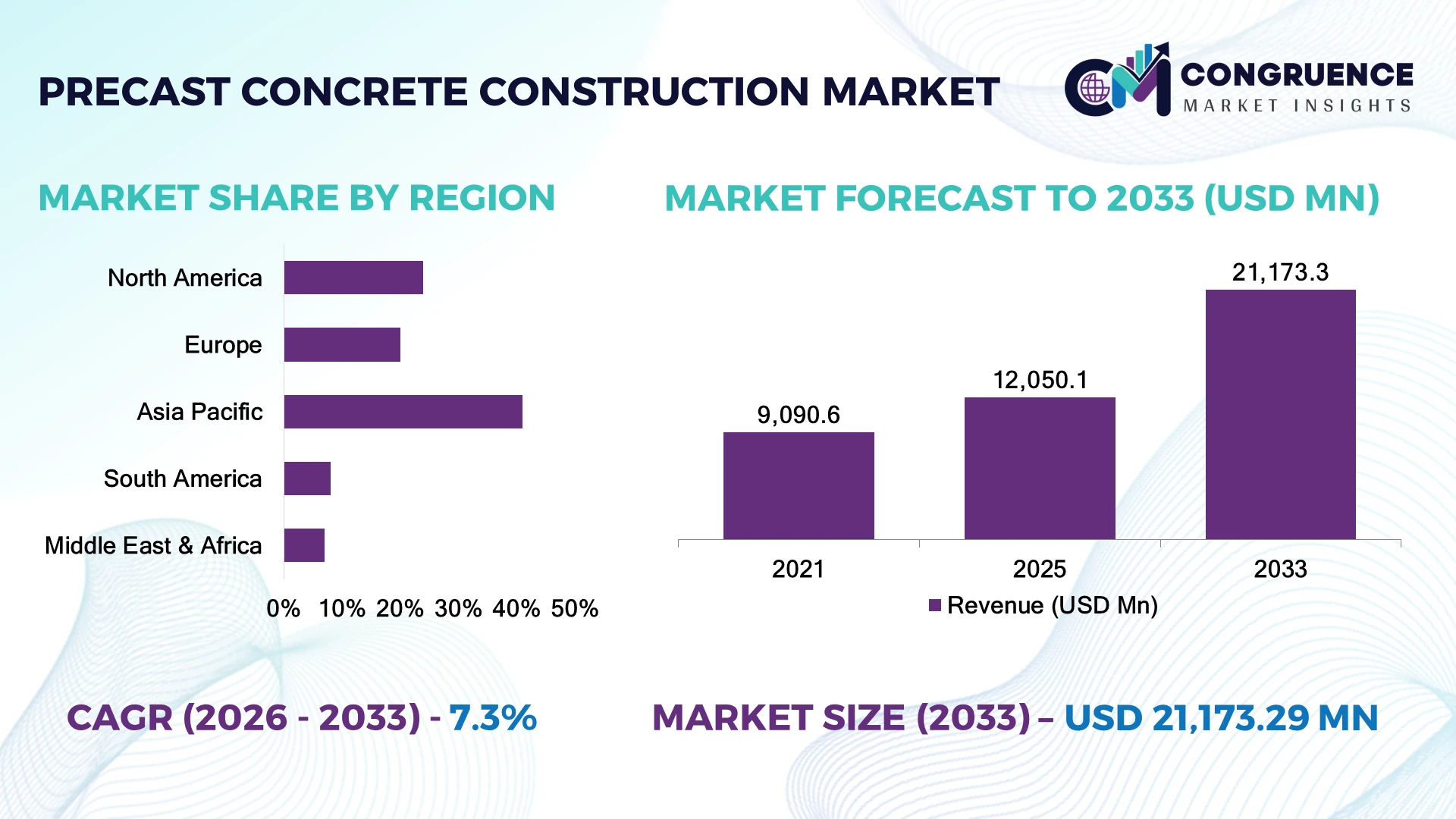
China remains the dominant country within the global precast ecosystem, accounting for approximately 43% of Asia-Pacific demand, while Asia-Pacific represents about 41% of global demand. India is accelerating deployment as infrastructure output increased 4.8% year-on-year in 2026, supported by transport, housing, industrial, and urban-development programs. China, India, and Southeast Asian markets are prioritizing standardized components, while geopolitical supply-chain disruptions are encouraging localized production and shorter procurement routes.
The strategic implication is clear: manufacturers combining automated production, digital design, logistics control, and low-carbon concrete are positioned to capture increasingly industrialized construction pipelines.
Market Size & Growth: USD 12.05 billion in 2025 to USD 21.17 billion by 2033 at a 7.3% CAGR, supported by off-site construction, infrastructure modernization, and factory-controlled production.
Top Growth Drivers: Infrastructure applications account for approximately 32% of demand; Asia-Pacific represents about 41% of the global market; industrialized construction adoption is accelerating as labor availability tightens.
Short-Term Forecast: By 2028, automated precast production is expected to improve plant throughput by 15–25%, while digital scheduling can reduce production coordination delays by approximately 10–15%.
Emerging Technologies: AI-assisted production planning, robotic reinforcement, BIM-linked manufacturing, digital twins, automated casting, and low-carbon curing are reshaping advanced precast construction.
Regional Leaders: Asia-Pacific is projected at approximately USD 8.7 billion by 2033, North America at USD 4.3 billion, and Europe at USD 3.8 billion, with BIM and automated-factory adoption strengthening across major construction markets.
Consumer/End-User Trends: Infrastructure represents approximately 32% of demand, while residential developers increasingly use standardized components to shorten repetitive construction cycles and improve schedule predictability.
Pilot/Case Example: A 2025 Australian precast manufacturing study found that increasing production throughput by at least 40% materially improved profitability by spreading fixed manufacturing costs across higher output.
Competitive Landscape: CRH, Holcim, CEMEX, Larsen & Toubro, and China National Building Material compete across structural components, infrastructure products, manufacturing capacity, logistics, and integrated construction services.
Regulatory & ESG Impact: Low-carbon cement substitution, environmental product declarations, and lifecycle-carbon requirements are increasing pressure for measurable reductions in embodied carbon across public and private construction projects.
Investment & Funding: Capital is shifting toward automated precast plants, robotics, digital production software, lower-carbon material systems, and vertically integrated manufacturing-logistics networks.
Innovation & Future Outlook: The market is moving from conventional component supply toward digitally engineered construction systems combining automation, traceability, low-carbon materials, standardized production, and integrated installation.
The Precast Concrete Construction Market is increasingly concentrated around infrastructure, residential, industrial, and transportation projects requiring predictable delivery and standardized structural components. Approximately 32% of demand is linked to infrastructure applications, while automated manufacturing, BIM integration, and lower-carbon concrete are reshaping production economics. In 2026, supply-chain localization and factory-based construction are strengthening as developers seek greater schedule certainty, creating a strategic transition toward integrated design-to-installation models.
Precast concrete construction is becoming strategically important because project owners are shifting from site-intensive construction toward controlled manufacturing environments. Factory production improves quality consistency, reduces weather exposure, and supports repeatable component delivery. Infrastructure accounts for approximately 32% of market demand, giving bridge, rail, road, utility, and transportation programs a decisive role in investment allocation. In India, accelerated infrastructure activity is strengthening demand for standardized structural components, while China continues to operate at substantially larger manufacturing scale.
Technology is becoming the primary productivity differentiator. Automated reinforcement, robotic formwork, BIM-linked production, and digital scheduling can improve manufacturing throughput by 15–25% compared with fragmented manual workflows. Digital twins are also connecting design information with production and installation, reducing coordination losses. European manufacturers are moving faster on low-carbon production and traceability, whereas Asian markets emphasize high-volume manufacturing and rapid project deployment.
Through 2026–2028, leading producers are expected to prioritize automated plants, standardized molds, recycled or lower-clinker inputs, and integrated logistics. A 2025 Australian industry study showed that increasing production throughput by at least 40% materially improves profitability through better fixed-cost absorption. Companies that control design, manufacturing, transport, and erection will therefore hold a stronger competitive position as precast construction becomes an integrated industrial process rather than simply a concrete-product category.
Infrastructure modernization is shifting construction toward factory-controlled production, with infrastructure applications representing approximately 32% of precast concrete demand and Asia-Pacific contributing about 41% of global consumption. India’s expanding highway, metro, and urban infrastructure programs are increasing requirements for standardized beams, columns, slabs, and drainage components. Labor shortages are also encouraging off-site manufacturing, where automated reinforcement and controlled curing can improve production throughput by approximately 15–25%. In response, major producers are expanding regional plants, standardizing molds, and integrating BIM with production scheduling. The non-obvious advantage is schedule certainty: manufacturers that control fabrication and logistics can reduce site-stage variability while handling larger project packages, strengthening their position in infrastructure procurement.
Precast manufacturers remain exposed to fluctuations in cement, aggregates, steel reinforcement, energy, and transport costs, particularly where plants operate far from major construction corridors. Steel reinforcement can represent approximately 20–30% of component material costs, while transportation can account for 10–15% of delivered project costs depending on component size and distance. Oversized elements also create logistics constraints because specialized trailers and lifting equipment are required. In India and Southeast Asia, fragmented supplier networks can increase procurement variability. Producers are responding through localized aggregate sourcing, longer-term steel contracts, optimized mix designs, and strategically positioned plants. A key operational constraint is that low unit manufacturing cost does not guarantee project competitiveness when transportation distance materially increases installed cost.
Digital manufacturing creates an opportunity to convert precast plants from component suppliers into highly coordinated construction-production platforms. BIM-linked scheduling, automated reinforcement, robotic casting, and production analytics can improve manufacturing throughput by approximately 15–25% and reduce manual coordination requirements by 10–20%. China and India offer particularly strong opportunities because large infrastructure pipelines support standardized, repeat-order component production. Low-carbon concrete, recycled aggregates, and carbon-efficient curing also create opportunities as procurement specifications increasingly incorporate embodied-carbon criteria. Companies are investing in automated molds, digital twins, and integrated logistics platforms to improve asset utilization. A less obvious opportunity is manufacturing-as-a-service, where producers can serve multiple contractors from strategically located plants instead of depending on individual project ownership.
Precast construction faces a deployment challenge when standardized factory production encounters highly variable site conditions. Component dimensional tolerances, lifting capacity, road access, connection detailing, and sequencing must remain synchronized; installation delays of even 5–10% can erode the scheduling advantage achieved during manufacturing. BIM interoperability also remains inconsistent across contractors, engineering firms, and fabrication facilities, creating coordination friction. In the United States and Europe, increasingly detailed digital documentation and embodied-carbon requirements add additional data-management responsibilities. Companies must therefore invest in interoperable design platforms, connection engineering, installation planning, workforce training, and real-time logistics tracking. The strategic challenge is no longer simply producing components efficiently; it is maintaining production-to-installation synchronization across the entire project lifecycle.
Automated Plants Gain Production Share: Precast manufacturers are increasing deployment of robotic reinforcement, automated casting, and computerized curing systems, with automated workflows improving throughput by approximately 15–25% in suitable high-volume facilities. Producers are prioritizing repetitive infrastructure components where standardized molds can maximize equipment utilization and reduce manual handling.
BIM Moves Into Production: BIM is increasingly connecting engineering models directly with fabrication schedules, component tracking, and installation sequencing. Adoption across digitally mature projects is approaching 40–50%, reducing design-to-production coordination effort by roughly 10–20%. Manufacturers are investing in model-based production planning because accurate component data increasingly determines delivery reliability.
Low-Carbon Mixes Enter Procurement: Lower-clinker cement, supplementary cementitious materials, recycled aggregates, and optimized mix designs are moving from pilot programs into commercial precast specifications. Material substitution can reduce cement-related embodied emissions by approximately 10–30%, depending on formulation. European producers are accelerating product declarations and carbon tracking as procurement requirements become more stringent.
Logistics Becomes Competitive Differentiator: Oversized component transportation is receiving greater attention as fuel, labor, and specialized-haulage costs remain operational constraints. Transport can represent approximately 10–15% of delivered component cost on longer routes, encouraging manufacturers to establish regional plants closer to project clusters. Companies are increasingly coordinating fabrication, dispatch, lifting, and installation as one integrated workflow.
Structural precast components represent approximately 42% of the global market, supported by extensive use of beams, columns, floor systems, wall panels, and load-bearing elements across infrastructure, residential, and commercial projects. Their dominance comes from repeatability, standardized engineering, and compatibility with BIM-led construction. Architectural precast accounts for about 21%, while utility and transportation products contribute approximately 19% and 18%, respectively. Structural systems remain the mature segment, but utility and transportation components are gaining importance as governments expand water, rail, road, and urban infrastructure programs.
Utility and transportation precast are among the fastest-growing categories, with adoption increasing as projects demand standardized drainage, culverts, tunnels, barriers, and railway components. These applications can reduce site installation time by approximately 20–30% compared with heavily site-fabricated alternatives. Manufacturers are expanding specialized product lines, investing in automated molds, and establishing plants near infrastructure corridors. The investment priority is shifting toward high-volume standardized components where repeat orders improve plant utilization and logistics economics.
The Precast/Prestressed Concrete Institute identifies standardized precast systems as a core mechanism for improving construction speed and quality, reinforcing the industry's shift toward factory-controlled component production.
Infrastructure is the leading application, representing approximately 32% of global precast concrete construction demand, driven by highways, bridges, railways, tunnels, drainage systems, and utility networks. Residential construction follows at roughly 29%, supported by repetitive housing layouts and demand for faster project completion. Commercial applications account for about 22%, while industrial construction contributes approximately 17%. Infrastructure maintains the strongest demand concentration because large public projects require standardized components at scale and benefit directly from controlled manufacturing and accelerated installation.
Industrial construction is emerging as a particularly dynamic application as warehouses, logistics centers, manufacturing facilities, and data centers require rapid structural deployment. Large precast systems can shorten structural installation schedules by approximately 15–25%, supporting faster asset commissioning. Companies are responding with larger casting beds, standardized structural designs, automated reinforcement, and project-specific engineering teams. The competitive implication is that producers increasingly need dedicated infrastructure and industrial product portfolios rather than relying exclusively on conventional building components.
Industry deployment assessments indicate that precast systems can compress structural construction schedules by roughly 15–25% on repetitive industrial and infrastructure projects, strengthening their value where earlier commissioning directly affects project economics.
Infrastructure developers and contractors represent approximately 34% of global precast concrete construction demand, reflecting large procurement volumes across highways, bridges, railways, utilities, and public infrastructure. Residential developers account for approximately 27%, commercial developers and contractors about 22%, while industrial and institutional users contribute roughly 17%. Infrastructure buyers prioritize standardized specifications, delivery reliability, structural performance, and lifecycle durability, whereas residential buyers place greater emphasis on production speed, cost control, and design repeatability.
Industrial users are emerging as one of the fastest-expanding buyer groups as logistics facilities, manufacturing plants, and data centers demand rapid construction cycles. Their adoption is increasingly linked to schedule compression, with prefabricated structural systems capable of reducing site labor requirements by approximately 20–30% on suitable projects. Producers are responding through dedicated key-account teams, engineering partnerships, integrated logistics, and customized component systems. The purchasing shift favors suppliers capable of managing design, manufacturing, transportation, and installation as a coordinated package rather than selling individual components.
Construction-industry productivity research consistently identifies off-site manufacturing as a mechanism for reducing site labor intensity, supporting greater precast adoption among infrastructure and industrial project developers.
Asia-Pacific accounted for the largest market share at 41% in 2025 moreover, Asia-Pacific is expected to register the fastest growth, expanding at a CAGR of 8.1% between 2026 and 2033.
Infrastructure renewal and industrial construction are driving higher-value precast deployment
North America represents approximately 24% of global precast concrete construction demand, supported by highway rehabilitation, bridge replacement, data-center construction, logistics facilities, and residential development. The United States dominates regional consumption, with transportation infrastructure and commercial construction creating sustained requirements for structural panels, bridge elements, utility products, and modular components. Factory-controlled production is gaining importance as contractors face skilled-labor constraints and pressure to compress construction schedules. Automated reinforcement and BIM-linked manufacturing can improve plant throughput by approximately 15–25% on standardized product lines. Producers are responding through regional plant expansions, acquisitions, automated casting systems, and closer integration with engineering contractors. The strongest competitive advantage increasingly comes from controlling manufacturing and delivery proximity rather than maximizing standalone plant capacity.
United States Market Outlook: The United States represents the principal North American market, supported by extensive transportation infrastructure and large-scale private construction. Bridge rehabilitation, road modernization, warehouses, and data centers are creating demand for high-performance precast systems. Infrastructure projects increasingly favor standardized components that can reduce site installation requirements by approximately 20–30%, strengthening the role of established regional manufacturers.
Low-carbon construction is reshaping precast product specifications and manufacturing investment
Europe accounts for approximately 20% of global precast concrete construction demand, with Germany, France, Italy, the United Kingdom, and the Nordic markets representing major consumption centers. Mature precast adoption is shifting toward low-carbon concrete, circular material use, digital design coordination, and energy-efficient building envelopes. European manufacturers are increasingly integrating environmental product declarations and lifecycle-carbon measurement into product development. Automated production can improve manufacturing throughput by approximately 15–20% for repetitive components, supporting labor productivity while maintaining dimensional consistency. Renovation programs and transport infrastructure modernization are creating additional demand for façade panels, bridge elements, floor systems, and utility products. Producers are prioritizing lower-clinker formulations, recycled aggregates, and digitally managed production lines to meet tightening construction specifications.
Germany Market Outlook: Germany remains a strategically important European market because of its established precast manufacturing base, engineering capabilities, and strong industrial construction ecosystem. Building modernization and infrastructure renewal are supporting demand for standardized structural and façade systems. Manufacturers are increasingly combining BIM-based design with automated production, while low-carbon material formulations are becoming more important in large commercial and public projects.
Large-scale infrastructure programs are turning precast into an industrialized construction system
Asia-Pacific represents approximately 41% of global precast concrete construction demand, led by China, India, Japan, South Korea, and Southeast Asian markets. China provides the region's largest production and deployment base, while India is rapidly expanding precast usage across highways, metros, housing, industrial parks, and urban infrastructure. Standardized manufacturing is particularly valuable where projects require thousands of repetitive components. Automated precast facilities can increase throughput by approximately 15–25%, while factory production reduces dependence on variable site labor. Companies are expanding strategically located plants, investing in automated reinforcement and casting equipment, and forming partnerships with EPC contractors. The region's scale advantage is increasingly reinforced by localized supply chains and high-volume component standardization.
China Market Outlook: China remains the largest country-level precast construction market, supported by extensive infrastructure manufacturing capacity and large urban-development programs. Its mature industrialized construction ecosystem enables high-volume production of structural panels, railway components, utility products, and modular building systems. Manufacturers are increasingly deploying automation and digital production controls to improve consistency across large project portfolios and reduce manual production bottlenecks.
Infrastructure modernization is strengthening demand for standardized structural components
South America represents approximately 8% of global precast concrete construction demand, with Brazil accounting for the largest share through residential, transportation, commercial, and industrial construction. Precast adoption is strongest around major urban centers where established manufacturers can support large projects with reliable transportation and installation services. Infrastructure renewal and housing requirements are encouraging greater use of standardized wall panels, structural frames, drainage systems, and bridge components. Manufacturing automation can improve production throughput by approximately 10–20% on repetitive product lines, although logistics distance remains an important cost variable. Companies are responding by locating facilities closer to project clusters, expanding product portfolios, and partnering with contractors to coordinate component delivery and erection. Regional competitiveness increasingly depends on logistics integration.
Brazil Market Outlook: Brazil is the principal South American market, supported by its large construction sector, established precast manufacturers, and extensive road, housing, sanitation, and industrial requirements. São Paulo and other major industrial centers provide concentrated demand and manufacturing infrastructure. Producers are increasingly using standardized components and automated production to improve delivery reliability while reducing site labor intensity on repetitive projects.
Mega-project construction is accelerating factory-based structural production
Middle East & Africa accounts for approximately 7% of global precast concrete construction demand, with Saudi Arabia, the United Arab Emirates, Qatar, and South Africa representing important deployment centers. Large urban-development, hospitality, transportation, and industrial projects are supporting high-volume requirements for façade systems, structural elements, utility products, and modular components. Saudi Arabia's large-scale development pipeline is particularly significant because repetitive construction favors factory-controlled production and centralized quality management. Precast manufacturing can reduce site installation time by approximately 20–30% for standardized elements. Producers are investing in new casting capacity, automated reinforcement, and project-specific manufacturing facilities while partnering with EPC contractors. The strategic advantage lies in aligning plant capacity with concentrated mega-project pipelines.
Saudi Arabia Market Outlook: Saudi Arabia is the region's most strategically significant market because large-scale urban, tourism, transportation, and industrial developments require high-volume standardized construction components. The country's project pipeline supports dedicated precast production capacity close to major development zones. Manufacturers are increasingly integrating engineering, fabrication, logistics, and installation to manage demanding project schedules and reduce dependence on fragmented site construction.
CRH, Holcim, CEMEX, Larsen & Toubro, and China National Building Material compete with specialized regional precast producers, with global groups emphasizing integrated materials supply while regional manufacturers compete on proximity, customization, and installation speed. The top five are estimated to control approximately 18% of the fragmented market. Competition centers on delivered cost, automation, logistics, product engineering, and project execution: transportation can represent 10–15% of delivered component cost, while automated production can raise throughput 15–25%. Holcim is expanding through acquisitions, while CEMEX is strengthening lower-carbon concrete solutions and Asian producers emphasize high-volume manufacturing. The competitive shift is toward vertical integration, localized plants, digital production, and low-carbon specifications rather than standalone component pricing. Entry barriers remain high because plants require specialized molds, lifting systems, engineering capabilities, and regional logistics networks. Winning suppliers need dense manufacturing footprints, repeatable quality, integrated design-to-installation services, and enough automation to combine cost competitiveness with project-specific customization reliably.
CRH plc
Holcim Ltd.
CEMEX S.A.B. de C.V.
Larsen & Toubro Limited
China National Building Material Company Limited
Heidelberg Materials
Consolis
Skanska AB
Forterra plc
Elematic Oyj
Boral Limited
Fuji Silvertech Concrete Pvt. Ltd.
Spancrete
Oldcastle Infrastructure
Precast manufacturing is moving toward automated reinforcement, robotic casting, BIM-linked production, and digital quality control. Automated lines can improve throughput by 15–25%, while sensor-based curing can reduce process variability by 5–10%. BIM-to-factory workflows are gaining adoption across digitally mature projects, increasingly linking design models with mold configuration, production sequencing, and component tracking. These systems benefit large manufacturers with high-volume standardized orders.
Emerging technologies include digital twins, machine-vision inspection, automated rebar cages, and low-carbon curing. Machine vision can reduce dimensional inspection time by roughly 20%, while automated reinforcement can lower manual handling requirements by 15–20%. Compared with conventional manual inspection and fabrication, integrated automated lines can improve production consistency by approximately 10–15%. The strongest competitive advantage goes to producers able to combine automation with regional logistics and engineering customization.
From 2026–2028, AI production scheduling and connected plant-management systems will become more important as manufacturers seek higher asset utilization. Digital tracking can reduce dispatch and sequencing errors by approximately 10%. Low-carbon mix optimization will increasingly integrate with production software, allowing manufacturers to balance strength, curing time, material efficiency, and embodied-carbon targets. Companies investing now in interoperable BIM, robotics, sensors, and data infrastructure will gain faster changeovers, tighter quality control, and stronger bidding credibility.
June 2025 Holcim acquired Langley Concrete Group, adding two British Columbia production facilities and 180 employees. The expansion strengthened precast capacity for infrastructure products, including pipes and culverts, improving regional reach and vertical integration across Western Canada. Source: holcim.com (Holcim)
January 2026 Holcim completed its acquisition of Alkern, a French precast producer with 1,000 employees and more than 50 sites. The deal expanded walling, flooring, and water-management capabilities, accelerating Holcim’s Building Solutions strategy and strengthening European market coverage. Source: reuters.com (Reuters)
2025 CEMEX expanded its Prime admixture portfolio across EMEA for precast, cement, and ready-mix applications. The solutions target lower-carbon concrete and improved durability, strengthening material-performance differentiation while supporting manufacturers seeking measurable decarbonization and operational efficiency across regional plants. Source: cemex.co.uk (cemex.co.uk)
March 2026 Gaurs Group announced a ₹250 crore precast and modular construction facility in Noida with Elematic India. The first phase represents ₹100 crore, with operations targeted within six months, increasing manufacturing capacity for faster project delivery. Source: business-standard.com (Business Standard)
The Precast Concrete Construction Market Report evaluates structural and architectural precast, utility and transportation products across infrastructure, residential, commercial, and industrial applications. End-user coverage includes infrastructure developers, residential and commercial contractors, industrial users, and institutional buyers. Regional analysis spans North America, Europe, Asia-Pacific, South America, and Middle East & Africa, with country-level assessment of major construction hubs, manufacturing capacity, logistics corridors, and project pipelines.
The report assesses automated reinforcement, robotic casting, BIM-linked manufacturing, digital twins, low-carbon concrete, recycled materials, curing technologies, and integrated logistics. Infrastructure represents approximately 32% of demand, while automated production can improve throughput by 15–25% on standardized product lines. Competitive analysis covers global building-material groups and regional specialists, supporting plant-location decisions, technology investment, partnership development, product positioning, expansion strategy, and procurement planning through 2026–2033.
| Report Attribute/Metric | Report Details |
|---|---|
|
Market Revenue in 2025 |
USD 12,050.1 Million |
|
Market Revenue in 2033 |
USD 21,173.3 Million |
|
CAGR (2026 - 2033) |
7.3% |
|
Base Year |
2025 |
|
Forecast Period |
2026 - 2033 |
|
Historic Period |
2021 - 2025 |
|
Segments Covered |
By Type
By Application
By End-User
|
|
Key Report Deliverable |
Revenue Forecast, Growth Trends, Market Dynamics, Segmental Overview, Regional and Country-wise Analysis, Competition Landscape |
|
Region Covered |
North America, Europe, Asia-Pacific, South America, Middle East, Africa |
|
Key Players Analyzed |
CRH plc, Holcim Ltd., CEMEX S.A.B. de C.V., Larsen & Toubro Limited, China National Building Material Company Limited, Heidelberg Materials, Consolis, Skanska AB, Forterra plc, Elematic Oyj, Boral Limited, Fuji Silvertech Concrete Pvt. Ltd., Spancrete, Oldcastle Infrastructure |
|
Customization & Pricing |
Available on Request (10% Customization is Free) |




