
Reports
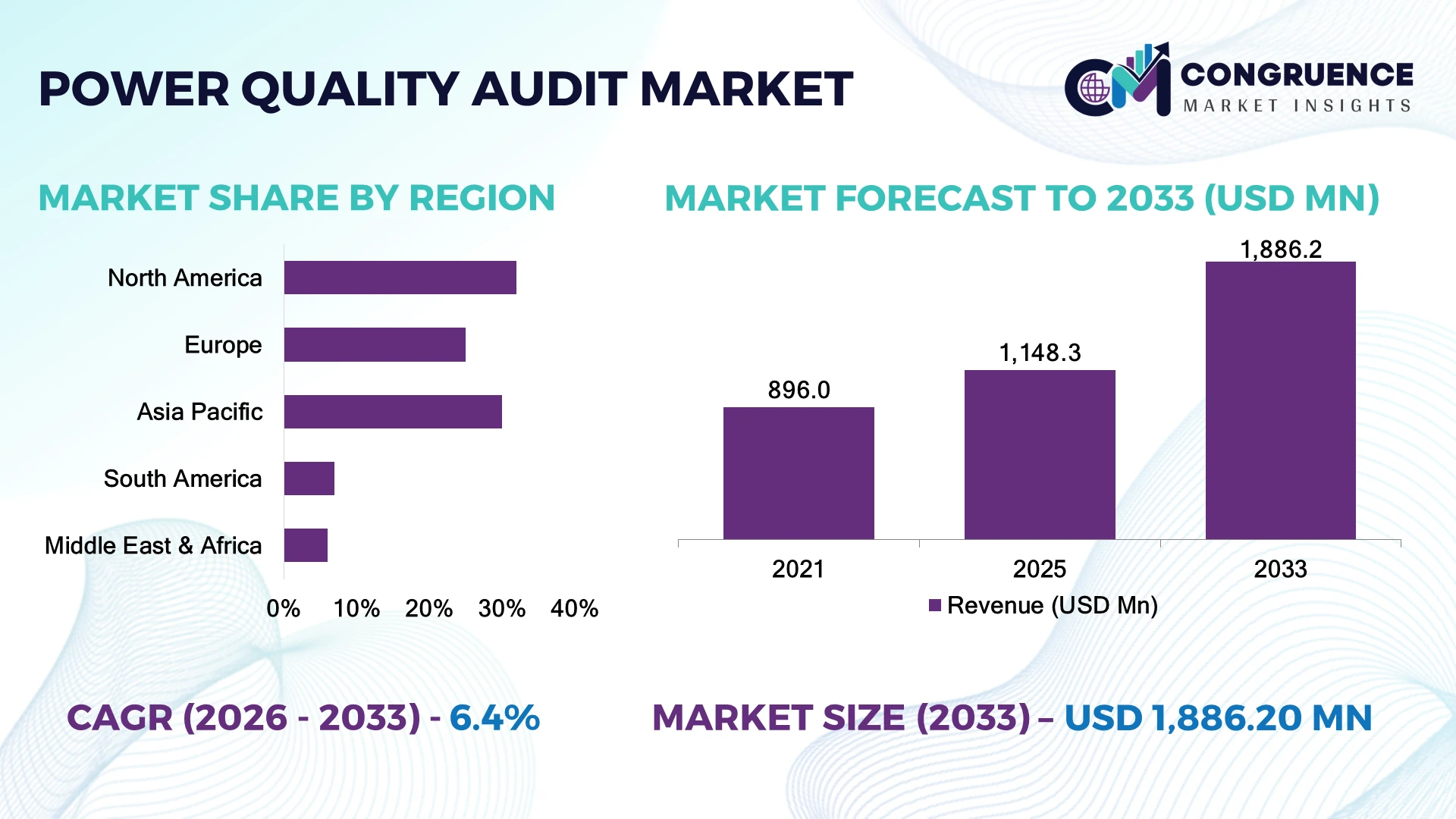
The Global Power Quality Audit Market was valued at USD 1,148.3 Million in 2025 and is anticipated to reach a value of USD 1,886.2 Million by 2033 expanding at a CAGR of 6.4% between 2026 and 2033. Growth is driven by industrial automation, inverter-based renewable generation, data-center expansion, harmonic distortion from nonlinear loads, and stricter requirements for electrical reliability and energy accountability.
China is a major influence on industrial electricity demand, accounting for 54% of global electricity demand growth in 2024. India offers a contrasting regulatory-led opportunity: distribution companies must conduct annual energy audits and quarterly energy accounting. Manufacturing, metals, chemicals, data centers, and renewable-energy installations require increasingly detailed assessment of voltage sags, harmonics, imbalance, and power factor. These conditions support demand for instrumented audits and continuous monitoring, although country-level shares of power quality audit spending are not independently established.
Strategic implication: service providers should prioritize industrial load diagnostics, renewable integration, and data-driven audit reporting that converts electrical disturbances into measurable operational actions.
The power quality audit market addresses electrical disturbances that affect production continuity, equipment life, and energy performance. Industrial plants, utilities, commercial buildings, hospitals, and data centers use audits to investigate voltage dips, transients, harmonics, flicker, and power-factor problems. The International Electrotechnical Commission published an updated IEC 61000-4-30 measurement standard in 2025, reinforcing standardized, repeatable assessment. As electrical loads become more dynamic, buyers are moving from isolated diagnostic visits toward recurring monitoring and corrective-action programs.
Power quality audits are becoming a strategic reliability function as facilities add variable-speed drives, power-electronic equipment, renewable generation, battery systems, and high-density computing loads. These technologies change current waveforms and voltage behavior, making routine energy bills insufficient for diagnosing equipment trips or unexplained production losses. Audits help operators distinguish supply-side disturbances from internal load problems before investing in filters, compensation equipment, or distribution upgrades.
Measurement practice is also becoming more standardized. The 2025 edition of IEC 61000-4-30 defines repeatable methods for assessing voltage dips, swells, harmonics, flicker, transients, and related power quality parameters. Compared with periodic handheld checks, continuous logging can capture intermittent events that short site visits miss; the improvement depends on monitoring duration, instrument class, and event configuration. China’s electricity-intensive manufacturing base and North America’s critical-facility requirements create different demand patterns, while India's mandatory distribution-company energy audits reinforce structured energy accounting.
During 2026–2028, buyers will increasingly expect synchronized event records, waveform analysis, and actionable reports rather than measurement tables alone. A manufacturing plant can correlate a drive trip with a recorded voltage sag, then evaluate mitigation against the cost of downtime. Providers are expanding digital reporting, remote monitoring, and engineering partnerships. Competitive advantage will belong to firms that connect standards-compliant measurements with defensible root-cause analysis and practical corrective actions.
Industrial automation, inverter-based generation, and high-density computing create electrical conditions that conventional energy metering cannot fully explain. The International Energy Agency reported that global electricity demand increased by approximately 3% in 2025, while data-center electricity consumption rose by 17%. These are demand indicators rather than direct audit-market growth rates, but they highlight the need to assess loading, harmonics, voltage stability, and equipment interaction. In India, mandatory annual energy audits and quarterly energy accounting for distribution companies reinforce measurement-led operations. Audit providers are responding with longer-duration logging, waveform capture, and engineering services that link electrical events to equipment behavior. The key commercial opportunity is identifying the source of recurring faults before operators commit to expensive mitigation hardware.
Reliable audits require suitable analyzer classes, correct sensor placement, adequate monitoring duration, and personnel capable of interpreting waveforms and harmonic spectra. Short site visits can miss intermittent events, while longer logging periods increase labor and equipment-utilization costs. IEC 61000-4-30 distinguishes Class A and Class S measurement methods, making instrument selection important when results must support formal comparison or detailed investigations. The standard does not establish one universal compliance threshold for every installation. Smaller facilities often struggle to justify advanced diagnostics until a failure occurs. Service providers are responding with tiered audit packages, calibrated instruments, standardized report templates, and remote review. The business priority is matching measurement depth to the operational risk instead of applying costly continuous monitoring to every load.
Continuous power quality monitoring creates an opportunity to move beyond one-time assessments toward recurring diagnostic and advisory services. Digital meters, waveform loggers, and centralized dashboards help facilities identify recurring voltage dips, harmonic patterns, and load-related disturbances. The 2025 IEC 61000-4-30 edition also addresses measurement methods for conducted disturbances, including emissions in the 2 kHz to 150 kHz range, broadening the technical relevance of advanced assessment. Data centers, renewable-energy installations, and automated production lines are attractive targets because electrical disturbances can affect sensitive equipment and operational continuity. Providers are developing monitoring subscriptions, remote diagnostics, and partnerships with electrical contractors. The strongest opportunity lies in combining measured evidence with prioritized remediation plans and follow-up verification.
Identifying a disturbance does not automatically establish its origin or the most economical remedy. Voltage sags can originate upstream or from large loads switching on; harmonic distortion can reflect nonlinear equipment, system resonance, or interactions between multiple installations. As distributed generation and electronic loads increase, auditors must distinguish simultaneous events and correlate electrical measurements with process logs and protection-system records. The IEA reported that electricity demand from data centers rose 17% in 2025, adding pressure to already constrained electrical infrastructure. Audit firms must invest in synchronized measurements, specialist training, secure data handling, and collaboration with facility engineers. Providers that recommend filters or compensators without validating the root cause risk unnecessary capital expenditure and repeat failures.
Harmonics analysis is a core service category in the power quality audit market because variable-frequency drives, rectifiers, inverters, and other nonlinear loads can distort electrical waveforms and affect equipment performance. Comprehensive audits combine harmonic assessment with voltage variation, transients, load balance, and power-factor measurements, making them valuable for facilities experiencing recurring electrical faults. Continuous monitoring is an emerging service category as intermittent disturbances can escape short-duration inspections. Compliance audits and targeted diagnostic assessments remain relevant where facilities need documented measurements or investigation of a specific incident. A reliable, independently verified market-share percentage for each audit type is not publicly established, so assigning a precise leading-segment share would create false accuracy.
Continuous monitoring is positioned for faster adoption as digital infrastructure and inverter-connected equipment increase the need for time-correlated electrical data. The International Energy Agency reported that data-center electricity consumption increased by 17% in 2025, highlighting the growing importance of electrical reliability in power-intensive facilities. Audit firms are responding with waveform logging, automated event classification, and recurring diagnostic services. Investment priorities are shifting from isolated measurement visits toward integrated assessment, monitoring, and corrective-action verification, particularly where equipment trips or poor power quality threaten production continuity.
Power quality monitoring is a central application because it identifies voltage sags, swells, harmonic distortion, transients, flicker, and phase imbalance before these conditions are incorrectly attributed to equipment failure. Energy management uses audit findings to improve electrical utilization and prioritize corrective investment, while power quality improvement focuses on mitigation through filters, voltage regulation, load redistribution, and power-factor correction. Compliance-related assessments support documented measurement and reporting requirements. A verified global market-share breakdown across these applications is not publicly available. Monitoring nevertheless has strategic relevance because recurring measurements reveal patterns that a single inspection can miss, while improvement projects convert diagnostic findings into targeted engineering interventions.
Demand is increasingly shifting toward integrated monitoring and energy management as facilities connect renewable generation, electronic loads, and digital control systems. In India, electricity distribution companies are required to conduct annual energy audits and quarterly energy accounting, creating a structured framework for analyzing energy flows and identifying losses. Although these requirements are not exclusively power quality audit mandates, they reinforce the importance of reliable electrical data. Service providers are expanding digital reporting, remote diagnostics, and post-remediation verification. The business opportunity lies in linking recorded disturbances to specific equipment or network conditions, enabling customers to prioritize interventions based on operational risk rather than purchasing mitigation equipment without sufficient diagnosis.
Industrial enterprises represent a principal end-user group because manufacturing plants, processing facilities, and automated production lines depend on stable electrical conditions for drives, control systems, motors, and sensitive equipment. Commercial buildings, healthcare facilities, utilities, and residential properties also require power quality assessment, but their priorities differ: commercial operators focus on building systems, healthcare facilities on critical-load reliability, and utilities on network performance and energy accounting. Data centers are an increasingly important specialist customer group because high electrical loads and sensitive computing infrastructure demand detailed investigation of power-distribution behavior. Publicly available evidence does not establish an independently audited market-share percentage for industrial or data-center audit spending, so precise segment shares should not be asserted.
Data centers are positioned for faster growth in audit intensity as electricity consumption and infrastructure complexity increase. The International Energy Agency reported that data-center electricity use rose 17% in 2025, outpacing the 3% increase in global electricity demand. This creates a stronger need to examine load profiles, harmonic behavior, voltage disturbances, and interactions between utility supplies, uninterruptible power supplies, and downstream circuits. Audit providers are targeting these customers with synchronized measurements, extended monitoring, and engineering-led reporting. Industrial buyers, by comparison, often prioritize fault diagnosis and production continuity. Competitive positioning will depend on tailoring audit depth, instrument selection, and corrective recommendations to the consequences of electrical disturbances in each operating environment.
North America accounted for the largest market share at approximately 32% in 2025 however, Asia-Pacific is expected to register the fastest growth, expanding at a CAGR of 7.8% between 2026 and 2033.

Critical-facility expansion and electrical reliability elevate diagnostic requirements.
North America is positioned as a leading market for power quality auditing because of its advanced industrial infrastructure, data-center expansion, and increasing complexity of electricity distribution. The United States is the principal demand center, with semiconductor manufacturing, healthcare facilities, automated production plants, and data centers requiring detailed analysis of voltage disturbances and harmonics. The International Energy Agency reported that US electricity demand increased by 2.1% in 2025, while data-center expansion emerged as a significant demand driver. This environment strengthens the case for longer-duration monitoring and root-cause investigations. Audit providers are differentiating through synchronized waveform capture, engineering-led recommendations, and integration with electrical maintenance programs rather than one-time measurement services.
United States Market Outlook: The United States offers a strong opportunity through its expanding critical-power infrastructure and increasing investment in semiconductor facilities, data centers, and advanced manufacturing. The International Energy Agency expects US electricity demand to grow by approximately 2% annually during 2026–2030. This expansion increases the importance of verifying power-distribution performance, identifying harmonic interactions, and investigating voltage events before they affect sensitive equipment. Audit firms can strengthen their position through partnerships with electrical contractors, facility-management companies, and power-system engineers, especially where customers require documented diagnostics and ongoing monitoring.
Grid modernization and renewable integration strengthen measurement-led maintenance.
Europe's power quality audit market is shaped by renewable generation, industrial electrification, and the need to maintain reliable distribution networks. Germany, France, and the United Kingdom offer important opportunities across manufacturing, commercial infrastructure, and energy-intensive operations. Germany generated 58.8% of its electricity from renewable sources in 2025, increasing the operational importance of assessing voltage behavior, inverter interactions, and network conditions. However, regional demand differs by country according to industrial activity, grid configuration, and investment priorities. Audit providers are expanding standardized measurement, harmonic assessment, and power-system engineering services to help customers distinguish network disturbances from problems originating within their own facilities.
Germany Market Outlook: Germany's manufacturing concentration, automation-intensive factories, and substantial renewable electricity generation make it a strategically important market for power quality auditing. Renewables supplied 58.8% of national electricity generation in 2025, creating an operating environment in which grid conditions and electronic equipment interactions warrant careful assessment. Automotive plants, chemical producers, machinery manufacturers, and industrial campuses can benefit from targeted diagnostics. Providers should combine standards-based measurements with practical corrective recommendations, enabling customers to prioritize mitigation investments and protect production reliability without replacing equipment unnecessarily.
Industrial electrification and rising system complexity accelerate diagnostic demand.
Asia-Pacific offers the strongest expansion potential, supported by manufacturing growth, expanding electrical infrastructure, renewable deployment, and increasing use of power-electronic equipment. China anchors regional electricity demand, while India, Japan, and South Korea contribute through industrial production, electronics manufacturing, and grid modernization. According to the International Energy Agency, China accounted for approximately 58% of global electricity-demand growth in 2025. This concentration highlights the scale of electrical infrastructure operating under increasingly complex load conditions, although it does not directly measure audit expenditure. Providers are targeting factories, utilities, commercial facilities, and renewable installations with portable analyzers, extended monitoring, and integrated diagnostic services.
China Market Outlook: China is strategically important because of its extensive manufacturing base, large electricity system, and concentration of electronics, machinery, chemical, and clean-energy equipment production. National electricity demand exceeded 9,500 TWh in 2025, increasing 5.1% year over year. This scale creates substantial requirements for diagnosing electrical disturbances across industrial facilities and distribution networks. Audit providers can differentiate through local engineering capabilities, fast deployment, and integration with plant maintenance systems. As inverter-connected equipment expands, detailed harmonic and voltage analysis will become increasingly important to reliable production and electrical-system planning.
Industrial reliability and renewable integration create selective service opportunities.
South America's power quality audit market is led by Brazil's industrial scale, followed by demand from mining, utilities, commercial buildings, and manufacturing facilities across the region. Electrical disturbances can affect motors, drives, processing equipment, and control systems, making targeted audits relevant to operations where interruptions carry substantial costs. Brazil's electricity-intensive industrial sector consumed 199,341 GWh in 2025, an increase of 0.7% over 2024. This establishes a measurable industrial demand base, although electricity consumption alone does not determine audit-market size. Providers must account for uneven technical resources, budget constraints, and geographic distances by combining regional engineering partnerships with appropriately scoped diagnostic services.
Brazil Market Outlook: Brazil offers the region's strongest opportunity through its manufacturing, mining, food processing, metals, and energy infrastructure. Industrial electricity consumption reached 199,341 GWh in 2025, providing a substantial base of facilities where electrical performance affects operating continuity. Audit providers can focus on high-load production sites, investigate recurring equipment trips, and assess harmonic distortion associated with drives and electronic loads. Partnerships with industrial maintenance contractors and electrical engineering firms can expand access beyond major cities. Clear prioritization of corrective actions is essential for customers balancing reliability improvements against capital expenditure constraints.
Infrastructure investment and critical-load expansion raise reliability priorities.
The Middle East and Africa market is shaped by industrial modernization, utility infrastructure, commercial development, and demand for reliable power in energy-intensive facilities. Saudi Arabia and the United Arab Emirates offer opportunities across petrochemicals, desalination, data centers, healthcare, and large commercial complexes. South Africa adds demand from mining, manufacturing, and facilities managing electricity-supply constraints. Saudi Arabia consumed approximately 358.4 million MWh of electricity in 2025, including around 56.6 million MWh in the industrial sector. These figures indicate the scale of electrical infrastructure requiring management, rather than direct audit expenditure. Service providers are targeting critical facilities with power-quality monitoring, diagnostic testing, and maintenance-oriented engineering support.
Saudi Arabia Market Outlook: Saudi Arabia combines industrial electricity demand with investment in petrochemicals, mining, desalination, commercial infrastructure, and digital services. Industrial electricity consumption reached approximately 56.6 million MWh in 2025, supporting a sizeable operational base for electrical diagnostics. Power quality audits can help facilities investigate harmonic distortion, voltage variation, and disturbances affecting motors, drives, and sensitive control systems. Providers should develop partnerships with industrial maintenance contractors and electrical engineering firms while offering monitoring plans suited to critical loads. Demonstrable reliability benefits and actionable technical reports will be important to procurement decisions.
The market combines electrical-equipment suppliers Schneider Electric, Eaton, Siemens, and ABB with instrument makers Fluke, Hioki, and Megger. Equipment OEMs compete through integrated monitoring platforms; testing specialists compete on diagnostic depth, portability, calibration, and field-service response. Top-five combined share is undisclosed because audits, analyzers, and mitigation projects are not consistently separated. Competition centers on measurement reliability, reporting speed, price, and corrective-action expertise. Eaton’s PXQ detects transients as short as 100 nanoseconds, while Hioki’s PW4001 samples at 2.5 MHz; these specifications illustrate performance differentiation, not service-market shares. Schneider Electric and Siemens leverage installed electrical-management ecosystems, while independent auditors compete through customization and vendor-neutral diagnosis. IEC 61000-4-30:2025 updates methods and adds coverage for emissions up to 150 kHz, raising expectations for instruments and reporting. Entry barriers include calibrated equipment, skilled analysts, standards knowledge, and root-cause attribution. Winners must connect measurements to actionable remediation and operational results across complex electrical facilities.
Power quality audits combine portable analyzers with continuous meters and synchronized waveform capture. Traditional spot checks can miss intermittent sags or transients; Eaton’s PXQ enhanced capture records events as short as 100 nanoseconds. Hioki’s PW4001 offers 2.5 MHz sampling and basic accuracy of ±0.03% of reading under specified conditions. These are instrument specifications, not guaranteed audit savings or universal improvement percentages.
Digital monitoring is expanding from standalone instruments to connected dashboards, remote data collection, and automated event classification. Schneider Electric’s ENMOD3P monitors three-phase circuits up to 100 A over Wi-Fi, enabling remote visibility into voltage, current, power factor, and energy. The International Energy Agency reported data-center electricity use rose 17% in 2025, reinforcing the operational value of understanding electrical behavior in high-load facilities. That figure signals context, not adoption of audit technology.
IEC 61000-4-30:2025 strengthens repeatability by updating voltage-event methods and adding measurement methods for conducted emissions from 9 kHz to 150 kHz. Through 2026–2028, audit firms will need compatible instruments, calibration discipline, and analysts able to correlate waveforms with process logs. No defensible universal percentage improvement over older audits is established. Competitive advantage will favor providers who combine standards-aligned measurement with fast reporting, credible diagnosis, and verified corrective actions.
The report evaluates power quality audits across diagnostic assessment, compliance measurement, continuous monitoring, and post-remediation verification. It covers industrial troubleshooting, utility distribution, data-center reliability, renewable integration, commercial buildings, and energy management. End-users include manufacturers, utilities, healthcare facilities, data centers, commercial property operators, and public agencies. Regional analysis spans North America, Europe, Asia-Pacific, South America, and the Middle East & Africa.
Technology coverage includes Class A and Class S analyzers, harmonic and transient measurement, synchronized waveform capture, wireless monitoring, and digital reporting. The report compares instrument manufacturers, electrical-equipment suppliers, and independent engineering firms, distinguishing product specifications from service-market performance. Indicators such as 100-nanosecond transient capture, 2.5 MHz sampling, and monitoring of three-phase circuits up to 100 A illustrate technical capabilities. The analysis supports investment planning, service expansion, competitive positioning, equipment selection, and partnership decisions through 2033.
| Report Attribute/Metric | Report Details |
|---|---|
|
Market Revenue in 2025 |
USD 1,148.3 Million |
|
Market Revenue in 2033 |
USD 1,886.2 Million |
|
CAGR (2026 - 2033) |
6.4% |
|
Base Year |
2025 |
|
Forecast Period |
2026 - 2033 |
|
Historic Period |
2021 - 2025 |
|
Segments Covered |
By Type
By Application
By End-User
|
|
Key Report Deliverable |
Revenue Forecast, Growth Trends, Market Dynamics, Segmental Overview, Regional and Country-wise Analysis, Competition Landscape |
|
Region Covered |
North America, Europe, Asia-Pacific, South America, Middle East, Africa |
|
Key Players Analyzed |
Schneider Electric, Eaton, Siemens, ABB, Fluke, Hioki E.E. Corporation, Megger, Chauvin Arnoux, Socomec, Janitza Electronics, Yokogawa Electric Corporation, Accuenergy, Circutor |
|
Customization & Pricing |
Available on Request (10% Customization is Free) |