
Reports
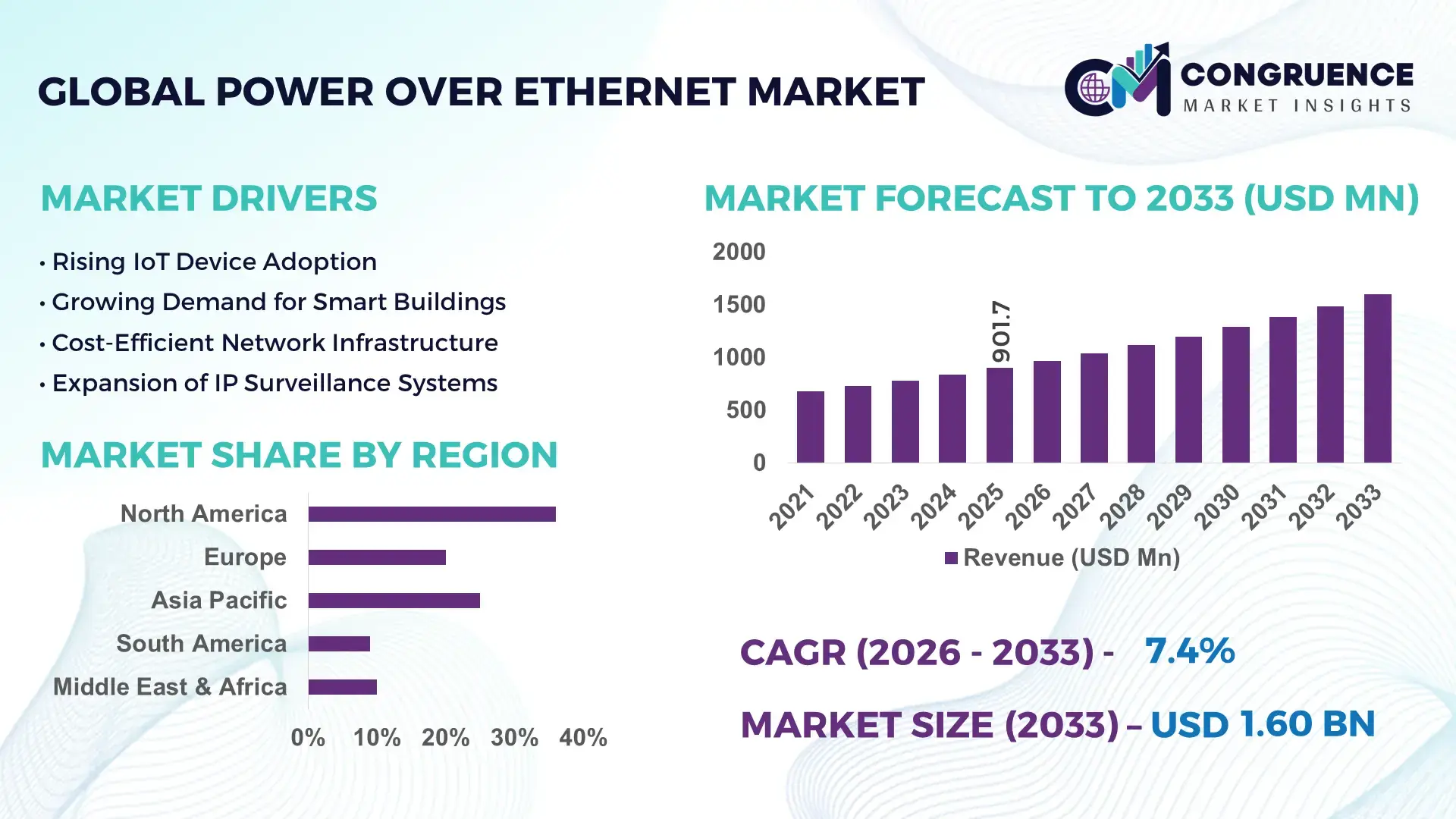
The Global Power over Ethernet Market was valued at USD 901.74 Million in 2025 and is anticipated to reach a value of USD 1596.31 Million by 2033 expanding at a CAGR of 7.4% between 2026 and 2033. The primary factor driving this growth is the increasing deployment of connected devices and smart infrastructure that require simplified, cost-efficient power and data transmission through a single Ethernet cable.
The United States represents a major hub for advanced Power over Ethernet ecosystem development, supported by large-scale investments in smart building infrastructure and enterprise networking. Over 65% of commercial buildings constructed after 2022 in major U.S. metropolitan areas integrate PoE-based lighting and security systems. Data center infrastructure spending exceeded USD 35 billion in 2024, with a growing share allocated to intelligent networking hardware capable of supporting high-power PoE standards such as IEEE 802.3bt. The country also hosts more than 2,500 enterprise campuses implementing PoE-enabled IoT systems for surveillance, wireless access points, and building automation. Additionally, over 70% of next-generation Wi-Fi access points deployed in North America rely on PoE connectivity to simplify installation and reduce electrical infrastructure complexity.
Market Size & Growth: The global Power over Ethernet market was valued at USD 901.74 Million in 2025 and is projected to reach USD 1596.31 Million by 2033, expanding at a CAGR of 7.4%, driven by rising demand for smart buildings, IoT-enabled infrastructure, and simplified network cabling systems.
Top Growth Drivers: Smart building adoption rising by 42%, enterprise network efficiency improvements of 35% through centralized power delivery, and connected IoT device installations increasing by 48% globally.
Short-Term Forecast: By 2028, advanced PoE deployment across commercial infrastructure is expected to reduce cabling installation costs by nearly 28% and improve device deployment efficiency by approximately 33%.
Emerging Technologies: IEEE 802.3bt high-power PoE standards, AI-enabled network management platforms, and PoE-integrated smart lighting systems are reshaping enterprise connectivity infrastructure.
Regional Leaders: North America projected to exceed USD 520 Million by 2033 driven by enterprise networking upgrades; Asia-Pacific approaching USD 480 Million with rapid smart city infrastructure expansion; Europe expected to surpass USD 350 Million supported by sustainable building automation initiatives.
Consumer/End-User Trends: Enterprise IT infrastructure, healthcare facilities, and industrial automation environments increasingly deploy PoE-powered cameras, access points, and IoT sensors to streamline network installation and maintenance.
Pilot or Case Example: In 2024, a large commercial office complex in Singapore deployed PoE-enabled lighting and surveillance infrastructure, achieving a 32% reduction in electrical installation costs and improving energy monitoring efficiency by 25%.
Competitive Landscape: Cisco Systems leads with approximately 24% share of enterprise PoE networking solutions, followed by major competitors including HPE Aruba Networking, Ubiquiti Networks, Dell Technologies, and Netgear.
Regulatory & ESG Impact: Governments across Europe and North America are encouraging low-voltage energy distribution technologies in smart buildings, with energy-efficiency frameworks targeting 20–30% reductions in building energy consumption by 2030.
Investment & Funding Patterns: Global investments in smart building infrastructure and intelligent networking technologies exceeded USD 4.5 billion between 2023 and 2025, accelerating deployment of PoE-enabled systems across commercial and industrial sectors.
Innovation & Future Outlook: Integration of PoE with edge computing devices, AI-driven building management platforms, and high-power networking standards is expected to transform enterprise digital infrastructure and intelligent facility management.
The Power over Ethernet market is expanding across multiple industry sectors including enterprise IT infrastructure, healthcare facilities, hospitality, transportation systems, and industrial automation. Enterprise networking applications account for nearly 40% of PoE device installations, particularly for wireless access points and IP surveillance systems. Technological innovations such as IEEE 802.3bt supporting up to 90 watts per port have enabled new applications including PoE-powered LED lighting and digital signage. Regulatory emphasis on energy-efficient building systems in Europe and North America is encouraging adoption of centralized low-voltage power architectures. Meanwhile, Asia-Pacific is witnessing rapid PoE consumption due to expanding smart city initiatives and digital infrastructure projects. Emerging trends include integration of PoE with edge computing devices, AI-powered building management platforms, and advanced IoT sensor networks designed to optimize energy consumption and facility operations.
The strategic importance of the Power over Ethernet Market is growing as organizations transition toward integrated digital infrastructure that combines power delivery and data connectivity through standardized Ethernet cabling. Advanced PoE standards such as IEEE 802.3bt deliver nearly 70% higher power capacity compared to earlier IEEE 802.3af implementations, enabling new enterprise applications including smart lighting, digital kiosks, and intelligent security systems.
North America dominates deployment volume through extensive enterprise networking upgrades, while Asia-Pacific leads in adoption momentum with nearly 52% of new smart building projects integrating PoE-powered devices. By 2027, AI-enabled network monitoring systems integrated with PoE infrastructure are expected to improve device performance monitoring efficiency by approximately 30%.
Sustainability initiatives are also influencing adoption patterns. Large technology firms and building operators are committing to energy-efficiency targets such as reducing building power consumption by 25% by 2030 through centralized PoE-based energy management systems. In 2024, a large technology campus in South Korea deployed AI-managed PoE lighting networks and achieved a 27% reduction in energy consumption across its office infrastructure. With increasing convergence between IoT ecosystems, intelligent building systems, and edge networking infrastructure, the Power over Ethernet Market is positioned as a critical pillar for resilient digital infrastructure, regulatory compliance, and sustainable enterprise technology deployment.
The rapid growth of smart building infrastructure is significantly boosting demand for Power over Ethernet solutions. Modern commercial facilities increasingly rely on connected lighting systems, environmental sensors, and IP surveillance devices that can be powered directly through Ethernet cables. More than 80% of newly installed wireless access points in enterprise environments now support PoE connectivity. Additionally, PoE-powered LED lighting installations have expanded by over 35% in large commercial buildings since 2022. By enabling centralized energy management and simplified cabling infrastructure, PoE technology reduces installation complexity and supports scalable building automation systems. These capabilities make PoE a preferred networking architecture for corporate campuses, hospitals, hotels, and educational institutions deploying integrated digital infrastructure.
Despite strong adoption trends, compatibility challenges with legacy networking infrastructure remain a key restraint for the Power over Ethernet Market. Many older enterprise networks operate on Ethernet switches that cannot support higher power PoE standards such as IEEE 802.3bt. Upgrading these systems requires substantial hardware replacement including switches, cabling, and network management platforms. Studies indicate that nearly 40% of corporate office networks still operate on legacy PoE standards that deliver limited power capacity. Additionally, long-distance cable runs in large facilities may reduce available power output, restricting certain device deployments. These infrastructure constraints can delay implementation timelines and increase capital expenditures for organizations transitioning toward modern PoE-enabled digital infrastructure.
The rapid expansion of IoT ecosystems presents substantial opportunities for the Power over Ethernet Market. Global IoT device installations exceeded 16 billion units in 2024, with enterprise environments increasingly deploying connected sensors, cameras, and wireless communication devices. PoE technology simplifies the integration of these devices by enabling both power and data transmission through a single Ethernet cable. Industrial facilities, smart transportation systems, and healthcare environments are adopting PoE-powered monitoring devices to enhance operational visibility and automation capabilities. Additionally, emerging applications such as smart retail displays, digital kiosks, and environmental monitoring networks are expanding the potential deployment scope of PoE-enabled infrastructure across diverse industries.
Although technological advancements have improved PoE capabilities, power delivery limitations remain a challenge for certain high-energy applications. Traditional PoE standards provide between 15 and 60 watts per port, which may be insufficient for devices requiring higher power levels such as advanced video conferencing systems or high-performance computing peripherals. Even with newer standards supporting up to 90 watts, network administrators must carefully manage device distribution across switches to avoid power overload risks. Large-scale enterprise deployments involving hundreds of connected devices require detailed power budgeting and network planning. These operational complexities can slow adoption in environments where diverse device types and high energy consumption requirements coexist within the same network infrastructure.
• Rapid Expansion of High-Power IEEE 802.3bt Deployments:
The adoption of IEEE 802.3bt PoE technology is expanding rapidly across enterprise networking environments as organizations demand higher power capacity for connected devices. This advanced standard delivers up to 90 watts per port, nearly 2.5 times the power capability of earlier 30-watt standards. In 2024, more than 48% of newly deployed enterprise Ethernet switches supported high-power PoE functionality. The number of PoE-powered wireless access points installed globally exceeded 120 million units, with over 75% using enhanced power standards to support high-bandwidth Wi-Fi 6 and Wi-Fi 7 infrastructure. Enterprises are also integrating PoE-powered LED lighting systems, which have demonstrated energy efficiency improvements of approximately 32% compared with traditional electrical lighting infrastructure. These high-power capabilities are expanding the potential for PoE in digital signage, conferencing equipment, and intelligent workplace solutions.
• Increasing Integration of PoE in Smart Building Infrastructure:
Smart building infrastructure is becoming one of the largest demand centers for Power over Ethernet technology. Nearly 68% of newly constructed commercial office buildings in developed economies now integrate PoE-based lighting, surveillance cameras, and environmental sensors. Modern PoE lighting systems can reduce installation wiring by up to 40% while enabling centralized monitoring of energy consumption. In large corporate campuses, over 65% of network-connected IoT sensors now rely on PoE power distribution to streamline installation and maintenance. Smart lighting systems powered through PoE have demonstrated energy consumption reductions of approximately 25% through automated occupancy sensors and intelligent dimming technologies. This integration supports broader building automation systems that combine security monitoring, climate control, and energy management within a unified network infrastructure.
• Rise in Modular and Prefabricated Construction:
The adoption of modular construction is reshaping demand dynamics in the Power over Ethernet market. Research indicates that nearly 55% of new commercial projects achieve measurable cost benefits through modular and prefabricated construction methods. Pre-cut cabling systems and factory-assembled network racks are increasingly integrated into building modules before on-site installation, reducing labor requirements by approximately 30%. In Europe and North America, nearly 42% of large commercial construction projects incorporate prefabricated networking infrastructure designed to support PoE connectivity. These prefabricated systems accelerate project timelines by nearly 20% while ensuring consistent network performance and easier integration of security cameras, wireless access points, and IoT sensors. As modular construction continues to expand in urban infrastructure projects, demand for standardized PoE-ready networking components is expected to increase significantly.
• Growth of PoE-Enabled IoT Device Ecosystems:
The rapid expansion of IoT ecosystems is accelerating deployment of PoE-powered network devices across enterprise and industrial environments. Global installations of connected IoT devices surpassed 16 billion units in 2024, with approximately 38% of enterprise IoT endpoints powered through PoE connectivity. IP surveillance cameras alone account for nearly 210 million installed units worldwide, with more than 60% relying on PoE for power delivery. Industrial facilities deploying PoE-powered environmental sensors have reported operational monitoring improvements of up to 35% due to real-time data collection. Additionally, PoE-enabled digital signage and retail kiosks have increased by nearly 28% in commercial retail locations. These developments highlight how PoE technology is becoming a foundational component of modern IoT infrastructure, supporting efficient device deployment and centralized network management.
The Power over Ethernet market segmentation reflects diverse deployment requirements across networking infrastructure, enterprise connectivity, and industrial IoT environments. By type, the market primarily includes power sourcing equipment controllers, powered devices, and midspan injector solutions designed for different network architectures. By application, IP surveillance systems, wireless access points, and VoIP communication devices represent the largest deployment categories due to widespread enterprise connectivity needs. Building automation systems and PoE-powered LED lighting are emerging applications gaining rapid adoption in smart building infrastructure projects. From an end-user perspective, enterprise IT infrastructure, commercial buildings, healthcare facilities, and industrial automation sectors dominate market demand. Increasing adoption of connected devices and centralized network management platforms is influencing how organizations deploy PoE infrastructure across multiple operational environments.
Power over Ethernet equipment types include Power Sourcing Equipment (PSE), Powered Devices (PD), and PoE injector or midspan solutions. Power Sourcing Equipment currently represents the leading segment, accounting for approximately 46% of total deployments because these devices deliver electrical power directly through Ethernet switches to multiple connected endpoints. Large enterprise networks rely heavily on PSE-enabled switches to support wireless access points, surveillance cameras, and IoT devices within centralized network architectures. Powered Devices account for roughly 34% of installations and include endpoints such as IP cameras, VoIP phones, wireless access points, LED lighting systems, and environmental sensors. These devices represent the fastest-growing category with an estimated growth rate of approximately 9.2% annually as organizations deploy increasing numbers of connected devices across enterprise and industrial environments. PoE injectors and midspan devices make up the remaining 20% of installations and are typically used to add PoE functionality to legacy networking systems without replacing existing switches.
IP surveillance systems represent the largest application segment within the Power over Ethernet market, accounting for approximately 39% of total deployments due to widespread adoption in commercial security infrastructure. Enterprises increasingly prefer PoE-powered surveillance cameras because they simplify installation by eliminating separate power wiring and allow centralized monitoring through network switches. Wireless access points represent the second-largest segment with approximately 28% adoption, supporting modern Wi-Fi networks across enterprise campuses, hotels, hospitals, and educational institutions. These devices are increasingly dependent on PoE connectivity to enable flexible deployment and easier maintenance. PoE-powered LED lighting systems are the fastest-growing application segment, expanding at an estimated 11.3% annual growth rate as smart building operators adopt centralized lighting control and energy monitoring systems. Intelligent PoE lighting installations can reduce building energy consumption by approximately 25% through automated control features.
Other applications including VoIP phones, digital signage, and access control systems collectively account for roughly 33% of deployments.
Enterprise IT infrastructure represents the largest end-user segment in the Power over Ethernet market, accounting for approximately 41% of deployments due to increasing adoption of network-connected devices across corporate campuses and office environments. Enterprises deploy PoE-enabled switches to power wireless access points, VoIP phones, and surveillance cameras while simplifying network installation and maintenance. Commercial buildings including offices, hotels, and retail facilities represent around 26% of market adoption. Smart building operators increasingly deploy PoE-powered lighting systems and IoT sensors to support automated energy management and building monitoring solutions. Healthcare facilities represent the fastest-growing end-user segment, expanding at an estimated 10.6% annual growth rate. Hospitals are integrating PoE-powered monitoring devices, patient communication systems, and security cameras to improve operational efficiency and reduce electrical infrastructure complexity.
Other end-users including industrial facilities, transportation infrastructure, and educational institutions collectively account for roughly 33% of deployments.
Region North America accounted for the largest market share at 36% in 2025 however, Asia-Pacific is expected to register the fastest growth, expanding at a CAGR of 8.9% between 2026 and 2033.
North America deployed more than 85 million PoE-enabled networking ports across enterprise campuses and data centers, supported by over 2,400 smart building projects integrating PoE lighting and security systems. Europe held approximately 28% share with more than 32 million PoE-powered devices installed in commercial infrastructure. Asia-Pacific accounted for nearly 24% of deployments with over 40 large smart city initiatives integrating PoE-based surveillance and connectivity systems. South America represented roughly 7% of global installations, while the Middle East & Africa contributed around 5%, supported by more than 150 digital infrastructure modernization projects.
How Are Smart Infrastructure Investments Accelerating Demand for Network-Powered Devices?
North America represents approximately 36% of global Power over Ethernet deployments, supported by large-scale enterprise networking upgrades and smart building infrastructure initiatives. The healthcare, financial services, and technology sectors collectively account for nearly 58% of PoE-enabled device installations across corporate campuses and hospitals. Regulatory frameworks encouraging energy-efficient building systems have accelerated PoE lighting deployments in over 65% of newly constructed commercial facilities. Digital transformation initiatives across enterprise IT networks have led to more than 75 million PoE-capable switch ports deployed across office environments. A major regional technology vendor, Cisco Systems, has expanded its enterprise networking portfolio with multi-gigabit PoE switches designed to support Wi-Fi 6 infrastructure. Regional consumer behavior shows strong enterprise adoption across healthcare institutions and financial services organizations deploying centralized network-powered device ecosystems.
Why Are Energy-Efficient Infrastructure Policies Driving Network Power Adoption?
Europe accounts for approximately 28% of the global Power over Ethernet market, with Germany, the United Kingdom, and France leading adoption across enterprise networking and building automation systems. More than 18 million PoE-powered LED lighting fixtures have been deployed across commercial office spaces in the region. Sustainability policies targeting a 30% reduction in building energy consumption by 2030 have accelerated adoption of centralized PoE-based energy management infrastructure. Advanced building automation systems integrating IoT sensors and environmental monitoring devices have expanded across over 1,200 commercial buildings. A European networking equipment manufacturer, Siemens, has developed PoE-enabled building automation solutions integrated with digital facility management platforms. Regional consumer behavior reflects strong regulatory-driven demand, where compliance requirements are encouraging adoption of intelligent PoE infrastructure for transparent energy monitoring and operational efficiency.
What Factors Are Accelerating Enterprise Network Modernization Across Rapidly Digitizing Economies?
Asia-Pacific represents the fastest expanding Power over Ethernet market with more than 40 million installed PoE-powered networking endpoints. China, Japan, and India collectively account for nearly 62% of regional device installations due to rapid expansion of smart city infrastructure and digital enterprise ecosystems. Over 30 metropolitan smart city projects across the region integrate PoE-enabled surveillance networks and wireless access points. Manufacturing and technology sectors are major adopters, deploying connected industrial sensors and monitoring devices powered through Ethernet infrastructure. A regional networking equipment provider, TP-Link Technologies, has introduced high-power PoE switches supporting advanced IoT device deployments in industrial facilities. Regional consumer behavior highlights strong growth in connected retail systems, digital kiosks, and enterprise wireless networking solutions driven by expanding e-commerce platforms and mobile-first technology ecosystems.
How Are Infrastructure Modernization Initiatives Expanding Network Power Applications?
South America holds approximately 7% share of the global Power over Ethernet market, led by Brazil and Argentina where enterprise networking modernization projects are increasing adoption of PoE-powered infrastructure. More than 5,000 commercial buildings across major metropolitan areas have implemented PoE-enabled surveillance and network connectivity systems. Infrastructure investments across telecommunications and transportation sectors have driven installation of over 2 million PoE-capable networking devices. Government initiatives supporting digital infrastructure development and connectivity expansion have encouraged enterprise adoption of centralized network power systems. A regional networking integrator in Brazil has implemented PoE-based security and connectivity infrastructure across multiple urban transit stations. Consumer behavior in the region shows increasing adoption in media broadcasting and localized communication networks supporting multilingual digital signage and connectivity solutions.
Why Are Digital Infrastructure and Smart City Projects Accelerating Network Power Adoption?
The Middle East & Africa region accounts for approximately 5% of the global Power over Ethernet market, supported by expanding construction, oil and gas infrastructure, and digital modernization initiatives. The United Arab Emirates and South Africa represent key markets, deploying PoE-powered surveillance systems across over 1,500 commercial facilities and transportation hubs. Smart city programs have accelerated installation of more than 900,000 network-connected monitoring devices powered through Ethernet infrastructure. Technology modernization initiatives across enterprise campuses are integrating wireless networking systems and security cameras through PoE-enabled switches. A regional telecommunications infrastructure provider has implemented large-scale PoE-powered monitoring networks across urban transportation corridors. Regional consumer behavior reflects strong adoption in security surveillance, hospitality infrastructure, and commercial building automation systems.
United States – 32% share of the Power over Ethernet market: Strong enterprise IT infrastructure, large-scale smart building deployments, and widespread adoption of PoE-powered networking equipment across corporate campuses drive dominance.
China – 19% share of the Power over Ethernet market: High production capacity for networking hardware and rapid expansion of smart city surveillance and wireless connectivity infrastructure support large-scale deployments.
The Power over Ethernet market exhibits a moderately consolidated competitive structure with more than 40 active networking equipment manufacturers and technology providers operating globally. The top five companies collectively account for approximately 55% of the global market, driven by strong enterprise networking portfolios, advanced PoE switch technologies, and extensive distribution networks. Market leaders focus on developing high-power PoE switches supporting IEEE 802.3bt standards capable of delivering up to 90 watts per port.
Competition is shaped by continuous innovation in multi-gigabit Ethernet switches, AI-powered network management software, and intelligent building automation systems. Over 120 new PoE-compatible networking products were introduced between 2023 and 2025, reflecting rapid technological advancement across enterprise connectivity solutions. Strategic partnerships between networking vendors and smart building solution providers are expanding integrated infrastructure ecosystems.
Major players are also investing heavily in research and development, with networking companies allocating approximately 12–15% of annual technology budgets toward product innovation. Several companies have introduced cloud-based management platforms capable of monitoring over 10,000 connected PoE devices across enterprise networks. Increasing demand for IoT connectivity, intelligent facility management, and digital surveillance infrastructure continues to intensify competition as vendors compete to deliver scalable, energy-efficient PoE networking solutions.
Cisco Systems
Hewlett Packard Enterprise (Aruba Networks)
Ubiquiti Inc.
Dell Technologies
Netgear Inc.
Broadcom Inc.
TP-Link Technologies
Juniper Networks
Huawei Technologies
Siemens AG
Allied Telesis
Technological innovation is significantly expanding the capabilities and deployment scope of Power over Ethernet infrastructure across enterprise and industrial networks. The adoption of IEEE 802.3bt standards has enabled power delivery of up to 90 watts per port, nearly three times the capacity of earlier PoE standards, allowing devices such as LED lighting systems, video conferencing units, and digital signage to operate directly through Ethernet cabling. More than 65% of enterprise-grade Ethernet switches introduced since 2023 support high-power PoE capabilities combined with multi-gigabit connectivity.
Integration with advanced wireless technologies is also accelerating demand. Nearly 80% of Wi-Fi 6 and Wi-Fi 6E enterprise access points require PoE connectivity to deliver high-speed data throughput exceeding 9.6 Gbps while maintaining centralized power management. Intelligent network management platforms equipped with AI-driven monitoring tools can now manage over 10,000 PoE-connected devices within a single enterprise network, improving operational visibility and reducing downtime by nearly 30%.
Emerging innovations include PoE-powered smart lighting systems integrated with IoT sensors capable of reducing building energy consumption by approximately 25%. Edge computing devices powered through PoE are also gaining adoption in industrial automation environments where low-voltage infrastructure simplifies installation across factories and logistics centers. These technological developments are strengthening PoE as a foundational component of modern digital infrastructure.
• In April 2025, Cisco Systems expanded its enterprise networking portfolio with the Catalyst 9300X Series switches featuring advanced IEEE 802.3bt PoE capabilities delivering up to 90W per port. The new switches support multi-gigabit speeds and enhanced security architecture designed for high-density enterprise wireless and IoT deployments. Source: www.cisco.com
• In September 2024, Netgear introduced the M4350 series managed switches designed for enterprise AV-over-IP installations. These switches support high-power PoE for connected audio-visual devices and deliver automated network configuration for deployments supporting up to 96 connected PoE devices. Source: www.netgear.com
• In March 2025, Hewlett Packard Enterprise through Aruba Networking launched the CX 6200M stackable switch series supporting high-density PoE ports and enhanced AI-powered network analytics. The solution enables centralized management of more than 1,000 connected IoT and networking devices within enterprise campus environments. Source: www.hpe.com
• In November 2024, Ubiquiti Inc. introduced the UniFi Enterprise PoE Switch with 2.5GbE ports designed for next-generation Wi-Fi 6E infrastructure. The switch provides high-power PoE output supporting advanced wireless access points and enterprise surveillance systems across high-density network deployments. Source: www.ui.com
The Power over Ethernet Market Report provides a comprehensive assessment of the global industry landscape, covering major networking technologies, deployment models, and end-use sectors driving adoption of PoE infrastructure. The report evaluates more than 20 product categories including power sourcing equipment, powered devices, PoE injectors, Ethernet switches, and integrated network management solutions.
The analysis spans multiple application areas such as IP surveillance systems, wireless access points, VoIP communication networks, LED lighting infrastructure, access control systems, digital signage platforms, and industrial IoT monitoring devices. Over 200 million PoE-enabled devices are currently deployed globally across enterprise campuses, healthcare facilities, hospitality properties, and transportation infrastructure.
Geographically, the report analyzes market trends across five key regions including North America, Europe, Asia-Pacific, South America, and the Middle East & Africa, with detailed country-level insights covering more than 18 major economies. The scope also examines emerging technology integration including IEEE 802.3bt high-power PoE standards, AI-enabled network management systems, and PoE-powered smart building platforms. Additionally, the report explores enterprise networking modernization, smart city infrastructure deployment, and the expanding role of PoE in supporting large-scale IoT ecosystems across commercial and industrial environments.
| Report Attribute/Metric | Report Details |
|---|---|
|
Market Revenue in 2025 |
USD V2025 Million |
|
Market Revenue in 2033 |
USD V2033 Million |
|
CAGR (2026 - 2033) |
7.4% |
|
Base Year |
2025 |
|
Forecast Period |
2026 - 2033 |
|
Historic Period |
2021 - 2025 |
|
Segments Covered |
By Types
By Application
By End-User
|
|
Key Report Deliverable |
Revenue Forecast, Growth Trends, Market Dynamics, Segmental Overview, Regional and Country-wise Analysis, Competition Landscape |
|
Region Covered |
North America, Europe, Asia-Pacific, South America, Middle East, Africa |
|
Key Players Analyzed |
Cisco Systems, Hewlett Packard Enterprise (Aruba Networks), Ubiquiti Inc., Dell Technologies, Netgear Inc., Broadcom Inc., TP-Link Technologies, Juniper Networks, Huawei Technologies, Siemens AG, Allied Telesis |
|
Customization & Pricing |
Available on Request (10% Customization is Free) |




