
Reports
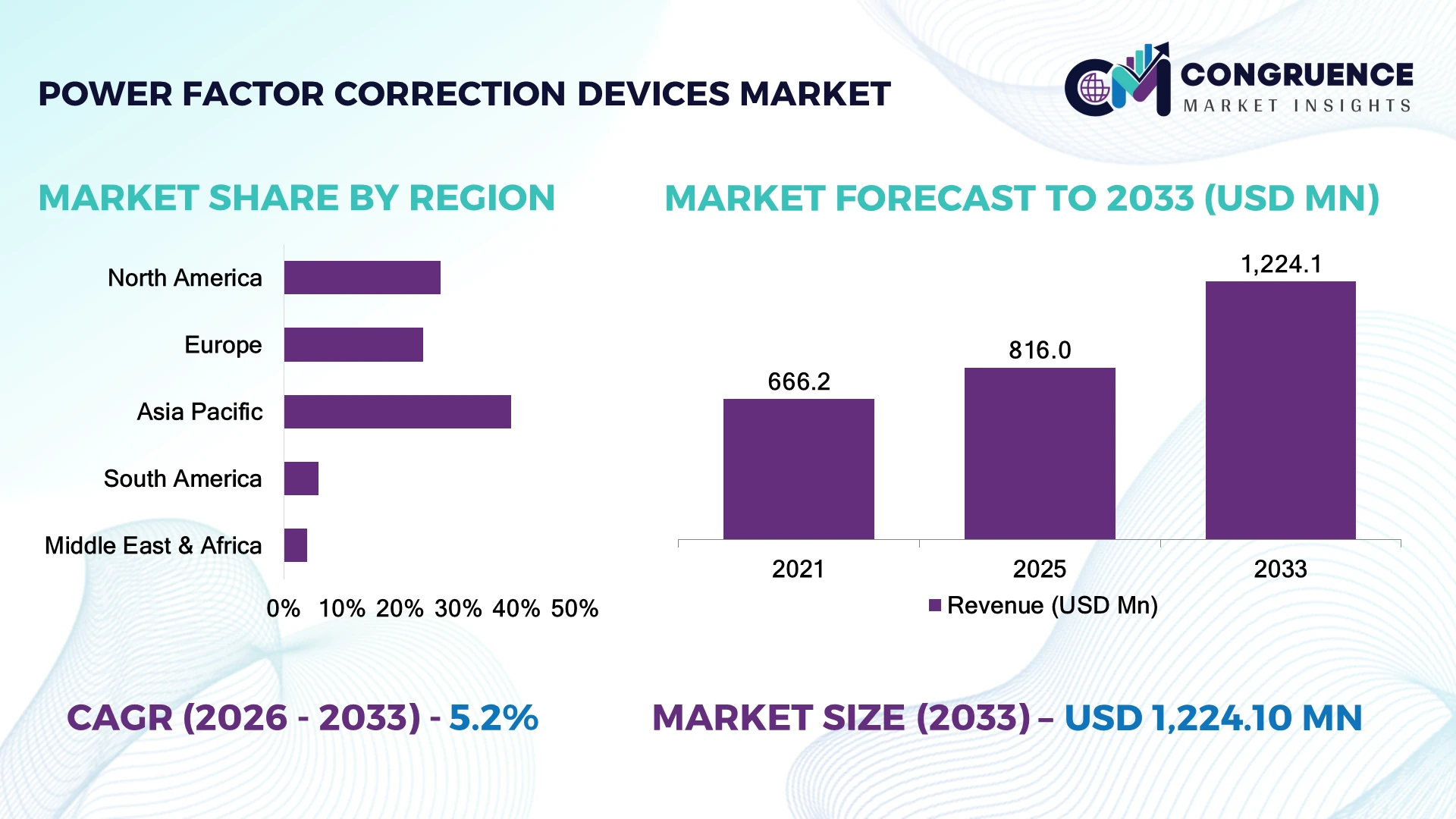
The Global Power Factor Correction Devices Market was valued at USD 816.0 Million in 2025 and is anticipated to reach a value of USD 1,224.1 Million by 2033 expanding at a CAGR of 5.2% between 2026 and 2033. Growth is driven by industrial electrification, rising harmonic loads from variable-frequency drives and data centers, and stricter power-quality requirements that are accelerating deployment of automatic capacitor banks, active filters, and hybrid correction systems.
China dominates with approximately 18% of global demand, supported by large manufacturing, steel, electronics, and utility investments, while India accounts for about 7% and is expanding industrial and data-center electrical infrastructure. China’s manufacturing scale remains substantially larger, whereas India is adopting digital monitoring and automated correction faster, with advanced systems increasingly targeting power factors above 0.95.
Strategically, suppliers with localized manufacturing, intelligent monitoring, and high-efficiency correction architectures are best positioned to capture industrial modernization projects.
Market Size & Growth: USD 816.0 Million in 2025 is projected to reach USD 1,224.1 Million by 2033 at a 5.2% CAGR, supported by industrial electrification and power-quality modernization.
Top Growth Drivers: Industrial automation contributes to roughly 28% of incremental demand, renewable integration 22%, and data-center expansion 17%.
Short-Term Forecast: By 2028, automated correction adoption is expected to increase by about 15%, while intelligent monitoring can reduce avoidable reactive-power losses by 8–12%.
Emerging Technologies: AI-enabled controllers, active harmonic filters, and advanced polypropylene-film capacitors are shifting PFC systems toward predictive and digitally monitored operation.
Regional Leaders: Asia-Pacific is projected near USD 490 Million, North America around USD 285 Million, and Europe approximately USD 290 Million by 2033, with smart-grid and industrial retrofit adoption strengthening.
Consumer/End-User Trends: Industrial facilities represent more than 45% of deployment, while automated correction systems are increasingly selected for factories with variable-frequency drives and nonlinear loads.
Pilot/Case Example: In 2025, industrial PFC modernization programs targeting automated capacitor control delivered power-quality improvements of approximately 10–15% in heavily motorized facilities.
Competitive Landscape: Schneider Electric, ABB, Siemens, Eaton, and Mitsubishi Electric remain leading international participants, with the top five collectively estimated to command about 25% of global competitive value.
Regulatory & ESG Impact: Power-quality requirements targeting power factors around 0.95–0.99 are encouraging correction investments while reducing distribution losses and unnecessary electrical capacity requirements.
Investment & Funding: More than USD 1 billion in combined industrial-grid modernization activity is supporting equipment upgrades, local manufacturing, automation partnerships, and power-quality infrastructure across major Asian markets.
Innovation & Future Outlook: Next-generation systems will combine active filtering, IoT monitoring, predictive maintenance, and modular architectures, shifting competition from standalone capacitors toward integrated energy-efficiency platforms.
Power Factor Correction Devices are gaining traction across manufacturing plants, commercial buildings, renewable-energy installations, EV charging infrastructure, and data centers. Automatic capacitor banks and active filters are increasingly replacing manually configured systems, while digital monitoring is becoming standard in higher-load installations. Adoption of correction systems designed to maintain power factors above 0.95 is strengthening as electricity networks manage increasingly nonlinear loads. Supply-chain restructuring is also encouraging localized component sourcing and modular manufacturing, creating a clearer transition toward integrated, service-supported PFC solutions and setting the stage for strategic technology positioning.
Power Factor Correction Devices are becoming strategically important because industrial operators increasingly treat power quality as an operational-performance issue rather than a basic electrical-design requirement. Manufacturing automation, data centers, EV charging, and renewable generation introduce nonlinear and variable loads that increase the value of precise reactive-power management. Maintaining power factors around 0.95–0.99 also improves usable electrical capacity and reduces avoidable system losses.
Technology differentiation is becoming measurable. Modern active power filters can dynamically compensate harmonics and reactive power, while legacy fixed capacitor systems provide narrower correction and limited adaptability. Intelligent controllers can reduce unnecessary switching and improve equipment utilization by roughly 8–12%. China remains the largest industrial deployment center, while India is moving faster in new automated installations, particularly around manufacturing and digital infrastructure.
Over the next 2–3 years, automated monitoring, retrofit projects, and digitally controlled correction systems are expected to gain greater penetration across high-load facilities. A practical deployment involves integrating capacitor banks, detuned reactors, and active filtering with plant energy-management systems. Companies are responding through localized production, technology partnerships, retrofit packages, and expanded service networks. Competitive advantage will increasingly depend on delivering measurable power-quality improvements with lower lifecycle complexity.
Industrial electrification is accelerating demand for automated correction as motor-driven equipment, variable-frequency drives, and power electronics increase reactive and harmonic loads. Manufacturing facilities increasingly target power factors above 0.95, while automated PFC deployment can reduce reactive-power-related inefficiencies by approximately 8–12%. China’s extensive electronics and machinery clusters are expanding high-load electrical systems, while India is adding automated correction capacity alongside new industrial facilities. The Russia-Ukraine conflict also exposed the importance of resilient electrical infrastructure and diversified component sourcing. Manufacturers are responding with modular capacitor banks, active filters, detuned reactors, and digital controllers. The strategic shift is clear: suppliers that integrate correction with monitoring and predictive maintenance capture more value than vendors selling standalone capacitor assemblies.
Power Factor Correction Devices remain exposed to volatility in copper, aluminum, electronic-control components, and specialized capacitor materials. Component costs can account for roughly 45–60% of equipment manufacturing expenses, placing pressure on margins when input prices move sharply. Imported electronic components can also extend procurement cycles by 10–20% for specialized active-filter systems. India and Southeast Asian manufacturers continue increasing local sourcing, but selected advanced components remain internationally dependent. The Russia-Ukraine conflict and broader logistics disruptions demonstrated how geopolitical instability can affect industrial electrical supply chains. Companies are reducing exposure through dual sourcing, longer-term procurement contracts, localized assembly, and standardized modular designs. The key operational constraint is not device availability alone but maintaining consistent component quality while protecting project economics.
Digitalized PFC represents a significant opportunity as industrial operators connect electrical assets to energy-management platforms. Intelligent controllers can improve correction response by approximately 10–15% compared with manually configured systems, while predictive monitoring can reduce unnecessary maintenance interventions by around 10%. India’s expanding manufacturing and data-center infrastructure provides a strong deployment environment for these systems, while Vietnam and other Southeast Asian production hubs are attracting electronics manufacturing investments. Advanced active filters, IoT-enabled capacitor controllers, and hybrid compensation architectures are emerging as high-value solutions. Companies are increasing R&D spending, forming automation partnerships, and developing retrofit-ready platforms. The non-obvious opportunity lies in converting existing installed capacitor systems into digitally monitored assets, creating recurring software, diagnostics, and maintenance revenue without replacing the complete electrical installation.
The increasing sophistication of PFC systems creates execution challenges around harmonic analysis, system coordination, cybersecurity, and commissioning expertise. Facilities integrating variable-frequency drives, solar inverters, battery systems, and EV chargers can experience substantially more complex electrical profiles than conventional motor loads, with harmonic distortion frequently exceeding 5% in poorly controlled installations. Digital PFC systems also require skilled commissioning and cybersecurity practices, increasing implementation complexity by roughly 10–15% compared with basic fixed correction assemblies. Japan and Germany maintain strong engineering capabilities, while rapidly expanding industrial hubs in India and Southeast Asia face larger specialist-workforce gaps. Companies must invest in engineering training, automated diagnostics, standardized commissioning procedures, and system-integrator partnerships. Long-term competitiveness will depend on reliable integration across increasingly heterogeneous electrical environments rather than hardware performance alone.
Intelligent Switching Gains Ground Automatic controllers are increasingly replacing fixed switching arrangements, with digitally monitored installations rising roughly 12–15% in high-load facilities. Real-time kvar measurement and load-following control are reducing unnecessary capacitor cycling by about 8–10%. Manufacturers are responding with IoT-connected controllers and predictive diagnostics, particularly in China and India where new industrial panels increasingly integrate energy-management interfaces.
Active Filtering Expands Retrofits Active power filters are gaining traction in facilities with variable-frequency drives, UPS systems, and rectifiers, with advanced installations increasing around 10–13%. Harmonic-focused retrofits can reduce problematic distortion by approximately 20–30% when correctly engineered. The shift is accelerating as data centers and automated factories add nonlinear loads, prompting suppliers to package filtering, reactive compensation, and monitoring into single retrofit solutions.
Compact Designs Reshape Procurement Equipment buyers are increasingly favoring modular PFC assemblies that shorten panel installation and commissioning time by roughly 15–20%. Newer capacitor and reactor designs also reduce cabinet footprint by around 10–15%, supporting constrained electrical rooms in commercial buildings and manufacturing sites. Supply-chain pressure on imported components is pushing manufacturers toward standardized platforms, regional assembly, and interchangeable components rather than highly customized configurations.
Power Quality Becomes Measurable Enterprises are moving from periodic electrical audits toward continuous power-quality monitoring, with connected PFC deployments increasing approximately 15% across digitally managed facilities. Maintaining operating power factors above 0.95 is becoming a practical procurement KPI rather than a design assumption. Regulatory attention to electrical efficiency and grid modernization is reinforcing this shift, while suppliers increasingly combine PFC equipment with dashboards, remote diagnostics, and service contracts.
Power Capacitors remain the leading type, accounting for approximately 47.1% of the market in 2025, because they provide scalable reactive-power compensation at comparatively low installation complexity. AC Reactors follow with about 19.8%, particularly where switching transients and harmonic conditions require additional control. Power Capacitors remain strongest across conventional industrial panels, utility installations, and predictable motor loads, while AC Reactors increasingly complement capacitor systems rather than compete directly with them. Companies are prioritizing standardized capacitor assemblies, safer switching architectures, and locally sourced components to protect project economics.
Active Power Filters represent a smaller share of roughly 9.9% but are the fastest-growing technology within the established type mix as variable-frequency drives, UPS systems, and nonlinear electronic loads increase harmonic-management requirements. Their dynamic compensation capability gives them a clear performance advantage over conventional passive correction in complex load environments. Other specialized devices retain strategic importance for high-performance applications. The investment shift is therefore moving from standalone reactive correction toward hybrid packages combining capacitors, reactors, active filtering, and digital control.
Industrial Utility represents the leading application with approximately 50.1% share, reflecting concentrated demand from manufacturing plants, process industries, machinery operations, and energy-intensive production lines. Large industrial loads create persistent reactive-power requirements, making PFC equipment operationally important for transformer utilization, electrical capacity, and power-quality management. Commercial Utility follows at roughly 40.0%, supported by offices, retail complexes, data centers, and large building systems. Industrial deployments generally prioritize high-capacity correction and durability, while commercial buyers increasingly emphasize compact equipment, automated switching, and remote monitoring. Suppliers are consequently expanding modular product ranges and engineering support for both retrofit and new-build projects.
Public Power Supply accounts for approximately 9.9% and remains strategically important because utility-side correction supports feeder stability and voltage management. Commercial Utility is experiencing the sharper technology transition as data centers and digitally managed buildings introduce more nonlinear loads. Active filtering and intelligent monitoring are therefore gaining importance alongside conventional capacitor installations. Companies are adapting through packaged systems that combine correction, harmonic mitigation, metering, and commissioning support. This creates a stronger value proposition than selling individual devices and improves deployment consistency across multi-site commercial portfolios.
Commercial users lead end-user demand at approximately 35% share, supported by offices, retail facilities, large buildings, and data centers where electrical efficiency and power-quality management directly affect operating costs. Commercial installations increasingly favor compact automatic systems because load profiles change throughout the day. Power Generation follows as a major buyer group, where large-scale correction supports voltage stability and reactive-power management. Electronics and automotive manufacturers are also strengthening procurement as automated production lines introduce increasingly nonlinear electrical loads. Companies are responding with modular architectures, remote monitoring, and application-specific engineering rather than one-size-fits-all capacitor packages.
Automotive, Electronics, Medical and Healthcare, Mining, and Other Industries collectively represent important specialized demand pools, with automotive emerging as one of the fastest-shifting segments because EV production and charging infrastructure introduce new power-electronic loads. Automotive facilities increasingly require harmonic control alongside conventional reactive compensation, while electronics plants prioritize cleaner power for sensitive equipment. Mining operations emphasize ruggedness and remote monitoring, whereas healthcare facilities prioritize continuity and power quality. Suppliers are consequently developing sector-specific configurations, strengthening system-integrator partnerships, and expanding service coverage. The competitive shift favors vendors capable of combining reliable correction hardware with application engineering and digital diagnostics.
Asia-Pacific accounted for the largest market share at 39% in 2025 however, Middle East & Africa is expected to register the fastest growth, expanding at a CAGR of 6.4% between 2026 and 2033.
North America represented approximately 27% of the global market in 2025, supported by extensive manufacturing, commercial infrastructure, data centers, and utility modernization. The United States concentrates most regional demand, particularly across automotive plants, semiconductor facilities, food processing, and large commercial buildings. Data-center construction is strengthening demand for active harmonic filters and digitally monitored capacitor systems as electrical loads become increasingly nonlinear. Around 35% of new large-scale industrial PFC installations increasingly incorporate automated monitoring or remote diagnostics. Utilities and industrial operators are also prioritizing equipment capable of maintaining power quality during variable-load operation. Manufacturers are responding through domestic assembly, integrator partnerships, and retrofit packages that combine capacitor banks, reactors, harmonic filtering, and monitoring. The strategic opportunity centers on replacing fragmented electrical correction equipment with integrated power-quality platforms.
United States Market Outlook: The United States remains the regional technology and deployment center, supported by large-scale semiconductor, automotive, logistics, and data-center investments. More than 40% of newly specified large commercial and industrial electrical projects increasingly include automated power-quality monitoring, strengthening demand for intelligent PFC architectures and engineering-led solutions.
Europe held approximately 24% of global demand in 2025, with Germany, Italy, France, the United Kingdom, and Spain forming important industrial deployment centers. Energy-efficiency requirements and electricity-cost pressures are encouraging manufacturers to upgrade aging capacitor banks with automated correction and harmonic-management systems. Industrial facilities increasingly combine PFC with energy-management platforms, while renewable generation and distributed power systems create more variable electrical conditions. Approximately 30% of newer industrial installations increasingly incorporate digital monitoring capabilities alongside conventional correction hardware. Germany’s machinery and automotive industries remain major demand centers, while Italy has strong equipment-manufacturing capabilities. Suppliers are emphasizing high-efficiency components, compact modular cabinets, and lifecycle service agreements. European procurement is consequently shifting from lowest upfront cost toward measurable energy performance, reliability, and compatibility with increasingly decentralized electrical infrastructure.
Germany Market Outlook: Germany provides Europe’s strongest industrial base for advanced PFC deployment, supported by automotive manufacturing, machinery production, chemicals, and automated factories. Industrial facilities with sophisticated motor and drive systems increasingly require harmonic mitigation alongside reactive compensation, creating strong positioning for suppliers offering integrated active filtering, monitoring, and engineering services.
Asia-Pacific accounted for approximately 39% of global demand in 2025, making it the largest regional market. China represents the principal deployment center, supported by electronics, steel, machinery, automotive, and semiconductor manufacturing, while India, Japan, South Korea, and Southeast Asian production hubs provide additional demand. Approximately 45% of regional installations are concentrated in industrial and manufacturing environments where motor loads and automated production equipment create persistent power-quality requirements. China’s extensive factory modernization is increasing adoption of automatic capacitor banks, detuned reactors, and active filtering. India is simultaneously expanding PFC deployment alongside new manufacturing facilities and data-center infrastructure. Suppliers are responding with localized production, regional component sourcing, and partnerships with electrical-system integrators. The region’s scale advantage is increasingly complemented by technology localization, shortening procurement cycles and supporting standardized PFC configurations.
China Market Outlook: China remains the region’s largest country market, benefiting from extensive manufacturing capacity and continued modernization of electronics, machinery, automotive, and industrial facilities. Industrial automation and high-density production environments are driving greater use of intelligent correction systems, with power-quality monitoring increasingly integrated into new electrical control panels.
South America accounted for approximately 6% of global PFC demand in 2025, with Brazil representing the principal market because of its manufacturing, mining, food processing, metals, and utility infrastructure. Industrial facilities with large motors and variable loads remain the primary deployment centers, while commercial buildings are increasingly adopting automatic correction to improve electrical utilization. Brazil’s mining and agricultural-processing industries are particularly relevant because remote and energy-intensive operations place greater emphasis on equipment reliability and power-quality control. Approximately 25% of newer industrial PFC projects increasingly include automated switching or monitoring functions. Imported components remain important, creating procurement sensitivity and longer lead times for specialized equipment. Manufacturers are therefore strengthening distributor networks, local assembly, and standardized product portfolios. Selective modernization rather than broad replacement remains the prevailing procurement pattern, favoring suppliers with strong local service capabilities.
Brazil Market Outlook: Brazil is the region’s most strategically significant market, supported by large industrial loads across mining, steel, food processing, pulp and paper, and manufacturing. Expansion of industrial electrical infrastructure is increasing demand for robust capacitor banks and harmonic-control systems, while local engineering and service networks provide an important competitive advantage.
Middle East & Africa represented approximately 4% of global PFC demand in 2025, with Saudi Arabia, the United Arab Emirates, South Africa, and Qatar serving as major deployment centers. Large commercial complexes, desalination facilities, oil and gas operations, manufacturing zones, airports, and data centers are generating demand for reliable reactive-power compensation. Approximately 20% of new large infrastructure electrical projects increasingly specify automated power-quality monitoring, reflecting greater attention to electrical efficiency and equipment utilization. Saudi Arabia and the UAE are particularly important for high-capacity commercial and infrastructure installations, while South Africa provides a strong industrial and mining application base. Suppliers are expanding through engineering partnerships, regional distributors, and packaged systems designed for demanding operating conditions. The region’s strongest opportunity lies in new-build infrastructure, where PFC can be engineered into electrical systems rather than added later through retrofit programs.
Saudi Arabia Market Outlook: Saudi Arabia leads regional investment momentum through large infrastructure, industrial, utilities, and urban-development programs. New industrial zones and large commercial facilities increasingly require automated reactive-power management, creating demand for high-capacity PFC assemblies, harmonic mitigation, and centralized monitoring integrated into modern electrical distribution systems.
Schneider Electric, ABB, Siemens, Eaton, and Hitachi Energy compete as global OEM leaders, while regional capacitor manufacturers compete on cost and delivery. The top five players hold an estimated 25% combined share, leaving a fragmented specialist tier. Technology drives differentiation, with intelligent systems commanding roughly 10–15% premiums, while localized supply can cut lead times 15–20%. Global OEMs are expanding smart capacitor portfolios, partnering with automation integrators, and integrating monitoring, harmonic filtering, and reactive compensation. Regional suppliers counter with customization and faster commissioning. Competition is shifting from conventional capacitor banks toward active, digitally monitored power-quality platforms as variable loads and renewable integration increase. Entry barriers remain high because certification, application engineering, service networks, and utility compliance require specialized capabilities. Supply-chain localization is becoming a decisive pressure point for capacitors, controllers, reactors, and power electronics. Winning requires reliable hardware, engineering support, intelligent diagnostics, lifecycle economics, and localized manufacturing or partnerships across markets.
Schneider Electric
ABB
Siemens
Eaton
Hitachi Energy
General Electric
TDK Corporation
Vishay Intertechnology
CIRCUTOR
Ducati Energia
Larsen & Toubro
Socomec
Comar Condensatori
Electronicon Kondensatoren
Current PFC technology is moving from fixed capacitor banks toward automatic and electronically controlled compensation. Smart capacitor banks with digital controllers measure reactive power and switch stages according to load, reducing unnecessary switching losses by roughly 5–8%. Active harmonic filters add dynamic correction for nonlinear loads, improving power-quality performance by approximately 10–15% in industrial installations. Adoption is strongest in factories, data centers, and commercial facilities with variable electrical loads.
Emerging systems combine active filtering, reactive compensation, monitoring, and energy-management software. Modular architectures can reduce installation time by about 15–20%, while compact dry-type capacitor designs reduce enclosure requirements by around 10%. Compared with older fixed correction, active compensation responds dynamically to changing loads and avoids overcorrection, giving digitally managed facilities operational flexibility. ABB, Schneider Electric, Eaton, and Hitachi Energy benefit from engineering ecosystems, while regional specialists gain opportunities through customization.
From 2026–2028, AI-assisted diagnostics, IoT connectivity, silicon-based power electronics, and hybrid capacitor-filter systems will reshape procurement. Connected PFC installations are expected to expand by roughly 15%, increasing demand for predictive maintenance and remote analytics. Competitive advantage will shift toward vendors integrating hardware, software, commissioning, and lifecycle services. Companies acting now can secure retrofit channels before power-quality architectures become standard procurement requirements.
October 2025 Hitachi Energy expanded Xi’an dry-type capacitor production using AI visual inspection and robotic automation. Phase one tripled capacity, strengthening supply for HVDC and renewable projects and improving China’s role in the company’s global power-quality manufacturing network. Source: hitachienergy.com
February 2025 Schneider Electric launched EcoConsult in India, combining audits, digital twins, and optimization services. The program targets up to 35% lower electrical energy losses and 15% utility-bill savings through power-factor improvement, strengthening retrofit opportunities for industrial customers. Source: se.com
March 2025 ABB’s SmartPQF active power filter portfolio added modular harmonic mitigation, reactive compensation, and three-phase unbalance treatment. The platform supports wall-mounted and rack-mounted configurations, enabling faster deployment where changing electronic loads require flexible power-quality correction without redesign. Source: abb.com
November 2025 Siemens and Delta formalized a partnership for data-center systems. The solution cuts deployment time by up to 50%, CAPEX by up to 20%, and carbon emissions by up to 27%, accelerating infrastructure for AI and cloud. Source: siemens.com
The report covers the Global Power Factor Correction Devices Market across Power Capacitors, AC Reactors, Active Power Filters, and Other Types, with applications spanning Industrial Utility, Commercial Utility, and Public Power Supply. End-user analysis includes Commercial, Power Generation, Automotive, Electronics, Medical and Healthcare, Mining, and Other Industries. The scope evaluates established correction architectures alongside intelligent and active power-quality systems.
Geographic coverage spans North America, Europe, Asia-Pacific, South America, and Middle East & Africa, with country-level assessment of industrial deployment, infrastructure modernization, manufacturing concentration, and technology adoption. The analysis tracks automated correction, harmonic filtering, digital monitoring, modular systems, and hybrid architectures, alongside competitive participation from major global and regional suppliers. Segment-level shares, adoption indicators, deployment patterns, and technology shifts support investment planning, market-entry decisions, expansion priorities, procurement strategy, and competitive positioning through 2026–2033.
| Report Attribute / Metric | Details |
|---|---|
| Market Revenue (2025) | USD 816.0 Million |
| Market Revenue (2033) | USD 1,224.1 Million |
| CAGR (2026–2033) | 5.2% |
| Base Year | 2025 |
| Forecast Period | 2026–2033 |
| Historic Period | 2021–2025 |
| Segments Covered |
By Type
By Application
By End-User
|
| Key Deliverables | Revenue Forecast; Market Trends; Growth Drivers & Restraints; Technology Insights; Segmentation Analysis; Regional Insights; Competitive Landscape; Regulatory & ESG Overview; Recent Developments |
| Regions Covered | North America; Europe; Asia-Pacific; South America; Middle East & Africa |
| Companies Profiled | Schneider Electric; ABB; Siemens; Eaton; Hitachi Energy; General Electric; TDK Corporation; Vishay Intertechnology; CIRCUTOR; Ducati Energia; Larsen & Toubro; Socomec; Comar Condensatori; Electronicon Kondensatoren |
| Customization & Pricing | Available on Request (10% Customization Free) |




