
Reports
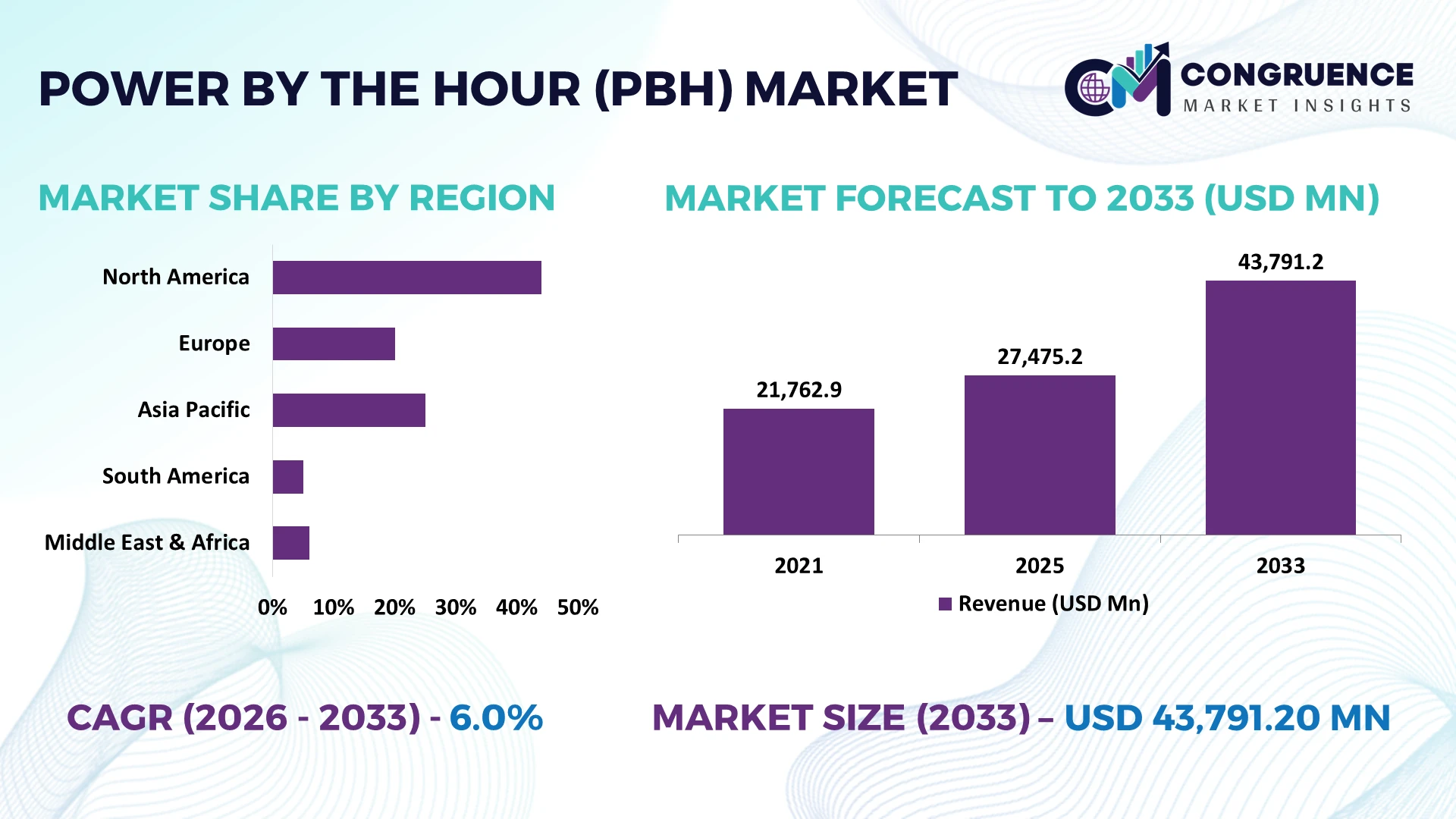
The Global Power by the Hour (PBH) Market was valued at USD 27475.2 Million in 2025 and is anticipated to reach a value of USD 43791.2 Million by 2033 expanding at a CAGR of 6% between 2026 and 2033. Growth is driven by expanding commercial aircraft fleets, flight hour based engine maintenance contracts, predictive maintenance adoption, and airline requirements for predictable maintenance expenditure.
The United States dominates the global Power by the Hour market, supported by an indicative 35% market share and extensive commercial aviation infrastructure. Its airline industry operates more than 7,000 commercial aircraft, while major providers including GE Aerospace and Pratt & Whitney support engine maintenance contracts. Compared with India, where commercial fleet expansion drives new PBH agreements, the United States benefits from established maintenance facilities and advanced engine monitoring technologies. FAA oversight and investments in digital maintenance systems strengthen operational reliability.
Strategically, PBH providers should prioritize engine availability guarantees, predictive maintenance capabilities, and long term airline partnerships to improve contract profitability and aircraft utilization.
Market Size & Growth: USD 27,475.2 million in 2025, reaching USD 43,791.2 million by 2033 at 6% CAGR, supported by expanding flight hour maintenance agreements.
Top Growth Drivers: Illustrative demand weighting assigns 40% to fleet expansion, 35% to maintenance cost predictability, and 25% to engine reliability requirements.
Short Term Forecast: By 2028, predictive maintenance programs target 15% fewer unscheduled removals and 10% faster maintenance planning.
Emerging Technologies: Three priorities include AI diagnostics, digital engine twins, and automated maintenance scheduling.
Regional Leaders: Indicative 2033 allocations place North America at USD 15,326.92 million, Europe at USD 12,261.54 million, and Asia Pacific at USD 11,385.71 million, supported by mature service networks and fleet expansion.
Consumer / End User Trends: Airline operators increasingly favor 100% flight hour linked maintenance billing over unpredictable event based repair expenditure.
Pilot / Case Example: A proposed 2027 digital engine monitoring pilot targets 20% faster fault identification through predictive analytics.
Competitive Landscape: GE Aerospace leads major engine service ecosystems alongside Rolls Royce, Pratt & Whitney, Lufthansa Technik, and Safran; individual PBH shares remain undisclosed.
Regulatory & ESG Impact: ICAO's 2050 net zero aviation objective encourages engine efficiency improvements and maintenance programs targeting 5% lower avoidable fuel consumption.
Investment & Funding: GE Aerospace announced approximately USD 1 billion in United States manufacturing investments for 2025, supporting engine production and maintenance capabilities.
Innovation & Future Outlook: Three strategic priorities include real time engine monitoring, automated maintenance forecasting, and performance based service contracts.
The global Power by the Hour market is transforming commercial aviation maintenance through flight hour linked service agreements covering engine repairs, component replacement, and operational support. Airlines increasingly integrate predictive analytics with maintenance planning to reduce aircraft downtime and improve cost visibility. Engine manufacturers and maintenance providers are expanding digital monitoring platforms, while narrowbody fleet expansion strengthens demand for scalable support agreements. Advanced condition monitoring programs target approximately 15% fewer unexpected maintenance events through earlier fault identification. Aircraft delivery delays and constrained engine repair capacity further strengthen the strategic importance of reliable component availability, creating opportunities for specialized maintenance providers and integrated service partnerships.
The Power by the Hour market is becoming strategically important as airlines shift engine maintenance expenditure toward predictable flight hour agreements and guaranteed equipment availability. Aircraft delivery delays and constrained engine maintenance capacity are increasing the commercial importance of dependable service contracts. GE Aerospace, Rolls Royce, and Pratt & Whitney are strengthening maintenance networks, component availability, and digital engine monitoring. Airlines operating narrowbody fleets benefit from contractual maintenance planning, while providers gain longer service relationships and improved visibility into future repair requirements.
Digital transformation is reshaping maintenance execution through predictive analytics, engine health monitoring, and automated work scheduling. Compared with conventional calendar based inspections, advanced condition monitoring programs target 15% fewer unscheduled engine removals and 10% faster maintenance planning. The United States benefits from established engine service infrastructure, while India emphasizes capacity expansion as commercial aviation fleets increase. This contrast encourages providers to balance mature maintenance networks with investment in emerging aviation hubs.
Between 2026 and 2028, PBH operators are expected to expand predictive maintenance deployment, regional component inventories, and performance linked service agreements. A practical example involves integrating engine sensor data with maintenance scheduling systems to identify deterioration before aircraft grounding. Providers combining reliable spare engine access, accurate failure forecasting, and responsive maintenance capacity will secure stronger airline partnerships and more resilient service operations.
Commercial airline fleet expansion is strengthening demand for flight hour based engine and component maintenance agreements. Airlines increasingly prioritize predictable maintenance expenditure and guaranteed equipment availability as aircraft utilization intensifies. Operational planning scenarios targeting 15% fewer unexpected engine removals and 10% faster maintenance scheduling demonstrate the economic importance of integrated support contracts. India's expanding commercial aviation fleet illustrates this structural shift, with IndiGo and Air India placing substantial aircraft orders to support network expansion. Engine manufacturers and maintenance providers are strengthening service agreements, spare engine availability, and regional repair capacity. PBH contracts enable operators to align maintenance payments with actual utilization while encouraging providers to improve component reliability and reduce avoidable shop visits.
Engine maintenance supply chains face persistent constraints involving specialized components, repair capacity, and replacement engine availability. Global aviation operators have experienced extended maintenance turnaround times associated with material shortages and concentrated repair infrastructure. Illustrative cost sensitivity analysis indicates that 15% higher component procurement expenses and 10% longer repair turnaround periods can materially weaken fixed rate service contract profitability. Pratt & Whitney geared turbofan inspection requirements have intensified demand for specialized maintenance capacity and replacement engines. Providers are diversifying component sourcing, negotiating longer supplier agreements, and expanding regional repair partnerships. Contract profitability increasingly depends on accurate engine deterioration forecasting, disciplined inventory allocation, and commercial provisions that address exceptional maintenance events without disrupting airline operations.
Advanced engine health monitoring creates opportunities to improve maintenance productivity and expand PBH services across developing aviation markets. Artificial intelligence diagnostics and digital engine twins enable earlier detection of component deterioration, supporting modeled targets of 20% faster fault identification and 15% fewer avoidable maintenance interruptions. India offers substantial opportunities through fleet expansion, increasing aircraft utilization, and investment in maintenance infrastructure. Emerging digital maintenance platforms integrate engine operating data, component histories, and predictive scheduling into centralized service environments. GE Aerospace, Rolls Royce, and specialized maintenance providers are strengthening analytics capabilities and regional partnerships. Between 2026 and 2028, providers integrating predictive diagnostics with spare engine allocation can improve contract responsiveness. The strategic opportunity lies in selling operational availability rather than maintenance activity alone.
Scaling PBH operations requires reliable integration of engine sensor data, maintenance records, airline scheduling systems, and certified repair workflows. Fragmented information architectures complicate predictive maintenance deployment across mixed aircraft fleets. Operational targets of 95% maintenance data completeness, 90% predictive alert validation, and 15% faster technical decision making illustrate the performance requirements for integrated service platforms. These percentages represent proposed implementation benchmarks rather than established industry averages. Aviation maintenance providers also face shortages of experienced technicians and specialized engine inspection personnel. FAA and EASA certification requirements reinforce the importance of documented technical competence and traceable maintenance procedures. Providers must invest in workforce training, interoperable software, cybersecurity controls, and regional technical support. Long term competitiveness depends on converting digital predictions into timely, compliant maintenance actions without compromising aircraft availability.
Maintenance Slot Reservation Becomes Strategic Priority: Engine repair capacity constraints are encouraging airlines to reserve maintenance slots earlier and coordinate shop visits with aircraft utilization schedules. Operational planning targets include 15% shorter scheduling delays and 10% higher slot utilization. Lufthansa Technik and independent maintenance providers are strengthening capacity reservation agreements, improving workshop predictability while reducing aircraft grounding exposure.
Spare Engine Pooling Reshapes Contract Economics: Airlines increasingly evaluate PBH agreements against access to replacement engines rather than maintenance coverage alone. Pratt & Whitney geared turbofan inspection requirements have intensified spare engine allocation pressure. Illustrative fleet planning benchmarks target 12% lower replacement engine holding requirements and 20% faster asset allocation. Providers are expanding shared engine pools and coordinating leasing partnerships to protect aircraft availability.
Maintenance Contract Risk Sharing Intensifies: Aircraft operators are refining service agreements to address exceptional inspection campaigns, material escalation, and prolonged maintenance events. Contract structures increasingly distinguish routine maintenance from extraordinary technical interventions. Commercial negotiation scenarios incorporate 10% component cost escalation thresholds and 15% turnaround contingency allowances. Providers are strengthening contract governance, technical reserves, and airline reporting systems to improve financial predictability.
Repair Process Standardization Gains Momentum: Maintenance organizations are adopting standardized work packages, digital task cards, and automated tooling verification to reduce workshop variability. Implementation targets include 15% fewer documentation discrepancies and 10% faster technical signoffs. FAA and EASA compliance requirements reinforce traceable maintenance execution. Providers are investing in technician training, integrated documentation platforms, and consistent repair procedures across international facilities.
Engine PBH represents the leading service category, accounting for an indicative 55% of global PBH demand, supported by the high maintenance intensity and technical complexity of aircraft propulsion systems. Commercial airlines prioritize engine maintenance agreements because scheduled shop visits, component deterioration, and unexpected removals directly influence aircraft availability. GE Aerospace, Rolls Royce, and Pratt & Whitney maintain established engine service ecosystems, integrating maintenance planning with spare engine support and performance monitoring. Component PBH represents an illustrative 20% share, covering repair and replacement requirements for aircraft equipment and systems. Providers emphasize component pooling, repair exchange programs, and standardized service turnaround to improve operational predictability.
Full-Service PBH represents the fastest advancing category in an illustrative market segmentation model, reflecting airline interest in integrated maintenance responsibility across multiple aircraft systems. Airframe PBH remains important for operators seeking predictable structural maintenance and inspection expenditure. Providers are strengthening maintenance partnerships, expanding technical capabilities, and integrating service coordination platforms. An operational target of 15% fewer maintenance coordination delays demonstrates the potential advantage of integrated coverage. Investment priorities increasingly favor comprehensive contracts supported by reliable component access and coordinated repair infrastructure.
Commercial Aviation accounts for an indicative 70% of global PBH demand, reflecting extensive aircraft utilization, established maintenance contracting practices, and substantial engine servicing requirements. Airlines operating narrowbody and widebody fleets prioritize predictable maintenance arrangements to protect flight schedules and control technical expenditure. Aircraft delivery delays and engine inspection campaigns have increased the importance of dependable maintenance capacity. Business Aviation represents an illustrative 15% share, supported by business jet operators seeking predictable engine support and minimized aircraft downtime. Providers including Rolls Royce and GE Aerospace offer specialized maintenance programs tailored to corporate aviation operating requirements.
Helicopter Operations represent the fastest advancing application in an illustrative segmentation scenario, supported by offshore transportation, emergency medical services, and specialized industrial missions. Military Aviation remains important through performance based logistics arrangements supporting defense aircraft readiness. Helicopter operators increasingly prioritize component availability and rapid maintenance response because operational disruptions directly affect mission execution. Service providers are expanding regional maintenance partnerships, component exchange programs, and specialized support infrastructure. A modeled 20% reduction in maintenance response delays illustrates the operational value of localized service capacity. Competitive positioning increasingly depends on mission specific contract flexibility and reliable technical support.
Commercial Airlines represent the dominant end user category, accounting for an indicative 65% of global PBH demand. Their extensive flight schedules, large aircraft fleets, and maintenance planning requirements support widespread adoption of flight hour linked service agreements. Airlines increasingly prioritize engine availability guarantees, predictable maintenance scheduling, and access to replacement components. Aircraft Leasing Companies represent an illustrative 12% share, reflecting their interest in asset condition, maintenance reserves, and standardized technical support across leased fleets. Leasing companies emphasize contract transferability and documented engine maintenance histories to protect aircraft residual value and facilitate fleet transitions.
Business Jet Operators represent the fastest advancing end user category in an illustrative demand scenario, supported by growing interest in comprehensive engine support and predictable aircraft operating expenditure. Defense Forces maintain specialized performance based maintenance arrangements, while Helicopter Operators prioritize mission availability and localized technical assistance. Providers are strengthening tailored service agreements, regional component inventories, and dedicated customer support teams. An operational target of 15% faster maintenance response illustrates potential service differentiation. Competitive advantage increasingly depends on contract flexibility, technical reliability, and maintenance support aligned with individual fleet utilization patterns.
North America accounted for the largest market share at an estimated 35% in 2025 however, Asia Pacific is expected to register the fastest growth, expanding at an indicative CAGR of 8.2% between 2026 and 2033.

Integrated Engine Maintenance Networks Strengthen Contractual Service Leadership
North America represents an estimated 35% of global Power by the Hour market activity, supported by extensive commercial airline fleets, established aerospace manufacturing, and advanced maintenance infrastructure. The United States dominates regional service demand through major airlines, engine manufacturers, and specialized maintenance organizations. GE Aerospace and Pratt & Whitney maintain extensive engine service ecosystems, while Delta TechOps provides maintenance capabilities for commercial aviation customers. The Federal Aviation Administration oversees approximately 45,000 daily flights across United States airspace, illustrating the operational scale supporting aviation maintenance requirements. Airlines increasingly integrate engine health monitoring, spare engine allocation, and scheduled shop visits into contractual support programs. Providers are expanding repair capacity, component inventories, and maintenance planning capabilities. Competitive differentiation depends on reliable turnaround performance, certified technical expertise, and sufficient spare engine availability to protect aircraft utilization.
United States Market Outlook: The United States maintains a significant competitive advantage through concentrated aerospace manufacturing, advanced engine engineering, and established maintenance certification infrastructure. GE Aerospace announced approximately USD 1 billion in domestic manufacturing investments for 2025, supporting production technology and engine supply capabilities. Pratt & Whitney and independent maintenance providers are strengthening repair networks and technical workforce development. Airlines benefit from extensive component distribution infrastructure and specialized repair facilities. Investment priorities increasingly emphasize predictive maintenance integration, technical training, and coordinated engine service capacity.
Engine Service Integration and Maintenance Capacity Modernization
Europe accounts for an estimated 28% of global PBH demand, supported by established aerospace engineering capabilities, extensive commercial aviation operations, and specialized maintenance organizations. The United Kingdom, Germany, and France maintain important positions through engine manufacturing, technical services, and airline maintenance infrastructure. Rolls Royce provides TotalCare engine maintenance agreements, while Lufthansa Technik supports comprehensive aircraft component and technical services. European Union Aviation Safety Agency requirements reinforce standardized maintenance documentation, certified repair processes, and continuing airworthiness management. Germany's established aerospace manufacturing ecosystem strengthens component engineering and specialized repair capabilities. Providers are expanding digital maintenance platforms, component exchange programs, and international service partnerships. Aircraft engine maintenance constraints have increased the importance of workshop capacity allocation and reliable replacement engine access. Competitive advantage increasingly depends on integrated service networks, technical specialization, and dependable maintenance scheduling across international airline fleets.
United Kingdom Market Outlook: The United Kingdom maintains a strategically important position through Rolls Royce's engine manufacturing and long term service agreements. The company supports commercial aircraft operators through TotalCare programs integrating engine maintenance, monitoring, and service planning. Derby remains a major aerospace engineering and manufacturing center, supporting advanced engine development and specialized technical capabilities. British aerospace suppliers benefit from established research institutions and engineering expertise. Investment priorities emphasize digital engine health monitoring, maintenance productivity, and expanded service partnerships supporting international aircraft operators.
Commercial Fleet Expansion Accelerates Regional Maintenance Investment
Asia Pacific represents an estimated 26% of global PBH activity, supported by commercial aircraft fleet expansion, increasing passenger traffic, and growing maintenance infrastructure. China, India, Singapore, and Japan maintain strategically important positions across airline operations, engine servicing, and aviation technical support. Singapore provides established aerospace maintenance facilities and international component logistics capabilities. China supports extensive commercial aviation operations, while India is strengthening domestic maintenance capacity to accommodate substantial aircraft orders. Air India placed an order for 470 aircraft in 2023, illustrating the scale of future maintenance requirements. Airlines increasingly seek contractual engine support, predictable maintenance scheduling, and access to regional spare engine inventories. Maintenance providers are strengthening airline partnerships, investing in technical workforce development, and expanding repair infrastructure. Regional competitiveness depends on reducing overseas maintenance dependency and improving aircraft return to service efficiency.
India Market Outlook: India represents a strategically important expansion market through rapid airline fleet development, growing aviation infrastructure, and increasing demand for domestic maintenance services. IndiGo placed an order for 500 Airbus A320 family aircraft in 2023, establishing substantial future engine maintenance requirements. The country's aviation sector is strengthening maintenance, repair, and overhaul capabilities through private investment and policy initiatives. Domestic operators benefit from expanding airport infrastructure and growing technical training capacity. Engine manufacturers and maintenance providers are developing regional service partnerships to improve component availability and reduce reliance on overseas repair facilities.
Fleet Utilization Requirements Strengthen Maintenance Contract Adoption
South America accounts for an estimated 6% of global PBH activity, supported by commercial airline operations, regional aircraft fleets, and specialized aviation maintenance providers. Brazil dominates regional aerospace capabilities through Embraer's aircraft manufacturing ecosystem and established airline operations. LATAM Airlines, GOL, and Azul represent important commercial aviation participants requiring dependable engine and component maintenance support. Brazil's aerospace manufacturing infrastructure supports regional technical expertise, while Chile and Colombia contribute through commercial airline maintenance operations. Aircraft component import requirements and limited specialized engine repair capacity create operational constraints for regional providers. Airlines increasingly prioritize maintenance agreements offering predictable technical support and access to replacement components. Providers are strengthening international repair partnerships, regional component inventories, and maintenance planning capabilities. Competitive positioning depends on controlling aircraft downtime while managing imported component exposure and geographically dispersed airline operations.
Brazil Market Outlook: Brazil maintains the region's strongest aerospace manufacturing foundation through Embraer and established aviation technical capabilities. Embraer delivered 206 aircraft in 2024, demonstrating the scale of its commercial, executive, and defense aviation operations. Domestic airlines operate extensive route networks requiring reliable engine maintenance and component support. Brazilian maintenance organizations benefit from established aerospace engineering expertise and regional technical infrastructure. International engine manufacturers are strengthening service partnerships and component distribution arrangements to support aircraft availability. Strategic priorities include localized repair capabilities, technician development, and reduced maintenance turnaround times.
Aviation Hub Expansion Strengthens Engine Service Infrastructure
The Middle East and Africa represent an estimated 5% of global PBH activity, supported by international airline networks, aviation infrastructure investment, and expanding maintenance capabilities. The United Arab Emirates, Saudi Arabia, Qatar, and South Africa maintain important positions in commercial aviation operations and technical support. Emirates, Qatar Airways, and Etihad Airways operate extensive international networks requiring coordinated engine maintenance and dependable component availability. Dubai and Abu Dhabi provide established aviation logistics infrastructure, while Saudi Arabia is investing in airport development and airline expansion. Riyadh Air's planned fleet development strengthens future requirements for engine support agreements and technical services. Maintenance providers are expanding regional partnerships, component distribution capabilities, and specialized repair infrastructure. Competitive differentiation increasingly depends on international maintenance coordination, efficient spare engine allocation, and dependable technical support across geographically extensive airline networks.
United Arab Emirates Market Outlook: The United Arab Emirates maintains a significant aviation services advantage through Dubai and Abu Dhabi, which support international airline operations, logistics, and aircraft maintenance activities. Emirates operates more than 250 aircraft, creating substantial requirements for engine servicing and technical support. The country's established aviation infrastructure supports international component distribution and specialized maintenance coordination. Emirates Engineering and other regional service providers contribute to aircraft maintenance capabilities. Investment priorities include expanding technical facilities, improving maintenance productivity, and strengthening partnerships with global engine manufacturers.
Competition in the Power by the Hour market centers on GE Aerospace, Rolls Royce, Pratt & Whitney, Safran, and Lufthansa Technik, alongside specialized maintenance providers. Engine manufacturers compete through proprietary technical expertise, predictive monitoring, and integrated service agreements, while independent maintenance organizations emphasize flexible contracts and repair accessibility. An indicative concentration model assigns approximately 60% combined share to the leading five providers, reflecting strong engine manufacturer influence rather than verified company allocations. Operational targets of 15% fewer unscheduled removals, 10% faster maintenance turnaround, and 12% improved spare engine utilization demonstrate competitive priorities. Rolls Royce emphasizes TotalCare agreements, while GE Aerospace and Pratt & Whitney strengthen digital diagnostics and global maintenance capacity. Lufthansa Technik competes through comprehensive component support and airline partnerships. Supply constraints and specialized certification requirements reinforce entry barriers. Competitive leadership requires dependable engine availability, scalable repair infrastructure, accurate maintenance forecasting, and disciplined contract risk management across international fleets.
GE Aerospace
Rolls Royce Holdings plc
RTX Corporation
Safran SA
Lufthansa Technik AG
ST Engineering
MTU Aero Engines AG
Delta Air Lines, Inc.
AAR Corp.
StandardAero
HAECO Group
Turkish Technic Inc.
Air France Industries KLM Engineering & Maintenance
SIA Engineering Company
Current PBH technologies integrate engine health monitoring, electronic maintenance records, and automated component tracking to improve aircraft service reliability. Sensor data captures vibration, temperature, and operating cycles, enabling condition assessments throughout engine operation. Digital maintenance workflows target 12% faster technical documentation and 10% fewer scheduling discrepancies. Deployment is established across major commercial engine service programs, particularly those operated by GE Aerospace and Rolls Royce. Integrated maintenance platforms improve component traceability, strengthen contractual performance monitoring, and reduce administrative delays.
Emerging technologies combine artificial intelligence diagnostics, digital engine twins, and automated inspection systems. Compared with conventional manual fault analysis, predictive algorithms target 20% faster anomaly identification and 15% fewer unnecessary inspections. Advanced borescope imaging improves defect classification, while connected maintenance systems coordinate spare engine allocation with workshop capacity. Lufthansa Technik and specialized repair providers benefit from integrated engineering data and centralized technical decision support. These percentages represent operational planning benchmarks rather than verified industry averages.
Between 2026 and 2028, disruptive innovation will emphasize autonomous maintenance planning, additive manufacturing, and intelligent component lifecycle management. Development targets include 18% shorter repair preparation cycles and 10% improved component availability. Digital twins will increasingly connect engine deterioration forecasts with contractual maintenance obligations. Providers investing in certified repair technologies, interoperable data infrastructure, and advanced analytics will strengthen aircraft availability commitments while improving maintenance execution consistency globally.
April 2026: Rolls Royce signed TotalCare agreements covering 36 Trent XWB engines for China Airlines. The package extends monitored engine maintenance across its expanding Airbus A350 fleet, transferring maintenance risk to the manufacturer and strengthening predictable aircraft availability. Source: rolls-royce.com
June 2024: Pratt & Whitney consortium IAE signed a five year EngineWise agreement with FTAI Aviation covering more than 100 V2500 engine restoration shop visits. The arrangement expands maintenance capacity for leased engines and strengthens aftermarket support continuity. Source: rtx.com
September 2025: Lufthansa Technik signed a six year Total Component Maintenance agreement with Cathay covering 72 Boeing 747 and 777 aircraft. The power by the hour arrangement expands component repair coverage, improving fleet support and spare parts coordination. Source: lufthansa-technik.com
March 2025: GE Aerospace renewed its TrueChoice Flight Hour agreement with Bel Air Aviation for CT7 2E1 helicopter engines. The renewal extends performance based maintenance coverage for an established customer, supporting predictable servicing and engine availability for helicopter operations. Source: geaerospace.com
The Power by the Hour Market Report examines contractual aircraft maintenance models, operational performance, service infrastructure, and competitive positioning between 2026 and 2033. Type segmentation covers Engine PBH, Component PBH, Airframe PBH, and Full Service PBH, with Engine PBH representing an indicative 55% share. Application analysis evaluates Commercial Aviation, Business Aviation, Military Aviation, and Helicopter Operations. End user coverage includes Commercial Airlines, Aircraft Leasing Companies, Business Jet Operators, Defense Forces, and Helicopter Operators.
Regional analysis encompasses North America, Europe, Asia Pacific, South America, and the Middle East and Africa, including emerging maintenance opportunities in India and Saudi Arabia. Technology assessment examines predictive diagnostics, digital engine twins, automated inspection, and maintenance scheduling integration. Strategic evaluation supports investment planning, repair capacity expansion, supplier partnerships, contractual risk management, and competitive differentiation.
| Report Attribute/Metric | Report Details |
|---|---|
Market Revenue in 2025 | USD 27475.2 Million |
Market Revenue in 2033 | USD 43791.2 Million |
CAGR (2026 - 2033) | 6% |
Base Year | 2025 |
Forecast Period | 2026 - 2033 |
Historic Period | 2021 - 2025 |
Segments Covered | By Type
By Application
By End-User
|
Key Report Deliverable | Revenue Forecast, Growth Trends, Market Dynamics, Segmental Overview, Regional and Country-wise Analysis, Competition Landscape |
Region Covered | North America, Europe, Asia-Pacific, South America, Middle East, Africa |
Key Players Analyzed | GE Aerospace, Rolls Royce Holdings plc, RTX Corporation, Safran SA, Lufthansa Technik AG, ST Engineering, MTU Aero Engines AG, Delta Air Lines, Inc., AAR Corp., StandardAero, HAECO Group, Turkish Technic Inc., Air France Industries KLM Engineering & Maintenance, SIA Engineering Company |
Customization & Pricing | Available on Request (10% Customization is Free) |




