
Reports
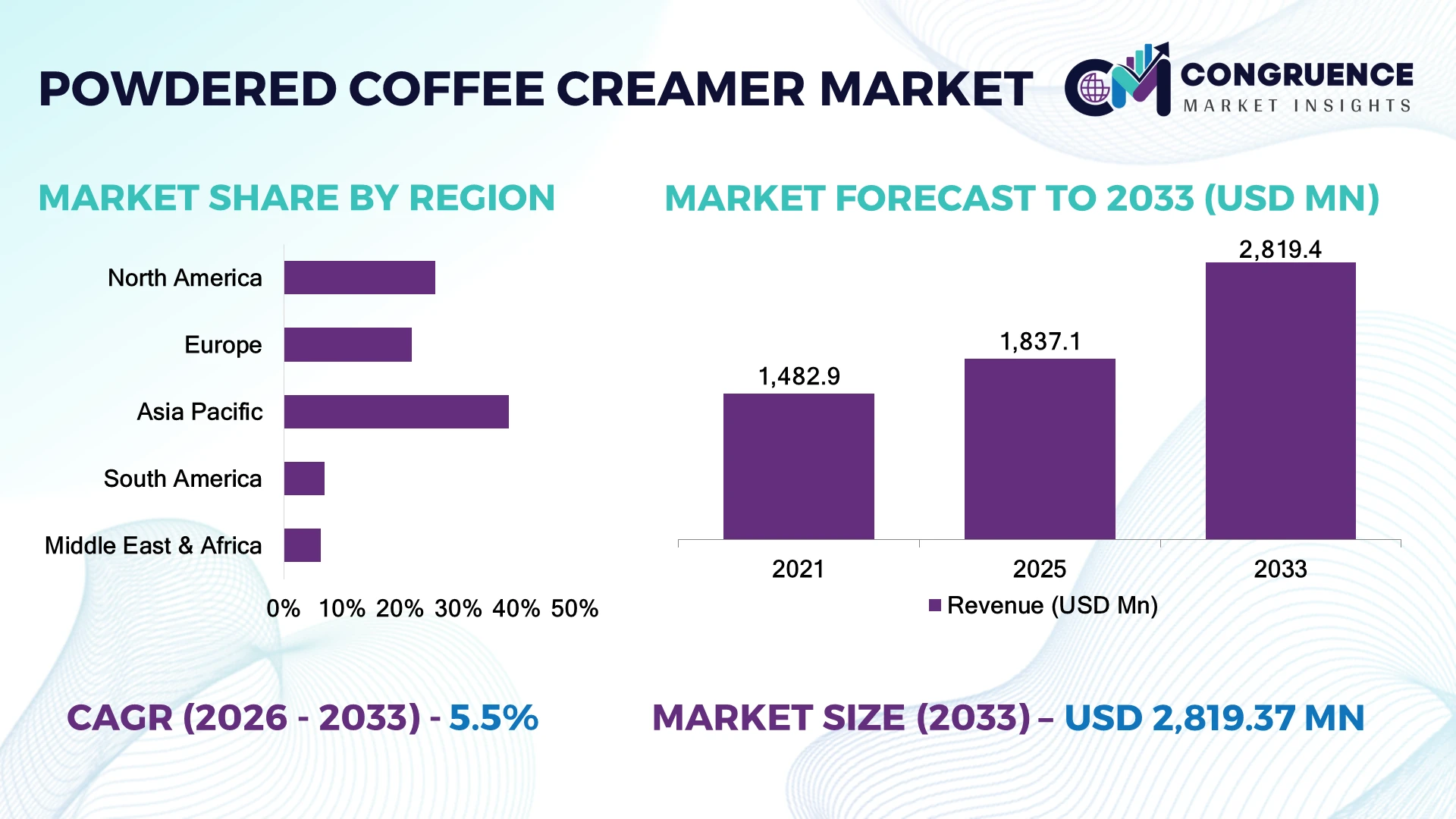
The Global Powdered Coffee Creamer Market was valued at USD 1,837.1 Million in 2025 and is anticipated to reach a value of USD 2,819.4 Million by 2033 expanding at a CAGR of 5.5% between 2026 and 2033. Growth is supported by extended shelf life, lower storage requirements than liquid creamers, expansion of instant coffee consumption, and demand for cost-controlled beverage formulations across retail, hospitality, vending, and institutional food service.
The United States remains strategically important for branded creamer innovation and retail distribution, while China and Southeast Asian markets offer manufacturing scale and growing instant-beverage consumption. Coffee-mate reports 92% brand awareness in the United States, illustrating the competitive value of established branding. By comparison, price-sensitive markets place greater emphasis on pack affordability, powder solubility, and shelf stability. Rising coffee input costs and weather-related supply uncertainty in producing countries are increasing the importance of formulation efficiency and procurement planning.
For manufacturers, competitive advantage depends on protecting product consistency while optimizing ingredient sourcing, pack formats, distribution reach, and differentiated formulations.
Market Size & Growth: The supplied market estimate rises from USD 1,837.1 million in 2025 to USD 2,819.4 million by 2033, supported by convenient beverage preparation and shelf-stable formulations.
Top Growth Drivers: Extended shelf life, instant coffee penetration, and food-service demand are key drivers; their individual market contributions are not consistently quantified.
Short-Term Forecast: By 2028, manufacturers should target 1–3% lower ingredient losses through improved dosing, blending controls, and batch-quality monitoring.
Emerging Technologies: Agglomeration, precision blending, and automated moisture control improve powder dispersibility, production consistency, and handling performance.
Regional Leaders: Asia-Pacific benefits from instant-beverage manufacturing and price-sensitive consumption; North America is important for branded innovation; Europe emphasizes ingredient compliance and packaging performance.
Consumer & End-User Trends: Original, flavored, non-dairy, and reduced-sugar options address different taste and dietary requirements across retail and institutional channels.
Pilot & Process Improvement: A plant-level trial targeting 2% lower powder loss can help validate dosing accuracy and process control before broader deployment.
Competitive Landscape: Nestlé, Kerry Group, FrieslandCampina, Danone, and regional manufacturers compete through branding, formulation expertise, pricing, and customer-specific supply.
Regulatory & ESG Impact: Ingredient declarations, allergen controls, packaging rules, and traceability requirements increase the importance of documented supplier and production controls.
Investment & Funding: Capital priorities include blending and packing automation, flexible production lines, packaging optimization, and diversified ingredient procurement; a consolidated market-wide investment total is not established.
Innovation & Future Outlook: By 2028, formulation flexibility, consistent dissolution, and efficient packaging will strengthen differentiation across consumer brands and business-to-business suppliers.
The powdered coffee creamer market serves retail beverages, office coffee systems, vending, hospitality, and institutional food service. Manufacturers are refining fat systems, flavor delivery, and powder flow properties to improve dissolution and reduce handling losses. Supply uncertainty in coffee-producing countries also reinforces the importance of diversified procurement and flexible formulations, creating a strategic link between ingredient sourcing, product affordability, and customer retention.
Powdered coffee creamer is strategically important because it combines shelf stability, convenient storage, and formulation flexibility in a category exposed to volatile ingredient costs and changing dietary preferences. Manufacturers compete not only on taste and price but also on dissolution, whiteness, mouthfeel, pack convenience, and consistency across production batches. These characteristics influence repeat purchases and suitability for high-volume beverage applications.
Production technology is becoming a differentiator. Better-controlled blending, agglomeration, and moisture management can improve powder flow and reduce batch variability compared with poorly controlled conventional processing. Plants should validate measurable outcomes through trials rather than assume a universal efficiency gain. North American brands emphasize consumer recognition and flavor extensions, while Asian manufacturers often compete through cost-efficient formats, local taste profiles, and flexible pack sizes.
During 2026–2028, manufacturers should prioritize ingredient traceability, supplier diversification, packaging efficiency, and automated quality monitoring. For example, a production line can test whether improved dosing reduces powder losses by 2% before committing to a wider rollout. Investment should follow validated plant-level results and customer requirements. Businesses that integrate reliable sourcing with consistent product performance and responsive formulation capabilities will be better positioned to defend margins and secure long-term retail and institutional contracts.
Powdered coffee creamer offers storage and distribution advantages because it generally requires no refrigerated handling before opening and supports compact inventory management. These attributes suit vending operators, offices, hotels, travel catering, and retail channels with limited cold-storage capacity. Compared with liquid formats, powder can simplify warehousing and reduce exposure to cold-chain interruptions. Manufacturers are responding with resealable packs, single-serve sachets, and improved powder dispersibility. A 1–3% reduction in handling losses is a reasonable plant-level optimization target, not a verified industry-wide result. The strongest commercial opportunity lies in matching pack size and dissolution performance to usage conditions rather than competing on price alone.
Powdered creamer manufacturers face cost exposure from vegetable oils, glucose syrups, dairy-derived ingredients, emulsifiers, packaging materials, and freight. Coffee-sector supply uncertainty adds pressure to the wider beverage category, affecting customer purchasing power and promotional planning even when coffee is not a principal creamer ingredient. A 5–10% change in a major formulation input can materially affect contribution margins when contracts prevent immediate price adjustments; the impact depends on recipe composition and purchasing terms. Producers are managing exposure through multi-supplier qualification, forward purchasing where appropriate, formulation flexibility, and pack-size adjustments. The critical restraint is not ingredient cost alone, but the speed at which companies can protect margins without compromising taste or customer specifications.
Opportunities are emerging in non-dairy formulations, reduced-sugar variants, flavored creamers, and customer-specific blends for vending and food-service operators. Manufacturers can differentiate through improved solubility, stable whitening performance, and ingredient profiles tailored to local preferences. Flexible production lines allow businesses to test smaller batches before scaling successful products. A pilot targeting 2% lower changeover losses can help determine whether shorter production runs are commercially viable. Companies are investing in application laboratories, formulation partnerships, and packaging options that address distinct customer requirements. The less obvious opportunity is business-to-business customization: a technically consistent blend can strengthen customer retention even when the final product is sold under another company’s brand.
Maintaining consistent whiteness, flavor, dissolution, flowability, and shelf stability becomes more complex when manufacturers change ingredient suppliers or operate across multiple facilities. Differences in fat characteristics, carrier materials, moisture levels, and processing conditions can alter the final beverage experience. Companies should monitor critical quality indicators by batch and validate performance under realistic storage and preparation conditions. A 2% reduction in out-of-specification batches can serve as a plant improvement target, but the achievable result depends on the existing quality baseline. Manufacturers must also manage allergen declarations, ingredient traceability, and packaging compliance across markets. Investment in process validation, supplier specifications, and workforce training is essential to scale innovation without increasing customer complaints or product rejection.
Precision Blending and Process Control: Producers are tightening control over ingredient dosing, moisture, and mixing uniformity to reduce batch variation. Automated monitoring and standardized recipes can support a 1–3% reduction target for ingredient losses, subject to plant validation. The commercial benefit is more consistent dissolution and lower rework exposure. Manufacturers are prioritizing process upgrades where throughput and quality data identify recurring losses.
Expansion of Non-Dairy Formulations: Manufacturers are broadening plant-based and dairy-free options to serve customers seeking alternatives to conventional milk ingredients. Formulation teams are balancing flavor, whitening, fat stability, and solubility rather than relying on ingredient substitution alone. Pilot programs should measure consumer acceptance and repeat-purchase performance, with a 2–3% improvement target used only when a baseline exists. This approach limits costly launches without demonstrated demand.
Flexible Pack Formats and Portion Control: Single-serve sachets, resealable pouches, and bulk food-service packs address different usage and storage conditions. Automated filling and sealing can target a 1–2% reduction in packaging rejects where current defect rates justify investment. Companies are adapting pack architecture to vending, travel, office, and retail requirements. The strategic benefit is lower handling waste and more precise alignment between pack size and customer consumption.
Supplier Diversification and Traceability: Ingredient price volatility and weather-related disruption in agricultural supply chains are encouraging more disciplined supplier qualification. Manufacturers are strengthening documentation, alternate-source approval, and procurement visibility to reduce exposure to single-origin or single-vendor interruptions. A 5–10% reduction in sourcing concentration can be used as a risk-management target, not an established industry average. Companies are prioritizing resilience alongside ingredient cost and specification compliance.
Conventional non-dairy powdered creamers are estimated to account for approximately 62% of the market, supported by competitive pricing, ambient storage, and compatibility with instant coffee and large-volume beverage preparation. Dairy-based creamers serve consumers and businesses prioritizing milk-derived ingredients and familiar sensory characteristics, representing an estimated 28%. Plant-based powdered alternatives, formulated around ingredients such as coconut, oat, or soy, account for an estimated 10% and are gaining attention among consumers seeking dairy-free formulations. These shares classify products by their primary formulation basis to minimize overlap.
Plant-based alternatives are positioned for faster expansion from a smaller base, while conventional formulations retain scale advantages in price-sensitive markets. Premium and specialized formulations increasingly emphasize improved dissolution, reduced sugar, and ingredient transparency. Manufacturers are responding through formulation trials, ingredient diversification, and flexible production lines. A 2–3% reduction in formulation losses is a potential operational target rather than an established industry average. Investment priorities increasingly center on preserving conventional product economics while developing differentiated alternatives without compromising taste, stability, or solubility.
Coffee preparation is estimated to represent approximately 68% of powdered coffee creamer demand, reflecting its core role in household consumption, office beverages, vending, and hospitality. Instant beverage mixes account for an estimated 18%, particularly through two-in-one and three-in-one formulations that combine coffee, sweetener, and creamer in a single serving. Tea applications contribute approximately 8%, while other food and beverage uses, including bakery fillings, dessert mixes, and specialty beverage preparations, represent the remaining 6%. These estimates describe application allocation rather than end-user purchasing channels.
Instant beverage mixes are positioned for faster expansion as manufacturers seek convenient, portion-controlled products with consistent preparation requirements. Conventional coffee applications remain comparatively mature, with competition focused on whitening performance, flavor neutrality, and rapid dissolution. Producers are refining powder dispersion and ingredient compatibility to limit clumping and improve consistency across hot beverages. A 1–3% reduction in preparation-related product waste is a potential customer-level target requiring validation. Manufacturers prioritizing instant-mix partnerships and application-specific formulations can strengthen supply relationships with beverage brands while maintaining established coffee applications.
Households are estimated to account for approximately 45% of powdered coffee creamer demand, supported by retail availability, shelf stability, and convenient home beverage preparation. Food-service and hospitality operators represent an estimated 27%, purchasing products for hotels, restaurants, cafés, catering, and institutional kitchens. Instant beverage manufacturers account for approximately 18%, incorporating creamer into packaged coffee mixes and ready-to-prepare beverage powders. Offices, vending operators, and other institutional buyers contribute the remaining 10%, with procurement shaped by serving volumes, storage constraints, and replenishment requirements. These estimates classify buyers by their principal purchasing role.
Instant beverage manufacturers and food-service operators are positioned for comparatively stronger expansion as standardized formulations and bulk procurement support repeatable preparation at scale. Household buyers remain more sensitive to retail pricing, flavor choice, and pack size, while commercial accounts prioritize consistent quality, dependable supply, and cost per serving. Suppliers are responding with bulk packs, single-serve sachets, customized blends, and contract-based supply arrangements. A 2–4% reduction in cost per serving is a potential procurement objective, not a verified market-wide result. Future competitive positioning will depend on matching pack formats and formulation specifications to each buyer group's operating model.
Asia-Pacific accounted for the largest market share at 38.6% in 2025 moreover, Asia-Pacific is expected to register the fastest growth, expanding at a CAGR of 6.8% between 2026 and 2033.
Branded Product Innovation and Established Coffee Consumption Sustain Regional Demand
North America is estimated to account for approximately 26% of the powdered coffee creamer market in 2025, supported by established retail distribution, strong household coffee consumption, and demand from offices, hotels, and food-service operators. The United States represents the principal market, with Canada contributing through retail, hospitality, and institutional channels. Competition centers on flavor variety, whitening performance, convenient packaging, and consistent product quality. Manufacturers are expanding flavored, reduced-sugar, and non-dairy formulations while optimizing pack sizes for household and commercial buyers. The National Coffee Association reported in 2025 that 66% of American adults drank coffee daily, demonstrating the scale of recurring coffee consumption underpinning related creamer demand. However, premium liquid creamers and milk alternatives compete for some consumption occasions, encouraging powdered-product suppliers to emphasize shelf stability, affordability, and storage convenience.
United States Market Outlook: The United States offers strong opportunities through established grocery distribution, private-label manufacturing, and high-volume food-service procurement. In 2025, 82% of past-day coffee drinkers reported drinking coffee at home, reinforcing the importance of retail availability and household pack formats. Manufacturers can strengthen market position through flavor innovation, reliable product performance, and differentiated formulations. Commercial suppliers also benefit from serving offices, hotels, and vending operators that prioritize consistent preparation, convenient storage, and predictable purchasing costs.
Ingredient Transparency and Specialized Formulations Shape Product Differentiation
Europe is estimated to represent approximately 22% of the powdered coffee creamer market in 2025. Demand is supported by retail coffee consumption, workplace beverage systems, hospitality, and instant coffee applications, although preferences vary considerably by country. Germany, the United Kingdom, France, and Poland are important markets for packaged beverages and food-service products. Manufacturers must align ingredient declarations, allergen controls, and product claims with European Union requirements while maintaining competitive pricing. Interest in plant-based alternatives and reduced-sugar formulations is encouraging investment in recipe development and application testing. Compared with established conventional products, specialized formulations require closer attention to taste, solubility, ingredient sourcing, and production consistency. Suppliers that combine compliant labeling with dependable performance can serve retailers and commercial customers seeking differentiated products.
Germany Market Outlook: Germany benefits from an established packaged-food industry, advanced processing capabilities, and strong retail and food-service distribution. Manufacturers serving the market must maintain documented ingredient traceability, allergen management, and accurate product labeling under European requirements. Product development opportunities include dairy-free formulations, portion-controlled packs, and blends tailored to vending and workplace beverage systems. Suppliers with flexible production, quality assurance, and dependable delivery can compete effectively with established brands and private-label producers while meeting retailer specifications.
Instant Coffee Manufacturing and Sachet-Based Consumption Strengthen Regional Leadership
Asia-Pacific accounted for an estimated 38.6% of the powdered coffee creamer market in 2025, supported by instant coffee consumption, extensive packaged beverage production, and established three-in-one coffee formats. China, Indonesia, Vietnam, Thailand, the Philippines, and India offer distinct demand opportunities, spanning large-scale manufacturing to affordable single-serve products. Regional manufacturers benefit from established ingredient sourcing and production ecosystems, while multinational brands compete through formulation expertise, distribution, and product recognition. Sachets and small packs help maintain affordability and simplify portion control in price-sensitive markets. Growing interest in premium instant beverages is also encouraging improvements in dissolution, creaminess, and flavor consistency. Manufacturers are balancing low unit costs with formulation flexibility, creating opportunities for suppliers able to serve both mass-market coffee mixes and more differentiated consumer products.
China Market Outlook: China combines extensive food-processing capacity, sophisticated packaging operations, and a growing range of instant and specialty coffee products. Powdered creamer suppliers can access established beverage manufacturers and distribution networks while developing formulations for domestic brands and export-oriented customers. Demand is differentiated between economical coffee-mix ingredients and products designed for more premium beverage experiences. Manufacturers that improve solubility, flavor consistency, and production efficiency can strengthen business-to-business relationships, while flexible packaging and batch sizes support different brand requirements.
Regional Coffee Expertise Creates Opportunities Beyond Traditional Coffee Production
South America is estimated to account for approximately 7% of the powdered coffee creamer market in 2025. Brazil is the region's most strategically significant market because of its extensive coffee industry, large consumer base, and established food-processing sector. Argentina, Chile, Colombia, and Peru provide additional opportunities through retail beverages, hospitality, and packaged instant coffee. However, coffee production strength does not automatically translate into equivalent creamer consumption, since local beverage preferences and dairy use differ by country. Currency volatility, imported ingredient costs, and uneven purchasing power also influence product positioning. Suppliers can improve market access through local distribution partnerships, affordable pack formats, and blends adapted to domestic tastes. The strongest opportunities lie in targeted retail and commercial channels rather than assuming uniform adoption across the region.
Brazil Market Outlook: Brazil offers a substantial consumer market, established food manufacturing, and extensive retail distribution. Its coffee-sector infrastructure supports a broad ecosystem of roasters, packaged beverage producers, wholesalers, and retailers that can provide routes to market for powdered creamer suppliers. Companies should evaluate local preferences for coffee preparation and dairy ingredients before expanding product portfolios. Competitive pricing, dependable supply, and clear differentiation between conventional, flavored, and non-dairy formulations can improve acceptance. Local partnerships can also reduce distribution friction and provide better insight into regional purchasing behavior.
Retail Modernization and Food-Service Expansion Support Shelf-Stable Beverage Products
The Middle East & Africa region is estimated to represent approximately 6.4% of the powdered coffee creamer market in 2025. Demand is concentrated in Gulf markets, South Africa, and selected North African economies, where supermarkets, hospitality, offices, and institutional food service create opportunities for shelf-stable beverage ingredients. Saudi Arabia and the United Arab Emirates are important markets for modern retail and hospitality procurement, while South Africa provides an established packaged-food distribution base. Ambient storage and portion-controlled packaging can be valuable where buyers prioritize inventory simplicity and convenient preparation. However, import dependence, currency fluctuations, and differences in consumer taste limit uniform market development. Suppliers are responding through distributor relationships, locally adapted pack sizes, and product formulations suited to regional beverage habits.
Saudi Arabia Market Outlook: Saudi Arabia presents opportunities through hospitality, modern retail, workplace beverage services, and large-scale catering operations. Vision 2030's tourism and economic diversification agenda is supporting the development of visitor infrastructure and commercial services, creating additional channels for packaged beverage products. Powdered creamer suppliers can target hotels, catering contractors, office operators, and retail distributors with bulk formats and portion-controlled packs. Success depends on reliable import and distribution arrangements, consistent product quality, and formulations aligned with customer preferences. Clear ingredient labeling and appropriate product documentation also support procurement across organized retail and institutional channels.
The market pits Nestlé’s Coffee mate against regional powdered-creamer and instant-mix producers such as Food Empire, Super Group, and Asian specialist manufacturers, while Kerry and FrieslandCampina compete through ingredient systems and formulation expertise. The top five suppliers are estimated to represent 35–45% of sales; this is directional because companies do not disclose comparable powdered-creamer shares. Branded players compete on taste, recognition, and retail access; private-label and regional producers compete on price, local flavor, and pack flexibility. Manufacturers target 1–3% lower powder loss and 1–2% fewer packaging rejects through process controls, although these are plant-level targets, not industry averages. Food Empire doubled Malaysian non-dairy creamer capacity in 2024, while Nestlé introduced food-service pouches and sachets in South Africa in 2025. Competition is shifting toward functional formulations, sourcing resilience, and channel-specific formats. Qualification, scale, consistency, and distribution access raise entry barriers. Winning requires cost discipline plus validated product performance and reliable supply.
Spray drying remains the core production technology for powdered coffee creamer, converting homogenized emulsions into free-flowing powders with controlled moisture. Compared with poorly controlled legacy drying and blending, tighter inlet-temperature, atomization, and moisture controls can target 1–3% lower product losses; results depend on equipment and formulation. Adoption is widespread among industrial producers.
Agglomeration and instantization improve wetting, dispersion, and lump resistance. Plants can target 1–2% fewer dissolution-related complaints or rejects after validating performance against baseline quality data. Automated dosing, inline moisture checks, metal detection, and digital batch records support traceability and reduce variability. Manufacturers compete through custom fat blends, cold-soluble powders, and small-batch flexibility. This matters most for high-volume food-service and retail contracts worldwide.
Emerging formulations include plant-based oat and coconut powders, protein-enriched blends, and reduced-sugar options. These products require careful management of flavor, oxidation, solubility, and ingredient declarations; a universal cost or performance advantage is not established. During 2026–2028, integration of process sensors with batch records should improve deviation detection and help manufacturers document customer specifications. Buyers should pilot changes and track yield, dissolution time, rework, and shelf stability before scaling. The strongest technology investment is the one that demonstrably improves consistency and lowers total cost per accepted batch.
May 2024 Food Empire announced Malaysian non-dairy creamer facility expansion, completed in Q2 2024, which doubled capacity. Output strengthens supply to existing customers and supports market entry, while phased utilization over two to three years limits ramp-up pressure. Source: investor.foodempire.com
May 2025 Nestlé Professional introduced a 500g powdered creamer pouch and 4g single-serve sachets in South Africa. The formats target coffee machines and high-volume hospitality, improving portion flexibility and reducing refrigeration needs across offices, cafés, and restaurants nationwide. Source: nestleprofessional.co.za
May 2024 Laird Superfood launched a powdered Protein Creamer delivering 12 grams of protein per serving from pea, hemp, and pumpkin-seed proteins. The product positions creamer as a functional nutrition format, extending competition beyond whitening and flavor alone. Source: prnewswire.com
May 2025 Oatbedient outlined its clean-label oat powder strategy, removing maltodextrin and gums from formulations. The move targets ingredient-conscious consumers and expands powder-based alternatives for beverage applications, though it is not a conventional coffee-creamer launch in the category. Source: foodnavigator-asia.com
The Powdered Coffee Creamer Market Report evaluates conventional non-dairy, dairy-based, plant-based formulations across coffee preparation, instant beverage mixes, tea, food and beverage applications. End-user coverage includes households, food-service and hospitality operators, instant beverage manufacturers, offices, and vending or institutional buyers. The analysis compares established branded suppliers with regional manufacturers and ingredient specialists, emphasizing formulation capability, pricing, pack formats, supply reliability, and distribution access.
Regional coverage spans North America, Europe, Asia-Pacific, South America, and the Middle East and Africa, with country-level assessments of consumption patterns, manufacturing capabilities, and channel development. Technology analysis examines spray drying, agglomeration, moisture control, cold-soluble powders, plant-based ingredients, and functional formulations. Directional segment estimates help readers compare demand concentration while recognizing that market shares are limited. The report supports investment screening, product development, expansion planning, supplier selection, and competitive positioning for decisions through 2033.
| Report Attribute/Metric | Report Details |
|---|---|
|
Market Revenue in 2025 |
USD 1,837.1 Million |
|
Market Revenue in 2033 |
USD 2,819.4 Million |
|
CAGR (2026 - 2033) |
5.5% |
|
Base Year |
2025 |
|
Forecast Period |
2026 - 2033 |
|
Historic Period |
2021 - 2025 |
|
Segments Covered |
By Type
By Application
By End-User
|
|
Key Report Deliverable |
Revenue Forecast, Growth Trends, Market Dynamics, Segmental Overview, Regional and Country-wise Analysis, Competition Landscape |
|
Region Covered |
North America, Europe, Asia-Pacific, South America, Middle East, Africa |
|
Key Players Analyzed |
Nestlé S.A., Food Empire Holdings Limited, Kerry Group plc, FrieslandCampina, Super Group Limited, Laird Superfood, Inc., Jiahe Foods Industry Group, Shandong Tianjiao Biotech Co., Ltd., Fujian Jumbo Grand Food Co., Ltd., Goodrich Foods India Ltd., Insta Foods, Drytech Processes Pvt. Ltd. |
|
Customization & Pricing |
Available on Request (10% Customization is Free) |




