
Reports
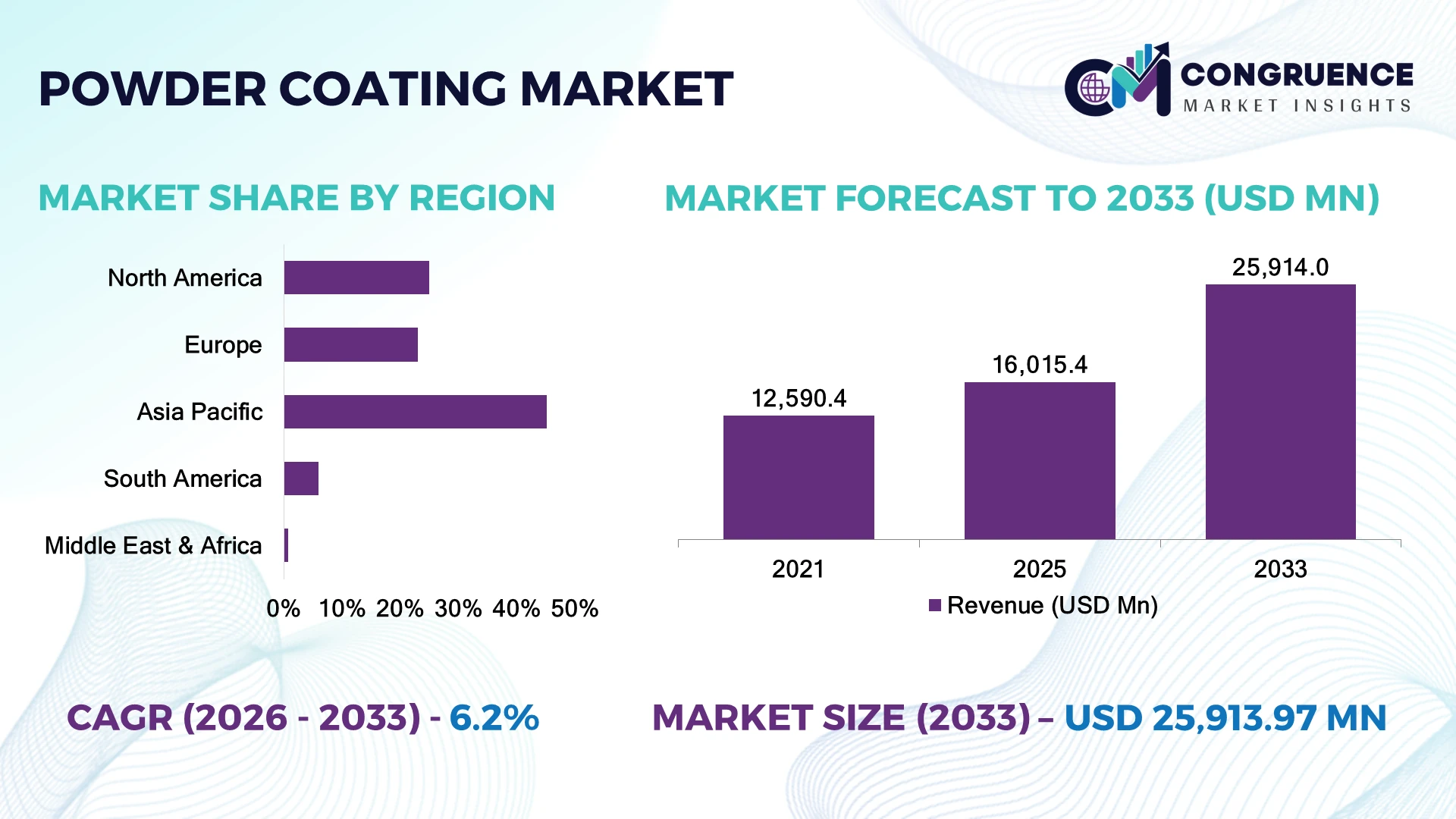
The Global Powder Coating Market was valued at USD 16,015.4 Million in 2025 and is anticipated to reach a value of USD 25,914.0 Million by 2033 expanding at a CAGR of 6.2% between 2026 and 2033. Growth is driven by solvent-free coating adoption, automated application lines, higher transfer efficiency, and demand from automotive, appliances, architectural aluminum, and industrial equipment manufacturers.
China is the dominant country market, representing approximately 15% of global powder coating demand, supported by automotive, appliance, aluminum-extrusion, and infrastructure production. Its market scale is substantially ahead of Germany, while India is expanding industrial powder-coating capacity as manufacturing localization accelerates. Automated electrostatic systems routinely achieve 90–95% powder utilization, strengthening the economics of high-volume production. Geopolitical supply-chain restructuring is encouraging regional sourcing of resins, pigments, and additives.
Strategic implication: manufacturers that combine low-emission formulations, automated application, and localized supply chains will capture the strongest industrial conversion opportunities.
Market Size & Growth: USD 16.0 billion in 2025 to USD 25.9 billion by 2033 at 6.2% CAGR, driven by solvent-free industrial coating conversion.
Top Growth Drivers: Automation 20–30% faster throughput, 90–95% powder utilization, and 15–25% lower material waste.
Short-Term Forecast: By 2028, automated coating lines are positioned to improve throughput by 10–15% while reducing rework by 5–10%.
Emerging Technologies: AI inspection, robotic spraying, low-temperature curing, and thin-film formulations are reshaping advanced powder coating production.
Regional Leaders: Asia-Pacific leads near USD 6.1 billion, North America approaches USD 4.5 billion, and Europe exceeds USD 4.0 billion, with automation adoption accelerating.
Consumer/End-User Trends: Automotive and appliance manufacturers increasingly specify powder coatings, with industrial automated lines achieving 90%+ utilization.
Pilot/Case Example: 2025 automated powder-coating deployments achieved approximately 15% higher line productivity through robotic application and recovery integration.
Competitive Landscape: AkzoNobel leads premium powder-coating supply, competing with PPG, Axalta, Sherwin-Williams, and Jotun across industrial and architectural applications.
Regulatory & ESG Impact: Solvent-free powder systems can reduce coating-related VOC exposure by more than 90% versus conventional solvent-intensive processes.
Investment & Funding: Manufacturers are directing multimillion-dollar expansion programs toward regional production, automated curing, recovery systems, and low-temperature powder technologies.
Innovation & Future Outlook: Bio-based resins, ultra-low-cure powders, digital color management, and AI quality inspection will shift competition toward lifecycle efficiency and formulation performance.
The Powder Coating Market is strengthening across automotive components, architectural aluminum, appliances, machinery, and metal furniture, with 90–95% powder utilization supporting material efficiency. Low-temperature curing, thin-film systems, robotic application, and AI inspection are gaining attention. Supply-chain localization is also increasing as manufacturers seek greater resin and additive security amid global trade restructuring, setting up a technology-led strategic shift.
Powder coating is becoming strategically important because manufacturers are balancing surface performance, production economics, emissions control, and increasingly localized supply chains. Automotive components, appliances, aluminum profiles, and industrial machinery are moving toward coating systems that reduce material losses while maintaining corrosion and abrasion resistance. Powder utilization of 90–95% gives automated lines a significant operational advantage over conventional spray processes, particularly at high production volumes.
Technology is accelerating this shift. Robotic electrostatic application combined with recovery systems can achieve utilization above 90%, compared with substantially lower conventional spray efficiency, while low-temperature curing reduces oven energy requirements. Europe is placing greater emphasis on chemical and environmental compliance, while China and India prioritize manufacturing scale, cost efficiency, and localized production. This creates distinct investment priorities across major markets.
Between 2026 and 2028, companies will increasingly deploy AI-based surface inspection, robotic coating cells, ultra-low-cure formulations, and digital color management. A practical deployment model is the integration of automated spraying, powder recovery, and curing controls on continuous appliance or automotive-component lines, improving throughput while reducing rework. Competitive advantage will increasingly depend on formulation innovation, application automation, regional supply resilience, and measurable lifecycle economics.
Automated electrostatic application is accelerating powder coating adoption as manufacturers target higher transfer efficiency and lower rework. Modern recovery-enabled systems can achieve 90–95% powder utilization, while robotic spraying can increase line productivity by approximately 10–20% versus labor-intensive application. In India, automotive-component and appliance manufacturers are expanding automated coating cells to address operator availability and finish consistency. The shift also reduces overspray and stabilizes coating thickness across high-volume production. Powder manufacturers are responding with formulations optimized for robotic application, faster curing, and improved edge coverage. The non-obvious advantage is repeatability: standardized deposition reduces quality variation sufficiently to support tighter OEM specifications and fewer downstream inspection interventions.
Powder coating producers remain exposed to fluctuations in polyester resins, epoxy resins, titanium dioxide, pigments, and specialty additives. Resin and pigment inputs can collectively represent roughly 50–65% of formulation costs, making even 10–15% raw-material price movements material to producer margins. China-based supply concentration for several chemical intermediates also increases procurement sensitivity during trade disruptions or energy-market shocks. Smaller formulators face greater difficulty passing these increases through short-cycle industrial contracts. Companies are therefore diversifying approved suppliers, increasing regional sourcing, and negotiating indexed procurement agreements. A key operational pressure is formulation reformulation: substituting a constrained additive without changing gloss, adhesion, or curing behavior requires qualification testing that can delay customer approvals and production changes.
Ultra-low-temperature curing creates a differentiated opportunity as manufacturers seek lower oven energy consumption and compatibility with heat-sensitive substrates. New formulations targeting curing temperatures around 120–140°C can reduce curing energy requirements by approximately 15–30% compared with conventional 160–200°C systems. Adoption is particularly relevant for aluminum profiles, engineered wood, and thin-gauge components where substrate distortion or energy intensity limits conventional processing. Japanese and European formulators are increasing R&D around reactive chemistries and fast-cure systems. Companies can capture value by pairing low-temperature powders with intelligent oven controls, infrared heating, and automated thickness monitoring. The strongest opportunity lies in retrofitting existing lines rather than replacing complete coating infrastructure, lowering conversion barriers while creating measurable operating-cost advantages.
Advanced powder-coating lines increasingly combine robotic spraying, automatic color changes, recovery systems, conveyor controls, curing ovens, and machine-vision inspection, creating integration complexity. Poor synchronization can increase color-change losses by 5–10% and generate 2–5% rework in demanding production environments. Workforce capability is another constraint: technicians must manage electrostatic parameters, powder recovery ratios, booth airflow, and curing profiles simultaneously. European automotive suppliers face additional pressure to document process stability and environmental performance across increasingly automated plants. Companies are addressing the challenge through integrated control platforms, predictive maintenance, operator certification, and standardized process recipes. The strategic issue is no longer simply installing automation; it is maintaining stable powder characteristics and coating performance across the entire connected production workflow.
Robotic Color Change Accelerates: Automated color-change systems are reducing booth-cleaning and transition times by approximately 20–40%, particularly in appliance and automotive-component plants handling frequent SKU changes. Manufacturers are pairing quick-clean booths with recipe-based controls to increase line availability, while tighter production scheduling is reducing powder-change losses and improving equipment utilization.
Thin-Film Coatings Gain Traction: Powder formulators are developing systems capable of achieving approximately 40–60 μm film thickness compared with conventional thicker applications, reducing material consumption while maintaining specified coverage. European appliance and aluminum manufacturers are testing these formulations as energy and material costs remain elevated, pushing suppliers toward improved flow, edge coverage, and curing consistency.
Digital Inspection Enters Production: Machine-vision inspection is increasingly detecting coating defects earlier, with automated systems capable of reducing manual inspection effort by roughly 30–50%. Manufacturers in Germany and Japan are integrating cameras with production-control software to identify orange peel, pinholes, and color deviations before downstream assembly, shifting quality control from sampling toward continuous monitoring.
Supply Localization Reshapes Procurement: Producers are increasing dual-sourcing for resins, pigments, and additives as geopolitical disruptions expose dependence on concentrated chemical supply chains. Regional sourcing programs can reduce procurement lead times by approximately 15–25% where qualified alternatives exist. Powder manufacturers are consequently building localized inventories and qualifying substitute formulations to protect production continuity without compromising customer specifications.
Thermoset powder coatings represent the leading type, accounting for approximately 85–90% of global powder coating consumption, supported by established epoxy, polyester, and epoxy-polyester systems across automotive components, appliances, machinery, and architectural aluminum. Their mature curing infrastructure, strong adhesion, corrosion resistance, and broad formulation availability give them a substantial scalability advantage. Thermoplastic powders remain a smaller segment at roughly 10–15%, but their rapid application without crosslinking, recyclability, and suitability for thick protective layers are increasing interest in specialized pipelines, wire, and metal applications. Companies continue optimizing thermoset systems for lower curing temperatures and thinner films, while thermoplastic suppliers are expanding application-specific grades.
The strategic shift is toward performance optimization rather than wholesale replacement. Low-temperature and fast-cure formulations can reduce oven energy consumption by approximately 15–30%, strengthening the business case for upgrading existing lines. Manufacturers are investing in resin chemistry, recovery systems, and application partnerships to improve material utilization and reduce rework. Thermoset remains the volume anchor, while thermoplastic powders provide a targeted growth opportunity where durability, thickness, or substrate sensitivity outweigh conventional processing economics.
The Powder Coating Institute reports that powder coatings can achieve transfer efficiencies exceeding 95% with effective powder-recovery systems, reinforcing the operational advantage of established powder-coating processes.
Automotive applications lead powder coating consumption at approximately 25–30% of global demand, supported by wheels, chassis components, underbody parts, brackets, and other metal assemblies requiring corrosion resistance and consistent finish quality. Appliances and architectural applications each represent roughly 15–20%, while general industrial equipment contributes another significant share. Automotive remains mature, but appliance and architectural applications are accelerating specification of low-temperature and thin-film systems. Automated lines can achieve powder utilization above 90%, making high-volume component coating particularly attractive where material recovery is integrated into booth operations.
The fastest-growing application opportunity is architectural aluminum, especially in China, India, and the Gulf states, where urban construction and façade modernization require durable finishes with controlled color consistency. Companies are expanding powder libraries, automated color-management systems, and regional application partnerships to serve shorter production runs and broader color ranges. Automotive suppliers emphasize robotic consistency and corrosion performance, while architectural coaters prioritize weatherability and color retention. Investment is therefore shifting toward flexible curing, rapid color changes, and digitally controlled application systems that reduce downtime while supporting customized orders.
The U.S. Environmental Protection Agency identifies powder coating as a technology that can substantially reduce VOC emissions compared with conventional liquid coating processes, supporting continued industrial adoption where air-quality compliance is a priority.
Automotive and transportation manufacturers form the leading end-user group, representing approximately 30–35% of global powder coating consumption through extensive use across wheels, components, frames, and metal assemblies. Appliance manufacturers follow at roughly 15–20%, while architectural and general industrial users collectively provide broad demand diversification. Automotive plants favor robotic application, recovery systems, and tightly controlled curing because production consistency directly affects downstream assembly. Appliance producers place greater emphasis on appearance, color flexibility, and low-temperature curing, creating different purchasing priorities despite overlapping equipment requirements.
Architectural fabricators and industrial-equipment manufacturers are among the faster-expanding users, supported by demand for durable finishes and localized manufacturing. Automated powder utilization above 90% gives high-volume users a measurable cost advantage, while low-temperature formulations can reduce curing energy requirements by approximately 15–30%. Suppliers are responding with customized resin systems, application engineering, technical-service partnerships, and equipment integration. The competitive opportunity is shifting toward account-specific coating solutions rather than commodity powder supply, particularly where OEM qualification, color consistency, and process validation determine supplier retention.
According to the U.S. Department of Energy, industrial motor-driven systems account for a major share of manufacturing electricity consumption, reinforcing the commercial importance of energy-efficient curing and automated coating operations for energy-intensive end users.
Asia-Pacific accounted for the largest market share at 45.2% in 2025 however, Middle East & Africa is expected to register the fastest growth, expanding at a CAGR of 7.1% between 2026 and 2033.
Automotive localization is pushing automated coating capacity
North America held approximately 25% of global powder coating demand in 2025, supported by automotive components, appliances, construction equipment, and architectural aluminum. The United States dominates regional consumption, with Mexico strengthening its position as manufacturers localize supply chains around automotive and industrial production. Automated electrostatic application is increasingly concentrated in high-volume plants, where transfer efficiency above 90% supports lower material losses and consistent coating thickness. Demand is also shifting toward low-temperature formulations as manufacturers seek to reduce curing-energy intensity. Powder producers are expanding technical service and regional distribution rather than relying solely on product sales, while equipment suppliers are integrating robotic spraying, recovery, and digital process controls. The strategic advantage is increasingly tied to proximity to OEM production clusters, rapid color/formulation support, and reliable resin and additive availability.
United States Market Outlook: The United States remains the region’s largest powder-coating market because of its extensive automotive-component, appliance, machinery, and architectural-product manufacturing base. Industrial users increasingly prioritize automated recovery systems and low-emission coating processes. Powder application can achieve utilization above 90%, making automated systems particularly attractive for large production lines where material efficiency directly influences operating costs and throughput.
Energy efficiency and chemical compliance are reshaping formulation priorities
Europe represents approximately 23% of global powder coating consumption, with Germany, Italy, France, and the United Kingdom forming important manufacturing and architectural-coating centers. Stricter environmental requirements and high industrial energy costs are accelerating interest in low-temperature curing and thinner-film formulations. Germany’s automotive and machinery sectors remain important demand anchors, while Italy has strong architectural and furniture-coating activity. Manufacturers are increasingly qualifying powders that cure at approximately 120–160°C rather than conventional higher-temperature ranges, helping reduce oven energy requirements by roughly 15–30% where process conditions permit. Suppliers are investing in resin chemistry, formulation customization, and application engineering to maintain performance while meeting tighter sustainability expectations.
Germany Market Outlook: Germany offers a strategically important combination of automotive production, industrial machinery manufacturing, and sophisticated coating infrastructure. OEM suppliers increasingly require consistent corrosion protection, color control, and documented process performance. Automated powder systems with recovery capabilities exceeding 90% utilization fit the country’s emphasis on manufacturing efficiency, while low-temperature powders offer manufacturers a route to reduce energy intensity without replacing complete coating lines.
Manufacturing scale is accelerating automated powder conversion
Asia-Pacific accounted for approximately 45.2% of global powder coating demand in 2025, led by China, India, Japan, and South Korea. China’s appliance, automotive, electronics, construction-equipment, and aluminum industries provide substantial production volume, while India is increasing domestic manufacturing capacity across automotive components and consumer durables. Large factories increasingly deploy robotic electrostatic systems, with powder recovery supporting utilization above 90%. Suppliers are expanding localized resin production, technical centers, and application partnerships to shorten lead times and accommodate regional formulation requirements. The region’s strategic advantage is not only consumption scale but also manufacturing density, allowing powder producers to integrate closely with OEM production clusters and rapidly commercialize customized grades.
China Market Outlook: China is the region’s largest production and consumption center, supported by extensive appliance, automotive, aluminum, and industrial-equipment manufacturing. High-volume factories favor automated booths, rapid color-change systems, and recovery equipment to control material losses. Domestic powder manufacturers are also strengthening formulation capabilities, enabling faster customization for OEMs and reducing dependence on imported specialty materials.
Brazil anchors localized industrial coating demand
South America represents approximately 6–7% of global powder coating demand, with Brazil accounting for the majority of regional consumption through automotive components, appliances, construction equipment, furniture, and architectural aluminum. Industrial manufacturers are increasingly replacing solvent-intensive coating processes where durability and emissions control justify the conversion cost. Automated application adoption remains below North American and European levels, but high-volume facilities can achieve powder utilization above 90% when recovery systems are properly configured. Companies are strengthening local distribution, technical support, and formulation availability to address logistics variability and currency-sensitive purchasing. The strongest commercial opportunity is concentrated around established manufacturing corridors rather than dispersed demand, making regional warehousing and application-service partnerships important competitive tools.
Brazil Market Outlook: Brazil provides the strongest industrial base for powder coating in South America, supported by automotive manufacturing, appliance production, metal furniture, and construction-material fabrication. Large manufacturers increasingly prioritize durable finishes and automated application where production volumes justify capital expenditure. Local technical support and dependable inventory are particularly important because extended replenishment cycles can disrupt production schedules and limit adoption of specialized powder grades.
Infrastructure modernization is creating premium coating demand
Middle East & Africa represents approximately 7–8% of global powder coating demand, with Saudi Arabia, the UAE, South Africa, and Turkey-linked supply networks supporting architectural aluminum, construction equipment, metal fabrication, and infrastructure projects. Gulf construction programs are increasing demand for weather-resistant powder systems designed for intense heat and UV exposure. Dubai and Saudi Arabia are also expanding sophisticated manufacturing and building-material production capacity, encouraging higher-specification coating systems. Powder utilization above 90% in automated operations provides a measurable material-efficiency advantage for large fabricators. Suppliers are responding through local inventories, technical partnerships, and customized polyester formulations for exterior durability. The strategic shift favors suppliers able to combine formulation performance with reliable regional logistics and application support.
Saudi Arabia Market Outlook: Saudi Arabia is emerging as the region’s most significant industrial opportunity through large-scale construction, infrastructure, building-material manufacturing, and industrial diversification. Powder coating suppliers benefit from demand for durable architectural finishes and corrosion-resistant industrial components. Local production initiatives and expanding manufacturing zones are encouraging suppliers to establish regional distribution and technical capabilities, reducing dependence on long-distance imports and improving response times for large projects.
AkzoNobel, PPG, Axalta, Sherwin-Williams, and Jotun compete as global formulation leaders, while Asian producers compete primarily on cost, localization, and delivery speed. The top five players are estimated to hold roughly 40–45% collectively, leaving substantial room for regional specialists. Competition centers on formulation performance, transfer efficiency, curing temperature, supply reliability, and customization. High-transfer-efficiency powders can reduce powder consumption by 20–25%, while low-cure systems can cut curing energy by up to 20%, shifting purchasing toward lifecycle economics rather than price alone. AkzoNobel is expanding capacity, PPG is integrating powder, pretreatment, and electrocoat technologies, and Jotun is developing specialized battery-coating systems. The competitive shift is toward vertical value-chain integration and application-specific chemistry, particularly for EV batteries, architectural aluminum, and heat-sensitive substrates. Entry barriers include formulation IP, OEM qualification, production scale, regulatory approvals, and technical-service networks. Winning requires localized supply, validated performance, rapid customization, and measurable process savings across OEM accounts globally today.
AkzoNobel N.V.
PPG Industries, Inc.
Axalta Coating Systems
The Sherwin-Williams Company
Jotun A/S
Nippon Paint Holdings Co., Ltd.
Kansai Paint Co., Ltd.
Asian Paints Limited
Berger Paints India Limited
TIGER Coatings GmbH & Co. KG
IFS Coatings, Inc.
Neochimica S.p.A.
allnex
Syntha Pulvin
Powder coating technology is moving from conventional thermal ovens and standard electrostatic guns toward high-transfer-efficiency application, robotic spraying, low-temperature curing, and near-infrared laser curing. High-transfer systems can reach first-pass transfer rates of 85%, reducing powder use by 20–25%. Laser curing is emerging as a disruptive alternative to 15–20-minute conventional oven cycles, with curing completed in minutes and substantially less factory-space demand.
Digital process control is becoming the integration layer. Automated color-change modules, machine vision, thickness monitoring, and recipe-based curing can reduce manual inspection and changeover work by roughly 20–30%. Adoption is strongest in automotive, appliances, architectural aluminum, and high-volume industrial plants, where repeatability directly affects rework and throughput. These improvements also support tighter film-thickness control, faster line balancing, and more predictable batch quality.
From 2026 to 2028, laser curing, ultra-low-temperature powders, PFAS-free formulations, and recycled-content resins will gain commercial importance across OEM and industrial finishing. New laser-enabled systems can cut curing time by more than 50% versus conventional thermal processing, while low-cure powders reduce oven energy requirements by up to 20%. Companies that integrate chemistry, equipment, and digital controls will capture the strongest competitive advantage.
June 2026 PPG, IPG Photonics and Whirlpool received the IRI Open Innovation Award for laser curing powder coatings. A pilot line was installed in Ohio, replacing thermal-oven curing with targeted laser energy, strengthening throughput and energy-efficiency economics further. Source: ppg.com (news.ppg.com)
October 2025 BASF commissioned an 80,000-metric-ton NPG plant in Zhanjiang, increasing global capacity to 335,000 metric tons annually. The expansion strengthens local resin-intermediate supply for Asia-Pacific powder coatings while its reduced-carbon product lowers footprint by at least 10%. Source: basf.com (BASF)
June 2025 Jotun launched EV Battery Solutions powder coatings for battery components, targeting thermal protection and electrical safety. It addresses battery requirements as EV sales approach 40 million units by 2030, expanding powder coatings into electrification applications. Source: jotun.com (Jotun)
April 2025 AkzoNobel partnered with IPG Photonics to calibrate Interpon powders for laser curing across EMEA. The process reduces curing from 15–20 minutes to a few minutes and requires less than half traditional oven space, improving line productivity. Source: paint.org (Paint.org)
The report covers powder coating types including thermoset and thermoplastic systems, with application analysis across automotive components, appliances, architectural aluminum, machinery, furniture, and general industrial products. End-user coverage evaluates OEMs, industrial manufacturers, architectural fabricators, appliance producers, and specialty coaters. Regional assessment spans North America, Europe, Asia-Pacific, South America, and Middle East & Africa, with country-level focus on major manufacturing centers.
Technology coverage includes electrostatic application, robotic spraying, recovery systems, low-temperature curing, laser curing, high-transfer-efficiency powders, PFAS-free formulations, recycled-content resins, and digital inspection. The competitive assessment tracks leading global and regional suppliers, with the top five players estimated to represent roughly 40–45% of market supply. The report supports investment planning, capacity expansion, technology selection, sourcing strategy, partnership development, and competitive positioning by identifying where automation, localized production, and next-generation formulations will influence market direction through 2033.
| Report Attribute/Metric | Report Details |
|---|---|
|
Market Revenue in 2025 |
USD 16,015.4 Million |
|
Market Revenue in 2033 |
USD 25,914.0 Million |
|
CAGR (2026 - 2033) |
6.2% |
|
Base Year |
2025 |
|
Forecast Period |
2026 - 2033 |
|
Historic Period |
2021 - 2025 |
|
Segments Covered |
By Type
By Application
By End-User
|
|
Key Report Deliverable |
Revenue Forecast, Growth Trends, Market Dynamics, Segmental Overview, Regional and Country-wise Analysis, Competition Landscape |
|
Region Covered |
North America, Europe, Asia-Pacific, South America, Middle East, Africa |
|
Key Players Analyzed |
AkzoNobel N.V., PPG Industries, Inc., Axalta Coating Systems, The Sherwin-Williams Company, Jotun A/S, Nippon Paint Holdings Co., Ltd., Kansai Paint Co., Ltd., Asian Paints Limited, Berger Paints India Limited, TIGER Coatings GmbH & Co. KG, IFS Coatings, Inc., Neochimica S.p.A., allnex, Syntha Pulvin |
|
Customization & Pricing |
Available on Request (10% Customization is Free) |




