
Reports
The Global Poultry Fat Market was valued at USD 2,410.4 Million in 2025 and is anticipated to reach a value of USD 3,454.2 Million by 2033 expanding at a CAGR of 4.6% between 2026 and 2033. Growth is driven by expanding poultry processing volumes, rising demand for rendered animal fats in feed and oleochemical applications, and greater utilization of processing by-products.
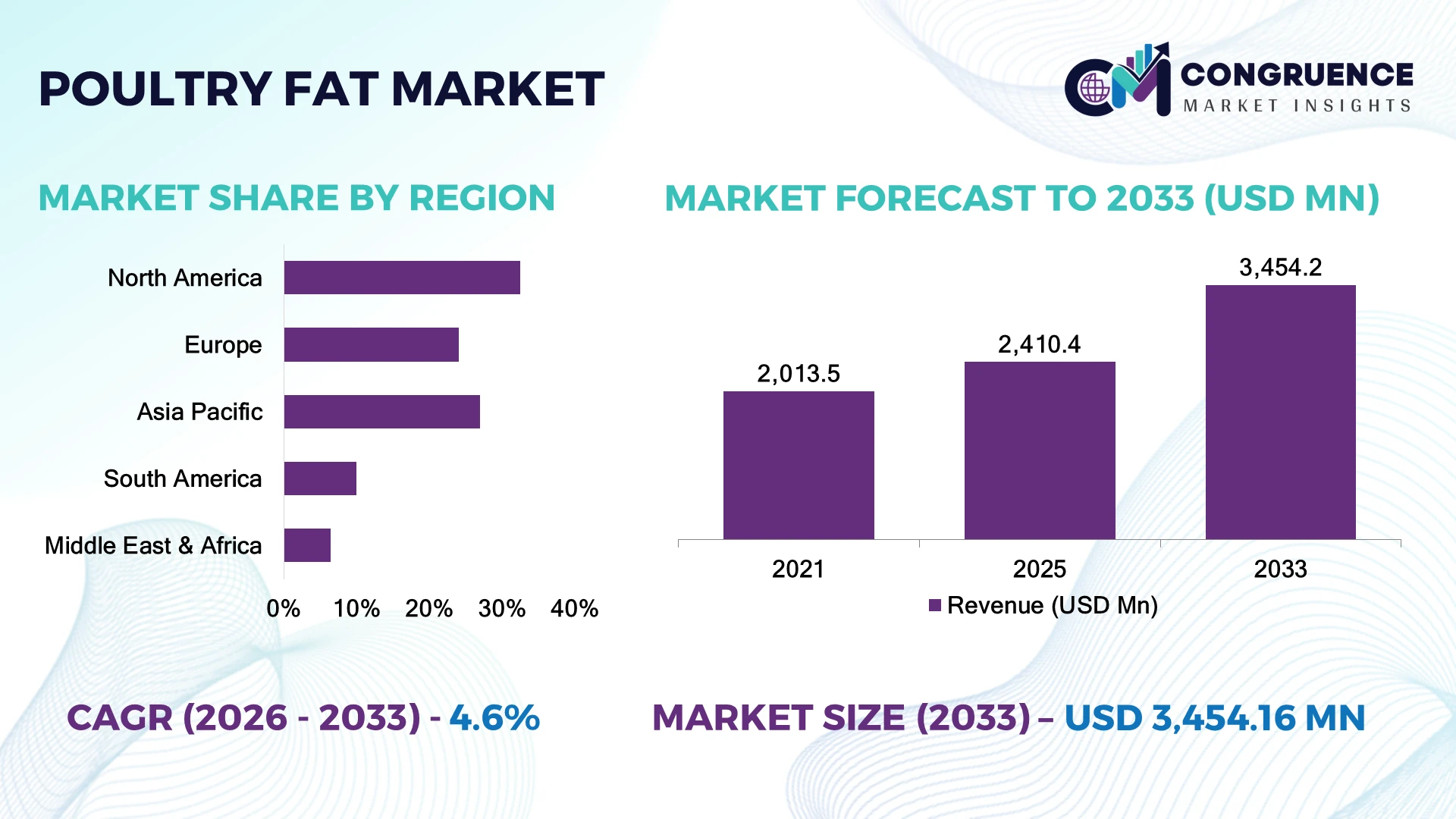
The United States represents approximately 28–32% of global poultry fat demand, supported by its large poultry-processing industry and established rendering infrastructure. China follows with roughly 18–22%, while Brazil benefits from its position as a major poultry exporter. U.S. rendering facilities increasingly integrate automated separation and quality-control systems, with recovery optimization improving usable fat yields by approximately 3–7%. Brazil's export-oriented processing base is expanding utilization, while European buyers place greater emphasis on traceability and sustainability following tighter circular-economy requirements.
Strategic implication: Suppliers with integrated poultry processing, rendering, purification, and downstream distribution capabilities are best positioned to capture higher-value applications and reduce feedstock volatility.
Market Size & Growth: USD 2,410.4 million in 2025 to USD 3,454.2 million by 2033 at 4.6% CAGR, supported by higher poultry processing and rendering utilization.
Top Growth Drivers: Animal feed 42%, oleochemicals 24%, and bioenergy 16% represent the leading demand drivers.
Short-Term Forecast: By 2028, automated rendering and separation can improve fat recovery efficiency by 3–7% and reduce processing losses by 2–5%.
Emerging Technologies: Continuous rendering, automated centrifugation, enzymatic purification, and digital quality monitoring are improving consistency and recovery.
Regional Leaders: North America is projected near USD 1.05 billion, Asia-Pacific around USD 0.95 billion, and South America approximately USD 0.55 billion by 2033.
Consumer/End-User Trends: Feed manufacturers account for approximately 40–45% of demand, prioritizing consistent energy value and controlled oxidation.
Pilot/Case Example: 2026 rendering modernization programs increasingly target 3–7% higher usable-fat recovery through automated separation and process monitoring.
Competitive Landscape: Tyson Foods, Darling Ingredients, JBS, Smithfield Foods, and Valley Proteins are important integrated poultry-processing and rendering participants.
Regulatory & ESG Impact: Greater by-product utilization can divert 10–20% of potentially discarded organic processing material toward feed, industrial, and energy applications.
Investment & Funding: Rendering operators are prioritizing multi-million-dollar capacity upgrades, automation, odor-control systems, and feedstock logistics rather than standalone commodity-fat expansion.
Innovation & Future Outlook: High-purity poultry fat, specialized feed grades, renewable-energy feedstocks, and integrated recovery systems will increasingly shift competition toward value-added utilization.
The Poultry Fat Market is concentrated across animal feed, pet nutrition, oleochemicals, industrial lubricants, and selected bioenergy applications, with feed remaining the largest consumption channel at approximately 42%. Modern rendering systems increasingly combine continuous processing, centrifugation, automated moisture control, and oxidation monitoring to improve consistency and recovery. Demand is also shifting toward traceable, specification-controlled poultry fat as feed manufacturers seek predictable energy content and quality. In 2026, tighter supply-chain coordination between poultry processors, renderers, feed mills, and industrial buyers is strengthening the value of integrated sourcing models and creating a clear transition toward higher-value applications.
The Poultry Fat Market is becoming strategically important because poultry processing companies can convert a high-volume by-product into multiple revenue-generating material streams while improving overall resource utilization. This is particularly relevant as feed manufacturers, oleochemical producers, and renewable-fuel processors seek dependable animal-fat feedstocks. Integrated rendering also reduces dependence on external disposal channels and strengthens supply-chain control.
Technology is improving both recovery and product consistency. Modern continuous rendering and automated centrifugation can improve usable-fat recovery by approximately 3–7% compared with less-controlled processing configurations, while automated moisture and impurity monitoring tightens specification control. North America benefits from mature rendering infrastructure, whereas Brazil combines expanding poultry production with strong export-oriented processing. Asia-Pacific is increasingly important because of its large poultry-processing base and expanding feed manufacturing capacity.
Over the next 2–3 years, investment will increasingly target process automation, purification, odor control, cold-chain coordination, and dedicated logistics. Poultry processors are strengthening partnerships with rendering operators and feed manufacturers to secure predictable offtake. Companies able to control collection, rendering, quality certification, and downstream distribution will gain stronger margins and supply reliability. The strategic advantage will increasingly come from maximizing value recovered from every tonne of processed poultry rather than simply increasing rendering volume.
Expanding poultry processing volumes are increasing the availability of recoverable fat for feed, pet nutrition, oleochemicals, and energy applications. Feed manufacturing absorbs approximately 42–45% of poultry fat demand, while integrated rendering can improve usable-fat recovery by 3–7% through controlled separation and moisture management. Brazil’s export-oriented poultry industry and the United States’ large processing base are strengthening investment in rendering capacity and automated recovery systems. Companies are increasingly linking slaughterhouses directly with rendering operations to reduce handling losses and stabilize feedstock availability. The non-obvious advantage is margin diversification: processors can monetize poultry by-products rather than relying solely on primary meat sales, improving resource efficiency and strengthening downstream supply-chain control.
Poultry fat quality varies with bird nutrition, processing conditions, moisture, impurities, and oxidation, creating specification challenges for feed and industrial buyers. Moisture and impurity levels can increase processing losses by approximately 3–8%, while oxidation-related deterioration can reduce usable product value by 5–10% in poorly controlled supply chains. Smaller processors in fragmented markets often lack advanced separation and storage systems, limiting consistent output. Long-distance transportation can further increase handling and storage exposure, particularly where rendering facilities are geographically separated from poultry plants. Companies are addressing the constraint through direct collection contracts, refrigerated or controlled storage, rapid rendering, and laboratory-based quality testing. The strategic pressure is shifting toward consistency rather than simply maximizing recovered volume.
Higher-purity poultry fat creates opportunities beyond conventional feed applications, particularly in oleochemicals, specialty formulations, pet nutrition, and renewable-energy feedstocks. Advanced filtration and centrifugation can improve usable product recovery by approximately 3–7%, while tighter moisture and impurity control can improve specification consistency by 5–10%. Brazil and the United States offer particularly strong opportunities because large poultry-processing clusters can support integrated collection and downstream processing. Companies are investing in purification, fractionation, and quality-control capabilities to capture premium applications rather than selling untreated rendered fat. A key opportunity is converting variable by-product streams into specification-controlled industrial inputs, allowing processors to diversify customers and reduce dependence on commodity feed markets.
Scaling poultry fat utilization requires tighter coordination between processing plants, rendering facilities, laboratories, storage infrastructure, and downstream buyers. Digital batch tracking can reduce manual documentation workloads by approximately 15–25%, while automated quality monitoring can shorten release decisions by 10–20%. Large U.S. processors increasingly require traceability from poultry processing through rendering and final delivery, raising integration requirements for smaller suppliers. Storage stability is another operational pressure because moisture, heat, and oxygen exposure can accelerate quality deterioration. Companies must therefore invest in automated sampling, oxidation monitoring, inventory controls, and standardized batch specifications. The long-term competitive advantage will favor integrated operators capable of proving product consistency and origin while maintaining efficient collection-to-delivery workflows.
Automated Quality Control Expands: Rendering facilities are increasingly using inline moisture, temperature, and impurity monitoring to stabilize finished-fat specifications. Automated controls can reduce quality-related processing deviations by approximately 5–10% and shorten batch-release decisions by 10–20%. U.S. processors are integrating laboratory data with production systems, shifting quality management from final inspection toward continuous process control.
Feed Buyers Tighten Specifications: Feed manufacturers are increasingly demanding consistent energy value, moisture levels, and oxidation parameters rather than purchasing solely on price. Specification-driven procurement now influences approximately 40–45% of commercial poultry-fat demand. Renderers are responding with standardized grades, contracted supply programs, and faster testing cycles, while larger buyers increasingly favor suppliers capable of delivering repeatable composition across multiple production batches.
Controlled Storage Gains Importance: Higher-value poultry fat applications are encouraging processors to improve storage temperature, oxygen exposure, and inventory rotation. Better storage management can reduce quality deterioration by approximately 5–10% and lower avoidable product losses by 3–6%. This is particularly relevant for facilities supplying distant customers, where longer logistics cycles increase exposure to oxidation and handling variability.
By-Product Logistics Become Integrated: Poultry processors are increasingly coordinating fat collection with rendering schedules instead of treating recovered fat as a secondary waste stream. Direct plant-to-renderer logistics can reduce intermediate handling by approximately 10–20% and improve feedstock availability. Companies are responding with dedicated collection contracts, centralized rendering hubs, and digital batch identification, strengthening supply reliability as poultry-processing networks expand.
Rendered poultry fat leads while purified grades gain strategic value
Rendered poultry fat accounts for approximately 78–82% of global demand, retaining dominance because it is widely available from conventional rendering operations, requires comparatively limited downstream processing, and remains cost-effective for feed and industrial applications. Purified or refined poultry fat represents roughly 12–16%, while specialty or fractionated grades account for approximately 5–8%. Standard rendered fat remains the mature volume segment, particularly across the United States and Brazil, where integrated poultry-processing networks generate substantial recoverable feedstock. Purified grades are the fastest-shifting segment as buyers increasingly require tighter moisture, impurity, and oxidation specifications.
Companies are investing in centrifugation, filtration, deodorization, and automated quality monitoring to move higher volumes into specification-controlled applications. Purification can improve consistency by approximately 5–10%, while improved separation can increase usable recovery by 3–7%. The business implication is a gradual shift from bulk commodity sales toward differentiated grades, encouraging processors to prioritize downstream processing and contracted supply relationships.
The U.S. rendering industry continues to emphasize higher-value utilization of animal by-products, with rendering converting millions of tonnes of processing residuals annually into feed, industrial, and energy inputs.
Animal feed dominates while industrial utilization broadens
Animal feed represents approximately 42–46% of global poultry fat consumption, making it the leading application because poultry fat provides concentrated energy and supports palatability in livestock and pet-food formulations. Oleochemicals account for roughly 20–24%, while bioenergy, industrial lubricants, and other applications collectively represent approximately 30–35%. Feed remains the mature application, supported by established formulation practices and large-scale procurement, whereas oleochemical and renewable-energy uses are expanding as processors seek additional outlets for rendered fats.
Bioenergy and specialty industrial applications represent the fastest-shifting demand pool, particularly where renewable feedstock policies improve the economics of animal-fat utilization. Companies are adapting through purification, specification-based grading, and partnerships with feed mills, oleochemical producers, and renewable-fuel processors. High-value applications increasingly require tighter oxidation and impurity control, creating investment incentives for advanced separation and quality-management systems rather than simply increasing rendering capacity.
The U.S. Environmental Protection Agency's 2025 renewable-fuel framework continues to recognize qualifying animal fats as renewable feedstocks, supporting their use in lower-carbon fuel pathways.
Feed manufacturers lead procurement while industrial buyers diversify demand
Animal feed manufacturers account for approximately 40–45% of global poultry fat purchases, supported by large-volume procurement and established formulation requirements. Rendering companies and integrated poultry processors represent roughly 25–30%, while oleochemical, biofuel, pet-food, and industrial users collectively account for approximately 25–30%. Feed manufacturers remain the dominant established buyers because poultry fat provides predictable energy density and improves palatability, while industrial and renewable-fuel users are becoming more important as specifications and sustainability requirements evolve.
Oleochemical and renewable-fuel producers represent the fastest-shifting end-user group, particularly in the United States and Brazil, where established poultry-processing networks provide scalable feedstock. These buyers increasingly demand traceable, specification-controlled material, encouraging renderers to establish dedicated grades and longer-term offtake agreements. Integrated poultry processors are also strengthening vertical coordination between slaughtering, rendering, storage, and downstream distribution. This shifts competitive positioning toward suppliers capable of guaranteeing consistent volume, quality, traceability, and logistics performance rather than competing solely on bulk-fat pricing.
The North American Renderers Association's 2025 industry outlook emphasized the continuing importance of rendering in converting animal-derived processing materials into feed, fuel, fertilizer, and industrial products, reinforcing demand for integrated by-product utilization.
North America accounted for the largest market share at 32.5% in 2025 however, Asia-Pacific is expected to register the fastest growth, expanding at a CAGR of 5.3% between 2026 and 2033.

Integrated rendering strengthens value recovery from large poultry-processing networks
North America represents approximately 32.5% of the global Poultry Fat Market, supported by large-scale poultry processing, mature rendering infrastructure, and established feed-manufacturing networks. The United States generates more than 85% of regional poultry-fat demand, with Arkansas, Georgia, Alabama, and North Carolina forming major poultry-processing clusters. Integrated processors increasingly route recoverable fat directly into rendering operations, improving material recovery and reducing intermediate handling. Automated centrifugation, moisture monitoring, and oxidation testing are increasingly used to maintain specification consistency. Feed remains the dominant outlet, accounting for approximately 40–45% of regional consumption, while renewable fuels and industrial applications are creating additional demand. Companies are expanding rendering capacity and strengthening processor-renderer contracts to secure feedstock and improve downstream utilization.
United States Market Outlook: The United States is the region's dominant market because of its extensive poultry-processing footprint and sophisticated rendering infrastructure. Large integrated producers can capture value across slaughtering, rendering, feed production, and downstream distribution. High-volume processing facilities increasingly use automated separation and quality-control systems, with optimized recovery capable of improving usable poultry-fat yields by approximately 3–7% while reducing handling losses.
Traceability and specification control reshape rendered-fat procurement
Europe accounts for approximately 24% of global Poultry Fat demand, supported by established poultry processing in Germany, France, Spain, Italy, Poland, and the United Kingdom. The market is increasingly shaped by traceability, feed-safety requirements, circular-economy objectives, and demand for standardized animal-derived feedstocks. Poultry fat used in feed and industrial applications increasingly undergoes tighter moisture, impurity, and oxidation controls. Advanced rendering and filtration systems can improve specification consistency by approximately 5–10%. European processors are also strengthening utilization of poultry by-products to reduce disposal volumes and improve resource efficiency. Demand for controlled-quality material is encouraging longer-term supply agreements between renderers, feed manufacturers, pet-food producers, and industrial buyers.
Germany Market Outlook: Germany provides a strategically important European market through its sophisticated food-processing infrastructure, large feed industry, and stringent quality-management practices. Buyers increasingly prioritize documented origin, controlled oxidation, and consistent composition. Automated laboratory testing and standardized batch specifications are strengthening procurement reliability, while integrated processors are targeting 5–10% improvements in quality consistency through improved separation and monitoring.
Poultry-processing scale expands regional rendering and feed integration
Asia-Pacific represents approximately 27% of global Poultry Fat demand and is becoming increasingly important because of expanding poultry production, feed manufacturing, and processed-food capacity. China accounts for approximately 45% of regional demand, followed by Japan, India, Indonesia, and Thailand. Large processing facilities are improving by-product recovery through continuous rendering, centrifugation, and automated separation. India is particularly important as organized poultry production and commercial feed manufacturing expand, while China combines substantial poultry-processing capacity with large downstream feed demand. Companies are increasingly developing processor-to-renderer supply agreements and localized storage networks. Improved recovery systems can raise usable-fat yields by approximately 3–7%, making process optimization an important investment priority.
China Market Outlook: China leads Asia-Pacific poultry-fat consumption through its large poultry-processing and animal-feed industries. High-volume processors increasingly integrate rendering into broader by-product management systems, reducing dependence on external disposal channels. Automated separation and quality monitoring support consistent feed-grade output, while localized distribution reduces handling time. The country's extensive feed-manufacturing network provides a strong downstream outlet for recovered poultry fat.
Export-oriented poultry processing strengthens integrated fat recovery
South America represents approximately 10% of global Poultry Fat demand, with Brazil accounting for more than 75% of regional consumption. The country's large poultry-processing clusters in Paraná, Santa Catarina, and Rio Grande do Sul generate substantial recoverable fat alongside export-oriented meat production. Integrated rendering enables processors to monetize by-products through feed, pet nutrition, industrial, and energy applications. Feed remains the primary outlet, while renewable-fuel and oleochemical opportunities are expanding the downstream customer base. Brazilian processors are increasingly investing in automated separation and storage systems that can improve recovery efficiency by approximately 3–7%. Export logistics and currency movements also encourage domestic utilization, reducing exposure to international commodity-market volatility.
Brazil Market Outlook: Brazil is the region's strategic center because of its large poultry-processing industry and globally integrated export infrastructure. Paraná and Santa Catarina provide dense processing and feed-manufacturing ecosystems, supporting efficient collection and rendering. Integrated operators can capture additional value by connecting slaughtering, fat recovery, storage, and downstream sales. The country's established poultry-export network also supports standardized quality management for industrial buyers.
Local poultry expansion increases demand for organized rendering capacity
Middle East & Africa represents approximately 6.5% of global Poultry Fat demand, with Saudi Arabia, South Africa, Egypt, the UAE, and Turkey forming key consumption and processing centers. Poultry production expansion and food-security programs are increasing the volume of processing by-products available for commercial recovery. Saudi Arabia and the UAE are strengthening modern poultry-processing infrastructure, while South Africa has a more established rendering and feed ecosystem. Organized rendering can redirect approximately 80–90% of recoverable poultry fat from processing streams into commercial applications when collection and separation are integrated. Companies are investing in localized rendering, storage, and quality-control capabilities to reduce disposal costs and improve feedstock utilization.
Saudi Arabia Market Outlook: Saudi Arabia is a strategically significant market because domestic poultry production is expanding alongside investments in food-processing capacity and supply-chain localization. Integrated poultry facilities increasingly require efficient by-product handling and rendering systems. Modern processing lines can improve recoverable-fat utilization by approximately 3–7%, while local rendering reduces dependence on external disposal and strengthens availability for feed and industrial applications.
Darling Ingredients, Tyson Foods, JBS, BRF, and Pilgrim’s Pride compete through integrated poultry processing, rendering, feed, and renewable-fuel channels, while regional renderers challenge them on collection economics and customer proximity and flexibility. The top five are estimated to represent 35–40% of organized poultry-fat supply. Competition centers on feedstock access, price, purity, logistics, and downstream integration: advanced separation can improve fat recovery 3–7%, while purification can improve specification consistency 5–10%. Darling expands rendering networks; poultry processors directly internalize by-product recovery; BRF and JBS leverage processing footprints; regional renderers compete through flexible collection and customized grades. The competitive shift is toward vertical integration and multi-market utilization, with feed, pet nutrition, oleochemicals, and renewable fuels competing for fat streams. Entry barriers include collection density, rendering assets, quality certification, storage, and long-term offtake contracts. Winning requires secure poultry-processing relationships, high recovery, consistent specifications, efficient logistics, and diversified downstream channels that maximize value per tonne.
Darling Ingredients
Tyson Foods
JBS
BRF
Pilgrim’s Pride
Perdue Farms
Wayne-Sanderson Farms
Mountaire Farms
Peco Foods
Maple Leaf Foods
Bachoco
Amick Farms
Sanimax
Haarslev
Current poultry-fat processing relies on rendering, centrifugation, filtration, moisture control, and automated quality testing. Modern wet-rendering systems can deliver about 10% higher fat yields than conventional configurations while reducing steam consumption. Automated temperature, moisture, and impurity monitoring improves batch consistency by approximately 5–10%. Adoption is strongest in integrated poultry-processing facilities where high feedstock volumes justify automation.
Emerging systems combine low-temperature rendering, three-phase separation, computer-controlled centrifuges, and digital batch tracking. Compared with basic settling and mechanical separation, advanced centrifugation can improve fat recovery by roughly 3–7% and reduce moisture-related specification deviations by 5–10%. Integrated processors benefit because recovered fat can be routed into feed, pet nutrition, oleochemicals, or renewable-fuel channels. Equipment suppliers partner with processors to retrofit existing rendering lines rather than requiring complete replacement.
During 2026–2028, purification, process optimization, heat recovery, and automated fractionation will become more important for premium poultry-fat grades. Refined poultry fat systems can reduce impurities and improve consistency by 5–10% versus rendered grades. Competitive advantage will favor Darling Ingredients, integrated poultry processors, and advanced equipment suppliers combining high recovery with traceability and flexible downstream specifications. Acting now allows operators to capture more value from each tonne of poultry by-product while strengthening quality control and reducing processing losses.
March 2025 Animex opened its K5 poultry rendering plant in Poland after investing US$35.7 million. The facility processes Category 3 poultry by-products into poultry fat, protein, and feather meal, expanding feed, pet-food, and biofuel supply while strengthening integrated rendering capacity. Source: Food Business Middle East & Africa
January 2024 Darling Ingredients completed its €110 million Miropasz acquisition, adding three Polish poultry rendering plants processing approximately 250,000 metric tons annually. The transaction expanded regional collection and rendering capacity, strengthening Darling’s access to poultry-derived fats and low-carbon feedstocks. Source: Darling Ingredients
May 2025 Haarslev reported new Category 3 processing orders in France, including a poultry rendering-line revamp and a new line for Prodia. The projects demonstrate European investment in rendering modernization, improving processing capability and supporting higher-value utilization of poultry by-products. Source: Haarslev
March 2026 Kerala State Poultry Development Corporation awarded an EPC contract valued at ₹18.10 crore for a new chicken processing and dry-rendering plant in Kollam. The project strengthens organized poultry by-product recovery and creates local capacity for poultry fat production. Source: Kerala State Poultry Development Corporation
The report evaluates the global Poultry Fat Market across rendered, purified, refined, and specialty poultry-fat grades, covering animal feed, pet nutrition, oleochemicals, bioenergy, lubricants, and other industrial applications. End-user analysis includes poultry processors, rendering companies, feed manufacturers, pet-food producers, oleochemical manufacturers, renewable-fuel producers, and industrial buyers, with emphasis on integrated recovery and specification-controlled supply.
Regional coverage spans North America, Europe, Asia-Pacific, South America, and Middle East & Africa, including major poultry-processing clusters and emerging rendering markets. The study assesses continuous rendering, wet rendering, centrifugation, filtration, purification, automated quality monitoring, heat recovery, and digital batch tracking. With feed accounting for approximately 42–46% of application demand and advanced processing improving recovery by roughly 3–7%, the report supports capacity investment, vertical integration, geographic expansion, technology selection, supply agreements, competitive positioning, and strategic planning through 2033.
| Report Attribute/Metric | Report Details |
|---|---|
|
Market Revenue in 2025 |
USD 2,410.4 Million |
|
Market Revenue in 2033 |
USD 3,454.2 Million |
|
CAGR (2026 - 2033) |
4.6% |
|
Base Year |
2025 |
|
Forecast Period |
2026 - 2033 |
|
Historic Period |
2021 - 2025 |
|
Segments Covered |
By Type
By Application
By End-User
|
|
Key Report Deliverable |
Revenue Forecast, Growth Trends, Market Dynamics, Segmental Overview, Regional and Country-wise Analysis, Competition Landscape |
|
Region Covered |
North America, Europe, Asia-Pacific, South America, Middle East, Africa |
|
Key Players Analyzed |
Darling Ingredients, Tyson Foods, JBS, BRF, Pilgrim’s Pride, Perdue Farms, Wayne-Sanderson Farms, Mountaire Farms, Peco Foods, Maple Leaf Foods, Bachoco, Amick Farms, Sanimax, Haarslev |
|
Customization & Pricing |
Available on Request (10% Customization is Free) |




