
Reports
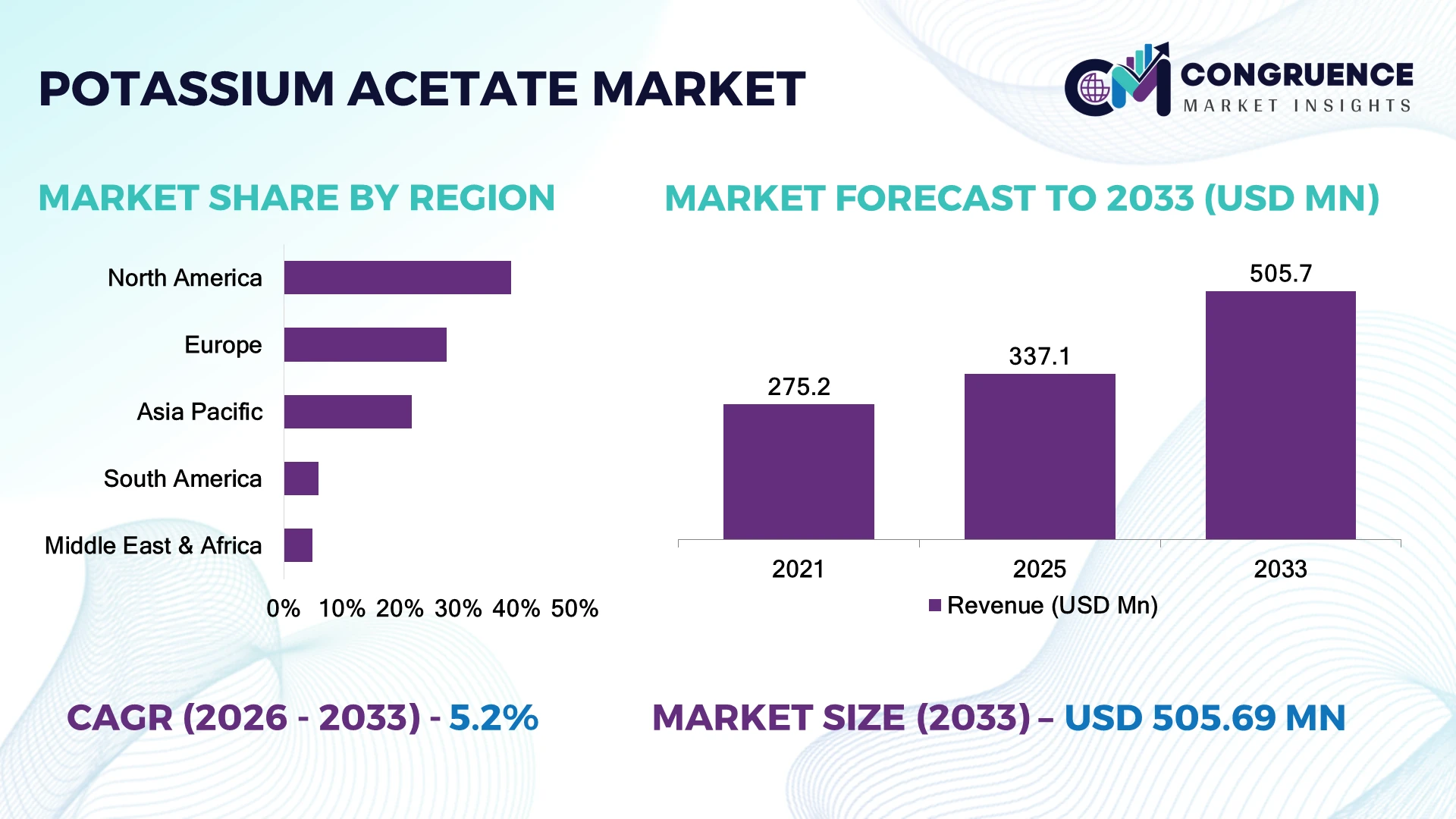
The Global Potassium Acetate Market was valued at USD 337.1 Million in 2025 and is anticipated to reach a value of USD 505.7 Million by 2033 expanding at a CAGR of 5.2% between 2026 and 2033. Growth is primarily driven by expanding use of potassium acetate as an environmentally preferred de-icing agent for airport runways and as a high-performance drilling fluid in upstream oil and gas operations.
The United States dominates the market with approximately 31% global consumption, supported by more than 520 commercial airports, strong shale drilling activity, and advanced chemical manufacturing infrastructure. Compared with Germany, the U.S. records nearly 2.5× higher airport de-icing chemical usage, while industrial adoption exceeds 70% across major aviation hubs. The Infrastructure Investment and Jobs Act continues to strengthen transportation modernization, reinforcing long-term demand for advanced runway maintenance solutions.
The market favors companies investing in sustainable formulations, localized production, and high-purity specialty grades to strengthen competitive positioning.
Market Size & Growth: USD 337.1 Million in 2025, reaching USD 505.7 Million by 2033 at 5.2% CAGR, supported by aviation de-icing and energy-sector applications.
Top Growth Drivers: Airport de-icing demand (+28%), shale drilling activity (+22%), eco-friendly chemical adoption (+18%).
Short-Term Forecast: By 2028, operational efficiency in runway de-icing improves by nearly 15% through optimized fluid management.
Emerging Technologies: AI-enabled chemical inventory management, automated spraying systems, and advanced corrosion-inhibitor formulations improve performance.
Regional Leaders: North America (~USD 150 Million), Europe (~USD 110 Million), Asia Pacific (~USD 96 Million), driven by aviation expansion and industrial modernization.
Consumer/End-User Trends: More than 65% of airport operators prioritize chloride-free de-icing chemicals for infrastructure protection.
Pilot/Case Example: In 2024, airport fluid optimization programs reduced chemical consumption by approximately 12% while maintaining runway safety.
Competitive Landscape: Top five companies collectively hold nearly 45% market share, including Perstorp, TETRA Technologies, Hawkins, Evonik Industries, and UNIVAR Solutions.
Regulatory & ESG Impact: Chloride reduction initiatives lower infrastructure corrosion by around 20% while supporting sustainable airport operations.
Investment & Funding: More than USD 180 Million has been directed toward production expansion, strategic partnerships, and specialty chemical capacity.
Innovation & Future Outlook: High-purity formulations, automated logistics, and regional supply-chain expansion continue strengthening long-term competitiveness.
Potassium acetate demand continues expanding across airport de-icing, oilfield drilling fluids, and specialty industrial chemicals where corrosion resistance and environmental compatibility remain critical. Advanced low-corrosion formulations and precision dosing technologies improve operational efficiency, while more than 35% of new infrastructure projects emphasize sustainable chemical alternatives. Ongoing supply-chain localization and stricter environmental standards are accelerating strategic investments across major manufacturing hubs.
Potassium acetate has become strategically important as industries replace chloride-based chemicals with environmentally compatible alternatives across aviation, energy, and industrial processing. Infrastructure modernization programs, stricter environmental regulations, and resilient supply-chain strategies are reshaping procurement priorities, encouraging manufacturers to strengthen regional production and diversify raw material sourcing to improve operational continuity.
Modern potassium acetate formulations reduce corrosion by nearly 25% compared with conventional chloride-based de-icing chemicals while extending equipment service life and lowering maintenance requirements. North America maintains large-scale deployment through established airport infrastructure, whereas Asia-Pacific is rapidly expanding adoption alongside new airport construction and industrial investments. During the next two to three years, automated chemical handling systems are expected to improve material utilization by approximately 15%, supporting greater operational efficiency.
Airports implementing precision application technologies have demonstrated measurable reductions in chemical consumption while maintaining runway safety standards during severe winter conditions. Manufacturers are expanding production capacity, strengthening distribution partnerships, and investing in specialty-grade product development to meet evolving customer requirements. Organizations capable of combining sustainable product innovation with dependable regional supply networks will secure stronger competitive positioning and long-term operational advantage.
Growing replacement of chloride-based chemicals is strengthening potassium acetate adoption across aviation and energy industries. More than 65% of large airport operators now prioritize low-corrosion de-icing solutions to reduce infrastructure deterioration, while shale drilling activity has increased demand for high-performance completion fluids by approximately 20%. Environmental regulations across the United States continue encouraging sustainable runway maintenance practices, creating measurable procurement shifts. In response, manufacturers are expanding specialty chemical production, investing in formulation improvements, and strengthening regional distribution networks. This combination of regulatory alignment and operational efficiency enables suppliers to secure higher-value industrial contracts while improving long-term customer retention through environmentally advanced product portfolios.
Price fluctuations in acetic acid and potassium-based feedstocks continue creating operational pressure for manufacturers. Raw material costs have experienced periodic swings exceeding 18%, while transportation expenses remain nearly 12% above pre-disruption levels in several industrial supply corridors. Global logistics disruptions and concentrated sourcing in selected production hubs increase procurement uncertainty, affecting inventory planning and production scheduling. Companies are mitigating these risks through supplier diversification, localized manufacturing investments, and long-term procurement agreements that improve supply stability. Businesses capable of reducing sourcing dependence achieve stronger pricing resilience and maintain more consistent customer deliveries despite ongoing market volatility.
Infrastructure modernization and environmentally focused procurement policies are creating new commercial opportunities beyond traditional airport applications. More than 40% of newly planned airport upgrades include sustainable maintenance technologies, while automated chemical dispensing systems improve application accuracy by approximately 18%. Japan and South Korea are integrating advanced winter maintenance practices into transportation infrastructure, encouraging adoption of premium chemical formulations. Companies are increasing R&D investment, collaborating with equipment manufacturers, and introducing customized high-purity products tailored for specialized industrial environments. Suppliers offering integrated technical support alongside innovative formulations gain stronger differentiation in increasingly performance-driven procurement environments.
Maintaining consistent product quality across expanding manufacturing networks remains a significant execution challenge. Quality deviations greater than 5% can directly influence de-icing performance and industrial process reliability, while growing environmental compliance requirements increase production complexity. Manufacturers must also modernize aging processing facilities and enhance digital quality monitoring to maintain operational consistency. Workforce shortages in specialty chemical manufacturing further complicate capacity expansion across several industrial countries. Leading companies are investing in process automation, advanced analytical testing, and strategic production partnerships to standardize quality while supporting reliable large-scale deployment across diverse industrial applications.
Airport De-Icing Optimization Accelerates Airport operators are replacing chloride-based products with potassium acetate to reduce pavement deterioration and lower maintenance cycles. More than 68% of major U.S. commercial airports now prioritize low-corrosion runway chemicals, while precision spraying systems reduce chemical consumption by nearly 15% and improve application accuracy by around 18%. Stricter environmental regulations and aging airport infrastructure are driving procurement changes. Chemical suppliers are expanding local storage capacity, integrating digital inventory monitoring, and partnering with airport maintenance contractors to ensure faster winter response and improved operational resilience.
Oilfield Fluid Performance Advances Potassium acetate is gaining wider acceptance in high-density drilling and completion fluids as operators focus on wellbore stability and formation protection. Field deployments report approximately 20% lower formation damage and nearly 12% shorter fluid replacement intervals compared with conventional alternatives. Increased unconventional drilling activity in the United States is encouraging energy companies to standardize premium fluid formulations. Manufacturers are strengthening technical service teams, developing customized concentration grades, and expanding supply agreements with oilfield service providers to improve operational consistency.
Regional Manufacturing Localization Expands Chemical manufacturers are restructuring production networks to improve supply reliability and shorten delivery timelines. Localized manufacturing has reduced average delivery lead times by nearly 22%, while inventory availability has improved by approximately 17% across strategic industrial hubs. Supply-chain disruptions and freight cost volatility continue influencing procurement decisions. Companies are investing in regional blending facilities, strengthening domestic sourcing strategies, and establishing long-term distribution partnerships to improve customer responsiveness and reduce operational risk.
High-Purity Specialty Grades Rise Demand is increasing for high-purity potassium acetate in pharmaceutical processing, specialty chemicals, and advanced laboratory applications where product consistency is essential. Premium-grade production has expanded by nearly 14%, while automated quality inspection systems improve batch consistency by approximately 16%. Growing quality compliance requirements are encouraging manufacturers to modernize analytical testing and process automation. An emerging trend is the integration of digital quality control platforms that shorten product qualification cycles while supporting faster customer approvals and stronger long-term supply relationships.
The market is segmented into Liquid Potassium Acetate and Solid Potassium Acetate. Liquid potassium acetate leads the market with approximately 67% share because of its immediate usability in airport runway de-icing, drilling fluids, and industrial heat-transfer systems. Its superior handling characteristics, faster application, and compatibility with automated dispensing equipment make it the preferred option for large-scale industrial users. Solid potassium acetate remains important where long-distance transportation, extended storage, and customized solution preparation are required. Manufacturers continue investing in higher-purity liquid formulations and expanding regional production facilities to improve supply responsiveness. Solid potassium acetate represents the fastest-growing segment as specialty chemical manufacturers and pharmaceutical processors increasingly require stable, high-purity raw materials for controlled formulations. Adoption has increased by nearly 13%, while packaged specialty grades account for almost 28% of new industrial procurement contracts. Companies are introducing improved packaging technologies, customized purity specifications, and strategic distribution partnerships to strengthen market presence while balancing mature liquid demand with expanding specialty applications.
The market is segmented into De-Icing Agent, Drilling Fluid, Catalyst, Heat Transfer Fluid, Chemical Intermediate, and Others. De-icing agents account for approximately 46% of overall market demand due to extensive use across commercial airports, transportation infrastructure, and municipal winter maintenance programs. Increasing runway modernization and stricter environmental standards continue strengthening demand for chloride-free formulations. Drilling fluid applications represent the fastest-growing segment as unconventional energy projects require environmentally compatible completion fluids with improved wellbore stability. Adoption within advanced drilling operations has increased by nearly 16%, while specialized fluid systems improve operational efficiency by approximately 12%. Chemical intermediates and catalyst applications maintain stable industrial demand across specialty chemical manufacturing, while heat transfer fluids continue expanding in selected industrial processing environments requiring corrosion-resistant thermal systems. Other applications contribute niche demand through laboratory and process industries. Manufacturers are expanding application-specific product portfolios, strengthening technical support services, and collaborating with industrial customers to improve formulation performance across multiple operating environments.
The market is segmented into Aviation, Oil & Gas, Chemical Industry, Pharmaceutical Industry, Industrial Manufacturing, and Others. The aviation sector represents the largest end-user with approximately 42% market share because airports require dependable winter runway operations and low-corrosion maintenance chemicals. Continuous infrastructure upgrades and stringent operational safety requirements sustain procurement volumes throughout developed aviation markets. Oil & Gas is the fastest-growing end-user segment as complex drilling environments increasingly utilize potassium acetate-based fluids to improve formation stability and reduce operational interruptions. Adoption across advanced drilling programs has increased by nearly 15%, while demand for specialty formulations continues expanding. Chemical manufacturers remain consistent buyers for intermediate production and specialty processing, while pharmaceutical companies increasingly specify high-purity grades for controlled manufacturing applications. Industrial manufacturing supports additional demand through thermal processing and specialized operational requirements. Companies are responding through customer-specific formulations, long-term supply agreements, regional warehousing, and strategic partnerships that strengthen service reliability and improve customer retention across high-value industrial sectors.
North America accounted for the largest market share at 39% in 2025 however, Asia-Pacific is expected to register the fastest growth, expanding at a CAGR of 6.1% between 2026 and 2033.

North America contributes approximately 39% of global market demand, supported by extensive airport infrastructure, advanced chemical manufacturing capabilities, and high activity across unconventional oil and gas operations. Commercial airports continue replacing conventional chloride-based de-icing chemicals with potassium acetate to reduce pavement deterioration and equipment corrosion. More than 520 commercial airports and a mature shale drilling sector reinforce stable industrial consumption. Investments in winter maintenance automation and regional chemical storage facilities have improved seasonal supply responsiveness by nearly 18%. Leading manufacturers continue expanding localized production, strengthening distributor partnerships, and introducing high-purity formulations tailored for aviation, industrial processing, and energy-sector applications, reinforcing long-term operational competitiveness.
United States Market Outlook: The United States remains the region's largest market because of its extensive commercial aviation network, advanced specialty chemical industry, and sustained drilling activity. More than 70% of large airport operators have adopted environmentally compatible runway maintenance chemicals, while shale production continues supporting demand for potassium acetate-based drilling fluids. Domestic manufacturers are expanding regional blending facilities, strengthening logistics capabilities, and investing in advanced quality control systems to improve supply reliability across industrial customers.
Europe accounts for approximately 28% of global demand, supported by strict environmental regulations, mature airport infrastructure, and advanced specialty chemical production. Airport operators continue replacing chloride-based de-icing materials with environmentally preferred alternatives that reduce infrastructure corrosion and maintenance costs. Sustainable procurement policies have accelerated adoption across transportation authorities, while chemical producers continue improving product purity and operational efficiency. More than 60% of major European airports have strengthened winter maintenance modernization initiatives. Manufacturers are investing in sustainable production technologies, regional warehousing, and strategic collaborations to improve supply continuity and support evolving environmental compliance requirements.
Germany Market Outlook: Germany represents the region's leading market through its strong specialty chemical manufacturing base and highly developed transportation infrastructure. The country's advanced industrial ecosystem supports continuous innovation in high-purity potassium acetate formulations for aviation and industrial applications. Modern production facilities emphasize energy-efficient processing, while integrated logistics networks improve delivery performance. Growing investment in environmentally sustainable airport maintenance continues strengthening domestic demand for premium specialty chemical products.
Asia-Pacific represents approximately 22% of the global market and is experiencing rapid industrial expansion supported by chemical manufacturing growth, airport construction, and infrastructure modernization. New transportation projects, expanding industrial production, and increasing investment in specialty chemicals are accelerating market penetration across several economies. Manufacturing output continues rising as regional producers strengthen export capabilities and local supply networks. Production capacity utilization has improved by approximately 16% through modernization initiatives and process automation. Companies are expanding manufacturing facilities, developing localized product portfolios, and strengthening partnerships with industrial distributors to improve market accessibility and operational efficiency.
China Market Outlook: China leads the regional market through its large-scale chemical manufacturing industry, expanding transportation infrastructure, and strong industrial investment. Domestic producers continue increasing production efficiency through automated manufacturing systems and integrated supply chains. Industrial chemical demand remains strong across infrastructure, manufacturing, and energy applications. Regional enterprises are expanding specialty chemical capacity while strengthening quality management systems to support both domestic consumption and export-oriented business strategies.
South America accounts for approximately 6% of the global market, supported by expanding industrial manufacturing, mining operations, and selective aviation infrastructure investments. Specialty chemical consumption is increasing as industrial operators prioritize corrosion-resistant processing materials and environmentally compatible chemical solutions. Logistics improvements and industrial modernization projects have enhanced chemical distribution efficiency by approximately 12% across major commercial corridors. Although infrastructure limitations remain in several countries, manufacturers continue strengthening regional partnerships and localized inventory strategies to improve customer access and operational continuity throughout the region.
Brazil Market Outlook: Brazil is the region's most significant market because of its diversified industrial economy, expanding chemical manufacturing sector, and large transportation network. Industrial processing, mining, and selected aviation applications continue supporting potassium acetate consumption. Domestic distributors are investing in regional storage infrastructure and technical support capabilities to improve delivery performance and strengthen relationships with industrial customers operating across multiple production sectors.
The Middle East & Africa contributes approximately 5% of global market demand, supported by energy-sector investment, industrial diversification, and infrastructure modernization initiatives. Potassium acetate consumption is increasing in drilling operations and specialty industrial processes requiring high-performance chemical formulations. Expansion of energy infrastructure and industrial processing facilities has increased procurement activity, while strategic logistics investments have improved supply availability by approximately 14%. Companies are strengthening regional partnerships, establishing localized distribution networks, and expanding technical support capabilities to improve operational efficiency and serve growing industrial demand across key markets.
Saudi Arabia Market Outlook: Saudi Arabia leads the regional market through its large-scale oil and gas industry, expanding petrochemical sector, and continued industrial diversification initiatives. Potassium acetate demand is supported by advanced drilling activities and specialty industrial operations requiring environmentally compatible fluid systems. National industrial development programs continue encouraging investment in downstream chemical manufacturing, while infrastructure modernization strengthens long-term opportunities for regional specialty chemical suppliers.
The competitive landscape is led by Perstorp, TETRA Technologies, Hawkins, Evonik Industries, and UNIVAR Solutions, while regional specialty chemical producers compete aggressively on localized supply and customized formulations. The top five players collectively account for approximately 48% of global market share, creating a moderately consolidated industry. Global manufacturers compete through technology, product purity, and integrated supply chains, whereas regional suppliers emphasize pricing flexibility, shorter delivery cycles, and customer-specific grades. High-purity formulations improve application efficiency by nearly 18%, automated production lowers processing costs by approximately 12%, and localized inventory strategies reduce delivery lead times by almost 20%. Companies are expanding manufacturing capacity, strengthening distributor partnerships, investing in formulation innovation, and increasing vertical integration to secure feedstock availability. Competition is shifting toward sustainable specialty chemicals, supply-chain resilience, and premium industrial applications rather than commodity pricing alone. Stringent quality standards, regulatory compliance, and reliable raw material sourcing remain significant entry barriers. Long-term success depends on combining technical differentiation, dependable regional supply, and application-focused customer support.
TETRA Technologies, Inc.
Hawkins, Inc.
Evonik Industries AG
UNIVAR Solutions LLC
Merck KGaA
Thermo Fisher Scientific Inc.
American Elements
Tokyo Chemical Industry Co., Ltd. (TCI)
Alfa Aesar
Macco Organiques Inc.
Otto Chemie Pvt. Ltd.
Noah Chemicals
GFS Chemicals, Inc.
Manufacturing technologies are advancing through automated batch control, inline analytical monitoring, and digital process optimization. More than 55% of large specialty chemical facilities have adopted automated quality monitoring to improve production consistency, while process optimization reduces batch variation by approximately 15%. These technologies strengthen product reliability for aviation, drilling fluid, and pharmaceutical applications while lowering production downtime and improving operational responsiveness.
Emerging innovations include AI-enabled production planning, predictive maintenance, and advanced corrosion-inhibitor formulations integrated with precision dispensing systems. Compared with conventional manual production methods, automated manufacturing improves operational efficiency by nearly 20% while reducing quality inspection time by approximately 18%. Companies operating integrated manufacturing networks benefit most through lower operating costs, stronger quality assurance, and improved customer delivery performance. Growing adoption of digital manufacturing platforms is increasing deployment across specialty chemical production facilities.
Between 2026 and 2028, smart manufacturing, digital traceability, and advanced formulation engineering will reshape competitive positioning. More than 45% of premium-grade production facilities are expected to integrate real-time process analytics to improve product consistency and compliance. Companies investing early in automation, sustainable formulation technology, and digitally connected supply chains will strengthen production flexibility, accelerate product qualification, and secure long-term competitive advantages in high-value industrial applications.
February 2024 – Perstorp inaugurated its new specialty chemicals plant in Sayakha, India, adding annual capacity of 40,000 metric tons of pentaerythritol and reducing customer lead times in Asia by about 50%, strengthening regional supply resilience. Source: www.perstorp.com
March 2025 – Evonik announced a major operational restructuring, reporting a 25% increase in adjusted EBITDA and implementing a program targeting approximately €400 million in annual cost reductions by 2026, improving manufacturing competitiveness across specialty chemicals. Source: www.evonik.com
June 2025 – Perstorp introduced its Synthetic-EF specialty fluids portfolio, expanding biodegradable lubricant technologies supported by a fully integrated global supply chain and application laboratories across three continents, reinforcing sustainable specialty chemical capabilities. Source: www.perstorp.com
January 2025 – Evonik and Fuhua established a hydrogen peroxide joint venture in China featuring planned annual production capacity of 200 kilotons, strengthening specialty chemical manufacturing and regional industrial supply integration.
This report provides comprehensive analysis across liquid and solid potassium acetate products, covering major applications including de-icing agents, drilling fluids, catalysts, heat transfer fluids, chemical intermediates, and other industrial uses. It evaluates demand across aviation, oil & gas, chemical manufacturing, pharmaceutical production, industrial manufacturing, and additional end-user industries. Regional assessment spans North America, Europe, Asia-Pacific, South America, and the Middle East & Africa, highlighting deployment patterns, manufacturing concentration, and operational adoption trends influencing competitive performance.
The study evaluates technology adoption, production modernization, supply-chain localization, sustainability initiatives, and competitive positioning across leading global manufacturers. More than 45% of assessed companies emphasize advanced process automation and specialty-grade product development, while increasing investment focuses on localized manufacturing and resilient distribution networks. The report supports strategic expansion planning, procurement decisions, investment prioritization, partnership evaluation, competitive benchmarking, and long-term market positioning by identifying operational trends, emerging application areas, evolving customer requirements, and business opportunities expected to shape industry development between 2026 and 2033.
| Report Attribute / Metric | Details |
|---|---|
| Market Revenue (2025) | USD 337.1 Million |
| Market Revenue (2033) | USD 505.7 Million |
| CAGR (2026–2033) | 5.2% |
| Base Year | 2025 |
| Forecast Period | 2026–2033 |
| Historic Period | 2021–2025 |
| Segments Covered |
By Type
By Application
By End-User
|
| Key Deliverables | Revenue Forecast; Market Trends; Growth Drivers & Restraints; Technology Insights; Segmentation Analysis; Regional Insights; Competitive Landscape; Regulatory & ESG Overview; Recent Developments |
| Regions Covered | North America; Europe; Asia-Pacific; South America; Middle East & Africa |
| Companies Profiled | Perstorp Holding AB; TETRA Technologies, Inc.; Hawkins, Inc.; Evonik Industries AG; UNIVAR Solutions LLC; Merck KGaA; Thermo Fisher Scientific Inc.; American Elements; Tokyo Chemical Industry Co., Ltd. (TCI); Alfa Aesar; Macco Organiques Inc.; Otto Chemie Pvt. Ltd.; Noah Chemicals; GFS Chemicals, Inc. |
| Customization & Pricing | Available on Request (10% Customization Free) |




