Global Post-Quantum Cryptography Migration Platform Market Report Overview
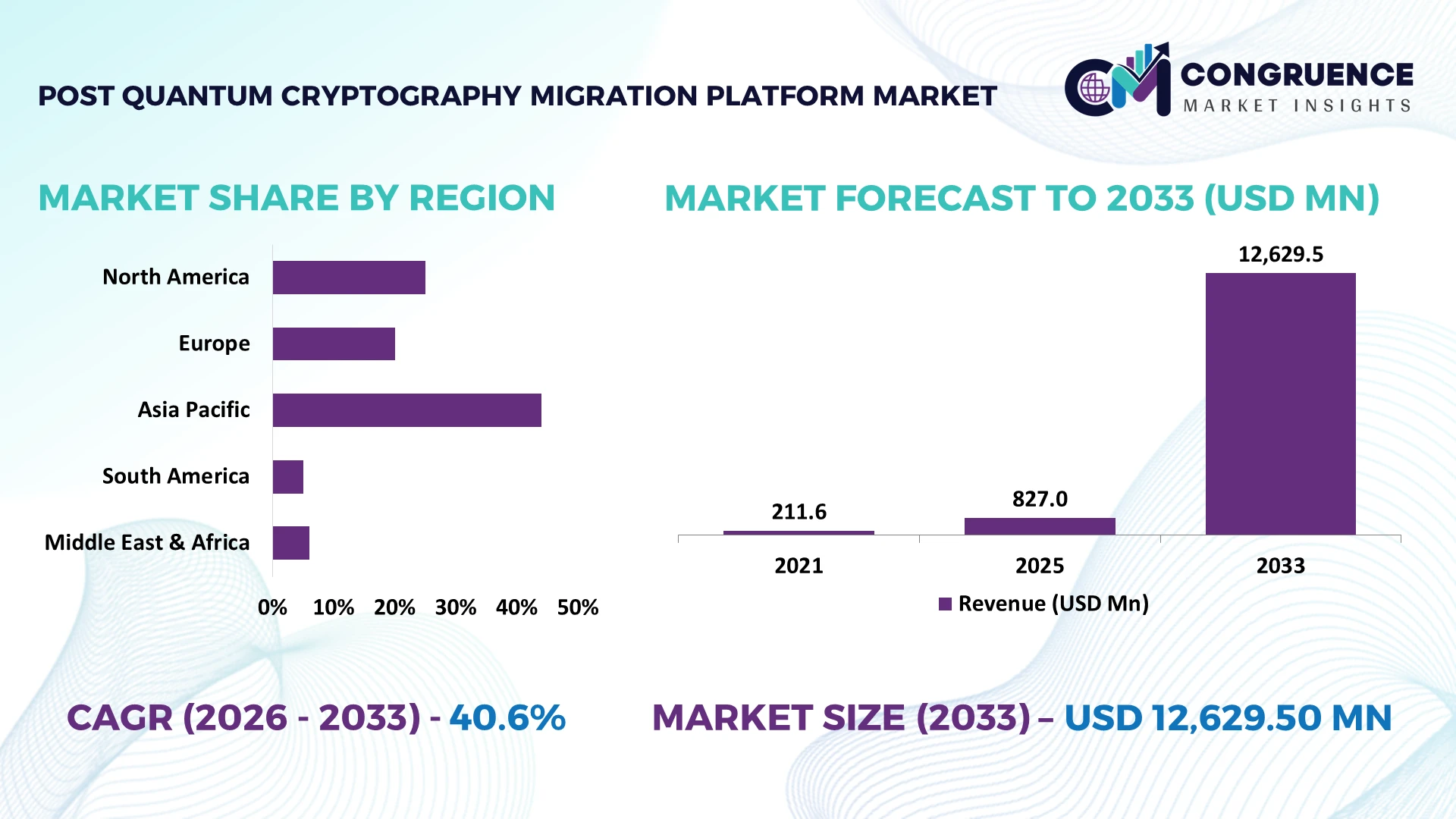
The Global Post-Quantum Cryptography Migration Platform Market was valued at USD 827 Million in 2025 and is anticipated to reach a value of USD 12629.5 Million by 2033 expanding at a CAGR of 40.6% between 2026 and 2033. Growth is driven by mandatory quantum resistant cryptographic transitions, increasing exposure to harvest now decrypt later attacks, and enterprise requirements for automated cryptographic asset discovery.
The United States dominates the global market with an estimated 38% share in 2025, supported by federal cybersecurity modernization, financial infrastructure protection, and defense investments. The National Quantum Initiative Act authorized approximately USD 1.2 billion in broader quantum research investments, strengthening the technology ecosystem. NIST finalized 3 post quantum cryptographic standards in August 2024, accelerating enterprise migration planning. Compared with China, the United States demonstrates stronger publicly documented standardization progress, while banking, telecommunications, healthcare, and government agencies represent major adoption areas.
Strategic prioritization of automated cryptographic discovery, interoperability, and regulatory compliance will strengthen vendor positioning across critical infrastructure procurement programs.
Key Highlights of the Global Post-Quantum Cryptography Migration Platform Market
-
Market Size & Growth: USD 827 million in 2025, reaching USD 12629.5 million by 2033 at 40.6% CAGR, driven by cryptographic modernization.
-
Top Growth Drivers: Estimated demand contributions include regulatory compliance (40%), quantum threat mitigation (35%), and cryptographic automation (25%).
-
Short Term Forecast: By 2028, automated migration platforms target 30% lower cryptographic assessment costs.
-
Emerging Technologies: Three priority innovations include AI enabled discovery, hybrid encryption, and automated crypto agility orchestration.
-
Regional Leaders: Estimated 2033 values include North America (USD 5051.8 million, compliance), Europe (USD 3536.26 million, infrastructure modernization), and Asia Pacific (USD 3157.38 million, banking adoption).
-
Consumer/End User Trends: An estimated 45% of enterprise demand originates from regulated industries prioritizing sensitive data protection.
-
Pilot/Case Example: Google's 2024 Chrome hybrid ML KEM transition introduced quantum resistant protection using 768 parameter encryption.
-
Competitive Landscape: IBM represents a leading contender with an indicative 15% share estimate, alongside SandboxAQ, PQShield, Thales, and Keyfactor.
-
Regulatory & ESG Impact: NSA's CNSA 2.0 roadmap targets quantum resistant transitions across national security systems by 2035.
-
Investment & Funding: PQShield secured USD 37 million in 2024, supporting cryptographic technology commercialization.
-
Innovation & Future Outlook: By 2028, an estimated 35% of platform deployments will incorporate continuous cryptographic monitoring.
The global Post Quantum Cryptography Migration Platform Market is witnessing concentrated demand across financial services, defense networks, cloud infrastructure, and telecommunications systems requiring long term information confidentiality. Recent innovations include automated cryptographic inventories, hybrid key exchange mechanisms, quantum resistant certificate management, and centralized migration orchestration. Continuous cryptographic monitoring is emerging as a procurement priority, with automated discovery targeting an estimated 40% reduction in manual assessment workloads. NIST standardization and federal cybersecurity transition requirements are accelerating structured migration programs, positioning scalable crypto agility capabilities at the center of enterprise strategic planning.
What Is the Strategic Relevance and Future Pathways of the Post-Quantum Cryptography Migration Platform Market?
The Post Quantum Cryptography Migration Platform Market is becoming strategically important as cryptographic resilience increasingly determines enterprise security, regulatory eligibility, and infrastructure investment priorities. The transition from conventional public key encryption toward quantum resistant algorithms is restructuring cybersecurity procurement. Automated cryptographic discovery platforms offer an estimated 35% reduction in assessment time compared with manual inventories, enabling enterprises to identify vulnerable assets without proportionally increasing security staffing.
The United States leads commercial migration activity through NIST standardization and federal modernization programs, while Germany emphasizes industrial infrastructure protection and cryptographic interoperability. Google's deployment of hybrid quantum resistant key exchange within Chrome demonstrates practical integration across widely distributed digital environments. Between 2026 and 2028, an estimated 30% of large regulated enterprises will initiate production migration across selected critical applications, accelerating demand for centralized orchestration.
Technology providers including IBM, Thales, and SandboxAQ are prioritizing cryptographic inventory management, migration automation, and integration partnerships with cloud infrastructure providers. Investment priorities are shifting toward reusable cryptographic abstraction layers that reduce dependence on individual encryption algorithms. Companies combining continuous asset visibility, automated policy enforcement, and application compatibility testing will secure stronger procurement positions while reducing customer migration costs and strengthening recurring enterprise relationships.
Post-Quantum Cryptography Migration Platform Market Dynamics
DRIVER:
Mandatory Cryptographic Infrastructure Modernization
Government mandated cryptographic modernization is accelerating enterprise procurement of migration platforms capable of identifying and replacing quantum vulnerable encryption. The United States CNSA 2.0 framework establishes transition milestones through 2035, creating immediate planning requirements across defense contractors and critical infrastructure operators. Regulatory compliance represents an estimated 40% of platform demand, while automated discovery targets a 35% reduction in initial assessment workloads. Financial institutions face additional pressure to protect information with extended confidentiality requirements. IBM and Keyfactor are expanding cryptographic inventory and certificate lifecycle capabilities to address these requirements. Vendors offering auditable migration records gain procurement advantages because regulatory readiness increasingly depends on demonstrable implementation progress rather than documented security policies alone.
RESTRAINT:
Legacy Infrastructure and Migration Economics
Existing cryptographic dependencies across embedded systems, mainframes, hardware security modules, and proprietary applications restrict immediate platform deployment. Legacy infrastructure remediation can account for an estimated 30% to 40% of enterprise migration expenditure, while compatibility testing represents approximately 20% under complex deployment scenarios. Banking institutions in Japan and Germany face particular constraints from established transaction processing environments requiring uninterrupted availability. Larger cryptographic keys and signatures also increase memory and bandwidth requirements across resource constrained devices. Technology providers are addressing these limitations through hybrid encryption, modular connectors, and phased migration architectures. Platforms lacking backward compatibility face weaker commercial scalability because customers prioritize infrastructure preservation over comprehensive cryptographic replacement.
OPPORTUNITY:
Continuous Crypto Agility Services
Continuous cryptographic lifecycle management presents a substantial opportunity beyond conventional migration projects. Automated policy orchestration, cryptographic bills of materials, and algorithm independent application interfaces enable enterprises to maintain security readiness without repeated infrastructure redesign. Integrated platforms target an estimated 25% reduction in recurring cryptographic maintenance expenditure and 40% improvement in vulnerability identification efficiency. Singapore's financial technology ecosystem offers attractive deployment opportunities through regulated digital banking and cross border payment infrastructure. SandboxAQ, PQShield, and Keyfactor are developing complementary discovery, implementation, and certificate management capabilities. Subscription based crypto agility services create additional commercial opportunities by converting periodic migration requirements into continuous operational assurance, strengthening customer retention and expanding managed cybersecurity service portfolios.
CHALLENGE:
Enterprise Migration Validation and Governance
Maintaining consistent cryptographic protection throughout multiyear migration programs represents a significant execution challenge. Distributed application ownership, evolving algorithm implementations, and inconsistent security policies complicate coordinated deployment across enterprise environments. Complex migration scenarios require an estimated 25% to 35% of implementation effort for validation, while automated regression testing targets a 30% reduction in verification workloads. The United Kingdom's cybersecurity roadmap establishes 2028 discovery and planning milestones, followed by priority migration activities through 2031. Companies must invest in cryptographic testing environments, specialized engineering capabilities, and standardized governance frameworks. Competitive differentiation increasingly depends on proving that migrated applications maintain authentication integrity, transaction reliability, and security assurance throughout subsequent algorithm updates.
Region-Wise Market Insights
North America accounted for the largest market share at an estimated 42% in 2025; however, Asia-Pacific is expected to register the fastest growth, expanding at an estimated CAGR of 45.8% between 2026 and 2033.
North America Post-Quantum Cryptography Migration Platform Market
Federal Modernization Accelerates Enterprise Cryptographic Transformation
North America maintains market leadership through advanced cybersecurity infrastructure, established enterprise software ecosystems, and government mandated cryptographic modernization. Financial institutions, defense contractors, cloud providers, and telecommunications operators represent major procurement groups, prioritizing automated cryptographic inventories and coordinated algorithm replacement. The United States accounts for an estimated 90% of regional platform demand, while Canada concentrates on financial infrastructure protection and public sector cybersecurity modernization. Canada's National Quantum Strategy allocated CAD 360 million toward quantum research, commercialization, and workforce development, strengthening the broader technology ecosystem. Enterprise procurement increasingly favors platforms supporting hybrid encryption, centralized policy management, and integration with existing hardware security modules. Technology providers are expanding partnerships with managed security service providers to accelerate implementation across distributed environments. Established cybersecurity distribution networks provide a significant commercialization advantage for integrated migration platforms.
United States Market Outlook: The United States benefits from extensive federal cybersecurity procurement and established cryptographic technology leadership. The NSA's CNSA 2.0 transition framework establishes implementation milestones through 2035, creating structured demand across national security infrastructure. IBM, SandboxAQ, and Keyfactor are strengthening enterprise migration capabilities through automated dependency mapping, cryptographic risk classification, and application modernization services.
Europe Post-Quantum Cryptography Migration Platform Market
Regulatory Coordination Strengthens Cryptographic Migration Readiness
Europe accounted for an estimated 27% of global market demand in 2025, supported by financial sector modernization, industrial cybersecurity requirements, and digital sovereignty initiatives. The European Commission issued a coordinated post quantum cryptography implementation recommendation in April 2024, followed by a European migration roadmap in 2025. These initiatives encourage coordinated implementation across critical infrastructure and public administration. France, Germany, and the United Kingdom represent major technology development and enterprise procurement centers, supported by established cryptographic research capabilities. The Digital Operational Resilience Act strengthens financial institutions' emphasis on documented technology risk management, supporting demand for cryptographic visibility and governance platforms. European enterprises increasingly prioritize solutions compatible with sovereign cloud infrastructure and domestic security requirements. Vendors offering localized implementation, regulatory alignment, and interoperable cryptographic architectures gain stronger positioning across regulated industries.
United Kingdom Market Outlook: The United Kingdom's National Cyber Security Centre establishes 2028 as the target for completing cryptographic discovery and migration planning, followed by priority implementation by 2031. London's financial services ecosystem and established cybersecurity research capabilities support commercial deployment. Domestic specialists including PQShield and Crypto Quantique strengthen innovation across quantum resistant software and embedded security architectures.
Asia-Pacific Post-Quantum Cryptography Migration Platform Market
Digital Infrastructure Expansion Accelerates Quantum Security Adoption
Asia Pacific represented an estimated 23% of global market demand in 2025, supported by extensive telecommunications infrastructure, semiconductor manufacturing, digital banking, and government technology modernization. Japan, China, South Korea, India, and Singapore are developing distinct quantum security ecosystems through domestic research programs and enterprise technology partnerships. Singapore launched its National Quantum Strategy in 2024, committing approximately SGD 300 million toward quantum technology development over five years. Japan's established electronics manufacturing ecosystem creates demand for embedded cryptographic modernization, while India's expanding digital payment infrastructure strengthens requirements for secure transaction processing. Telecommunications operators increasingly evaluate quantum resistant communication protocols across distributed network environments. Technology providers are prioritizing regional integration partnerships and modular deployment architectures. Commercial opportunities concentrate on platforms capable of supporting heterogeneous infrastructure without requiring extensive replacement of existing enterprise applications.
Japan Market Outlook: Japan's automotive, electronics, and telecommunications industries create substantial demand for quantum resistant device authentication and secure industrial communications. In 2024, Japan's government announced approximately JPY 42 billion in support for quantum computing development through selected projects. Domestic technology companies are strengthening cryptographic research and enterprise integration capabilities, supporting migration across manufacturing infrastructure and connected devices.
South America Post-Quantum Cryptography Migration Platform Market
Financial Digitization Creates Targeted Migration Opportunities
South America accounted for an estimated 4.5% of global market demand in 2025, with procurement concentrated across banking, telecommunications, government services, and expanding cloud infrastructure. Brazil, Chile, and Colombia represent significant implementation opportunities as digital transaction volumes increase and enterprises modernize security architectures. Brazil's Pix instant payment system processed approximately 63.8 billion transactions in 2024, demonstrating the operational scale of infrastructure requiring sustained cryptographic protection. Financial institutions prioritize migration assessments that minimize disruption to authentication and transaction processing environments. Limited specialist engineering availability and constrained cybersecurity budgets restrict comprehensive implementation across smaller enterprises. International technology providers are addressing these limitations through managed deployment services, regional distribution partnerships, and cloud delivered security platforms. Modular migration offerings provide commercial advantages by allowing organizations to prioritize critical applications before extending protection across broader infrastructure.
Brazil Market Outlook: Brazil leads regional demand through its extensive banking ecosystem, domestic technology infrastructure, and expanding cloud services. AWS announced plans in September 2024 to invest BRL 10.1 billion in Brazilian cloud infrastructure through 2034. This infrastructure expansion creates opportunities for cryptographic modernization platforms supporting secure application deployment, certificate management, and centralized enterprise security governance.
Middle East & Africa Post-Quantum Cryptography Migration Platform Market
Sovereign Digital Infrastructure Drives Security Investment
The Middle East and Africa represented an estimated 3.5% of global market demand in 2025, with procurement concentrated across government infrastructure, energy companies, financial institutions, and telecommunications networks. The United Arab Emirates and Saudi Arabia are establishing advanced digital infrastructure ecosystems that support quantum security implementation, while South Africa represents an important financial technology market. In 2024, Microsoft announced a USD 1.5 billion investment in UAE technology company G42, strengthening regional cloud and artificial intelligence infrastructure development. These investments expand the operational environments requiring adaptable cryptographic protection. Energy infrastructure operators prioritize secure industrial communications and long lifecycle equipment authentication. Technology providers are targeting sovereign cloud integration, localized security services, and government technology partnerships. Uneven technical readiness across African markets favors scalable managed platforms that reduce dependence on specialized internal cryptographic engineering resources.
United Arab Emirates Market Outlook: The United Arab Emirates benefits from coordinated government technology investment and established cybersecurity research infrastructure. Abu Dhabi's Technology Innovation Institute maintains dedicated quantum and cryptography research centers, including development of quantum resistant security technologies. Its Quantum Research Center unveiled a 10 qubit superconducting quantum computer in 2024, reinforcing domestic research capabilities and supporting commercial cryptographic modernization initiatives.
Market Competition Landscape
IBM, SandboxAQ, Thales, Keyfactor, and PQShield compete across integrated migration orchestration, cryptographic discovery, enterprise security infrastructure, and algorithm implementation. The top five players collectively account for an estimated 52% market share, indicating moderate concentration. IBM and Thales leverage established enterprise distribution, while SandboxAQ and PQShield differentiate through specialized cryptographic intelligence and implementation capabilities. Keyfactor competes through certificate lifecycle integration and public key infrastructure modernization. Automated discovery targets approximately 35% lower assessment workloads, while integrated orchestration offers estimated implementation cost reductions of 20%. Competition increasingly centers on interoperability, deployment speed, regulatory alignment, and compatibility with existing security infrastructure. Companies are expanding cloud partnerships, developing modular migration connectors, and integrating standardized quantum resistant algorithms. The competitive shift favors continuous cryptographic governance over isolated replacement projects. Entry barriers include specialized engineering expertise, enterprise integration requirements, and security validation. Winning requires demonstrable migration reliability, scalable automation, flexible deployment architectures, and sustained compatibility across evolving cryptographic standards.
Companies Profiled in the Post-Quantum Cryptography Migration Platform Market Report
-
IBM Corporation
-
SandboxAQ
-
Thales Group
-
Keyfactor
-
PQShield
-
Entrust Corporation
-
QuSecure
-
CryptoNext Security
-
ISARA Corporation
-
evolutionQ
-
DigiCert
-
Crypto Quantique
-
Quantum Xchange
Technology Insights for the Post-Quantum Cryptography Migration Platform Market
Current technologies center on automated cryptographic discovery, dependency mapping, and standardized quantum resistant algorithms. Automated discovery targets an estimated 35% reduction in assessment time compared with conventional manual inventories, while centralized dependency mapping targets 25% lower remediation workloads. Production adoption is advancing through hybrid key exchange deployments across browsers and cloud networks. These technologies improve asset visibility, reduce implementation uncertainty, and support coordinated cryptographic replacement.
Emerging technologies include intelligent migration orchestration, cryptographic abstraction layers, and automated compatibility testing. Intelligent orchestration targets an estimated 30% improvement in implementation efficiency, while abstraction layers offer potential maintenance savings of 20%. Automated compatibility testing targets 25% lower validation workloads. Financial institutions and cloud providers benefit from these integrations through reduced application disruption, standardized security policies, and improved deployment consistency across distributed infrastructure environments.
Disruptive innovations include autonomous cryptographic remediation and adaptive algorithm selection, currently concentrated in emerging commercial implementations. Autonomous remediation targets an estimated 40% reduction in manual intervention, while adaptive algorithm selection offers potential operational overhead savings of 15%. Between 2026 and 2028, integration with enterprise security orchestration systems will accelerate production readiness. Vendors combining automated implementation, continuous validation, and infrastructure interoperability gain competitive advantages by reducing migration complexity and supporting sustained cryptographic resilience.
Recent Developments in the Global Post-Quantum Cryptography Migration Platform Market
* October 2026: IBM announced its unified Quantum Safe suite, comprising three specialized solutions for cryptographic discovery, migration management, and protocol interoperability. The portfolio enables enterprises to coordinate remediation activities, prioritize vulnerable assets, and maintain continuous cryptographic governance. Source: ibm.com
* December 2025: Swift participated in Project Leap Phase 2, involving six organizations testing quantum resistant cryptography within operational payment infrastructure. Successful execution of all test scenarios demonstrated migration feasibility, helping financial institutions establish practical cryptographic transition strategies. Source: bis.org
* June 2025: Keyfactor released Command 25.2, expanding support for hybrid certificates incorporating three standardized ML DSA variants. The enhancement strengthens certificate lifecycle management, allowing enterprises to integrate quantum resistant authentication while maintaining compatibility with conventional cryptographic environments. Source: keyfactor.com
* June 2024: PQShield secured USD 37 million through Series B financing led by Addition. The investment supports recruitment and closer customer collaboration, strengthening commercialization capacity for quantum resistant hardware and software across semiconductor and enterprise technology markets. Source: techcrunch.com
Scope of the Post-Quantum Cryptography Migration Platform Market Report
The report examines the global Post Quantum Cryptography Migration Platform Market across six product types, seven applications, and seven end user categories. Coverage includes cryptographic discovery, risk assessment, migration orchestration, crypto agility, PKI modernization, and key management technologies. Application analysis evaluates algorithm replacement, certificate migration, network security, and compliance monitoring across financial institutions, government agencies, telecommunications operators, healthcare organizations, cloud providers, utilities, and manufacturing enterprises.
Regional analysis encompasses North America, Europe, Asia Pacific, South America, and the Middle East and Africa, assessing regulatory frameworks, infrastructure readiness, deployment concentration, and enterprise adoption patterns. The report profiles 13 influential companies, evaluating technological differentiation, product portfolios, partnerships, and competitive positioning. Emerging opportunities include autonomous cryptographic remediation, hybrid authentication, and continuous cryptographic governance, supporting investment prioritization, geographic expansion, and strategic technology planning between 2026 and 2033.
Post-Quantum Cryptography Migration Platform Market Report Summary
| Report Attribute/Metric | Report Details |
|---|
Market Revenue in 2025 | USD 827 Million |
Market Revenue in 2033 | USD 12629.5 Million |
CAGR (2026 - 2033) | 40.6% |
Base Year | 2025 |
Forecast Period | 2026 - 2033 |
Historic Period | 2021 - 2025 |
Segments Covered | By TypeBy ApplicationBy End-UserAutomotive and Manufacturing
|
Key Report Deliverable | Revenue Forecast, Growth Trends, Market Dynamics, Segmental Overview, Regional and Country-wise Analysis, Competition Landscape |
Region Covered | North America, Europe, Asia-Pacific, South America, Middle East, Africa |
Key Players Analyzed | IBM Corporation, SandboxAQ, Thales Group, Keyfactor, PQShield, Entrust Corporation, QuSecure, CryptoNext Security, ISARA Corporation, evolutionQ, DigiCert, Crypto Quantique, Quantum Xchange |
Customization & Pricing | Available on Request (10% Customization is Free) |





