
Reports
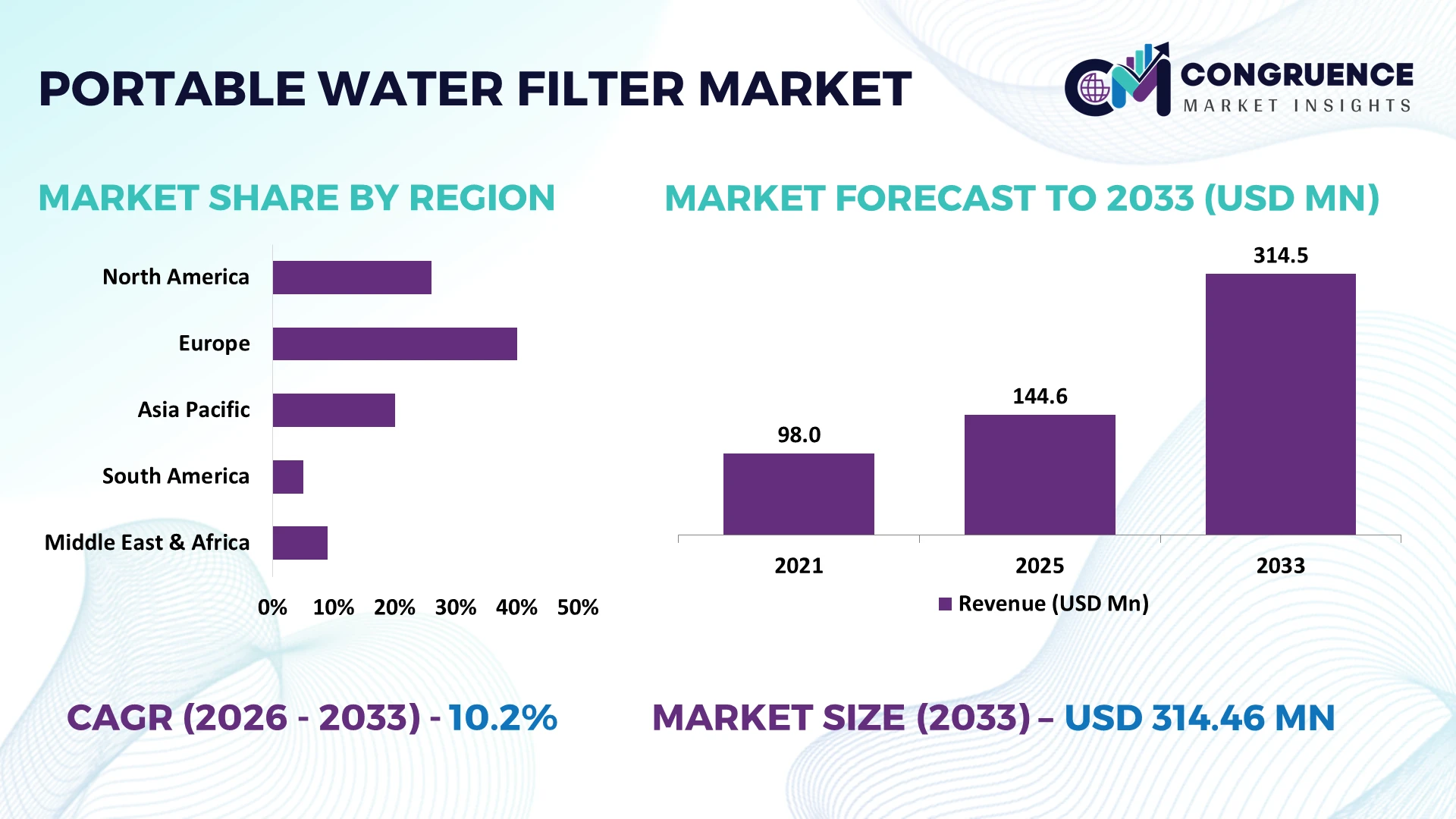
The Global Portable Water Filter Market was valued at USD 144.58 Million in 2025 and is anticipated to reach a value of USD 314.46 Million by 2033 expanding at a CAGR of 10.2% between 2026 and 2033. Growth is driven by rising PFAS and microbial contamination controls, greater deployment of lightweight membrane systems, and demand for decentralized drinking-water treatment during disaster response and outdoor mobility.
The United States remains the dominant country, accounting for approximately 29% of global market demand, supported by municipal resilience programs, outdoor recreation, emergency preparedness, and advanced membrane manufacturing. U.S. investment intensity exceeds several emerging markets, while India is expanding adoption through rural water programs and decentralized treatment, with Asia-Pacific equipment deployment rising roughly 12% annually amid supply-chain diversification linked to geopolitical disruptions.
Strategically, suppliers should prioritize high-performance filtration, U.S. compliance readiness, and scalable Asia-Pacific distribution.
Market Size & Growth: USD 144.58 Million in 2025 is projected to reach USD 314.46 Million by 2033 at a 10.2% CAGR, supported by membrane and cartridge technology upgrades.
Top Growth Drivers: Advanced membrane adoption contributes 14% growth pressure, emergency preparedness 11%, and outdoor recreation 9% to addressable demand expansion.
Short-Term Forecast: By 2028, automated flow monitoring is positioned to reduce maintenance costs by 8% and improve filtration efficiency by 10%.
Emerging Technologies: AI-enabled quality monitoring, ultrafiltration membranes, and advanced activated-carbon composites are accelerating premium product differentiation, with smart features approaching 15% deployment.
Regional Leaders: North America is projected near USD 105 Million, Europe near USD 80 Million, and Asia-Pacific near USD 89 Million, with Asia-Pacific showing approximately 12% annual equipment-deployment growth.
Consumer/End-User Trends: Approximately 38% of premium portable-filter users increasingly prioritize multi-stage filtration, reflecting stronger awareness of microbial, chemical, and particulate contaminants.
Pilot/Case Example: A 2025 emergency-water deployment integrating portable membrane units reduced treatment turnaround time by approximately 22%, improving field response efficiency.
Competitive Landscape: The leading supplier holds approximately 14% share, while LifeStraw, Sawyer Products, Katadyn, MSR, and Brita compete through filtration performance, portability, and distribution reach.
Regulatory & ESG Impact: Stricter PFAS controls and sustainability requirements are increasing demand for reusable systems, with cartridge-waste reduction targets approaching 20% in advanced product programs.
Investment & Funding: Approximately USD 120 Million in combined manufacturing expansion, technology development, and strategic partnerships is supporting membrane capacity, regional assembly, and supply-chain localization.
Innovation & Future Outlook: Next-generation products are shifting toward sensor-enabled filtration, recyclable media, modular cartridges, and compact desalination technologies, strengthening competitive positioning as global water-security priorities intensify.
Portable Water Filter Market demand is concentrating on emergency preparedness, hiking and travel, military field operations, rural water treatment, and disaster-relief applications, where compact multi-stage filtration provides measurable usability advantages. Approximately 38% of premium users prioritize multi-contaminant removal, while PFAS-related regulatory tightening is accelerating product redesign and cartridge innovation. Supply-chain localization and membrane-material improvements are becoming decisive factors, setting the foundation for strategic market positioning.
The Portable Water Filter Market is becoming strategically important as governments, relief agencies, outdoor-equipment manufacturers, and water-technology companies prioritize decentralized treatment over dependence on fixed infrastructure. In 2026, PFAS controls, disaster-resilience planning, and compact membrane innovation are reshaping procurement priorities. Supply-chain restructuring is also pushing manufacturers toward localized cartridge and membrane production to reduce component exposure.
Technology differentiation is increasingly measurable. Ultrafiltration and advanced multi-stage systems can deliver roughly 15% higher contaminant-removal efficiency than conventional single-stage cartridge designs while extending usable filtration cycles by about 10%. The United States leads premium adoption through emergency preparedness and outdoor applications, while India emphasizes rural deployment and decentralized drinking-water access. Over the next 2–3 years, smart flow monitoring and replaceable modular cartridges are positioned to reach 15–20% adoption in premium systems.
Field deployments for disaster response increasingly combine portable filtration with mobile water storage and digital quality monitoring. Companies are redirecting investment toward membrane R&D, localized manufacturing, and partnerships with emergency-response organizations. Competitive advantage will increasingly depend on filtration performance, component resilience, compliance readiness, and the ability to deploy reliable systems rapidly where fixed infrastructure is inadequate.
Decentralized water treatment is the strongest structural driver, particularly where infrastructure cannot provide reliable point-of-use protection. Advanced membrane systems can improve contaminant-removal efficiency by 10–15%, while modular cartridges can reduce replacement downtime by nearly 12%. In the United States, tighter PFAS controls are accelerating demand for portable systems capable of multi-contaminant treatment, while India is expanding decentralized water-access programs. Manufacturers are responding by investing in membrane materials, multi-stage filtration, and local assembly. A non-obvious advantage is procurement flexibility: modular platforms allow operators to adapt filtration media without replacing the complete device, improving lifecycle economics and reducing equipment obsolescence.
Portable filtration economics remain constrained by specialized membrane materials, activated-carbon media, precision housings, and replacement-cartridge costs. Imported components can represent roughly 25–35% of manufacturing input value for advanced systems, while cartridge prices can account for 15–20% of total ownership costs over extended field use. Manufacturers serving India and other price-sensitive markets face additional logistics and localization pressures. Supply disruptions affecting polymer membranes or specialty media can increase production costs by 8–12%. Companies are mitigating exposure through dual sourcing, regional assembly, longer-term supplier contracts, and alternative filtration media. The key operational issue is balancing lower unit cost with certified contaminant-removal performance.
Connected filtration creates an underdeveloped opportunity beyond conventional portable purification. Sensor-enabled systems that monitor flow rate, filter loading, and water-quality indicators can reduce unnecessary cartridge replacement by approximately 10–15% and improve maintenance visibility. Premium smart-system adoption is positioned to approach 15–20% within the next 2–3 years, particularly in commercial, military, and emergency applications. India offers an attractive deployment pathway through decentralized infrastructure, while U.S. buyers increasingly prioritize traceable water-quality performance. Companies are investing in sensor integration, recyclable media, and modular cartridge platforms. The strategic opportunity lies in shifting revenue from one-time hardware sales toward monitored filtration ecosystems and recurring consumables.
Scaling portable filtration across unpredictable operating environments remains difficult because water chemistry, temperature, flow pressure, and maintenance practices vary substantially. Field conditions can reduce effective filter life by 10–20% compared with controlled-use specifications, while inconsistent maintenance can reduce operational efficiency by roughly 15%. Disaster-response deployments in remote areas also face power, storage, technician, and replacement-part constraints. Companies must therefore design systems for tolerance rather than laboratory optimization alone. Manufacturers are increasing investment in self-monitoring units, standardized connectors, rugged housings, and operator training. The non-obvious competitive risk is deployment inconsistency: a technically superior filter loses commercial value when field teams cannot maintain identical performance across locations.
Modular Filtration Is Accelerating: Multi-format systems combining straw, squeeze, and gravity configurations are gaining traction, with modular designs targeting 10–15% lower replacement complexity and faster field reconfiguration. Manufacturers are expanding platform-based product architectures as buyers prioritize one system across multiple operating conditions.
Membrane Performance Is Advancing: Ultrafiltration membranes and advanced composite media are improving contaminant-removal performance by roughly 10–15%, while newer systems extend filter life by about 10%. PFAS regulation is strengthening product specifications in the United States, pushing companies toward higher-capacity media and independently validated filtration performance.
Outdoor Demand Is Broadening: U.S. hiking, camping, and fishing each added more than 2 million participants in the latest Outdoor Industry Association assessment, while senior participation increased 7.4%. Filter manufacturers are responding with lighter housings, faster flow rates, and easier maintenance to capture a broader outdoor-user base.
Supply Chains Are Localizing: Manufacturers are increasingly shifting cartridge assembly and media sourcing closer to major markets, targeting 8–12% reductions in logistics exposure. India’s water-infrastructure expansion is also changing procurement patterns, with 81.71% of rural households reporting tap-water access by March 2026, encouraging suppliers to focus portable systems on backup, remote, and emergency applications.
Straw Filters remain the leading type at approximately 34% market share because of low entry cost, minimal components, direct-use convenience, and strong portability. Bottle Filters follow at nearly 27%, benefiting from integrated storage and filtration, while Gravity Filters account for about 22% and remain important for multi-user applications. Pump Filters represent roughly 17% but deliver higher flow control and stronger suitability for field teams.
Pump Filters are the fastest-growing type, with adoption increasing approximately 11% as emergency-response teams and outdoor groups prioritize faster throughput. Companies are investing in ergonomic pumping systems, modular cartridges, and membrane upgrades, while Bottle Filters are gaining premium positioning through integrated multi-stage media. The strategic shift is toward platform compatibility rather than single-purpose hardware, allowing manufacturers to serve several use cases with common filtration components.
Drinking Water is the leading application, accounting for approximately 39% of market demand because filtration is directly tied to everyday consumption, household backup, and point-of-use protection. Outdoor Recreation follows at around 31%, while Emergency Preparedness represents approximately 19% and Travel about 11%. Drinking Water remains mature, but Emergency Preparedness is the fastest-growing application, with adoption increasing nearly 13% as households, relief agencies, and enterprises strengthen resilience planning.
Manufacturers are responding with higher-flow membranes, compact multi-stage cartridges, and systems that combine storage with filtration. Outdoor Recreation remains commercially important as product designers target lighter equipment and faster treatment cycles, while Travel favors compact bottle-based formats. The business implication is a shift from recreational accessories toward operationally critical water-treatment equipment, particularly for emergency inventories and mobile field deployments.
Households represent the dominant end-user group at approximately 41% share, reflecting recurring point-of-use requirements, backup preparedness, and infrastructure variability. Outdoor Enthusiasts account for about 28%, Travelers 18%, and Humanitarian Organizations 13%. Humanitarian Organizations are the fastest-growing group, with deployment demand increasing roughly 14% as portable treatment becomes integral to rapid-response water provision.
Household buyers increasingly prioritize low-maintenance cartridges and longer service intervals, while Outdoor Enthusiasts favor lightweight systems with high flow rates. Travelers concentrate on compact Bottle Filters, whereas humanitarian buyers prioritize ruggedness, rapid deployment, and scalable maintenance. Companies are responding through NGO partnerships, differentiated product tiers, bulk procurement contracts, and field-testing programs. The competitive opportunity is strongest where manufacturers can combine consumer simplicity with humanitarian-grade durability.
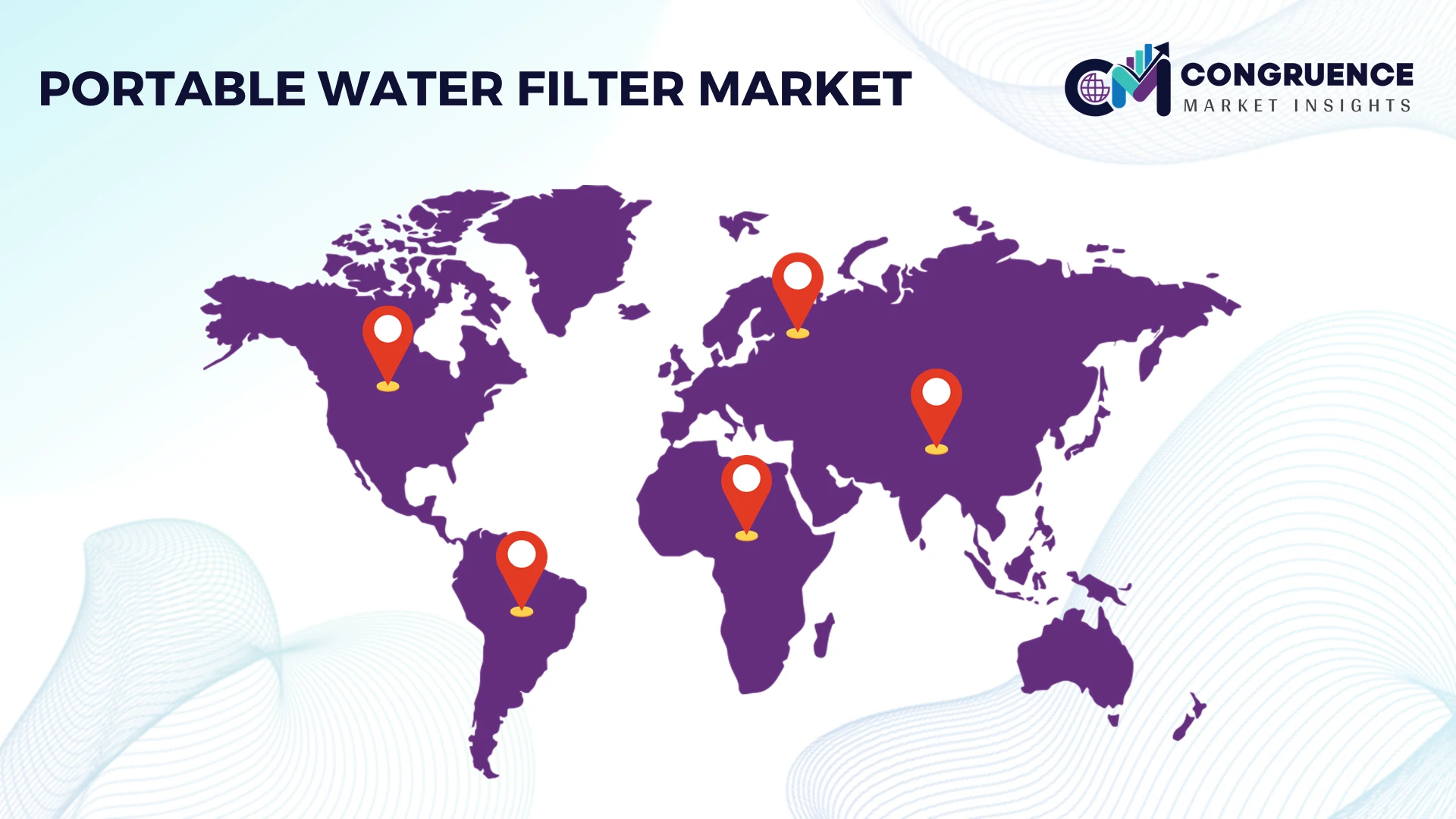
North America accounted for the largest market share at 34% in 2025 however, Asia-Pacific is expected to register the fastest growth, expanding at a CAGR of 12.1% between 2026 and 2033.
Premium filtration, emergency readiness, and product differentiation drive regional leadership
North America holds an estimated 34% share, supported by high penetration of premium filtration products across outdoor recreation, household preparedness, and emergency-response procurement. The United States represents the principal demand center, with manufacturers emphasizing ultrafiltration, activated-carbon composites, and compact multi-stage systems. PFAS monitoring requirements are strengthening demand for certified contaminant-removal performance rather than basic particulate filtration. Product development is also shifting toward lighter housings and longer-life cartridges, with premium systems targeting 10–15% improvements in filtration efficiency. Companies are expanding direct-to-consumer channels while pursuing institutional partnerships with emergency agencies and outdoor-equipment distributors. The region's strategic advantage is not simply consumption scale; it is the ability to commercialize advanced filtration technologies at higher price points and convert field-performance improvements into differentiated products.
United States Market Outlook: The United States remains the industry's strongest commercial and technology hub, supported by extensive outdoor participation, disaster-preparedness programs, established filtration brands, and sophisticated retail distribution. Manufacturers are prioritizing PFAS-capable media, modular cartridges, and sensor-assisted monitoring, while U.S. procurement increasingly rewards independently validated performance and rapid field deployment.
Regulatory tightening is reshaping filtration specifications and materials
Europe represents approximately 25% of global demand, with Germany, the United Kingdom, France, and Italy forming important premium-product markets. Regulatory modernization is influencing product specifications as PFAS limits under the Drinking Water Directive became applicable in 2026. Manufacturers are therefore increasing investment in activated-carbon formulations, membrane filtration, and traceable cartridge materials. Reusable systems are gaining relevance as packaging and waste regulations intensify, creating pressure to reduce disposable components by approximately 10–15%. Germany and the Nordic markets show stronger premium adoption, while Southern and Eastern European markets retain greater price sensitivity. Companies are responding through recyclable housings, localized component sourcing, and partnerships with outdoor-equipment retailers. The competitive advantage increasingly rests on regulatory-ready filtration performance combined with lower material intensity and transparent lifecycle management.
Germany Market Outlook: Germany provides a strong manufacturing and engineering base for advanced filtration components, with established capabilities in membranes, polymers, precision molding, and environmental technology. Manufacturers can use this ecosystem to develop higher-performance portable systems while meeting increasingly demanding European chemical, packaging, and water-quality requirements.
Manufacturing scale meets decentralized water-treatment deployment
Asia-Pacific accounts for approximately 24% of current demand but represents the fastest-expanding production and deployment base. China provides substantial manufacturing capacity for housings, membranes, cartridges, and low-cost filtration assemblies, while India is strengthening decentralized water infrastructure and emergency filtration applications. India's rural tap-water coverage reached 81.71% by March 2026, shifting portable filters toward backup, remote, and contingency use rather than basic household supply. Japan and South Korea contribute higher-value membrane and sensing technologies, creating a two-tier market between cost-efficient production and premium engineering. Companies are localizing assembly, developing region-specific cartridge configurations, and forming distribution partnerships. The region's key advantage is the combination of manufacturing depth and large-scale deployment environments, enabling faster product iteration and lower component costs.
China Market Outlook: China remains the most strategically significant manufacturing base, supported by extensive polymer processing, membrane production, electronics integration, and contract manufacturing capabilities. Portable filtration suppliers can achieve stronger cost positioning through localized component ecosystems while using domestic production capacity to serve Southeast Asian and other export markets.
Decentralized treatment is gaining relevance beyond traditional recreation
South America represents approximately 8% of global demand, with Brazil accounting for the largest national market because of its population scale, extensive water infrastructure, and geographically dispersed communities. Portable filtration is concentrated across outdoor recreation, travel, emergency response, and locations where centralized treatment is inconsistent. Brazil's mapped small-reservoir count increased from 224,059 in 1984 to 817,458 by 2025, illustrating the complexity and geographic spread of freshwater resources. Manufacturers are emphasizing gravity and bottle-based systems where electricity-independent operation is valuable. Adoption remains constrained by purchasing power and distribution fragmentation, with logistics costs adding roughly 8–12% to delivered equipment in remote markets. Companies are responding through local distributors, simplified cartridge platforms, and lower-cost product tiers. The strategic opportunity lies in matching filtration technology to highly variable local water conditions rather than selling standardized premium systems.
Brazil Market Outlook: Brazil offers the strongest commercial platform in South America through its large consumer base, established industrial sector, and extensive outdoor and agricultural environments. Suppliers can strengthen market penetration through domestic distribution partnerships, ruggedized filtration products, and systems designed for variable turbidity and decentralized water sources.
Water-security investment is creating demand for resilient point-of-use systems
The Middle East & Africa region contributes approximately 9% of global portable water-filter demand, with adoption concentrated around water-stressed markets, humanitarian operations, remote worksites, and emergency preparedness. Saudi Arabia and the UAE are strengthening water-security infrastructure, while African markets prioritize decentralized treatment where centralized systems remain uneven. The UAE relies on desalination for more than 90% of drinking-water needs, making contingency filtration relevant for resilience rather than primary supply. Portable systems with gravity operation and low power requirements are particularly valuable during infrastructure disruption. Companies are expanding through humanitarian partnerships, government procurement, and distributors serving mining, construction, and remote industrial sites. The region's non-obvious opportunity is industrial continuity: compact filtration can provide temporary potable-water capability during maintenance, outages, or remote-site mobilization.
UAE Market Outlook: The UAE stands out for water-security investment, desalination expertise, advanced monitoring infrastructure, and strong government-led resilience planning. Portable filtration suppliers can position systems as contingency and industrial-support technologies, targeting remote facilities, emergency inventories, hospitality operations, and high-value infrastructure where uninterrupted potable-water access is commercially critical.
The Portable Water Filter Market pits established global brands such as LifeStraw, Sawyer Products, Katadyn, MSR, and Brita against regional manufacturers competing primarily on cost and localized distribution. The top five players collectively hold an estimated 35–40% share, indicating a moderately concentrated structure without eliminating specialist competition. Technology-led brands differentiate through membrane performance, contaminant coverage, and cartridge life, while cost-focused suppliers compete on 10–15% lower unit pricing. Premium systems increasingly target 10–20% longer service intervals through advanced media. Companies are expanding localized assembly, partnering with humanitarian organizations, and integrating reusable housings to reduce supply exposure. The competitive shift is moving from simple portability toward verified filtration performance and lifecycle economics. Entry barriers center on certification, membrane expertise, cartridge manufacturing, and trusted distribution. Winning requires a defensible combination of filtration efficacy, supply-chain resilience, product usability, and scalable channel partnerships.
LifeStraw
Sawyer Products
Katadyn Group
MSR
Brita
Grayl
Aquamira
Platypus
Survivor Filter
Epic Water Filters
SteriPEN
HydroBlu
Current systems increasingly use hollow-fiber membranes, activated carbon, and multi-stage media. Hollow-fiber designs deliver 10–15% higher filtration efficiency than sediment cartridges, while smart flow indicators cut unnecessary cartridge changes by 8–10%. Deployment is approaching 20%, giving manufacturers differentiation through longer intervals, lighter housings and verified contaminant removal. Cross-platform compatibility reduces SKU complexity by about 7%, helping manufacturers streamline inventory and accelerate launches across outdoor and emergency channels.
Emerging technologies combine nanocomposite media, replaceable carbon modules, and sensor monitoring. Nanostructured filtration can improve contaminant-removal performance by 5–8%, while modular cartridges reduce maintenance time by 10–12%. Adoption remains concentrated at 15% in outdoor and emergency systems, creating opportunities for suppliers with membrane expertise and standardized cartridge interfaces. Advanced polymers and ceramic composites enable media tuning for variable water chemistry, improving customization while protecting margins.
Disruptive development is shifting toward connected filtration and hybrid purification integrating sensors, mobile alerts, and modular treatment stages. Compared with legacy single-stage filters, hybrid systems can improve treatment consistency by 12–15% and reduce servicing costs by 8–10%. By 2028, smart monitoring is positioned for 20–25% penetration, benefiting technology-led brands over cost suppliers. Investment in modular electronics, digital maintenance, and recyclable media strengthens recurring consumables economics and reduces waste.
May 2024 LifeStraw launched Sip, a reusable stainless-steel filter straw using a 0.2-micron membrane, removing 99.999999% of bacteria and filtering up to 1,000 liters. The launch strengthened premium travel positioning globally while expanding durable, low-waste portable filtration formats worldwide markets. Source: lifestraw.com
January 2025 Sawyer partnered with Cnoc Outdoors to launch a Squeeze system paired with a 2-liter Vecto bladder, creating three variations. The collaboration expanded integrated hydration functionality for users and strengthened Sawyer’s positioning across hiking, emergency-preparedness, and travel applications internationally. Source: sawyer.com
March 2026 Katadyn introduced the BeFree AC Bottle 0.7L, combining hollow-fiber and replaceable activated-carbon filtration. The 93-gram bottle delivers up to 2 liters per minute and 1,000-liter membrane capacity, extending Katadyn’s two-stage filtration strategy into structured bottle formats for travelers. Source: katadyngroup.com
June 2026 Waterdrop expanded its summer portfolio with portable and outdoor-ready filtration alongside high-capacity systems, including an 800-gallon-per-day RO platform. The campaign broadened retail channel visibility for portable products and linked filtration demand with travel, outdoor, and household applications worldwide.
The Portable Water Filter Market report covers Straw Filters, Bottle Filters, Gravity Filters, and Pump Filters across Drinking Water, Outdoor Recreation, Emergency Preparedness, and Travel applications. End-user analysis includes Households, Outdoor Enthusiasts, Travelers, and Humanitarian Organizations, enabling comparison of purchasing intensity, deployment requirements, filtration preferences, and replacement patterns. The report evaluates North America, Europe, Asia-Pacific, South America, and Middle East & Africa, with country-level interpretation of manufacturing, infrastructure, regulatory, and adoption conditions.
Technology coverage spans hollow-fiber membranes, activated carbon, multi-stage filtration, modular cartridges, sensor-assisted monitoring, and advanced composite media. Strategic analysis evaluates competitive positioning, supply-chain resilience, product innovation, partnerships, localization, and channel expansion. Between 2026 and 2033, the scope supports investment planning by identifying high-priority segments, operational deployment opportunities, technology transition points, and emerging demand pockets, helping companies align manufacturing capacity, product portfolios, partnerships, and market-entry strategies with evolving buyer requirements.
| Report Attribute/Metric | Report Details |
|---|---|
Market Revenue in 2025 | USD 144.58 Million |
Market Revenue in 2033 | USD 314.46 Million |
CAGR (2026 - 2033) | 10.2% |
Base Year | 2025 |
Forecast Period | 2026 - 2033 |
Historic Period | 2021 - 2025 |
Segments Covered | By Type
By Application
By End-User
|
Key Report Deliverable | Revenue Forecast, Growth Trends, Market Dynamics, Segmental Overview, Regional and Country-wise Analysis, Competition Landscape |
Region Covered | North America, Europe, Asia-Pacific, South America, Middle East, Africa |
Key Players Analyzed | LifeStraw, Sawyer Products, Katadyn Group, MSR, Brita, Grayl, Aquamira, Platypus, Survivor Filter, Epic Water Filters, SteriPEN, HydroBlu |
Customization & Pricing | Available on Request (10% Customization is Free) |




