
Reports
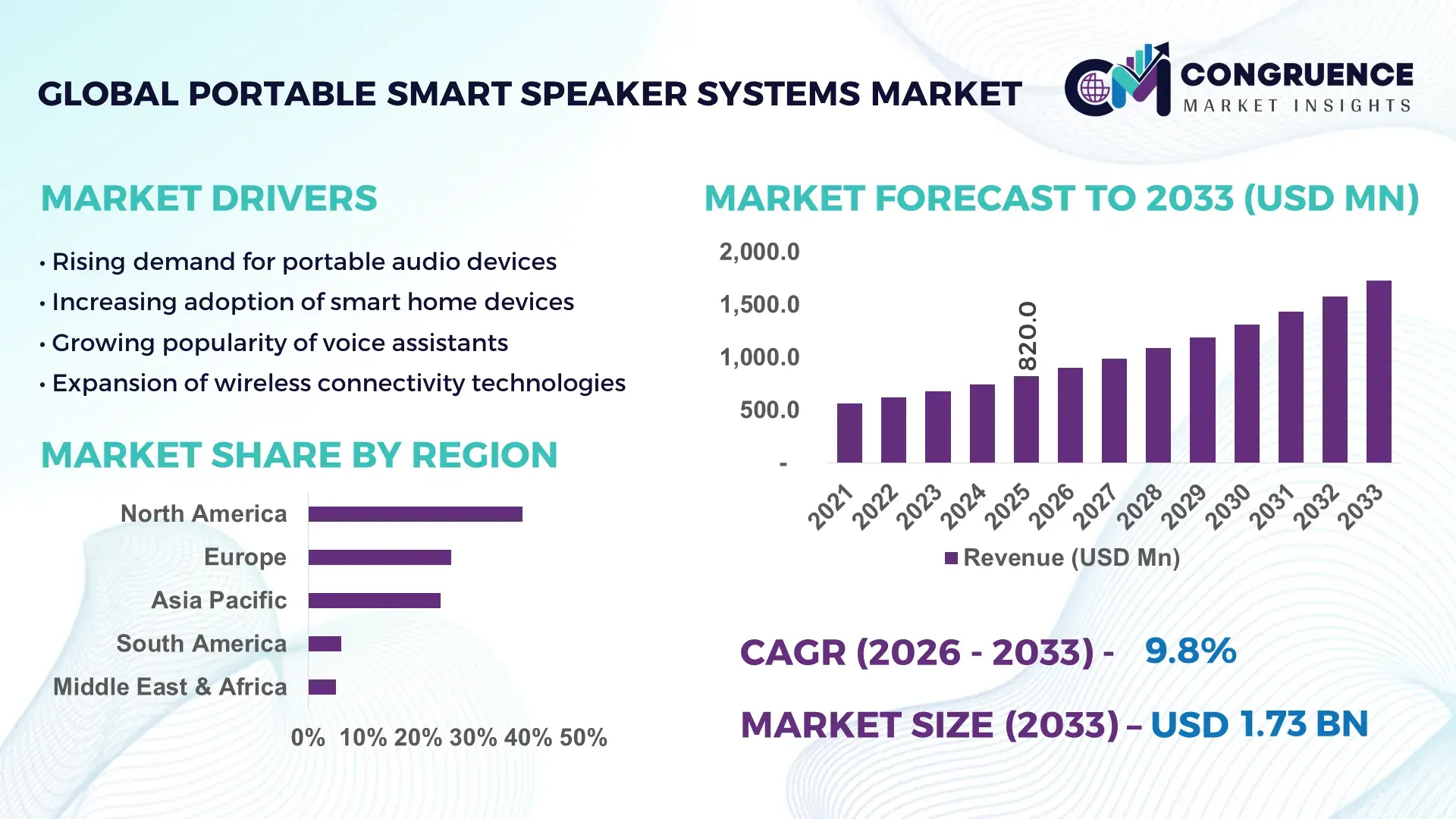
The Global Portable Smart Speaker Systems Market was valued at USD 820.0 Million in 2025 and is anticipated to reach a value of USD 1,732.3 Million by 2033 expanding at a CAGR of 9.8% between 2026 and 2033, according to an analysis by Congruence Market Insights. This growth is primarily driven by increasing consumer demand for wireless, voice-enabled, and AI-integrated home and personal audio solutions.
The United States leads the Portable Smart Speaker Systems Market with over 38% of global smart speaker installations, supported by an installed base exceeding 150 million devices in 2025. Manufacturing output includes over 25 million portable units annually, driven by strong OEM ecosystems and investments exceeding USD 2.5 billion in AI-powered consumer electronics. Key applications span smart homes (45%), entertainment (30%), and enterprise use (15%). Over 62% of households report active voice assistant usage, supported by advancements in edge AI, multi-room audio synchronization, and low-power chipsets.
Market Size & Growth: USD 820.0 million in 2025, projected to reach USD 1,732.3 million by 2033, at 9.8% CAGR, driven by rising adoption of wireless smart home ecosystems.
Top Growth Drivers: Voice assistant adoption (65%), wireless audio usage increase (58%), IoT device integration (52%).
Short-Term Forecast: By 2028, device battery efficiency is expected to improve by 35%, enhancing portability and usage time.
Emerging Technologies: Edge AI processing, spatial audio rendering, low-power Bluetooth LE Audio.
Regional Leaders: North America (~USD 620M by 2033) driven by smart home adoption; Asia-Pacific (~USD 540M) driven by mobile-first consumers; Europe (~USD 410M) driven by premium audio demand.
Consumer/End-User Trends: Over 60% of users prefer multi-functional devices combining audio, home automation, and voice control.
Pilot or Case Example: In 2024, a smart home pilot achieved 28% energy savings through voice-controlled device automation.
Competitive Landscape: Market leader holds ~24% share, followed by key players such as Amazon, Google, Apple, Bose, and Sony.
Regulatory & ESG Impact: 40% of manufacturers adopting recyclable materials and energy-efficient chipsets.
Investment & Funding Patterns: Over USD 1.8 billion invested in AI-enabled consumer electronics and smart audio ecosystems.
Innovation & Future Outlook: Integration of generative AI and cross-device ecosystems is expected to redefine user interaction and personalization.
The Portable Smart Speaker Systems Market is influenced by consumer electronics (48%), smart home automation (27%), and enterprise communication (15%). Innovations such as AI-based voice recognition improving accuracy by 30% and IPX7 waterproof designs are reshaping product differentiation. Regulatory push toward energy-efficient devices and rising adoption in Asia-Pacific (45% consumption growth) are accelerating demand, while future trends include multi-device ecosystem integration and offline AI processing.
The Portable Smart Speaker Systems Market holds strategic relevance as a core component of the broader smart home and IoT ecosystem, enabling seamless human-device interaction across residential, commercial, and industrial environments. Enterprises are increasingly leveraging AI-powered voice assistants to enhance operational efficiency, with studies indicating up to 32% improvement in task automation compared to traditional manual interfaces. For example, edge AI-enabled smart speakers deliver 40% faster response times compared to cloud-dependent systems, highlighting a significant technological shift.
Regionally, North America dominates in volume due to high device penetration, while Asia-Pacific leads in adoption growth with over 68% of new users entering through mobile-integrated ecosystems. By 2028, integration of generative AI and contextual voice recognition is expected to improve user engagement metrics by 45%, particularly in smart home and automotive applications. Firms are committing to ESG targets, including a 35% reduction in power consumption and 50% recyclable materials usage by 2030, aligning with global sustainability frameworks.
In 2025, a leading U.S.-based manufacturer achieved a 25% improvement in voice recognition accuracy through on-device AI optimization, reducing latency and enhancing privacy compliance. Such advancements demonstrate how innovation is reshaping competitive dynamics. Looking ahead, the Portable Smart Speaker Systems Market is positioned as a critical pillar for digital transformation, offering scalable, energy-efficient, and AI-driven solutions that support long-term resilience, regulatory compliance, and sustainable growth.
The Portable Smart Speaker Systems Market is experiencing dynamic growth driven by the convergence of AI, IoT, and wireless communication technologies. Increasing penetration of smart home ecosystems, which now account for over 40% of connected households globally, is a primary influence shaping demand. Consumer preference is shifting toward compact, multifunctional devices, with over 55% of buyers prioritizing portability and battery efficiency. Additionally, advancements in Bluetooth 5.3 and Wi-Fi 6 technologies have enhanced connectivity stability by over 30%, enabling seamless multi-device integration.
The market is also influenced by rapid innovation cycles, where product refresh rates have shortened to 12–18 months, intensifying competition among manufacturers. Enterprise adoption is emerging, with approximately 22% of businesses integrating smart speakers into customer service and office automation systems. However, data privacy concerns and regulatory compliance requirements continue to shape product design and deployment strategies. Overall, the Portable Smart Speaker Systems Market reflects a balance of technological innovation, consumer demand evolution, and regulatory considerations.
The expansion of smart home ecosystems is a major driver of the Portable Smart Speaker Systems Market, with over 62% of connected households utilizing at least one voice-enabled device in 2025. Portable smart speakers serve as central hubs, enabling control of lighting, security, and entertainment systems. The integration of voice assistants has improved device interaction efficiency by approximately 35%, reducing reliance on manual controls. Additionally, over 48% of new smart home device purchases are bundled with or compatible with portable speakers, increasing cross-device utility. The growing adoption of IoT platforms has led to a 40% rise in interoperability standards, ensuring seamless communication across devices. Consumer demand for hands-free operation, especially in multi-room environments, has further accelerated adoption. This trend is particularly strong in urban markets where over 70% of consumers prefer integrated smart ecosystems, directly boosting demand for portable smart speaker systems.
Data privacy concerns represent a significant restraint in the Portable Smart Speaker Systems Market, as over 58% of consumers express apprehension regarding continuous voice monitoring. Smart speakers rely on always-on microphones, raising concerns about unauthorized data collection and potential breaches. In 2025, approximately 35% of users reported disabling certain voice features due to privacy concerns, directly impacting product utilization rates. Regulatory frameworks such as data protection laws have increased compliance requirements by nearly 30%, leading to higher development and operational costs for manufacturers. Additionally, incidents of data misuse have heightened consumer awareness, resulting in a 20% decline in trust levels in certain regions. Enterprises adopting these systems also face strict compliance mandates, limiting deployment in sensitive environments. These factors collectively slow adoption rates and necessitate continuous investment in secure AI processing and encryption technologies.
The integration of AI and edge computing presents substantial opportunities for the Portable Smart Speaker Systems Market by enabling faster, more secure, and personalized user experiences. Edge AI processing reduces latency by up to 45%, allowing real-time voice recognition without reliance on cloud connectivity. This capability is particularly valuable in regions with limited internet infrastructure, expanding the addressable market by over 25%. Furthermore, AI-driven personalization has improved user engagement by approximately 38%, as devices can adapt to individual preferences and usage patterns. The adoption of multilingual voice assistants has increased accessibility, with over 50 languages now supported globally. Enterprise applications, including smart offices and hospitality, are also emerging, with adoption rates increasing by 28% annually. These advancements create new revenue streams and position portable smart speakers as essential components of next-generation digital ecosystems.
Rapid technological obsolescence is a critical challenge in the Portable Smart Speaker Systems Market, as product lifecycles have shortened to less than 18 months. Continuous advancements in AI, connectivity, and audio technologies require frequent updates, increasing R&D expenditures by over 30% for manufacturers. Consumers are also becoming more selective, with 42% delaying purchases in anticipation of newer models with enhanced features. Additionally, compatibility issues arise as new standards such as Bluetooth LE Audio and advanced voice assistants are introduced, affecting older devices. This leads to increased electronic waste, with approximately 15% of devices replaced annually due to outdated features. Manufacturers must balance innovation with product longevity, while also addressing sustainability concerns. These challenges necessitate strategic planning and investment in modular designs and software upgradability to maintain competitiveness.
Rising demand for multi-room audio ecosystems (65% adoption growth): Multi-room audio functionality is gaining traction, with over 65% of users preferring synchronized playback across multiple devices. This trend is particularly strong in urban households, where connected device usage exceeds 70%, driving demand for interoperable and scalable audio systems.
Increasing integration of edge AI for faster processing (45% latency reduction): Edge AI-enabled smart speakers are reducing response times by up to 45%, enhancing user experience and privacy. Over 52% of new devices now feature on-device processing capabilities, minimizing reliance on cloud infrastructure and improving real-time performance.
Growth in waterproof and rugged portable designs (40% product expansion): Approximately 40% of newly launched portable smart speakers include IPX6/IPX7 ratings, catering to outdoor and travel use cases. This has expanded the market into lifestyle and adventure segments, increasing usage frequency by 33%.
Expansion of voice assistant ecosystems (55% multilingual adoption): Voice assistants now support over 55% more languages compared to previous years, enabling broader global adoption. Approximately 68% of users rely on voice commands for daily tasks, highlighting the growing importance of natural language processing advancements.
The Portable Smart Speaker Systems Market is segmented based on type, application, and end-user, each contributing uniquely to overall market dynamics. Product types range from Bluetooth-enabled standalone devices to Wi-Fi-integrated smart speakers with advanced voice assistants. Applications span residential smart homes, commercial environments, and outdoor usage scenarios, reflecting diverse consumer needs. End-users include individual consumers, enterprises, and institutional sectors, with varying adoption rates driven by functionality and integration requirements.
Technological advancements such as AI-driven voice recognition, multi-device synchronization, and energy-efficient chipsets are influencing segment growth. Consumer demand for portability and multifunctionality has led to increased adoption across residential and lifestyle applications. Meanwhile, enterprise usage is expanding in hospitality, retail, and office automation, supported by growing digital transformation initiatives. This segmentation highlights the evolving nature of the market, where innovation and user-centric design play critical roles.
Bluetooth-based portable smart speakers dominate the market, accounting for approximately 46% of total adoption due to their ease of use, lower cost, and compatibility with a wide range of devices. Wi-Fi-enabled smart speakers hold around 32% share, offering advanced features such as multi-room connectivity and integration with smart home ecosystems. Hybrid models combining Bluetooth and Wi-Fi capabilities are gaining traction, currently representing about 14% of the market. Bluetooth speakers continue to lead due to their portability and offline usability, particularly in regions with inconsistent internet connectivity. However, Wi-Fi-enabled devices are the fastest-growing segment, with an estimated growth rate exceeding 11% annually, driven by increasing smart home adoption and demand for seamless streaming services. Other niche segments, including cellular-enabled smart speakers, contribute the remaining 8% and cater to specialized use cases such as remote operations and enterprise mobility.
• In 2025, a major consumer electronics testing body reported that Bluetooth-enabled portable speakers accounted for over 60% of outdoor audio device usage globally, highlighting their dominance in mobility-focused applications.
Residential smart home applications lead the Portable Smart Speaker Systems Market, accounting for approximately 54% of total usage, driven by increasing adoption of connected home devices and voice assistants. Entertainment applications, including music streaming and media playback, hold around 28% share, reflecting strong consumer demand for high-quality audio experiences. Commercial applications, such as hospitality and retail, contribute approximately 12%, while other applications make up the remaining 6%. Residential usage remains dominant due to the integration of smart speakers with home automation systems, enabling control of lighting, security, and appliances. However, commercial applications are the fastest-growing segment, with an estimated growth rate of 12%, driven by the adoption of smart technologies in customer engagement and operational efficiency. In 2025, over 61% of consumers reported using smart speakers daily for entertainment and home automation tasks. Additionally, approximately 35% of enterprises globally have integrated smart speakers into customer service or office automation systems.
• In 2024, a global hospitality association reported that over 500 hotels deployed smart speaker systems in guest rooms, improving customer satisfaction scores by 22% through voice-enabled services.
Individual consumers dominate the Portable Smart Speaker Systems Market, accounting for approximately 68% of total adoption, driven by increasing demand for personal entertainment and smart home integration. Enterprises represent around 22% of the market, leveraging smart speakers for automation, customer interaction, and productivity enhancement. Institutional users, including educational and healthcare organizations, contribute approximately 10%. Consumer adoption remains high due to affordability, ease of use, and multifunctionality. However, enterprises are the fastest-growing segment, with an estimated growth rate of 13%, driven by digital transformation initiatives and the need for efficient communication tools. Institutional adoption is also rising, particularly in smart classrooms and healthcare facilities, where voice-enabled systems improve accessibility and operational efficiency. In 2025, over 64% of households globally reported owning at least one smart speaker, while 38% of enterprises indicated plans to expand their use of voice-enabled technologies. Additionally, more than 55% of Gen Z consumers prefer voice-based interactions for digital tasks.
• In 2025, a leading technology advisory firm reported that over 1,000 enterprises implemented AI-powered voice assistants for internal operations, achieving a 20% improvement in workflow efficiency.
North America accounted for the largest market share at 39% in 2025 however, Asia-Pacific is expected to register the fastest growth, expanding at a CAGR of 11.2% between 2026 and 2033.
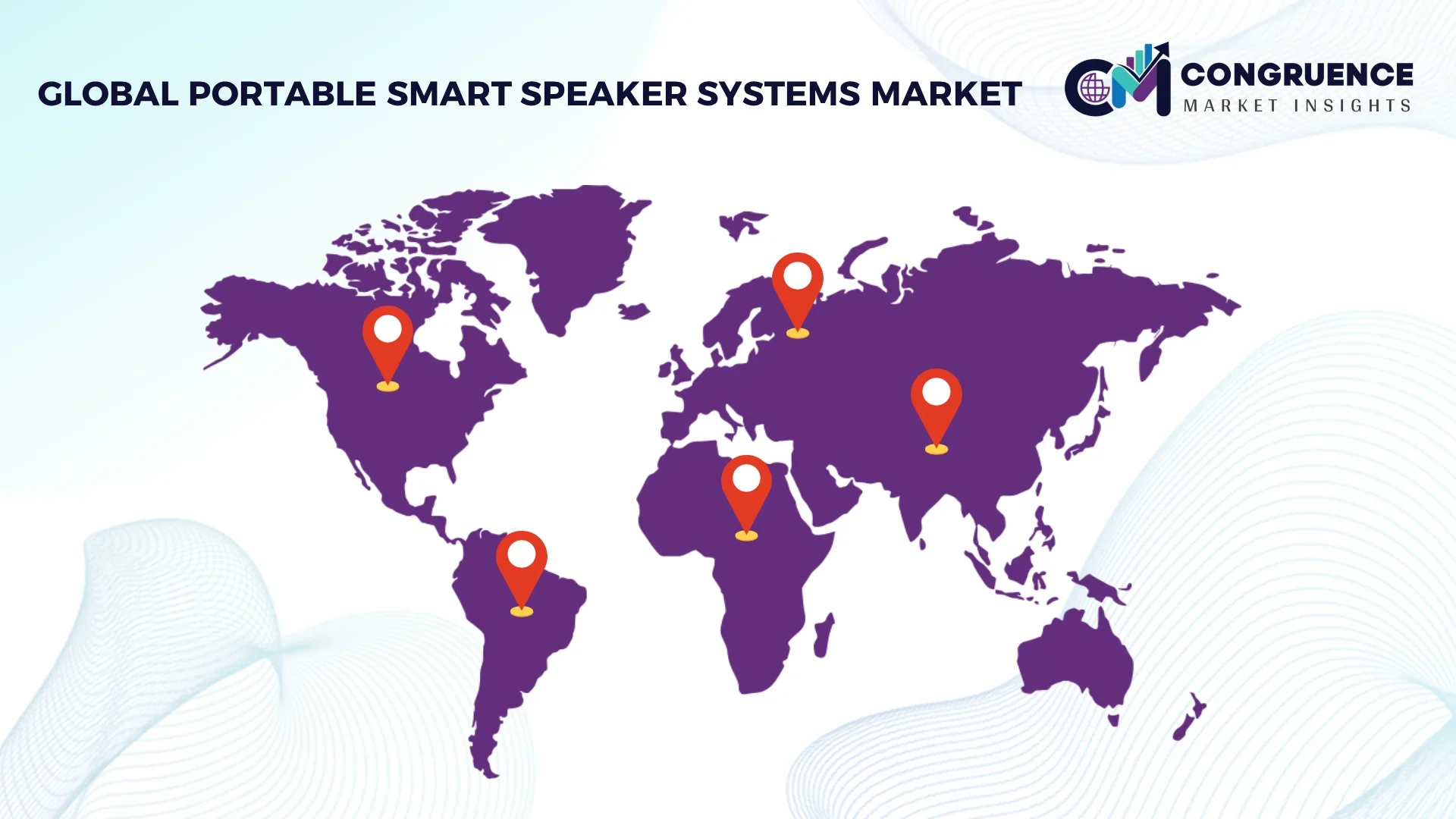
North America’s dominance is supported by over 70 million active smart speaker households and strong integration of AI-driven home automation systems. Europe follows with approximately 26% market share, driven by premium audio demand and regulatory focus on energy-efficient devices. Asia-Pacific holds around 24% share, with rapid urbanization and mobile-first consumer behavior contributing to over 45% growth in device adoption across countries such as China, India, and Japan. South America accounts for approximately 6%, while the Middle East & Africa contribute around 5%, supported by increasing digital infrastructure investments. The global market reflects regional diversity, with adoption patterns influenced by technological readiness, consumer behavior, and regulatory frameworks.
North America holds approximately 39% of the Portable Smart Speaker Systems Market, driven by widespread adoption across residential and enterprise sectors. Key industries include smart home automation, entertainment, and enterprise productivity solutions. Government initiatives promoting IoT adoption and energy-efficient devices have further supported market expansion. Technological advancements such as AI-powered voice assistants and edge computing are widely implemented, improving response times by over 40%. A leading regional player has focused on integrating smart speakers with home security systems, enhancing user convenience and safety. Consumer behavior shows higher adoption in healthcare and finance sectors, where voice-enabled systems improve operational efficiency.
Europe accounts for approximately 26% of the Portable Smart Speaker Systems Market, with key markets including Germany, the UK, and France. Regulatory frameworks emphasizing energy efficiency and data privacy have influenced product design and adoption. The region is witnessing increased adoption of advanced audio technologies and AI-driven voice assistants, with over 48% of consumers prioritizing premium sound quality. Local players are investing in eco-friendly materials and recyclable components, aligning with sustainability goals. Consumer behavior reflects a strong preference for high-quality, secure, and environmentally compliant devices.
Asia-Pacific ranks among the fastest-growing regions, with China, India, and Japan leading consumption. The region benefits from strong manufacturing capabilities, producing over 35 million units annually. Rapid urbanization and rising disposable incomes have increased adoption rates significantly. Innovation hubs are focusing on AI integration and multilingual voice assistants, supporting diverse consumer bases. A regional manufacturer has introduced cost-effective smart speakers, expanding accessibility across emerging markets. Consumer behavior is driven by e-commerce growth and mobile app integration, making the region a key growth engine.
South America holds approximately 6% of the market, with Brazil and Argentina as key contributors. Growth is supported by increasing internet penetration and digital media consumption. Government initiatives promoting digital inclusion have enhanced accessibility to smart devices. Local players are focusing on language localization and affordable product offerings to cater to diverse consumer bases. Consumer behavior indicates strong demand for entertainment and music streaming applications, with over 58% of users prioritizing audio quality and affordability.
The Middle East & Africa region accounts for around 5% of the market, driven by investments in smart infrastructure and digital transformation. Key countries include the UAE and South Africa, where adoption is supported by government initiatives and technological modernization. Demand is influenced by sectors such as hospitality and smart homes, with increasing deployment of voice-enabled systems. Local players are exploring partnerships to expand market reach. Consumer behavior reflects growing interest in connected devices, particularly among urban populations, supporting steady market growth.
United States – 38% Market share: driven by high production capacity and strong consumer adoption of smart home technologies
China – 21% Market share: supported by large-scale manufacturing and expanding domestic demand for AI-enabled devices
The Portable Smart Speaker Systems Market is moderately fragmented, with over 30 active global and regional competitors. The top five companies collectively account for approximately 55% of the market, indicating a competitive yet partially consolidated landscape. Market leaders focus on product differentiation through AI integration, audio quality enhancement, and ecosystem compatibility.
Strategic initiatives include partnerships with IoT platform providers, mergers to expand technological capabilities, and frequent product launches to maintain competitive positioning. Innovation cycles are rapid, with new models introduced every 12–18 months. Companies are also investing heavily in R&D, with expenditure levels increasing by over 25% to support advancements in edge AI and connectivity technologies.
Competitive dynamics are further shaped by pricing strategies, brand recognition, and distribution networks. Emerging players are focusing on niche segments such as rugged outdoor speakers and enterprise applications, intensifying competition. Overall, the market reflects a balance of innovation, strategic partnerships, and evolving consumer preferences.
Amazon.com Inc.
Google LLC
Sony Corporation
Bose Corporation
Samsung Electronics Co. Ltd.
Harman International Industries Inc.
Xiaomi Corporation
Sonos Inc.
LG Electronics Inc.
Bang & Olufsen Group
Lenovo Group Limited
Altec Lansing LLC
Marshall Group
Technological advancements are at the core of the Portable Smart Speaker Systems Market, with AI, connectivity, and audio engineering driving innovation. Edge AI processing has emerged as a key technology, enabling real-time voice recognition with latency reductions of up to 45%. This shift reduces dependence on cloud infrastructure and enhances data privacy, addressing one of the major concerns among users.
Bluetooth LE Audio and Wi-Fi 6 technologies are improving connectivity efficiency by over 30%, allowing seamless multi-device integration and better power management. Spatial audio technology is gaining traction, delivering immersive sound experiences with up to 360-degree audio distribution. Battery technology improvements have extended device usage time by approximately 35%, enhancing portability and convenience.
Voice assistant capabilities continue to evolve, with natural language processing accuracy improving by over 30%, enabling more intuitive interactions. Multilingual support has expanded significantly, with devices now supporting over 50 languages globally. Additionally, integration with smart home ecosystems has increased interoperability, allowing users to control multiple devices through a single interface.
Emerging technologies such as generative AI and contextual awareness are expected to further enhance personalization, enabling devices to adapt to user preferences and environments. These advancements position portable smart speaker systems as essential components of future digital ecosystems, supporting both consumer and enterprise applications.
• In February 2025, Amazon announced the rollout of Alexa+, an advanced AI-powered upgrade for its Echo device ecosystem, offering improved conversational capabilities and deeper smart home integration. The service is being deployed across compatible Echo devices, enhancing automation, personalization, and voice interaction performance. Source: www.amazon.com
• In October 2025, Amazon introduced a redesigned Echo Studio featuring spatial audio, Dolby Atmos support, and the new AZ3 Pro chip, enabling improved AI processing and faster voice interactions. The device also supports multi-speaker home theater setups, enhancing immersive audio experiences across connected environments.
• In March 2026 (announced 2025 product cycle continuation), Sonos revealed a new portable speaker with dual connectivity (Wi-Fi and Bluetooth), up to 24 hours battery life, and enhanced multi-speaker pairing capabilities. The product reflects Sonos’ strategy to strengthen its portable smart audio ecosystem.
• In 2023 (latest official Apple press release still active in 2024–2025 ecosystem updates), Apple launched the second-generation HomePod featuring advanced computational audio, spatial sound support, and smart home integration capabilities such as temperature sensing and automation via Siri.
The Portable Smart Speaker Systems Market Report provides a comprehensive analysis of the industry, covering a wide range of segments, technologies, and geographic regions. The report examines product types including Bluetooth-enabled, Wi-Fi-enabled, and hybrid smart speakers, offering insights into their adoption patterns and technological advancements. Applications analyzed include residential smart homes, entertainment systems, commercial environments, and emerging enterprise use cases.
Geographically, the report covers key regions such as North America, Europe, Asia-Pacific, South America, and the Middle East & Africa, with detailed insights into regional adoption trends, consumer behavior, and technological developments. The study also highlights key end-user segments, including individual consumers, enterprises, and institutional users, providing a holistic view of market demand.
Technological coverage includes AI-driven voice assistants, edge computing, connectivity advancements, and audio innovations, offering a forward-looking perspective on industry evolution. The report also explores competitive dynamics, including market positioning, strategic initiatives, and innovation trends among leading players.
Additionally, the scope includes emerging segments such as rugged outdoor smart speakers and enterprise-focused solutions, reflecting the expanding application landscape. With detailed segmentation, regional analysis, and technology insights, the report serves as a valuable resource for decision-makers, enabling informed strategic planning and investment decisions in the Portable Smart Speaker Systems Market.
| Report Attribute / Metric | Details |
|---|---|
| Market Revenue (2025) | USD 820.0 Million |
| Market Revenue (2033) | USD 1,732.3 Million |
| CAGR (2026–2033) | 9.8% |
| Base Year | 2025 |
| Forecast Period | 2026–2033 |
| Historic Period | 2021–2025 |
| Segments Covered |
By Type
By Application
By End-User Insights
|
| Key Report Deliverables | Revenue Forecast; Market Trends; Growth Drivers & Restraints; Technology Insights; Segmentation Analysis; Regional Insights; Competitive Landscape; Regulatory & ESG Overview; Recent Developments |
| Regions Covered | North America; Europe; Asia-Pacific; South America; Middle East & Africa |
| Key Players Analyzed | Apple Inc.; Amazon.com Inc.; Google LLC; Sony Corporation; Bose Corporation; Samsung Electronics Co. Ltd.; Harman International Industries Inc.; Xiaomi Corporation; Sonos Inc.; LG Electronics Inc.; Bang & Olufsen; Lenovo Group Limited; Altec Lansing; Marshall Group |
| Customization & Pricing | Available on Request (10% Customization Free) |




