
Reports
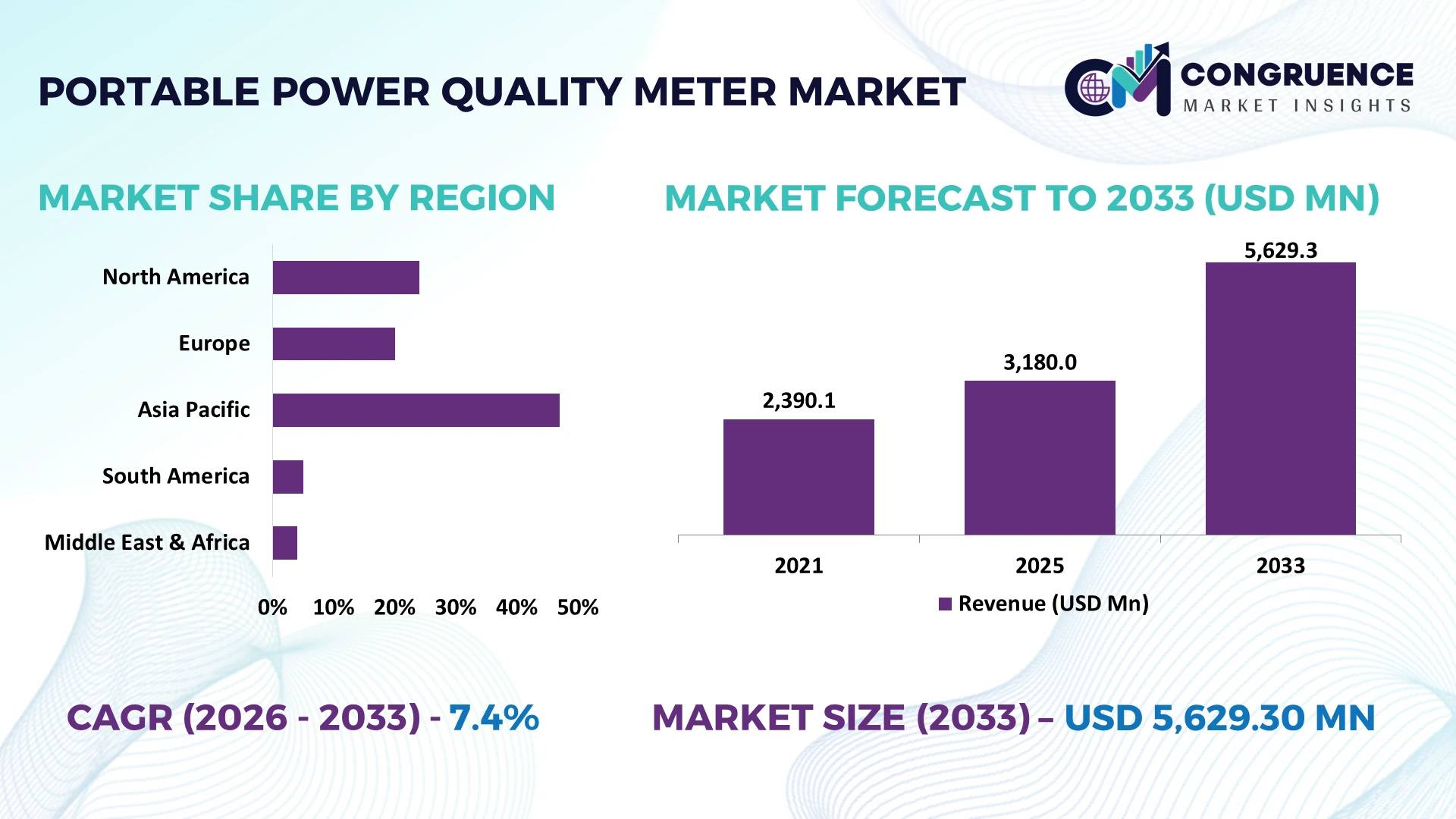
The Global Portable Power Quality Meter Market was valued at USD 3180 Million in 2025 and is anticipated to reach a value of USD 5629.3 Million by 2033 expanding at a CAGR of 7.4% between 2026 and 2033. Growth is supported by rapid grid modernization, expanding renewable energy integration, stricter industrial power quality compliance, and predictive electrical maintenance across utilities and manufacturing facilities.
China remains the dominant country, accounting for approximately 31% of global production capacity, supported by large-scale investments in smart grid infrastructure, semiconductor manufacturing, and industrial automation. Japan records over 82% deployment of advanced power monitoring across major manufacturing plants, while the United States leads in portable diagnostic adoption within utility maintenance programs, driven by grid resilience initiatives following continued energy security investments after global supply-chain disruptions.
For market participants, strengthening regional manufacturing, calibration capabilities, and advanced analytics integration is becoming a decisive competitive strategy.
Market Size & Growth: USD 3180 Million in 2025, reaching USD 5629.3 Million by 2033 at 7.4% CAGR, supported by accelerating smart grid modernization and predictive maintenance adoption.
Top Growth Drivers: Renewable grid integration contributes 28% demand growth, industrial automation 24%, and utility digitalization 19% across high-growth markets.
Short-Term Forecast: By 2028, diagnostic efficiency improves by 18% while field inspection time declines by 15% through connected monitoring platforms.
Emerging Technologies: AI-based waveform analytics, cloud-enabled reporting, and edge processing reduce fault detection time by approximately 30%.
Regional Leaders: Asia-Pacific exceeds USD 2200 Million, North America approaches USD 1450 Million, and Europe surpasses USD 1180 Million, each advancing smart infrastructure deployment.
Consumer/End-User Trends: Nearly 68% of utility and industrial maintenance teams prioritize portable digital analyzers for faster onsite power quality assessment.
Pilot/Case Example: A 2026 smart substation modernization program improved fault identification accuracy by 27% while reducing maintenance visits by 16%.
Competitive Landscape: The leading manufacturer holds approximately 17% market share alongside major participants including Fluke, Hioki, Chauvin Arnoux, Yokogawa, and Megger.
Regulatory & ESG Impact: Grid compliance initiatives reduce electrical losses by approximately 8% while supporting higher renewable power integration across transmission networks.
Investment & Funding: More than USD 1.2 Billion supports manufacturing expansion, digital monitoring partnerships, and regional supply-chain diversification initiatives.
Innovation & Future Outlook: Next-generation wireless meters with AI diagnostics, cybersecurity features, and remote firmware updates strengthen enterprise asset management and operational resilience.
Portable Power Quality Meter Market demand continues to expand across utilities, renewable energy sites, data centers, and advanced manufacturing, where continuous electrical reliability is essential. New products increasingly combine wireless connectivity, AI-assisted diagnostics, and cloud reporting, improving field productivity by approximately 25%. Ongoing grid modernization programs and regional supply-chain localization efforts are reinforcing procurement priorities, establishing a strong foundation for the strategic market assessment that follows.
The Portable Power Quality Meter Market has become strategically important as utilities, industrial manufacturers, and critical infrastructure operators prioritize electrical reliability, asset optimization, and digital maintenance. Infrastructure modernization and stricter power quality compliance are reshaping procurement priorities, while supply-chain diversification since recent geopolitical disruptions has encouraged localized manufacturing and component sourcing. Portable diagnostic instruments are increasingly integrated into predictive maintenance programs, enabling faster field decisions and reducing unplanned electrical downtime across energy-intensive industries.
Modern AI-assisted portable power quality meters process waveform events approximately 35% faster than legacy standalone analyzers while reducing manual reporting effort by nearly 30% through cloud-enabled analytics. Japan emphasizes high-precision deployment within advanced manufacturing facilities, whereas India is expanding adoption across power distribution upgrades and industrial parks, supported by accelerating grid digitalization. Over the next two to three years, connected fleet management platforms are expected to exceed 45% enterprise deployment among large utility maintenance teams, improving inspection consistency and operational visibility.
A 2026 utility asset modernization program demonstrated a 22% reduction in troubleshooting time after deploying portable digital analyzers with remote reporting capabilities. Manufacturers are responding through software partnerships, calibration network expansion, and investments in interoperable monitoring platforms. Companies combining intelligent diagnostics, cybersecurity, and service-driven business models will secure stronger competitive positioning as power quality monitoring becomes an essential component of resilient electrical infrastructure.
Grid modernization and predictive maintenance are becoming the primary structural drivers for portable power quality meter deployment. Approximately 64% of large utility operators are expanding condition-based maintenance programs, while digital substations reduce fault localization time by nearly 28%. China continues investing in intelligent transmission infrastructure, creating sustained demand for advanced portable diagnostic instruments compatible with digital protection systems. This operational shift enables maintenance teams to identify harmonics, voltage disturbances, and transient events before equipment failures occur. In response, manufacturers are expanding calibration facilities, strengthening software partnerships, and introducing AI-enabled analytics that improve reporting speed. A notable strategic trend is the integration of portable meters into enterprise asset management platforms, transforming standalone diagnostic tools into connected operational intelligence assets.
Product deployment remains constrained by interoperability differences, calibration requirements, and dependence on specialized electronic components. Approximately 32% of industrial users report compatibility challenges when integrating portable meters with legacy monitoring platforms, while certification and calibration activities can extend deployment schedules by nearly 18%. Japan and Germany maintain rigorous measurement accuracy standards, increasing compliance complexity for new suppliers entering regulated industrial sectors. Semiconductor supply fluctuations continue affecting production planning for premium measurement devices. Companies are reducing operational exposure by localizing component sourcing, standardizing communication protocols, and securing long-term procurement agreements with electronics suppliers. Strategic differentiation increasingly depends on delivering certified, interoperable solutions without increasing ownership costs for industrial customers.
The strongest emerging opportunity lies in intelligent diagnostics combined with cloud-based service ecosystems. AI-assisted power quality analysis improves anomaly classification accuracy by approximately 27%, while remote firmware management lowers field maintenance costs by nearly 20%. India is expanding industrial digitalization initiatives across manufacturing clusters, creating demand for portable instruments capable of integrating with centralized asset monitoring platforms. Companies are increasing investment in digital twin compatibility, wireless connectivity, and subscription-based analytics rather than competing solely on hardware performance. A non-obvious opportunity is the growing requirement for portable verification during renewable energy commissioning, where temporary onsite measurement delivers faster compliance validation and supports more efficient grid integration.
Long-term expansion depends on overcoming execution challenges related to cybersecurity, workforce capability, and large-scale digital integration. Around 41% of industrial facilities identify shortages of skilled power quality specialists, while connected diagnostic devices increase cybersecurity compliance requirements by approximately 24%. The United States is strengthening operational technology security expectations for critical infrastructure, requiring vendors to incorporate secure communication architectures into portable measurement systems. These pressures affect deployment consistency across distributed utility networks and complex manufacturing environments. Companies must invest in technician training, encrypted data platforms, interoperable software architectures, and collaborative technology partnerships. Organizations that combine secure digital ecosystems with scalable technical support will achieve stronger operational resilience and maintain long-term competitive differentiation.
AI-Powered Field Diagnostics Portable power quality meters increasingly integrate AI-assisted waveform recognition and automated event classification, reducing diagnostic time by approximately 32% while improving anomaly detection accuracy by nearly 24%. Utilities in Japan and Germany are embedding intelligent analytics into maintenance workflows as skilled labor shortages accelerate digital inspection practices. Manufacturers are expanding embedded software capabilities and partnering with industrial analytics providers to strengthen lifecycle service offerings and reduce manual reporting requirements.
Wireless Fleet Connectivity Expansion Wireless-enabled instruments now account for nearly 42% of new enterprise deployments, enabling centralized asset monitoring and remote synchronization across dispersed maintenance teams. Cloud-connected calibration management shortens reporting cycles by approximately 20% and improves equipment utilization by 17%. Companies are restructuring product portfolios around connected ecosystems, responding to stricter operational traceability requirements and growing demand for scalable field service management.
Renewable Grid Integration Focus Renewable power integration is reshaping measurement priorities as harmonic distortion monitoring requirements increase across distributed energy networks. Around 38% of newly commissioned utility projects now specify advanced portable diagnostic capability during commissioning and maintenance activities. Equipment suppliers are strengthening partnerships with renewable engineering firms while developing higher-frequency measurement functions to address evolving grid compliance requirements and improve commissioning efficiency.
Modular Enterprise Service Models Subscription-based software, modular accessories, and digital calibration services are transforming procurement decisions, with enterprise service contracts expanding by approximately 26% over conventional hardware-only purchases. United States industrial operators increasingly prioritize lifecycle support as supply-chain planning shifts toward long-term operational resilience. Vendors are scaling service networks, introducing remote firmware management, and standardizing interoperable platforms that improve customer retention while lowering ownership complexity.
Three-Phase portable power quality meters represent the leading segment with approximately 44% of total market demand, driven by extensive deployment across utilities, manufacturing plants, and large commercial electrical networks where comprehensive system diagnostics are essential. Their ability to monitor multiple phases simultaneously, capture complex harmonic events, and integrate with industrial maintenance platforms makes them the preferred choice for mission-critical operations. Single-Phase models remain widely adopted in commercial facilities and light industrial applications because of lower acquisition costs and simplified operation, supporting consistent replacement demand.
Wireless portable meters are the fastest-growing segment, recording adoption gains exceeding 19% as utilities and enterprise maintenance teams transition toward connected inspection workflows and centralized asset management. Handheld models continue expanding through improved portability and faster onsite troubleshooting, particularly among electrical contractors and field service providers. Manufacturers are prioritizing compact wireless architectures, enhanced battery performance, and software interoperability while expanding product portfolios through strategic technology partnerships. Investment priorities increasingly favor intelligent portable platforms capable of supporting predictive maintenance instead of standalone measurement functions.
Power Monitoring accounts for approximately 39% of total application demand as utilities, industrial facilities, and critical infrastructure operators prioritize continuous electrical performance verification and rapid fault identification. Permanent asset reliability programs increasingly depend on portable diagnostic verification during inspections, improving maintenance efficiency and reducing operational disruptions. Energy Auditing remains a mature segment as organizations strengthen energy optimization initiatives and regulatory compliance, particularly across manufacturing and commercial facilities.
Preventive Maintenance is the fastest-growing application, supported by digital maintenance strategies and predictive asset management initiatives, with enterprise adoption expanding by approximately 23%. Fault Analysis continues gaining operational importance as electrical systems become more complex with renewable integration and automated production environments. Companies are integrating portable meters into maintenance software platforms, expanding deployment across field teams, and automating reporting processes to improve decision speed and workforce productivity. Demand is shifting from reactive diagnostics toward continuous operational intelligence, creating stronger long-term positioning for advanced portable monitoring solutions.
Utilities remain the largest end-user segment, representing approximately 36% of market demand because electrical transmission, distribution, and grid modernization programs require continuous field diagnostics and compliance verification. Large utility operators increasingly deploy portable meters for outage investigations, commissioning activities, and preventive maintenance across substations and distribution assets. Manufacturing continues as a significant customer group, driven by production continuity requirements and growing investments in electrical reliability across automated factories.
Data Centers are the fastest-growing end-user segment, supported by rapid expansion of AI computing infrastructure and increasing sensitivity to voltage disturbances, with deployment activity rising by approximately 24%. Commercial Buildings continue adopting portable monitoring for energy optimization, while Oil & Gas operators utilize advanced diagnostic instruments to maintain electrical reliability in remote and hazardous operating environments. Suppliers are introducing sector-specific software, customized service agreements, and integrated support programs while strengthening channel partnerships to address distinct operational requirements across critical infrastructure industries.
Asia-Pacific accounted for the largest market share at 41.8% in 2025 however, Middle East & Africa is expected to register the fastest growth, expanding at a 9.1% CAGR between 2026 and 2033.
Grid Resilience and Digital Utility Modernization
North America represents a mature deployment market supported by grid modernization, industrial automation, and expanding digital maintenance programs. The region contributes approximately 26% of global demand, with utilities, data centers, and advanced manufacturing facilities driving equipment deployment. Portable power quality meters are increasingly integrated into predictive maintenance workflows, reducing diagnostic response times and improving electrical asset reliability. More than 52% of large utility maintenance teams now utilize connected diagnostic instruments during field inspections. Recent investments in transmission modernization and substation upgrades continue strengthening demand for portable monitoring technologies. Manufacturers are expanding calibration facilities, software integration capabilities, and service partnerships to support enterprise-scale asset management while improving interoperability across utility and industrial environments.
United States Market Outlook: The United States remains the regional technology leader due to extensive utility infrastructure, advanced manufacturing capacity, and rapid expansion of hyperscale data centers. Approximately 61% of enterprise electrical maintenance programs incorporate portable digital power quality diagnostics into routine inspections. Companies continue investing in AI-enabled monitoring, cybersecurity-compliant communication protocols, and nationwide service networks to improve operational reliability and reduce maintenance-related disruptions across critical infrastructure.
Industrial Electrification Strengthens Compliance Deployment
Europe maintains a strong position through industrial electrification, energy efficiency initiatives, and advanced manufacturing modernization. The region accounts for approximately 24% of global market activity, supported by stringent electrical performance standards and widespread deployment of digital monitoring systems. Manufacturers increasingly specify portable power quality meters during commissioning and preventive maintenance to improve equipment availability and regulatory compliance. Nearly 47% of industrial maintenance organizations are integrating portable diagnostic tools with centralized asset management software. Equipment suppliers are strengthening local calibration services and collaborative technology partnerships to support expanding demand from utilities, automotive production, and renewable energy infrastructure.
Germany Market Outlook: Germany leads the European market through its advanced industrial base, precision engineering capabilities, and highly automated manufacturing sector. Around 58% of large manufacturing facilities have implemented digital electrical monitoring programs supporting predictive maintenance strategies. Companies continue investing in intelligent measurement platforms and interoperable industrial communication technologies, reinforcing Germany's position as a strategic center for high-performance portable power quality monitoring solutions.
Manufacturing Scale and Grid Expansion Drive Leadership
Asia-Pacific leads the global market through unmatched manufacturing capacity, extensive utility modernization, and rapid industrial expansion. The region contributes approximately 42% of worldwide demand, supported by electronics manufacturing, renewable energy integration, and large-scale transmission infrastructure development. More than 48% of new industrial electrical projects incorporate advanced portable diagnostic equipment during commissioning and maintenance. Expanding smart manufacturing initiatives and investments in intelligent substations continue accelerating deployment across industrial hubs. Suppliers are increasing localized production, strengthening distribution partnerships, and expanding software-enabled product portfolios to improve responsiveness and operational support across diverse customer segments.
China Market Outlook: China dominates regional demand through large-scale industrial production, extensive smart grid investment, and strong domestic electronics manufacturing. Approximately 31% of global portable power quality meter production capacity is concentrated within China. Companies continue expanding intelligent manufacturing facilities, digital calibration capabilities, and integrated diagnostic software development to strengthen competitiveness across utility, industrial, and renewable energy applications.
Infrastructure Modernization Expands Industrial Adoption
South America is steadily increasing deployment as utilities modernize electrical infrastructure and industrial operators strengthen maintenance efficiency. The region represents approximately 5.8% of global demand, supported by mining, energy production, and expanding industrial electrification projects. Utility modernization programs have increased portable diagnostic deployment by nearly 18% across selected transmission and distribution networks. Infrastructure execution remains uneven because of investment cycles and grid modernization differences between countries. Manufacturers are responding through regional distributor partnerships, localized technical support, and expanded service capabilities that improve equipment availability while reducing implementation delays for industrial customers.
Brazil Market Outlook: Brazil remains the region's largest market due to its extensive transmission network, mining operations, and diversified manufacturing economy. Nearly 46% of large industrial electrical maintenance programs utilize portable monitoring instruments during preventive inspections. Companies are expanding local service centers and technical partnerships to improve maintenance efficiency while supporting modernization of utility infrastructure and energy-intensive industries.
Energy Infrastructure Investment Reshapes Demand
The Middle East & Africa is transitioning into a strategic growth market through large-scale utility investment, industrial diversification, and smart infrastructure development. The region contributes approximately 7% of global demand while recording accelerating deployment across energy, utilities, and commercial infrastructure. More than 21% of recently commissioned power infrastructure projects include advanced portable diagnostic equipment during commissioning and maintenance. Grid modernization and renewable energy integration continue strengthening demand for high-accuracy monitoring technologies. Suppliers are expanding regional partnerships, technical training programs, and after-sales support to improve deployment quality and operational continuity across emerging infrastructure projects.
Saudi Arabia Market Outlook: Saudi Arabia leads regional deployment through ambitious power infrastructure expansion, industrial diversification initiatives, and investments in smart utility networks. Approximately 35% of major electrical modernization projects specify advanced portable power quality testing during commissioning activities. Companies are strengthening local technical capabilities, forming engineering partnerships, and introducing intelligent diagnostic platforms that support long-term electrical reliability across industrial and utility operations.
The market is led by global instrumentation specialists including Fluke, Hioki, Yokogawa, Chauvin Arnoux, and Megger, competing directly against regional measurement equipment manufacturers focused on cost efficiency and localized support. The top five players collectively control approximately 54% of the market through established distribution networks, software capabilities, and calibration expertise. Competition centers on diagnostic accuracy, wireless connectivity, lifecycle services, and reporting speed, with AI-enabled platforms improving fault analysis efficiency by nearly 30% and cloud integration reducing reporting time by around 20%. Premium suppliers differentiate through advanced analytics and cybersecurity, while regional manufacturers compete on pricing, customization, and faster delivery. Companies are expanding calibration centers, forming software partnerships, and integrating digital asset management platforms to strengthen customer retention. Technology convergence and service-based business models are raising competitive intensity. The strongest market position belongs to vendors combining measurement precision, connected software ecosystems, responsive technical support, and scalable global service infrastructure.
Fluke Corporation
Hioki E.E. Corporation
Yokogawa Electric Corporation
Chauvin Arnoux
Megger Group Limited
Kyoritsu Electrical Instruments Works, Ltd.
Sonel S.A.
HT Italia S.r.l.
Extech Instruments
AEMC Instruments
Dranetz Technologies
Metrel d.d.
GOSSEN METRAWATT GmbH
Circutor S.A.
Portable power quality meters are evolving from standalone diagnostic instruments into intelligent edge devices with integrated analytics, wireless connectivity, and automated compliance reporting. AI-assisted waveform classification improves disturbance identification accuracy by approximately 28%, while high-speed digital signal processors reduce analysis time by nearly 22% compared with conventional architectures. Around 58% of newly deployed enterprise-grade portable meters now support cloud synchronization and mobile reporting, allowing maintenance teams to standardize inspections across multiple facilities. This transition strengthens operational visibility and reduces repeat site visits, providing utilities and industrial operators with measurable productivity gains.
Emerging technologies include edge AI, secure wireless communication, digital calibration management, and interoperability with enterprise asset management platforms. Compared with legacy offline analyzers, connected portable meters improve reporting efficiency by approximately 35% while lowering manual documentation effort by nearly 30%. More than 46% of large industrial organizations are integrating portable diagnostic equipment into predictive maintenance workflows instead of isolated testing processes. Vendors expanding software ecosystems and subscription-based analytics gain stronger customer retention, while manufacturers focused only on hardware face increasing competitive pressure as digital service capabilities become a purchasing requirement.
Between 2026 and 2028, cybersecurity-enabled connectivity, digital twin integration, and automated compliance verification will reshape competitive positioning. Intelligent firmware updates, remote fleet management, and AI-assisted diagnostics are expected to exceed 50% deployment among newly specified premium portable systems. Companies investing now in interoperable platforms, secure cloud infrastructure, and advanced analytics will achieve faster deployment cycles, stronger lifecycle service revenues, and sustained differentiation as enterprise customers prioritize connected electrical reliability solutions over conventional measurement devices.
July 2026 Hioki announced a tenfold advance in high-frequency power calibration technology, significantly improving measurement accuracy for EV and clean-energy testing applications. The enhancement strengthens precision measurement capabilities and reinforces competitive positioning in advanced power quality diagnostics.
October 2024 Yokogawa Test & Measurement launched the WT1800R Precision Power Analyzer featuring expanded mathematical functions and integrated multi-instrument operation for complex power evaluation, improving measurement flexibility across automotive and renewable energy testing environments.
July 2024 Hioki announced the establishment of new technical centers in Yokohama and Osaka to strengthen customer collaboration, engineering support, and application development, expanding technical service capacity through two dedicated innovation locations. Source: hioki.com
June 2024 Yokogawa Test & Measurement introduced the CT1000S AC/DC Split Core Current Sensor, supporting wide-bandwidth, high-current measurements for automotive and industrial applications while simplifying installation through its split-core design. Source: yokogawa.com
This report delivers comprehensive coverage of the Portable Power Quality Meter Market across Single-Phase, Three-Phase, Handheld, and Wireless products, together with Power Monitoring, Energy Auditing, Fault Analysis, and Preventive Maintenance applications. It evaluates demand across utilities, manufacturing, commercial buildings, oil and gas, and data centers while examining deployment patterns across North America, Europe, Asia-Pacific, South America, and the Middle East & Africa. More than 50% of enterprise deployments are increasingly centered on connected monitoring platforms and intelligent diagnostic workflows.
The analysis combines competitive benchmarking, technology assessment, regional positioning, operational trends, and adoption dynamics to support strategic business decisions between 2026 and 2033. It highlights digital monitoring, AI-assisted diagnostics, cybersecurity-enabled connectivity, and predictive maintenance integration alongside evolving customer purchasing priorities. The report supports investment evaluation, product expansion, partnership development, market entry planning, competitive positioning, and long-term portfolio optimization by identifying high-opportunity segments, emerging deployment models, and shifting enterprise procurement strategies across mature and developing markets.
| Report Attribute/Metric | Report Details |
|---|---|
Market Revenue in 2025 | USD 3180 Million |
Market Revenue in 2033 | USD 5629.3 Million |
CAGR (2026 - 2033) | 7.4% |
Base Year | 2025 |
Forecast Period | 2026 - 2033 |
Historic Period | 2021 - 2025 |
Segments Covered | By Type
By Application
By End-User
|
Key Report Deliverable | Revenue Forecast, Growth Trends, Market Dynamics, Segmental Overview, Regional and Country-wise Analysis, Competition Landscape |
Region Covered | North America, Europe, Asia-Pacific, South America, Middle East, Africa |
Key Players Analyzed | Fluke Corporation, Hioki E.E. Corporation, Yokogawa Electric Corporation, Chauvin Arnoux, Megger Group Limited, Kyoritsu Electrical Instruments Works, Ltd., Sonel S.A., HT Italia S.r.l., Extech Instruments, AEMC Instruments, Dranetz Technologies, Metrel d.d., GOSSEN METRAWATT GmbH, Circutor S.A. |
Customization & Pricing | Available on Request (10% Customization is Free) |




