Global Portable Molecular Sieve Oxygen Concentrator Market Report Overview
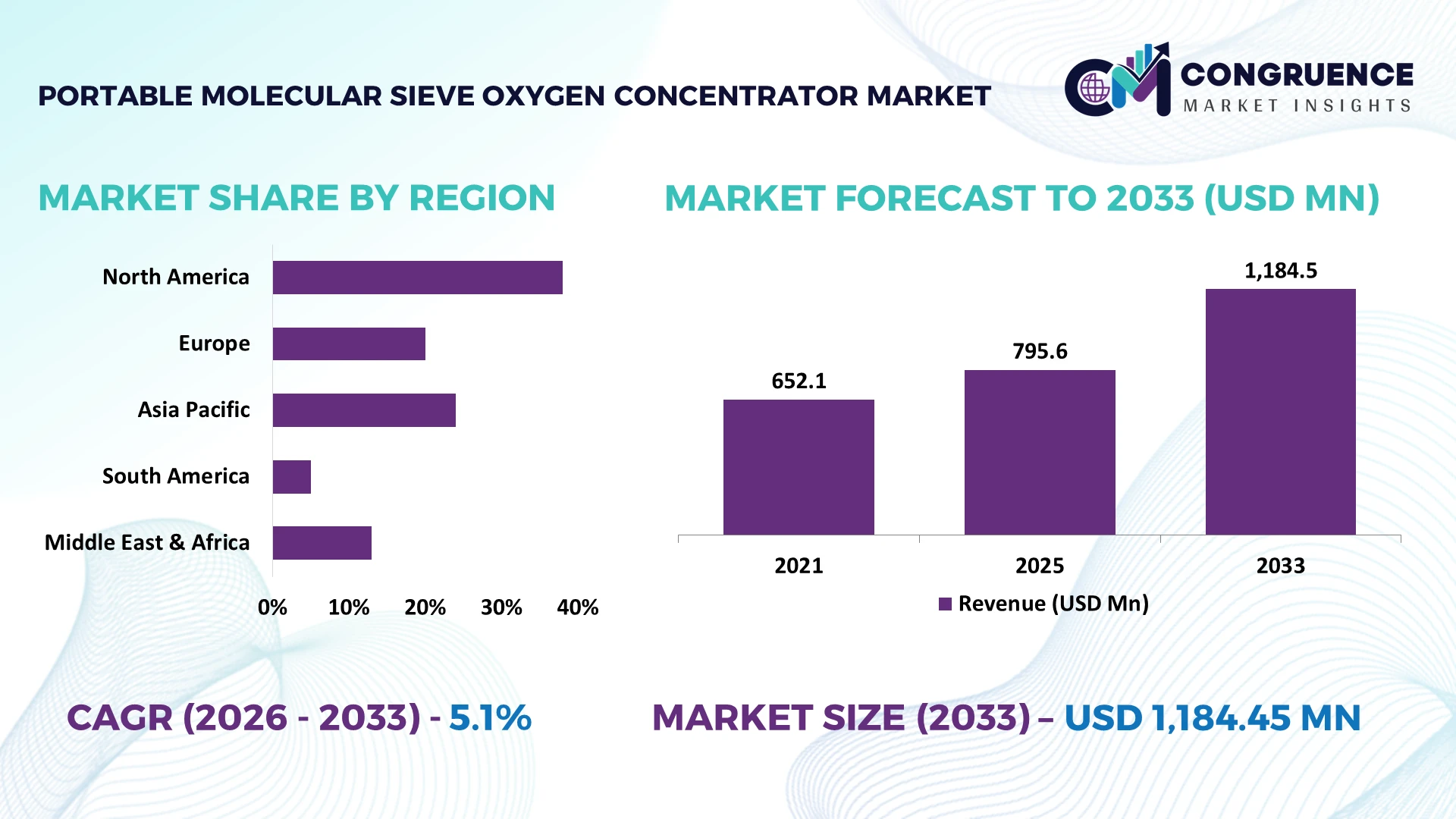
The Global Portable Molecular Sieve Oxygen Concentrator Market was valued at USD 795.6 Million in 2025 and is anticipated to reach a value of USD 1184.45 Million by 2033 expanding at a CAGR of 5.1% between 2026 and 2033. Growth is driven by increasing home oxygen therapy utilization, adoption of pulse-dose oxygen delivery systems, miniaturization of pressure swing adsorption technology, and integration of high-density lithium-ion batteries.
China represents a major manufacturing hub for portable molecular sieve oxygen concentrators, supported by its medical equipment production ecosystem and domestic respiratory care requirements. China's population aged 65 years and above reached approximately 220.23 million in 2024, accounting for 15.6% of its population, compared with approximately 18% in the United States. Manufacturers including Yuwell leverage domestic compressor manufacturing, zeolite adsorption systems, and integrated medical device supply chains. China's Healthy China 2030 initiative further supports healthcare equipment localization, while international suppliers emphasize compact designs and advanced pulse-dose technologies.
Strategically, manufacturers should prioritize compressor efficiency, lightweight molecular sieve systems, and internationally compliant oxygen delivery technologies to capture opportunities across homecare and ambulatory respiratory treatment.
Key Highlights of the Global Portable Molecular Sieve Oxygen Concentrator Market
-
Market Size & Growth: USD 795.6 million in 2025 to USD 1,184.45 million by 2033, at 5.1% CAGR, driven by portable PSA oxygen systems.
-
Top Growth Drivers: COPD-related disability linked to particulate pollution at 41.7%, growing homecare utilization, and international oxygen equipment sales expanding 18.4% for Inogen in 2025.
-
Short-Term Forecast: By 2028, the market reaches approximately USD 923.7 million on the stated growth trajectory, supporting investment in battery efficiency and portable oxygen delivery.
-
Emerging Technologies: Dual-bed zeolite adsorption, intelligent pulse-dose algorithms, and lithium-ion battery integration support oxygen purity specifications commonly around 90–96%.
-
Regional Leaders: North America, Europe, and Asia-Pacific are key markets; estimated 2033 regional revenue allocations require validated market-share inputs rather than assumed percentages.
-
Consumer/End-User Trends: Inogen sold approximately 189,400 oxygen systems in 2025, up 20.3%, demonstrating growing equipment volumes across its distribution channels.
-
Pilot/Case Example: In 2025, Inogen's international portable oxygen concentrator sales increased 18.4%, demonstrating the commercial impact of overseas distribution expansion.
-
Competitive Landscape: Inogen, CAIRE, Philips Respironics, Drive DeVilbiss Healthcare, and Yuwell compete in portable respiratory equipment; Inogen recorded a 44.2% company gross margin in 2025.
-
Regulatory & ESG Impact: US Medicare's 36-month oxygen equipment rental payment period places greater importance on equipment longevity, service availability, and replacement component planning.
-
Investment & Funding: Inogen ended 2025 with USD 120.9 million in cash and investments and authorized USD 30 million in share repurchases, reflecting its capital allocation position.
-
Innovation & Future Outlook: Next-generation 2026–2033 designs prioritize compact adsorption modules, connected diagnostics, and continuous monitoring of oxygen delivery performance.
The portable molecular sieve oxygen concentrator market is increasingly shaped by respiratory equipment portability, outpatient treatment, and home-based oxygen delivery. Inogen's 2025 oxygen system shipments increased 20.3%, reflecting stronger equipment distribution volumes, particularly through international channels. Advanced pressure swing adsorption modules, responsive pulse-dose sensors, and rechargeable battery systems are central to product differentiation. Meanwhile, China's established medical equipment manufacturing ecosystem supports component sourcing and device production, while US Medicare reimbursement requirements influence supplier servicing models. These developments position product reliability, distribution efficiency, and regulatory compliance as critical considerations for strategic investment and competitive positioning.
What Is the Strategic Relevance and Future Pathways of the Portable Molecular Sieve Oxygen Concentrator Market?
Portable molecular sieve oxygen concentrators are becoming strategically important as healthcare providers transition from stationary oxygen infrastructure toward mobile respiratory therapy and decentralized patient management. The World Health Organization estimates that chronic obstructive pulmonary disease caused 3.5 million deaths in 2021, reinforcing the importance of accessible respiratory support. In the United States, Medicare's 36-month oxygen equipment rental framework influences equipment lifecycle economics, encouraging manufacturers to prioritize durable compressors, replaceable sieve beds, and reliable battery performance rather than initial acquisition cost alone.
Pressure swing adsorption technology provides an operational advantage over conventional oxygen cylinders by extracting oxygen directly from ambient air, eliminating routine cylinder refilling. Modern portable concentrators typically deliver oxygen concentrations of approximately 90–96%, although performance varies by device and operating conditions. China benefits from integrated medical equipment manufacturing and component supply chains, while the United States emphasizes pulse-dose innovation, clinical usability, and reimbursement-compatible distribution. India's expanding home healthcare ecosystem presents opportunities for affordable portable respiratory devices.
Between 2026 and 2028, competitive investment will concentrate on adsorption efficiency, battery endurance, remote diagnostics, and lightweight equipment architecture. Inogen's Rove-series portable concentrators illustrate the deployment of compact pulse-dose technology for ambulatory oxygen therapy. Manufacturers are strengthening distributor partnerships and service networks to improve equipment availability. Long-term competitive advantage depends on clinically reliable oxygen delivery, lifecycle cost control, and scalable aftermarket support.
Portable Molecular Sieve Oxygen Concentrator Market Dynamics
DRIVER:
Expansion of Home-Based Oxygen Therapy and Ambulatory Respiratory Care
The transition toward home-based respiratory treatment is accelerating demand for portable molecular sieve oxygen concentrators. Chronic obstructive pulmonary disease accounted for approximately 3.5 million deaths globally in 2021, representing around 5% of all deaths, according to WHO estimates. In China, people aged 65 and above represented 15.6% of the population in 2024, reinforcing the importance of accessible chronic disease management. Portable pressure swing adsorption equipment reduces dependence on delivered oxygen cylinders and enables ambulatory treatment. Manufacturers such as Inogen and Yuwell are developing lightweight oxygen concentrators with rechargeable batteries, pulse-dose delivery, and simplified controls. The strategic advantage lies in expanding treatment mobility while reducing recurring oxygen logistics requirements for homecare providers.
RESTRAINT:
High Equipment Costs and Reimbursement Constraints
Premium portable oxygen concentrators face affordability barriers because specialized compressors, lithium-ion batteries, molecular sieve cartridges, and medical-grade sensors increase equipment acquisition and maintenance expenses. In the United States, Medicare generally covers 80% of the approved oxygen equipment amount after the deductible, leaving 20% coinsurance under standard Part B arrangements. Its 36-month rental payment structure also requires suppliers to manage equipment economics across extended service periods. Oxygen concentrators commonly target approximately 90–96% oxygen purity, requiring calibrated adsorption controls and dependable components. These requirements constrain low-cost product substitution and increase maintenance obligations. Manufacturers are responding through modular product engineering, supplier diversification, standardized replacement parts, and distributor service agreements to protect margins and equipment availability.
OPPORTUNITY:
Smart Oxygen Delivery and Connected Homecare Expansion
Intelligent oxygen delivery creates opportunities for manufacturers targeting digitally connected respiratory care. Inogen's Rove 6 provides 6 pulse-dose settings and up to 12 hours 45 minutes of operation with an extended battery under specified conditions, approximately 104% longer than its standard battery's 6 hours 15 minutes. Bluetooth connectivity supports device integration with mobile applications, creating opportunities for equipment monitoring and service coordination. In India, manufacturers and distributors can combine portable concentrators with homecare subscriptions, battery replacement programs, and clinical support partnerships. Between 2026 and 2028, investment in predictive maintenance, compact zeolite beds, and connected diagnostics will differentiate suppliers. The strongest opportunity lies in combining hardware performance with recurring service capabilities.
CHALLENGE:
Clinical Performance Consistency and Complex Operating Conditions
Maintaining dependable oxygen delivery across variable breathing patterns, altitude, temperature, and battery conditions presents a significant engineering challenge. Inogen's Rove 6 specifies oxygen concentration at 90%, with a tolerance of +6% and −3%, while its operating humidity range extends from 15% to 90% under noncondensing conditions. The device operates within a specified temperature range of 5–40°C and supports altitudes up to 3,048 meters. These operating boundaries complicate deployment across India's hot, humid, and high-altitude environments. Pulse-dose delivery also requires appropriate patient assessment because it is not interchangeable with continuous-flow oxygen therapy. Manufacturers must invest in environmental validation, respiratory-trigger accuracy, clinical training, and field-service infrastructure to sustain reliable long-term performance.
Portable Molecular Sieve Oxygen Concentrator Market Latest Trends
-
Miniaturization of Portable Adsorption Systems: Manufacturers are optimizing zeolite molecular sieve cartridges, compressor assemblies, and airflow channels to reduce equipment weight without compromising oxygen delivery. Inogen's Rove 6 weighs approximately 2.2 kg with a standard battery and offers 6 pulse-dose settings. Compact adsorption architecture enables manufacturers to differentiate products through portability, thermal management, and reduced component complexity, strengthening competitiveness in ambulatory respiratory equipment.
-
Battery Configuration and Runtime Optimization: Portable concentrator manufacturers increasingly offer interchangeable lithium-ion battery configurations instead of fixed-power designs. Inogen's Rove 6 provides up to 6 hours 15 minutes with a standard battery and 12 hours 45 minutes with an extended battery under specified operating conditions. This approximately 104% runtime increase allows distributors to offer application-specific equipment packages while expanding battery replacement and accessory servicing opportunities.
-
Digital Controls and Performance Monitoring: Embedded microprocessors coordinate respiratory-trigger detection, compressor cycling, and oxygen delivery alerts. Portable systems operate within defined oxygen purity specifications, commonly around 90–96%, while devices such as the Rove 6 provide 6 selectable pulse-dose settings. Manufacturers are integrating connected interfaces and diagnostic functions to simplify troubleshooting, support maintenance workflows, and improve equipment management across distributed healthcare networks.
-
Regulatory Standardization of Device Performance: US FDA requirements and European medical device regulations reinforce oxygen concentration accuracy, electrical safety, and product traceability. Medicare's 36-month rental payment framework and broader 5-year equipment-use obligations influence supplier purchasing decisions. Manufacturers are investing in validated components, standardized replacement assemblies, and quality-management processes to reduce servicing disruptions and improve product lifecycle economics.
Segmentation Analysis
By Type
Pulse-Dose Concentrators Lead Portable Oxygen Technology Adoption
Pulse-Dose Oxygen Concentrators represent the leading product category in the portable molecular sieve oxygen concentrator market, supported by compact equipment architecture, breath-triggered oxygen delivery, and lower oxygen consumption between inhalations. Inogen's Rove 6 demonstrates this positioning through 6 selectable pulse-dose settings and a weight of approximately 2.2 kg with a standard battery. Unlike Continuous-Flow Oxygen Concentrators, which deliver oxygen throughout the respiratory cycle, pulse-dose devices synchronize delivery with detected inhalation. This distinction improves mobility and supports smaller battery-powered systems. Inogen's 2025 oxygen system sales increased 20.3%, providing a measurable commercial indicator, although the company does not disclose global market share by flow type.
Dual-Mode Oxygen Concentrators represent an important product-development opportunity because they combine continuous-flow delivery with pulse-dose functionality. Their flexibility addresses patients requiring different oxygen delivery configurations across activities and clinical settings. Continuous-flow models remain essential where consistent oxygen administration is clinically prescribed. Manufacturers are prioritizing oxygen delivery accuracy, battery integration, and compact compressors, while dual-mode development requires additional engineering to balance continuous-flow capability against portability.
- Inogen's 2025 annual reporting identifies portable pulse-dose systems as a central product category, with approximately 189,400 oxygen systems sold during the year. Its product strategy emphasizes ambulatory oxygen delivery and home medical equipment partnerships.
By Application
COPD Management Anchors Portable Oxygen Utilization
Chronic Obstructive Pulmonary Disease (COPD) represents a principal clinical demand category for portable molecular sieve oxygen concentrators, reflecting the established role of supplemental oxygen in managing chronic hypoxemia. US CDC findings published in 2025 identified diagnosed COPD prevalence of 3.8% among adults in 2023, increasing to 10.5% among people aged 75 and older. This age-related concentration supports targeted equipment distribution through respiratory specialists and homecare providers. Home Oxygen Therapy represents an established delivery setting, emphasizing reliable operation, maintenance accessibility, and compatibility with prescribed oxygen requirements. Global market shares for these application categories are not separately disclosed in comparable audited datasets.
Ambulatory Oxygen Therapy is an important expansion area as patients seek oxygen support during daily activities outside clinical facilities. Lightweight pulse-dose concentrators support mobility when their delivery characteristics meet individual clinical needs. Sleep-Related Breathing Disorders require careful application differentiation because portable oxygen therapy does not replace positive airway pressure treatment for obstructive sleep apnea. Manufacturers are strengthening clinical education, prescription support, and equipment selection protocols to improve appropriate utilization.
- The US Centers for Disease Control and Prevention reported in its 2025 COPD analysis that diagnosed prevalence reached 11.5% among adults reporting fair or poor health, compared with 2.2% among those reporting better health.
By End-User
Homecare Patients Dominate Portable Equipment Deployment
Homecare Patients constitute the primary commercial focus for portable molecular sieve oxygen concentrators because long-term oxygen therapy frequently requires equipment outside hospital environments. Inogen's 2025 reporting identified approximately 189,400 oxygen systems sold, representing a 20.3% annual increase. Its business model combines direct patient sales, equipment rentals, and home medical equipment distribution, demonstrating the importance of decentralized respiratory care. Hospitals and Clinics remain important institutional users for discharge planning, oxygen therapy assessment, and transitional patient management. However, comparable global purchasing shares across the four specified end-user categories are not publicly established.
Long-Term Care Facilities represent a strategically important institutional opportunity, particularly where operators require standardized maintenance and dependable oxygen equipment availability. Emergency Medical Services serve a more specialized application, where portability must be balanced against immediate oxygen flow requirements, power reliability, and emergency treatment protocols. Manufacturers are responding through institutional distributor partnerships, equipment servicing programs, and differentiated product configurations. Competitive investment increasingly emphasizes patient training, dependable maintenance, and lifecycle equipment management rather than hardware specifications alone.
- Inogen's 2026 second-quarter reporting recorded approximately 53,300 portable units sold, compared with 47,600 a year earlier, representing 12.0% growth. This supports continued investment in portable respiratory equipment distribution and provider partnerships.
Region-Wise Market Insights
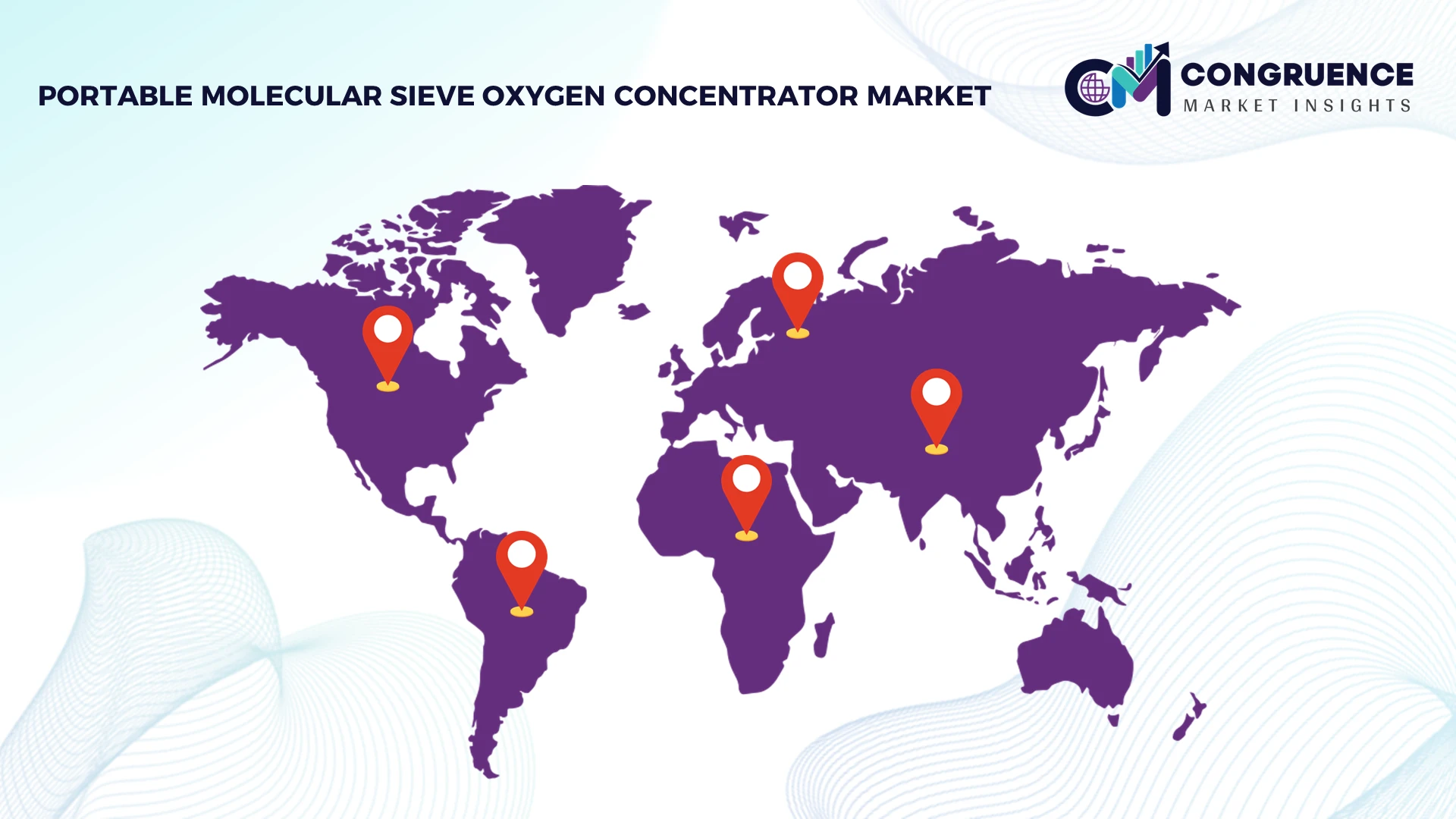
North America accounted for the largest market share at an estimated 39% in 2025 however, Asia-Pacific is expected to register the fastest growth, expanding at a CAGR of approximately 6.8% between 2026 and 2033.
North America Portable Molecular Sieve Oxygen Concentrator Market
Established Homecare Networks and Advanced Respiratory Equipment Adoption
North America holds an estimated 39% of the global portable molecular sieve oxygen concentrator market, supported by established home medical equipment distribution, respiratory therapy infrastructure, and advanced portable oxygen technologies. The United States dominates regional procurement through Medicare-supported oxygen therapy, direct-to-consumer equipment sales, and specialized respiratory equipment suppliers. Inogen, CAIRE, and Drive DeVilbiss Healthcare compete through pulse-dose innovation, battery performance, and service network accessibility. The region benefits from established clinical prescribing practices and reimbursement arrangements, with Medicare generally covering 80% of approved equipment costs after applicable deductibles. Canada's publicly funded provincial healthcare programs support prescribed oxygen therapy through varying equipment assistance frameworks. Suppliers increasingly prioritize lightweight adsorption systems, digital equipment monitoring, and maintenance efficiency. Competitive differentiation depends on reducing service interruptions and strengthening distributor relationships across decentralized care settings.
United States Market Outlook: The United States anchors regional technology development through established oxygen equipment manufacturers, specialized respiratory distributors, and FDA-regulated medical device commercialization. Inogen's Rove 6 offers six pulse-dose settings and extended battery operation reaching approximately 12 hours 45 minutes under specified conditions. Medicare's 36-month rental payment framework shapes equipment procurement, maintenance planning, and supplier economics. Manufacturers are investing in product reliability, battery accessories, and clinical distribution partnerships to strengthen patient access.
Europe Portable Molecular Sieve Oxygen Concentrator Market
Medical Device Compliance and Portable Respiratory Equipment Modernization
Europe represents an estimated 27% of global portable molecular sieve oxygen concentrator demand, with Germany, France, the United Kingdom, and Italy supporting established respiratory treatment infrastructure. The European Union Medical Device Regulation strengthens requirements for clinical evidence, post-market surveillance, product traceability, and device safety. Manufacturers consequently emphasize certified oxygen delivery performance, validated components, and standardized quality-management systems. Germany's medical technology manufacturing capabilities support equipment engineering, while the United Kingdom's National Health Service facilitates prescribed home oxygen services through contracted suppliers. European manufacturers and distributors are integrating compact compressors, low-noise operation, and energy-efficient adsorption assemblies into equipment portfolios. The shift toward longer equipment service life encourages modular repair strategies and reliable replacement component availability. Suppliers with established regulatory documentation and cross-border distribution capabilities maintain an advantage in institutional procurement.
Germany Market Outlook: Germany combines advanced medical device engineering with a substantial elderly population, with approximately 23% of residents aged 65 years and above in 2024. Its medical technology manufacturing ecosystem supports precision components, electronic controls, and equipment validation. Portable concentrator suppliers benefit from established respiratory care providers and structured reimbursement pathways. Competitive positioning increasingly depends on EU MDR compliance, product durability, and reliable technical servicing rather than equipment acquisition price alone.
Asia-Pacific Portable Molecular Sieve Oxygen Concentrator Market
Manufacturing Localization and Expanding Respiratory Equipment Accessibility
Asia-Pacific accounts for an estimated 25% of the global portable molecular sieve oxygen concentrator market, supported by concentrated medical equipment manufacturing in China, advanced healthcare technology adoption in Japan, and expanding respiratory care infrastructure in India. Chinese manufacturers benefit from established compressor production, zeolite processing, battery manufacturing, and electronic component integration. Japan's aging population strengthens demand for compact, quiet oxygen delivery systems suitable for residential use. India represents an important distribution opportunity as healthcare providers expand home-based respiratory support and medical equipment rental services. Regional suppliers increasingly focus on product affordability, domestic component sourcing, and international certification. Manufacturing integration reduces dependence on imported assemblies, while export-oriented manufacturers prioritize product testing and distributor partnerships. Competitive investment centers on adsorption efficiency, equipment portability, and localized technical support.
China Market Outlook: China combines medical device manufacturing scale with an expanding elderly population, which reached approximately 220.23 million people aged 65 and above in 2024. Yuwell represents a prominent domestic respiratory equipment manufacturer, offering oxygen therapy products through established healthcare distribution channels. China's integrated electronics and battery supply chains support portable device development. Manufacturers increasingly target international markets through product certification, automated assembly, and diversified distribution arrangements.
South America Portable Molecular Sieve Oxygen Concentrator Market
Homecare Distribution Expansion and Imported Equipment Dependence
South America represents an estimated 5% of the global portable molecular sieve oxygen concentrator market, with Brazil accounting for a substantial portion of regional healthcare equipment demand. Respiratory care procurement is influenced by private hospital networks, home healthcare providers, and medical device importers. Brazil's Unified Health System supports healthcare access, while private insurers and specialized distributors serve equipment-dependent patients requiring respiratory support. Portable concentrator availability depends heavily on imported compressors, battery assemblies, and complete medical devices, exposing distributors to exchange-rate fluctuations and customs-related delivery delays. Suppliers are expanding equipment rental arrangements, maintenance partnerships, and localized inventory management to improve availability. Chile and Colombia provide additional opportunities through established urban healthcare networks. Companies offering dependable technical support and flexible procurement arrangements gain an advantage over importers focused exclusively on equipment pricing.
Brazil Market Outlook: Brazil represents the region's principal commercial opportunity because of its large population, established healthcare infrastructure, and medical equipment distribution ecosystem. The country had approximately 203 million residents in the 2022 census, providing a substantial potential respiratory care population. ANVISA medical device requirements influence product registration and commercialization. Manufacturers and distributors are strengthening local servicing capabilities, replacement battery availability, and hospital referral relationships to improve equipment accessibility.
Middle East & Africa Portable Molecular Sieve Oxygen Concentrator Market
Healthcare Infrastructure Investment and Respiratory Care Modernization
The Middle East & Africa region accounts for an estimated 4% of global portable molecular sieve oxygen concentrator demand, with Saudi Arabia, the United Arab Emirates, and South Africa representing important healthcare equipment markets. Saudi Arabia's Vision 2030 healthcare transformation supports private sector participation, digital healthcare services, and medical infrastructure modernization. The United Arab Emirates emphasizes advanced medical technology procurement and specialized healthcare services, while South Africa maintains established private hospital and respiratory equipment distribution networks. Equipment availability across parts of Africa remains constrained by import dependence, maintenance infrastructure gaps, and inconsistent access to replacement components. Manufacturers are responding through regional distributor agreements, clinical equipment training, and localized inventory support. Procurement priorities increasingly emphasize dependable oxygen purity, battery endurance, and equipment servicing capacity, particularly where centralized respiratory infrastructure is limited.
Saudi Arabia Market Outlook: Saudi Arabia represents a strategic healthcare equipment market under Vision 2030, which targets substantial private sector participation in healthcare delivery. The Health Sector Transformation Program emphasizes healthcare accessibility, service quality, and digital integration. Portable oxygen concentrator suppliers benefit from hospital modernization, expanding home healthcare services, and specialized medical equipment procurement. Companies are prioritizing regulatory registration, distributor partnerships, and technical maintenance capabilities to strengthen commercial positioning.
Market Competition Landscape
The portable molecular sieve oxygen concentrator market features competition between technology-focused manufacturers Inogen, CAIRE, and O2 Concepts and diversified respiratory equipment suppliers Drive DeVilbiss Healthcare, Yuwell, and Nidek Medical. The five largest manufacturers' combined global share remains undisclosed; concentration estimates for broader oxygen concentrator categories cannot reliably represent portable devices alone. Inogen differentiates through lightweight pulse-dose systems, while CAIRE competes through continuous-flow and ambulatory product versatility. Inogen's extended battery configuration provides approximately 104% longer runtime than its standard configuration under specified conditions. Medicare's 80% approved-cost coverage and 20% patient coinsurance influence purchasing economics in the United States. Manufacturers are strengthening distributor partnerships, optimizing compressors, and integrating connected diagnostics. Competition is shifting toward lifetime equipment performance rather than hardware pricing alone. Regulatory certification, reliable oxygen delivery, and established servicing infrastructure create entry barriers. Winning requires clinically validated products, resilient component sourcing, and dependable aftermarket support across international healthcare markets.
Companies Profiled in the Portable Molecular Sieve Oxygen Concentrator Market Report
-
Inogen, Inc.
-
CAIRE Inc.
-
Drive DeVilbiss Healthcare
-
O2 Concepts LLC
-
Nidek Medical Products, Inc.
-
Precision Medical, Inc.
-
GCE Healthcare
-
React Health
-
Rhythm Healthcare
-
Jiangsu Yuyue Medical Equipment & Supply Co., Ltd. (Yuwell)
-
Teijin Limited
-
Longfian Scitech Co., Ltd.
Technology Insights for the Portable Molecular Sieve Oxygen Concentrator Market
Pressure swing adsorption technology remains central to portable molecular sieve oxygen concentrators, using zeolite adsorbents to separate nitrogen from ambient air. Modern systems maintain approximately 90–96% oxygen concentration through alternating adsorption cycles, electronic valves, and compact compressors. Breath-triggered pulse-dose delivery reduces oxygen discharge between inhalations compared with continuous-flow operation, supporting smaller equipment configurations. Inogen's Rove 6 provides six pulse-dose settings and weighs approximately 2.2 kilograms with its standard battery, demonstrating commercially deployed miniaturization. Manufacturers benefit from lower transport weight, improved mobility, and differentiated respiratory equipment portfolios.
Emerging technologies emphasize high-performance lithium-ion batteries, adaptive respiratory sensing, and compact adsorption cartridges. Rove 6 configurations provide up to 12 hours 45 minutes of operation with an extended battery versus 6 hours 15 minutes using a standard battery, representing approximately 104% longer runtime under specified conditions. Embedded controllers regulate compressor cycling, oxygen concentration monitoring, and device alarms. Manufacturers integrating replaceable battery modules and diagnostic interfaces strengthen equipment servicing efficiency and patient mobility.
Between 2026 and 2028, development priorities include advanced zeolite materials, predictive maintenance algorithms, and connected device management. Inogen, CAIRE, and Yuwell compete through adsorption efficiency, clinical reliability, and integrated equipment support. Suppliers combining validated oxygen delivery with modular components gain stronger positioning in decentralized respiratory care.
Recent Developments in the Global Portable Molecular Sieve Oxygen Concentrator Market
-
October 2025: CAIRE introduced its FreeStyle Comfort with autoSAT technology in the United States, featuring 5 pulse settings and automatic respiratory-rate adjustment. The launch strengthened personalized ambulatory oxygen delivery and expanded advanced respiratory equipment options for healthcare providers. Source: caireinc.com
-
May 2026: Inogen confirmed the Brazilian launch of its Rove 6 portable oxygen concentrator, offering 6 pulse-dose settings. This geographic expansion strengthened its international respiratory equipment portfolio and increased access to lightweight oxygen delivery technology through local distribution channels. Source: inogen.com
-
February 2024: Belluscura partnered with Sunset Healthcare Solutions to distribute X-PLOR portable oxygen concentrators through a network exceeding 1,600 healthcare customers. The agreement expanded commercial reach, strengthened equipment accessibility, and established distribution infrastructure for subsequent DISCOV-R product commercialization. Source: hmenews.com
-
July 2025: CAIRE received FDA 510(k) clearance for its FreeStyle Comfort portable oxygen concentrator under submission K250671. The regulatory decision confirmed substantial equivalence, supporting commercialization of the updated device and strengthening access to the regulated United States respiratory equipment market. Source: fda.gov
Scope of the Portable Molecular Sieve Oxygen Concentrator Market Report
The Portable Molecular Sieve Oxygen Concentrator Market Report evaluates product technology, clinical utilization, procurement dynamics, and competitive developments across 2026–2033. Type segmentation covers Continuous-Flow Oxygen Concentrators, Pulse-Dose Oxygen Concentrators, and Dual-Mode Oxygen Concentrators. Application analysis examines COPD, Sleep-Related Breathing Disorders, Home Oxygen Therapy, and Ambulatory Oxygen Therapy. End-user coverage includes Homecare Patients, Hospitals and Clinics, Long-Term Care Facilities, and Emergency Medical Services, with attention to equipment specifications and purchasing requirements.
Geographical coverage encompasses North America, Europe, Asia-Pacific, South America, and the Middle East & Africa. The report evaluates zeolite adsorption technology, battery configurations, respiratory sensing, and connected diagnostics. Competitive assessment considers equipment performance, regulatory requirements, distribution partnerships, and manufacturing localization. Quantitative benchmarks include oxygen concentrations around 90–96%, portable equipment weight, and battery endurance, supporting investment prioritization, geographic expansion, and product differentiation.
Portable Molecular Sieve Oxygen Concentrator Market Report Summary
| Report Attribute/Metric | Report Details |
|---|
Market Revenue in 2025 | USD 795.6 Million |
Market Revenue in 2033 | USD 1184.45 Million |
CAGR (2026 - 2033) | 5.1% |
Base Year | 2025 |
Forecast Period | 2026 - 2033 |
Historic Period | 2021 - 2025 |
Segments Covered | By TypeContinuous-Flow Oxygen Concentrators Pulse-Dose Oxygen Concentrators Dual-Mode Oxygen Concentrators
By ApplicationChronic Obstructive Pulmonary Disease (COPD) Sleep-Related Breathing Disorders Ambulatory Oxygen Therapy
By End-UserLong-Term Care Facilities Emergency Medical Services
|
Key Report Deliverable | Revenue Forecast, Growth Trends, Market Dynamics, Segmental Overview, Regional and Country-wise Analysis, Competition Landscape |
Region Covered | North America, Europe, Asia-Pacific, South America, Middle East, Africa |
Key Players Analyzed | Inogen, Inc., CAIRE Inc., Drive DeVilbiss Healthcare, O2 Concepts LLC, Nidek Medical Products, Inc., Precision Medical, Inc., GCE Healthcare, React Health, Rhythm Healthcare, Jiangsu Yuyue Medical Equipment & Supply Co., Ltd. (Yuwell), Teijin Limited, Longfian Scitech Co., Ltd. |
Customization & Pricing | Available on Request (10% Customization is Free) |