
Reports
The Global Portable Milling Machine Market was valued at USD 1230 Million in 2025 and is anticipated to reach a value of USD 1803.47 Million by 2033 expanding at a CAGR of 4.9% between 2026 and 2033. Growth is driven by expanding onsite precision machining across ship repair, power generation, oil and gas, aerospace maintenance, mining, and heavy equipment refurbishment, where machining installed components reduces dismantling requirements and asset downtime.
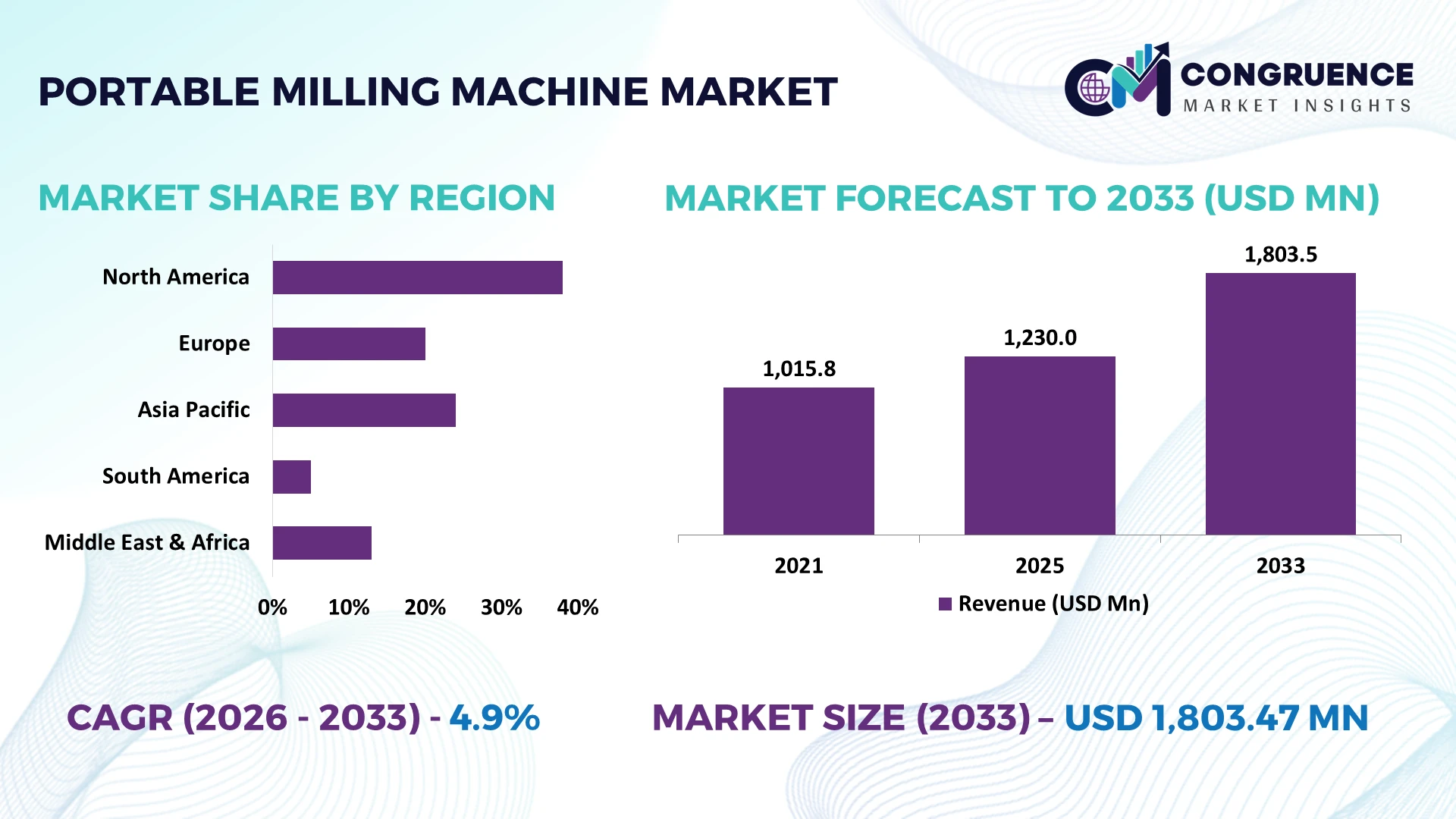
The United States anchors North American demand, with the region accounting for 38.1% of the global market, supported by aerospace, defense, ship repair, energy, and industrial maintenance activity. Manufacturing captured 52.5% of new US foreign direct investment expenditure in 2025, while the US Navy continues modernization across 4 public shipyards. China provides the strongest industrial comparison, producing 53.69 million DWT of ships in 2025, equivalent to 56.1% of global shipbuilding output and reinforcing Asian requirements for onsite machining systems.
Strategically, suppliers combining modular portable platforms, CNC capability, rental availability, and rapid field support are positioned to capture maintenance spending shifting from component removal toward machining directly at operating assets.
Market Size & Growth: USD 1,230 million in 2025 is projected to reach USD 1,803.47 million by 2033 at 4.9%, supported by expanding onsite precision machining across maintenance intensive industries.
Top Growth Drivers: Metalworking represents 47.6% of application demand, manufacturing contributes 55.8% of end use demand, and horizontal machines account for 43.0% of product demand.
Short Term Forecast: Through 2028, portable field machining economics strengthen as optimized onsite drilling and machining configurations can reduce job completion time by up to 60% in suitable applications.
Emerging Technologies: CNC controls, automated feeds, digital measurement, and modular gantry configurations are expanding, with CNC portable machines representing 45% to 55% of unit demand within advanced European applications.
Regional Leaders: Based on 2025 regional shares, North America represents roughly USD 469 million, Asia Pacific about USD 383 million, and Europe approximately USD 292 million, with CNC adoption strengthening advanced equipment penetration.
End User Trends: Manufacturing holds 55.8% of end user demand as operators prioritize portable equipment supporting flexible maintenance, lean production, reduced component transportation, and machining directly on installed industrial assets.
Pilot Case Example: In one steel recycling field repair, portable machining completed work in 46 hours versus the conventional 6 days while improving machining accuracy from 0.024 inches to 0.002 inches.
Competitive Landscape: North America leads with 38.1% share, while CLIMAX, Enerpac, CS Unitec, Mactech Europe, and Field Machine Tools compete through precision, modularity, equipment portability, rental fleets, and field service capabilities.
Regulatory & ESG Impact: European machinery compliance requirements can increase compliance expenditure by 10% to 20% for smaller equipment suppliers, strengthening the competitive value of standardized safety engineering and documented machine performance.
Investment & Funding: The US Navy committed USD 448 million toward AI and autonomous technologies for shipbuilding modernization, reinforcing digital investment across an industrial ecosystem requiring advanced maintenance and precision machining capabilities.
Innovation & Future Outlook: Modular portable milling platforms now extend to machining lengths approaching 192 inches, enabling large structural components to be processed onsite and accelerating the strategic transition from workshop based repair toward digitally assisted field machining.
Portable milling machines are becoming critical maintenance assets across shipyards, power plants, steel facilities, mining operations, aerospace MRO, and heavy engineering sites where transporting oversized components creates substantial downtime. CNC controls, digital measurement, automated feeds, and configurable gantry architectures are improving field machining accuracy and setup flexibility. CNC equipped portable machines account for 45% to 55% of unit demand across advanced European applications, indicating accelerating automation adoption. Shipyard modernization and tighter maintenance schedules are simultaneously pushing operators toward onsite machining, establishing technology integration and service responsiveness as increasingly important competitive priorities.
Portable milling machines are becoming strategically important as asset intensive industries move maintenance closer to operating equipment rather than transporting large components to fixed workshops. Manufacturing represents 55.8% of end use demand, while metalworking accounts for 47.6% of applications. Shipyard modernization, energy infrastructure refurbishment, and localized maintenance networks are consequently directing investment toward field machining capacity that reduces disassembly and logistics exposure.
Digital positioning, CNC control, automated feed systems, and modular gantry designs are changing field productivity. Advanced portable systems can reduce selected machining job times by 60% compared with conventional removal and workshop processing. North America holds 38.1% of market activity, supported by mature industrial maintenance networks, while China’s 56.1% share of global shipbuilding output creates substantial deployment potential around coastal manufacturing clusters and repair yards.
A steel recycling repair demonstrates the operational value: portable equipment completed machining in 46 hours instead of 6 days while improving accuracy from 0.024 inches to 0.002 inches. Through 2028, suppliers are prioritizing CNC integration, modular platforms, rental fleets, and service partnerships. Competitive advantage will increasingly depend on converting machining precision into measurable reductions in downtime, logistics complexity, and maintenance turnaround.
Industrial operators are increasingly machining large installed components onsite because dismantling, lifting, transportation, and workshop processing extend maintenance outages. Manufacturing represents 55.8% of portable milling machine end use, metalworking contributes 47.6% of applications, and horizontal configurations hold 43.0% of product demand. The United States provides a strong demand catalyst as modernization continues across 4 public naval shipyards alongside extensive aerospace, energy, and heavy manufacturing infrastructure. Portable systems allow damaged flanges, turbine components, foundations, and structural surfaces to be restored without removing complete assemblies. This converts equipment portability directly into higher asset availability. Manufacturers are responding with modular beds, lightweight structures, interchangeable machining heads, rental fleets, and field engineering services designed to shorten setup and increase utilization across multiple maintenance applications.
Advanced portable milling systems require substantial expenditure on rigid machine structures, precision drives, metrology, tooling, operator training, and field setup, restricting adoption among smaller maintenance contractors. CNC equipped portable machines represent 45% to 55% of European unit demand, while machinery compliance requirements can increase related costs by 10% to 20% for smaller suppliers. Horizontal systems already command 43.0% of product demand, intensifying competition around high specification platforms rather than basic equipment. Germany’s tightly regulated industrial machinery environment further raises documentation, guarding, electrical safety, and conformity requirements for equipment providers. These economics can lengthen replacement cycles and constrain fleet expansion. Suppliers are mitigating exposure through rental models, standardized modular components, localized service inventories, refurbishment programs, and longer customer contracts that distribute equipment costs across multiple maintenance projects.
CNC integration, automated feeds, digital measurement, and modular gantry architectures are creating opportunities beyond conventional repair work by enabling repeatable precision machining directly on large assets. CNC equipped machines already represent 45% to 55% of advanced European unit demand, while selected field machining configurations can reduce job completion time by 60%. China produced 53.69 million DWT of ships in 2025, representing 56.1% of global shipbuilding output, creating a concentrated opportunity around shipyard commissioning, retrofits, structural machining, and lifecycle maintenance. The non obvious opportunity is data enabled service: digitally recorded alignment, dimensional verification, and machining parameters can support traceable maintenance workflows. Suppliers are investing in remote diagnostics, automated positioning, application engineering, rental ecosystems, and partnerships with shipyards and industrial service contractors to capture recurring equipment utilization rather than relying solely on machine sales.
Scaling portable machining depends on consistently reproducing workshop level accuracy under variable field conditions, making workforce capability and setup discipline critical long term challenges. One documented industrial repair improved machining accuracy from 0.024 inches to 0.002 inches while reducing completion time from 6 days to 46 hours, demonstrating both the potential and the precision expectations placed on field teams. With manufacturing representing 55.8% of end use demand and CNC systems reaching 45% to 55% penetration in advanced European applications, operators increasingly require technicians proficient in alignment, CNC programming, metrology, fixturing, and digital diagnostics. US shipyard modernization intensifies competition for these multidisciplinary skills. Equipment manufacturers must therefore invest in operator certification, simulation based training, remote technical assistance, standardized setup procedures, and intuitive control systems. Long term competitiveness depends on making high precision performance repeatable across different operators, assets, and industrial environments.
Rental Fleets Reshape Equipment Access: Procurement is shifting from ownership toward project based access as shutdown contractors seek flexible capacity without carrying underutilized machinery. In India, onsite machining represents 30% to 40% of portable milling demand, while power equipment maintenance contributes another 15% to 20%. Suppliers are expanding rental fleets, application engineering, and rapid mobilization services, turning equipment availability into a competitive differentiator for scheduled outages and emergency interventions.
Modular Platforms Handle Larger Assets: Portable mills are moving beyond compact repair jobs toward configurable systems capable of machining substantially larger structures. Current modular platforms provide X axis travel reaching 176 inches, accommodate cutter heads up to 10 inches, and operate with 25 HP hydraulic power units. Manufacturers are standardizing interchangeable bed sections and multidirectional configurations, allowing contractors to cover broader work envelopes with fewer dedicated machines and improve fleet utilization.
Input Costs Favor Asset Refurbishment: Higher material costs are strengthening the economics of repairing existing industrial equipment instead of replacing major structures. Hot rolled coil prices increased 28% year over year to around USD 840 per ton by April 2026, while Northeast Asian steel plate prices rose 3.4%. Maintenance providers are consequently extending refurbishment capabilities and deploying portable machining earlier within lifecycle programs, protecting customers from replacement lead times and material exposure.
Shipyard Workflows Accelerate Automation: Shipbuilders are restructuring production around robotics, digital workflows, and localized machining as orderbooks remain elevated. Global newbuilding tonnage contracted in 2025 remained 30% above the ten year average, the orderbook expanded 8%, and one third of ordered tonnage incorporated alternative fuel capability. Equipment providers are aligning portable machining systems with increasingly automated fabrication and retrofit workflows, especially where complex vessel structures still require adaptable field processing.
Linear Milling leads the type landscape with approximately 42.5% share, reflecting its suitability for long straight surfaces, mounting pads, machine beds, structural members, and other repeatable field machining tasks. Its comparatively straightforward fixturing supports high utilization across maintenance contractors and industrial service fleets. Gantry Milling follows at roughly 33.3%, benefiting from greater rigidity and multidirectional machining across large components. Circular Milling and Orbital Milling collectively represent about 18% of established demand, serving geometries requiring controlled machining around cylindrical structures, large flanges, and rotating assemblies. Keyway Milling remains specialized but operationally important for shafts, couplings, and drive systems.
Gantry Milling is emerging as the fastest developing type as buyers move toward machines capable of handling broader work envelopes and multiple axes without transferring components between setups. Hydraulic Milling remains strategically relevant for high torque field operations where electrical availability or environmental conditions constrain conventional drives. Suppliers are responding with convertible linear and gantry architectures, configurable beds, alternative power packages, and integrated feed systems. Investment is therefore moving toward multipurpose platforms that increase equipment utilization rather than narrowly optimized single task machines.
On Site Repair represents the leading application, accounting for an estimated 30% to 40% of portable milling deployment in established field service environments because damaged structures can be restored without relocating heavy assemblies. Flange Machining remains a high frequency requirement across process equipment where sealing surface condition directly affects shutdown completion and restart integrity. Surface Milling is gaining importance for foundations, bearing seats, mounting pads, and structural interfaces as operators pursue tighter alignment during refurbishment. Pipe Machining remains concentrated around pipeline and process plant interventions, while Keyway Cutting supports shafts and rotating equipment requiring localized dimensional restoration.
Surface Milling is becoming the fastest developing application as modular gantry systems extend portable machining into larger, flatter, and more complex work areas. Weld Preparation is simultaneously moving toward more controlled field processing where subsequent joining quality depends on consistent geometry. Suppliers are adapting through three axis platforms, extended travel beds, interchangeable spindle positions, and application specific fixtures. The commercial implication is significant: equipment capable of moving between surface restoration, flange work, and repair operations generates higher utilization per deployed platform and strengthens rental economics.
Oil & Gas leads the supplied end user categories with approximately 35.8% share, reflecting recurring machining requirements around refineries, pipelines, offshore installations, compressors, pumps, and processing assets. Power Generation follows at roughly 28.2%, where outage schedules create concentrated requirements for precision intervention on turbines and associated structures. Mining and Heavy Machinery maintain established demand because oversized equipment is expensive to transport for workshop processing. Construction uses portable systems selectively for large fabricated structures, while Aerospace remains a smaller but specification intensive buyer requiring controlled tolerances and documented machining quality.
Shipbuilding is the fastest advancing end user opportunity as yard workloads expand and vessel complexity increases. China secured 69% of global new ship orders in 2025, while its outstanding order volume increased 31.5%, creating substantial requirements for fabrication correction, retrofit work, machinery foundations, and lifecycle servicing. Manufacturing remains important for localized rework where fixed machining centers cannot accommodate assembled structures. Suppliers are targeting these buyers with marine configurations, ruggedized equipment, service partnerships, rental programs, and application specific tooling rather than standardized machine packages.
Asia Pacific accounted for the largest market share at 38.6% in 2025 however, Asia Pacific is expected to register the fastest growth, expanding at a CAGR of 6.5% between 2026 and 2033.

Service Networks Shift Toward High Precision Field Work
North America represented 25.3% of global portable milling machine demand in 2025, with deployment concentrated around industrial service contractors, aerospace facilities, marine yards, energy infrastructure, and heavy equipment maintenance. The operating model increasingly favors digitally controlled machines supported by local technical service because buyers place greater value on rapid mobilization and repeatable tolerances than basic equipment availability. US factory orders increased 6.8% year over year in August 2026, while machinery orders advanced 1.1%, indicating continued capital equipment activity. Canada adds demand through mining, hydroelectric infrastructure, energy projects, and remote industrial sites where transporting oversized workpieces is particularly inefficient. Suppliers are strengthening distributor coverage, application engineering, spare parts inventories, and technician training to improve equipment availability near industrial clusters.
United States Market Outlook: The United States combines a deep installed base of process equipment with substantial aerospace, defense, power, petrochemical, and machinery production. Core capital goods orders excluding aircraft increased 1.6% in August 2026, demonstrating active equipment investment. Gulf Coast processing assets and Midwest manufacturing clusters create recurring requirements for precision field machining, favoring suppliers capable of providing rapid technical support and configurable equipment.
Precision Regulation Favors Advanced Equipment
Europe accounted for 23.8% of global demand in 2025, supported by sophisticated machinery production, offshore engineering, aerospace, renewable energy maintenance, and industrial refurbishment. European machinery manufacturers supply an unusually dense installed equipment base: approximately 81% of machinery consumed within the EU market during 2025 originated from production sites inside the bloc. This manufacturing depth sustains demand for specialized maintenance tools while CE conformity, machine guarding, operator safety, and dimensional accuracy requirements favor engineered systems over low specification alternatives. Wind energy infrastructure also creates machining requirements around foundations, interfaces, large fabricated structures, and drivetrain servicing. Equipment providers are responding with documented safety architectures, compact CNC platforms, metrology integration, and localized technical support, positioning regulatory compliance and precision capability as procurement differentiators rather than competing primarily on acquisition price.
Germany Market Outlook: Germany accounted for 36% of machinery supplied into the EU market in 2025 and employed almost 1.3 million people across machinery and equipment manufacturing. Mining and minerals machinery orders increased 35%, creating a distinct maintenance opportunity despite weaker investment elsewhere. German buyers consequently favor high accuracy, documented performance, automation compatibility, and lifecycle service, reinforcing the position of technically differentiated portable machining systems.
Industrial Scale Accelerates Equipment Localization
Asia Pacific's 38.6% market position reflects the scale of machinery manufacturing, industrial construction, marine engineering, power equipment, and export oriented production across China, India, Japan, and South Korea. CNC equipped portable systems account for roughly 35% to 45% of regional unit demand, indicating that procurement is progressing from manual field equipment toward programmable precision platforms. High specification machines remain import dependent, with imported CNC, rail type, and large format systems satisfying an estimated 55% to 70% of requirements. This gap is encouraging distributors and domestic engineering companies to localize components, service capabilities, and operator training. Japan provides another technology signal: machine tool production increased 9.0% in 2025, reinforcing the region's advanced manufacturing ecosystem and supporting greater availability of precision drives, controls, tooling, and machining expertise.
Japan Market Outlook: Japanese machine tool orders increased 9% during 2025 to their highest level since 2022, while export orders advanced 13%. Overseas business accounted for 73% of total order value, demonstrating the country's strong precision machinery orientation. Portable milling suppliers benefit from mature automation capabilities, demanding quality standards, and extensive engineering expertise serving aerospace, marine, industrial equipment, and high specification fabrication applications.
Resource Industries Drive Distributed Field Machining
South America represents roughly 8% of global portable milling machine demand, with equipment utilization concentrated around mining, offshore energy, processing plants, ports, and industrial maintenance. The market remains strongly import dependent, with 70% to 80% of equipment requirements supplied by manufacturers outside Latin America. That dependence makes local inventory and technical service strategically important because urgent repairs cannot absorb lengthy international procurement cycles. Brazil, Chile, and Argentina generate particularly demanding field conditions where mining machinery, processing installations, pipelines, and remote assets require machining at the operating location. Manual equipment still represents around 55% to 65% of regional unit demand, leaving substantial scope for gradual digital upgrading. Suppliers are expanding distributor partnerships, rental availability, spare parts stocks, and technician coverage to reduce deployment delays.
Brazil Market Outlook: Brazil accounts for an estimated 30% to 35% of Latin American portable milling demand, supported by mining, offshore petroleum, processing facilities, and heavy industry. Brazilian mining investment planned through 2030 totals USD 76.9 billion, while Minas Gerais generated 39.9% of national mining sector revenue in 2025. This concentrated asset base supports recurring requirements for localized equipment restoration and precision maintenance.
Industrial Localization Reshapes Maintenance Capacity
Middle East and Africa represents approximately 6% of global portable milling machine activity, with procurement centered on hydrocarbon processing, power infrastructure, desalination, marine servicing, metals, and heavy industrial projects. Gulf markets remain heavily dependent on imported specialized machinery, with 75% to 85% of Middle Eastern portable milling requirements supplied externally. This dependency is driving operators and distributors to establish local rental pools, training capacity, and spare parts inventories around major industrial corridors. Oil and gas pipeline fabrication and maintenance represents approximately 30% to 35% of regional demand, making shutdown responsiveness a critical purchasing criterion. Saudi Arabia, the UAE, and Qatar collectively account for an estimated 55% to 65% of Middle Eastern consumption. Equipment suppliers are therefore prioritizing local service infrastructure and approved contractor relationships alongside direct machine sales.
Saudi Arabia Market Outlook: Saudi Arabia is strengthening domestic industrial capability through its Future Factories Program, which targets transformation of more than 4,000 factories using automation and advanced manufacturing technologies. Localization initiatives across Jubail, Yanbu, and the Eastern Province create opportunities for portable machining suppliers that combine equipment provision with training, application engineering, and locally available maintenance support.
CLIMAX Portable Machine Tools competes with Hydratight, Tri Tool, Sir Meccanica, D.L. Ricci, and specialist field machining suppliers across industrial maintenance, energy, aerospace, and marine applications. The top five manufacturers controlled approximately 68.4% of the market in 2025, indicating moderate concentration around engineering capability, installed relationships, and service coverage. CLIMAX held about 18.3%, Hydratight 14.7%, and Tri Tool 12.4%, while Sir Meccanica and D.L. Ricci collectively represented 22.9%. Competition increasingly centers on machining accuracy, deployment speed, modularity, and lifecycle support rather than standalone equipment pricing. Leading manufacturers direct roughly 8% to 12% of sales toward product development, strengthening controls, spindle architecture, portability, and application flexibility. Rental expansion, distributor partnerships, operator training, and integrated field services are increasing customer retention. The competitive shift favors manufacturers able to combine equipment with application expertise. Specialized engineering knowledge, certification requirements, and service infrastructure remain meaningful entry barriers. Winning requires precision platforms, rapid field support, adaptable configurations, and dependable lifecycle execution.
CLIMAX Portable Machine Tools
Enerpac
Normaco
CS Unitec
Field Machine Tools
Mactech Europe
Sir Meccanica
Tri Tool
York Portable Machine Tools
Elsa
KRAIS Tube Expanders
PROTEM
Dongguan Portable Tools
Thermotech AS
Portable milling technology is shifting toward modular precision architectures combining reduced friction rails, ball screws, electric feeds, and configurable spindle systems. Modern LM5200 platforms expand bed length from 48 to 96 inches, a 100% increase, while maintaining rigidity. Electric feed control replaces manual advancement for steadier cutting, improving repeatability and reducing operator intervention during long surface passes. Multi orientation mounting further extends utilization across constrained field environments.
Emerging systems integrate three axis control, digital metrology, laser alignment, and CNC programming with interchangeable linear and gantry configurations. The LM6200 architecture expands from 48 to 192 inches, providing a 300% configurable length increase over its minimum setup, while 360 degree spindle positioning reduces repositioning requirements. Compared with fixed configuration legacy mills, modular platforms consolidate milling, drilling, and boring functions, increasing equipment utilization and reducing separate machine requirements.
Through 2026 to 2028, sensor assisted alignment, connected diagnostics, automated tool positioning, and digital machining records will become stronger procurement differentiators. Early adopters benefit through faster commissioning, traceable tolerances, and fewer setup corrections. Rental operators and field service specialists gain particular advantage because one configurable platform supports diverse geometries. Suppliers investing now in control integration, remote support, and modular interoperability will secure stronger lifecycle relationships.
November 2024 CLIMAX highlighted LM6200 deployment across Asia Pacific shipyards, using configurable linear and gantry machining directly on commercial and naval vessels. Its 176 inch maximum X axis travel enables large surface work while reducing vessel component movement and downtime.
April 2025 ITER reported portable milling machines bolted directly to vacuum vessel sector T ribs during bevel joint repairs. Sector 5 was successfully repaired, while Sectors 7 and 6 were completed onsite, demonstrating precision machining within constrained nuclear assembly environments.
May 2025 Lagun Machine Tools presented three CNC portable platforms at FEINDEF 2025: a 3 axis mill, gantry mill, and combined milling and boring machine. The three configuration portfolio expands digitally controlled field machining options for defense and industrial users.
June 2026 NODHA updated its portable gantry milling machine documentation, adding a dedicated 4.37 MB technical package alongside electric and hydraulic drive options. The configurable platform strengthens project specific machine sizing for shipbuilding, energy, and heavy industrial field machining applications.
The Portable Milling Machine Market report evaluates six equipment types: Linear Milling, Keyway Milling, Orbital Milling, Circular Milling, Gantry Milling, and Hydraulic Milling. Application coverage spans six workflows including Flange Machining, Keyway Cutting, Pipe Machining, Surface Milling, Weld Preparation, and On Site Repair, while eight end user industries capture procurement behavior across asset intensive operations. Technology assessment addresses control architecture, precision positioning, modular machine construction, power systems, metrology, and field service integration.
Geographic coverage examines North America, Europe, Asia Pacific, South America, and Middle East and Africa through industrial concentration, infrastructure renewal, manufacturing capability, and deployment economics. The report also tracks niche requirements involving confined space machining, large geometry processing, remote asset maintenance, and configurable service fleets. Between 2026 and 2033, indicators support investment screening, distributor expansion, product portfolio allocation, competitive benchmarking, partnership decisions, and identification of underserved application clusters.
| Report Attribute/Metric | Report Details |
|---|---|
Market Revenue in 2025 | USD 1230 Million |
Market Revenue in 2033 | USD 1803.47 Million |
CAGR (2026 - 2033) | 4.9% |
Base Year | 2025 |
Forecast Period | 2026 - 2033 |
Historic Period | 2021 - 2025 |
Segments Covered | By Type
By Application
By End-User
|
Key Report Deliverable | Revenue Forecast, Growth Trends, Market Dynamics, Segmental Overview, Regional and Country-wise Analysis, Competition Landscape |
Region Covered | North America, Europe, Asia-Pacific, South America, Middle East, Africa |
Key Players Analyzed | CLIMAX Portable Machine Tools, Enerpac, Normaco, CS Unitec, Field Machine Tools, Mactech Europe, Sir Meccanica, Tri Tool, York Portable Machine Tools, Elsa, KRAIS Tube Expanders, PROTEM, Dongguan Portable Tools, Thermotech AS |
Customization & Pricing | Available on Request (10% Customization is Free) |




