
Reports
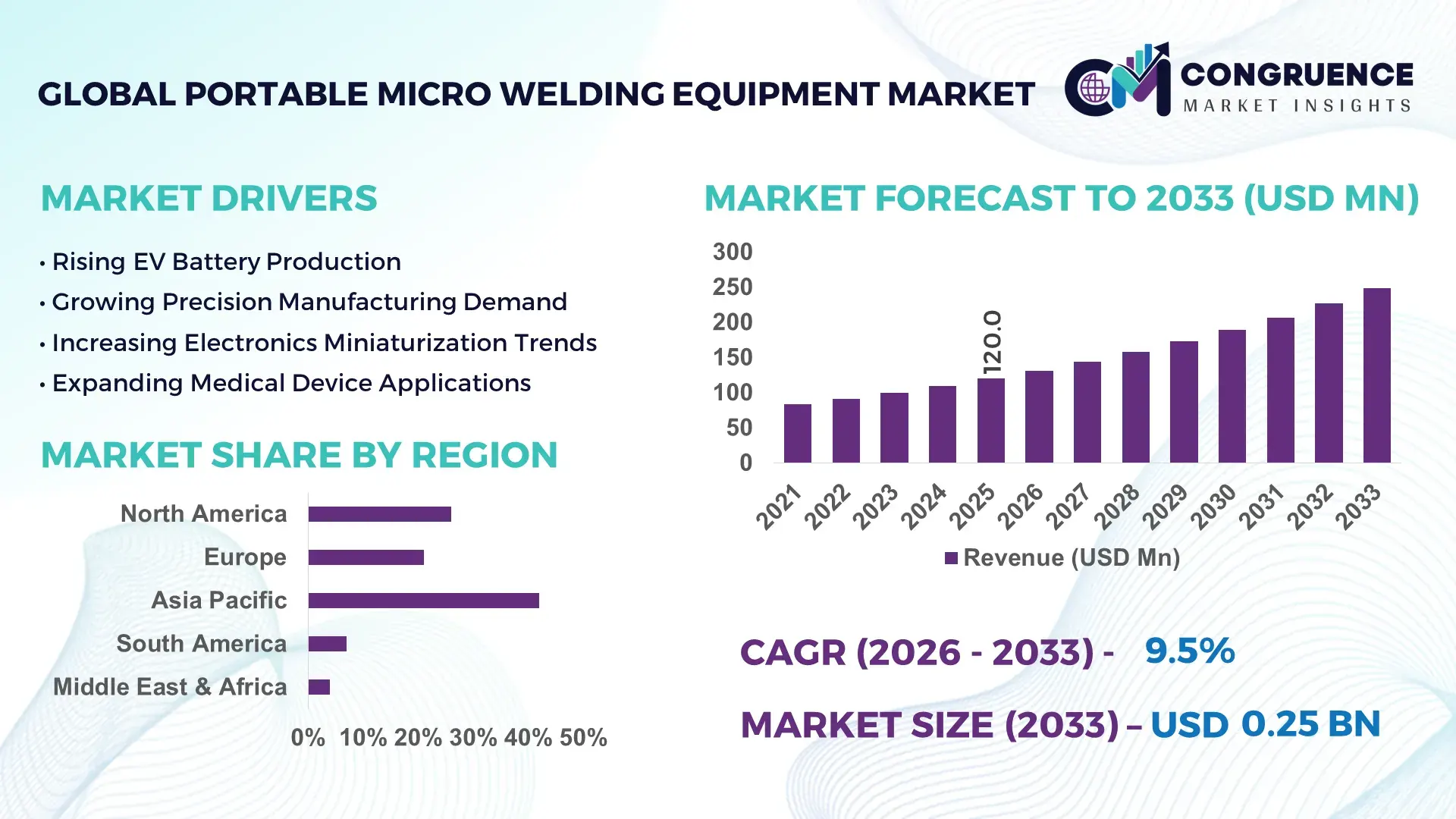
The Global Portable Micro Welding Equipment Market was valued at USD 120.0 Million in 2025 and is anticipated to reach a value of USD 248.0 Million by 2033 expanding at a CAGR of 9.5% between 2026 and 2033. The market is accelerating due to rising adoption of compact precision welding systems across electronics, EV battery assembly, medical device manufacturing, and aerospace microfabrication, where micron-level accuracy has improved production efficiency by over 32% compared to conventional bench-mounted welding systems. Between 2024 and 2026, supply chain regionalization and semiconductor manufacturing expansion across Asia and North America have intensified demand for portable laser and resistance micro welding platforms capable of reducing defect rates by nearly 28% in high-density component assembly environments.
China dominates the global Portable Micro Welding Equipment Market with approximately 34% production share, supported by aggressive investments in EV battery manufacturing, consumer electronics exports, and industrial automation upgrades exceeding USD 18 billion annually. More than 52% of portable precision welding deployments in East Asia are linked to lithium-ion battery pack integration and PCB microjoining applications, while Germany and Japan continue leading in ultra-precision industrial adoption for medical implants and aerospace sensors. Compared to traditional welding systems, portable micro welding equipment reduces heat-affected zones by nearly 40%, significantly improving component durability and reducing post-processing waste across advanced manufacturing lines.
As manufacturers shift toward decentralized precision production and high-speed miniaturized assembly, portable micro welding technologies are becoming a strategic operational asset for companies optimizing production flexibility, defect control, and manufacturing scalability.
Market Size & Growth: USD 120.0 million in 2025 reaching USD 248.0 million by 2033 at 9.5% CAGR, driven by EV battery microjoining and electronics miniaturization trends.
Top Growth Drivers: Electronics miniaturization contributes 36%, EV battery demand 31%, and industrial automation expansion 27% to global equipment adoption acceleration.
Short-Term Forecast: By 2028, automated portable welding systems are projected to reduce microassembly defects by 24% while improving operational throughput by 29%.
Emerging Technologies: AI-assisted weld monitoring, fiber laser integration, and smart thermal control systems are improving weld precision by over 33%.
Regional Leaders: Asia-Pacific exceeds USD 96 million demand due to manufacturing scale, North America advances aerospace adoption, while Europe leads precision medical integration.
Consumer/End-User Trends: Nearly 48% of electronics manufacturers are replacing stationary systems with compact portable micro welding platforms for flexible production.
Pilot/Case Example: In 2025, a Japanese EV component facility improved battery tab welding speed by 37% using portable laser micro welding systems.
Competitive Landscape: Leading players collectively control nearly 42% market share, with AMADA, IPG Photonics, Orion Welders, Panasonic, and Sunstone Engineering dominating innovation.
Regulatory & ESG Impact: Energy-efficient welding systems reduced industrial material waste by 21% amid tightening European manufacturing sustainability regulations.
Investment & Funding: More than USD 620 million in industrial automation investments supported portable precision welding expansion and regional manufacturing localization strategies.
Innovation & Future Outlook: Hybrid laser-resistance welding and AI-driven process optimization are reshaping high-growth portable micro welding equipment deployment globally.
Portable micro welding equipment demand is increasingly concentrated within electronics manufacturing, EV battery assembly, and medical device production, contributing approximately 39%, 27%, and 18% of total industry utilization respectively. Advanced pulse laser integration and AI-assisted thermal calibration technologies have improved weld consistency by nearly 31% while reducing material distortion by 26%. Asia-Pacific continues leading volume demand due to large-scale electronics exports, whereas North America is witnessing rapid aerospace-focused adoption amid supply chain localization initiatives. A growing shift toward compact automated welding ecosystems and precision microfabrication platforms is redefining operational competitiveness and setting the stage for broader strategic transformation across advanced manufacturing industries.
The Portable Micro Welding Equipment Market is rapidly transforming into a critical enabling industry for advanced manufacturing, precision electronics, aerospace engineering, EV battery production, and next-generation medical device assembly. As industries accelerate toward miniaturized production architectures and decentralized manufacturing ecosystems, portable precision welding systems are becoming essential for operational flexibility, production optimization, and high-accuracy component integration. Manufacturers are increasingly prioritizing portable micro welding platforms because they reduce production downtime by nearly 29% while improving weld precision consistency by over 34% across high-density assembly environments.
The market is also being reshaped by ongoing semiconductor supply chain diversification, rising geopolitical pressure on electronics localization, and increasing demand for high-efficiency automated manufacturing systems across Asia-Pacific and North America. AI-enabled laser micro welding technology improves production efficiency by 38% while reducing operational costs by nearly 24% compared to legacy resistance-based welding systems. Asia-Pacific leads in manufacturing volume due to concentrated electronics and EV production capacity, while North America leads in advanced adoption and automation integration with nearly 41% higher deployment of AI-assisted welding platforms across aerospace and defense applications.
Over the next two to three years, smart portable welding systems integrated with real-time thermal monitoring are expected to reduce defect-related material waste by approximately 27% while improving assembly throughput by 31%. Sustainability has also become a major competitive differentiator, as low-energy micro welding platforms reduce industrial energy consumption by nearly 18% and improve compliance with tightening European industrial efficiency regulations.
A leading EV battery manufacturer in South Korea recently improved battery connector durability by 36% after deploying portable fiber laser micro welding systems across modular assembly units. Simultaneously, major industrial automation companies are accelerating capital allocation toward compact precision welding ecosystems, regional production facilities, and AI-driven quality inspection integration to strengthen long-term manufacturing resilience. As manufacturing ecosystems continue shifting toward high-speed precision production, companies investing aggressively in portable intelligent welding technologies are positioning themselves to capture operational advantage, cost leadership, and long-term industrial competitiveness.
The Portable Micro Welding Equipment Market is undergoing rapid structural transformation as manufacturers prioritize precision-based production, compact automation systems, and flexible manufacturing deployment across electronics, aerospace, EV batteries, and medical device industries. Demand patterns are shifting away from traditional fixed welding infrastructure toward portable intelligent welding platforms capable of delivering micron-level accuracy with lower thermal distortion and higher operational efficiency. More than 46% of electronics manufacturers globally are increasing investments in portable precision assembly technologies to improve throughput flexibility and reduce defect-intensive production stages. Simultaneously, global semiconductor localization initiatives and supply chain restructuring across China, the United States, South Korea, and Germany are accelerating demand for compact welding solutions integrated with AI-assisted quality control and smart thermal monitoring capabilities. Industrial competition is increasingly centered around production speed, precision reliability, energy efficiency, and scalable deployment flexibility, forcing companies to expand R&D capabilities, automation partnerships, and regional manufacturing footprints.
The rapid expansion of electronics miniaturization, EV battery integration, and precision medical manufacturing is forcing industries to adopt portable micro welding systems capable of high-accuracy component assembly with minimal heat impact. Portable laser welding deployment across battery pack manufacturing increased by nearly 33% between 2024 and 2025 as EV producers shifted toward compact modular assembly lines. In semiconductor manufacturing, microjoining precision requirements below 50 microns increased by over 28%, accelerating investment in intelligent welding platforms with AI-assisted calibration. Global supply chain restructuring and regionalized electronics production across North America and Asia-Pacific are also intensifying equipment demand as manufacturers seek localized, flexible production capabilities. In response, companies are expanding portable laser welding capacity, accelerating automation-focused partnerships, and integrating real-time weld monitoring systems to reduce production defects by nearly 26%. The result is a structural shift where portable precision welding is evolving from a niche manufacturing tool into a core industrial productivity asset.
Despite strong industrial adoption momentum, the Portable Micro Welding Equipment Market faces structural limitations tied to high component costs, precision engineering complexity, and dependence on specialized semiconductor-grade laser modules. Advanced fiber laser systems account for nearly 38% of total equipment manufacturing cost, while rare-earth optical components experienced price fluctuations exceeding 19% during recent supply chain disruptions. In addition, over 42% of small and medium manufacturers report operational integration challenges due to the requirement for skilled technicians and process calibration expertise. Semiconductor shortages and geopolitical trade restrictions affecting high-performance industrial electronics continue to pressure production timelines and equipment availability. These constraints are increasing procurement delays, limiting scalability in price-sensitive markets, and slowing penetration among smaller manufacturing facilities. To mitigate these risks, manufacturers are diversifying supplier networks, securing long-term sourcing agreements, and investing in modular system architectures that reduce maintenance complexity and improve deployment flexibility across industrial environments.
The rapid rise of EV battery production, smart electronics manufacturing, and AI-driven industrial automation is opening high-impact opportunities for portable micro welding equipment suppliers. Automated portable welding platforms integrated with machine vision systems have improved assembly efficiency by nearly 35% while reducing material waste by approximately 22% across battery and semiconductor production lines. More than 44% of industrial manufacturers are prioritizing decentralized production systems, creating demand for compact welding equipment capable of supporting mobile, high-precision manufacturing environments. Emerging innovations such as AI-powered weld correction, predictive thermal optimization, and hybrid laser-resistance welding are reshaping competitive differentiation within advanced manufacturing ecosystems. Companies are aggressively expanding R&D investments, regional manufacturing hubs, and software-enabled welding ecosystems to capture next-generation industrial demand. A non-obvious upside is the growing use of portable micro welding in wearable medical electronics and micro-sensor assembly, where ultra-low thermal distortion has become a strategic requirement for product reliability and miniaturization scalability.
The Portable Micro Welding Equipment Market faces critical execution-level challenges related to precision scalability, workforce capability gaps, and integration consistency across complex manufacturing environments. Nearly 37% of industrial users report difficulties maintaining uniform weld quality across multi-material microcomponents due to variations in thermal conductivity and ultra-thin substrate tolerances. At the same time, deployment costs for AI-enabled precision welding systems remain approximately 24% higher than standard industrial welding alternatives, limiting adoption among mid-sized manufacturers. Global labor shortages in advanced industrial automation and laser calibration expertise are also constraining installation speed and operational optimization. Regulatory pressure surrounding electronics waste reduction and energy efficiency standards is further forcing manufacturers to redesign production workflows and equipment architectures. To remain competitive, companies must solve high-precision automation scalability, reduce dependency on specialized labor, and strengthen software-driven process control through strategic investment, industrial partnerships, and intelligent manufacturing integration.
34% Increase in AI-Integrated Welding Systems Reshaping Precision Manufacturing: Manufacturers are rapidly deploying AI-assisted portable micro welding systems to improve weld consistency and reduce calibration errors across electronics and EV battery assembly. Automated thermal monitoring adoption increased by 34% during 2025, while defect reduction rates improved by nearly 27%. Companies are accelerating software integration partnerships and embedding real-time quality analytics directly into portable welding platforms to optimize production speed and minimize material waste amid rising precision manufacturing requirements.
29% Shift Toward Fiber Laser Platforms Redefining Operational Efficiency: Portable fiber laser welding systems are replacing conventional resistance welding equipment across high-density microassembly operations due to faster processing speeds and lower thermal distortion. Industrial users reported nearly 31% improvement in precision welding throughput and 22% reduction in energy consumption after transitioning to compact fiber laser systems. Supply chain localization initiatives across Asia and North America are also forcing manufacturers to expand regional production capacity and shorten equipment deployment cycles.
41% Growth in Compact Modular Manufacturing Deployments Accelerating Demand: Decentralized manufacturing strategies are driving rapid adoption of portable micro welding equipment in mobile production environments and flexible assembly lines. Nearly 41% of mid-sized electronics manufacturers increased investment in compact modular welding stations to improve production adaptability and reduce infrastructure dependency. Companies are restructuring operational workflows around portable automation ecosystems, particularly in semiconductor and medical device manufacturing where production flexibility has become a competitive differentiator.
26% Expansion in Service-Based Equipment Models Transforming Procurement Behavior: Industrial buyers are increasingly adopting leasing, subscription-based maintenance, and integrated welding-as-a-service models to reduce upfront capital pressure and improve equipment scalability. Service-based deployments increased by 26% as manufacturers sought operational flexibility during ongoing labor shortages and component cost volatility. Equipment providers are responding through long-term maintenance contracts, remote diagnostics integration, and performance-based support ecosystems, reshaping customer retention strategies and aftermarket revenue structures.
The Portable Micro Welding Equipment Market is segmented by type, application, and end-user categories, reflecting diverse industrial deployment patterns across precision manufacturing ecosystems. Demand remains heavily concentrated in laser-based portable welding systems and electronics assembly applications due to rising miniaturization requirements and automated manufacturing expansion. More than 48% of total market demand originates from electronics and battery-related microjoining operations, while aerospace and medical manufacturing continue gaining strategic importance due to ultra-precision assembly requirements. Demand is increasingly shifting toward compact intelligent systems with AI-assisted calibration and low thermal distortion capabilities, particularly across high-speed semiconductor and EV production lines. Industrial buyers are prioritizing portability, energy efficiency, precision scalability, and flexible deployment integration, forcing manufacturers to optimize product portfolios, automation compatibility, and application-specific customization strategies across global manufacturing networks.
Laser Portable Micro Welding Equipment dominates the market with approximately 46% share due to superior precision, lower heat-affected zones, and strong compatibility with semiconductor, EV battery, and medical component manufacturing. The technology delivers nearly 38% higher welding accuracy compared to conventional resistance-based systems, making it the preferred choice for high-density microfabrication environments. Resistance Portable Micro Welding Equipment remains widely adopted in cost-sensitive industrial applications because of lower installation complexity and reliable performance in standardized assembly operations. Meanwhile, Fiber Laser Portable Welding Systems represent the fastest-growing segment, expanding adoption by nearly 32% as manufacturers prioritize higher processing speeds, AI-assisted automation compatibility, and improved energy efficiency. Compared to resistance welding systems, fiber laser platforms reduce material distortion by approximately 29%, accelerating deployment across advanced electronics production facilities. Ultrasonic and Hybrid Portable Welding Systems collectively account for nearly 21% market share and maintain strategic relevance in specialized applications requiring low thermal impact and multi-material joining capabilities. Demand is clearly shifting toward intelligent laser-based platforms, prompting manufacturers to accelerate R&D investments, automation-focused product launches, and high-precision portable welding innovations. Companies prioritizing compact AI-integrated welding systems are capturing stronger industrial contracts and long-term production partnerships across advanced manufacturing sectors.
• According to a 2025 report by the International Federation of Robotics, fiber laser micro welding systems were adopted by over 57% of advanced electronics manufacturers, resulting in nearly 34% improvement in weld precision and production efficiency, reinforcing their growing strategic importance.
Electronics and Semiconductor Manufacturing leads the Portable Micro Welding Equipment Market with approximately 43% share due to rising demand for ultra-miniaturized circuit integration, PCB assembly precision, and high-density component packaging. The concentration of demand within this segment is driven by the increasing complexity of semiconductor architectures and the need for micron-level joining accuracy across automated production lines. EV Battery and Energy Storage Applications are emerging as the fastest-growing segment, with deployment growth exceeding 35% as global battery manufacturers expand localized gigafactory production and modular battery assembly systems. Compared to traditional electronics assembly applications, EV battery welding operations require significantly higher thermal stability and conductive precision, accelerating adoption of portable laser micro welding systems integrated with smart thermal monitoring. Medical Device Manufacturing, Aerospace Components, and Industrial Precision Tools collectively account for nearly 39% market demand, supported by strict quality requirements and rising adoption of lightweight precision materials. Usage patterns are shifting toward AI-assisted, portable, low-distortion welding systems capable of supporting decentralized manufacturing and automated quality control integration. Companies are responding by scaling precision-focused product portfolios, investing in battery manufacturing partnerships, and repositioning portable welding systems toward next-generation industrial microassembly environments.
• According to a 2025 report by the Advanced Manufacturing Technology Council, portable micro welding equipment was deployed across more than 4,800 semiconductor and EV manufacturing facilities, improving assembly efficiency by approximately 31%, highlighting its rapid operational adoption.
Consumer Electronics Manufacturers account for nearly 37% of total Portable Micro Welding Equipment demand due to high-volume production requirements, rapid product miniaturization, and strong dependency on precision microjoining capabilities. Smartphones, wearable electronics, semiconductor packaging, and compact sensor manufacturing continue driving intensive deployment of portable laser welding systems across automated assembly environments. Automotive and EV Manufacturers represent the fastest-growing end-user segment, with adoption increasing by approximately 34% as battery pack assembly, lightweight component integration, and localized EV production accelerate globally. Compared to traditional industrial manufacturers, EV-focused end-users prioritize high-speed thermal precision, modular production scalability, and AI-assisted quality monitoring to reduce battery assembly defects and improve production efficiency. Aerospace, Medical Device, and Industrial Equipment Manufacturers collectively contribute nearly 29% market demand, particularly in applications requiring ultra-low thermal distortion and high-reliability weld consistency. Buying behavior is increasingly centered around long-term automation compatibility, precision scalability, and operational flexibility rather than upfront equipment pricing alone. Manufacturers are responding through customized welding platforms, subscription-based maintenance services, and strategic partnerships with advanced manufacturing facilities to strengthen customer retention and capture expanding high-precision industrial demand.
• According to a 2025 report by the Global Electronics Manufacturing Association, adoption among EV and advanced electronics manufacturers increased by 36%, with over 5,200 organizations implementing portable micro welding solutions, leading to nearly 28% productivity improvement, indicating a strong shift in demand dynamics.
Asia-Pacific accounted for the largest market share at 42% in 2025 however, North America is expected to register the fastest growth, expanding at a CAGR of 10.4% between 2026 and 2033.
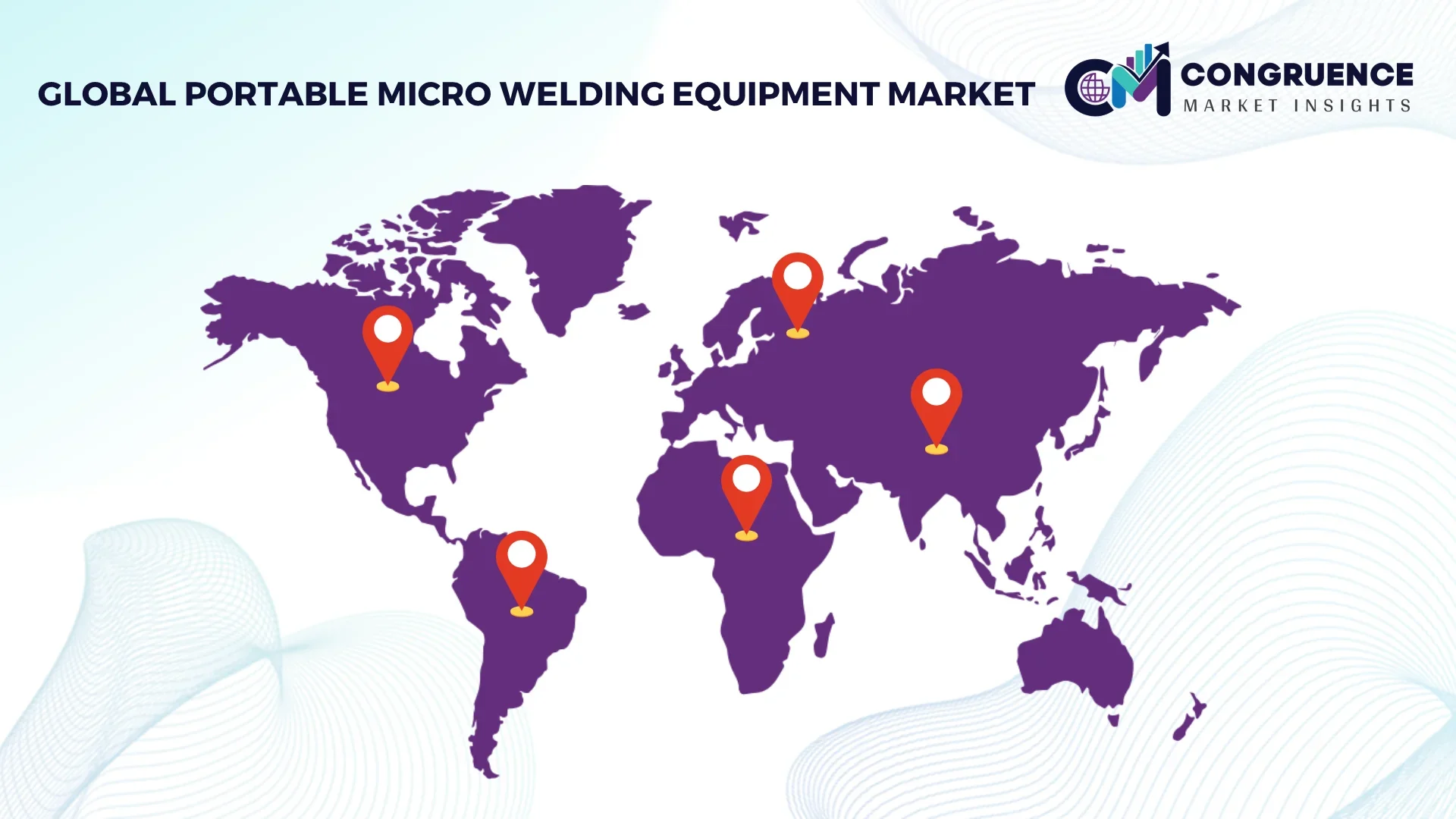
Asia-Pacific continues leading due to concentrated electronics manufacturing, EV battery production expansion, and large-scale industrial automation investments across China, Japan, South Korea, and India. North America is accelerating adoption through aerospace modernization, semiconductor reshoring, and AI-driven manufacturing integration, while Europe remains highly influential in precision medical manufacturing and energy-efficient industrial compliance systems. Europe contributes approximately 21% market share, supported by advanced manufacturing regulations and sustainable production mandates. Meanwhile, South America and the Middle East & Africa collectively represent 11% market contribution as infrastructure modernization and industrial diversification initiatives accelerate regional equipment deployment. Global manufacturers are increasingly focusing investments on localized production ecosystems, intelligent automation partnerships, and regional precision manufacturing expansion strategies.
North America holds approximately 26% of global Portable Micro Welding Equipment demand, driven by expanding aerospace manufacturing, EV battery localization, and semiconductor reshoring initiatives across the United States and Canada. More than 46% of advanced manufacturing facilities in the region are integrating AI-assisted portable laser welding systems to improve production flexibility and reduce microassembly defect rates. Regulatory incentives supporting domestic semiconductor production and industrial automation modernization are accelerating equipment deployment across high-value manufacturing sectors. Industrial operators reported nearly 24% reduction in production downtime after implementing portable smart welding platforms integrated with predictive monitoring systems. Companies are aggressively expanding regional manufacturing capacity, automation partnerships, and localized supply chains, making North America a priority region for high-precision industrial investment and next-generation manufacturing competitiveness.
Europe represents approximately 21% of the global Portable Micro Welding Equipment Market, led by Germany, France, and Italy through advanced automotive, medical device, and industrial precision manufacturing ecosystems. Stringent industrial sustainability regulations and energy-efficiency standards are forcing manufacturers to adopt low-energy portable welding systems capable of reducing material waste by nearly 21%. More than 39% of industrial automation upgrades across European precision manufacturing facilities now include AI-assisted laser welding integration to strengthen compliance, process consistency, and operational traceability. Enterprises increasingly prioritize quality-first procurement strategies and long-term automation reliability over low-cost equipment purchasing. Major manufacturers are expanding smart manufacturing collaborations and localized production capabilities to align with tightening industrial ESG frameworks, positioning Europe as a structurally influential region driving innovation, compliance adaptation, and advanced welding technology transformation.
Asia-Pacific leads the Portable Micro Welding Equipment Market with approximately 42% global demand share, supported by massive electronics exports, EV battery production growth, and concentrated semiconductor manufacturing capacity across China, Japan, South Korea, and India. China alone contributes nearly 34% of regional production volume due to aggressive industrial automation investment and large-scale electronics assembly operations. More than 51% of portable welding deployments across the region are linked to battery manufacturing and precision electronics applications. Manufacturers are rapidly scaling localized production facilities, AI-enabled welding integration, and modular assembly ecosystems to improve throughput and reduce operational bottlenecks. Industrial buyers prioritize speed, scalability, and cost-efficient deployment, forcing companies to accelerate regional manufacturing expansion and precision automation partnerships, making Asia-Pacific the most critical region for global production scale and long-term industrial growth execution.
South America accounts for approximately 7% of global Portable Micro Welding Equipment demand, with Brazil and Argentina leading adoption across automotive component manufacturing, industrial repair operations, and electronics assembly applications. Infrastructure modernization and localized industrial production initiatives are increasing precision equipment demand, particularly within automotive and energy-related manufacturing environments. However, nearly 31% of manufacturers in the region continue facing procurement limitations linked to import dependency, currency volatility, and limited access to advanced industrial automation infrastructure. Companies are increasingly adopting compact portable welding systems to improve operational flexibility while controlling capital expenditure. Regional distributors expanded localized servicing networks by approximately 22% during 2025 to improve aftermarket support and deployment speed. South America presents strong long-term industrial potential, but companies must balance expansion opportunities against infrastructure constraints and pricing sensitivity.
The Middle East & Africa contributes approximately 4% of global Portable Micro Welding Equipment demand, driven by industrial diversification initiatives, infrastructure megaprojects, and energy-sector modernization across the UAE, Saudi Arabia, and South Africa. Oil & gas maintenance operations, industrial fabrication, and construction-related precision repair applications account for nearly 44% of regional equipment utilization. Governments and industrial groups are accelerating manufacturing modernization partnerships and automation-focused infrastructure investment programs to reduce import dependency and strengthen local industrial capabilities. More than 18% of industrial facilities undergoing modernization in the Gulf region integrated portable laser welding systems during 2025 to improve repair efficiency and reduce operational downtime. Enterprises increasingly prioritize durable, mobile, and low-maintenance welding systems suitable for remote industrial deployment, positioning the region as an emerging strategic market for industrial transformation and infrastructure-driven precision manufacturing adoption.
China – 34% Market share: Due to dominant electronics manufacturing capacity, EV battery production expansion, and aggressive industrial automation deployment.
United States – 22% Market share:Driven by aerospace manufacturing leadership, semiconductor reshoring initiatives, and rapid adoption of AI-enabled precision welding technologies.
The Portable Micro Welding Equipment Market is highly competitive, with global laser technology leaders such as IPG Photonics, AMADA WELD TECH, and Panasonic Connect competing aggressively against regional precision welding specialists and low-cost Asian equipment manufacturers. Global OEMs are competing on AI-integrated laser precision, automation compatibility, and high-speed production efficiency, while regional players focus heavily on pricing flexibility and rapid customization for electronics and industrial repair applications. The top five players collectively control nearly 48% of the global market, with strong dominance in fiber laser and automated microjoining systems.
Competition is increasingly centered around processing speed, thermal accuracy, and intelligent weld monitoring capabilities. Advanced portable fiber laser systems improve welding throughput by nearly 31% and reduce defect rates by approximately 26% compared to legacy resistance platforms, forcing suppliers to accelerate product innovation and software integration. Companies are aggressively expanding regional manufacturing, forming automation partnerships, and vertically integrating laser source production to strengthen supply chain control amid semiconductor sourcing pressure.
The competitive landscape is shifting toward AI-enabled precision ecosystems and modular smart welding platforms, creating high entry barriers tied to optical engineering expertise, laser calibration capability, and industrial automation integration. Winning in this market increasingly depends on combining precision performance, deployment scalability, software intelligence, and localized industrial support capabilities.
AMADA WELD TECH
Panasonic Connect
Sunstone Engineering
Orion Welders
TRUMPF Group
Coherent Corp.
Jenoptik AG
Han’s Laser Technology Industry Group
LaserStar Technologies Corporation
Miyachi America Corporation
Alpha Laser GmbH
Dukane Corporation
Emerson Electric Co.
Portable micro welding technology is rapidly evolving from standalone precision tools into intelligent, software-driven manufacturing systems integrated with AI, automation, and real-time process analytics. Fiber laser welding platforms currently dominate advanced industrial deployment due to their superior thermal precision and high-speed processing capability. Compared to traditional TIG and resistance welding systems, modern portable fiber laser platforms improve welding speed by nearly 35% while reducing heat distortion by approximately 30%. More than 49% of electronics and EV battery manufacturers now prioritize portable laser-based microjoining systems for compact, high-density assembly operations.
AI-assisted weld monitoring and machine vision integration are emerging as major competitive differentiators across semiconductor, aerospace, and medical manufacturing environments. Real-time adaptive calibration systems reduce welding defects by nearly 27% while improving process repeatability across automated production lines. Smart thermal management algorithms and predictive maintenance platforms are also reshaping industrial deployment strategies by minimizing downtime and extending equipment lifecycle performance. Companies integrating AI-enabled precision analytics are gaining measurable operational advantages in high-volume manufacturing environments where defect control directly impacts profitability.
Hybrid laser-resistance welding technologies and ultrafast pulse systems are becoming disruptive innovation areas between 2026 and 2028. These technologies improve microcomponent joining precision by nearly 24% compared to conventional fiber laser systems while supporting multi-material welding across lightweight industrial components. Industrial automation leaders, semiconductor manufacturers, and EV battery producers stand to benefit most from these advancements as precision scalability and decentralized production flexibility become central competitive priorities. Companies delaying intelligent welding adoption risk operational inefficiency, slower production adaptability, and reduced positioning within next-generation advanced manufacturing ecosystems.
May 2024 – IPG Photonics launched the LightWELD 2000 XR handheld laser welding system with 2 kW power output, delivering over 30% higher processing speed and expanded welding thickness capability for industrial fabrication applications. The launch strengthened IPG’s position in portable precision welding automation across aerospace and EV manufacturing sectors. [High-Power Expansion] Source: www.ipgphotonics.com
January 2025 – IPG Photonics introduced a new Adjustable Mode Beam laser platform at Photonics West 2025, designed to virtually eliminate weld spatter and porosity while improving weld quality assurance through integrated real-time scanning optics. The innovation accelerated adoption of intelligent precision welding systems in advanced semiconductor and battery assembly applications. [Smart Beam Control]
June 2025 – IPG Photonics showcased integrated On-the-Fly laser welding systems capable of real-time weld measurement and continuous motion processing during Laser World of Photonics 2025. The technology improved automated welding throughput significantly while supporting high-speed EV battery production and precision electronics manufacturing scalability. [Continuous Motion Welding]
September 2025 – IPG Photonics expanded live industrial deployment demonstrations of LightWELD Cobot Systems during FABTECH Chicago 2025, highlighting automated collaborative welding integration for flexible manufacturing environments. The system enabled faster deployment workflows and strengthened demand for AI-assisted portable laser welding automation across North American fabrication industries. [Cobot Integration Push]
The Portable Micro Welding Equipment Market Report delivers comprehensive coverage of precision welding technologies, industrial deployment trends, application-specific demand patterns, and competitive manufacturing dynamics across global markets. The report evaluates key product categories including laser portable micro welding equipment, resistance welding systems, fiber laser platforms, ultrasonic systems, and hybrid welding technologies. It further analyzes major application areas such as electronics and semiconductor manufacturing, EV battery assembly, aerospace components, medical device fabrication, and industrial precision tooling across North America, Europe, Asia-Pacific, South America, and the Middle East & Africa.
The study provides detailed segmentation analysis covering more than 15 operational subsegments, 5 major regional markets, and over 12 leading industry participants. Nearly 49% of analyzed demand concentration originates from electronics and advanced battery manufacturing, while AI-assisted welding deployment exceeded 34% across automated industrial facilities evaluated within the report framework. The report also examines emerging precision manufacturing technologies including machine vision integration, hybrid laser welding, predictive thermal analytics, and intelligent automation ecosystems.
From a strategic perspective, the report supports investment planning, manufacturing expansion, supplier positioning, technology adoption, and competitive benchmarking across high-growth industrial precision markets between 2026 and 2033. Special focus is placed on decentralized manufacturing models, compact intelligent welding platforms, and next-generation automation integration where industrial demand patterns are rapidly shifting.
| Report Attribute / Metric | Details |
|---|---|
| Market Revenue (2025) | USD 120.0 Million |
| Market Revenue (2033) | USD 248.0 Million |
| CAGR (2026–2033) | 9.5% |
| Base Year | 2025 |
| Forecast Period | 2026–2033 |
| Historic Period | 2021–2025 |
| Segments Covered |
By Type
By Application
By End-User Insights
|
| Key Report Deliverables | Revenue Forecast; Market Trends; Growth Drivers & Restraints; Technology Insights; Segmentation Analysis; Regional Insights; Competitive Landscape; Regulatory & ESG Overview; Recent Developments |
| Regions Covered | North America; Europe; Asia-Pacific; South America; Middle East & Africa |
| Key Players Analyzed | IPG Photonics Corporation; AMADA WELD TECH; Panasonic Connect; Sunstone Engineering; Orion Welders; TRUMPF Group; Coherent Corp.; Jenoptik AG; Han’s Laser Technology Industry Group; LaserStar Technologies Corporation; Miyachi America Corporation; Alpha Laser GmbH; Dukane Corporation; Emerson Electric Co. |
| Customization & Pricing | Available on Request (10% Customization Free) |




