
Reports
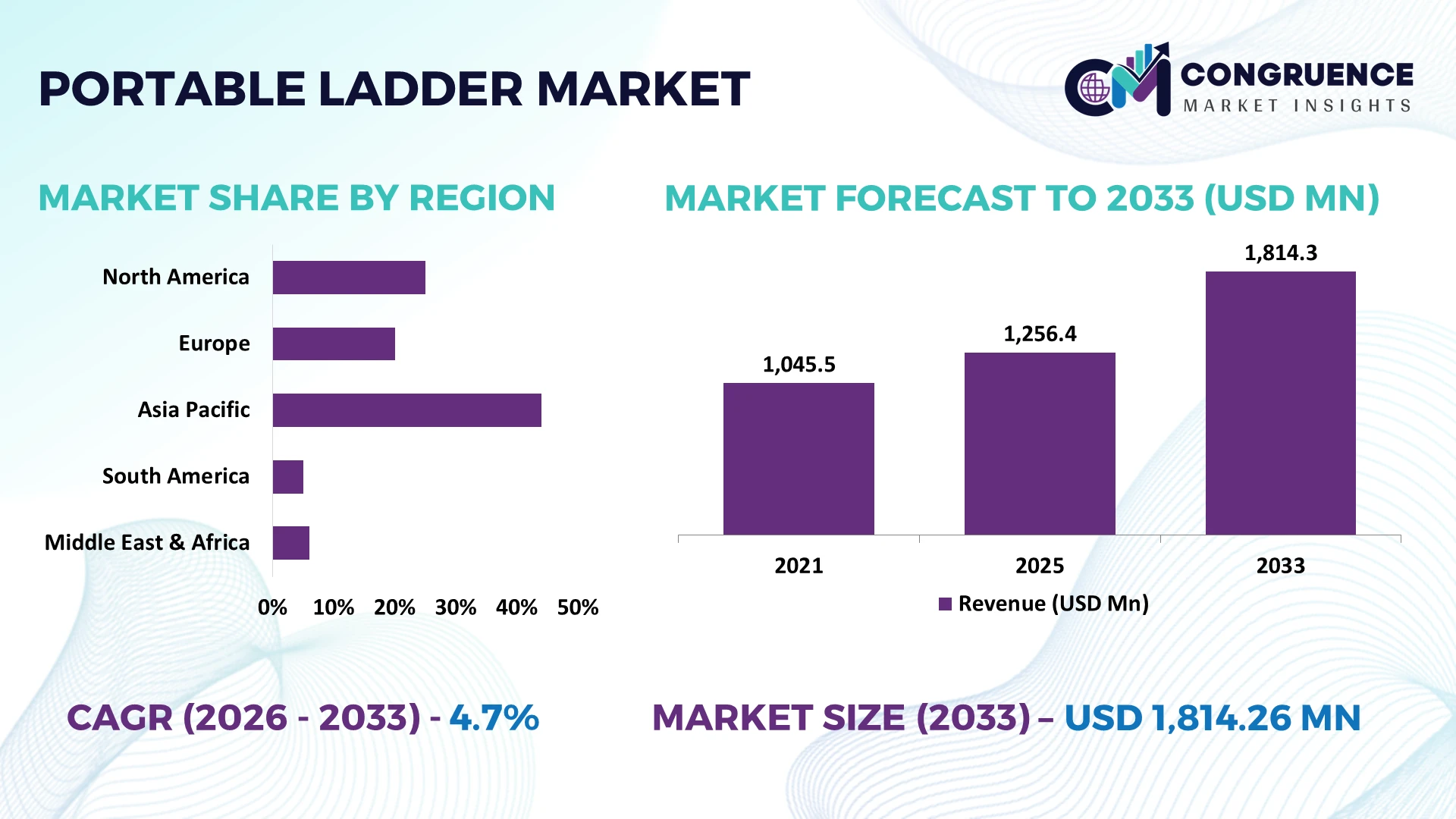
The Global Portable Ladder Market was valued at USD 1256.4 Million in 2025 and is anticipated to reach a value of USD 1814.26 Million by 2033 expanding at a CAGR of 4.7% between 2026 and 2033. Growth is driven by warehouse expansion, construction maintenance, utility fieldwork, telecom servicing, and replacement of heavy ladders with lightweight aluminum and electrically insulated fiberglass models.
The United States dominates portable ladder consumption with an estimated 27% global share, supported by construction, warehousing, utilities, telecommunications, and professional maintenance. Aluminum ladders represent approximately 55% of domestic unit demand, while fiberglass products maintain strong adoption among electrical contractors requiring nonconductive access equipment. U.S. consumption is roughly 2.4 times Germany’s level, reflecting a larger contractor and facility maintenance base. Infrastructure Investment and Jobs Act projects continue supporting utility, transportation, broadband, and public infrastructure maintenance activity requiring portable access equipment.
Manufacturers prioritizing lightweight structures, electrical safety, compact storage, and multi-position functionality can capture higher-value professional replacement demand.
Market Size & Growth: USD 1,256.4 million in 2025 reaches USD 1,814.26 million by 2033 at 4.7% CAGR, supported by professional maintenance and infrastructure activity.
Top Growth Drivers: Construction maintenance contributes an estimated 29% demand influence, home improvement 24%, and utility plus telecom servicing 18%.
Short-Term Forecast: By 2027, advanced lightweight ladder designs are expected to reduce carrying weight by approximately 15%, improving technician mobility and jobsite handling.
Emerging Technologies: Advanced fiberglass composites, telescoping structures, and smart stability indicators are gaining traction, with optimized materials delivering approximately 12% weight reduction.
Regional Leaders: By 2033, North America approaches USD 590 million, Asia Pacific USD 535 million, and Europe USD 455 million, supported by professional-grade product adoption.
Consumer/End-User Trends: Approximately 58% of mainstream professional unit demand favors aluminum models because contractors prioritize portability, corrosion resistance, and frequent repositioning.
Pilot/Case Example: 2025 fleet trials using lighter composite access equipment demonstrated approximately 10% faster repositioning during repetitive facility maintenance operations.
Competitive Landscape: Werner represents an estimated 14% global share, competing with Louisville Ladder, Little Giant, Hailo, and FACAL across professional and consumer segments.
Regulatory & ESG Impact: EN 131 requirements emphasize stability and structural testing, while lightweight designs can reduce material usage by approximately 8% versus conventional configurations.
Investment & Funding: More than USD 100 million in estimated manufacturing modernization and capacity programs supports automation, composite processing, partnerships, and regional supply-chain localization.
Innovation & Future Outlook: Next-generation designs targeting 10–15% lower weight increasingly combine multi-position geometry, composite materials, anti-slip systems, and compact storage for high-growth professional applications.
Portable Ladder Market demand is increasingly concentrated across construction, warehouse operations, electrical maintenance, telecom servicing, home improvement, and industrial facility management. Product development is shifting toward telescoping formats, multi-position hinges, reinforced fiberglass rails, anti-slip feet, and lighter aluminum structures. Professional buyers increasingly prioritize transportability and electrical isolation, with fiberglass accounting for approximately 35% of demand in safety-sensitive applications. EN 131 compliance continues influencing European product engineering, while supply-chain localization encourages manufacturers to shorten component sourcing and production cycles. These shifts establish the operational priorities shaping strategic market positioning.
Portable ladders are becoming strategically important as contractors, utilities, warehouses, and facility operators tighten productivity and worker safety requirements. Procurement is shifting from basic access equipment toward certified multi-position, telescoping, and nonconductive systems designed for frequent deployment. Infrastructure modernization in the United States and tighter EN 131 requirements in Europe reinforce replacement cycles, while manufacturers increasingly localize components to reduce exposure to international freight and aluminum supply disruptions.
Technology differentiation is moving toward weight reduction and faster deployment. Modern aerospace-grade aluminum and composite designs can weigh 15–20% less than comparable legacy steel configurations, reducing handling effort and vehicle payload. North American professional users emphasize fiberglass for electrical work, whereas Germany and other European markets show stronger penetration of compact multipurpose designs because storage, transportation, and standardized safety testing influence purchasing. Through 2028, premium lightweight and multi-position products are positioned to exceed 40% of professional replacement purchases.
A practical example is telecom field servicing, where technicians repeatedly reposition ladders between poles, cabinets, and building access points. Reducing equipment weight by 15% can materially improve daily handling efficiency. Manufacturers are consequently investing in composite rails, locking mechanisms, automated fabrication, and distributor partnerships. Competitive advantage will increasingly depend on combining certified safety, low carrying weight, deployment flexibility, and dependable localized supply.
Infrastructure maintenance is strengthening professional ladder replacement as utilities, telecom contractors, warehouses, and construction companies require safer access equipment for repetitive field operations. In the United States, approximately 60% of professional ladder usage involves aluminum products, while fiberglass can represent above 35% within electrical and utility applications because of nonconductive properties. Lightweight redesigns can reduce equipment mass by 15–20% versus comparable conventional configurations, improving technician mobility. Broadband deployment and grid modernization under U.S. infrastructure programs are expanding maintenance workloads across poles, substations, facilities, and communications assets. Manufacturers are responding with higher-capacity fiberglass models, multi-position platforms, reinforced locking systems, and expanded professional distribution. The strategic advantage lies in replacement frequency: intensive commercial users generate recurring demand well before structural product life is exhausted.
Aluminum, fiberglass reinforcement, resin, and transportation costs remain structural constraints because portable ladder manufacturers operate across price-sensitive retail and professional channels. Aluminum can represent approximately 30–40% of the material weight of mainstream metal ladder configurations, exposing production economics to commodity fluctuations. A 10% increase in aluminum input prices can translate into roughly 3–5% additional manufacturing cost depending on design and procurement structure. U.S. tariff exposure and changing international aluminum trade conditions further complicate sourcing decisions, particularly for manufacturers dependent on imported extrusions and components. Retailers resist rapid price adjustments, compressing supplier margins during commodity spikes. Producers are reducing exposure through dual sourcing, longer-term metal contracts, recycled-aluminum integration, and localized extrusion partnerships. Companies controlling rail fabrication and component procurement gain a meaningful margin advantage over import-dependent competitors.
Product intelligence offers an underdeveloped opportunity beyond conventional ladder construction. Sensor-enabled leveling, inclination indication, load alerts, and connected inspection records can address professional users managing large equipment fleets. Digital inspection workflows can shorten routine compliance checks by approximately 20–30%, while optimized aluminum and composite structures can lower product weight by 10–15% without sacrificing rated capacity. The United States presents strong potential among utilities and facility-management contractors, while India offers an additional opportunity as organized warehousing and telecom infrastructure expand professional access-equipment requirements. Through 2028, manufacturers are positioned to integrate QR-based inspection histories, replaceable wear components, and smart stability indicators into premium product families. R&D partnerships involving sensor suppliers and fleet-management platforms can transform ladders from commodity hardware into traceable safety assets, supporting higher-value recurring inspection and replacement ecosystems.
Maintaining consistent safety performance across product variants, user environments, and international standards creates a longer-term execution challenge. Ladder incidents frequently arise from incorrect setup, unsuitable inclination, unstable surfaces, or inappropriate product selection rather than structural failure alone. Professional fleets can contain hundreds or thousands of units, making inspection consistency difficult; manual checks can consume 15–25% more maintenance time than digitally documented inspection processes. European EN 131 requirements and U.S. ANSI and OSHA expectations also create different testing, labeling, load-rating, and workplace-use considerations. Manufacturers therefore face complexity when standardizing global platforms without increasing certification and engineering workloads. Investment must focus on intuitive locking mechanisms, visible wear indicators, digital inspection systems, installer education, and standardized modular components. Long-term competitiveness depends on reducing misuse-related variability while preserving rapid deployment and economical fleet maintenance.
Premium Lightweight Designs Gain Share: Professional procurement is moving toward reduced-weight aluminum and composite ladders as contractors prioritize vehicle loading and repetitive handling. Newer configurations are typically 10–18% lighter than comparable conventional products, while high-strength extrusions can reduce component mass by about 12%. U.S. manufacturers are expanding lightweight SKUs and redesigning rails, rungs, and braces to improve portability without lowering duty ratings.
Retail Portfolios Shift Toward Versatility: Home-improvement channels are allocating more shelf space to folding and convertible products that replace multiple single-purpose ladders. Multi-function configurations can support 4–6 working positions, while folded storage length can fall by more than 40% versus equivalent extension formats. Suppliers are consolidating overlapping SKUs and expanding modular product families, improving inventory productivity while giving retailers higher-value products within constrained merchandising space.
Manufacturing Automation Improves Consistency: Ladder production is adopting robotic welding, automated riveting, precision extrusion processing, and machine-vision inspection to improve repeatability. Automated fabrication can reduce selected assembly-cycle times by 15–25% and lower rework by around 10%. Labor availability pressures in U.S. manufacturing are accelerating equipment upgrades, with producers standardizing components and redesigning assembly cells to increase throughput without proportionally expanding direct labor.
Safety Features Move Upmarket: Anti-slip feet, oversized platforms, visual lock indicators, stabilizer bars, and improved handrails are becoming purchasing differentiators rather than accessories. Enhanced stabilizer configurations can increase effective ground-contact width by over 20%, while larger standing platforms provide 25–35% more usable footing area on selected designs. Manufacturers are expanding safety-led premium ranges as contractors increasingly evaluate setup stability and ergonomics alongside load capacity.
Step Ladders lead the Portable Ladder Market with an estimated 34% share, supported by self-supporting construction, competitive pricing, rapid setup, and broad applicability across professional and household tasks. Their mature supply base enables manufacturers to offer multiple heights and duty ratings without extensive platform redesign. Extension Ladders remain essential for roofing and exterior access, while Platform Ladders serve users requiring prolonged elevated positioning. Folding Ladders retain relevance where compact storage outweighs maximum working height.
Telescopic Ladders represent the fastest-developing type as urban contractors and mobile technicians prioritize compact transportation. Collapsed dimensions can be 60–75% shorter than deployed height, creating a meaningful advantage for service vehicles and constrained storage. Multi-Position Ladders are also gaining professional attention because one unit can replace several fixed configurations, potentially reducing fleet equipment counts by 20–30%. Manufacturers are strengthening telescoping locks, lightweight rails, hinge assemblies, and portability features, shifting product investment toward higher-value formats that improve equipment utilization rather than simply adding height variants.
Construction represents the leading application with an estimated 32% market share because framing, roofing, finishing, installation, and interior fit-out require portable elevation equipment throughout multiple project phases. Step and extension products dominate established workflows because they offer rapid relocation without powered access equipment. Maintenance represents another substantial application, while Painting and Cleaning favor lightweight products that reduce repositioning effort. Gardening remains concentrated around lower-height residential and landscaping tasks where portability and storage efficiency determine selection.
Electrical Work is the fastest-growing application as grid upgrades, building electrification, renewable installations, and data infrastructure increase technician access requirements. Fiberglass products can account for more than 60% of professional ladder selection in energized-work environments because nonconductive side rails provide a critical safety advantage. Warehousing is simultaneously strengthening as operators require mobile access for inventory, inspection, and facility servicing; multipurpose products can reduce equipment switching by approximately 20%. Suppliers are consequently expanding electrically rated fiberglass portfolios, industrial platforms, and maneuverable warehouse configurations while targeting specialist distributors serving electrical contractors and facility operators.
Construction is the dominant end-user group with an estimated 30% share, reflecting continuous ladder deployment across residential building, commercial projects, renovation, roofing, and finishing activities. Contractors purchase across several duty classes and heights, producing greater unit intensity than Residential buyers focused primarily on occasional maintenance. Industrial and Commercial customers emphasize durability and inspection compliance, while Agriculture requires portable access around buildings, equipment, and storage facilities. Manufacturers target these established buyers through contractor-grade ranges, volume pricing, distributor networks, and replaceable wear components.
Utilities represent the fastest-developing end-user category as electricity-network modernization, broadband rollout, distributed energy systems, and field inspection increase technician deployment. Fiberglass can exceed 65% of ladder usage for selected electrical utility tasks where conductive materials introduce unacceptable exposure. Warehousing is another strategically important buyer group as larger fulfillment facilities increase inspection and maintenance intensity; standardized access fleets can improve equipment availability by roughly 15%. Suppliers are prioritizing nonconductive rails, high duty ratings, fleet identification features, and utility-distributor partnerships, while residential portfolios increasingly compete through compact storage and multipurpose functionality.
North America accounted for the largest market share at 34.2% in 2025 however, Asia-Pacific is expected to register the fastest growth, expanding at a CAGR of 5.8% between 2026 and 2033.

Professional Replacement Shifts Toward Safety-Certified Equipment
North America accounts for approximately 34.2% of global portable ladder demand, anchored by high professional utilization across construction, facility maintenance, utilities, telecommunications, and logistics. U.S. workplace requirements favor ANSI-rated equipment and OSHA-compliant operating practices, strengthening replacement demand for fiberglass and heavy-duty aluminum configurations. The region also has extensive installed commercial infrastructure: the United States operates more than 20,000 warehouse establishments, creating recurring requirements for inventory access, lighting maintenance, inspections, and building services. Contractors increasingly standardize ladder fleets by duty rating rather than purchasing equipment job by job. Canadian demand differs through stronger exposure to residential renovation, utilities, and resource-sector maintenance. Suppliers are expanding contractor distribution, fleet-oriented product ranges, and rapid replacement availability, making channel coverage increasingly important alongside product engineering.
United States Market Outlook: The United States leads through its large contractor workforce, extensive electrical infrastructure, mature home-improvement retail network, and substantial renovation activity. Construction employment exceeds 8 million workers, creating a deep professional user base. Manufacturers increasingly differentiate through ANSI duty classes, fiberglass electrical protection, ergonomic handling, and national distributor availability rather than competing solely on retail price.
Safety Regulation Reshapes Product Engineering
Europe holds approximately 27.1% of global demand, with Germany, the United Kingdom, France, Italy, and the Netherlands supporting concentrated professional consumption. EN 131 requirements have shifted product engineering toward wider stabilizer systems, improved structural testing, dimensional consistency, and clearer load classifications. This regulatory environment favors established manufacturers capable of absorbing certification and redesign costs while limiting low-specification imports. Compact folding and multi-position products have stronger relevance in dense urban markets where service vehicles and storage areas are constrained. Construction renovation also matters structurally: roughly 85% of European buildings were constructed before 2000, sustaining extensive maintenance requirements. Producers are redesigning platforms around standardized components, recyclable aluminum, replaceable feet, and improved locking systems, allowing regulatory compliance to support portfolio simplification rather than simply adding manufacturing cost.
Germany Market Outlook: Germany combines advanced manufacturing capability with a large skilled-trades economy and rigorous equipment standards. More than 2 million craft enterprises and establishments support recurring access-equipment requirements across building services, electrical work, installation, and industrial maintenance. Domestic buyers emphasize tested durability, compact transport dimensions, replaceable components, and conformity documentation, favoring technically differentiated suppliers over low-cost commodity offerings.
Manufacturing Scale Meets Infrastructure Deployment
Asia-Pacific represents approximately 25.3% of global portable ladder consumption and combines substantial manufacturing capacity with expanding construction, logistics, telecom, and industrial maintenance requirements. China remains central to aluminum ladder production because its extrusion ecosystem supports high-volume rail, rung, hinge, and platform fabrication. India is becoming increasingly important on the demand side as organized warehousing, urban construction, renewable power installations, and telecom servicing broaden professional equipment requirements. Japan and South Korea maintain more mature demand centered on compact, high-quality access products suited to space-constrained facilities. China accounts for more than half of global primary aluminum output, giving domestic manufacturers significant material-processing scale. Export-oriented producers are increasing automated welding, standardized components, and compliance-oriented testing as overseas buyers tighten specifications and diversify procurement beyond purely price-based sourcing.
China Market Outlook: China benefits from unmatched aluminum-processing depth, dense component supplier networks, and extensive export manufacturing infrastructure. Annual primary aluminum production exceeds 40 million tonnes, supporting cost-efficient extrusion availability for ladder producers. Competitive positioning is shifting from basic OEM output toward telescopic, multi-position, and internationally certified products as manufacturers pursue higher-value exports and branded distribution.
Formal Construction Expands Professional Equipment Demand
South America represents approximately 6.9% of global portable ladder demand, led by Brazil and followed by Argentina, Chile, and Colombia. Purchasing remains concentrated in construction, industrial maintenance, utilities, painting, and commercial facility services, while informal contracting continues to sustain price-sensitive conventional ladder demand. Brazil's extensive logistics and industrial base is encouraging greater use of standardized aluminum and fiberglass equipment among organized enterprises. Renewable power installations provide another operational trigger: Brazil has installed more than 50 GW of solar generation capacity, expanding inspection and maintenance requirements across distributed and utility-scale assets. Currency volatility and imported component costs constrain premium-product penetration outside major industrial centers. Manufacturers and distributors are responding with localized inventories, simplified professional ranges, regional assembly, and stronger dealer networks to reduce replenishment times and foreign-exchange exposure.
Brazil Market Outlook: Brazil provides the strongest operating base through its construction scale, industrial facilities, electrical networks, and rapidly expanding distributed energy infrastructure. The country has more than 3 million formal construction workers, sustaining professional access-equipment usage. Suppliers targeting contractors increasingly emphasize durable aluminum products, electrically safer fiberglass models, local inventory availability, and repairable components to reduce lifecycle ownership costs.
Megaproject Investment Raises Equipment Standards
Middle East & Africa contributes approximately 6.5% of global portable ladder demand, with procurement concentrated in Gulf construction, oil and gas maintenance, utilities, commercial facilities, and African urban infrastructure. Saudi Arabia and the United Arab Emirates increasingly require professional-grade access equipment as large developments shift contractor procurement toward documented safety specifications and standardized site equipment. Saudi construction activity associated with Vision 2030 includes more than USD 1 trillion in announced and planned infrastructure and real-estate projects, creating substantial downstream requirements for installation and maintenance tools. South Africa provides a different demand profile centered on industrial facilities, power infrastructure, mining services, and building maintenance. Suppliers are strengthening project-distributor relationships, increasing fiberglass availability for electrical applications, and maintaining local inventories to address long international replenishment cycles.
Saudi Arabia Market Outlook: Saudi Arabia is the region's strongest strategic demand center because airports, hospitality developments, industrial projects, utilities, and large mixed-use developments create intensive contractor deployment. Vision 2030 projects have raised procurement expectations around certified equipment and site safety. Manufacturers with local distributors, project inventories, high-duty aluminum ranges, and nonconductive fiberglass portfolios hold a practical advantage in contractor qualification.
Werner, Little Giant Ladder Systems, Louisville Ladder, Hailo, and FACAL compete across professional, industrial, and consumer channels, with global brands challenging regional manufacturers through safety engineering, distribution depth, and broader product portfolios. The top five players account for approximately 38% of market demand, leaving substantial room for specialist and local suppliers. Werner and Louisville Ladder emphasize contractor-grade aluminum and fiberglass platforms, while Little Giant differentiates through multi-position functionality and compact deployment. Premium engineered products command roughly 15–25% price advantages, while automated fabrication can reduce selected assembly costs by 10–15%. Competitors are expanding distributor partnerships, consolidating component platforms, localizing extrusion sourcing, and investing in lighter structures and improved locking mechanisms. The competitive shift favors vertically coordinated suppliers able to control quality, certification, and replenishment speed. Safety testing, tooling investment, brand credibility, and established retail access remain significant entry barriers. Winning requires certified performance, differentiated portability, dependable supply, and channel-specific product architecture.
Werner Co.
Little Giant Ladder Systems
Louisville Ladder
Hailo-Werk Rudolf Loh GmbH & Co. KG
FACAL S.r.l.
Altrex B.V.
ZARGES GmbH
Günzburger Steigtechnik GmbH
TB Davies (Cardiff) Ltd.
Featherlite Industrial Ladders Ltd.
Cotterman Company
Bauer Corporation
Tri-Arc Manufacturing Company
JOMY SA
Current portable-ladder technology is shifting toward lighter fiberglass composites, high-strength aluminum extrusions, automatic leveling, and controlled telescoping mechanisms. Lightweight fiberglass designs can cut ladder mass by 15% versus conventional professional step ladders, improving vehicle loading and jobsite handling. Automatic levelers capable of compensating for 8.5 inches of uneven ground eliminate repeated lifting. Adoption is strongest among construction, electrical, HVAC, and inspection trades, where portability and setup speed influence technician productivity.
Emerging designs combine visual lock indicators, micro-adjust mechanisms, enlarged platforms, tool-storage tops, and multi-position geometry. Compared with legacy fixed-position ladders, convertible systems can consolidate three to five access configurations into one unit, lowering fleet duplication by an estimated 20–30%. Telescoping products compress to roughly one-quarter of deployed height, improving van storage efficiency. Manufacturers with professional distribution benefit because these features support premium positioning while solving contractor constraints around transport, storage, and uneven surfaces.
Disruptive development through 2026–2028 will center on sensor-assisted stability, digital inspection records, QR-linked asset histories, and predictive fleet replacement. Digitized inspection workflows can reduce documentation time by 20% while improving traceability across enterprise fleets. Integration with safety-management platforms will turn ladders from standalone hardware into managed access assets, rewarding suppliers combining certified structures, connected compliance, and serviceability.
March 2024 HAILO presented the LP Outdoor platform and T100 FlexLine telescopic ladder at Cologne’s International Hardware Fair, introducing two access products addressing uneven surfaces and operational-safety requirements. The launches broadened HAILO’s professional portfolio toward safer, application-specific portable access solutions.
September 2025 Werner expanded manufacturing at its Maldon, Essex facility, adding three UK-made product lines: TradePRO D-Rung Triple Extension, X4 ExtensionPLUS Combination, and Roof Ladders. Localization shortened supply exposure, safeguarded employment, and established the first phase of planned UK scaling.
January 2025 the American Ladder Institute reported a 21% decline in ladder accidents causing serious injury or death between 2020 and 2024. The findings strengthened industry emphasis on training, correct ladder selection, and safer setup practices across professional workplaces nationwide.
January 2026 Little Giant Ladder Systems secured U.S. patent 12,529,264 covering combination ladders and related components after a 2025 continuation filing. The grant strengthened intellectual-property protection around configurable ladder engineering, supporting differentiated product development in multi-function professional portable access equipment.
The Portable Ladder Market Report evaluates competitive and operational conditions across Step, Extension, Platform, Telescopic, Folding, and Multi-Position Ladders, alongside Construction, Maintenance, Warehousing, Painting, Electrical Work, Cleaning, and Gardening applications. End-user coverage spans Construction, Industrial, Commercial, Residential, Warehousing, Utilities, and Agriculture. The analysis examines North America, Europe, Asia-Pacific, South America, and Middle East & Africa, including country-level deployment patterns and professional versus household purchasing behavior.
Technology coverage includes lightweight aluminum structures, nonconductive fiberglass, automatic leveling, telescoping mechanisms, multi-position hinges, enhanced stabilizers, and emerging digital inspection systems. Professional ladder configurations account for a substantial share of replacement activity, while premium designs increasingly target 10–20% weight reductions and improved fleet utilization. The report benchmarks leading manufacturers, segment positioning, regulatory influences, localization strategies, and niche safety-led applications, supporting investment planning, geographic expansion, portfolio prioritization, competitive positioning, and technology decisions through 2033.
| Report Attribute/Metric | Report Details |
|---|---|
Market Revenue in 2025 | USD 1256.4 Million |
Market Revenue in 2033 | USD 1814.26 Million |
CAGR (2026 - 2033) | 4.7% |
Base Year | 2025 |
Forecast Period | 2026 - 2033 |
Historic Period | 2021 - 2025 |
Segments Covered | By Type
By Application
By End-User
|
Key Report Deliverable | Revenue Forecast, Growth Trends, Market Dynamics, Segmental Overview, Regional and Country-wise Analysis, Competition Landscape |
Region Covered | North America, Europe, Asia-Pacific, South America, Middle East, Africa |
Key Players Analyzed | Werner Co., Little Giant Ladder Systems, Louisville Ladder, Hailo-Werk Rudolf Loh GmbH & Co. KG, FACAL S.r.l., Altrex B.V., ZARGES GmbH, Günzburger Steigtechnik GmbH, TB Davies (Cardiff) Ltd., Featherlite Industrial Ladders Ltd., Cotterman Company, Bauer Corporation, Tri-Arc Manufacturing Company, JOMY SA |
Customization & Pricing | Available on Request (10% Customization is Free) |




