
Reports
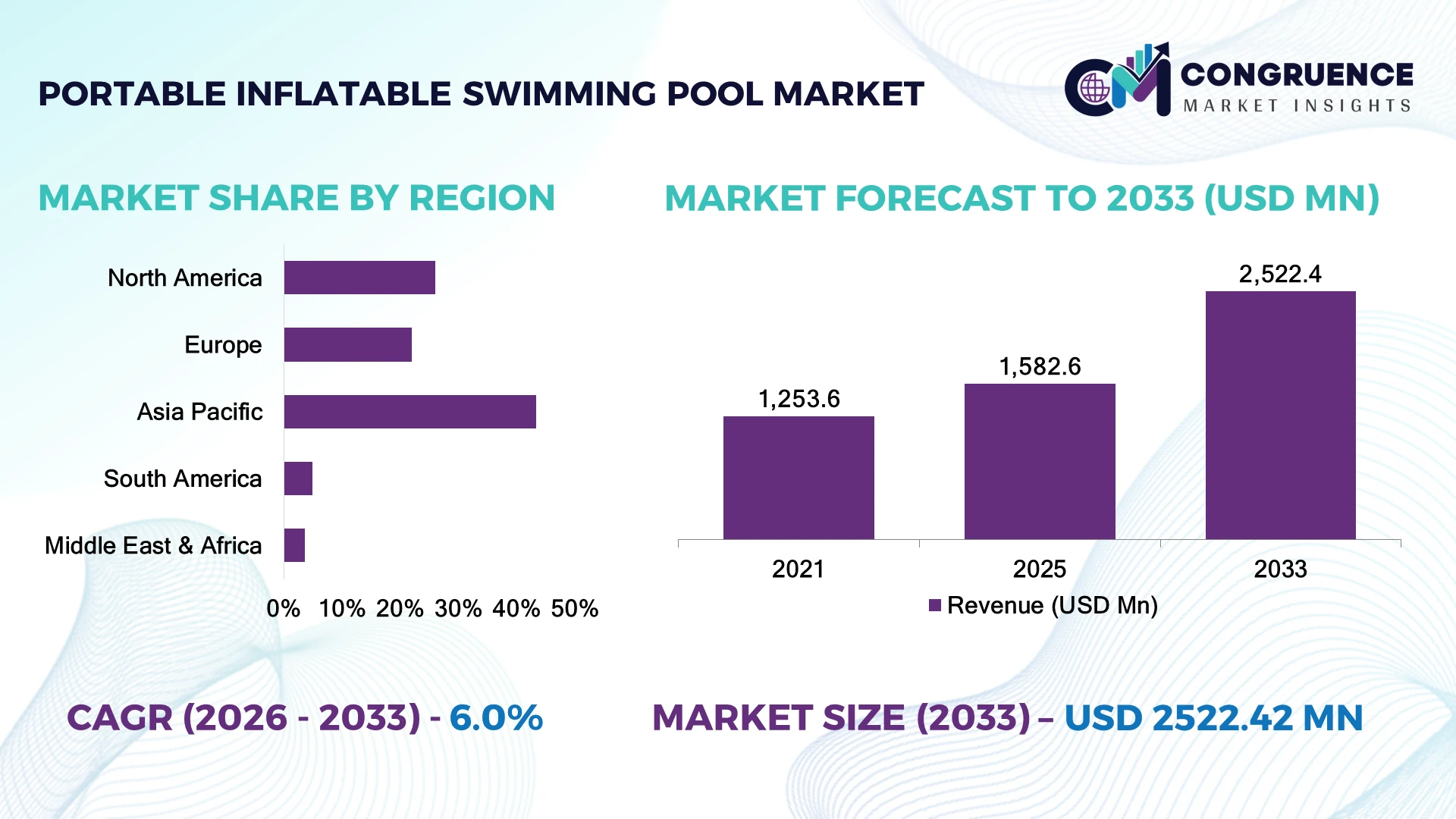
The Global Portable Inflatable Swimming Pool Market was valued at USD 1,582.6 Million in 2025 and is anticipated to reach a value of USD 2,522.4 Million by 2033 expanding at a CAGR of 6.0% between 2026 and 2033. Growth is driven by rising demand for affordable home recreation, rapid product innovation in puncture-resistant materials, and expanding e-commerce distribution supported by compact, easy-to-install designs.
China accounts for approximately 46% of global manufacturing capacity, supported by large-scale PVC processing, automated production lines, and export-oriented consumer goods industries. More than 68% of inflatable pool exports originate from Chinese manufacturers, while the United States remains the largest consumer market for premium family pools. Ongoing global supply-chain diversification since recent geopolitical trade realignments has encouraged additional production investments across Southeast Asia, improving sourcing flexibility and reducing procurement concentration.
Manufacturers prioritizing material innovation, diversified production networks, and premium product differentiation will strengthen long-term competitive positioning.
Market Size & Growth: USD 1,582.6 million in 2025, reaching USD 2,522.4 million by 2033 at 6.0% CAGR, driven by home recreation demand.
Top Growth Drivers: Family recreation (+21%), e-commerce sales (+18%), premium product upgrades (+15%).
Short-Term Forecast: By 2028, manufacturing efficiency improves by 16% through automated fabrication.
Emerging Technologies: Reinforced PVC, anti-UV coatings, and automated air-valve systems improve durability.
Regional Leaders: Asia-Pacific (~USD 980 million), North America (~USD 670 million), Europe (~USD 510 million), supported by online retail expansion.
Consumer/End-User Trends: Around 63% of purchases are made by households with children under 12 years.
Pilot/Case Example: In 2026, automated production reduced material waste by approximately 14% at large manufacturing facilities.
Competitive Landscape: Leading brands control nearly 52% of market demand through product innovation and retail reach.
Regulatory & ESG Impact: Recyclable material adoption increased by approximately 19% across premium product lines.
Investment & Funding: More than USD 420 million supports manufacturing expansion and supply-chain modernization.
Innovation & Future Outlook: Smart inflation accessories and sustainable materials are reshaping premium product positioning.
Portable inflatable swimming pools continue gaining popularity across residential households, seasonal recreation, and outdoor leisure markets because of their convenience, affordability, and space efficiency. Advanced multi-layer PVC materials improve puncture resistance by approximately 22%, while manufacturers increasingly adopt recyclable packaging and localized sourcing to strengthen supply resilience. These developments position the market for stronger product differentiation and strategic expansion discussed below.
The portable inflatable swimming pool market has become strategically significant as manufacturers compete through product quality, supply-chain resilience, and premium consumer experiences rather than pricing alone. Rising urbanization, limited backyard space, and increasing investment in home-based recreation are reshaping purchasing behavior. Supply-chain diversification across Southeast Asia and greater digital retail penetration are encouraging companies to redesign sourcing strategies and strengthen regional fulfillment capabilities.
Modern reinforced PVC construction and multi-layer seam welding improve product durability by approximately 24% compared with conventional inflatable pool designs while reducing warranty-related defects by nearly 18%. North America leads premium product adoption through higher consumer spending, whereas Asia-Pacific dominates manufacturing scale and export capacity through integrated production ecosystems. Over the next two to three years, nearly 38% of new product launches are expected to emphasize sustainable materials, enhanced portability, and simplified installation features.
Manufacturers are expanding partnerships with online retailers, investing in automated fabrication technologies, and introducing modular accessory ecosystems including filtration, covers, and quick-drain systems. A practical example is the deployment of automated heat-sealing production lines that improve manufacturing consistency while reducing material waste. Companies combining durable product engineering, efficient supply chains, and premium consumer-focused innovation will establish stronger competitive positions in the evolving portable inflatable swimming pool market.
Growing consumer spending on home-based leisure and outdoor family recreation is accelerating demand for portable inflatable swimming pools across residential markets. Approximately 64% of purchases are made by households with children, while premium oversized models account for nearly 29% of new product introductions. In the United States, expanding e-commerce fulfillment networks have shortened average delivery times by approximately 18%, making seasonal products more accessible. This shift is increasing replacement purchases and encouraging consumers to upgrade from entry-level designs to reinforced multi-layer models. Manufacturers are responding through automated production expansion, premium material innovation, and partnerships with online retail platforms, creating differentiated product portfolios that improve durability, customer satisfaction, and inventory responsiveness.
Fluctuating PVC resin prices and dependence on imported synthetic materials continue to pressure manufacturing costs and pricing stability. Raw materials represent approximately 47% of total production costs, while international freight expenses remain nearly 16% above pre-disruption averages for seasonal consumer goods. China continues to dominate upstream PVC processing, exposing manufacturers to supply disruptions arising from trade policy adjustments and logistics bottlenecks. These structural constraints reduce inventory flexibility and compress operating margins during peak demand periods. Companies are mitigating risk by diversifying sourcing across Southeast Asia, negotiating long-term polymer procurement contracts, and increasing localized component production to improve cost stability and supply continuity.
Manufacturers are creating new revenue opportunities through integrated accessory ecosystems rather than competing solely on pool size or pricing. Nearly 34% of premium product launches now include filtration systems, solar-powered pumps, or smart inflation devices that simplify setup and maintenance. Japan and South Korea are accelerating demand for compact recreational products designed for limited outdoor spaces, encouraging modular product innovation. Automated air-pressure monitoring reduces setup time by approximately 21% while minimizing inflation-related failures. Companies are investing in accessory development, collaborative product ecosystems, and recyclable materials to strengthen customer retention and increase average selling value beyond traditional seasonal offerings.
Balancing product affordability with stricter environmental expectations presents a significant execution challenge for manufacturers. Approximately 41% of consumers now consider recyclable materials during purchase decisions, yet only around 24% of production currently incorporates recycled polymer content without affecting durability. Compliance with evolving product safety and chemical regulations in Europe requires continuous material validation and manufacturing process upgrades. These operational pressures increase development complexity and extend product qualification cycles. Companies must invest in advanced polymer engineering, automated quality inspection, and strategic material partnerships to maintain durability, regulatory compliance, and competitive product differentiation while scaling sustainable manufacturing practices.
Premium Material Upgrades Manufacturers are rapidly replacing conventional PVC with reinforced multi-layer composites that improve puncture resistance by approximately 22% and extend product lifespan by nearly 18%. Automated welding processes reduce defect rates, while retailers expand premium product portfolios to address increasing consumer expectations for durability and long-term value.
E-Commerce Fulfillment Expansion Digital retail continues reshaping seasonal purchasing patterns, with online sales representing nearly 58% of consumer purchases and order fulfillment times improving by approximately 17%. Companies are expanding regional warehouses, optimizing inventory forecasting, and strengthening logistics partnerships to improve availability during peak summer demand.
Compact Urban Designs Demand is shifting toward space-efficient inflatable pools designed for balconies, patios, and smaller residential properties. Compact models account for approximately 31% of new product introductions, while modular accessories increase repeat purchases by nearly 15%. Manufacturers are redesigning product dimensions to match changing urban housing trends and consumer lifestyles.
Sustainable Packaging Adoption Recyclable packaging usage has increased by approximately 26%, while optimized packaging designs reduce transportation volume by nearly 14%, lowering logistics costs and warehouse requirements. Growing environmental expectations and evolving packaging regulations are prompting manufacturers to automate packaging operations, improve material efficiency, and integrate sustainability into product positioning without compromising retail performance.
Family-sized portable inflatable swimming pools accounted for approximately 57% of the market in 2025, driven by their larger water capacity, multi-user functionality, and strong appeal among households seeking cost-effective outdoor recreation. Their balance of affordability, durability, and ease of installation makes them the preferred choice across suburban residential markets. Nearly 66% of premium retail inventory is allocated to family-sized models as manufacturers prioritize reinforced PVC construction, integrated seating, and quick-drain systems. Product standardization and scalable manufacturing continue to support efficient production while strengthening retailer margins during seasonal demand peaks.
Kids' inflatable swimming pools represent the fastest-growing segment as parents increasingly seek compact, safe, and easily portable recreational products. Adult lounge pools and specialty inflatable spa-style pools remain strategically important, catering to premium lifestyle buyers and urban consumers with limited outdoor space. Around 28% of new product launches now feature child-safe materials, UV-resistant coatings, and modular accessory compatibility. Manufacturers are expanding premium product lines, collaborating with retail chains, and investing in differentiated designs that strengthen brand positioning while capturing higher-value consumer segments.
A 2026 consumer recreation assessment indicated that family-oriented inflatable pools remained the preferred seasonal outdoor recreation product for households with children, supported by increasing demand for larger-capacity and enhanced safety designs.
Residential household use accounted for approximately 74% of market demand in 2025, reflecting strong consumer preference for convenient home-based outdoor recreation. Portable inflatable swimming pools offer low installation costs, seasonal flexibility, and minimal space requirements compared with permanent pools, making them highly attractive for families. Nearly 69% of online purchases are made for residential backyards, patios, or garden spaces, encouraging manufacturers to introduce larger capacities, integrated filtration options, and premium comfort features. Retailers continue expanding direct-to-consumer distribution and seasonal inventory planning to meet predictable peak demand.
Commercial recreational use represents the fastest-growing application as resorts, holiday parks, childcare centers, and temporary event venues increasingly adopt portable pool solutions for seasonal operations. Educational institutions and community recreation programs also contribute to demand by utilizing portable pools for training and summer activities. Approximately 23% of newly introduced commercial models emphasize rapid installation, reinforced construction, and higher durability. Companies are expanding commercial product portfolios, strengthening institutional partnerships, and introducing modular accessories that improve operational efficiency across temporary recreational environments.
Industry findings released during 2025 highlighted that residential purchases continued to represent the majority of seasonal inflatable pool sales, while commercial recreation facilities accelerated procurement of heavy-duty portable pool solutions for temporary installations.
Households accounted for approximately 78% of market demand in 2025, supported by rising investment in home leisure products, family recreation, and outdoor lifestyle improvements. Consumers value portable inflatable swimming pools for their affordability, portability, and simple installation without permanent construction. Around 64% of household purchases are completed through e-commerce platforms, encouraging manufacturers to optimize packaging, improve logistics efficiency, and introduce premium bundled accessories. Product customization, attractive designs, and enhanced safety features continue strengthening consumer loyalty within this dominant segment.
Commercial hospitality operators represent the fastest-growing end-user group as hotels, resorts, vacation rentals, and recreation centers increasingly adopt portable pools for flexible guest amenities. Schools, childcare centers, and community organizations remain important institutional buyers, particularly for seasonal recreational programs. Nearly 27% of manufacturers have expanded customized product offerings specifically for hospitality and institutional customers through reinforced materials, larger capacities, and maintenance-friendly designs. Companies are strengthening distributor partnerships, value-added accessory packages, and targeted pricing strategies to secure long-term growth across both residential and commercial customer groups.
A 2026 enterprise survey of outdoor recreation retailers found that households continued to account for the largest share of portable inflatable swimming pool purchases, while hospitality operators recorded the strongest increase in premium commercial-grade product adoption.
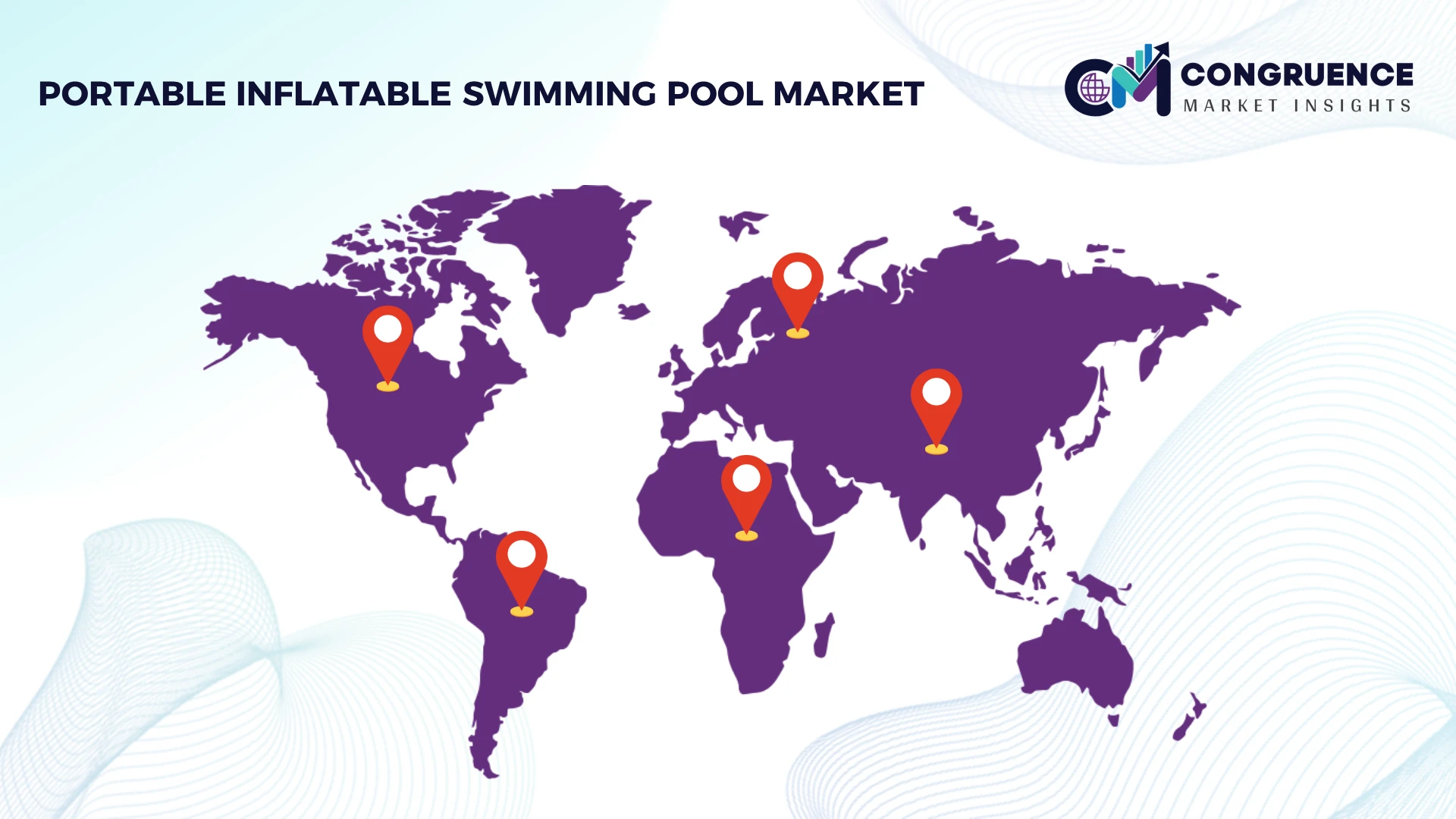
Asia-Pacific accounted for the largest market share at 48.3% in 2025 however, North America is expected to register the fastest growth, expanding at a CAGR of 6.8% between 2026 and 2033.
Premium Outdoor Living Drives Product Upgrades
North America represents approximately 28% of the global market, supported by strong consumer spending on home recreation, mature e-commerce infrastructure, and growing demand for premium outdoor leisure products. Seasonal purchasing patterns, coupled with larger residential properties, continue to encourage adoption of family-sized inflatable pools with integrated filtration and reinforced construction. Nearly 57% of premium inflatable pool sales in the region occur through online retail platforms, prompting manufacturers to strengthen direct-to-consumer distribution and regional fulfillment networks. Companies are expanding warehouse capacity, improving inventory forecasting, and introducing value-added accessory bundles to increase customer retention while shortening seasonal delivery cycles and enhancing operational efficiency.
United States Market Outlook: The United States remains the largest regional market due to high household spending on backyard recreation, well-developed retail networks, and strong seasonal demand. Approximately 69% of premium inflatable pool purchases are concentrated within suburban residential households. Manufacturers continue investing in localized distribution centers, automated fulfillment, and premium product collections featuring UV-resistant materials and quick-installation systems to improve customer experience and market penetration.
Sustainability Shapes Consumer Purchasing Decisions
Europe accounts for approximately 22% of global demand, driven by growing preference for compact outdoor leisure products and increasing emphasis on environmentally responsible manufacturing. Consumers are favoring durable inflatable pools produced with recyclable packaging and reduced chemical content. Around 34% of premium product introductions now incorporate sustainable packaging and enhanced material durability. Manufacturers are strengthening regional distribution partnerships while investing in improved polymer processing technologies that extend product life and reduce warranty claims.
Germany Market Outlook: Germany leads the European market through strong purchasing power, established retail channels, and increasing demand for premium family recreation products. Nearly 37% of regional premium outdoor leisure product sales are concentrated in Germany during peak summer seasons. Companies continue introducing durable, space-efficient inflatable pools while expanding partnerships with specialty retailers and online marketplaces to strengthen nationwide product availability.
Manufacturing Scale Reinforces Global Supply Leadership
Asia-Pacific dominates the market through extensive manufacturing capacity, integrated PVC processing, and export-oriented consumer goods production. The region contributes approximately 48% of global demand while supplying the majority of portable inflatable swimming pools distributed worldwide. More than 71% of high-volume production lines now utilize automated heat-sealing and precision welding technologies to improve manufacturing consistency and reduce material waste. Manufacturers continue expanding export infrastructure, modernizing production facilities, and strengthening supplier ecosystems to improve cost competitiveness and supply-chain resilience.
China Market Outlook: China serves as the industry's primary manufacturing hub, accounting for approximately 46% of global production capacity through highly integrated consumer goods supply chains. Automated production facilities have improved manufacturing efficiency by nearly 19%, supporting large-scale international shipments. Companies continue investing in advanced PVC processing, automated quality inspection, and diversified export networks to strengthen global competitiveness while responding to evolving trade dynamics.
Seasonal Recreation Expands Retail Demand
South America represents approximately 5% of global demand, supported by rising consumer spending on affordable outdoor recreation and expanding modern retail distribution. Seasonal tourism, warmer climates, and increasing penetration of online shopping continue to strengthen market activity. Around 22% of seasonal recreational product sales are now fulfilled through digital retail channels, encouraging manufacturers to improve regional inventory planning and logistics capabilities. Although import dependence remains high, suppliers are strengthening local distributor partnerships and expanding after-sales support to improve product availability and customer satisfaction.
Brazil Market Outlook: Brazil is the region's largest consumer market due to favorable climate conditions, expanding middle-income households, and growing investment in family-oriented leisure products. Nearly 49% of South America's portable inflatable swimming pool sales are generated in Brazil. Companies continue strengthening retail partnerships, enhancing seasonal inventory management, and expanding localized marketing strategies to improve brand visibility and consumer engagement.
Hospitality Expansion Supports Leisure Product Adoption
The Middle East & Africa accounts for approximately 3.7% of global demand, driven by expanding hospitality infrastructure, premium residential developments, and increasing investment in family leisure amenities. Resorts, private villas, and recreational facilities are incorporating portable inflatable pools for seasonal and temporary applications. Approximately 18% of premium hospitality leisure purchases now include portable recreational water products, encouraging suppliers to strengthen regional distribution and customized product offerings. Companies are expanding logistics partnerships and improving climate-resistant product designs to address demanding environmental conditions.
United Arab Emirates Market Outlook: The United Arab Emirates leads the regional market through luxury residential developments, premium hospitality investments, and strong consumer demand for outdoor lifestyle products. Around 42% of high-value recreational leisure purchases within the Gulf are concentrated in the UAE. Manufacturers are strengthening partnerships with specialty retailers, introducing UV-resistant premium models, and improving regional distribution efficiency to serve both residential and hospitality customers.
Intex Recreation, Bestway, Polygroup, Jilong, and FUNBOY compete across distinct value propositions, with global volume manufacturers challenging premium lifestyle brands through product innovation and retail reach. The top five players collectively account for approximately 55% of global market activity. Intex and Bestway leverage manufacturing scale and supply-chain efficiency, while FUNBOY differentiates through premium design and brand positioning. Polygroup and Jilong compete on private-label production, retailer partnerships, and cost optimization. Automated production improves manufacturing efficiency by approximately 16%, reinforced PVC technology extends product durability by nearly 22%, and optimized logistics reduce seasonal replenishment time by around 18%. Companies are expanding Southeast Asian production, strengthening e-commerce partnerships, introducing recyclable materials, and vertically integrating component sourcing to improve responsiveness. Product safety compliance, seasonal inventory planning, and durable material engineering remain key entry barriers. Winning requires resilient supply chains, differentiated product design, premium material quality, and rapid fulfillment across global retail channels.
Intex Recreation Corp.
Bestway Global Holding Inc.
Polygroup Limited
Jilong Group Co., Ltd.
FUNBOY LLC
Swimline Corporation
Aqua Leisure Recreation, LLC
Kokido Development Ltd.
General Foam Plastics Corp.
Happy Hop (East Inflatables)
SunClub (Wehncke GmbH & Co. KG)
Sable (Sunvalley Group)
Portable inflatable swimming pool technology is advancing through reinforced multi-layer PVC construction, high-frequency heat-sealing, anti-UV surface coatings, and automated leak-testing systems. Approximately 68% of premium product launches now incorporate reinforced polymer structures that improve puncture resistance by nearly 22% while extending usable product life by around 18%. Automated welding improves production consistency and reduces manufacturing defects, allowing suppliers to enhance product reliability and shorten seasonal production cycles.
Compared with conventional single-layer PVC pools, reinforced composite designs deliver approximately 25% greater structural durability and reduce air leakage by nearly 17%. Integrated quick-inflation valves, modular filtration compatibility, and compact folding designs further improve consumer convenience. Intex, Bestway, and Polygroup benefit through large-scale automated manufacturing and vertically integrated supply chains, while premium lifestyle brands strengthen competitive positioning through differentiated materials, innovative aesthetics, and accessory ecosystems.
Between 2026 and 2028, recyclable polymers, bio-based PVC alternatives, digital production monitoring, and modular smart accessories will redefine premium product development. Nearly 36% of planned manufacturing upgrades include automated inspection, precision cutting, and sustainable packaging technologies. Companies investing now will improve production efficiency, strengthen regulatory readiness, reduce material waste, and build stronger brand differentiation through higher-quality, environmentally responsible recreational products.
February 2025 Intex Recreation introduced a new eco-focused inflatable pool range featuring biodegradable material concepts, rapid-inflation technology, and integrated filtration for urban households. Business impact: strengthens premium product differentiation and sustainability positioning across Asia-Pacific.
April 2025 Bestway Global Holding inaugurated a new manufacturing facility in Vietnam to strengthen Southeast Asian production capacity and regional supply-chain resilience. Business impact: expands manufacturing flexibility and supports faster export fulfillment.
July 2025 Intex Recreation, Bestway, and Polygroup participated in a coordinated safety recall covering approximately 5 million above-ground pools, introducing redesigned repair solutions to improve child safety. Business impact: accelerates product safety enhancements and quality-control investment. Source: U.S. Consumer Product Safety Commission coverage
October 2025 Bestway Global Holding released its 2026 summer product catalog earlier than previous seasonal cycles, enabling distributors to optimize inventory planning and merchandising. Business impact: supports more efficient retail forecasting and global product rollout.
The report provides comprehensive analysis of the Portable Inflatable Swimming Pool market across product types, applications, end-user groups, and major geographic regions. It evaluates family-sized pools, children's pools, adult leisure models, and specialty portable designs used across residential households, hospitality facilities, recreational centers, and institutional environments. Regional coverage includes North America, Europe, Asia-Pacific, South America, and the Middle East & Africa, supported by country-level manufacturing, distribution, and consumer demand assessments. More than 60% of the evaluation focuses on household purchasing patterns, premium product adoption, and evolving retail channels.
The study further examines reinforced PVC technology, automated manufacturing, sustainable materials, modular accessories, and digital retail strategies influencing competitive positioning. It analyzes product innovation, seasonal deployment trends, manufacturing concentration, company benchmarking, and supply-chain developments to support investment planning, production expansion, market entry strategies, competitive differentiation, and long-term business decision-making across the global portable inflatable swimming pool market between 2026 and 2033.
| Report Attribute/Metric | Report Details |
|---|---|
|
Market Revenue in 2025 |
USD 1,582.6 Million |
|
Market Revenue in 2033 |
USD 2,522.4 Million |
|
CAGR (2026 - 2033) |
6% |
|
Base Year |
2025 |
|
Forecast Period |
2026 - 2033 |
|
Historic Period |
2021 - 2025 |
|
Segments Covered |
By Type
By Application
By End-User
|
|
Key Report Deliverable |
Revenue Forecast, Growth Trends, Market Dynamics, Segmental Overview, Regional and Country-wise Analysis, Competition Landscape |
|
Region Covered |
North America, Europe, Asia-Pacific, South America, Middle East, Africa |
|
Key Players Analyzed |
Intex Recreation Corp., Bestway Global Holding Inc., Polygroup Limited, Jilong Group Co., Ltd., FUNBOY LLC, Swimline Corporation, Aqua Leisure Recreation, LLC, Kokido Development Ltd., General Foam Plastics Corp., Happy Hop (East Inflatables), SunClub (Wehncke GmbH & Co. KG), Sable (Sunvalley Group) |
|
Customization & Pricing |
Available on Request (10% Customization is Free) |




