
Reports
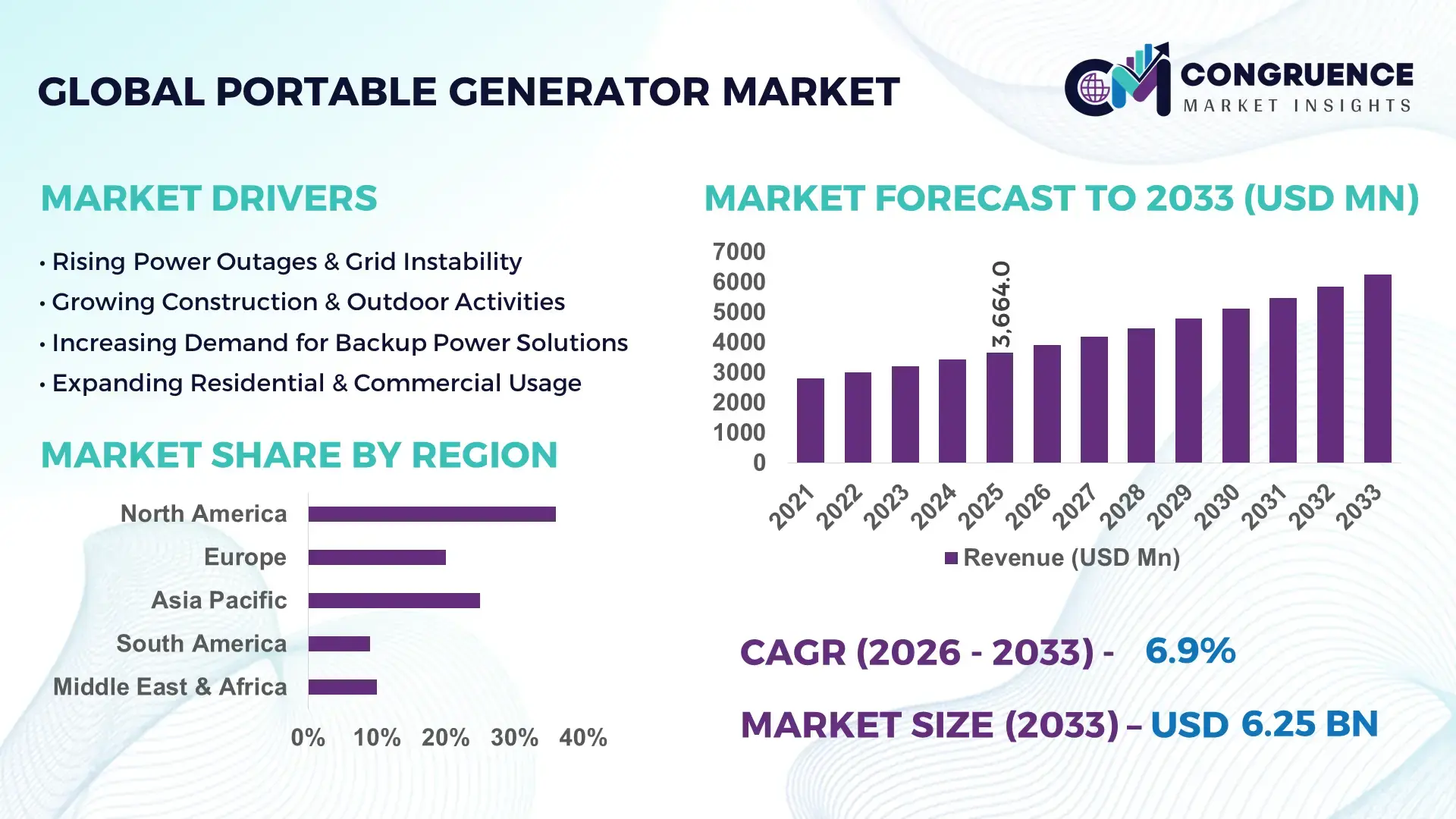
The Global Portable Generator Market was valued at USD 3664 Million in 2025 and is anticipated to reach a value of USD 6248.51 Million by 2033 expanding at a CAGR of 6.9% between 2026 and 2033. The market is primarily driven by the increasing frequency of power outages and rising demand for reliable backup power solutions across residential, commercial, and industrial sectors.
The United States remains a dominant force in the portable generator market, supported by advanced manufacturing capabilities and strong infrastructure investment. The country produces over 2.5 million portable generators annually, with a significant portion used in residential backup applications, accounting for nearly 60% of domestic consumption. Industrial applications, including construction and emergency services, contribute approximately 25% of total demand. The U.S. market also benefits from continuous technological advancements such as inverter-based generators and hybrid fuel systems, which improve fuel efficiency by up to 30% and reduce emissions significantly. Additionally, government-backed disaster preparedness programs and rising adoption of smart grid-compatible generators have further strengthened the country’s production and deployment ecosystem.
Market Size & Growth: USD 3664 Million in 2025, projected to reach USD 6248.51 Million by 2033 at 6.9% CAGR, driven by rising power reliability concerns and infrastructure expansion.
Top Growth Drivers: Power outage frequency increase (35%), construction activity growth (28%), residential backup adoption rise (32%).
Short-Term Forecast: By 2028, fuel efficiency improvements are expected to increase operational performance by 22%.
Emerging Technologies: Inverter generator systems, dual-fuel and tri-fuel generators, IoT-enabled remote monitoring solutions.
Regional Leaders: North America projected at USD 2200 Million by 2033 with strong residential demand; Asia-Pacific at USD 2100 Million driven by infrastructure expansion; Europe at USD 1500 Million with sustainability-focused adoption.
Consumer/End-User Trends: Increasing adoption among homeowners, small businesses, and construction contractors, with demand shifting toward quieter and fuel-efficient models.
Pilot or Case Example: In 2024, a utility-backed pilot in Japan reduced outage downtime by 18% through smart portable generator integration.
Competitive Landscape: Market leader holds approximately 18% share, followed by key players such as Honda, Generac, Yamaha, Briggs & Stratton, and Cummins.
Regulatory & ESG Impact: Emission regulations and noise control standards are driving adoption of low-emission and inverter-based generators.
Investment & Funding Patterns: Over USD 1.2 Billion invested in generator innovation, hybrid systems, and distributed energy solutions.
Innovation & Future Outlook: Integration of AI-based load management, battery hybridization, and renewable-compatible portable generators shaping future growth.
The portable generator market is influenced by diverse industry sectors including residential, construction, oil and gas, and emergency services, with residential usage contributing nearly 45% of total demand. Technological innovations such as inverter generators, which reduce noise levels by up to 50%, and dual-fuel systems that enhance operational flexibility are transforming product offerings. Regulatory frameworks emphasizing emission reduction and fuel efficiency are encouraging manufacturers to adopt cleaner technologies. Regionally, Asia-Pacific is witnessing rapid consumption growth due to urbanization and infrastructure development, while North America continues to lead in product innovation and adoption. Emerging trends include integration with renewable energy sources and smart home systems, indicating a shift toward sustainable and intelligent portable power solutions.
The portable generator market holds strategic importance as a critical component of decentralized energy systems and emergency preparedness frameworks. Increasing reliance on uninterrupted power supply across industries has positioned portable generators as essential assets in sectors such as healthcare, telecommunications, and construction. Advanced inverter technology delivers up to 25% higher fuel efficiency compared to conventional generators, significantly reducing operational costs and emissions. North America dominates in volume due to widespread residential usage, while Asia-Pacific leads in adoption with nearly 40% of enterprises integrating portable generators into infrastructure projects.
By 2028, the integration of AI-driven load optimization systems is expected to improve energy efficiency by approximately 20%, enabling smarter energy management in both residential and commercial applications. Companies are increasingly committing to ESG targets, including a 30% reduction in carbon emissions by 2030 through the adoption of cleaner fuel technologies and hybrid generator systems.
In 2024, a major infrastructure project in India achieved a 15% reduction in fuel consumption by deploying IoT-enabled portable generators with real-time monitoring capabilities. This demonstrates the growing role of digital transformation in enhancing generator performance and operational efficiency. Looking ahead, the portable generator market is expected to evolve as a cornerstone of resilient energy systems, supporting sustainable growth, regulatory compliance, and technological innovation. Its role in disaster recovery, remote power supply, and decentralized energy networks ensures its continued strategic relevance across global markets.
The rising frequency of power outages due to aging grid infrastructure and extreme weather events is a major driver of the portable generator market. In several regions, outage durations have increased by over 20% in the past decade, prompting households and businesses to invest in backup power solutions. Residential adoption has surged, with nearly 35% of homeowners in outage-prone areas owning or planning to purchase portable generators. In the commercial sector, industries such as retail and healthcare rely on uninterrupted power to prevent operational disruptions and financial losses. Construction sites, which often operate in off-grid environments, also contribute significantly to demand. The growing need for energy reliability and continuity is accelerating the deployment of portable generators across diverse applications.
Stringent environmental regulations related to emissions and noise pollution are limiting the growth of the portable generator market. Governments across regions have implemented strict standards requiring generators to reduce carbon monoxide and nitrogen oxide emissions by up to 40%. Compliance with these regulations often necessitates advanced technologies, increasing production costs and limiting affordability for price-sensitive consumers. Additionally, noise restrictions in urban areas are pushing manufacturers to redesign products, which further raises development expenses. Traditional fuel-based generators face increasing scrutiny, leading to reduced adoption in environmentally regulated markets. These factors collectively create barriers for manufacturers and slow down the widespread adoption of conventional portable generators.
The integration of hybrid and renewable energy technologies presents significant opportunities for the portable generator market. Solar-assisted portable generators and battery hybrid systems are gaining traction, offering up to 30% reduction in fuel consumption and emissions. These solutions are particularly attractive in remote and off-grid locations where access to conventional fuel sources is limited. The increasing adoption of clean energy solutions, supported by government incentives and sustainability goals, is encouraging innovation in this segment. Additionally, the development of smart generators with IoT connectivity enables real-time monitoring and predictive maintenance, improving operational efficiency by nearly 20%. These advancements are opening new avenues for market expansion across residential, commercial, and industrial applications.
Rising fuel costs and supply chain disruptions pose significant challenges to the portable generator market. Fuel prices have fluctuated by over 25% in recent years, directly impacting the operating costs of portable generators and reducing their cost-effectiveness. Additionally, global supply chain constraints have led to delays in the availability of critical components such as engines and electronic systems, increasing production lead times. Manufacturers are also facing higher logistics and raw material costs, which are often passed on to consumers, affecting demand. These challenges are further compounded by geopolitical uncertainties and trade restrictions, creating an unpredictable business environment for market participants.
• Rapid Shift Toward Inverter-Based Generators with 30% Efficiency Gains
The portable generator market is experiencing a strong transition toward inverter-based models, driven by demand for fuel efficiency and reduced noise levels. Inverter generators now account for nearly 38% of total unit sales, compared to 25% five years ago. These systems deliver up to 30% better fuel efficiency and operate at noise levels as low as 50–60 decibels, making them suitable for residential and recreational use. Additionally, over 45% of new product launches in 2024 featured inverter technology, indicating a clear shift in manufacturer focus toward compact, eco-friendly solutions.
• Expansion of Dual-Fuel and Tri-Fuel Systems Increasing Adoption by 28%
The integration of dual-fuel and tri-fuel capabilities is transforming purchasing decisions across both residential and commercial segments. Approximately 42% of newly sold portable generators now support multiple fuel options, enabling users to switch between gasoline, propane, and natural gas. This flexibility has led to a 28% increase in adoption among emergency preparedness users. Industrial buyers, particularly in construction and utilities, are also adopting these systems to mitigate fuel supply risks and reduce downtime during operations.
• Growth in IoT-Enabled Smart Generators Enhancing Monitoring by 20%
Smart portable generators equipped with IoT-based monitoring systems are gaining traction, particularly in developed markets. Around 35% of premium generator models now feature remote monitoring capabilities, allowing users to track fuel levels, runtime, and maintenance schedules in real time. These systems have demonstrated a 20% improvement in operational efficiency by reducing unexpected breakdowns. Integration with mobile applications and smart home ecosystems is further strengthening demand, especially among tech-savvy residential consumers and small businesses.
• Rising Demand from Construction Sector Driven by 55% Modular Project Adoption
The adoption of modular and prefabricated construction practices is significantly influencing demand patterns in the portable generator market. Approximately 55% of new construction projects are utilizing modular techniques, which require reliable portable power solutions for off-site fabrication and on-site assembly. This has increased demand for high-performance generators by over 25% in the construction segment. Regions such as Europe and North America are leading this trend, where efficiency improvements of up to 40% in project timelines are driving increased reliance on portable power equipment.
The portable generator market is segmented based on type, application, and end-user, each contributing distinct dynamics to overall demand. Product types range from conventional to inverter and hybrid generators, with inverter models gaining traction due to efficiency and low noise benefits. Applications are broadly categorized into residential, commercial, and industrial uses, with residential demand accounting for a substantial portion due to increasing outage concerns. End-user segmentation highlights homeowners, construction firms, emergency services, and industrial operators as key consumers. Approximately 45% of total demand originates from residential users, while industrial and commercial sectors collectively contribute over 40%. Regional consumption patterns vary, with North America showing high residential adoption rates and Asia-Pacific witnessing rapid growth in infrastructure-driven applications. The segmentation landscape reflects a transition toward technologically advanced, fuel-efficient, and application-specific portable generator solutions.
The portable generator market includes conventional generators, inverter generators, and hybrid or dual-fuel systems, each serving distinct operational requirements. Inverter generators currently lead the segment, accounting for approximately 40% of total adoption, while conventional generators hold around 35%. However, hybrid and dual-fuel systems are emerging rapidly, with adoption expected to surpass 30% by 2033 due to their operational flexibility. Inverter generators dominate due to their superior fuel efficiency, reduced noise levels, and compatibility with sensitive electronic devices. Their ability to adjust engine speed based on load results in up to 30% fuel savings, making them ideal for residential and recreational use. Meanwhile, hybrid and dual-fuel generators represent the fastest-growing segment, expanding at an estimated rate of over 8% annually, driven by increasing demand for fuel flexibility and emergency preparedness solutions. Conventional generators continue to maintain relevance in heavy-duty applications such as construction and industrial backup, contributing a combined 25% share along with niche portable hybrid variants. These models are preferred for their higher power output and durability in demanding environments.
Applications of portable generators span residential, commercial, and industrial sectors, each with unique demand drivers. Residential applications lead the market with approximately 45% share, while commercial applications account for around 30%. Industrial usage, though smaller at 25%, is rapidly expanding in infrastructure and remote operations. Residential use dominates due to increasing power outages and the growing need for reliable backup power in households. In contrast, commercial applications such as retail stores, offices, and healthcare facilities rely on portable generators to maintain business continuity, particularly during grid failures. Industrial applications, including construction sites and oil and gas operations, are witnessing the fastest growth, with adoption expected to increase at over 7% annually due to rising infrastructure projects and off-grid operations. Other applications, including outdoor events and recreational activities, collectively contribute nearly 15% of the market, reflecting niche but steady demand. The shift toward quieter and more efficient models is also influencing application trends across segments.
End-users of portable generators include residential consumers, construction companies, industrial operators, and emergency services, each contributing significantly to market demand. Residential users lead with approximately 45% share, followed by construction and industrial sectors at 30% and 15% respectively. Emergency services and other niche users account for the remaining 10%. Residential dominance is driven by increasing awareness of backup power solutions and rising frequency of outages, particularly in urban and suburban areas. Construction companies represent the fastest-growing end-user segment, with adoption expected to grow at over 8% annually, supported by expanding infrastructure projects and the need for reliable off-grid power sources. Industrial users, including manufacturing and oil and gas sectors, continue to adopt high-capacity portable generators for operational continuity, while emergency services rely on these systems for disaster response and critical operations. Collectively, these segments contribute over 55% of non-residential demand, reflecting diverse application needs.
Region North America accounted for the largest market share at 36% in 2025 however, Asia-Pacific is expected to register the fastest growth, expanding at a CAGR of 7.8% between 2026 and 2033.
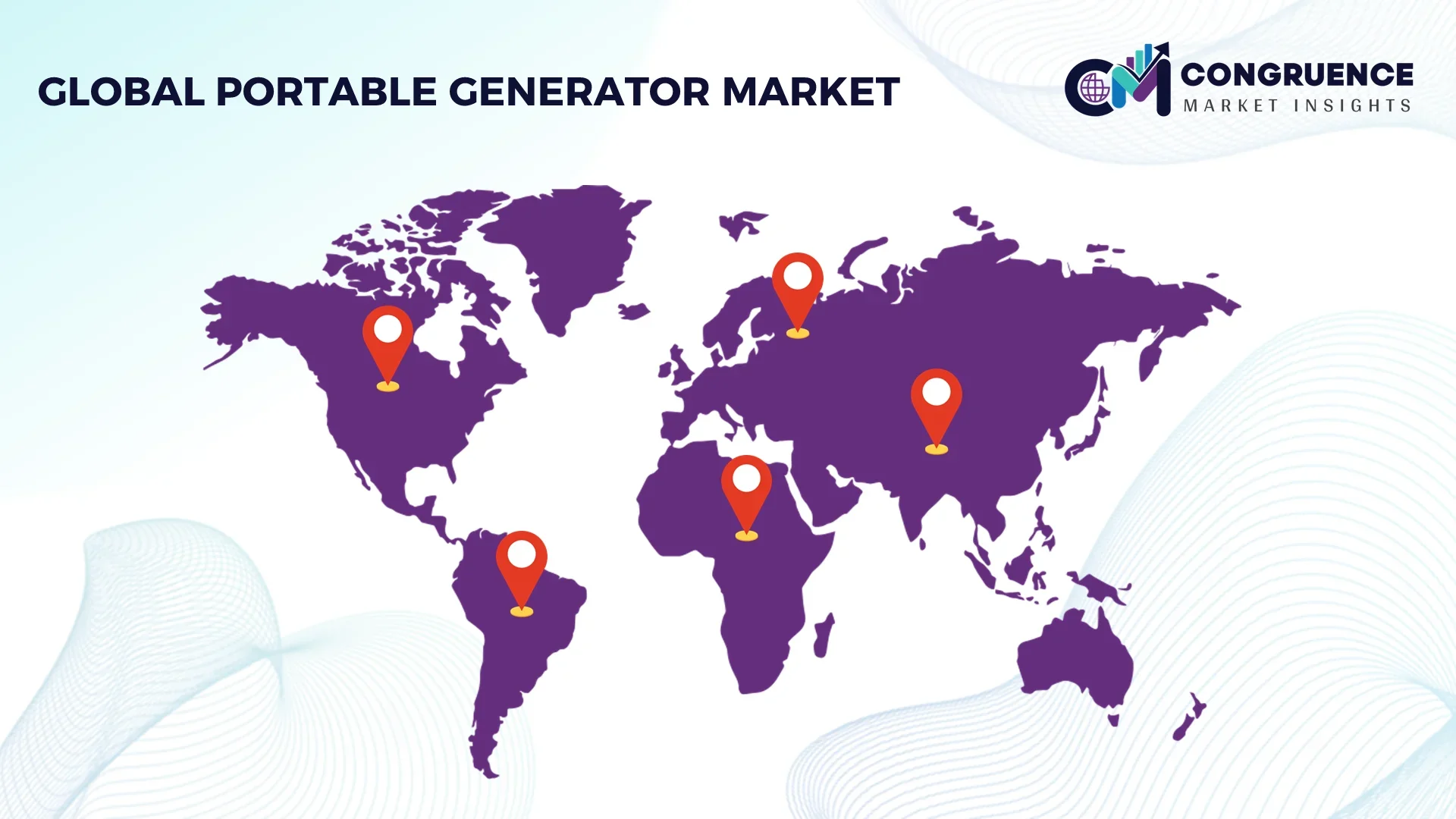
North America’s dominance is supported by high residential adoption rates, with nearly 40% of households in outage-prone areas utilizing portable generators. Europe follows with a 24% market share, driven by strict emission standards and increasing demand for low-noise inverter generators, particularly in Germany, the UK, and France. Asia-Pacific holds approximately 28% share, with China and India contributing over 55% of regional demand due to infrastructure expansion and urbanization. South America accounts for nearly 7%, with Brazil representing over 60% of the regional consumption, while the Middle East & Africa collectively hold about 5%, led by the UAE and South Africa. Industrial and construction sectors contribute over 50% of demand in emerging regions, while residential applications dominate developed markets with shares exceeding 45%, reflecting diverse consumption patterns across geographies.
North America represents approximately 36% of the global portable generator market, supported by strong demand across residential, healthcare, and construction sectors. Residential users account for nearly 42% of regional consumption, driven by increasing power outage incidents and disaster preparedness initiatives. Healthcare and data centers collectively contribute over 25%, as uninterrupted power supply remains critical. Regulatory frameworks focusing on emission reductions have led to the adoption of EPA-compliant generators, with over 60% of new units meeting advanced emission standards. Technological advancements such as inverter-based generators and IoT-enabled monitoring systems are widely adopted, with nearly 35% of products featuring smart connectivity. A key regional player, Generac Holdings, has expanded its smart generator portfolio, achieving a 20% increase in connected device installations. Consumer behavior in this region reflects a strong preference for high-capacity, fuel-efficient, and technologically advanced portable generators, particularly among residential and small business users.
Europe holds around 24% of the portable generator market, with Germany, the UK, and France collectively accounting for over 65% of regional demand. Strict environmental regulations, including emission and noise control standards, have resulted in over 55% of generators sold being inverter-based or low-emission models. Sustainability initiatives aligned with carbon reduction targets are driving adoption of hybrid and alternative fuel generators. The region has also seen a 30% increase in demand for low-noise equipment, particularly in urban areas. Technological advancements include the integration of digital monitoring systems, with approximately 28% of generators featuring smart diagnostics. A notable regional manufacturer, Atlas Copco, has introduced energy-efficient portable power solutions that reduce fuel consumption by up to 15%. Consumer behavior in Europe emphasizes eco-friendly and regulation-compliant products, with businesses prioritizing sustainability and efficiency over traditional fuel-based systems.
Asia-Pacific accounts for nearly 28% of the global portable generator market and ranks as the fastest-growing region in terms of volume expansion. China, India, and Japan together contribute over 70% of regional demand, driven by rapid urbanization and large-scale infrastructure projects. Construction and industrial applications represent more than 55% of usage, reflecting the region’s strong development focus. Manufacturing output of portable generators has increased by approximately 18% over the past three years, supported by local production hubs. Technological innovation is also accelerating, with around 25% of new models incorporating fuel-efficient and hybrid technologies. A leading regional player, Honda Motor Co., has expanded its inverter generator lineup, achieving a 15% improvement in fuel efficiency. Consumer behavior in this region is characterized by high demand for cost-effective and durable generators, particularly in rural and semi-urban areas where grid reliability remains inconsistent.
South America holds approximately 7% of the portable generator market, with Brazil and Argentina accounting for over 70% of regional demand. Infrastructure development and energy supply instability are key drivers, with nearly 35% of businesses relying on backup power solutions. The construction and mining sectors contribute over 40% of total demand, reflecting the region’s industrial focus. Government initiatives promoting infrastructure development have increased equipment imports by approximately 12% annually. Trade policies supporting local manufacturing are also encouraging market growth. A regional player, WEG Industries, has expanded its generator production capabilities, improving supply chain efficiency by nearly 18%. Consumer behavior in South America shows a strong preference for cost-effective and high-capacity generators, particularly among commercial users seeking reliable power solutions in regions with inconsistent electricity supply.
The Middle East & Africa region accounts for around 5% of the portable generator market, with the UAE and South Africa leading demand. Oil and gas, construction, and mining sectors collectively contribute over 60% of regional consumption, reflecting the importance of portable power in energy-intensive industries. Infrastructure projects have increased generator usage by nearly 20% over recent years. Technological modernization is evident, with approximately 22% of generators incorporating advanced fuel management systems. Trade partnerships and government investments in infrastructure development are further supporting market expansion. A notable regional player, Jubaili Bros, has introduced high-efficiency portable generators designed for extreme environmental conditions, improving operational reliability by 25%. Consumer behavior varies, with industrial users prioritizing durability and high output, while commercial users seek cost-efficient and easy-to-maintain solutions.
United States – 32% market share in the Portable Generator market, driven by high residential adoption and advanced manufacturing capabilities.
China – 22% market share in the Portable Generator market, supported by large-scale production capacity and strong infrastructure demand.
The portable generator market is characterized by a moderately fragmented competitive landscape, with over 50 active global and regional manufacturers competing across various product segments. The top five companies collectively account for approximately 45% of the total market share, indicating a balanced mix of established leaders and emerging players. Key companies are focusing on product innovation, particularly in inverter technology, hybrid fuel systems, and IoT-enabled generators, with nearly 40% of new product launches incorporating advanced features.
Strategic initiatives such as mergers, acquisitions, and partnerships are shaping the competitive environment. Over 15 major collaborations were recorded in the past two years, primarily aimed at expanding distribution networks and enhancing technological capabilities. Companies are also investing heavily in research and development, with an estimated 8–10% of annual budgets allocated to innovation.
The market is witnessing increased competition from regional manufacturers offering cost-effective solutions, particularly in Asia-Pacific and South America. At the same time, established players are strengthening their market positions through brand recognition, extensive service networks, and product diversification. The competitive intensity is further heightened by the introduction of environmentally compliant products, with over 60% of leading companies aligning their portfolios with emission standards and sustainability goals.
Honda Motor Co.
Generac Holdings Inc.
Yamaha Motor Co., Ltd.
Briggs & Stratton Corporation
Cummins Inc.
Kohler Co.
Atlas Copco AB
Wacker Neuson SE
Champion Power Equipment
Westinghouse Electric Corporation
Hyundai Power Equipment
WEG Industries
Kirloskar Oil Engines Ltd.
Technological advancements in the portable generator market are increasingly focused on improving fuel efficiency, reducing emissions, and enhancing user control through digital integration. Inverter technology has become a cornerstone innovation, with approximately 38% of modern portable generators now utilizing inverter systems that adjust engine speed dynamically based on load demand. This results in fuel consumption reductions of up to 30% and noise levels below 60 decibels, making them highly suitable for residential and commercial applications.
The integration of dual-fuel and tri-fuel systems is another key development, with nearly 42% of newly manufactured units offering multi-fuel compatibility. These systems enable users to switch between gasoline, propane, and natural gas, increasing operational flexibility and reducing dependency on a single fuel source. Hybrid generator solutions combining battery storage with traditional engines are also gaining traction, delivering up to 25% improvement in fuel efficiency and significantly lowering emissions during intermittent use.
Digital transformation is reshaping the market through IoT-enabled smart generators. Around 35% of premium models now feature remote monitoring capabilities, allowing real-time tracking of fuel levels, runtime, and maintenance schedules via mobile applications. These systems have demonstrated up to 20% reduction in unplanned downtime by enabling predictive maintenance. Additionally, AI-based load management technologies are being introduced to optimize power distribution, improving efficiency by approximately 15% in commercial applications.
Emerging technologies such as solar-assisted portable generators and hydrogen-ready systems are also entering the market. Solar-integrated models can reduce fuel consumption by up to 20% in hybrid configurations, while hydrogen-compatible prototypes are being tested to achieve near-zero emissions. Advanced materials and compact engine designs are further reducing generator weight by 10–15%, enhancing portability without compromising performance. These innovations collectively indicate a shift toward cleaner, smarter, and more efficient portable power solutions.
• In January 2025, Generac Holdings Inc. expanded its residential portable generator lineup by introducing new inverter models with enhanced COsense® technology, designed to automatically shut down the generator when unsafe carbon monoxide levels are detected, improving user safety and meeting updated emission compliance standards. Source: www.generac.com
• In March 2025, Honda Motor Co. launched an upgraded EU series inverter generator featuring improved fuel injection technology, delivering approximately 15% higher fuel efficiency and reduced noise levels, targeting both residential backup and outdoor recreational markets. Source: www.honda.com
• In September 2024, Cummins Inc. introduced advanced portable generator solutions integrated with remote monitoring capabilities, enabling real-time diagnostics and predictive maintenance, which improved operational uptime by nearly 18% for commercial users. Source: www.cummins.com
• In November 2024, Yamaha Motor Co., Ltd. enhanced its portable generator portfolio with new inverter-based models incorporating smart throttle technology, optimizing engine speed based on load demand and achieving up to 20% fuel savings compared to conventional models. Source: www.yamaha-motor.com
The portable generator market report provides a comprehensive analysis of key industry segments, technological advancements, and regional dynamics shaping global demand. The scope encompasses a detailed evaluation of product types, including conventional generators, inverter-based systems, and hybrid or dual-fuel models, which collectively account for over 90% of market deployments. It also examines emerging product categories such as solar-assisted and battery-integrated portable generators, which are gaining traction in sustainability-focused markets.
From an application perspective, the report covers residential, commercial, and industrial use cases, with residential applications contributing approximately 45% of total demand, followed by commercial and industrial sectors at 30% and 25% respectively. The analysis extends to niche applications such as outdoor events, disaster recovery, and remote operations, which together represent nearly 15% of usage. Geographically, the report includes in-depth coverage of North America, Europe, Asia-Pacific, South America, and the Middle East & Africa, collectively representing 100% of global market activity. Asia-Pacific accounts for nearly 28% of total consumption, while North America leads with approximately 36%, highlighting regional variations in demand and adoption patterns.
The report further explores technological trends such as IoT integration, hybrid fuel systems, and AI-driven load management, which are influencing over 40% of new product developments. It also addresses regulatory frameworks, emission standards, and sustainability initiatives impacting product design and adoption. Additionally, the scope includes competitive benchmarking, supply chain analysis, and end-user insights, providing a holistic view of the portable generator market for strategic decision-making.
| Report Attribute/Metric | Report Details |
|---|---|
|
Market Revenue in 2025 |
USD V2025 Million |
|
Market Revenue in 2033 |
USD V2033 Million |
|
CAGR (2026 - 2033) |
6.9% |
|
Base Year |
2025 |
|
Forecast Period |
2026 - 2033 |
|
Historic Period |
2021 - 2025 |
|
Segments Covered |
By Types
By Application
By End User
|
|
Key Report Deliverable |
Revenue Forecast, Growth Trends, Market Dynamics, Segmental Overview, Regional and Country-wise Analysis, Competition Landscape |
|
Region Covered |
North America, Europe, Asia-Pacific, South America, Middle East, Africa |
|
Key Players Analyzed |
Honda Motor Co., Generac Holdings Inc., Yamaha Motor Co., Ltd., Briggs & Stratton Corporation, Cummins Inc., Kohler Co., Atlas Copco AB, Wacker Neuson SE, Champion Power Equipment, Westinghouse Electric Corporation, Hyundai Power Equipment, WEG Industries, Kirloskar Oil Engines Ltd. |
|
Customization & Pricing |
Available on Request (10% Customization is Free) |




