
Reports
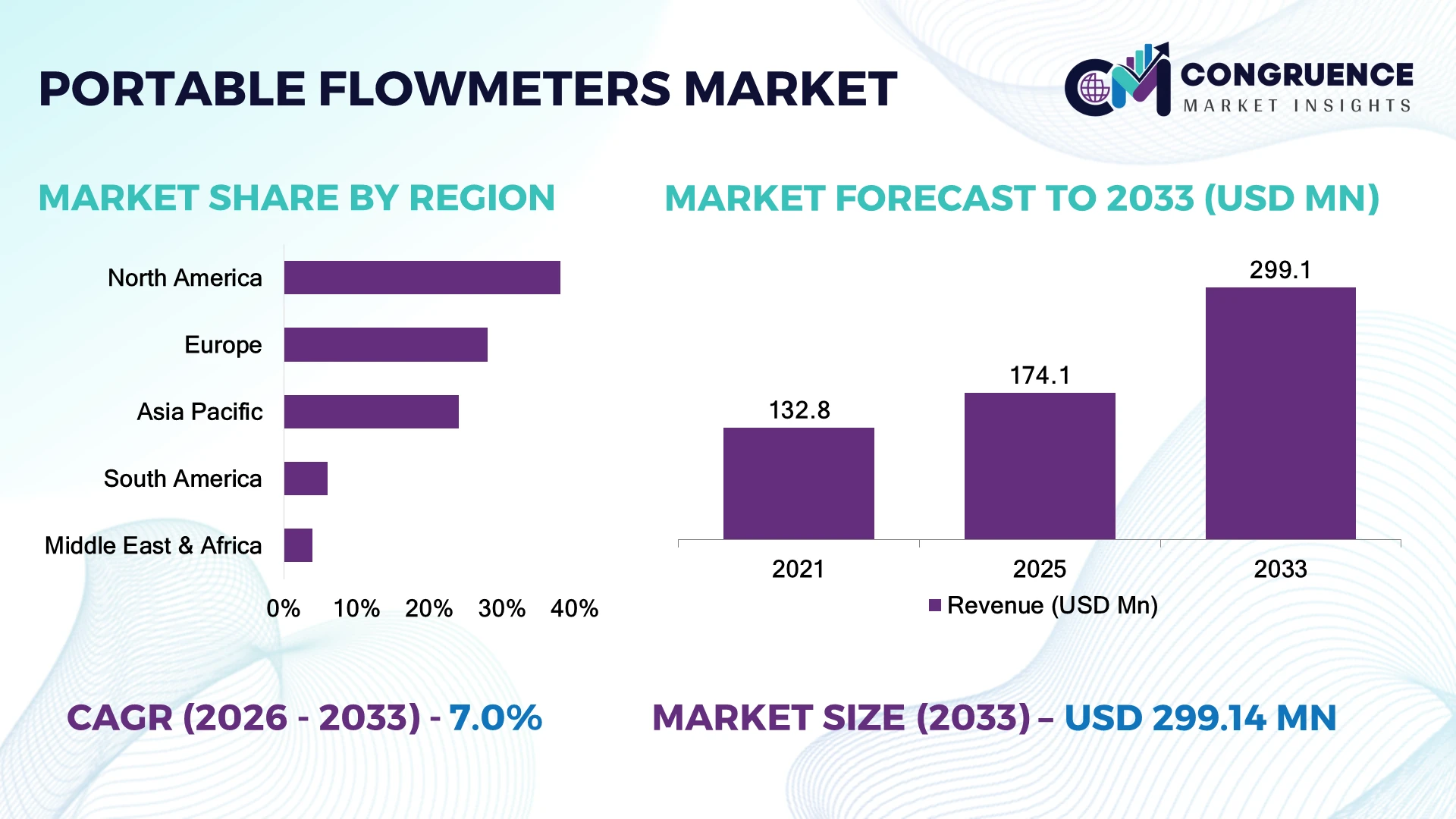
The Global Portable Flowmeters Market was valued at USD 174.1 Million in 2025 and is anticipated to reach a value of USD 299.1 Million by 2033 expanding at a CAGR of 7.0% between 2026 and 2033. Growth is driven by rising deployment of portable ultrasonic flow measurement systems across water utilities, oil & gas pipelines, and industrial maintenance operations seeking non-invasive monitoring and rapid field diagnostics.
The United States dominates the market with an estimated 31% share, supported by extensive adoption across shale oil operations, municipal water networks, and chemical processing facilities. More than 68% of large utility inspection programs utilize portable flow verification tools, compared with approximately 49% in Germany’s industrial sector. Infrastructure modernization programs and energy-efficiency mandates continue accelerating deployment, while post-energy-security investments following global supply-chain realignments have strengthened procurement activity. Portable ultrasonic technologies now account for over 55% of field flow measurement installations in major U.S. industrial projects.
The market’s leadership position in advanced industrial economies signals a strong strategic advantage for suppliers investing in digital diagnostics, predictive maintenance integration, and high-accuracy portable measurement platforms.
Market Size & Growth: USD 174.1 Million in 2025 reaching USD 299.1 Million by 2033, driven by expanding ultrasonic monitoring and industrial asset optimization programs.
Top Growth Drivers: Water infrastructure upgrades (+27%), industrial automation adoption (+24%), and pipeline monitoring investments (+21%) accelerate deployment.
Short-Term Forecast: By 2028, inspection time is expected to decline by nearly 30% through advanced portable digital measurement systems.
Emerging Technologies: AI-enabled diagnostics, wireless connectivity, and advanced ultrasonic sensing improve measurement accuracy and field productivity.
Regional Leaders: North America (~USD 92 Million), Europe (~USD 78 Million), and Asia-Pacific (~USD 70 Million) lead through utility modernization and industrial digitalization.
Consumer/End-User Trends: More than 60% of industrial facilities prioritize non-invasive flow monitoring to reduce downtime and maintenance costs.
Pilot/Case Example: In 2024, a municipal water utility project reduced leak-detection time by 35% using portable ultrasonic flowmeters.
Competitive Landscape: Emerson holds roughly 14% market share alongside Siemens, Baker Hughes, KROHNE, Endress+Hauser, and Badger Meter.
Regulatory & ESG Impact: Water-loss reduction initiatives improved monitoring efficiency by over 20% across utility networks.
Investment & Funding: More than USD 450 Million has been directed toward smart water, industrial monitoring, and measurement technology expansion programs.
Innovation & Future Outlook: Cloud-connected analytics and digital twin integration are reshaping high-growth portable flow measurement strategies.
Portable flowmeters play a critical role in water management, oil & gas maintenance, chemical processing, and energy infrastructure where rapid, non-invasive measurement is essential. Recent innovations focus on wireless data transmission, battery-life optimization, and AI-assisted diagnostics that improve field accuracy by over 25%. Increasing localization of industrial supply chains and stricter operational efficiency targets are accelerating adoption across maintenance-intensive industries, creating a stronger foundation for strategic technology deployment and market expansion.
Portable flowmeters are becoming strategically important as industries prioritize operational visibility, asset reliability, and maintenance efficiency. Water utilities, energy operators, and process manufacturers increasingly require mobile measurement solutions that deliver real-time performance insights without disrupting production. Infrastructure modernization programs, industrial digitalization initiatives, and stricter monitoring requirements are reshaping procurement priorities and expanding the role of portable measurement technologies.
Modern portable ultrasonic flowmeters provide measurement accuracy above 98% while reducing installation costs by nearly 40% compared with many conventional inline systems. The United States emphasizes deployment across utility and energy networks, whereas Germany and Japan focus on precision manufacturing and process optimization applications. Over 60% of industrial maintenance teams now integrate portable diagnostic tools into predictive maintenance workflows, improving equipment utilization and reducing unplanned outages.
A practical example is the deployment of portable ultrasonic systems for temporary pipeline verification during maintenance shutdowns, enabling faster inspections and improved resource allocation. Companies are expanding software partnerships, investing in cloud-connected monitoring ecosystems, and strengthening regional service networks. Over the next two to three years, adoption of connected field instrumentation is expected to rise significantly, making portable flowmeters a key differentiator for operational agility, competitive positioning, and long-term industrial performance.
The strongest market driver is the rapid shift toward non-invasive measurement technologies across critical industrial infrastructure. Portable ultrasonic flowmeters reduce installation-related downtime by up to 40% and improve maintenance productivity by nearly 30% compared with conventional intrusive systems. More than 60% of large water utilities now utilize portable verification equipment during inspection cycles. Rising energy-security initiatives in the United States and pipeline integrity programs across Canada have accelerated investment in field-monitoring technologies. This shift directly improves asset reliability and operational transparency. In response, companies are expanding ultrasonic product portfolios, investing in wireless connectivity, and forming partnerships with industrial automation providers. A notable strategic insight is that portable devices are increasingly replacing temporary fixed installations, reducing project costs while improving deployment flexibility.
Calibration requirements, equipment certification standards, and component cost volatility continue to constrain market scalability. Advanced portable ultrasonic systems often carry acquisition costs 25–35% higher than basic mechanical alternatives, limiting adoption among smaller operators. Sensor and semiconductor supply disruptions increased lead times by approximately 18% during recent procurement cycles. In India and parts of Southeast Asia, inconsistent calibration infrastructure affects measurement standardization and long-term operational confidence. These constraints impact deployment consistency and return-on-investment calculations for end users. To reduce exposure, manufacturers are localizing assembly operations, expanding service networks, and securing long-term component agreements. A key operational insight is that after-sales calibration capability increasingly influences purchasing decisions as much as measurement performance.
A significant opportunity lies in integrating portable flowmeters with digital asset management platforms and intelligent utility networks. More than 55% of utility operators are expanding digital monitoring initiatives, while smart water programs have reduced network losses by over 20% in selected deployments. Japan and Singapore are actively investing in connected infrastructure projects where portable diagnostics complement fixed monitoring assets. AI-assisted analytics, edge computing, and cloud-based reporting create opportunities for faster decision-making and reduced field inspection costs. Companies are increasing R&D spending, developing software ecosystems, and forming technology alliances to strengthen data-driven service offerings. A non-obvious opportunity is the use of portable flowmeters for temporary validation of digital twin models, improving infrastructure planning accuracy and operational forecasting.
Long-term market expansion depends on overcoming integration complexity and workforce capability gaps. Nearly 42% of industrial facilities report challenges in connecting field instrumentation with centralized analytics platforms. Advanced portable systems can require 20–30% more technical training than conventional measurement tools, creating deployment bottlenecks. In Germany and the United States, the shortage of experienced instrumentation technicians is increasing implementation timelines for sophisticated monitoring projects. The challenge extends beyond equipment adoption to consistent data interpretation, cybersecurity readiness, and interoperability with existing industrial systems. Companies must address these issues through workforce development programs, software standardization initiatives, and stronger technology partnerships. The most important strategic insight is that successful deployment increasingly depends on data integration capabilities rather than measurement hardware alone.
Wireless Field Data Integration Portable flowmeters are increasingly deployed with Bluetooth, Wi-Fi, and cloud-based connectivity, with more than 58% of newly installed units supporting remote data transfer. Industrial operators have reduced manual reporting workloads by nearly 35% through digital workflows, while maintenance teams complete field verification tasks 28% faster. Labor shortages across utility networks are accelerating adoption, prompting manufacturers to expand software partnerships and develop interoperable monitoring platforms that improve operational visibility.
Ultrasonic Technology Leadership Ultrasonic portable flowmeters now account for approximately 55% of field measurement deployments, supported by non-invasive installation and high measurement reliability. Industrial facilities report downtime reductions of nearly 30% when replacing temporary inline measurement methods. Energy infrastructure operators in the United States increasingly utilize clamp-on technologies for pipeline diagnostics and asset verification. Companies are scaling ultrasonic product portfolios and enhancing sensor performance to address growing demand for rapid deployment and minimal process disruption.
Smart Water Network Expansion Water utilities are expanding portable flowmeter usage as leakage reduction and network optimization programs intensify. More than 62% of large municipal operators have integrated portable flow verification into inspection workflows, while leak-detection efficiency has improved by roughly 25%. Regulatory pressure surrounding water conservation and infrastructure modernization is accelerating procurement activity. Suppliers are responding through utility-focused product customization, digital reporting capabilities, and long-term service agreements that strengthen recurring operational engagement.
Portable Analytics and Automation Advanced analytics integration is transforming portable measurement from a diagnostic tool into a decision-support platform. Approximately 41% of enterprise users now utilize portable flow data within predictive maintenance systems, improving asset utilization by over 20%. A non-obvious shift is the growing use of portable flowmeters for validating digital twin simulations before capital investments are approved. Companies are expanding automation capabilities, embedding AI-assisted diagnostics, and restructuring product strategies around software-enabled operational intelligence.
Ultrasonic portable flowmeters hold the leading position with approximately 55% of total market demand due to their non-invasive operation, rapid deployment capability, and compatibility with existing pipeline infrastructure. Industrial operators increasingly prefer clamp-on ultrasonic systems because installation times are often reduced by more than 40% compared with intrusive alternatives. Electromagnetic portable flowmeters remain widely utilized in water and wastewater applications, accounting for nearly 22% of deployments due to high accuracy in conductive fluid environments. Turbine and differential pressure portable systems continue serving established industrial applications where process familiarity and installed infrastructure remain important purchasing considerations. Ultrasonic systems also represent the fastest-growing type category as industrial digitalization and maintenance optimization initiatives accelerate. Adoption rates for advanced portable ultrasonic devices have increased by approximately 18% across utility inspection programs and energy infrastructure projects. Manufacturers are prioritizing wireless connectivity, AI-assisted diagnostics, and enhanced battery performance while expanding partnerships with automation providers. Meanwhile, electromagnetic technologies are evolving through improved portability and data integration features, ensuring continued relevance across municipal and industrial operations. Investment priorities increasingly favor flexible, software-enabled measurement platforms capable of supporting predictive maintenance and mobile workforce requirements.
Water and wastewater management represents the largest application segment with an estimated 34% market share, supported by extensive use in leak detection, network balancing, and infrastructure assessment. Utilities increasingly depend on portable flowmeters to verify system performance without interrupting operations. Oil and gas applications remain a significant demand center, particularly for pipeline diagnostics and maintenance activities where portable measurement reduces inspection complexity. Industrial process monitoring accounts for a substantial share of deployments as manufacturers seek greater operational visibility and equipment reliability across production environments. Oil and gas is emerging as the fastest-growing application segment, with adoption increasing by nearly 16% as operators expand asset integrity programs and field-based monitoring practices. Chemical processing, power generation, and HVAC systems continue broadening usage patterns through mobile maintenance workflows and temporary measurement requirements. Companies are scaling deployment support services, integrating digital reporting tools, and enhancing interoperability with industrial monitoring systems. Demand is becoming increasingly concentrated around applications requiring rapid diagnostics, reduced downtime, and operational flexibility, making portable measurement a critical component of modern asset management strategies.
Utilities remain the dominant end-user group with approximately 36% market share due to extensive dependence on flow verification, water distribution monitoring, and infrastructure maintenance programs. Large municipal operators deploy portable flowmeters across network inspections, leakage investigations, and temporary monitoring projects. Oil and gas companies represent another major buyer category because field-based measurement capabilities improve operational flexibility and reduce maintenance disruptions. Manufacturing facilities continue expanding adoption to support predictive maintenance initiatives and process optimization programs where portable diagnostics complement fixed instrumentation systems. The fastest-growing end-user segment is industrial manufacturing, where adoption has increased by roughly 17% as factories accelerate automation and condition-based maintenance strategies. Chemical producers, food processing companies, and power generation operators are increasingly incorporating portable measurement into reliability-focused workflows. Vendors are responding through application-specific product customization, flexible service contracts, and expanded software integration capabilities. Future demand is shifting toward organizations seeking real-time operational intelligence and mobile diagnostics, encouraging suppliers to strengthen ecosystem partnerships and develop industry-focused solutions that enhance competitive differentiation.
North America accounted for the largest market share at 38% in 2025 however, Asia-Pacific is expected to register the fastest growth, expanding at a CAGR of 8.4% between 2026 and 2033.
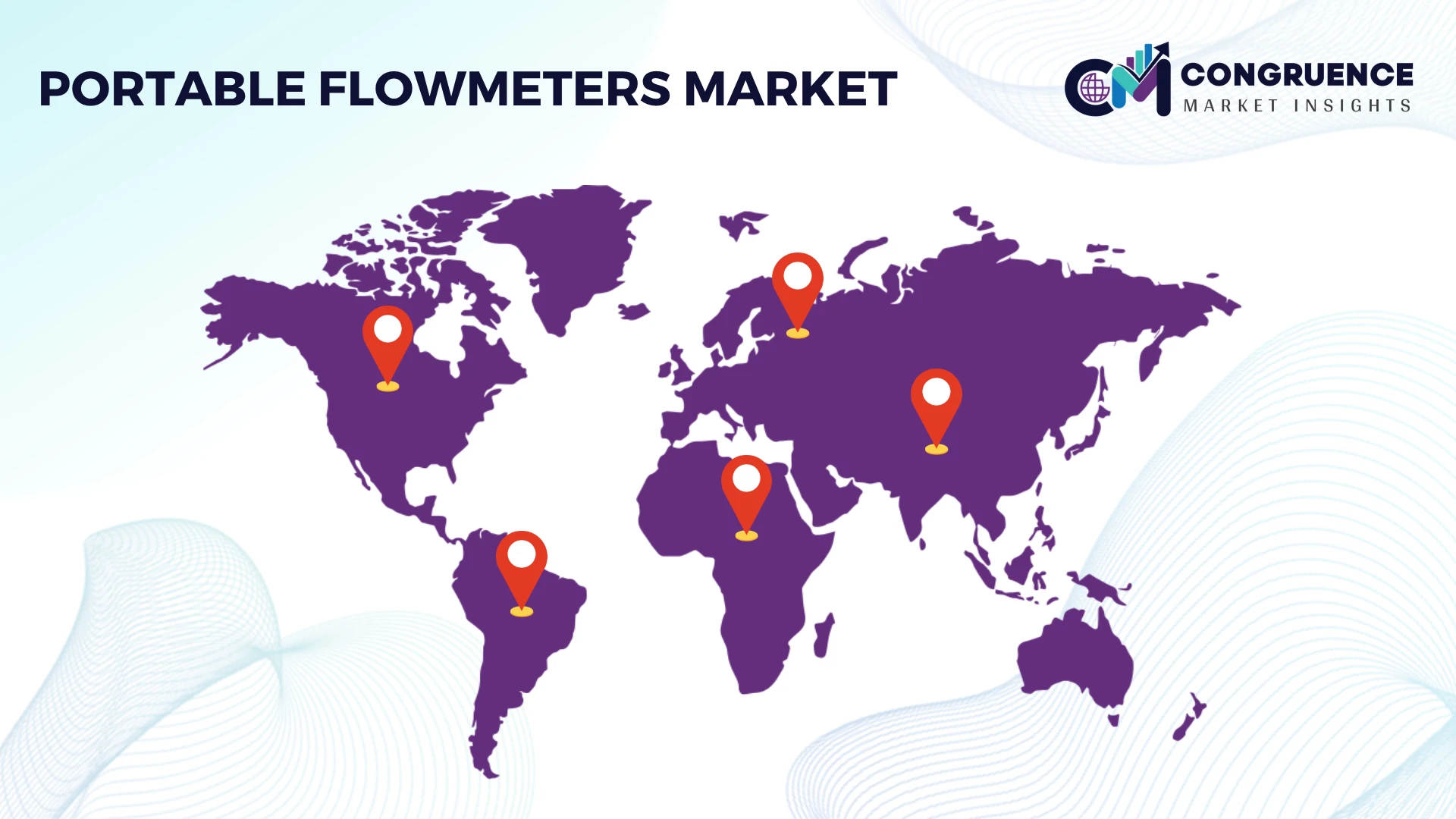
North America maintains the largest share of the Portable Flowmeters Market due to extensive deployment across municipal water systems, oil & gas infrastructure, chemical processing facilities, and industrial maintenance programs. The region benefits from advanced instrumentation standards, mature automation ecosystems, and widespread adoption of non-invasive monitoring technologies. Approximately 65% of large utility operators utilize portable flow verification tools within maintenance workflows, supporting efficient asset management and leakage control. The United States and Canada continue investing in pipeline integrity monitoring and water infrastructure upgrades, accelerating demand for portable ultrasonic solutions. Digital integration remains a key trend, with enterprises increasingly connecting portable devices to centralized asset management platforms. Recent infrastructure modernization programs have expanded deployment across aging utility networks, strengthening the role of portable measurement technologies in operational reliability and regulatory compliance.
United States Market Outlook: The United States represents the largest national market due to its extensive energy infrastructure, municipal water systems, and advanced industrial automation landscape. More than 68% of large-scale utility inspection programs incorporate portable flow measurement technologies for field diagnostics and performance verification. Strong investment in pipeline monitoring, predictive maintenance, and smart water initiatives continues supporting demand. Industrial operators increasingly prioritize mobile measurement platforms capable of reducing downtime while improving maintenance efficiency, positioning the country as a technology leader in portable instrumentation deployment.
Europe remains a strategically important market supported by strong industrial automation adoption, stringent environmental compliance requirements, and modernization of water infrastructure assets. The region accounts for approximately 28% of global demand, with widespread deployment across manufacturing, water management, energy, and chemical processing sectors. Portable flowmeters are increasingly utilized to support efficiency optimization and resource management initiatives. More than 55% of industrial facilities implementing advanced maintenance programs now integrate portable diagnostic measurement equipment. Regulatory emphasis on water conservation and operational transparency continues influencing procurement priorities. Companies are strengthening regional service capabilities and expanding digital monitoring solutions to address enterprise requirements for mobile diagnostics and real-time operational intelligence.
Germany Market Outlook: Germany leads the European market through its highly developed industrial base, advanced manufacturing ecosystem, and strong process automation culture. Industrial enterprises increasingly deploy portable flowmeters within predictive maintenance and process optimization programs. Nearly 52% of large manufacturing facilities utilize portable measurement systems for temporary verification and troubleshooting applications. Strong engineering expertise, high instrumentation standards, and continued investment in industrial digitalization provide a favorable environment for advanced portable flow technologies and software-integrated monitoring solutions.
Asia-Pacific is emerging as the fastest-expanding regional market due to rapid industrialization, large-scale infrastructure investment, and increasing adoption of automation technologies. The region accounts for approximately 24% of global market activity and continues expanding across water utilities, power generation, manufacturing, and petrochemical operations. Governments and enterprises are prioritizing operational efficiency improvements and infrastructure monitoring, creating sustained demand for portable measurement solutions. More than 40% of newly commissioned industrial monitoring projects in major manufacturing hubs now include portable diagnostic instrumentation. Expanding utility networks, industrial capacity additions, and smart infrastructure initiatives continue driving deployment across diverse end-user sectors.
China Market Outlook: China represents the most influential market within Asia-Pacific due to its extensive industrial footprint, large utility infrastructure, and manufacturing scale. Industrial modernization initiatives continue accelerating deployment of portable monitoring technologies across petrochemical, water treatment, and energy facilities. More than 45% of large industrial maintenance projects increasingly incorporate portable flow verification equipment to improve operational visibility and reduce maintenance disruptions. Strong domestic manufacturing capabilities and continued infrastructure investment support broader adoption of advanced portable measurement platforms throughout the country.
South America is experiencing steady market development supported by expanding water infrastructure programs, mining activities, and energy-sector monitoring requirements. The region contributes approximately 6% of global demand and demonstrates increasing adoption of portable measurement technologies across utility and industrial operations. Mining operators and water utilities are utilizing portable flowmeters to improve operational visibility while reducing inspection complexity. Infrastructure modernization remains uneven across countries, creating differences in deployment maturity. However, portable solutions are gaining preference because they minimize installation requirements and support field-based diagnostics. Several industrial operators have expanded digital monitoring initiatives, increasing demand for connected portable instrumentation and mobile measurement workflows.
Brazil Market Outlook: Brazil remains the leading South American market due to its large industrial economy, extensive water infrastructure requirements, and significant mining and energy operations. Utility operators are increasing investments in leakage monitoring and network optimization programs, supporting wider deployment of portable flow measurement technologies. More than 35% of large industrial maintenance projects now incorporate portable diagnostic tools to improve equipment reliability and process efficiency. Growing industrial digitalization initiatives continue strengthening the country’s position within the regional market landscape.
The Middle East & Africa market is supported by strategic investments in energy infrastructure, desalination facilities, water distribution networks, and industrial modernization programs. The region accounts for approximately 4% of global market activity, with demand concentrated around oil & gas operations and large-scale utility projects. Portable flowmeters are increasingly deployed for pipeline monitoring, asset verification, and maintenance optimization activities. Water security initiatives have accelerated adoption of mobile measurement technologies across municipal and industrial applications. Several infrastructure projects have incorporated digital monitoring frameworks, improving operational efficiency and asset visibility. Enterprises continue prioritizing portable solutions that support rapid deployment in geographically dispersed operational environments.
Saudi Arabia Market Outlook: Saudi Arabia represents the most strategically significant market in the region due to extensive energy infrastructure, large desalination capacity, and ongoing industrial diversification initiatives. Oil & gas operators increasingly deploy portable flowmeters for maintenance verification and pipeline performance assessment. More than 50% of newly modernized utility monitoring projects incorporate advanced mobile diagnostic technologies. Continued investment in industrial automation, water management systems, and infrastructure modernization supports sustained demand for portable measurement solutions across both public and private sector operations.
The Portable Flowmeters Market is led by global instrumentation companies including Emerson, Siemens, Endress+Hauser, Baker Hughes (Panametrics), KROHNE, and Badger Meter, competing directly against regional measurement specialists and cost-focused manufacturers. The top five players collectively control approximately 48% of market activity, creating a moderately consolidated competitive structure. Competition is centered on measurement accuracy, deployment flexibility, software integration, and service responsiveness rather than price alone. Advanced ultrasonic platforms improve installation efficiency by nearly 40%, while wireless diagnostics reduce field verification time by approximately 30%. Global leaders compete through technology differentiation and integrated monitoring ecosystems, whereas regional suppliers focus on customization and faster project execution. Companies are expanding service networks, strengthening automation partnerships, and enhancing portable analytics capabilities. A major competitive shift is the migration from standalone measurement devices toward software-connected diagnostic platforms. High calibration requirements, certification standards, and application expertise create meaningful entry barriers. Winning requires superior measurement performance, digital integration capabilities, strong field support, and industry-specific application expertise.
Siemens AG
Endress+Hauser Group
Baker Hughes (Panametrics)
KROHNE Group
Badger Meter, Inc.
Fuji Electric Co., Ltd.
Katronic Technologies Ltd.
ONICON Incorporated
Pulsar Measurement Ltd.
Greyline Instruments Inc.
FLEXIM GmbH
Yokogawa Electric Corporation
ABB Ltd.
Portable flowmeter technology is rapidly shifting toward advanced ultrasonic sensing, wireless communication, and intelligent diagnostics. Ultrasonic clamp-on systems now represent more than 55% of new deployments because they eliminate pipe penetration and reduce installation time by nearly 40%. Compared with traditional intrusive technologies, modern ultrasonic platforms improve field deployment speed by approximately 35% while minimizing operational disruption. Adoption is strongest across water utilities, energy infrastructure, and process manufacturing environments where downtime reduction is a critical operational objective.
Emerging technologies include AI-assisted signal processing, cloud-connected monitoring, and edge-based analytics. Nearly 41% of enterprise users now integrate portable flow measurement data into predictive maintenance systems. Advanced diagnostic algorithms improve measurement stability by up to 20% under challenging operating conditions, while wireless reporting reduces manual data handling requirements by approximately 30%. Companies deploying these technologies gain faster troubleshooting capabilities, improved asset visibility, and stronger maintenance planning performance.
Between 2026 and 2028, software-enabled portable flowmeters will increasingly function as operational intelligence platforms rather than standalone instruments. Vendors with strong analytics ecosystems, interoperability capabilities, and digital service models will benefit most. As industrial operators expand predictive maintenance strategies and infrastructure modernization programs, technology leadership will become a primary competitive differentiator requiring immediate investment and deployment focus.
April 2025 – Emerson launched the Flexim FLUXUS®/PIOX® 731 ultrasonic flowmeter series featuring nine application-specific models for liquids and gases. The modular platform strengthened non-intrusive measurement capabilities and expanded deployment flexibility across industrial facilities, supporting faster project execution and improved maintenance efficiency. Source: www.emerson.com
May 2025 – Endress+Hauser’s Proline Prosonic Flow P 500 ultrasonic flowmeter received the AMA Innovation Award, highlighting its ability to perform non-contact flow measurement at temperatures up to 550°C. The advancement enhanced measurement reliability in demanding process industries and expanded high-temperature application opportunities. Source: www.endress.com
June 2025 – Baker Hughes announced the divestment of its Precision Sensors and Instrumentation business, including the Panametrics flow measurement portfolio, through a $1.15 billion transaction. The move sharpened portfolio focus and accelerated strategic realignment toward higher-priority industrial and energy technology segments. Source: www.reuters.com
July 2026 – Emerson introduced the next-generation Flexim FLUXUS™ 631 portable ultrasonic flowmeter series with five portable models supporting liquids, gases, and steam measurement. The launch strengthened temporary measurement, verification, and condition-monitoring capabilities while improving plant-wide operational transparency and maintenance effectiveness.
This report provides comprehensive analysis of the Portable Flowmeters Market across major technology categories, application areas, end-user industries, and regional markets. Coverage includes ultrasonic, electromagnetic, turbine, and differential-pressure portable flowmeter technologies along with detailed assessment of water and wastewater management, oil and gas operations, industrial process monitoring, power generation, and specialized measurement applications. The study evaluates adoption patterns, deployment strategies, digital integration trends, and evolving competitive positioning across more than 10 major industry participants.
The report further examines demand distribution across utilities, manufacturing, energy, chemical processing, and infrastructure operators while assessing regional dynamics in North America, Europe, Asia-Pacific, South America, and the Middle East & Africa. Analysis incorporates operational performance indicators, technology penetration rates, deployment trends, and enterprise purchasing priorities. Strategic insights support investment evaluation, expansion planning, product positioning, partnership development, and competitive benchmarking, helping stakeholders identify emerging opportunities and market direction through 2033.
| Report Attribute / Metric | Details |
|---|---|
| Market Revenue (2025) | USD 174.1 Million |
| Market Revenue (2033) | USD 299.1 Million |
| CAGR (2026–2033) | 7.0% |
| Base Year | 2025 |
| Forecast Period | 2026–2033 |
| Historic Period | 2021–2025 |
| Segments Covered |
By Type
By Application
By End-User
|
| Key Deliverables | Revenue Forecast; Market Trends; Growth Drivers & Restraints; Technology Insights; Segmentation Analysis; Regional Insights; Competitive Landscape; Regulatory & ESG Overview; Recent Developments |
| Regions Covered | North America; Europe; Asia-Pacific; South America; Middle East & Africa |
| Companies Profiled | Emerson Electric Co.; Siemens AG; Endress+Hauser Group; Baker Hughes (Panametrics); KROHNE Group; Badger Meter, Inc.; Fuji Electric Co., Ltd.; Katronic Technologies Ltd.; ONICON Incorporated; Pulsar Measurement Ltd.; Greyline Instruments Inc.; FLEXIM GmbH; Yokogawa Electric Corporation; ABB Ltd. |
| Customization & Pricing | Available on Request (10% Customization Free) |




