
Reports
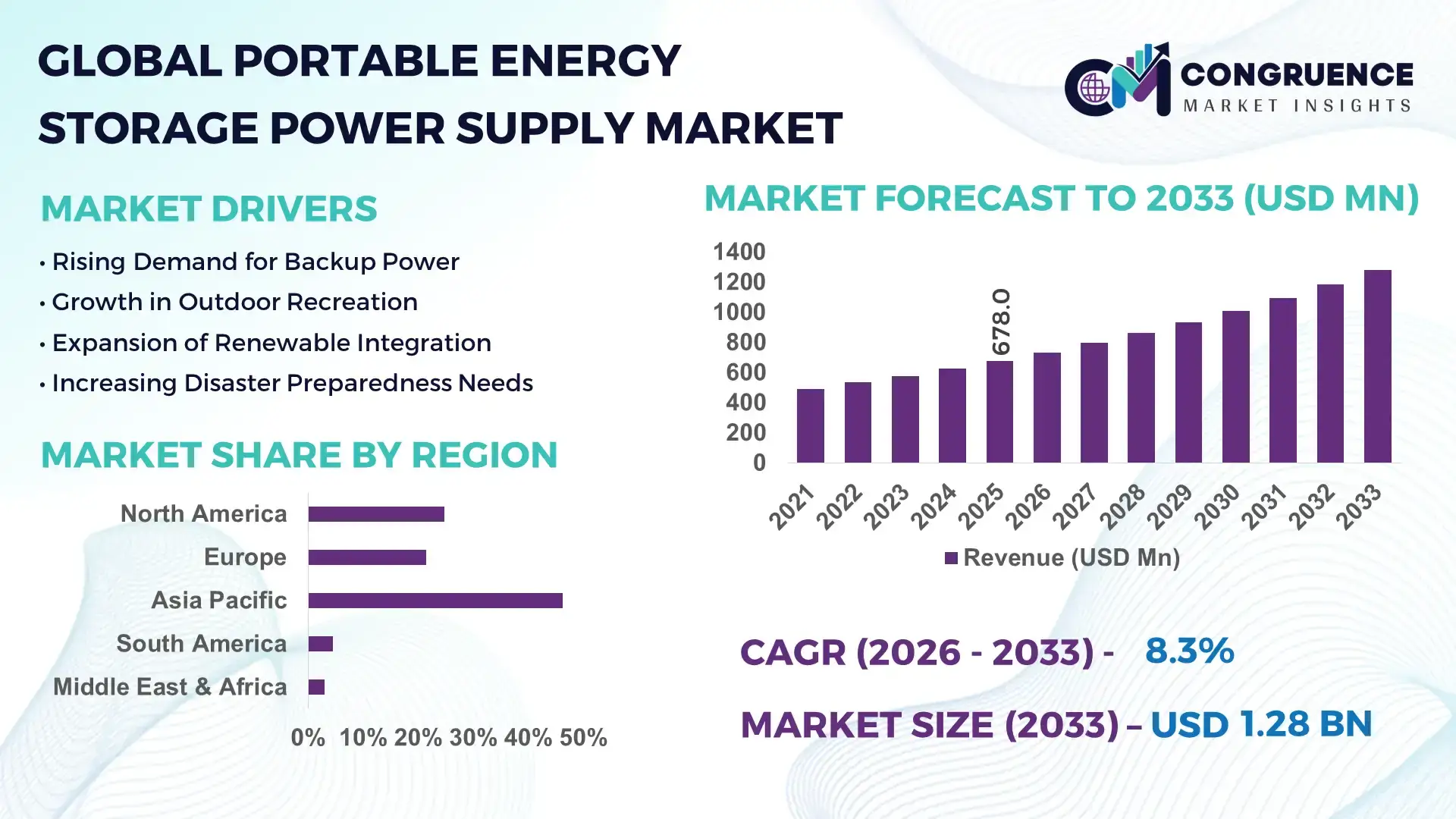
The Global Portable Energy Storage Power Supply Market was valued at USD 678.0 Million in 2025 and is anticipated to reach a value of USD 1,283.1 Million by 2033 expanding at a CAGR of 8.3% between 2026 and 2033. Growth is being accelerated by rising deployment of lithium-ion portable power systems for off-grid industrial operations, emergency backup applications, outdoor recreation, and resilient energy infrastructure amid increasing grid instability and disaster-preparedness investments.
China remains the dominant country in the market, accounting for approximately 42% of global portable energy storage manufacturing capacity, supported by over USD 15 billion in battery ecosystem investments and extensive lithium-ion supply-chain integration. Chinese manufacturers operate production facilities exceeding 180 GWh annually, significantly outperforming the United States, which holds nearly 18% manufacturing share. The country's leadership is reinforced by strong adoption across telecom backup, outdoor power, and emergency response applications, while geopolitical supply-chain diversification initiatives continue reshaping procurement strategies across North America and Europe.
For market participants, securing battery supply partnerships and localized assembly capabilities is becoming a decisive factor for sustaining competitiveness and operational resilience.
Market Size & Growth: USD 678.0 Million in 2025, reaching USD 1,283.1 Million by 2033 at 8.3% CAGR, supported by rapid battery energy-density improvements and expanding backup power applications.
Top Growth Drivers: Battery energy density improved by 25%, outdoor power demand increased 18%, and emergency backup adoption expanded 22% across key markets.
Short-Term Forecast: By 2028, lithium battery pack costs are expected to decline by 15% while portable system runtime efficiency improves by nearly 20%.
Emerging Technologies: AI-powered battery management, solid-state battery research, and advanced silicon-anode materials are enhancing safety and performance.
Regional Leaders: Asia Pacific exceeds USD 520 Million, North America surpasses USD 300 Million, and Europe approaches USD 250 Million, driven by energy resilience initiatives.
Consumer/End-User Trends: More than 37% of buyers prioritize portable backup power for home resilience and outdoor mobility requirements.
Pilot/Case Example: In 2024, advanced mobile energy deployment projects reduced diesel generator dependence by 30% during remote operations.
Competitive Landscape: Leading manufacturers collectively control nearly 45% market share, with key participants including EcoFlow, Jackery, Anker, Bluetti, and Goal Zero.
Regulatory & ESG Impact: Clean-energy support programs increased battery storage adoption by 20% while reducing fossil-fuel backup reliance.
Investment & Funding: Global battery and portable storage investments exceeded USD 20 billion, driven by manufacturing expansion and supply-chain localization.
Innovation & Future Outlook: Next-generation modular systems, bidirectional charging, and integrated smart-energy ecosystems are strengthening long-term market positioning.
Portable Energy Storage Power Supply systems are witnessing strong demand across residential backup power, outdoor recreation, telecommunications, disaster response, and remote industrial operations. Manufacturers are introducing faster-charging battery architectures, intelligent energy management platforms, and high-density lithium iron phosphate solutions that deliver up to 40% longer operational cycles. Simultaneously, supply-chain localization initiatives and grid-resilience programs are accelerating product deployment, while portable micro-energy ecosystems emerge as a key trend shaping future competitive differentiation and setting the stage for strategic market evolution.
Portable energy storage power supply solutions have evolved from niche consumer products into critical infrastructure assets supporting energy resilience, operational continuity, and decentralized power deployment. Growing grid disruptions, electrification initiatives, and supply-chain restructuring are increasing their strategic relevance across residential, commercial, industrial, and emergency-response environments. Companies are increasingly integrating portable storage systems into broader energy-security strategies as businesses seek flexible power solutions that reduce dependence on conventional backup generation assets.
Technological advancement is strengthening market competitiveness. Modern lithium iron phosphate-based systems deliver approximately 30% longer cycle life and require substantially lower maintenance than traditional fuel-powered generators while eliminating direct emissions during operation. China continues to lead large-scale manufacturing and battery integration, whereas the United States and Germany emphasize innovation, premium product development, and energy-management software integration. Over the next two to three years, smart battery management adoption is expected to exceed 50% among newly deployed premium portable energy systems.
A practical example is the deployment of portable storage units at construction sites and telecom towers, where operators reduce fuel logistics complexity and improve operational flexibility. Market participants are responding through battery supply agreements, manufacturing expansion, and technology partnerships focused on charging speed, energy density, and digital monitoring capabilities. Organizations that establish resilient supply networks and differentiated energy-management ecosystems will secure stronger competitive positioning as portable power becomes increasingly embedded within modern energy infrastructure strategies.
Demand for portable energy storage power supplies is accelerating due to increasing requirements for resilient and mobile power infrastructure. Lithium iron phosphate battery adoption has expanded by more than 35% in portable systems because of superior safety and lifecycle performance. Approximately 28% of telecom backup deployments now incorporate battery-based mobile power solutions, while outdoor and recreational energy applications have recorded adoption increases exceeding 20% annually. Rising grid reliability concerns following extreme weather events and energy-security initiatives are further supporting deployment. In response, manufacturers are expanding battery-pack production, investing in fast-charging technologies, and establishing strategic partnerships with component suppliers. A notable operational insight is that customers increasingly evaluate systems based on lifecycle value rather than upfront equipment cost, reshaping product development priorities across the industry.
Supply-chain concentration remains a significant structural limitation. More than 70% of global lithium-ion battery cell production is concentrated within a limited number of manufacturing hubs, creating procurement exposure and pricing volatility. Critical battery-material costs have experienced fluctuations exceeding 25% during recent market cycles, impacting production planning and inventory management. Smaller manufacturers face margin pressure due to limited bargaining power and long procurement lead times. Trade restrictions, logistics disruptions, and raw-material dependencies further complicate international expansion strategies. To reduce risk, companies are pursuing supplier diversification, localized assembly operations, and long-term procurement contracts. A key strategic insight is that firms with vertically integrated battery sourcing capabilities maintain stronger operational stability and pricing flexibility than competitors dependent on spot-market procurement.
The emergence of intelligent portable energy ecosystems presents substantial opportunities beyond traditional backup power applications. Smart energy management integration is projected to exceed 40% penetration in advanced portable storage systems over the next several years. Portable solar-compatible units can reduce operating costs by nearly 25% in remote deployment environments compared with conventional fuel-dependent alternatives. India, Indonesia, and Southeast Asian industrial corridors are witnessing increasing adoption for construction, field operations, and temporary infrastructure projects. Companies are investing heavily in AI-enabled battery diagnostics, modular storage architectures, and energy-sharing platforms that enhance utilization rates. A notable opportunity lies in portable microgrid deployment, where integrated storage, solar generation, and digital monitoring create new service-based revenue models while expanding access to reliable distributed energy resources.
Maintaining performance consistency as system complexity increases remains a critical challenge. Advanced portable energy storage platforms integrate battery management software, connectivity modules, inverters, and remote monitoring capabilities, creating greater interoperability requirements. Studies indicate that nearly 30% of field-service issues stem from system integration and software-related performance inconsistencies rather than battery hardware failures. Cybersecurity considerations are also becoming more relevant as connected energy devices expand across commercial and industrial environments. In countries with fragmented charging infrastructure, deployment efficiency can be reduced by more than 20% during remote operations. To address these challenges, companies are investing in software validation, interoperability standards, digital security frameworks, and technician training programs. Organizations that successfully balance technological sophistication with operational reliability will establish durable competitive advantages in increasingly demanding deployment environments.
Smart Battery Intelligence Expansion Advanced battery management systems are becoming standard across premium portable energy storage platforms, with smart monitoring integration exceeding 45% of newly launched models. Remote diagnostics adoption has increased by nearly 30%, while predictive maintenance capabilities are reducing service interventions by approximately 20%. As enterprise customers prioritize uptime visibility, manufacturers are embedding AI-enabled analytics and cloud connectivity into product ecosystems. This transition is improving asset utilization, accelerating troubleshooting workflows, and strengthening recurring service opportunities through digital energy management platforms.
LFP Chemistry Becoming Standard Lithium iron phosphate (LFP) technology continues replacing conventional lithium-ion chemistries, with deployment penetration surpassing 60% in several major product portfolios. Cycle-life performance improvements of 35%–50% and enhanced thermal stability are driving the shift. Following battery supply-chain disruptions and safety scrutiny, manufacturers in China and the United States are restructuring sourcing strategies and expanding dedicated LFP production capacity. The result is lower lifecycle ownership costs, stronger product reliability, and greater acceptance across commercial backup and mobile infrastructure applications.
Faster Charging Ecosystem Adoption High-speed charging capability has emerged as a major purchasing criterion, with charging times declining by nearly 40% compared with earlier-generation systems. More than 50% of new premium units now support rapid charging and multi-source energy input configurations. Businesses operating in field services, telecommunications, and temporary infrastructure environments increasingly require reduced downtime between deployments. In response, companies are investing in advanced power electronics, higher-efficiency inverters, and strategic technology partnerships to improve operational readiness and maximize equipment availability.
Portable Solar Integration Growth Portable solar-compatible systems are gaining traction as organizations seek greater energy independence and fuel-cost control. Solar-coupled deployments have expanded by over 25% in remote operational environments, while hybrid energy configurations are reducing generator runtime by approximately 30%. Energy-security initiatives and resilience-focused procurement policies are reinforcing this trend. Manufacturers are responding through bundled solar-storage offerings, modular expansion architectures, and ecosystem partnerships that simplify deployment while improving energy flexibility across construction, emergency response, and off-grid industrial applications.
Portable energy storage power supplies with capacities between 500Wh and 1,000Wh represent the leading segment, accounting for nearly 38% of global deployments. Their dominance is driven by an optimal balance of portability, runtime performance, and affordability, making them suitable for residential backup, outdoor recreation, field operations, and mobile workstations. These systems offer greater operational flexibility than sub-500Wh units while maintaining manageable weight and charging requirements. Manufacturers continue prioritizing this category through enhanced battery management systems, fast-charging capabilities, and modular expansion features. The above 1,000Wh segment is emerging as the fastest-growing category, with adoption increasing by approximately 24% as commercial users, emergency response teams, and telecom operators require longer-duration power support. Meanwhile, sub-500Wh systems maintain relevance in consumer electronics and recreational applications where portability remains critical. Companies are increasingly expanding premium product portfolios, investing in lithium iron phosphate battery technology, and forming strategic component partnerships to improve energy density and lifecycle performance. Investment priorities are shifting toward scalable, high-capacity platforms capable of supporting broader industrial and infrastructure use cases while preserving portability advantages.
Residential backup power remains the leading application segment, contributing approximately 35% of market demand due to rising concerns over grid reliability, extreme weather disruptions, and household energy resilience. Consumers increasingly seek portable energy storage systems capable of supporting essential appliances, communications equipment, and home-office operations during outages. Product adoption has accelerated through improved battery safety, quieter operation, and lower maintenance requirements compared with conventional fuel-based generators. Manufacturers are responding through integrated app-based monitoring, bundled solar compatibility, and expanded distribution networks. The telecommunication application segment is experiencing the fastest growth, with deployment activity increasing by nearly 22% as network operators strengthen backup infrastructure for remote towers and edge-network assets. Outdoor recreation and camping applications continue expanding due to growing demand for mobile power independence, while emergency response and disaster-relief deployments are becoming operationally critical. Companies are investing in ruggedized systems, rapid deployment configurations, and smart energy management platforms to address evolving performance requirements. Demand is increasingly shifting toward applications where uninterrupted power availability directly impacts operational continuity and service reliability.
Residential users represent the dominant end-user segment, accounting for approximately 42% of total market demand. Adoption is concentrated among homeowners seeking energy resilience, emergency preparedness, and off-grid flexibility. Increased utilization of home electronics, remote work infrastructure, and portable renewable energy systems continues supporting deployment. Product manufacturers are targeting this segment through simplified interfaces, financing options, bundled solar kits, and ecosystem-based product strategies designed to improve accessibility and customer retention. The commercial and industrial user segment is the fastest-growing category, recording adoption gains of approximately 20% as businesses seek flexible backup solutions for field operations, construction sites, logistics hubs, and critical infrastructure environments. Government agencies and emergency-response organizations continue expanding procurement programs focused on disaster readiness and operational mobility. Meanwhile, recreational and outdoor users remain an important customer base for lightweight portable systems. Companies are increasingly developing segment-specific solutions, forming channel partnerships, and introducing modular product architectures tailored to differing operational requirements. Future demand is gradually shifting toward enterprise-grade deployments where uptime, mobility, and operational continuity have measurable business value.
Asia-Pacific accounted for the largest market share at 46.2% in 2025 however, Middle East & Africa is expected to register the fastest growth, expanding at a CAGR of 10.1% between 2026 and 2033.
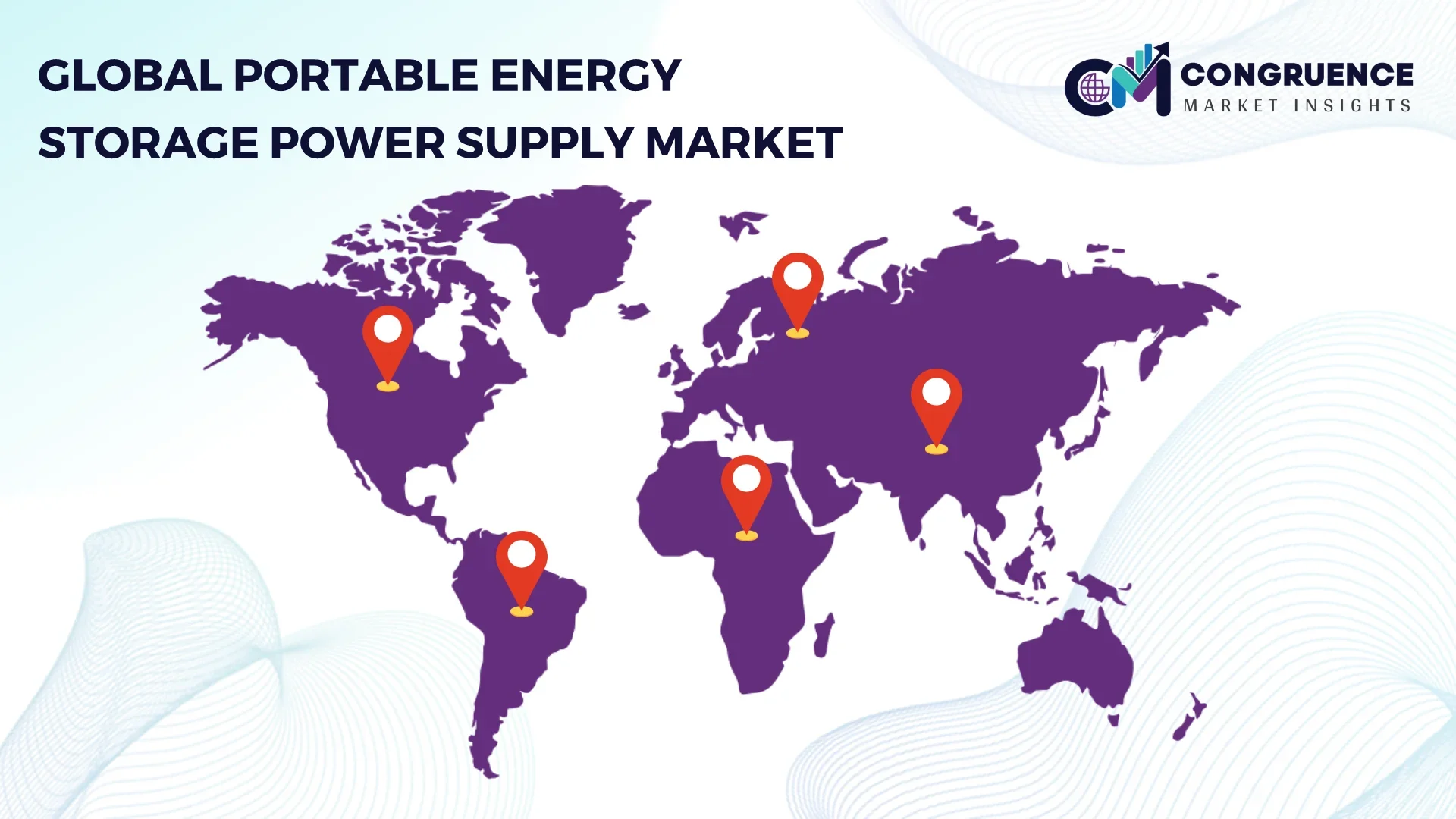
North America represented approximately 24.8% of the global Portable Energy Storage Power Supply Market in 2025, supported by growing investments in energy resilience, emergency preparedness, and distributed power solutions. Demand is increasingly concentrated in residential backup systems, telecommunications infrastructure, construction sites, and recreational applications. Grid reliability concerns and severe weather disruptions have accelerated deployment of portable battery-powered systems as alternatives to fuel-based generators. More than 35% of newly launched premium products in the region now integrate intelligent battery management and remote monitoring capabilities. Companies are expanding domestic assembly operations, strengthening battery sourcing agreements, and introducing modular product platforms to improve operational flexibility and supply-chain security.
United States Market Outlook: The United States remains the dominant market within North America due to its advanced energy infrastructure, high consumer awareness, and extensive deployment of backup power solutions. Residential resilience initiatives, remote work adoption, and increasing weather-related power outages continue driving product utilization. More than 60% of regional portable energy storage deployments originate from the U.S., while enterprise demand is expanding across telecommunications, disaster response, and field-service operations. Companies are prioritizing local manufacturing partnerships and advanced battery technologies to enhance product availability and operational performance.
Europe accounted for approximately 21.5% of global market activity, benefiting from strong decarbonization targets, energy-security priorities, and growing distributed energy adoption. Rising electricity-price volatility has encouraged businesses and households to invest in portable energy storage systems capable of supporting backup power and renewable energy integration. Demand is particularly strong in residential and small commercial applications, where energy flexibility is becoming a strategic requirement. Several manufacturers have expanded regional assembly operations and battery partnerships to improve procurement stability. Portable solar-compatible systems now represent a rapidly expanding portion of premium product sales across major European markets.
Germany Market Outlook: Germany serves as the region's strategic hub due to its advanced energy transition framework, strong battery ecosystem, and widespread renewable energy deployment. The country has witnessed increasing integration of portable energy storage systems alongside residential solar installations and mobile commercial applications. More than 30% of portable storage purchases are linked to renewable energy optimization and backup power use cases. German enterprises continue investing in smart energy management technologies, high-efficiency battery platforms, and localized supply networks to strengthen long-term energy resilience.
Asia-Pacific led the global market with a 46.2% share in 2025, driven by unmatched battery manufacturing capacity, integrated supply chains, and expanding domestic demand. The region dominates production of lithium-ion cells, battery management systems, and portable storage components, creating substantial cost and scale advantages. Manufacturing facilities across major industrial hubs support more than 65% of global portable energy storage output. Rising adoption across telecommunications, outdoor recreation, emergency preparedness, and remote infrastructure applications continues strengthening market momentum. Companies are expanding production lines, investing in automation, and accelerating exports to support increasing international demand.
China Market Outlook: China remains the most influential country in the global portable energy storage ecosystem due to its vertically integrated battery supply chain and large-scale manufacturing infrastructure. The country accounts for more than 40% of global portable energy storage production capacity and hosts many of the industry's leading manufacturers. Extensive lithium processing, battery-cell manufacturing, and electronics assembly capabilities enable rapid product development and cost optimization. Chinese companies are increasingly focusing on international expansion, premium product innovation, and smart energy technologies to reinforce global competitiveness.
South America represented approximately 4.5% of global market activity, supported by increasing demand for reliable power solutions in remote and underserved locations. Portable energy storage systems are gaining traction across mining operations, telecommunications infrastructure, agricultural facilities, and emergency-response applications. Energy-access challenges and grid instability continue creating demand for mobile power alternatives capable of supporting critical operations. Deployment activity is expanding gradually despite infrastructure limitations and procurement cost pressures. Companies are entering strategic distribution partnerships and localized service agreements to improve market penetration while addressing operational support requirements.
Brazil Market Outlook: Brazil leads regional demand due to its large industrial base, extensive rural geography, and expanding renewable energy sector. Portable energy storage adoption is increasing across telecommunications, agriculture, and off-grid commercial applications where reliable electricity access remains essential. Nearly 40% of regional deployments are concentrated in Brazil, supported by growing investment in distributed energy solutions and operational continuity initiatives. Businesses are increasingly integrating portable storage systems with solar installations to reduce fuel dependency and improve energy reliability in remote operating environments.
Middle East & Africa accounted for roughly 3.0% of global demand but remains the fastest-evolving regional market. Infrastructure modernization programs, off-grid electrification initiatives, and energy diversification strategies are expanding deployment opportunities across multiple sectors. Portable energy storage systems are increasingly utilized in construction projects, telecommunications networks, emergency-response operations, and remote industrial facilities. Governments and enterprises are investing in mobile energy solutions that support operational continuity while reducing dependence on conventional fuel-based systems. Several large-scale infrastructure projects have incorporated battery-powered backup technologies to improve energy reliability and deployment flexibility.
Saudi Arabia Market Outlook: Saudi Arabia is emerging as the region's most strategically important market due to ongoing infrastructure expansion, industrial diversification, and energy-transition initiatives. Large construction developments, smart-city projects, and remote industrial operations are creating substantial demand for portable energy storage solutions. More than 25% of regional project-based deployments are linked to infrastructure and industrial applications within the country. Organizations are increasingly investing in advanced battery systems, renewable energy integration, and intelligent power management technologies to enhance operational efficiency and support long-term modernization objectives.
The Portable Energy Storage Power Supply Market is characterized by competition between global technology leaders such as EcoFlow, Jackery, Bluetti, Anker SOLIX, Goal Zero, and regional value-focused manufacturers. The top five players collectively account for approximately 48–52% of market activity, creating a moderately consolidated structure where premium innovation competes directly against cost-efficient manufacturing models. EcoFlow and Bluetti emphasize advanced energy management, while Jackery and Goal Zero focus on brand strength and outdoor energy ecosystems. Anker leverages consumer electronics distribution and fast product commercialization. Competition is primarily driven by battery performance, charging speed, supply-chain control, software integration, and product scalability. Fast-charging systems reduce recharge times by nearly 40%, while lithium iron phosphate platforms deliver up to 50% longer cycle life than earlier battery technologies. More than 60% of premium launches now incorporate app-enabled monitoring and intelligent battery management. Leading companies are expanding manufacturing capacity, securing battery-cell partnerships, pursuing vertical integration, and introducing modular product ecosystems. The competitive shift is moving toward battery supply control and software-enabled differentiation. High capital requirements, battery sourcing access, and certification complexity remain key barriers. Winning requires scale, technology leadership, resilient supply chains, and ecosystem-based customer retention.
Jackery
BLUETTI
Anker Innovations (Anker SOLIX)
Goal Zero
Zendure
Pecron
ALLPOWERS
VTOMAN
OUKITEL
Duracell Power
Lion Energy
Yoshino Technology
Renogy
Portable energy storage technology is rapidly shifting from conventional lithium-ion systems toward advanced lithium iron phosphate (LFP) architectures, intelligent battery management software, and modular energy platforms. LFP batteries now represent more than 60% of premium product deployments because they provide up to 50% longer operational life and significantly improved thermal stability. Smart battery management systems are reducing maintenance interventions by nearly 20% while improving energy utilization efficiency across residential, commercial, and mobile applications.
Emerging technologies include AI-enabled power optimization, bidirectional charging, remote diagnostics, and modular battery expansion. More than 45% of newly introduced premium systems integrate mobile application monitoring and predictive battery analytics. Compared with traditional generator-based backup systems, advanced portable storage solutions reduce operating costs by approximately 30% while eliminating fuel logistics requirements. Companies with strong software integration capabilities gain a competitive advantage through superior user experience, remote asset visibility, and energy optimization performance.
Between 2026 and 2028, next-generation silicon-enhanced anodes, solid-state battery research, and intelligent energy ecosystem integration are expected to accelerate. Fast-charging technology is already reducing charging times by nearly 40% compared with earlier-generation products. Manufacturers investing in advanced battery chemistry, digital energy management, and scalable storage architectures will secure stronger market positioning as enterprise and infrastructure applications become increasingly sophisticated.
June 2024 – EcoFlow launched the DELTA Pro 3 portable energy storage platform with enhanced home-backup functionality and support for high-power appliances. The system improved power and storage capabilities over the previous generation, strengthening EcoFlow’s position in premium energy resilience solutions. Source: www.ecoflow.com
January 2025 – Anker SOLIX introduced the EverFrost 2 hybrid portable cooler featuring a detachable 288Wh LFP battery and up to 104 hours of cooling with dual batteries. The launch expanded portable energy storage into multifunctional outdoor power applications.
August 2025 – Jackery unveiled the Explorer 500 v2 portable power station featuring 512Wh capacity and 6,000 charge cycles, delivering a more compact design and extended lifecycle performance. The development strengthened Jackery’s premium mobility and emergency-power portfolio.
October 2025 – EcoFlow expanded its DELTA 3 lineup with new Delta 3 Max and Ultra platforms incorporating expandable battery architecture and Smart Output Priority functionality. The launch strengthened modular energy management capabilities and improved deployment flexibility across residential and mobile applications.
The report provides comprehensive analysis of the Portable Energy Storage Power Supply Market across capacity-based product categories, major application areas, end-user groups, and key geographic markets. Coverage includes portable systems used for residential backup power, telecommunications, outdoor recreation, emergency response, commercial operations, and remote industrial activities. The study evaluates market participation across North America, Europe, Asia-Pacific, South America, and the Middle East & Africa, where deployment patterns, manufacturing concentration, and adoption dynamics differ significantly.
The analysis examines battery technologies, intelligent energy management systems, charging innovations, modular storage architectures, and evolving deployment models. More than 60% of recent product introductions focus on advanced LFP battery platforms and digital monitoring capabilities, reflecting the industry's technology transition. The report supports strategic decision-making through competitive benchmarking, investment assessment, expansion planning, supply-chain evaluation, and identification of emerging demand pockets expected to influence market direction between 2026 and 2033.
| Report Attribute / Metric | Details |
|---|---|
| Market Revenue (2025) | USD 678.0 Million |
| Market Revenue (2033) | USD 1,283.1 Million |
| CAGR (2026–2033) | 8.3% |
| Base Year | 2025 |
| Forecast Period | 2026–2033 |
| Historic Period | 2021–2025 |
| Segments Covered |
By Type
By Application
By End-User
|
| Key Report Deliverables | Revenue Forecast; Market Trends; Growth Drivers & Restraints; Technology Insights; Segmentation Analysis; Regional Insights; Competitive Landscape; Regulatory & ESG Overview; Recent Developments |
| Regions Covered | North America; Europe; Asia-Pacific; South America; Middle East & Africa |
| Key Players Analyzed | EcoFlow; Jackery; BLUETTI; Anker Innovations (Anker SOLIX); Goal Zero; Zendure; Pecron; ALLPOWERS; VTOMAN; OUKITEL; Duracell Power; Lion Energy; Yoshino Technology; Renogy |
| Customization & Pricing | Available on Request (10% Customization Free) |




