
Reports
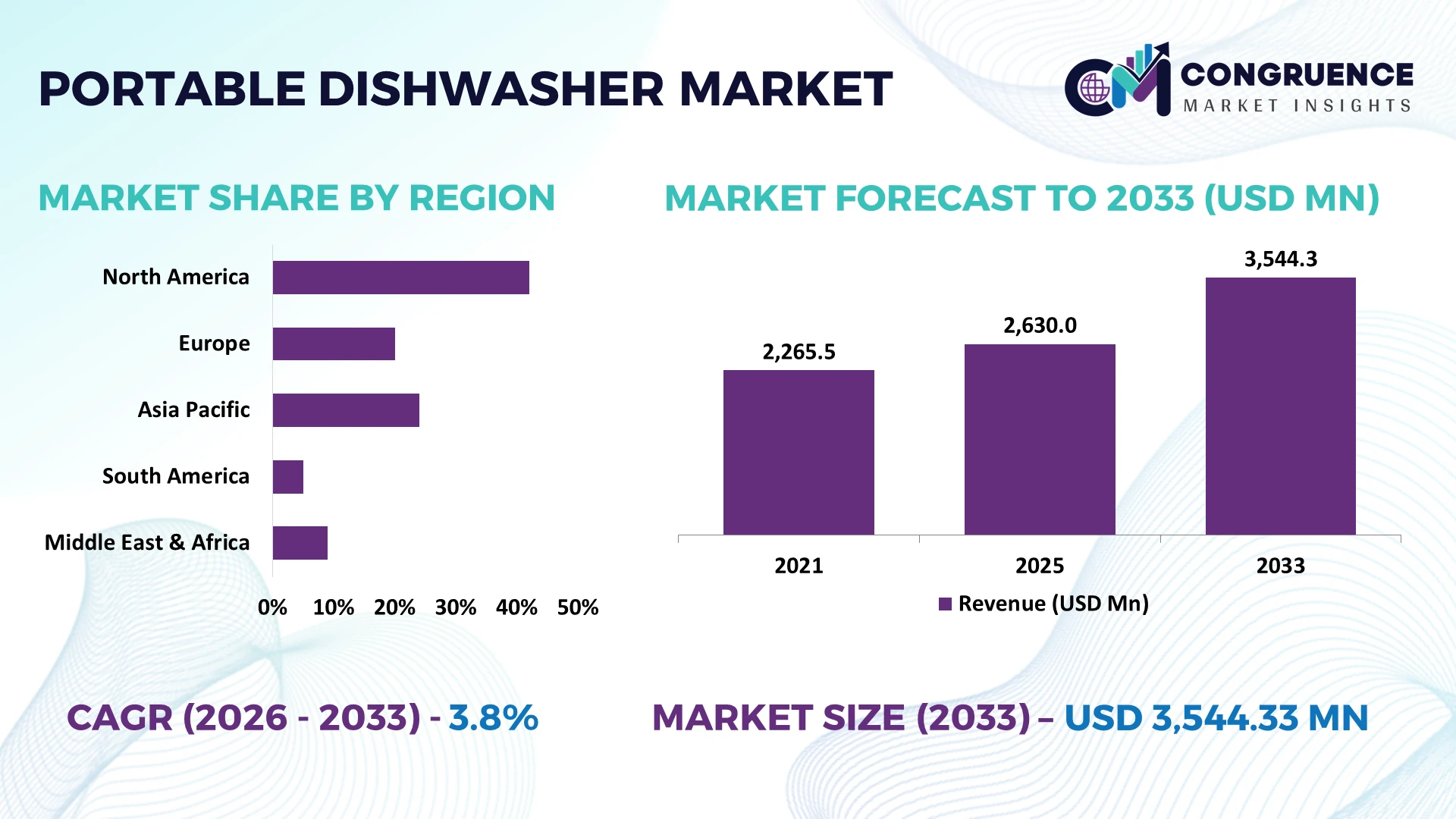
The Global Portable Dishwasher Market was valued at USD 2630 Million in 2025 and is anticipated to reach a value of USD 3544.33 Million by 2033 expanding at a CAGR of 3.8% between 2026 and 2033. Growth is driven by compact urban kitchens, rising renter households, countertop appliance adoption, and water-efficient wash systems that eliminate permanent plumbing requirements.
The United States remains the dominant portable dishwasher market, accounting for approximately 32% of global demand, supported by more than 45 million renter-occupied households and strong penetration of compact kitchen appliances. Countertop models using roughly 5–8 liters per cycle are gaining preference over manual dishwashing, particularly in apartments and smaller households. U.S. adoption remains ahead of Germany, while China is expanding rapidly through space-saving countertop formats and domestic appliance manufacturing scale. Post-pandemic appliance supply-chain diversification has further strengthened regional sourcing strategies.
Manufacturers prioritizing low-water, compact, installation-free models are positioned to capture the strongest replacement and first-time buyer opportunities.
Market Size & Growth: USD 2,630 million in 2025 advances to USD 3,544.33 million by 2033 at 3.8% CAGR, supported by compact, plumbing-free appliance adoption.
Top Growth Drivers: Urban apartment penetration contributes approximately 35% of demand momentum, water-efficiency preferences 28%, and renter-friendly installation formats 22%.
Short-Term Forecast: By 2028, advanced wash-control systems are expected to reduce water consumption per cleaning cycle by approximately 10–15% versus conventional portable designs.
Emerging Technologies: Sensor-controlled washing, inverter pumps, and app-connected cycle management are improving operating precision, with advanced models targeting 10–20% lower resource consumption.
Regional Leaders: North America approaches USD 1.1 billion, Europe USD 0.9 billion, and Asia-Pacific USD 1.2 billion toward 2033, supported respectively by renter, efficiency, and compact-living adoption.
Consumer/End-User Trends: Approximately 60% of category demand is concentrated around compact countertop and freestanding formats suited to apartments, rental properties, and small kitchens.
Pilot/Case Example: In 2025, next-generation countertop platforms demonstrated wash cycles using around 5 liters of water, cutting consumption substantially compared with prolonged manual washing.
Competitive Landscape: Leading brands collectively command a substantial share, with Whirlpool, GE Appliances, Electrolux, Midea, and Haier competing across countertop and freestanding portable configurations.
Regulatory & ESG Impact: High-efficiency designs increasingly target water consumption below 8 liters per cycle, strengthening alignment with appliance efficiency and household resource-conservation requirements.
Investment & Funding: Global appliance manufacturers continue directing multimillion-dollar product-development budgets toward compact platforms, localized production, automation, and supply-chain diversification following recent component disruptions.
Innovation & Future Outlook: Smart sensors, compact 6-place-setting architectures, quieter motors, and automated detergent control are shifting competition toward high-efficiency portable dishwashers rather than basic capacity expansion.
Portable dishwasher demand is increasingly concentrated in urban apartments, rental housing, studio kitchens, recreational properties, and households without built-in dishwasher connections. Countertop systems, integrated water tanks, sensor-based wash programs, inverter pumps, and app-enabled controls are widening product functionality while reducing installation complexity. Advanced models can operate with roughly 10–20% lower resource consumption than older configurations. At the same time, appliance manufacturers are diversifying component sourcing following global logistics disruptions, while compact housing development across Asia-Pacific strengthens demand for space-efficient designs. These shifts establish the operating context for the market’s strategic outlook.
Portable dishwashers are becoming strategically important as appliance manufacturers target renters, compact households, and kitchens where permanent plumbing restricts conventional dishwasher installation. The U.S. had more than 45 million renter-occupied housing units in 2024, creating a substantial addressable base for countertop and faucet-connected systems. Product competition is consequently shifting from basic portability toward water efficiency, sensor-based washing, integrated tanks, and digitally controlled cycles.
Technology is materially changing operating economics. Current U.S. efficiency criteria limit qualifying compact dishwashers to 2.0 gallons per cycle and 155 kWh annually, versus older compact benchmarks of 3.5 gallons and 225 kWh, representing roughly 43% lower permitted water use. Europe is simultaneously tightening appliance efficiency requirements, while China retains advantages in compact-appliance manufacturing scale. Tank-equipped models also remove the need for permanent water-line modification, accelerating deployment in rented apartments.
Through 2026–2028, soil sensing, inverter pumps, automated dosing, and app-based controls will increasingly differentiate premium products. Manufacturers are concentrating engineering investment on sub-eight-place-setting platforms and localized component sourcing. Competitive advantage will therefore depend on combining installation flexibility, certified efficiency, and supply-chain resilience rather than competing primarily on appliance capacity.
Structural demand is being strengthened by rental housing and smaller kitchens where permanent dishwasher installation is economically or physically impractical. The United States recorded more than 45 million renter-occupied homes in 2024, while compact ENERGY STAR dishwasher criteria permit maximum consumption of 2.0 gallons per cycle and 155 kWh annually. Compared with the earlier 3.5-gallon compact benchmark, this represents approximately 43% lower permitted water consumption. The shift creates a clear value proposition: portable systems combine installation flexibility with measurable utility efficiency. Manufacturers are responding with countertop water tanks, faucet adapters, soil sensors, and sub-eight-place-setting platforms. The strategic advantage lies in converting households previously excluded from built-in dishwasher ownership into addressable appliance customers without requiring kitchen remodeling.
Portable designs face a structural compromise between footprint, usable rack capacity, and cycle efficiency. Compact classification covers systems below eight place settings, limiting throughput compared with full-size appliances and increasing the likelihood of additional cycles in larger households. Although qualifying compact models operate within 2.0 gallons per cycle and 155 kWh annually, smaller loads can weaken efficiency per item when machines are repeatedly operated at partial capacity. In the United States, this constrains positioning beyond one- and two-person households, while imported pumps, electronic controllers, and specialized compact components remain exposed to international logistics and tariff changes. Manufacturers are mitigating these limitations through adjustable racks, modular spray arms, diversified component sourcing, and higher-density internal layouts. Improving usable capacity without expanding countertop footprint remains a critical profitability lever.
Integrated water reservoirs create an opportunity to expand portable dishwashers beyond kitchens with conventional plumbing. Five-liter-class tank systems already demonstrate how countertop appliances can operate without dedicated inlet connections, opening demand across rented apartments, student accommodation, recreational vehicles, secondary homes, and older housing stock. Soil sensing can dynamically adjust cycle operation, while current compact efficiency thresholds of 2.0 gallons per cycle establish a strong benchmark for water-focused innovation. China’s established compact-appliance manufacturing ecosystem provides a scalable base for integrating inverter pumps, connected controls, and automated dosing before international rollout. Manufacturers are increasing R&D around tank architecture and multifunctional countertop platforms. The non-obvious opportunity is ecosystem integration: connected portable dishwashers can become part of broader smart-kitchen portfolios rather than remaining standalone entry-level appliances.
Long-term competitiveness depends on achieving full-size cleaning performance within tighter hydraulic, acoustic, thermal, and physical constraints. Compact dishwashers operate below eight place settings, yet qualifying U.S. products must remain within 155 kWh annually and 2.0 gallons per cycle, forcing engineers to extract greater cleaning performance from limited water and energy budgets. Soil sensing improves cycle control, but variable loading, food residue, tank pressure, and user-selected programs complicate consistent results. Europe adds another execution pressure through stricter ecodesign requirements, including an Energy Efficiency Index below 56 for qualifying larger household dishwashers since 2024, reinforcing the wider industry shift toward efficiency-led engineering. Companies must invest in optimized spray geometry, quieter inverter pumps, sensor calibration, software validation, and service networks. Reliable performance, not portability alone, will determine repeat purchases and brand differentiation.
Smarter Wash-Cycle Optimization: Sensor-controlled programs are moving into compact models, with soil detection, automatic cycle selection, and inverter-driven pumps enabling approximately 10–20% lower resource consumption under optimized loads. Manufacturers are recalibrating spray pressure and cycle duration around smaller wash chambers rather than simply downsizing full-size systems. Connected diagnostics increasingly support maintenance and fault detection. The operational benefit is more consistent cleaning without proportionally increasing water or electricity consumption, encouraging appliance brands to integrate electronic controls across premium countertop portfolios.
Efficiency Standards Reshape Engineering: U.S. ENERGY STAR compact dishwasher specifications limit qualifying units to 155 kWh annually and 2.0 gallons per cycle, approximately 43% below the earlier 3.5-gallon water benchmark. Efficiency regulation is therefore influencing heating elements, filtration systems, pump architecture, and drying processes. Manufacturers are redesigning hydraulic circuits and software-controlled cycles to protect cleaning performance while meeting tighter consumption parameters, making engineering efficiency an increasingly important competitive differentiator.
Higher-Density Interior Configurations: Portable platforms are moving toward six-place-setting layouts, adjustable racks, foldable supports, and specialized glassware configurations. Current compact platforms can accommodate 30+ individual items despite substantially smaller footprints than conventional dishwashers. Brands are increasing usable rack density without enlarging external dimensions, improving appliance economics for space-constrained households. This design shift supports premium pricing because usable capacity, rather than external appliance size, increasingly determines consumer value.
Localized Component Strategies Expand: Appliance manufacturers are reducing dependence on single-country sourcing for pumps, electronic controllers, motors, and semiconductor-based controls following pandemic-era logistics disruption and continuing trade-policy uncertainty. Localization programs increasingly target 2–3 sourcing locations for critical assemblies while automation reduces production variability. The non-obvious advantage is faster product customization: diversified component architectures allow manufacturers to adapt voltage, connectivity, efficiency, and installation specifications for individual national markets without redesigning complete platforms.
Countertop portable dishwashers lead the type segmentation with an estimated 45–50% share, reflecting their small footprint, straightforward faucet or tank connection, and suitability for kitchens without dedicated appliance cavities. Their installation economics provide a clear advantage over Built-In Portable units, particularly for renters and small households. Six-place-setting platforms increasingly combine soil sensors, multiple wash programs, and water consumption near 5–8 liters per cycle, strengthening the segment’s performance proposition. Manufacturers are concentrating product development on higher rack density, quieter pumps, and integrated reservoirs.
Drawer-Style models represent the fastest-developing premium format as consumers prioritize ergonomic loading and flexible small-load operation. Freestanding units remain strategically relevant where users require higher capacity and mobility, while Built-In Portable configurations serve buyers seeking more integrated kitchen aesthetics without abandoning installation flexibility. Drawer-Style products remain comparatively premium, limiting mass penetration but supporting higher-value positioning. Investment is consequently splitting between scalable Countertop platforms for volume and differentiated Drawer-Style systems for premium households.
Residential Kitchens represent the leading application, accounting for an estimated 45–50% of portable dishwasher deployment as households seek automated dishwashing without permanent cabinetry modification. Established demand centers on supplemental appliances, older kitchens, and households requiring flexible installation. Small Apartments form an increasingly important adjacent application because countertop models can accommodate approximately six place settings while operating within compact footprints. Manufacturers are adapting through slimmer housings, integrated filtration, lower-noise pumps, and simplified connections that reduce installation requirements.
Rental Housing is the fastest-growing application as portability transfers appliance ownership from landlords toward tenants and eliminates structural plumbing modifications. More than 45 million U.S. households were renter-occupied during 2024, providing a substantial addressable installation base. Recreational Vehicles require lightweight, low-water systems, while Small Foodservice Operations value compact units where dish volumes remain below commercial-machine requirements. Product strategies increasingly separate residential convenience platforms from higher-cycle-duty configurations, allowing suppliers to align durability, capacity, and pricing with distinct operating environments.
Households represent the dominant end-user group with an estimated 65–70% share, supported by apartment living, kitchen retrofits, smaller household sizes, and demand for appliances requiring limited installation. Their purchasing criteria increasingly emphasize countertop footprint, six-place-setting capacity, water efficiency, noise, and simplified faucet or reservoir operation. Manufacturers are targeting this volume segment with broader price ladders, digital controls, adjustable racks, and compact platforms capable of handling 30+ items under optimized loading conditions.
RV Owners represent the fastest-expanding specialized buyer group as onboard kitchens increasingly incorporate compact electrical appliances and water-management systems. Restaurants and Cafes remain smaller but operationally demanding segments because repeated cycles place greater emphasis on durability and turnaround time. Catering Businesses require mobility but typically need higher throughput, restricting portable residential-style deployment to smaller operations. Suppliers are therefore differentiating warranties, pump durability, rack configuration, and cycle architecture by user intensity. Competitive positioning is shifting from one universal portable format toward application-specific platforms optimized for household convenience or repeated professional use.
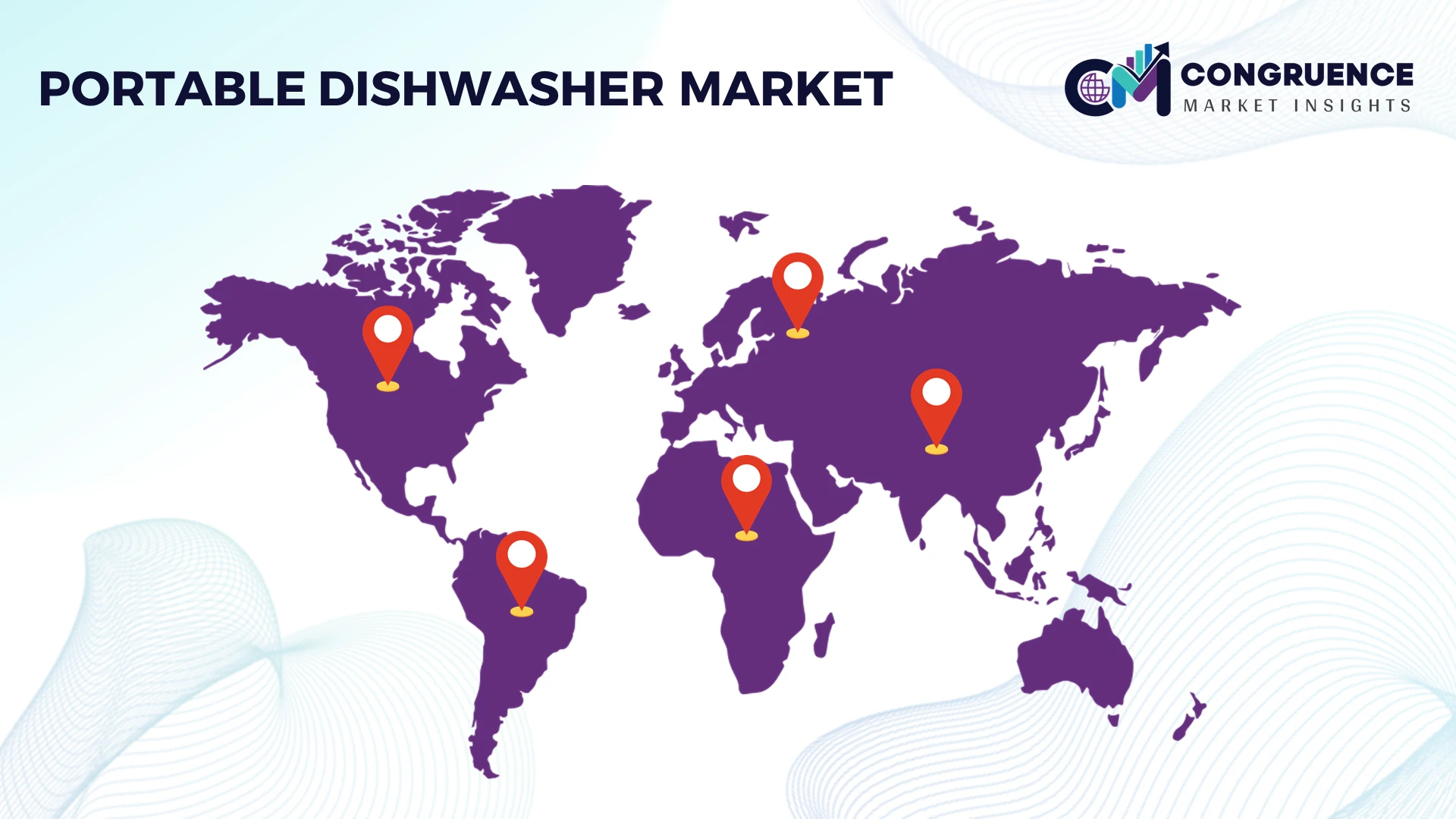
North America accounted for the largest market share at 34.3% in 2025 however, Asia-Pacific is expected to register the fastest growth, expanding at a CAGR of 8.7% between 2026 and 2033.
Compact-Appliance Penetration Strengthens Leadership
North America accounted for approximately 34.3% of portable dishwasher demand in 2025, supported by mature appliance retail networks, high replacement activity, and substantial renter-household concentration. The U.S. anchors deployment as countertop and mobile units address apartments, secondary kitchens, and properties where permanent cabinetry modification is impractical. Import flows also create extensive product choice: South Korea, the European Union, and China supplied substantial dishwasher volumes to the U.S., reinforcing a globally distributed procurement structure. Manufacturers are differentiating through adjustable racks, smart controls, low-noise pumps, and water-efficient wash architecture. Retailers increasingly combine physical appliance channels with digital fulfillment, allowing specialist portable formats to reach consumers beyond major metropolitan areas. The operational priority is now balancing imported-component flexibility with dependable service coverage and shorter replenishment cycles.
United States Market Outlook: The U.S. provides the region’s strongest combination of renter demand, appliance distribution, and technology adoption. More than 45 million renter-occupied households create a substantial addressable base for non-permanent installations. Manufacturers increasingly target six-place-setting formats, app-enabled controls, faucet adapters, and compact systems engineered around stringent water and electricity consumption requirements.
Ecodesign Rules Accelerate Efficiency Competition
Europe represents approximately 28–29% of portable automatic dishwasher demand, with Germany, the UK, France, and Italy forming important appliance markets. Competition is shaped more strongly by efficiency, reparability, and product longevity than by basic portability. EU Ecodesign requirements mandate availability of selected dishwasher spare parts for 10 years after models leave the market, while professional repairers receive access for at least seven years. Efficient dishwashers use around 9 liters for up to 15 place settings compared with approximately 20 liters for equivalent handwashing, sharpening the sustainability proposition. Manufacturers are consequently optimizing pumps, filtration, eco-programs, electronic controls, and serviceability rather than simply reducing appliance dimensions. Europe’s established built-in dishwasher base limits portable substitution, making countertop formats most relevant for smaller dwellings, secondary kitchens, and installation-constrained properties.
Germany Market Outlook: Germany combines mature dishwasher ownership with demanding energy-efficiency and durability expectations. Its strategic importance lies in premium engineering and regulatory compliance rather than first-time appliance penetration. Suppliers competing effectively emphasize low-noise motors, repairable assemblies, eco-cycle performance, and compact footprints, positioning portable units as specialized complements to the country’s established built-in appliance infrastructure.
Manufacturing Scale Meets Urban Compact Living
Asia-Pacific represents roughly 27–28% of portable automatic dishwasher demand and combines strong appliance manufacturing capacity with comparatively underpenetrated household dishwasher ownership in several countries. China provides the central manufacturing advantage through established motor, pump, electronics, molding, and appliance assembly ecosystems, allowing brands to iterate countertop products quickly and compete across multiple price bands. Midea led the Asia-Pacific portable segment with approximately 19.8% share in 2025, while the five largest suppliers collectively represented about 55.9%. Japan and South Korea reinforce technology development through compact-space engineering, inverter systems, and connected appliances. India adds a different demand pathway as dishwasher acceptance broadens beyond premium households. Manufacturers are localizing specifications, strengthening e-commerce distribution, and developing smaller-capacity platforms tailored to dense urban kitchens rather than exporting standardized full-size architectures.
China Market Outlook: China holds a strategic advantage through vertically integrated appliance manufacturing and supplier density. Midea and Haier combine domestic scale with extensive international distribution, supporting rapid commercialization of tank-based, sensor-controlled, and connected models. Chinese manufacturers can leverage common electronics and motor platforms across appliance categories, reducing development cycles and strengthening price competitiveness in export markets.
Brazil Anchors Localized Appliance Demand
South America accounts for a comparatively small share of portable dishwasher consumption, but Brazil provides a meaningful expansion base because dishwasher penetration remains below mature appliance markets. Brazil recorded approximately 186,000 dishwasher retail unit sales in 2025, up 4% year over year, while local manufacturing limits dependence on finished-product imports across the wider domestic-appliance industry. Consumer adoption increasingly favors water-saving and multifunctional products, creating room for portable formats in smaller urban households. Execution remains constrained by price sensitivity, financing conditions, and uneven category awareness outside higher-income cities. Electrolux, Whirlpool, and Midea are using domestic manufacturing and broader retail coverage to improve availability. For portable-dishwasher suppliers, localization of assembly, components, and pricing provides a stronger route to scale than relying primarily on imported finished appliances.
Brazil Market Outlook: Brazil is the region’s most strategically important appliance base, with households representing 93.5% of domestic-appliance demand in 2024. Electrolux held approximately 37% of dishwasher retail volume in 2025, Whirlpool 34%, and Midea 17%, demonstrating how localized production and distribution increasingly determine competitive positioning.
Urban Modernization Expands Premium Appliance Access
Middle East & Africa represents approximately 3% of portable automatic dishwasher demand, with deployment concentrated in wealthier urban centers, expatriate housing, hospitality-linked residences, and modern apartment developments. The UAE and Saudi Arabia provide the strongest premium-appliance environments through high urbanization, large residential construction programs, and established electronics retail networks. Portable formats address furnished apartments and properties where tenants cannot modify cabinetry or plumbing, while South Africa provides a broader conventional appliance channel. Dependence on imported finished appliances and components increases exposure to freight costs, exchange-rate movements, and longer replenishment cycles. Suppliers are therefore emphasizing distributor partnerships, regional inventory hubs, e-commerce availability, and standardized compact platforms capable of serving multiple Gulf markets. The strategic opportunity rests on selective urban deployment rather than broad household penetration.
United Arab Emirates Market Outlook: The UAE offers a concentrated addressable market through Dubai and Abu Dhabi’s apartment, hospitality, and expatriate housing ecosystems. With urbanization exceeding 85%, compact appliances benefit from dense modern residential infrastructure. Brands can strengthen deployment through local distributors, rapid-delivery e-commerce, premium appliance retailers, and portable models requiring minimal property modification.
Midea, Haier, Bosch, Samsung, and Whirlpool compete globally against Electrolux, LG, Panasonic, Danby, and specialist compact-appliance brands across price, efficiency, connectivity, and distribution. The five leading portable-dishwasher suppliers collectively held approximately 42.6% share in 2025, with Midea leading at about 12.4%. Chinese manufacturers leverage manufacturing scale and vertically integrated sourcing, while Bosch and premium appliance groups emphasize engineering, noise reduction, durability, and efficiency. Value-oriented brands pressure entry pricing, while connected models command roughly 10–20% feature premiums in selected channels. Competition increasingly centers on 5–8-liter wash cycles, six-place-setting capacity, integrated tanks, and app-based control. Manufacturers are expanding localized production, retailer partnerships, e-commerce distribution, and common component platforms. Supply-chain control is becoming more important as motors, pumps, electronics, and semiconductor controls determine availability. Brand trust, compliance certification, service infrastructure, and retailer access remain substantial entry barriers. Winning requires efficient compact architecture, disciplined sourcing, differentiated functionality, and dependable after-sales support.
Midea Group
Haier Group
Robert Bosch GmbH
Whirlpool Corporation
Electrolux
LG Electronics
Samsung Electronics
Panasonic Holdings
Smeg
Danby Products
IFB Industries
Havells India
Sharp Corporation
Hisense Group
Current portable dishwashers are moving from timer-based washing toward soil sensors, inverter pumps, optimized spray arms, and heating. Sensor-led cycles can reduce water and energy use by roughly 10–20% under variable loads, while compact systems operate near 5–8 liters per cycle. Wi-Fi monitoring and remote cycle control are moving into premium six-place-setting platforms, giving manufacturers differentiation in apartments, rental properties, and kitchens where installation flexibility matters across urban households.
Emerging systems combine turbidity sensing, adaptive cycle logic, drying, and over-the-air software updates. Compared with older compact platforms using fixed wash sequences, adaptive systems can cut water consumption by 40% when moving from 3.5-gallon legacy benchmarks toward 2-gallon operation. Integrated tanks and quick-connect plumbing further reduce installation complexity. Brands controlling pumps, electronics, software, and service ecosystems benefit most because integrated architecture improves reliability, feature deployment, and product-margin differentiation.
Between 2026 and 2028, AI-assisted soil recognition, predictive maintenance, quieter brushless motors, and energy-aware scheduling will move from premium differentiation toward competitive requirements. Connected diagnostics should reduce service visits by 10–15%, while optimized drying can lower heating demand. Manufacturers should prioritize electronics, sensor calibration, cybersecurity, and upgradeable software now, because portable-dishwasher competition is shifting from appliance mobility toward resource efficiency and intelligent operation.
February 2025 GE Profile launched its Smart Compact Dishwasher with three installation configurations, six place settings, SmartHQ connectivity, and two-gallon wash cycles, using 75% less water than nine-gallon handwashing. The launch expands compact deployment in constrained kitchens. Source: GE Appliances
September 2024 Samsung showcased its Bespoke Dishwasher at IFA 2024 with WaterJet Clean, Active Fan Dry and 7.9-liter Eco-cycle consumption. SmartThings AI Energy Mode cuts Pots & Pans energy use by up to 21%, strengthening connected efficiency positioning. Source: SamMobile
April 2024 U.S. Department of Energy finalized dishwasher efficiency standards, with compliance required from April 23, 2027. Compact models face tighter energy-and-water requirements, accelerating redesign of pumps, heating systems and controls while raising compliance pressure across portable products. Source: DOE
January 2025 BSH showcased the Bosch 500 Series smart dishwasher at CES, powered by Home Connect within its Matter-focused appliance ecosystem. The platform supports kitchen workflows, strengthening software integration as a competitive requirement for next-generation compact dishwashing systems. Source: BSH
The Portable Dishwasher Market Report evaluates Countertop, Freestanding, Built-In Portable, and Drawer-Style configurations across Residential Kitchens, Small Apartments, Rental Housing, Recreational Vehicles, and Small Foodservice Operations. End-user coverage spans Households, Restaurants, Cafes, Catering Businesses, and RV Owners. The assessment examines North America, Europe, Asia-Pacific, South America, and Middle East & Africa, alongside country-level deployment patterns and compact-appliance adoption.
Technology coverage includes soil sensing, inverter pumps, integrated water tanks, connected controls, adaptive washing, automated drying, and energy-management software. The report evaluates competitive positioning, regulatory efficiency requirements, distribution strategies, supply-chain localization, and niche demand from plumbing-constrained properties. With countertop formats representing roughly 45–50% of category demand, the analysis supports 2026–2033 investment planning, geographic expansion, product portfolio allocation, technology prioritization, partnership decisions, and competitive benchmarking.
| Report Attribute/Metric | Report Details |
|---|---|
Market Revenue in 2025 | USD 2630 Million |
Market Revenue in 2033 | USD 3544.33 Million |
CAGR (2026 - 2033) | 3.8% |
Base Year | 2025 |
Forecast Period | 2026 - 2033 |
Historic Period | 2021 - 2025 |
Segments Covered | By Type
By Application
By End-User
|
Key Report Deliverable | Revenue Forecast, Growth Trends, Market Dynamics, Segmental Overview, Regional and Country-wise Analysis, Competition Landscape |
Region Covered | North America, Europe, Asia-Pacific, South America, Middle East, Africa |
Key Players Analyzed | Midea Group, Haier Group, Robert Bosch GmbH, Whirlpool Corporation, Electrolux, LG Electronics, Samsung Electronics, Panasonic Holdings, Smeg, Danby Products, IFB Industries, Havells India, Sharp Corporation, Hisense Group |
Customization & Pricing | Available on Request (10% Customization is Free) |




