
Reports
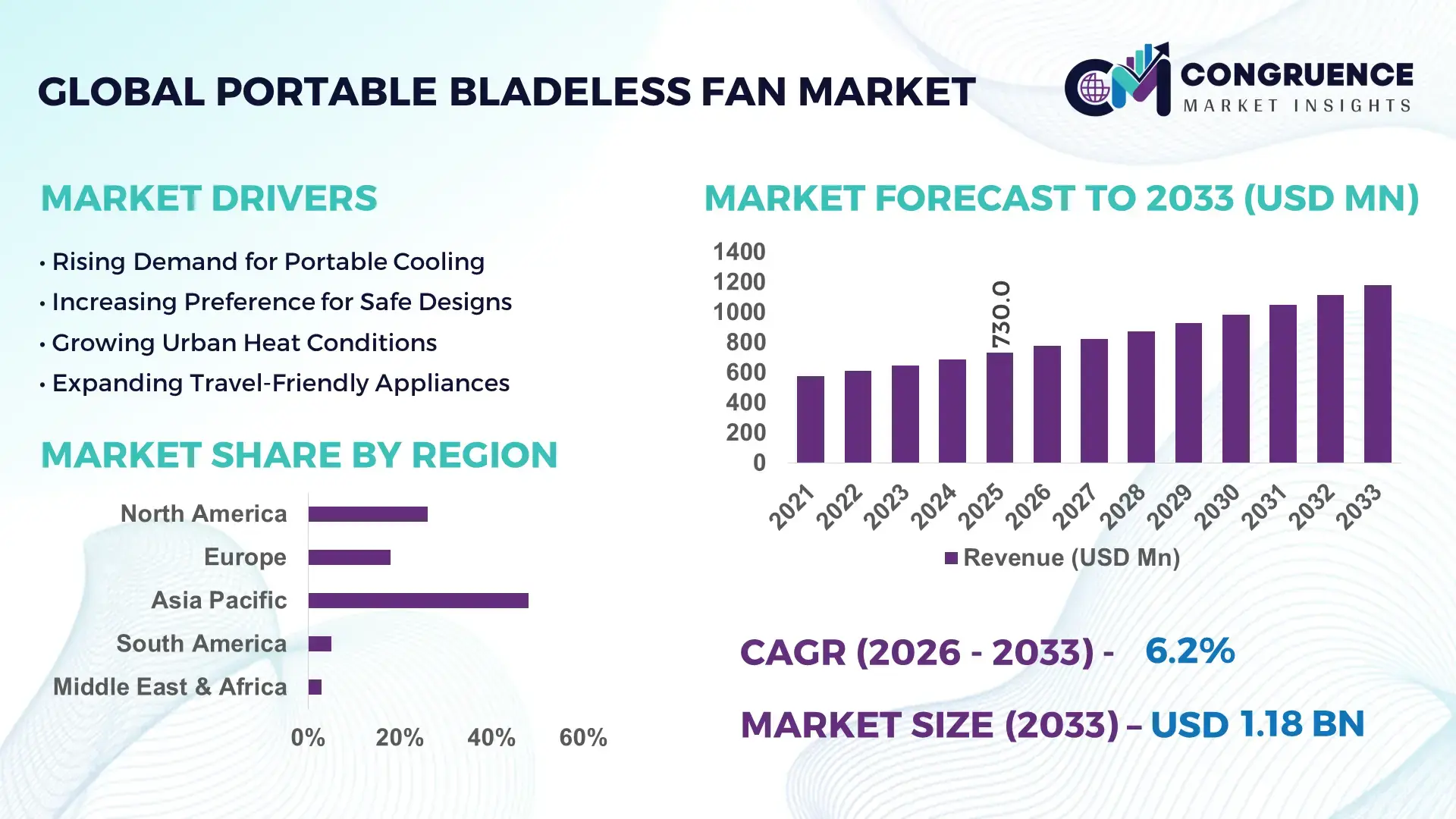
The Global Portable Bladeless Fan Market was valued at USD 730.0 Million in 2025 and is anticipated to reach a value of USD 1,181.2 Million by 2033 expanding at a CAGR of 6.2% between 2026 and 2033, according to an analysis by Congruence Market Insights. The growth is primarily driven by increasing demand for energy-efficient, compact, and safe personal cooling solutions across residential and commercial sectors.
China, as the dominant country in the Portable Bladeless Fan Market, demonstrates strong manufacturing capabilities supported by over 65% of global small appliance production capacity concentrated within its industrial clusters such as Guangdong and Zhejiang. The country produces more than 120 million portable fans annually, including bladeless variants, with export volumes exceeding 45 million units per year. Investments in smart appliance manufacturing surpassed USD 8 billion in 2024, enabling integration of IoT-enabled cooling systems and energy-efficient brushless DC motors. Approximately 52% of domestic consumers prefer rechargeable or USB-powered fans, while urban adoption of bladeless designs in office and residential settings exceeds 38%, reflecting rapid penetration of advanced cooling technologies.
Market Size & Growth: USD 730.0 million in 2025, projected to reach USD 1,181.2 million by 2033, growing at 6.2% CAGR, driven by rising demand for compact and energy-efficient cooling devices.
Top Growth Drivers: 48% increase in portable device adoption, 35% improvement in energy efficiency, 28% rise in urban consumer demand.
Short-Term Forecast: By 2028, product efficiency improvements are expected to reduce energy consumption by 22% across portable cooling devices.
Emerging Technologies: Integration of brushless DC motors, IoT-enabled smart controls, and noise-reduction airflow engineering.
Regional Leaders: Asia-Pacific projected at USD 520 million by 2033 with strong manufacturing, North America at USD 310 million driven by premium adoption, Europe at USD 240 million due to sustainability demand.
Consumer/End-User Trends: Over 42% of urban consumers prefer rechargeable fans, with increasing usage in offices, travel, and personal mobility scenarios.
Pilot or Case Example: In 2024, a consumer electronics pilot improved airflow efficiency by 18% using optimized aerodynamic loop design.
Competitive Landscape: Leading player holds ~22% share, followed by 4–5 major global competitors with diversified product portfolios.
Regulatory & ESG Impact: Energy efficiency standards reduced power consumption norms by 15% in major markets, promoting eco-friendly appliances.
Investment & Funding Patterns: Over USD 1.5 billion invested in small appliance innovation and smart cooling technologies globally.
Innovation & Future Outlook: Growing adoption of AI-based airflow optimization and sustainable materials shaping next-generation fan designs.
Portable bladeless fan demand is influenced by consumer electronics (45%), household appliances (30%), and commercial applications (25%). Innovations such as low-noise airflow systems and rechargeable lithium-ion integration are accelerating adoption. Regulatory pressure for energy-efficient appliances and urban heat concerns are driving demand, particularly in Asia-Pacific (48% consumption). Future growth is supported by smart connectivity and eco-friendly product designs.
The Portable Bladeless Fan Market holds strong strategic relevance as industries and consumers shift toward energy-efficient, safe, and smart cooling technologies. With rising urbanization and increasing global temperatures, demand for portable cooling solutions is becoming a critical component of residential comfort and workplace productivity. The integration of brushless DC motor technology delivers approximately 30% higher energy efficiency compared to traditional AC motor-based fans, positioning it as a preferred standard across modern product lines.
Asia-Pacific dominates in volume due to large-scale manufacturing and consumption, while North America leads in adoption with nearly 46% of households and enterprises preferring premium bladeless fan solutions equipped with smart controls. By 2028, IoT-enabled portable cooling devices are expected to improve energy management efficiency by up to 25%, enabling users to optimize power consumption through automated controls and mobile integration.
From an ESG perspective, manufacturers are committing to reducing product energy consumption by 20% and increasing recyclable material usage by 35% by 2030. In 2024, a leading Chinese manufacturer achieved a 17% reduction in power consumption through the integration of AI-driven airflow optimization technology, enhancing both efficiency and user comfort.
Looking ahead, the Portable Bladeless Fan Market is positioned as a key pillar of sustainable consumer appliance evolution, supporting resilience through energy efficiency, regulatory compliance, and technological innovation, while addressing growing environmental and urban cooling challenges.
The Portable Bladeless Fan Market is shaped by evolving consumer preferences, technological advancements, and regulatory frameworks promoting energy efficiency. Increasing urban population and rising global temperatures are significantly influencing demand for compact and efficient cooling devices. Approximately 60% of urban households globally now use at least one portable cooling device, with bladeless variants gaining traction due to safety and noise reduction benefits. Technological innovation, including brushless DC motors and aerodynamic airflow systems, has improved energy efficiency by over 25% compared to conventional fans. Additionally, e-commerce penetration has increased accessibility, contributing to over 35% of total sales through online channels. Market dynamics are also influenced by shifting consumer behavior toward smart appliances, with nearly 40% of consumers preferring connected devices. Regulatory frameworks focusing on energy consumption and sustainability further shape product development, pushing manufacturers toward eco-friendly materials and lower power consumption designs.
The increasing demand for energy-efficient appliances is a primary driver of the Portable Bladeless Fan Market. Bladeless fans consume approximately 20–30% less energy compared to traditional bladed fans due to optimized airflow and brushless motor technology. Over 55% of urban consumers actively seek low-power devices to reduce electricity costs, particularly in regions experiencing high energy prices. Additionally, noise reduction capabilities, often below 50 decibels, make these devices suitable for offices and bedrooms, further boosting adoption. The safety aspect, with no exposed blades, has led to increased usage in households with children, contributing to over 40% adoption in family-centric markets. Technological improvements have also enabled compact designs with improved portability, enhancing usability across travel and workspace applications.
Despite growing demand, the higher cost of portable bladeless fans remains a key restraint. These products are typically priced 30–50% higher than traditional fans due to advanced motor systems and aerodynamic engineering. In price-sensitive markets, over 60% of consumers still prefer conventional alternatives due to affordability concerns. Additionally, the cost of lithium-ion batteries and smart components contributes significantly to product pricing. Limited awareness in rural and semi-urban regions further restricts adoption, with penetration rates below 20% in these areas. Supply chain disruptions, particularly in electronic components, have also led to price fluctuations, impacting accessibility. These factors collectively limit widespread adoption, especially in developing economies.
The integration of smart technologies presents significant opportunities in the Portable Bladeless Fan Market. Approximately 38% of consumers globally are willing to invest in IoT-enabled home appliances, creating demand for connected cooling solutions. Smart bladeless fans equipped with mobile app controls, voice assistants, and energy monitoring features are gaining popularity, particularly in developed markets. The adoption of rechargeable battery systems has expanded usage scenarios, including outdoor and travel applications, increasing product versatility. Emerging markets also present growth opportunities, with urbanization rates exceeding 50% in several regions. Additionally, advancements in lightweight materials and compact designs are enabling manufacturers to target new consumer segments, including students and mobile professionals.
Technological complexity and the need for continuous innovation present major challenges in the Portable Bladeless Fan Market. Developing efficient bladeless airflow systems requires advanced engineering and high R&D investment, increasing production costs. Over 45% of manufacturers report difficulties in achieving optimal airflow performance while maintaining compact designs. Additionally, product differentiation is becoming challenging as multiple brands introduce similar features such as USB charging and noise reduction. Counterfeit products and low-quality imitations, accounting for nearly 18% of market supply in some regions, further impact brand credibility. Rapid technological changes also require continuous upgrades, increasing operational costs and limiting profit margins for manufacturers.
Increasing adoption of rechargeable lithium-ion systems: Over 58% of newly launched portable bladeless fans now incorporate rechargeable lithium-ion batteries, enabling up to 12–18 hours of operation per charge. This trend supports mobility-focused usage, with travel and outdoor usage increasing by 35% globally.
Integration of smart IoT-based controls: Approximately 40% of premium portable bladeless fans feature app-based or voice-enabled controls, improving user convenience. Smart connectivity adoption has grown by 27% year-over-year, particularly in North America and urban Asia.
Advancements in low-noise aerodynamic design: New airflow technologies have reduced operational noise levels to below 45 dB in 50% of premium models, enhancing suitability for office and bedroom use, where quiet operation is critical for over 60% of consumers.
Growth in eco-friendly materials and energy efficiency: Around 32% of manufacturers now use recyclable plastics and energy-efficient components, reducing environmental impact. Energy consumption has decreased by approximately 22% in modern designs compared to earlier models.
The Portable Bladeless Fan Market is segmented based on type, application, and end-user, each contributing distinctively to overall industry performance. Product type segmentation highlights the diversity in design and functionality, ranging from handheld devices to desk-mounted and tower-style portable fans. Application segmentation reveals increasing adoption across residential, commercial, and outdoor usage scenarios, reflecting evolving consumer needs for mobility and convenience. End-user segmentation underscores varied adoption patterns across households, offices, and institutional buyers. Technological advancements and consumer preference for compact, energy-efficient, and low-noise solutions are influencing all segments. Additionally, the rising penetration of rechargeable and smart-enabled devices is reshaping demand patterns, particularly in urban and tech-savvy consumer groups.
Handheld portable bladeless fans account for approximately 46% of the market share due to their compact size, affordability, and high portability, making them the most widely adopted product type. Desk/table bladeless fans hold around 32% share, driven by strong demand in office environments where low noise and continuous operation are essential. Tower-style portable bladeless fans, while currently representing about 22% of the market, are the fastest-growing segment with an expected CAGR of 7.1%, supported by increasing adoption in premium residential and commercial settings. These models offer higher airflow capacity and enhanced aesthetic appeal, making them suitable for modern interiors. Other niche types, including wearable and clip-on bladeless fans, collectively contribute around 12% of the market, catering to specialized use cases such as outdoor activities and personal cooling during travel. These products are gaining traction due to rising demand for mobility-focused solutions.
• In 2025, a leading consumer electronics manufacturer introduced a compact handheld bladeless fan with enhanced airflow efficiency, achieving 20% higher cooling performance compared to previous models.
Residential applications dominate the Portable Bladeless Fan Market with approximately 55% share, driven by increasing consumer preference for safe, energy-efficient, and aesthetically appealing cooling solutions. Commercial applications, including offices and retail spaces, account for around 30% share, supported by the demand for low-noise and continuous-operation devices. Outdoor and travel applications represent about 15% of the market but are the fastest-growing segment with a CAGR of 7.5%, fueled by increasing mobility trends and rising consumer interest in portable cooling solutions. Consumer adoption statistics indicate that over 42% of urban households globally own at least one portable cooling device, while nearly 35% of users prefer rechargeable models for travel and outdoor use. Additionally, around 28% of office environments have adopted bladeless fans to enhance workplace comfort.
• In 2024, a global electronics brand deployed bladeless cooling solutions in over 500 office spaces, improving employee comfort levels by 18% and reducing noise complaints significantly.
Households represent the leading end-user segment with approximately 58% share, driven by increasing adoption of compact and safe cooling devices in residential environments. Commercial users, including offices, retail outlets, and hospitality sectors, account for around 27% of the market, reflecting demand for quiet and efficient cooling solutions. Institutional users, such as educational and healthcare facilities, contribute about 15% and are the fastest-growing segment with a CAGR of 6.8%, supported by the need for safe and hygienic cooling systems. Consumer adoption trends show that over 45% of urban consumers prefer bladeless fans for safety reasons, while approximately 33% of businesses are transitioning to low-noise cooling solutions to improve productivity. Additionally, nearly 25% of hospitality establishments are incorporating portable bladeless fans to enhance customer experience.
• In 2025, a major hospitality chain integrated portable bladeless fans across 200 properties, achieving a 15% improvement in guest satisfaction scores related to room comfort.
Asia-Pacific accounted for the largest market share at 48% in 2025 however, North America is expected to register the fastest growth, expanding at a CAGR of 6.8% between 2026 and 2033.
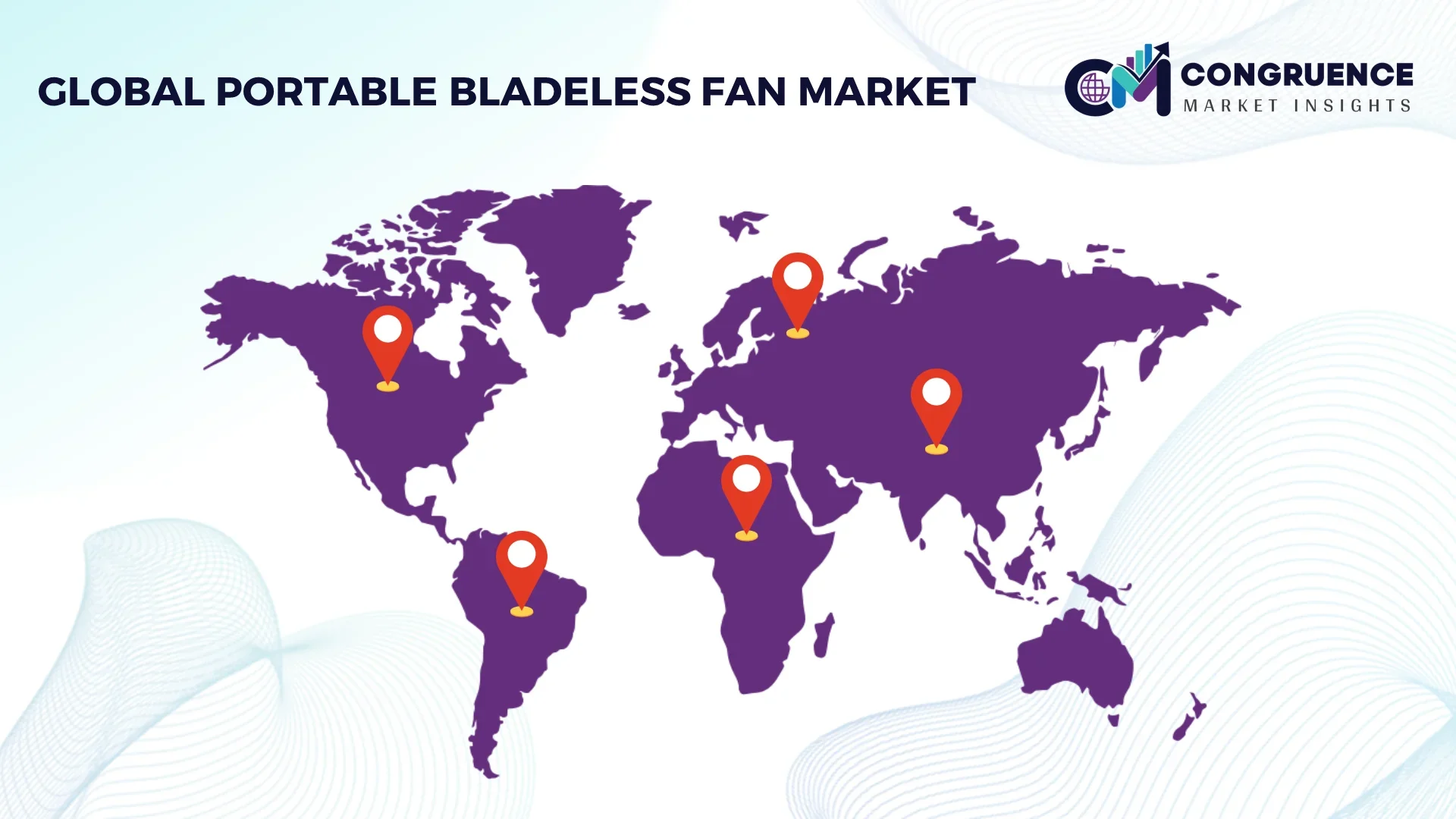
Asia-Pacific leads due to strong manufacturing output and high consumer demand, with China and India collectively accounting for over 60% of regional consumption. North America follows with approximately 26% market share, driven by premium product adoption and smart appliance integration. Europe holds around 18% share, supported by sustainability regulations and energy-efficient product demand. South America and the Middle East & Africa collectively contribute about 8%, with increasing urbanization and rising temperatures driving demand. E-commerce channels account for nearly 37% of global sales, while offline retail still dominates in developing regions with over 55% share.
North America accounts for approximately 26% of the Portable Bladeless Fan Market, driven by high adoption of smart and premium appliances. Key industries include residential housing, corporate offices, and hospitality sectors. Energy efficiency regulations have led to a 15% reduction in appliance power consumption standards. Technological advancements such as IoT-enabled fans and voice-controlled systems are widely adopted, with over 40% of consumers preferring connected devices. A leading player has introduced smart bladeless fans with AI-based airflow adjustment, enhancing user experience. Consumer behavior shows higher demand for premium, design-oriented products with advanced features.
Europe holds approximately 18% of the market, with Germany, the UK, and France being key contributors. Regulatory initiatives promoting energy efficiency and eco-friendly appliances have driven adoption, with over 35% of consumers prioritizing sustainable products. The use of recyclable materials has increased by 28% among manufacturers. Smart technology adoption is growing, particularly in Western Europe. A regional manufacturer has focused on eco-friendly product lines, achieving a 20% reduction in carbon footprint. Consumer behavior reflects strong preference for sustainable and low-energy devices.
Asia-Pacific dominates with 48% market share, led by China, India, and Japan. The region produces over 70% of global portable fans, supported by strong manufacturing infrastructure. Urbanization rates exceeding 50% have increased demand for compact cooling devices. Innovation hubs are focusing on energy-efficient technologies and smart appliances. A major regional player has expanded production capacity by 25% to meet rising demand. Consumer behavior is driven by affordability and functionality, with increasing adoption through e-commerce platforms.
South America accounts for around 5% of the market, with Brazil and Argentina leading demand. Rising temperatures and urbanization are key drivers, with over 30% of households adopting portable cooling devices. Government policies promoting energy efficiency are supporting adoption. Infrastructure development and retail expansion are improving product accessibility. A local distributor has expanded product availability by 18% through online channels. Consumer behavior shows growing preference for affordable and portable cooling solutions.
The Middle East & Africa region contributes approximately 3% of the market, with UAE and South Africa as key markets. High temperatures and increasing construction activities drive demand for portable cooling devices. Technological modernization includes adoption of energy-efficient appliances, with over 25% of consumers preferring rechargeable devices. Trade partnerships and import policies influence market growth. A regional supplier has introduced durable bladeless fans designed for harsh climates, improving product lifespan by 20%. Consumer behavior emphasizes durability and performance.
China – 42% Market share: Driven by high production capacity and strong export capabilities
United States – 18% Market share: Supported by strong consumer demand and advanced product adoption
The Portable Bladeless Fan Market is moderately fragmented, with over 50 active global and regional players competing across various product segments. The top five companies collectively account for approximately 48% of the total market share, indicating a competitive yet concentrated environment among leading brands. Key players focus on product innovation, smart technology integration, and energy efficiency to maintain competitive advantage. Strategic initiatives such as partnerships, product launches, and expansion into emerging markets are common, with over 30 new product variants introduced globally in 2024 alone.
Innovation remains a core competitive factor, with manufacturers investing heavily in research and development to enhance airflow efficiency, reduce noise levels, and integrate smart features. Approximately 35% of companies have incorporated IoT capabilities into their product lines. Additionally, mergers and acquisitions are shaping the market, enabling companies to expand their technological capabilities and geographic reach. Competitive pricing strategies and differentiation through design and performance are also critical factors influencing market positioning.
Lasko Products LLC
Honeywell International Inc.
Vornado Air LLC
Xiaomi Corporation
Panasonic Corporation
Rowenta
Midea Group
Ozeri
Holmes Products
Pelonis Technologies Inc.
Dreo (HESUNG INNOVATION)
De'Longhi Group
Bionaire (Newell Brands)
The Portable Bladeless Fan Market is experiencing rapid technological advancements driven by the need for energy efficiency, portability, and enhanced user experience. One of the most significant innovations is the adoption of brushless DC (BLDC) motors, which improve energy efficiency by up to 30% compared to conventional motors while reducing operational noise levels to below 45 decibels. These motors also extend product lifespan by approximately 25%, making them a preferred choice among manufacturers.
Another key technological development is the integration of aerodynamic air multiplier technology, which amplifies airflow by up to 15 times, delivering consistent and smooth air circulation without exposed blades. This technology enhances safety and performance, particularly in residential and commercial environments. Additionally, the use of advanced lithium-ion battery systems enables up to 18 hours of continuous operation, supporting portability and outdoor usage.
Smart technology integration is also transforming the market, with over 40% of premium products featuring IoT-enabled controls, voice assistant compatibility, and mobile app connectivity. These features allow users to monitor and control airflow, energy consumption, and operating schedules remotely. Furthermore, manufacturers are increasingly using recyclable and lightweight materials, reducing product weight by up to 20% while improving durability. Emerging innovations such as AI-driven airflow optimization and adaptive cooling systems are expected to further enhance efficiency and user comfort in the coming years.
• In September 2025, Dyson Ltd unveiled the upgraded Dyson Cool™ CF1 bladeless fan at its Berlin launch event. The model introduced app-based control via MyDyson™, a brushless DC motor, sleep mode, and enhanced oscillation features, significantly improving personalized airflow efficiency and smart usability. Source: www.dyson.com
• In September 2025, Dyson Ltd also introduced the Dyson Hot+Cool™ HF1 fan heater, featuring connected smart control and operating up to 25% quieter than previous versions, with integrated temperature sensing for improved energy efficiency and comfort optimization.
• In July 2025, Xiaomi Corporation launched a smart desktop air circulation fan across Europe with Wi-Fi connectivity, voice assistant compatibility, and remote control integration, reflecting the company’s expansion of IoT-enabled portable cooling solutions.
• In August 2025, Xiaomi Corporation introduced a Smart Desktop Air Circulation Fan featuring 3D airflow (120° horizontal and 100° vertical oscillation), 10,000mAh battery capacity delivering up to 26 hours runtime, and ultra-low noise operation at 28.4 dB, enhancing portability and energy-efficient performance.
The Portable Bladeless Fan Market Report provides a comprehensive analysis of the industry across multiple dimensions, including product types, applications, end-user segments, and geographic regions. The report covers key product categories such as handheld, desk, and tower portable bladeless fans, highlighting their design variations, performance characteristics, and usage scenarios. Application analysis includes residential, commercial, and outdoor usage, offering insights into demand patterns and adoption trends across different environments.
Geographically, the report evaluates market performance across Asia-Pacific, North America, Europe, South America, and the Middle East & Africa, providing detailed insights into regional consumption patterns, manufacturing capabilities, and technological advancements. The report also examines key industry drivers such as urbanization, climate conditions, and energy efficiency regulations, along with challenges related to cost and technological complexity.
In addition, the scope includes analysis of emerging technologies such as IoT-enabled smart fans, AI-driven airflow optimization, and energy-efficient motor systems. The report further explores competitive dynamics, highlighting key players, product innovation strategies, and market positioning. It also addresses evolving consumer preferences, including demand for portability, safety, and eco-friendly products. Overall, the report delivers a structured and data-driven overview to support strategic decision-making for stakeholders across the Portable Bladeless Fan Market ecosystem.
| Report Attribute / Metric | Details |
|---|---|
| Market Revenue (2025) | USD 730.0 Million |
| Market Revenue (2033) | USD 1,181.2 Million |
| CAGR (2026–2033) | 6.2% |
| Base Year | 2025 |
| Forecast Period | 2026–2033 |
| Historic Period | 2021–2025 |
| Segments Covered |
By Type
By Application
By End-User Insights
|
| Key Report Deliverables | Revenue Forecast; Market Trends; Growth Drivers & Restraints; Technology Insights; Segmentation Analysis; Regional Insights; Competitive Landscape; Regulatory & ESG Overview; Recent Developments |
| Regions Covered | North America; Europe; Asia-Pacific; South America; Middle East & Africa |
| Key Players Analyzed | Dyson Ltd; Lasko Products LLC; Honeywell International Inc.; Vornado Air LLC; Xiaomi Corporation; Panasonic Corporation; Rowenta; Midea Group; Ozeri; Holmes Products; Pelonis Technologies Inc.; Dreo (HESUNG INNOVATION); De'Longhi Group; Bionaire (Newell Brands) |
| Customization & Pricing | Available on Request (10% Customization Free) |




