
Reports
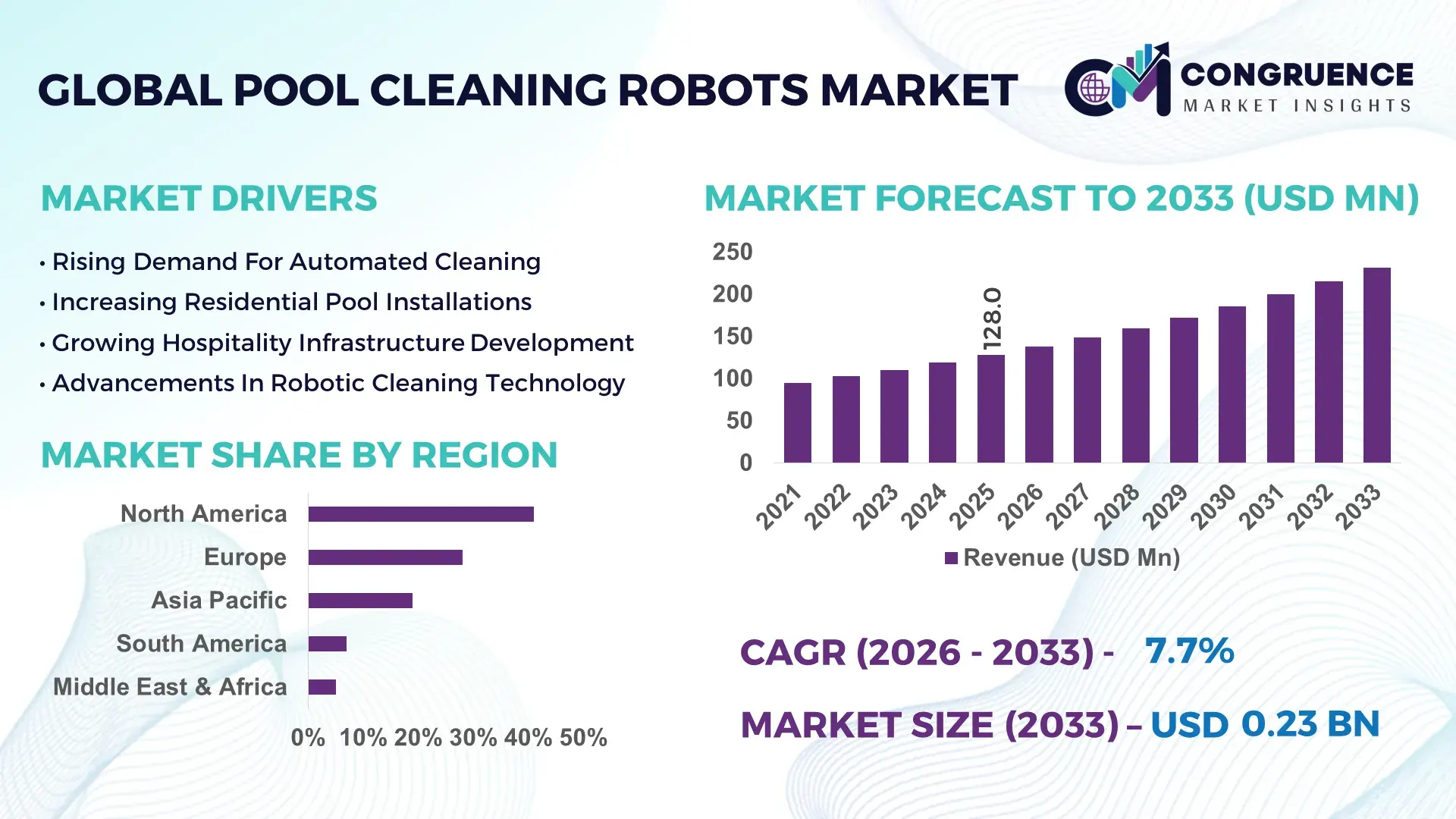
The Global Pool Cleaning Robots Market was valued at USD 128.0 Million in 2025 and is anticipated to reach a value of USD 231.7 Million by 2033 expanding at a CAGR of 7.7% between 2026 and 2033, according to an analysis by Congruence Market Insights. Rising demand for automated, energy-efficient pool maintenance solutions is a key factor driving market expansion.
The United States continues to dominate the Pool Cleaning Robots Market with over 10.7 million residential swimming pools and more than 300,000 commercial pools, creating sustained demand for automated cleaning technologies. Robotic cleaners account for nearly 42% of pool maintenance equipment adoption in residential segments, with penetration rising due to labor cost increases of over 18% in maintenance services. The country has witnessed over USD 250 million in annual investments in smart pool technologies, including IoT-enabled robotic systems. Advanced manufacturing capabilities, particularly in California and Florida, support production of high-efficiency robotic cleaners with AI navigation and energy-saving motors. Commercial applications in hotels and resorts contribute nearly 28% of total robotic cleaner usage, supported by stringent hygiene standards and operational efficiency requirements.
Market Size & Growth: Valued at USD 128.0 Million in 2025 and projected to reach USD 231.7 Million by 2033, expanding at 7.7% CAGR due to rising automation demand.
Top Growth Drivers: Automation adoption increased by 46%, operational efficiency improved by 32%, and maintenance cost reduction reached 28%.
Short-Term Forecast: By 2028, robotic pool cleaners are expected to reduce manual cleaning costs by 35% and improve cleaning efficiency by 40%.
Emerging Technologies: AI-based navigation, IoT-enabled remote monitoring, and energy-efficient brushless motors are transforming product performance.
Regional Leaders: North America to reach USD 98 Million by 2033 with high residential adoption; Europe USD 72 Million driven by eco-regulations; Asia-Pacific USD 45 Million supported by urbanization.
Consumer/End-User Trends: Residential users account for over 60% usage, while commercial sectors adopt automation to reduce labor dependency by 30%.
Pilot or Case Example: In 2025, a hospitality chain in the US reduced pool maintenance time by 38% using AI-enabled robotic cleaners.
Competitive Landscape: Market leader holds approximately 22% share, followed by major players including Zodiac, Hayward, Pentair, and Maytronics.
Regulatory & ESG Impact: Energy efficiency regulations have driven adoption of low-power robots reducing electricity consumption by up to 25%.
Investment & Funding Patterns: Over USD 300 Million invested globally in smart pool automation technologies between 2023 and 2025.
Innovation & Future Outlook: Integration of AI, mobile apps, and predictive maintenance is expected to enhance operational efficiency and extend product lifecycle.
Pool Cleaning Robots Market is influenced by residential (60%), commercial (30%), and industrial (10%) sectors, with innovation in AI navigation improving cleaning accuracy by 35%. Environmental regulations are pushing adoption of energy-efficient models reducing power consumption by 20%. North America leads consumption, while Asia-Pacific shows rapid adoption growth. Future trends include smart connectivity and predictive maintenance.
The Pool Cleaning Robots Market is strategically positioned as a key component of automation-driven facility management, particularly across residential, hospitality, and recreational infrastructure sectors. Increasing labor shortages and rising operational costs have accelerated the adoption of robotic cleaning systems, with automated solutions delivering up to 40% higher efficiency compared to traditional suction-based cleaners. AI-enabled navigation systems deliver approximately 35% improvement compared to manual or semi-automatic cleaning methods, significantly enhancing cleaning precision and coverage.
North America dominates in volume due to high pool ownership density, while Europe leads in adoption with over 48% of commercial facilities integrating energy-efficient robotic systems. The growing integration of IoT and AI is reshaping operational strategies, enabling predictive maintenance and real-time performance monitoring. By 2028, AI-powered robotic systems are expected to reduce maintenance downtime by 30% while improving operational efficiency by 45%.
Sustainability and ESG commitments are becoming central to market strategies, with manufacturers targeting up to 25% reduction in energy consumption and increased use of recyclable materials by 2030. In 2025, a leading U.S. hospitality operator achieved a 37% reduction in maintenance costs by deploying AI-driven robotic pool cleaners across multiple properties.
Strategically, the Pool Cleaning Robots Market is evolving into a critical pillar supporting automation, regulatory compliance, and sustainability initiatives. Continuous innovation in smart technologies, combined with increasing adoption across emerging markets, positions the market for long-term resilience and scalable growth.
The Pool Cleaning Robots Market is characterized by rapid technological evolution, increasing automation demand, and growing emphasis on energy efficiency. Rising global pool installations, particularly in residential and hospitality sectors, have significantly influenced demand patterns. Over 65% of newly constructed premium residential properties now incorporate automated pool maintenance solutions. Technological advancements such as AI navigation, smart sensors, and IoT integration are reshaping product capabilities, enabling up to 40% improvement in cleaning efficiency. Additionally, rising labor costs and stringent hygiene regulations are pushing commercial establishments to adopt robotic cleaners. Market dynamics are further influenced by seasonal demand fluctuations, regional climate variations, and increasing consumer preference for smart home integration. Manufacturers are focusing on product innovation, durability, and energy optimization to gain competitive advantage while addressing environmental concerns.
The increasing shift toward automation across residential and commercial sectors is a primary driver of the Pool Cleaning Robots Market. More than 58% of pool owners in developed regions prefer automated cleaning systems due to reduced manual effort and improved efficiency. Robotic cleaners can reduce cleaning time by up to 45% while enhancing debris removal accuracy by over 30%. In commercial settings such as hotels and resorts, automation has led to operational cost savings of nearly 25%, making robotic solutions highly attractive. Additionally, the integration of AI-based navigation systems allows robots to optimize cleaning paths, reducing energy consumption by approximately 20%. Growing smart home adoption, which has surpassed 35% globally, is further boosting demand for connected robotic pool cleaners.
Despite strong demand, high upfront costs remain a significant barrier to adoption in the Pool Cleaning Robots Market. Advanced robotic cleaners can cost 2 to 3 times more than traditional suction or pressure-based systems, limiting accessibility in price-sensitive markets. Approximately 40% of potential consumers in emerging economies cite cost as the primary barrier to adoption. Maintenance and repair costs, including replacement of motors and sensors, can add up to 15% of the product cost annually. Additionally, lack of awareness regarding long-term cost benefits and energy savings continues to slow adoption rates. Limited availability of financing options and uneven distribution networks further restrict market penetration in developing regions.
Integration of smart technologies such as IoT, AI, and mobile connectivity presents significant growth opportunities in the Pool Cleaning Robots Market. Over 50% of new robotic cleaner models now feature app-based control and remote monitoring capabilities, enhancing user convenience. AI-driven navigation systems improve cleaning efficiency by up to 35%, creating strong demand among tech-savvy consumers. Emerging markets in Asia-Pacific and the Middle East are witnessing increasing adoption, with smart home penetration growing by over 30%. Additionally, eco-friendly innovations, including energy-efficient motors and water-saving technologies, are attracting environmentally conscious consumers. The expansion of commercial infrastructure, particularly luxury hotels and resorts, further opens new avenues for market growth.
Technological complexity and maintenance requirements pose key challenges for the Pool Cleaning Robots Market. Advanced robotic systems incorporate multiple sensors, motors, and software components, increasing the risk of technical failures. Nearly 22% of users report issues related to navigation errors or component malfunctions within the first two years of usage. Repair and servicing often require specialized expertise, leading to higher downtime and operational costs. Compatibility issues with different pool surfaces and shapes further complicate product performance. Additionally, software updates and connectivity issues in IoT-enabled models can impact user experience. These challenges highlight the need for simplified designs, improved durability, and enhanced after-sales support.
AI-driven navigation improving cleaning efficiency by 35%: Advanced robotic pool cleaners are increasingly adopting AI-based mapping technologies, enabling optimized cleaning paths and reducing cleaning time by up to 40%. Approximately 48% of newly launched models in 2025 incorporate intelligent navigation systems, enhancing debris detection and surface adaptability across varied pool types.
Rising adoption of IoT-enabled smart pool systems reaching 52% usage: Integration of IoT technology allows users to control robotic cleaners remotely through mobile applications. Around 52% of high-end robotic pool cleaners now offer real-time monitoring, scheduling, and performance analytics, improving operational convenience and reducing manual intervention by nearly 30%.
Energy-efficient motors reducing power consumption by 25%: Manufacturers are focusing on brushless DC motors and optimized filtration systems that lower energy consumption by up to 25%. Nearly 44% of new robotic cleaners introduced in 2025 comply with advanced energy efficiency standards, aligning with sustainability goals and reducing operational costs.
Growing demand from commercial sector contributing 30% adoption share: Hotels, resorts, and public pools are increasingly adopting robotic cleaning solutions to maintain hygiene standards. Commercial adoption has reached approximately 30%, with large facilities reporting a 38% reduction in maintenance time and a 27% decrease in labor costs.
The Pool Cleaning Robots Market is segmented based on type, application, and end-user, each playing a critical role in shaping demand patterns and technological adoption. Product types vary in terms of automation levels and operational efficiency, with robotic cleaners gaining strong traction due to their superior performance and reduced manual intervention. Application-wise, residential pools dominate usage due to high ownership rates, while commercial applications such as hotels and sports facilities are rapidly increasing adoption due to operational efficiency needs. End-user segmentation highlights a strong inclination toward automation among individual homeowners, while institutional users emphasize cost optimization and regulatory compliance. Technological integration, including AI and IoT, is influencing adoption across all segments, with increased preference for energy-efficient and smart-enabled solutions.
Robotic pool cleaners dominate the market, accounting for approximately 52% of total adoption due to their advanced automation capabilities, superior cleaning efficiency, and reduced manual effort. These systems utilize AI-based navigation and smart sensors, enabling up to 40% higher cleaning accuracy compared to traditional solutions. Suction-side cleaners hold around 28% share, primarily due to their lower cost and ease of installation, making them popular in price-sensitive markets. Pressure-side cleaners contribute nearly 20%, offering moderate efficiency with lower dependency on pool filtration systems. Among these, robotic cleaners are also the fastest-growing segment, expanding at an estimated CAGR of 9.2%, driven by increasing smart home integration and demand for energy-efficient solutions. Continuous advancements in battery technology and app-based control systems further support growth. The combined share of suction and pressure-side cleaners remains significant due to their affordability and established presence.
• In 2025, a leading research institute reported that over 45% of newly installed pool cleaning systems in urban households were fully robotic, highlighting rapid adoption of automation technologies.
Residential applications lead the Pool Cleaning Robots Market with approximately 62% share, driven by the increasing number of private swimming pools and growing preference for automated home solutions. Robotic cleaners provide up to 35% time savings for homeowners, making them highly attractive. Commercial applications, including hotels, resorts, and sports facilities, account for around 28%, benefiting from automation that reduces labor costs by nearly 30%. Industrial or public pools contribute the remaining 10%, where efficiency and hygiene standards are critical. Commercial applications are the fastest-growing segment, with an estimated CAGR of 8.8%, supported by expanding hospitality infrastructure and stricter sanitation requirements. Consumer adoption trends show that over 55% of residential pool owners prefer smart-enabled cleaners, while nearly 48% of commercial facilities are transitioning to robotic systems.
• In 2025, a global hospitality association reported deployment of robotic pool cleaners across over 1,200 hotel properties, improving maintenance efficiency by more than 30%.
Individual homeowners dominate the Pool Cleaning Robots Market, accounting for nearly 60% of total usage due to high pool ownership and increasing smart home adoption. Residential users benefit from up to 40% reduction in manual cleaning effort, making robotic solutions highly appealing. Commercial end-users, including hotels and resorts, represent around 30% of the market, focusing on operational efficiency and compliance with hygiene standards. Public institutions such as sports complexes and community pools contribute approximately 10%. Commercial end-users are the fastest-growing segment, expanding at an estimated CAGR of 8.5%, driven by increased infrastructure development and automation adoption. Over 50% of commercial facilities have adopted robotic cleaning solutions to optimize operations, while 45% of homeowners prefer app-controlled devices for convenience.
• In 2025, a recognized industry report indicated that over 35% of newly constructed hospitality properties integrated robotic pool cleaning systems as a standard facility feature.
North America accounted for the largest market share at 41% in 2025 however, Asia-Pacific is expected to register the fastest growth, expanding at a CAGR of 8.6% between 2026 and 2033.

North America benefits from over 10 million residential pools and high automation adoption rates exceeding 55%. Europe holds approximately 28% share, driven by strong environmental regulations and energy-efficient product demand. Asia-Pacific accounts for around 19%, supported by rapid urbanization and rising disposable income. South America and Middle East & Africa collectively contribute 12%, with increasing infrastructure investments and tourism growth supporting demand. Regional differences in climate, pool ownership density, and technological adoption significantly influence market performance.
North America holds approximately 41% of the Pool Cleaning Robots Market, driven by widespread pool ownership and high consumer purchasing power. Residential demand accounts for nearly 65% of regional usage, while commercial sectors contribute 35%. Regulatory emphasis on energy efficiency has led to adoption of low-power robotic systems reducing electricity usage by up to 25%. Technological advancements include AI-enabled navigation and smart connectivity, with over 50% of products offering mobile app control. A leading player, Hayward Industries, has expanded its robotic cleaner portfolio with advanced filtration systems improving cleaning efficiency by 30%. Consumer behavior indicates strong preference for automated solutions, with over 58% of households opting for robotic cleaners.
Europe accounts for approximately 28% of the Pool Cleaning Robots Market, with key markets including Germany, France, and the UK. Strict environmental regulations have driven adoption of energy-efficient cleaning systems, reducing power consumption by nearly 20%. Around 46% of commercial pools in Europe have adopted robotic cleaners to meet hygiene standards. Technological advancements focus on eco-friendly designs and water-saving features. Companies such as Zodiac Pool Systems are investing in smart robotic technologies with improved navigation systems. Consumer behavior shows increasing demand for sustainable products, with over 52% of buyers prioritizing energy-efficient solutions.
Asia-Pacific represents around 19% of the Pool Cleaning Robots Market, with China, Japan, and Australia leading consumption. The region is witnessing rapid growth in residential pool installations, increasing by nearly 22% annually. Manufacturing hubs in China contribute significantly to production capacity, supporting cost-effective product availability. Technological adoption includes AI-based cleaning systems and IoT-enabled devices, with nearly 35% of new installations featuring smart connectivity. Companies such as Shenzhen-based manufacturers are expanding product lines to cater to domestic and export demand. Consumer trends indicate rising preference for affordable automated solutions.
South America holds approximately 7% of the Pool Cleaning Robots Market, led by Brazil and Argentina. Increasing tourism infrastructure and hotel construction projects are driving demand for automated cleaning systems. Around 38% of commercial pools have adopted robotic cleaners to reduce maintenance costs. Government initiatives supporting tourism development are contributing to market growth. Local distributors are expanding availability of cost-effective robotic cleaners. Consumer behavior reflects growing awareness of automation benefits, with adoption rates increasing steadily.
Middle East & Africa account for nearly 5% of the Pool Cleaning Robots Market, driven by luxury real estate and hospitality developments in the UAE and South Africa. Approximately 42% of high-end hotels use robotic cleaners to maintain hygiene standards. Technological modernization includes adoption of AI-enabled systems and energy-efficient designs. Trade partnerships and import regulations influence product availability. Regional demand is supported by rising disposable income and premium lifestyle trends, with consumers favoring high-performance automated solutions.
United States – 39% Market share: Driven by high residential pool ownership and advanced automation adoption
China – 18% Market share: Supported by strong manufacturing capacity and increasing domestic demand
The Pool Cleaning Robots Market is moderately fragmented, with over 25 active global and regional players competing across product innovation, pricing strategies, and technological advancements. The top five companies collectively hold approximately 58% of the total market share, indicating a semi-consolidated competitive environment. Leading players focus on AI integration, energy-efficient designs, and smart connectivity features to differentiate their offerings.
Strategic initiatives such as mergers, partnerships, and product launches are common, with over 35 new robotic cleaner models introduced globally between 2023 and 2025. Companies are also investing heavily in R&D, with innovation budgets increasing by nearly 20% to develop advanced navigation and filtration technologies. Expansion into emerging markets and enhancement of distribution networks remain key strategies to strengthen market presence.
Hayward Industries Inc.
Pentair plc
Zodiac Pool Systems LLC
Fluidra S.A.
Waterco Ltd.
iRobot Corporation
Aiper Intelligent LLC
Kokido Development Ltd.
Smartpool LLC
XtremepowerUS
Intex Recreation Corp.
Aquabot (Aqua Products Inc.)
Mariner 3S AG
Technological advancements are significantly transforming the Pool Cleaning Robots Market, with a strong focus on automation, efficiency, and connectivity. AI-powered navigation systems are now integrated into over 45% of advanced robotic cleaners, enabling optimized cleaning paths and reducing cleaning time by up to 40%. These systems utilize sensors and mapping algorithms to identify pool shapes, obstacles, and debris concentration zones, ensuring comprehensive coverage. IoT integration is another key development, with nearly 50% of premium models offering mobile app connectivity for remote operation, scheduling, and performance monitoring.
Battery technology has also improved, with lithium-ion batteries providing up to 30% longer operational life compared to traditional power systems. Energy-efficient motors reduce electricity consumption by approximately 25%, aligning with global sustainability goals. Filtration systems have evolved to capture micro-debris particles as small as 2 microns, improving water quality significantly. Additionally, advancements in waterproofing and durability have extended product lifespan by nearly 20%.
Robotic cleaners are increasingly incorporating predictive maintenance capabilities, allowing users to identify potential issues before system failure. Integration with smart home ecosystems is gaining traction, with over 35% of users preferring connected devices. Future technological trends include autonomous docking, solar-powered systems, and enhanced AI capabilities, positioning the market for continued innovation and growth.
• In October 2025, Maytronics Ltd. announced that its Dolphin Liberty 600 cordless robotic pool cleaner was named among TIME’s Best Inventions of 2025, delivering up to 4.5 hours runtime and maintaining pools clean for nearly two weeks per charge through advanced battery and filtration technology. Source: www.maytronics.com
• In October 2025, Maytronics Ltd. introduced next-generation AI-powered robotic pool cleaners with adaptive navigation designed for large residential pools, enhancing cleaning coverage and optimizing path efficiency through intelligent mapping systems.
• In September 2025, Fluidra S.A. (Zodiac brand) launched new energy-efficient robotic pool cleaners featuring smart app-based control systems and enhanced debris filtration capabilities, improving operational efficiency and enabling real-time remote monitoring for users.
• In August 2025, leading players including Pentair plc, Hayward Industries, Fluidra, and Maytronics reinforced market positioning through expanded product portfolios and continuous innovation, collectively holding nearly 60% share in the U.S. market supported by strong distribution networks and advanced robotic technologies.
The Pool Cleaning Robots Market Report provides a comprehensive analysis of industry dynamics, covering key segments such as type, application, end-user, and regional markets. The report evaluates three primary product categories—robotic, suction-side, and pressure-side cleaners—highlighting their operational efficiency, adoption levels, and technological advancements. Applications analyzed include residential, commercial, and public pool segments, each contributing distinct demand patterns based on usage frequency and maintenance requirements.
Geographically, the report covers major regions including North America, Europe, Asia-Pacific, South America, and Middle East & Africa, analyzing regional adoption trends, infrastructure development, and consumer behavior variations. The study includes insights into technological advancements such as AI navigation, IoT integration, and energy-efficient systems, which are shaping product innovation and competitive differentiation.
Additionally, the report examines key industry drivers such as automation demand, rising pool installations, and sustainability regulations. It also explores emerging opportunities in smart home integration and commercial infrastructure expansion. The scope extends to competitive landscape analysis, profiling major companies, and evaluating strategic initiatives including product launches and partnerships. Overall, the report provides actionable insights and data-driven analysis to support strategic decision-making for stakeholders across the Pool Cleaning Robots Market ecosystem.
| Report Attribute / Metric | Details |
|---|---|
| Market Revenue (2025) | USD 128.0 Million |
| Market Revenue (2033) | USD 231.7 Million |
| CAGR (2026–2033) | 7.7% |
| Base Year | 2025 |
| Forecast Period | 2026–2033 |
| Historic Period | 2021–2025 |
| Segments Covered |
By Type
By Application
By End-User Insights
|
| Key Report Deliverables | Revenue Forecast; Market Trends; Growth Drivers & Restraints; Technology Insights; Segmentation Analysis; Regional Insights; Competitive Landscape; Regulatory & ESG Overview; Recent Developments |
| Regions Covered | North America; Europe; Asia-Pacific; South America; Middle East & Africa |
| Key Players Analyzed | Maytronics Ltd.; Hayward Industries Inc.; Pentair plc; Zodiac Pool Systems LLC; Fluidra S.A.; Waterco Ltd.; iRobot Corporation; Aiper Intelligent LLC; Kokido Development Ltd.; Smartpool LLC; XtremepowerUS; Intex Recreation Corp.; Aquabot (Aqua Products Inc.); Mariner 3S AG |
| Customization & Pricing | Available on Request (10% Customization Free) |




