
Reports
The Global Polytetrafluoroethylene (PTFE) Market was valued at USD 1933 Million in 2025 and is anticipated to reach a value of USD 2565.13 Million by 2033 expanding at a CAGR of 3.6% between 2026 and 2033. Growth is supported by expanding semiconductor manufacturing, electrification programs, advanced chemical processing infrastructure, and rising demand for high-performance fluoropolymer components in critical industrial applications.
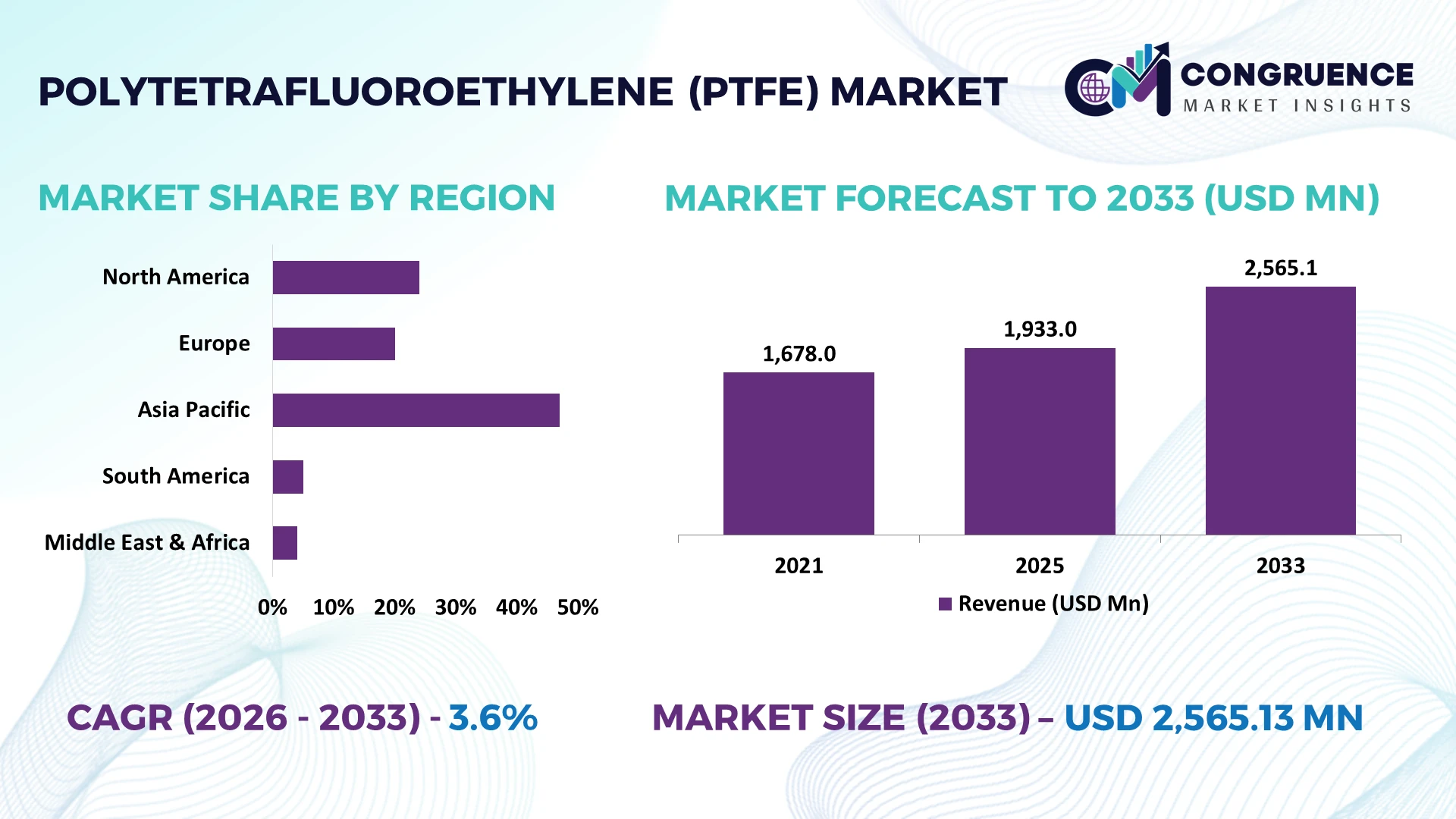
China remains the dominant PTFE producer with approximately 45% of global production capacity, supported by continuous investments in fluorochemical manufacturing, electronics, and industrial processing, while the United States leads in high-value aerospace and semiconductor-grade PTFE adoption with over 30% of demand concentrated in advanced manufacturing applications. Ongoing supply-chain diversification following global trade realignments has accelerated regional capacity expansion across Asia, strengthening production resilience and technology deployment.
Manufacturers should prioritize regional supply-chain partnerships, high-purity product development, and advanced processing capabilities to strengthen competitive positioning in high-value industrial applications.
Market Size & Growth: USD 1933 Million in 2025, projected to reach USD 2565.13 Million by 2033 at 3.6% CAGR, driven by expanding semiconductor fabrication and advanced industrial sealing applications.
Top Growth Drivers: Semiconductor demand contributes approximately 18% growth momentum, EV component adoption expands by 14%, and chemical processing capacity increases by 11% globally.
Short-Term Forecast: By 2028, manufacturing efficiency improves by nearly 12% through automation, reducing production waste and operating costs.
Emerging Technologies: AI-enabled process monitoring, precision extrusion, and advanced fluoropolymer compounding improve production consistency by over 10%.
Regional Leaders: Asia Pacific exceeds USD 1200 Million with electronics expansion, North America surpasses USD 560 Million through aerospace adoption, while Europe approaches USD 470 Million driven by industrial modernization.
Consumer/End-User Trends: More than 42% of high-performance industrial sealing systems integrate advanced PTFE materials for durability and chemical resistance.
Pilot/Case Example: In 2026, automated fluoropolymer processing upgrades improved manufacturing throughput by approximately 15% while lowering material losses.
Competitive Landscape: The leading manufacturer holds an estimated 16% market share, with Chemours, Daikin Industries, AGC, Gujarat Fluorochemicals, and Dongyue Group maintaining strong global positions.
Regulatory & ESG Impact: Cleaner production technologies reduce process emissions by nearly 9%, supporting stricter industrial compliance and sustainability targets.
Investment & Funding: More than USD 900 Million supports capacity expansion, strategic partnerships, and supply-chain localization across high-growth manufacturing hubs.
Innovation & Future Outlook: Next-generation modified PTFE grades and precision-engineered fluoropolymer solutions strengthen performance, supporting global industrial expansion and resilient supply-chain strategies.
Polytetrafluoroethylene (PTFE) demand continues to strengthen across semiconductor equipment, electric vehicles, chemical processing, and medical device manufacturing as producers introduce higher-purity grades with improved wear resistance. Advanced modified PTFE materials deliver approximately 15% longer service life, while regional supply-chain localization and tighter environmental compliance accelerate investment in efficient production technologies, setting the stage for broader strategic market expansion.
Polytetrafluoroethylene (PTFE) has become strategically important as manufacturers prioritize durable, chemically inert, and high-temperature materials for semiconductor fabrication, electric mobility, hydrogen processing, and critical industrial infrastructure. Supply-chain restructuring has encouraged companies to diversify fluoropolymer production beyond traditional manufacturing hubs, improving procurement resilience and reducing delivery risks. High-performance engineering applications now account for nearly 40% of advanced PTFE consumption, strengthening long-term investment priorities across precision manufacturing sectors.
Advanced modified PTFE grades deliver approximately 15% longer operational life and reduce maintenance frequency by nearly 12% compared with conventional formulations, lowering lifecycle operating costs in demanding environments. China maintains the largest manufacturing scale through integrated fluorochemical production, while Japan focuses on premium-grade PTFE for electronics and semiconductor applications with greater process precision and quality consistency. During the next two to three years, automated processing and digital quality inspection are expected to exceed 30% deployment among leading manufacturers, improving production uniformity and traceability.
Industrial equipment manufacturers are expanding partnerships with compounders to develop application-specific PTFE solutions for battery systems, chemical processing, and medical devices while increasing localized production capabilities. These investments strengthen supply security, accelerate product customization, and position companies to compete through higher-value materials, operational efficiency, and technology-led differentiation rather than production volume alone.
Semiconductor fabrication, electric vehicle systems, and advanced chemical processing continue to reshape PTFE demand as manufacturers require materials capable of operating under aggressive thermal and chemical conditions. Semiconductor-related PTFE component demand has increased by approximately 18%, while industrial automation applications have expanded by nearly 13%, supported by continuous equipment modernization. China has accelerated fluoropolymer capacity additions to strengthen domestic manufacturing resilience following global supply-chain realignment. In response, producers are investing in high-purity PTFE grades, expanding precision processing facilities, and forming technology partnerships with equipment manufacturers. A notable strategic trend is the shift from commodity production toward specialized application-specific materials that deliver stronger margins and longer customer contracts.
PTFE manufacturing remains exposed to fluorochemical feedstock availability, environmental compliance costs, and energy-intensive processing requirements. Raw material price fluctuations of approximately 10–15% continue to affect production planning, while compliance-related operating costs have increased by nearly 8% in several industrial markets. Dependence on concentrated fluorochemical production in China creates procurement uncertainty for international manufacturers during logistics or trade disruptions. Companies are responding by diversifying supplier networks, expanding localized inventories, and securing long-term procurement agreements to stabilize production schedules. An emerging operational strategy involves increasing recycled process material utilization where technically feasible to improve manufacturing efficiency without compromising product performance.
The transition toward electrification, hydrogen infrastructure, and advanced semiconductor packaging is creating opportunities for engineered PTFE solutions with enhanced wear resistance and dielectric performance. Modified PTFE compounds improve component durability by approximately 15%, while precision extrusion technologies reduce manufacturing waste by nearly 10%. Japan and South Korea continue expanding investment in semiconductor process equipment requiring ultra-high-purity fluoropolymer components. Companies are increasing R&D spending, collaborating with equipment manufacturers, and developing customized formulations for battery systems, medical devices, and high-frequency electronics. A distinctive strategic opportunity lies in integrating digital manufacturing with application-specific PTFE engineering, enabling faster product qualification and shorter customer development cycles.
Maintaining consistent quality while expanding production capacity remains a critical challenge for PTFE manufacturers serving highly regulated industries. More than 25% of production processes now require advanced inline inspection, while precision tolerance requirements have tightened by approximately 12% for semiconductor and medical applications. Workforce shortages in specialized fluoropolymer processing and stricter environmental compliance standards increase operational complexity, particularly in technologically advanced manufacturing countries such as Germany and Japan. Companies are addressing these issues through automation, AI-assisted quality monitoring, workforce training, and investment in digitally connected manufacturing facilities. Long-term competitiveness will depend on balancing production scalability with process precision, regulatory compliance, and sustainable manufacturing performance.
Advanced Processing Automation Expands Manufacturers are accelerating automated sintering, precision extrusion, and AI-assisted quality inspection across PTFE production lines, with automated inspection adoption exceeding 30% and production defects declining by nearly 12%. Rising labor costs and stricter industrial quality standards are driving this transition. Companies in Japan and Germany are upgrading digital manufacturing platforms, reducing process variability while improving production consistency for semiconductor, healthcare, and industrial customers.
Localized Supply Chains Strengthen Supply-chain diversification remains a major operational priority as manufacturers reduce dependence on single-country fluoropolymer sourcing. Local procurement programs have expanded by approximately 18%, while strategic inventory levels have increased by nearly 15% across critical industrial sectors. Companies are establishing regional compounding facilities, signing long-term supplier agreements, and restructuring logistics networks to improve delivery reliability amid continuing geopolitical trade adjustments.
High-Purity Grades Gain Priority Demand for semiconductor-grade and medical-grade PTFE continues to accelerate as contamination control becomes increasingly critical. High-purity product qualification activity has increased by approximately 20%, while cleanroom manufacturing capacity has expanded by nearly 14%. Producers are investing in advanced purification technologies, collaborating with precision equipment manufacturers, and introducing application-specific material grades that improve operational reliability in highly regulated production environments.
Modified PTFE Product Innovation Material engineering is shifting toward modified PTFE compounds with enhanced wear resistance, lower friction coefficients, and improved mechanical stability. New formulations extend component service life by approximately 15% while reducing maintenance frequency by nearly 10%. Supported by industrial decarbonization initiatives and equipment modernization, companies are expanding R&D partnerships and accelerating commercialization of customized fluoropolymer solutions for battery systems, hydrogen processing, and advanced electronics.
Fine Powder remains the leading PTFE type, accounting for approximately 41% of overall demand because of its superior processability, uniform particle characteristics, and extensive use in wire insulation, filtration media, and high-performance industrial components. Manufacturers continue expanding premium-grade Fine Powder production to support semiconductor equipment and electrical applications requiring high purity and dimensional consistency. Granular PTFE maintains strong demand in molded industrial products and heavy-duty mechanical components, supported by its durability and cost-efficient processing for large-scale manufacturing.
Dispersion represents the fastest-growing segment as demand increases for advanced coatings and precision surface treatments across electronics and industrial processing. Adoption has expanded by nearly 16%, while automated coating applications have improved processing efficiency by approximately 11%. Micronized PTFE continues strengthening its position in specialty lubricants, inks, and engineering composites where low-friction performance is critical. Producers are broadening product portfolios, investing in customized formulations, and strengthening partnerships with downstream processors to capture higher-value specialty applications while reducing dependence on standard commodity grades.
Seals & Gaskets remain the largest application, representing approximately 38% of PTFE consumption due to extensive deployment across chemical processing, oil and gas equipment, pharmaceuticals, and industrial machinery. The material's chemical resistance and temperature stability continue supporting mission-critical operations with lower maintenance requirements. Coatings remain an important mature segment for corrosion protection, while Linings maintain stable demand in aggressive processing environments where equipment longevity directly affects operational performance.
Electrical Insulation is the fastest-growing application as semiconductor manufacturing, electric vehicles, and high-frequency communication systems require advanced dielectric materials. Adoption has increased by approximately 17%, while high-performance cable production has expanded by nearly 13%. Manufacturers are scaling automated extrusion, improving precision quality control, and integrating specialized PTFE compounds into next-generation electrical products. Companies are also strengthening partnerships with electronics manufacturers to accelerate customized insulation solutions, making electrical applications increasingly important for long-term product differentiation.
The Chemical industry remains the dominant PTFE end-user, accounting for approximately 35% of total demand due to widespread deployment in corrosion-resistant piping, valves, pumps, reactors, and processing equipment. Continuous modernization of chemical production facilities and stricter operational safety requirements sustain replacement demand. Aerospace and Healthcare remain specialized but strategically important markets where high-performance fluoropolymer materials support critical applications requiring reliability and regulatory compliance.
Electronics is the fastest-growing end-user segment, supported by semiconductor manufacturing expansion, advanced packaging technologies, and high-speed communication infrastructure. Electronics-related PTFE demand has increased by approximately 18%, while precision component production has expanded by nearly 14%. Automotive manufacturers continue integrating PTFE into electric powertrain systems and thermal management components, improving efficiency and durability. Companies are responding through application-specific product development, collaborative engineering partnerships, and localized manufacturing strategies to strengthen customer integration and secure long-term supply agreements across technology-intensive industries.
Asia-Pacific accounted for the largest market share at 49% in 2025 however, North America is expected to register the fastest growth, expanding at a CAGR of 4.1% between 2026 and 2033.
Advanced Manufacturing and Semiconductor Expansion
North America represents approximately 24% of global PTFE demand, supported by semiconductor fabrication, aerospace manufacturing, healthcare technologies, and chemical processing infrastructure. The region continues shifting toward high-purity fluoropolymer applications where quality consistency and traceability are operational priorities. More than 35% of PTFE demand is concentrated in advanced industrial manufacturing, while automation deployment across precision polymer processing has increased by nearly 18%. Companies continue expanding domestic production capabilities through strategic partnerships and localized supply chains to strengthen resilience against global procurement disruptions. Growing investment in electric vehicle production and semiconductor capacity further accelerates demand for engineered PTFE components with superior thermal and chemical performance.
United States Market Outlook: The United States remains the region's largest PTFE market due to extensive semiconductor investments, aerospace production, and chemical manufacturing infrastructure. High-performance industrial applications account for more than 40% of national PTFE consumption, while manufacturers continue expanding advanced fluoropolymer processing capacity through automation and precision manufacturing. Enterprise investment in localized supply networks strengthens long-term procurement security for strategic industries.
Sustainable Industrial Modernization Drives Adoption
Europe contributes approximately 21% of global PTFE consumption, supported by advanced automotive manufacturing, industrial equipment production, pharmaceuticals, and specialty chemicals. Environmental compliance and process efficiency continue influencing material selection, encouraging manufacturers to adopt durable fluoropolymer solutions with extended operational life. More than 30% of industrial equipment modernization projects now integrate high-performance polymer components, while digital manufacturing initiatives have improved production efficiency by nearly 12%. Companies increasingly emphasize recycling initiatives, production optimization, and collaborative product development to strengthen competitiveness across specialized industrial applications.
Germany Market Outlook: Germany leads the European PTFE market through its strong engineering base, automotive manufacturing, industrial machinery production, and chemical processing capabilities. Precision manufacturing facilities continue adopting advanced PTFE solutions for high-performance equipment, while automated production technologies have improved manufacturing consistency by approximately 14%. Strong collaboration between manufacturers and industrial equipment suppliers supports continued innovation across demanding engineering applications.
Manufacturing Scale and Export Leadership
Asia-Pacific accounts for nearly 49% of global PTFE demand, supported by extensive fluorochemical production, electronics manufacturing, automotive components, and expanding industrial infrastructure. China, Japan, South Korea, and India continue strengthening regional manufacturing capacity through integrated production ecosystems and export-oriented operations. China alone contributes approximately 45% of global PTFE production capacity, while regional electronics manufacturing has expanded by nearly 17%. Companies continue investing in capacity expansion, advanced compounding technologies, and supply-chain integration to improve operational efficiency and support rising international demand for specialty fluoropolymer products.
China Market Outlook: China dominates global PTFE manufacturing through integrated fluorochemical supply chains, large-scale production facilities, and competitive processing capabilities. Continuous investment in semiconductor manufacturing, industrial automation, and specialty chemical production strengthens domestic demand alongside export growth. Advanced manufacturing facilities continue expanding high-purity PTFE output while improving production efficiency through digital quality management and automated processing technologies.
Industrial Processing Supports Demand
South America represents an emerging PTFE market driven by mining, chemical processing, food processing, and energy infrastructure investments. Approximately 60% of regional PTFE demand originates from industrial equipment requiring corrosion-resistant sealing systems and processing components. Industrial modernization initiatives have increased equipment upgrades by nearly 10%, encouraging greater adoption of durable fluoropolymer materials. However, dependence on imported specialty materials and limited domestic processing capacity continue affecting supply flexibility. Companies are strengthening regional distribution networks and expanding technical service partnerships to improve product availability and operational support.
Brazil Market Outlook: Brazil remains the region's largest PTFE consumer due to its diversified industrial base covering mining, chemicals, oil and gas, and manufacturing. Industrial maintenance programs continue increasing demand for corrosion-resistant components, while localized distribution partnerships have improved product availability by approximately 12%. Continued infrastructure investment strengthens long-term opportunities for engineered fluoropolymer applications across industrial processing sectors.
Infrastructure Investment Accelerates Industrial Deployment
The Middle East & Africa market continues expanding through investments in petrochemical facilities, desalination infrastructure, industrial processing, and energy diversification projects. Approximately 55% of regional PTFE demand is linked to oil, gas, and chemical processing operations where corrosion resistance remains operationally essential. Industrial modernization programs have increased deployment of advanced sealing materials by nearly 11%, while new processing facilities continue strengthening demand for engineered fluoropolymers. Companies are expanding regional partnerships, technical support capabilities, and localized inventories to improve responsiveness across infrastructure-intensive industries.
Saudi Arabia Market Outlook: Saudi Arabia leads regional PTFE demand through large-scale petrochemical production, refinery modernization, and industrial diversification initiatives. Advanced processing facilities increasingly adopt high-performance fluoropolymer components to improve operational reliability and reduce maintenance requirements. Industrial expansion programs continue encouraging supplier partnerships and localized inventory strategies, supporting stable deployment across critical processing infrastructure.
Global leaders including Chemours, Daikin Industries, AGC, Gujarat Fluorochemicals, and Dongyue Group compete directly with regional fluoropolymer manufacturers and specialized compounders focused on customized PTFE solutions. The top five players collectively control approximately 58% of the market, balancing production scale with technology differentiation. Competition increasingly centers on high-purity materials, customized formulations, supply-chain resilience, and processing precision rather than commodity pricing alone. Advanced manufacturing technologies improve production efficiency by nearly 12%, while localized supply networks reduce delivery lead times by approximately 15%, strengthening customer retention. Companies are expanding production facilities, forming technology partnerships with semiconductor and industrial equipment manufacturers, and pursuing vertical integration to secure fluorochemical feedstocks. Consolidation continues around specialty PTFE grades as premium industrial applications outpace standard products. The principal barrier to entry remains capital-intensive fluoropolymer processing combined with stringent environmental compliance requirements. Winning requires integrated supply chains, application-specific innovation, reliable quality control, and long-term customer collaboration.
Chemours
Daikin Industries Ltd.
AGC Inc.
Gujarat Fluorochemicals Limited
Dongyue Group
Solvay
3M
HaloPolymer
Shamrock Technologies
Micro Powders Inc.
Zeus Industrial Products
Saint-Gobain Performance Plastics
Chenguang Research Institute of Chemical Industry
Jiangsu Meilan Chemical Co., Ltd.
Manufacturers are increasingly deploying precision extrusion, automated sintering, and AI-enabled quality inspection to improve PTFE consistency for semiconductor, aerospace, and medical applications. AI-assisted process monitoring reduces production defects by approximately 12%, while automated material handling lowers processing costs by nearly 9%. More than 35% of high-volume PTFE manufacturing facilities now integrate digital production monitoring, enabling tighter dimensional control and faster qualification cycles. These technologies strengthen operational reliability while reducing scrap and supporting premium-grade fluoropolymer manufacturing.
Emerging technologies are centered on modified PTFE formulations, plasma surface treatment, advanced compounding, and digital twin-enabled production optimization. Compared with conventional processing, next-generation precision manufacturing improves component service life by nearly 15% and enhances production efficiency by approximately 11%. Adoption of automated inline inspection exceeds 30% among leading producers as customers demand traceability and contamination-free materials for electronics and healthcare. Companies investing in customized PTFE compounds gain stronger positioning in high-value applications where performance, qualification speed, and product consistency outweigh price competition.
Between 2026 and 2028, smart manufacturing platforms, predictive maintenance, and digitally connected production systems will become strategic differentiators across fluoropolymer processing. Integration of machine learning with process analytics is expected to shorten production cycle times by approximately 10% while improving yield stability. Companies expanding automated manufacturing, application-specific R&D, and semiconductor-focused material portfolios will strengthen competitive advantage, whereas manufacturers relying on conventional PTFE processing risk losing share in premium industrial markets requiring precision, traceability, and operational flexibility.
August 2025 Chemours announced strategic manufacturing agreements with SRF Limited to strengthen global fluoropolymer supply capacity for semiconductor, automotive, aerospace, and industrial markets, expanding operational flexibility without upfront capital investment while supporting commercial supply beginning in 2026.
February 2026 Daikin introduced expanded PTFE anti-dripping fluoropolymer solutions targeting electronics, automotive, construction, and data-center applications, highlighting broader deployment in flame-retardant engineering plastics as electrification accelerates across advanced manufacturing sectors.
December 2025 AGC announced its Fluon PTFE G-grade resin manufactured using recycled fluorite achieved UL 2809 third-party verification, advancing lower-impact fluoropolymer production and strengthening sustainability credentials for industrial customers requiring certified specialty materials.
May 2025 Chemours partnered with Navin Fluorine to manufacture Opteon two-phase immersion cooling fluid, establishing initial production capacity from 2026 to support AI-driven data centers and next-generation chip cooling through expanded fluorochemical manufacturing collaboration. Source: Chemours
This report delivers comprehensive analysis of the global PTFE market across Granular, Fine Powder, Dispersion, and Micronized product categories, together with applications including Coatings, Seals & Gaskets, Electrical Insulation, and Linings. End-user assessment covers Chemical, Electronics, Automotive, Aerospace, and Healthcare industries, representing more than 90% of commercial PTFE deployment. Regional evaluation spans North America, Europe, Asia-Pacific, South America, and the Middle East & Africa, highlighting manufacturing concentration, technology adoption, supply-chain developments, and competitive positioning.
The study examines automation, advanced compounding, precision processing, high-purity fluoropolymer technologies, and digital manufacturing trends influencing operational performance between 2026 and 2033. It evaluates deployment patterns, investment priorities, production strategies, and innovation pipelines across major manufacturers while identifying emerging specialty applications. Strategic insights support expansion planning, portfolio optimization, partnership evaluation, competitive benchmarking, procurement decisions, and long-term positioning in high-value industrial and advanced manufacturing markets.
| Report Attribute/Metric | Report Details |
|---|---|
Market Revenue in 2025 | USD 1933 Million |
Market Revenue in 2033 | USD 2565.13 Million |
CAGR (2026 - 2033) | 3.6% |
Base Year | 2025 |
Forecast Period | 2026 - 2033 |
Historic Period | 2021 - 2025 |
Segments Covered | By Type
By Application
By End-User
|
Key Report Deliverable | Revenue Forecast, Growth Trends, Market Dynamics, Segmental Overview, Regional and Country-wise Analysis, Competition Landscape |
Region Covered | North America, Europe, Asia-Pacific, South America, Middle East, Africa |
Key Players Analyzed | Chemours, Daikin Industries Ltd., AGC Inc., Gujarat Fluorochemicals Limited, Dongyue Group, Solvay, 3M, HaloPolymer, Shamrock Technologies, Micro Powders Inc., Zeus Industrial Products, Saint-Gobain Performance Plastics, Chenguang Research Institute of Chemical Industry, Jiangsu Meilan Chemical Co., Ltd. |
Customization & Pricing | Available on Request (10% Customization is Free) |




