
Reports
The Global Polyester Magnet Wire Market was valued at USD 3,554.2 Million in 2025 and is anticipated to reach a value of USD 4,977.6 Million by 2033 expanding at a CAGR of 4.3% between 2026 and 2033. Growth is being driven by rising demand for high-efficiency electric motors, transformers, traction systems, and electrified industrial equipment requiring thermally stable winding insulation.
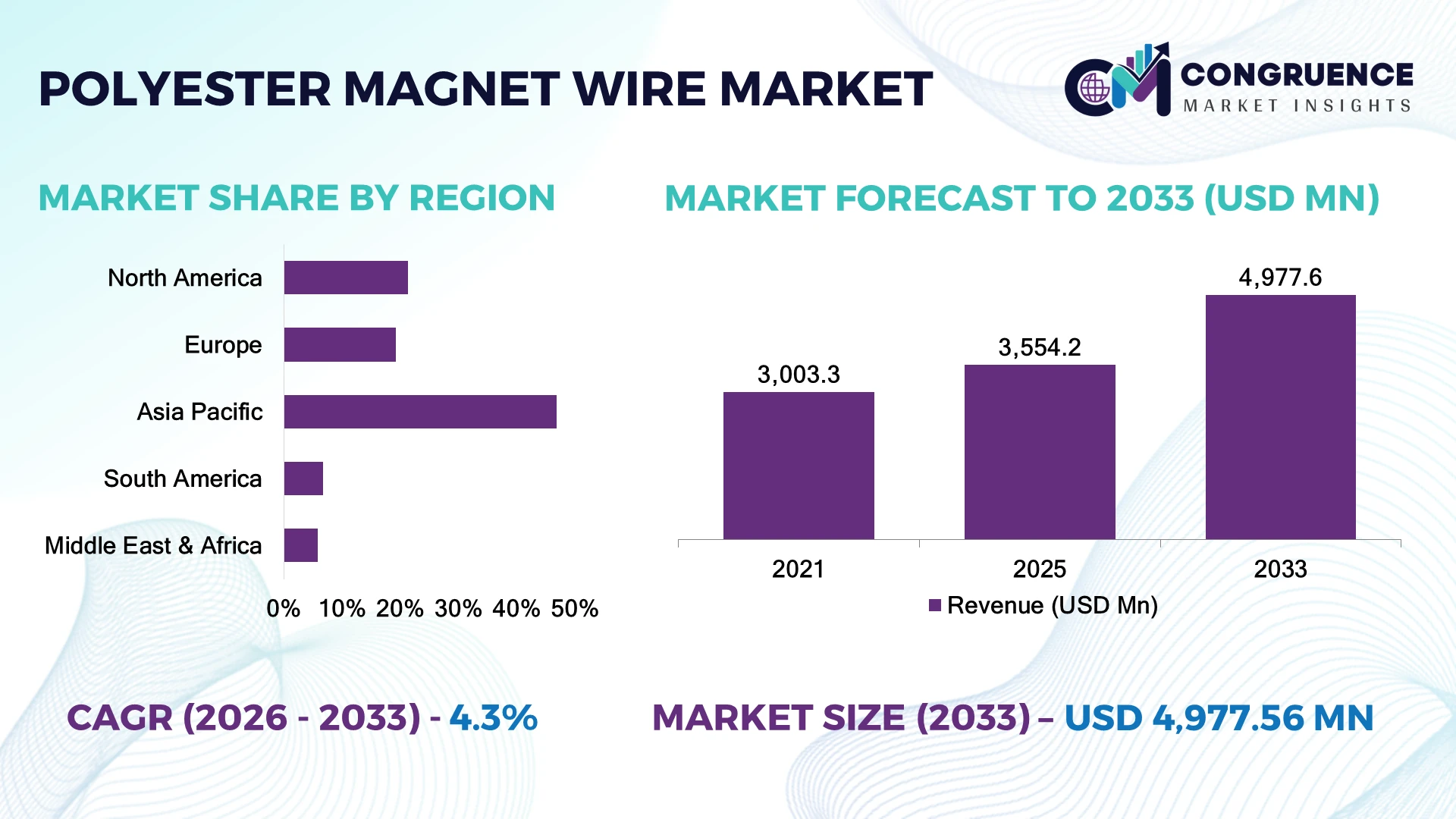
China remains the dominant country market, accounting for approximately 29% of global polyester magnet wire consumption, supported by large motor, transformer, appliance, and EV manufacturing clusters. Its annual electrical-equipment production capacity substantially exceeds that of India, while Japan maintains stronger adoption of precision winding technologies. China's investment in advanced manufacturing and EV supply chains has increased demand for automated wire-enameling and high-throughput winding systems, with automated production lines improving winding productivity by approximately 15–20%.
Strategically, manufacturers should prioritize China-centered capacity, localized supply chains, and higher-performance insulation grades to capture electrification-driven demand.
Market Size & Growth: USD 3,554.2 million in 2025 to USD 4,977.6 million by 2033 at 4.3% CAGR, driven by motor and transformer electrification.
Top Growth Drivers: EV manufacturing 32%, industrial motors 27%, transformer demand 22%.
Short-Term Forecast: By 2028, automated winding and enameling can improve production efficiency by 12–18%.
Emerging Technologies: AI-based winding inspection, advanced polyester insulation, and automated enamel-thickness control are gaining adoption at approximately 25%.
Regional Leaders: Asia-Pacific is projected at about USD 2.6 billion, Europe at USD 1.1 billion, and North America at USD 0.9 billion, with automation-led adoption strengthening.
Consumer/End-User Trends: Electric-motor manufacturers increasingly specify higher thermal-performance magnet wire, with premium-grade adoption approaching 30%.
Pilot/Case Example: 2026 automated motor-production deployments are targeting 15% lower winding defects through machine-vision inspection and closed-loop process control.
Competitive Landscape: Global leaders collectively command approximately 40% share, with established wire manufacturers competing through insulation performance, diameter precision, capacity, and regional supply networks.
Regulatory & ESG Impact: Energy-efficiency requirements for motors and transformers are pushing manufacturers toward designs delivering approximately 5–10% lower operating losses.
Investment & Funding: More than USD 1 billion in announced electrical-equipment and electrification manufacturing investments is strengthening demand for localized magnet-wire supply.
Innovation & Future Outlook: Next-generation polyester systems will emphasize thinner insulation, higher thermal endurance, automated inspection, and compatibility with compact high-efficiency motor designs.
The Polyester Magnet Wire Market is becoming increasingly important across electric motors, transformers, generators, compressors, household appliances, and automotive traction systems. Demand is shifting toward thinner conductors, tighter dimensional tolerances, and improved thermal performance as equipment designers pursue higher power density. Approximately 30% of premium applications now prioritize enhanced thermal-class insulation, while manufacturers are expanding automated enameling and inline inspection to reduce defects. Supply-chain localization is also strengthening as electrification programs increase the strategic value of reliable domestic wire availability, creating a transition toward higher-value, application-specific magnet-wire products.
Polyester magnet wire is becoming strategically important because it directly influences motor efficiency, thermal endurance, winding density, and equipment reliability. Electrification is increasing the importance of insulation systems capable of operating under higher thermal and electrical stresses. Motor and transformer manufacturers are therefore moving from basic conductor specifications toward tighter enamel-thickness, dielectric-strength, and thermal-performance requirements. This shift is raising the value of precision manufacturing rather than simply increasing wire volumes.
Technology differentiation is becoming measurable. Modern automated enameling and inline inspection can reduce coating variation by approximately 15–20% compared with conventional manual inspection, while closed-loop tension control can improve winding consistency by roughly 10–12%. China remains the largest production ecosystem, whereas Japan and Germany emphasize high-precision specialty applications and advanced motor engineering. North American manufacturers are strengthening localized electrical-component supply chains to reduce exposure to overseas disruptions.
Between 2026 and 2028, demand will increasingly favor thinner, thermally stable, and automation-compatible polyester magnet wire. A practical deployment example is the integration of machine-vision inspection into high-speed motor-winding lines, where defect detection occurs continuously rather than through periodic sampling. Producers are consequently investing in automated enameling, digital quality control, and application-specific insulation formulations. Competitive advantage will increasingly depend on dimensional precision, thermal performance, process consistency, and dependable regional supply rather than commodity pricing alone.
Electrification of motors, transformers, compressors, and industrial drives is increasing demand for polyester magnet wire with tighter insulation tolerances and higher thermal stability. Electric-motor applications account for an estimated 40–45% of consumption, while premium insulation grades are gaining approximately 8–10% faster adoption than conventional specifications. In China, expanding EV and industrial-motor production is accelerating automated enameling and precision winding. Manufacturers are responding by increasing high-speed coating capacity, integrating inline diameter and insulation-thickness inspection, and developing thinner insulation systems. The non-obvious shift is that productivity gains are increasingly coming from process consistency rather than line speed alone, allowing producers to reduce rejection rates by approximately 10–15% while maintaining tighter winding tolerances.
Copper accounts for a substantial portion of magnet-wire manufacturing cost, making producers sensitive to raw-material price movements and procurement volatility. Copper-related input exposure can represent roughly 60–70% of material cost, while energy-intensive enameling and curing can contribute another 8–12% to conversion expenses. Producers operating in India and Southeast Asia remain exposed to imported copper and specialty coating-material dependencies, creating margin pressure when logistics costs rise. The constraint is particularly significant for standardized wire grades where pricing power is limited. Manufacturers are responding through indexed supply contracts, multi-country sourcing, inventory buffers, and localized coating procurement. The strategic pressure is shifting toward yield optimization: a 2–3% reduction in conductor and coating waste can materially offset input-cost volatility without compromising electrical performance.
Compact motors for EV traction, industrial automation, robotics, compressors, and high-efficiency appliances are creating opportunities for polyester magnet wire with thinner insulation and improved thermal endurance. Premium applications already represent roughly 25–30% of specification-driven demand, while automated winding compatibility is expanding by approximately 10–12% across advanced motor production lines. The strongest opportunity lies in thinner insulation systems that increase copper fill factor without requiring larger stator dimensions. Manufacturers are investing in R&D for higher dielectric strength, improved abrasion resistance, and faster enamel curing, while partnering with motor OEMs to qualify application-specific grades. In India, China, and Mexico, localized production near motor-manufacturing clusters can reduce lead times by approximately 15–20%, creating a competitive advantage beyond material pricing.
High-speed enameling creates a difficult balance between coating thickness, dielectric strength, curing temperature, conductor tension, and production throughput. Variations of even 3–5% in insulation thickness can affect winding fill, thermal behavior, and downstream rejection rates, particularly in compact motor assemblies. Automated lines also require skilled technicians capable of calibrating tension controls, curing systems, and inline inspection equipment; workforce gaps can reduce effective equipment utilization by approximately 5–8%. The long-term challenge is therefore process integration rather than basic production capacity. Manufacturers are deploying machine vision, closed-loop tension control, predictive maintenance, and digital quality records to stabilize production. Companies that connect coating, inspection, and winding data can improve first-pass yield by roughly 8–12%, strengthening consistency while reducing dependence on manual quality intervention.
Thinner Insulation Gains Momentum Polyester magnet wire specifications are shifting toward thinner enamel layers as motor designers pursue higher copper fill factors. Premium thin-wall products are gaining approximately 8–10% adoption, while automated insulation inspection is expanding near 15%. Manufacturers are refining coating chemistry and curing profiles to preserve dielectric strength while increasing conductor density.
Automation Reshapes Quality Control High-speed production lines increasingly combine laser measurement, machine vision, and closed-loop tension control. Automated inspection can reduce coating-related defects by roughly 10–15%, while digital process monitoring improves production consistency by 8–12%. Producers are integrating inspection directly into enameling lines rather than relying on downstream sampling, shortening response times and reducing scrap.
Localized Supply Chains Strengthen Copper procurement and specialty coating availability are becoming strategic production variables as manufacturers seek greater resilience after recent logistics disruptions. Regional sourcing initiatives can reduce material lead times by 15–20%, while localized inventories increasingly cover 20–30% more critical input requirements. Producers are expanding regional supplier networks and negotiating indexed contracts to protect margins.
Thermal Performance Becomes Differentiator Motor manufacturers are placing greater emphasis on insulation endurance as compact, high-power-density equipment operates at higher temperatures. Premium thermal-class specifications are expanding roughly 10% annually within demanding applications, while qualification cycles increasingly include thermal aging and abrasion testing. Wire producers are responding with advanced polyester formulations and closer co-development with motor manufacturers.
Round polyester magnet wire remains the leading type, accounting for approximately 62% of global demand in 2025, supported by standardized manufacturing, broad winding compatibility, and lower tooling complexity. Its established position across motors, transformers, generators, and appliances gives producers strong economies of scale, while automated winding systems remain optimized for cylindrical conductors. Rectangular wire represents roughly 23% of demand but is the fastest-growing type, gaining traction where higher slot fill, compact motor architecture, and improved thermal utilization are priorities. Square wire remains a specialized segment at about 9%, while other configurations serve customized electrical assemblies and niche engineering requirements.
The shift toward rectangular and square geometries is changing investment priorities because manufacturers increasingly need application-specific insulation thickness, dimensional accuracy, and automated forming capability. Producers are expanding precision drawing and coating capacity, developing tighter dimensional tolerances, and partnering with motor manufacturers for qualification. Rectangular wire adoption is estimated to be expanding by approximately 10–12% in advanced motor applications, compared with 5–7% for conventional round-wire demand, strengthening its strategic importance.
The International Energy Agency reported that global electric-car production reached nearly 22 million units in 2025, more than 25% above 2024, reinforcing the manufacturing base for high-performance motor components and magnet-wire demand.
Motors account for approximately 48% of polyester magnet wire demand in 2025, making motor winding the dominant application because of extensive deployment across industrial equipment, automotive systems, compressors, pumps, HVAC equipment, and appliances. Transformers follow at nearly 24%, supported by grid modernization and electrical infrastructure investment, while generators contribute about 13%. The fastest-growing application is electric-motor systems, where compact designs and higher power density are increasing demand for precisely insulated conductors and tighter dimensional control.
Conventional industrial motors remain the volume foundation, but electrified mobility and automated equipment are shifting incremental demand toward higher-performance wire specifications. Electric-motor applications are expanding at roughly 9–11% in high-density equipment, compared with approximately 5–6% growth in mature general-purpose motor applications. Producers are responding through thinner insulation systems, automated coating inspection, improved thermal classifications, and application-specific qualification programs. This shift makes engineering collaboration with motor manufacturers increasingly important because wire selection is becoming an integrated design decision rather than a simple component purchase.
The International Energy Agency reported that global electric-car production reached nearly 22 million units in 2025, with China accounting for nearly 75% of global output, highlighting the scale of electrified motor manufacturing and its downstream component requirements.
The automotive sector represents approximately 34% of polyester magnet wire demand, supported by electric traction motors, auxiliary motors, compressors, pumps, and increasingly electrified vehicle architectures. Industrial equipment follows at about 28%, benefiting from motor-driven automation, while appliances and electrical equipment together represent roughly 25%. Automotive is also the fastest-growing end-user group, with demand for high-temperature, compact, and tightly controlled winding systems expanding by approximately 10–12% as vehicle manufacturers increase electrification and power density.
Industrial buyers remain more volume-oriented and prioritize reliability, interchangeability, and total operating cost, whereas automotive procurement increasingly emphasizes dimensional consistency, thermal endurance, and qualification performance. Appliance manufacturers occupy a more cost-sensitive position, but premium inverter-driven products are raising insulation requirements. Wire producers are therefore segmenting product portfolios by thermal class, conductor geometry, coating performance, and automated-winding compatibility. Approximately 20–25% of new application development is increasingly linked to customized specifications rather than standard catalog grades, encouraging closer technical partnerships and localized production near major automotive and electrical-equipment manufacturing clusters.
The International Energy Agency reported that electric vehicles represented more than 25% of global car sales in 2025, while China produced nearly 16 million electric cars, demonstrating the accelerating industrial base behind automotive motor-component demand.
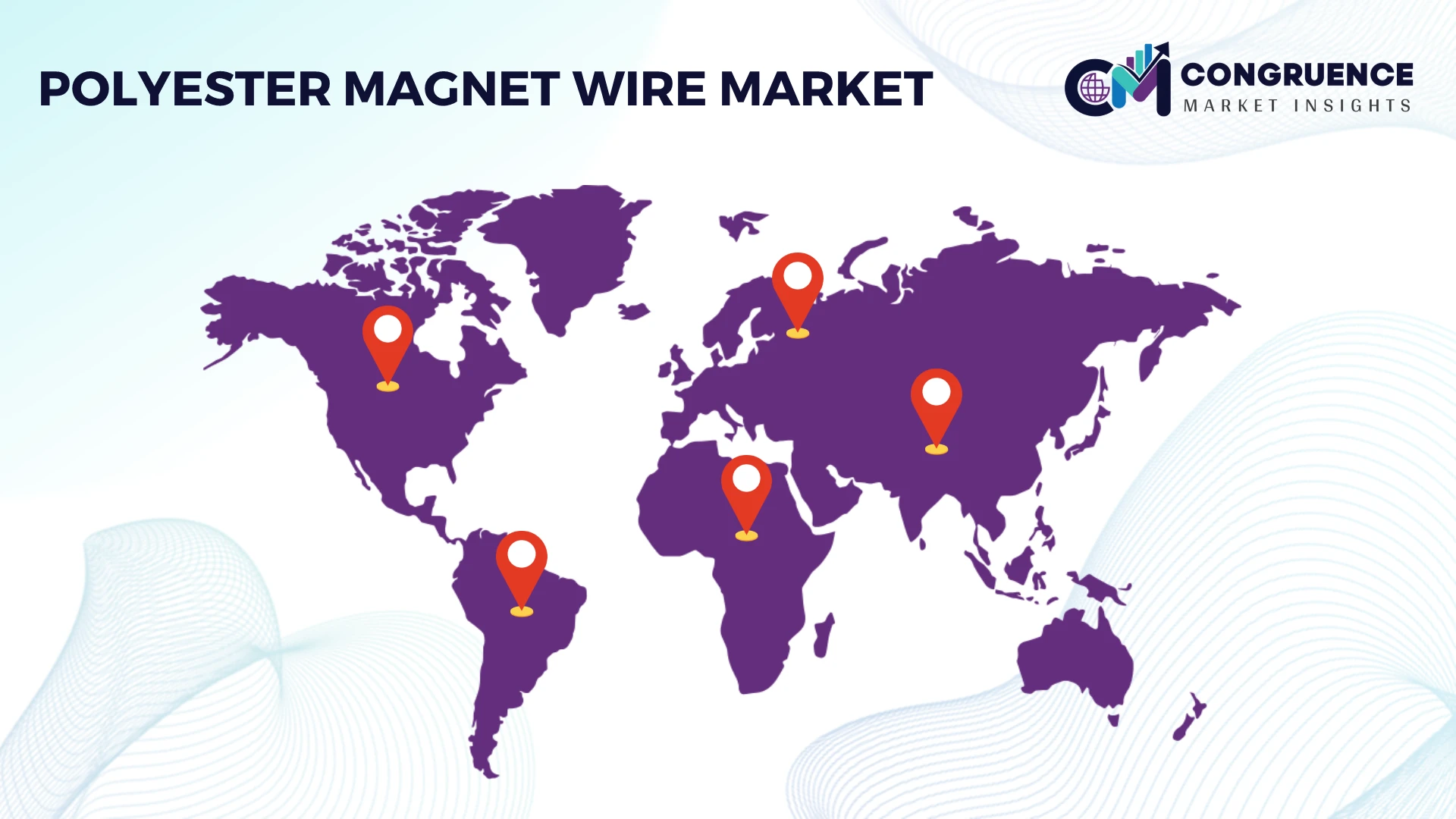
Asia-Pacific accounted for the largest market share at 46.8% in 2025 however, South America is expected to register the fastest growth, expanding at a CAGR of 5.2% between 2026 and 2033.
Electrification and localized motor manufacturing reshape demand
North America accounted for approximately 21.4% of the global Polyester Magnet Wire Market in 2025, supported by established motor, transformer, HVAC, automotive, and industrial-equipment manufacturing. The United States concentrates most regional demand, with advanced motor production increasingly favoring tighter insulation tolerances and higher-efficiency winding systems. Regional manufacturers are strengthening domestic supply chains as reshoring and infrastructure investment increase demand for locally available electrical components. Approximately 30% of regional magnet-wire consumption is linked to motor-related applications, while premium insulation specifications are gaining traction in energy-efficient equipment. Recent investments in U.S. motor manufacturing, including a $19 million expansion by Nidec, reinforce localized production capacity. Producers are responding with automated enameling, inline inspection, and shorter lead-time supply models.
United States Market Outlook:
The United States remains the strategic production center because of its mature industrial motor, HVAC, aerospace, power-equipment, and electrical-infrastructure base. Domestic manufacturing investments are increasing requirements for high-consistency winding materials, particularly in energy-efficient motors and electrified equipment. U.S. manufacturers are also prioritizing supply-chain resilience, with localized sourcing becoming an increasingly important procurement criterion. The country’s combination of engineering capability, industrial automation, and large installed equipment base supports premium polyester magnet wire adoption.
Efficiency regulations accelerate premium insulation adoption
Europe represented approximately 19.2% of global demand in 2025, supported by Germany, Italy, France, and Central European motor and electrical-equipment manufacturing clusters. Energy-efficiency requirements are shifting purchasing toward magnet wire capable of supporting compact, high-efficiency motors and thermal-performance requirements. Germany remains particularly important, with 1.67 million electric passenger cars produced domestically in 2025, strengthening the regional electrification ecosystem. Approximately 27% of European demand is associated with motor applications requiring enhanced winding performance. Producers are investing in thinner insulation systems, precision coating, and automated quality inspection to meet tighter engineering specifications while controlling material consumption.
Germany Market Outlook:
Germany represents Europe's strongest strategic market because of its advanced automotive, industrial machinery, electrical equipment, and motor-manufacturing ecosystem. The country produced 1.67 million electric passenger cars in 2025, creating a substantial downstream base for high-performance motor components. German manufacturers increasingly prioritize dimensional consistency, thermal endurance, and automated winding compatibility. This environment favors suppliers capable of delivering customized polyester insulation systems and consistent batch quality rather than competing primarily through commodity pricing.
Manufacturing scale drives regional supply dominance
Asia-Pacific held approximately 46.8% of the global Polyester Magnet Wire Market in 2025, making it the principal production and consumption center. China, Japan, South Korea, and India provide extensive demand from electric motors, transformers, appliances, industrial machinery, and automotive electrification. China retains the strongest manufacturing concentration, while India is rapidly strengthening localized electrical-component and motor production. Approximately 52% of regional demand is linked to motor and electrical-equipment applications. Producers are expanding high-speed drawing, enameling, and automated inspection capacity to serve increasingly specification-intensive customers. India is also strengthening its domestic component ecosystem through large-scale manufacturing incentives, creating additional opportunities for localized magnet-wire production and regional supply-chain diversification.
China Market Outlook:
China remains the dominant country market because of its vertically integrated electrical-equipment, motor, appliance, renewable-energy, and automotive manufacturing base. Its large-scale motor production supports substantial consumption of polyester magnet wire across standardized and high-performance applications. Manufacturers are increasingly investing in automated winding compatibility and higher-precision insulation systems as electric mobility and industrial automation expand. China's scale advantage allows suppliers to combine high-volume production with increasingly specialized product grades, maintaining strong cost and supply-chain competitiveness.
Industrial electrification creates localized supply opportunities
South America represented approximately 6.7% of global Polyester Magnet Wire demand in 2025, with Brazil accounting for the largest share through its automotive, electrical equipment, appliance, agricultural machinery, and industrial manufacturing base. Demand is concentrated around São Paulo and other manufacturing corridors where motor and transformer production supports recurring wire consumption. Approximately 31% of regional demand is associated with motor-related applications. Local producers are increasingly evaluating domestic sourcing and inventory strategies to reduce exposure to imported copper and coating materials. Brazil's comparatively broad industrial base gives it a stronger position than neighboring markets, while Argentina and Chile provide smaller but specialized opportunities tied to electrical infrastructure and industrial equipment.
Brazil Market Outlook:
Brazil is the most strategically significant South American market because of its diversified manufacturing base, automotive production, agricultural machinery industry, electrical equipment manufacturing, and extensive installed motor population. Localized production can reduce exposure to international freight and copper procurement volatility, while regional industrial modernization supports higher-quality insulation requirements. Suppliers that establish distribution and technical-service capabilities close to São Paulo's manufacturing corridor can improve responsiveness and qualification support, strengthening their position against imported magnet-wire products.
Infrastructure investment expands localized electrical-equipment demand
Middle East & Africa accounted for approximately 5.9% of global Polyester Magnet Wire demand in 2025, with demand concentrated in Saudi Arabia, the United Arab Emirates, Türkiye, South Africa, and major industrial hubs. Power infrastructure, water systems, HVAC equipment, industrial automation, and manufacturing localization are supporting demand for insulated winding conductors. Approximately 24% of regional consumption is linked to industrial motors and electrical equipment, while transformer-related applications remain strategically important. Saudi Arabia and the UAE are expanding industrial infrastructure and localization programs, encouraging suppliers to establish regional inventories and technical partnerships. The main competitive advantage is increasingly delivery reliability, with shorter regional lead times helping buyers reduce exposure to international logistics disruptions.
Saudi Arabia Market Outlook:
Saudi Arabia holds the strongest strategic position because industrial diversification, power infrastructure expansion, water treatment, petrochemical facilities, and manufacturing localization are increasing requirements for electric motors, generators, transformers, and related electrical components. Industrial projects increasingly favor reliable local or regionally stocked components to minimize procurement delays. Suppliers that combine technical qualification, application engineering, and regional inventory can capture higher-value demand while reducing dependence on long international supply chains.
Superior Essex, Elektrisola, Proterial, Von Roll, and regional winding-wire manufacturers compete across global and application-specific polyester magnet wire markets. Superior Essex and Elektrisola emphasize scale, automotive qualification, and supply coverage, while Proterial differentiates through advanced insulation; regional producers compete on price and delivery. The top five players are estimated to control about 42% of the market. Standard grades remain price-sensitive, with 3–5% procurement differences influencing purchasing, while premium specifications command roughly 6–10% value advantages through tighter tolerances, thermal performance, and inverter compatibility. Supply reliability is increasingly important, with localized producers targeting 10–15% shorter lead times. Companies are expanding coating capacity, integrating copper sourcing, developing application-specific insulation systems, and forming OEM qualification partnerships. Competition is shifting from volume pricing toward supply assurance and engineering differentiation. Entry barriers remain high because qualification, process consistency, and capital-intensive enameling equipment require technical credibility. Winners will combine scale, customization, reliable supply, and proven winding performance.
Superior Essex
Elektrisola
Proterial
Von Roll
REA Magnet Wire
IRCE S.p.A.
Ederfil-Becker
Samdong Co., Ltd.
Tongling Jingda Special Magnet Wire Co., Ltd.
LS Cable & System
Roshow Technology
Condumex
KSH International
Ram Ratna Wires
Polyester magnet wire production is moving from conventional batch inspection toward automated enameling, inline diameter measurement, machine vision, and closed-loop tension control. These systems can reduce coating defects by 10–15% and improve first-pass yield by 8–12%. Automated inspection is increasingly deployed on high-volume lines, giving large producers better consistency and lower scrap exposure.
Advanced polyester and polyester-imide insulation systems are gaining adoption in compact motors, inverter-fed drives, and high-temperature applications. High-PDIV and surge-resistant coatings can extend insulation life by 15–25% under demanding electrical conditions. Compared with conventional insulation systems, optimized thin-film constructions can increase copper fill utilization by approximately 4–7%, enabling smaller motor architectures. Technology-led suppliers benefit most because qualification capability becomes a stronger differentiator than commodity pricing.
From 2026 to 2028, digital process control, predictive maintenance, and application-specific wire geometries will increasingly converge with automated winding equipment. Rectangular and ultrathin high-aspect-ratio wire can improve slot utilization by 5–10%, supporting compact EV and industrial motors. Producers are integrating coating, inspection, and production data to shorten qualification cycles and stabilize quality across plants. The strategic priority is to modernize lines before higher-performance motor programs scale, because early qualification with OEMs can secure specifications, reduce switching risk, and create longer-term supply positions.
March 2024 – Superior Essex completed its acquisition of the remaining Essex Furukawa stake, consolidating magnet-wire operations and strengthening vertical integration across automotive and energy applications. The transaction expanded control over manufacturing capabilities globally and sharpened supply-chain coordination. Source: superioressex.com
February 2024 – KSH International announced a 6,000-MTPA winding-wire expansion program valued at INR 63 crore, targeting production capacity and upgraded equipment. The investment strengthens Indian supply availability and supports faster response to transformer, motor, and industrial customers. Source: kshinternational.com
July 2025 – Proterial advanced high-performance magnet-wire technologies, including inverter-surge-resistant and high-PDIV products designed to extend insulation life. The development strengthens positioning in compact, high-voltage motor systems requiring improved reliability, thermal performance, and electrical durability under inverter operation. Source: proterial.com
August 2025 – Wellascent advanced construction of its Texas copper-wire facility, targeting 3,000 metric tons of capacity by 2028 through a $100 million investment. The localization strategy improves U.S. supply resilience and reduces exposure to tariffs and logistics.
The Polyester Magnet Wire Market Report covers market structure across wire configurations, insulation systems, thermal classes, conductor materials, applications, and end-user industries. The analysis evaluates motor windings, transformers, generators, automotive systems, appliances, industrial equipment, and emerging electrification applications, with attention to standard versus premium specifications and evolving rectangular or high-performance wire demand.
Regional coverage spans North America, Europe, Asia-Pacific, South America, and the Middle East & Africa, with country-level assessment of production concentration, manufacturing capacity, supply-chain positioning, and adoption patterns. The report examines automated enameling, inline inspection, advanced insulation chemistry, precision winding compatibility, and digital quality control. Competitive analysis covers major producers, estimated market concentration, capacity strategies, partnerships, product differentiation, and localization. The study supports investment planning, capacity expansion, procurement strategy, technology prioritization, competitive positioning, and market-entry decisions through 2033.
| Report Attribute/Metric | Report Details |
|---|---|
|
Market Revenue in 2025 |
USD 3,554.2 Million |
|
Market Revenue in 2033 |
USD 4,977.6 Million |
|
CAGR (2026 - 2033) |
4.3% |
|
Base Year |
2025 |
|
Forecast Period |
2026 - 2033 |
|
Historic Period |
2021 - 2025 |
|
Segments Covered |
By Type
By Application
By End-User
|
|
Key Report Deliverable |
Revenue Forecast, Growth Trends, Market Dynamics, Segmental Overview, Regional and Country-wise Analysis, Competition Landscape |
|
Region Covered |
North America, Europe, Asia-Pacific, South America, Middle East, Africa |
|
Key Players Analyzed |
Superior Essex, Elektrisola, Proterial, Von Roll, REA Magnet Wire, IRCE S.p.A., Ederfil-Becker, Samdong Co., Ltd., Tongling Jingda Special Magnet Wire Co., Ltd., LS Cable & System, Roshow Technology, Condumex, KSH International, Ram Ratna Wires |
|
Customization & Pricing |
Available on Request (10% Customization is Free) |




