
Reports
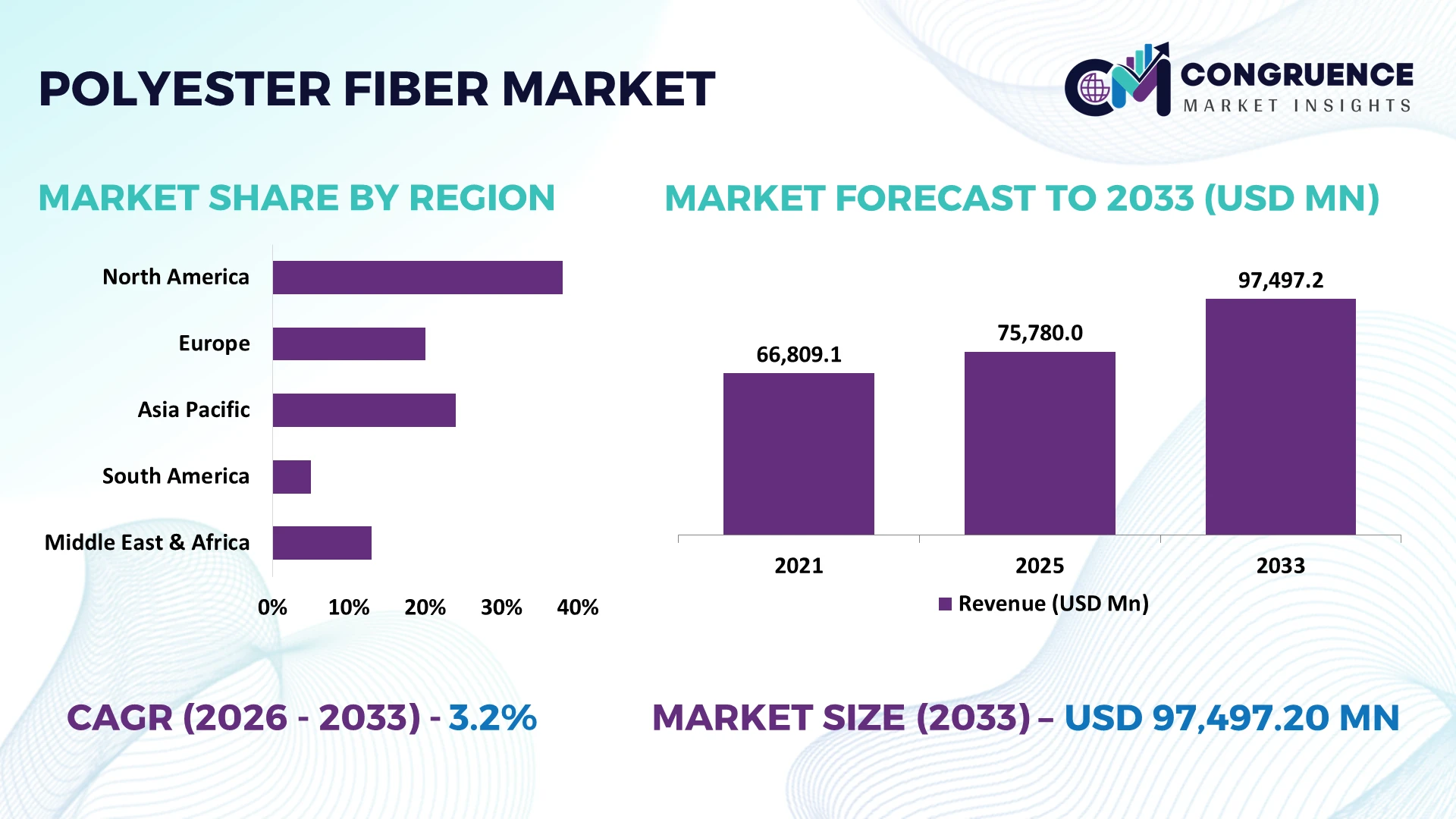
The Global Polyester Fiber Market was valued at USD 75780 Million in 2025 and is anticipated to reach a value of USD 97497.2 Million by 2033 expanding at a CAGR of 3.2% between 2026 and 2033. Growth is supported by rising recycled polyester integration, capacity expansion across Asia, and increasing use of high-performance fibers in apparel, automotive, technical textiles, and home furnishing applications.
China remains the dominant producer, accounting for approximately 58% of global polyester fiber manufacturing capacity, supported by large-scale petrochemical integration, advanced spinning technologies, and continuous investments in textile modernization. India is strengthening its position with capacity additions exceeding 8% since 2024, while China maintains over 30% higher production efficiency through automation. Amid ongoing Red Sea shipping disruptions influencing global logistics in 2026, regional supply chain diversification continues to reshape sourcing strategies.
Manufacturers prioritizing integrated production, recycled feedstock, and automation-driven operational efficiency are positioned to strengthen long-term competitiveness across global polyester fiber value chains.
Market Size & Growth: Valued at USD 75780 Million in 2025 and projected to reach USD 97497.2 Million by 2033 at a CAGR of 3.2%, driven by recycled polyester adoption and advanced manufacturing integration.
Top Growth Drivers: Recycled fiber utilization exceeds 22%, textile automation improves productivity by 18%, and technical textile demand expands by approximately 12%.
Short-Term Forecast: By 2027, automated production lines reduce manufacturing costs by nearly 9% while increasing operational efficiency by around 11%.
Emerging Technologies: AI-enabled quality inspection, digital spinning automation, and advanced low-energy melt processing improve defect detection by nearly 20%.
Regional Leaders: Asia Pacific surpasses USD 61 Billion with integrated production expansion, Europe exceeds USD 15 Billion through recycled fiber adoption, and North America crosses USD 11 Billion with advanced industrial textile applications.
Consumer/End-User Trends: More than 35% of apparel manufacturers increase recycled polyester usage to meet sustainability and performance targets.
Pilot/Case Example: In 2026, an automated smart fiber production project improved production consistency by approximately 16% while reducing material waste by 10%.
Competitive Landscape: The top five manufacturers collectively control around 38% of global capacity, led by Tongkun Group alongside Reliance Industries, Indorama Ventures, Hengli Group, and Far Eastern New Century.
Regulatory & ESG Impact: Circular economy initiatives increase recycled polyester utilization by approximately 15%, supported by stricter sustainability requirements and regional supply chain diversification.
Investment & Funding: More than USD 6 Billion supports capacity expansion, recycling infrastructure, and strategic partnerships across high-growth manufacturing hubs.
Innovation & Future Outlook: Next-generation bio-based polyester, chemical recycling, and intelligent manufacturing accelerate premium product differentiation and long-term supply chain resilience.
Polyester Fiber Market demand continues expanding across apparel, automotive interiors, filtration media, and industrial textiles as manufacturers adopt recycled materials and intelligent production systems. Advanced spinning technologies improve production efficiency by approximately 14%, while growing chemical recycling capacity supports circular manufacturing. Ongoing supply-chain diversification and evolving sustainability regulations are accelerating regional investments, setting the stage for broader strategic competitiveness across the global polyester fiber industry.
The Polyester Fiber Market has become strategically important as manufacturers balance cost competitiveness, supply security, and sustainability objectives across global textile and industrial value chains. Supply-chain restructuring following logistics disruptions has accelerated investments in integrated production facilities and regional sourcing networks. At the same time, stricter recycled-content requirements and expanding technical textile applications are reshaping procurement priorities, encouraging producers to modernize operations while reducing dependence on fragmented raw material supply.
Modern automated spinning systems deliver approximately 15% higher production efficiency and reduce energy consumption by nearly 12% compared with conventional production lines, enabling lower operating costs and improved product consistency. China continues to lead large-scale deployment through vertically integrated manufacturing, while India is expanding high-value polyester capacity with automation-focused investments and specialty fiber production. Over the next two to three years, recycled polyester penetration is expected to exceed 28% of total production in several major manufacturing clusters as digital process monitoring and quality analytics become standard operational tools.
A practical example is the deployment of AI-assisted quality inspection integrated with continuous spinning lines, reducing defect rates by around 18% while improving throughput stability. Manufacturers are expanding recycling partnerships, investing in chemical recycling technologies, and strengthening downstream textile collaborations to secure feedstock and premium product positioning. Companies combining integrated manufacturing, digital production, and circular material strategies will establish stronger competitive differentiation and long-term operational resilience.
The strongest structural driver is the rapid integration of recycled polyester and advanced technical textiles into manufacturing portfolios. Recycled polyester utilization has increased by approximately 22% across leading textile producers, while automated fiber production improves manufacturing productivity by nearly 18% and reduces material waste by about 10%. China's investment in integrated petrochemical-textile complexes and India's production-linked manufacturing initiatives continue to strengthen domestic capacity and export competitiveness. These developments increase supply reliability while supporting sustainability objectives. In response, leading companies are expanding recycling facilities, establishing long-term feedstock partnerships, and investing in high-performance polyester grades for automotive, filtration, and industrial applications. The strategic advantage increasingly lies in vertically integrated production capable of balancing cost efficiency with premium product differentiation.
Polyester fiber manufacturers continue to face pressure from fluctuating purified terephthalic acid and monoethylene glycol costs, with feedstock price movements exceeding 15% during periods of supply imbalance. Energy expenses account for nearly 25% of operating costs in several manufacturing facilities, increasing production uncertainty. Ongoing shipping disruptions through critical maritime trade routes have extended delivery schedules by approximately 12% for selected export markets, reducing inventory flexibility and contract stability. These structural constraints directly affect pricing discipline, profitability, and production planning. To reduce exposure, companies are localizing procurement, negotiating multi-year supply agreements, expanding regional warehousing, and increasing recycled feedstock integration. Strong procurement diversification has become a competitive requirement rather than a cost-management initiative.
Chemical recycling, AI-enabled production optimization, and specialty polyester development are creating high-value opportunities beyond conventional textile markets. Smart manufacturing platforms improve process efficiency by approximately 14%, while predictive maintenance lowers unexpected equipment downtime by nearly 20%. Japan and India are accelerating investments in high-performance fibers for automotive, medical, and filtration applications supported by advanced manufacturing policies. Companies are also developing bio-based polyester blends and digital traceability platforms that strengthen compliance with evolving sustainability requirements. A particularly valuable opportunity lies in combining recycled feedstock with intelligent production analytics, enabling premium product positioning while improving operational efficiency. Businesses expanding strategic partnerships across recycling, material science, and downstream textile ecosystems are strengthening long-term differentiation and supply-chain resilience.
The principal long-term challenge is achieving consistent quality and operational efficiency while scaling advanced polyester manufacturing across multiple production sites. Implementing intelligent automation requires workforce upskilling, digital integration, and process standardization, with implementation periods extending by approximately 20% for complex facilities. Advanced inspection technologies reduce quality deviations by nearly 16%, yet interoperability between legacy equipment and modern digital platforms remains a significant operational barrier. Manufacturers in India and Southeast Asia must also strengthen technical capabilities to support specialty fiber production at international quality standards. Companies addressing these issues through workforce development, standardized digital architectures, equipment modernization, and collaborative technology partnerships will achieve more reliable production performance and stronger competitive positioning in increasingly demanding industrial markets.
Advanced Recycling Capacity Expansion Recycled polyester production is accelerating as manufacturers increase chemical recycling deployment, with recycled feedstock utilization rising by approximately 20% and processing efficiency improving by nearly 14%. Regulatory requirements for recycled content and brand sustainability commitments are driving investment decisions. Companies in China and India are expanding closed-loop recycling partnerships, integrating automated sorting technologies, and securing long-term waste feedstock contracts to reduce raw material dependence while improving operational consistency and product traceability.
Smart Manufacturing Integration AI-enabled inspection, digital twins, and predictive maintenance are becoming standard across modern spinning facilities. Automated quality monitoring reduces defect rates by approximately 18%, while predictive maintenance lowers unplanned downtime by nearly 16%. Labor shortages and higher productivity expectations are accelerating digital transformation. Producers are restructuring manufacturing workflows, deploying intelligent sensors across production lines, and integrating centralized manufacturing execution systems to improve throughput, energy efficiency, and product consistency without major capacity disruptions.
Shift Toward Specialty Fibers High-performance polyester fibers for automotive, filtration, and industrial textiles are expanding rapidly, with specialty product output increasing by around 15% and premium-grade production improving operating margins by approximately 10%. Demand for lightweight and durable engineered materials continues to reshape production priorities. Manufacturers are strengthening material science partnerships, expanding differentiated product portfolios, and upgrading spinning technologies to support customized applications with higher value realization.
Localized Supply Network Development Manufacturers are reducing exposure to logistics disruptions by regionalizing production and supplier networks. Local procurement has increased by approximately 17%, while inventory turnover has improved by nearly 11% through integrated planning systems. Continued shipping uncertainty and evolving trade policies are encouraging companies to establish multi-country sourcing strategies, expand downstream textile collaborations, and invest in flexible production hubs that improve delivery reliability while strengthening long-term supply-chain resilience.
Virgin polyester remains the leading segment, accounting for approximately 61% of global demand because of its cost efficiency, stable quality, and compatibility with large-scale textile manufacturing. Its extensive deployment across apparel, home textiles, and industrial applications supports consistent production economics and integrated supply chains. Solid polyester continues to dominate conventional textile processing owing to its versatility and high spinning efficiency, while hollow polyester strengthens demand in insulation, bedding, and lightweight filling applications where thermal performance remains a priority.
Recycled polyester represents the fastest-growing segment as sustainability requirements reshape procurement strategies across global manufacturers. Recycled fiber utilization has increased by nearly 22%, while investments in chemical recycling have improved material recovery efficiency by approximately 15%. Companies are expanding recycling partnerships, upgrading sorting infrastructure, and introducing premium recycled grades for performance textiles. Meanwhile, hollow fiber producers continue enhancing insulation performance, and virgin manufacturers increasingly integrate recycled content into blended portfolios. Investment priorities are steadily shifting toward circular manufacturing without compromising operational efficiency or product consistency.
Apparel remains the largest application, representing approximately 48% of polyester fiber consumption due to its affordability, durability, and suitability for mass-market garment production. Strong integration with global textile manufacturing and increasing demand for moisture-management fabrics sustain its leadership. Home textiles maintain stable demand through bedding and furnishing products, while nonwoven fabrics continue expanding across hygiene and filtration applications supported by automated production technologies.
Automotive textiles are the fastest-growing application as lightweight material adoption and interior performance requirements continue increasing. Polyester usage in automotive applications has expanded by approximately 16%, while advanced industrial textile production has improved manufacturing productivity by nearly 13%. Industrial textiles are also gaining strategic importance in geotextiles, filtration, and infrastructure applications requiring high durability. Manufacturers are expanding specialized production lines, strengthening OEM collaborations, and deploying automated fiber processing technologies to deliver application-specific materials with improved quality consistency and operational efficiency.
The textile industry remains the dominant end-user, accounting for approximately 63% of polyester fiber consumption through extensive deployment in apparel, home furnishings, and technical fabrics. Large-scale manufacturing infrastructure, integrated supply chains, and consistent processing performance reinforce its leadership. Packaging and construction continue providing stable demand, particularly for woven fabrics, reinforcement materials, and flexible industrial packaging applications requiring strength and durability.
Healthcare is emerging as the fastest-growing end-user as demand increases for medical textiles, protective apparel, and disposable nonwoven products. Medical-grade polyester utilization has increased by approximately 17%, while nonwoven manufacturing efficiency has improved by nearly 12% through automated production systems. Automotive manufacturers continue expanding polyester use in lightweight interiors and acoustic insulation solutions. Companies are responding by developing specialized product grades, establishing healthcare partnerships, implementing value-based pricing strategies, and strengthening downstream collaboration to capture higher-value industrial and medical applications.
Asia-Pacific accounted for the largest market share at 64% in 2025 however, Middle East & Africa is expected to register the fastest growth, expanding at a 4.3% between 2026 and 2033.
Advanced Manufacturing and High-Value Textile Integration
North America represents approximately 15% of global polyester fiber consumption, supported by advanced industrial textiles, automotive manufacturing, and high-performance nonwoven production. Manufacturers are prioritizing specialty polyester grades, automated production systems, and recycled fiber integration to strengthen supply resilience and product differentiation. More than 35% of newly commissioned production upgrades now incorporate AI-assisted quality monitoring and predictive maintenance, improving process consistency while reducing operational downtime. Strategic partnerships between fiber manufacturers and downstream textile processors are shortening product development cycles and supporting customized applications for healthcare, filtration, and transportation industries. Continued investment in domestic production capabilities also reduces reliance on imported intermediate materials while improving supply-chain responsiveness.
United States Market Outlook: The United States leads regional demand through its strong technical textile ecosystem, advanced automotive manufacturing, and expanding healthcare materials sector. Nearly 40% of industrial textile capacity upgrades completed since 2025 have focused on intelligent manufacturing technologies. Companies continue investing in specialty polyester production, recycling infrastructure, and collaborative innovation with automotive and medical manufacturers to improve supply security and accelerate commercialization of high-performance fiber solutions.
Circular Economy Policies Drive Manufacturing Transformation
Europe accounts for nearly 14% of global polyester fiber demand, with sustainability regulations reshaping manufacturing priorities and procurement strategies. Producers are increasing recycled polyester integration, modernizing processing equipment, and expanding chemical recycling capabilities to comply with evolving circular economy objectives. More than 30% of premium textile manufacturers have adopted certified recycled feedstocks as standard production inputs. Investment in digital production monitoring and energy-efficient spinning technologies is improving operational performance while supporting environmental targets. Companies increasingly collaborate across recycling, fiber production, and apparel value chains to strengthen traceability and long-term material availability.
Germany Market Outlook: Germany remains the region's technology leader through advanced textile engineering, industrial automation, and technical fiber innovation. Approximately 28% of newly installed textile production equipment incorporates intelligent monitoring systems that improve manufacturing precision and energy performance. German manufacturers continue strengthening research partnerships and expanding specialty polyester applications for automotive, filtration, and industrial engineering sectors.
Integrated Manufacturing Scale Strengthens Global Leadership
Asia-Pacific dominates global polyester fiber production through vertically integrated petrochemical infrastructure, competitive manufacturing costs, and extensive textile processing capacity. The region contributes approximately 64% of worldwide polyester fiber output, supported by continuous investments in automation, recycling infrastructure, and export-oriented manufacturing. Production efficiency has improved by nearly 18% following widespread deployment of intelligent spinning technologies and digital process control. Manufacturers continue expanding integrated production hubs while strengthening logistics networks and downstream textile partnerships to improve supply reliability and production flexibility. The region remains the primary global sourcing destination for apparel, industrial textiles, and engineered polyester materials.
China Market Outlook: China maintains the world's largest polyester fiber manufacturing base, accounting for approximately 58% of global production capacity. Extensive petrochemical integration, automated production facilities, and large-scale recycling investments provide significant operational advantages. Chinese enterprises continue expanding specialty fiber production, implementing intelligent manufacturing platforms, and strengthening export competitiveness through vertically integrated supply chains and continuous technology modernization.
Industrial Modernization Supports Textile Expansion
South America represents approximately 4% of global polyester fiber demand, driven by expanding textile manufacturing, packaging applications, and industrial fabric production. Manufacturers are upgrading spinning facilities and improving regional supply networks to reduce import dependence and strengthen operational flexibility. Production efficiency has increased by approximately 10% following selective automation investments across major manufacturing clusters. While infrastructure limitations and logistics costs continue influencing competitiveness, strategic partnerships between fiber producers and textile converters are improving regional value addition. Companies increasingly prioritize localized manufacturing to stabilize supply and shorten delivery cycles for domestic customers.
Brazil Market Outlook: Brazil leads the regional market through its diversified textile industry, growing industrial manufacturing base, and expanding domestic consumer demand. More than 45% of South America's polyester fiber processing capacity is concentrated within Brazil. Local manufacturers continue investing in recycled polyester production, operational modernization, and integrated textile partnerships to improve competitiveness while reducing dependence on imported finished materials.
Petrochemical Investment Accelerates Value Chain Development
Middle East & Africa is strengthening its polyester fiber position through expanding petrochemical integration, industrial diversification, and downstream textile investments. The region contributes approximately 3% of global demand but continues increasing production capability through infrastructure modernization and export-focused manufacturing projects. Integrated production facilities have improved feedstock efficiency by nearly 13%, supporting lower operating costs and enhanced supply reliability. Governments are encouraging industrial diversification while manufacturers establish partnerships to expand fiber conversion capacity and strengthen regional textile ecosystems. Investment increasingly targets value-added polyester production rather than raw material exports.
Saudi Arabia Market Outlook: Saudi Arabia leads regional development through its integrated petrochemical infrastructure and industrial diversification strategy. Recent manufacturing projects have expanded domestic polyester processing capacity by approximately 12%, supported by modern industrial zones and competitive feedstock availability. Companies continue investing in downstream textile manufacturing, strategic export partnerships, and advanced production technologies to strengthen regional competitiveness and capture higher-value industrial applications.
The Polyester Fiber Market is led by global manufacturers including Tongkun Group, Indorama Ventures, Reliance Industries, Hengli Group, and Far Eastern New Century, competing directly with regional integrated producers on manufacturing scale, cost efficiency, and specialty product capability. The top five companies collectively control approximately 38% of global production capacity. Competition centers on vertically integrated supply chains, recycled fiber innovation, and automated production, with intelligent manufacturing improving operational efficiency by nearly 15% and recycling technologies reducing raw material dependence by approximately 18%. Global leaders expand through capacity additions, recycling partnerships, and downstream textile integration, while regional producers compete through localized supply, faster delivery, and customized industrial applications. Competitive dynamics increasingly favor companies controlling feedstock, processing, and distribution within integrated ecosystems. High capital requirements, technology-intensive production, and sustainability compliance create substantial entry barriers. Winning requires manufacturing efficiency, circular material capabilities, reliable supply-chain control, and differentiated specialty fiber portfolios that consistently outperform price-based competition.
Tongkun Group
Reliance Industries Limited
Indorama Ventures Public Company Limited
Hengli Group
Far Eastern New Century Corporation
Alpek S.A.B. de C.V.
Toray Industries, Inc.
Teijin Limited
China Resources Chemical Innovative Materials Co., Ltd.
Zhejiang Hengyi Group Co., Ltd.
Xin Feng Ming Group Co., Ltd.
Nan Ya Plastics Corporation
Hyosung TNC Corporation
Jiangsu Sanfangxiang Group Co., Ltd.
Digital manufacturing, AI-enabled quality inspection, and automated spinning systems are now defining polyester fiber production. AI-based defect detection improves inspection accuracy by approximately 18%, while automated process control reduces energy consumption by nearly 12%. Around 45% of newly upgraded production lines incorporate intelligent sensors and predictive maintenance, improving throughput stability and lowering unplanned downtime. These technologies enable manufacturers to deliver consistent fiber quality, optimize raw material utilization, and strengthen supply-chain responsiveness across large-scale textile operations.
Emerging technologies are centered on chemical recycling, digital traceability, and bio-based polyester feedstocks. Chemical recycling increases usable material recovery by approximately 20% compared with conventional mechanical recycling, while blockchain-enabled traceability is deployed across nearly 30% of premium recycled polyester supply chains. Compared with conventional spinning operations, AI-integrated production improves manufacturing efficiency by around 15% through real-time process optimization and automated quality correction. Companies investing in integrated recycling and smart manufacturing gain stronger operational flexibility and faster compliance with evolving sustainability requirements.
Disruptive innovation between 2026 and 2028 will focus on closed-loop textile recycling, digital twin manufacturing, and advanced polymer engineering. Adoption of digital twin platforms is expected to exceed 35% among leading integrated manufacturers, reducing production optimization time by approximately 16%. Global leaders investing in intelligent recycling ecosystems, specialty fibers, and automated manufacturing will strengthen competitive positioning through lower production costs, higher product consistency, and resilient circular supply chains while slower adopters face increasing operational disadvantages.
May 2025 Indorama Ventures expanded its deja™ portfolio with polyester fibers and filament yarns produced entirely from recycled textile waste while introducing additional bio-based fiber solutions to support textile circularity and European sustainability requirements. Business impact: broader premium sustainable product portfolio.
August 2025 Indorama Ventures announced recycling of more than 150 billion post-consumer PET bottles across over 20 recycling facilities in 11 countries, strengthening global recycled polyester feedstock availability. Business impact: improved circular material supply security and industrial-scale recycling capability.
November 2025 Indorama Ventures and Jiaren Chemical Recycling formed a joint venture targeting up to 100,000 tonnes of annual textile-recycled PET spinning capacity. Business impact: accelerated commercial-scale chemical recycling and enhanced global supply-chain resilience for recycled polyester. Source: indoramaventures.com
June 2026 Indorama Ventures showcased industrial-scale recycled polyester fiber and yarn solutions with traceable supply-chain integration at the Textiles Recycling Expo, enabling faster supplier qualification and improved sourcing transparency. Business impact: strengthened adoption of circular textile manufacturing across global brands. Source: hygiene.indoramaventures.com
This report provides comprehensive analysis of the Polyester Fiber Market across Solid, Hollow, Virgin, and Recycled fiber categories, covering applications including Apparel, Home Textiles, Industrial Textiles, Nonwoven Fabrics, and Automotive Textiles, together with key end-users across Textile Industry, Automotive, Construction, Healthcare, and Packaging. The assessment spans North America, Europe, Asia-Pacific, South America, and the Middle East & Africa, while evaluating adoption patterns, manufacturing deployment, specialty fiber development, recycling technologies, and digital production transformation. More than 10 major global manufacturers are assessed for strategic positioning and competitive capability.
The study delivers business intelligence supporting investment planning, expansion strategies, supply-chain optimization, technology benchmarking, and competitive positioning between 2026 and 2033. It evaluates deployment trends, production modernization, circular manufacturing initiatives, regional manufacturing concentration, and evolving demand across technical textiles, industrial applications, automotive materials, healthcare products, and emerging specialty polyester segments, enabling decision-makers to identify operational opportunities, strategic risks, and long-term market priorities.
| Report Attribute/Metric | Report Details |
|---|---|
Market Revenue in 2025 | USD 75780 Million |
Market Revenue in 2033 | USD 97497.2 Million |
CAGR (2026 - 2033) | 3.2% |
Base Year | 2025 |
Forecast Period | 2026 - 2033 |
Historic Period | 2021 - 2025 |
Segments Covered | By Type
By Application
By End-User
|
Key Report Deliverable | Revenue Forecast, Growth Trends, Market Dynamics, Segmental Overview, Regional and Country-wise Analysis, Competition Landscape |
Region Covered | North America, Europe, Asia-Pacific, South America, Middle East, Africa |
Key Players Analyzed | Tongkun Group, Reliance Industries Limited, Indorama Ventures Public Company Limited, Hengli Group, Far Eastern New Century Corporation, Alpek S.A.B. de C.V., Toray Industries, Inc., Teijin Limited, China Resources Chemical Innovative Materials Co., Ltd., Zhejiang Hengyi Group Co., Ltd., Xin Feng Ming Group Co., Ltd., Nan Ya Plastics Corporation, Hyosung TNC Corporation, Jiangsu Sanfangxiang Group Co., Ltd. |
Customization & Pricing | Available on Request (10% Customization is Free) |




