
Reports
The Global PolyDADMAC Market was valued at USD 262.3 Million in 2025 and is anticipated to reach a value of USD 332.3 Million by 2033 expanding at a CAGR of 3.0% between 2026 and 2033. Growth is driven by stricter wastewater discharge requirements, expansion of industrial water reuse, and increasing adoption of high-charge-density organic coagulants for lower-sludge clarification.
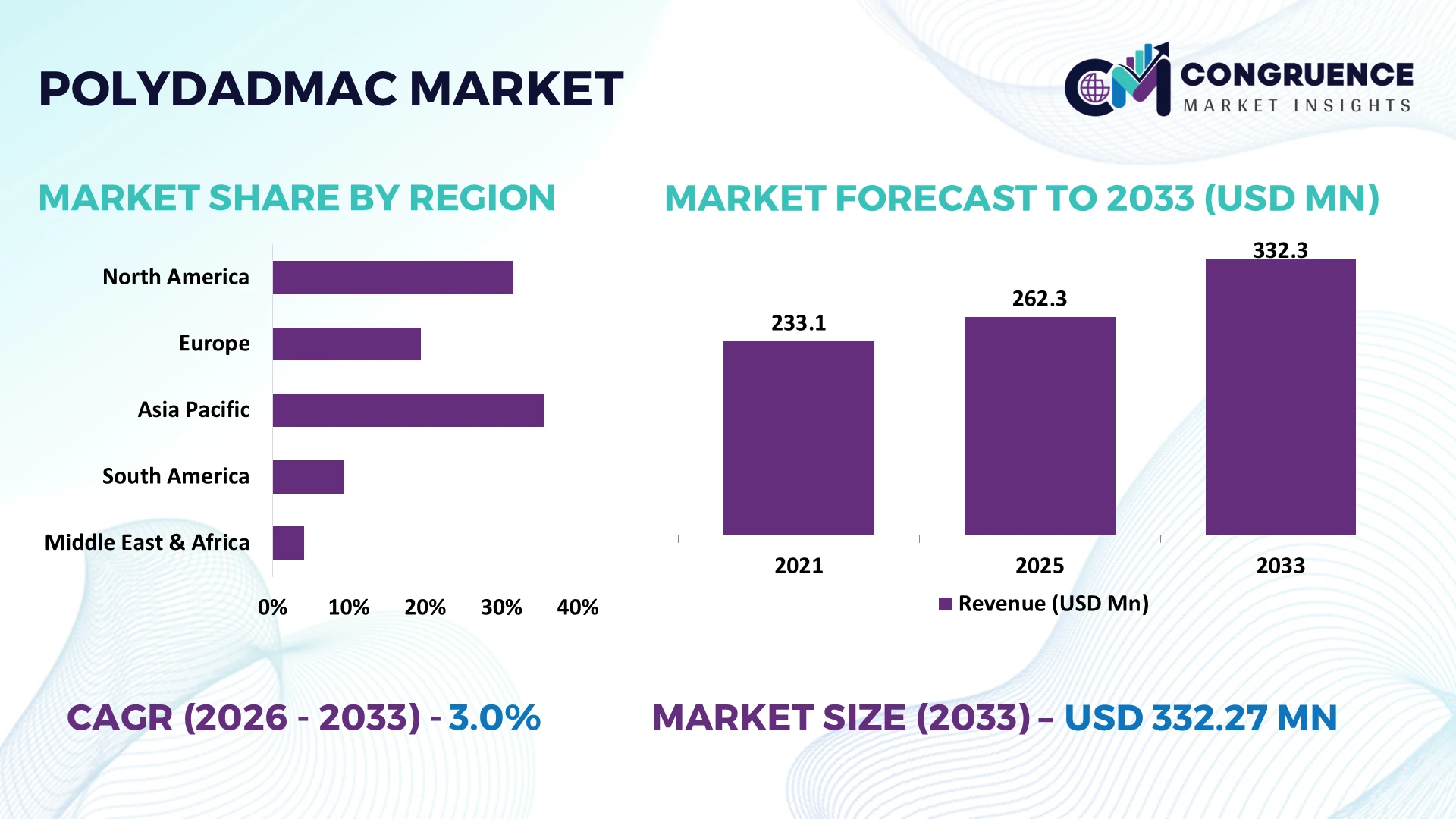
Asia Pacific accounted for approximately 35.6% of global PolyDADMAC demand in 2025, led by China’s large municipal water-treatment, pulp-and-paper, and industrial-processing base. China’s water-resource investment reached more than USD 143 billion in 2025, supporting treatment infrastructure and chemical dosing demand. India is accelerating wastewater deployment, with 3,977 MLD of sewage-treatment capacity created under Namami Gange by December 2025. China’s infrastructure scale and industrial water consumption continue to give it a stronger operating base than smaller emerging markets, while India is expanding treatment capacity through major river-cleanup programs.
The strategic implication is clear, suppliers should prioritize high-efficiency formulations, localized production, and technical service around expanding water-treatment infrastructure.
Market Size & Growth: USD 262.3 Million in 2025 is projected to reach USD 332.3 Million by 2033 at a 3.0% CAGR, supported by advanced wastewater clarification and sludge-management requirements.
Top Growth Drivers: Wastewater modernization contributes to approximately 35% of incremental demand, industrial reuse 25%, and automated chemical dosing 20%.
Short-Term Forecast: By 2028, precision dosing systems can reduce PolyDADMAC consumption by up to 20%, improving chemical-use efficiency and treatment economics.
Emerging Technologies: Smart dosing, real-time turbidity monitoring, and molecular-weight optimization are reshaping advanced PolyDADMAC formulations.
Regional Leaders: Asia Pacific is projected around USD 118 Million, North America near USD 105 Million, and Europe around USD 65 Million as automation and water-reuse adoption expands.
Consumer/End-User Trends: Water-treatment applications represent approximately 55% of demand, reinforcing PolyDADMAC’s role in clarification and solids separation.
Pilot/Case Example: In 2025, India commissioned 25 sewage-treatment plants adding 530 MLD of capacity, expanding the addressable base for high-efficiency coagulation chemistry.
Competitive Landscape: Leading suppliers include Kemira, BASF, SNF, Accepta, and GEO Specialty Chemicals, competing through formulation consistency, application support, and supply reliability.
Regulatory & ESG Impact: China’s water infrastructure investment exceeded USD 143 billion in 2025, strengthening demand for efficient treatment chemistry and resource-recovery systems.
Investment & Funding: China invested USD 810 billion in water conservancy during 2021–2025, accelerating infrastructure modernization and chemical-treatment opportunities.
Innovation & Future Outlook: Next-generation low-viscosity grades, automated dosing, and application-specific polymers will shift competition toward treatment performance rather than commodity-volume supply.
PolyDADMAC demand is increasingly concentrated in municipal wastewater, industrial effluent, pulp and paper, and process-water applications, where high charge density improves flocculation and solids capture. Approximately 55% of demand is linked to water-treatment applications, while smart dosing can reduce chemical consumption by up to 20%. China’s infrastructure expansion and India’s wastewater programs are strengthening regional procurement pipelines and encouraging suppliers to build localized technical support.
PolyDADMAC is becoming strategically important because water-treatment operators are shifting from bulk chemical consumption toward precision coagulation, lower sludge generation, and tighter process control. Its high cationic charge density enables efficient particle destabilization across municipal and industrial systems, strengthening its role in modern clarification and wastewater-treatment trains.
The technology transition is particularly important: automated dosing platforms can reduce chemical consumption by up to 20% compared with less-optimized dosing practices, while real-time turbidity monitoring improves dosage consistency. Asia Pacific combines larger treatment volumes with rapid infrastructure expansion, whereas North America emphasizes retrofit, compliance, and digital optimization. China’s 2021–2025 water infrastructure investment exceeded USD 810 billion, reinforcing the scale of modernization.
Over the next 2–3 years, suppliers will increasingly prioritize low-viscosity formulations, application-specific molecular weights, and dosing-system partnerships. A practical deployment model is integrating PolyDADMAC feed systems with online turbidity monitoring at municipal treatment plants, reducing chemical waste while stabilizing effluent quality. Companies that combine formulation expertise with localized technical service will strengthen operational positioning and customer retention.
Stricter discharge controls and expanding treatment infrastructure are increasing demand for high-charge-density coagulants. Water-treatment applications account for approximately 55% of PolyDADMAC demand, while optimized dosing can reduce chemical consumption by up to 20%. China invested USD 143.2 billion in water-resource management projects during 2025, while India added 530 MLD of sewage-treatment capacity through 25 projects during the year. These infrastructure programs are shifting procurement toward performance-based chemistry. Suppliers are responding with application-specific molecular weights, liquid formulations, and automated dosing compatibility. The non-obvious advantage is reduced sludge and improved process stability, allowing operators to evaluate PolyDADMAC on total treatment cost rather than purchase price alone.
PolyDADMAC suppliers face cost pressure from monomer inputs, energy-intensive processing, logistics, and formulation requirements. Chemical consumption can fall by up to 20% through optimized dosing, but this simultaneously encourages customers to scrutinize delivered cost per treated cubic meter rather than polymer volume. Liquid grades also create transportation and storage considerations that affect smaller treatment operators. Competition from alum, ferric salts, polyaluminum chloride, and alternative polymers further limits pricing flexibility. Companies are responding through regional inventory, longer-term procurement contracts, formulation optimization, and higher-concentration grades. The key operational constraint is margin protection: suppliers must demonstrate measurable treatment efficiency while maintaining consistent charge density and molecular-weight specifications across production batches.
The strongest emerging opportunity lies in integrating PolyDADMAC with automated dosing, online turbidity measurement, and digital treatment controls. Smart dosing can deliver chemical-consumption reductions of up to 20%, while application-specific formulations improve solids capture and sludge dewatering performance. India’s wastewater infrastructure expansion, including 530 MLD of new capacity commissioned in 2025, creates additional deployment opportunities for digitally controlled chemical systems. Suppliers can capture higher-value demand by combining polymers with dosing equipment, monitoring software, and technical services rather than selling standalone chemicals. The strategic opportunity is to convert PolyDADMAC from a commodity treatment input into a performance-linked solution with recurring service relationships and stronger customer retention.
Long-term competitiveness depends on maintaining consistent polymer performance across different water chemistries, treatment configurations, and dosing environments. Overdosing can cause particle charge reversal and destabilize flocs, while insufficient dosing reduces clarification efficiency. Automated systems therefore require precise calibration, operator capability, and reliable online monitoring. Treatment facilities adopting digital controls increasingly expect dosage accuracy within tightly managed operating parameters rather than simple chemical availability. Companies must invest in application laboratories, process simulation, technical training, and localized field support. The non-obvious challenge is interoperability: polymer chemistry, dosing pumps, sensors, and treatment-control software must operate as one system. Suppliers that solve this integration problem can protect customer relationships while reducing deployment variability and operational disruption.
Automated Dosing Gains Ground: Treatment plants are shifting toward automated polymer dosing, with optimized systems reducing chemical consumption by up to 20% while improving turbidity control. Real-time sensors linked with dosing pumps are reducing manual intervention and batch variability. Suppliers are integrating monitoring software and formulation support as utilities prioritize treatment cost per cubic meter.
Liquid Grades Strengthen Integration: Liquid PolyDADMAC is gaining preference because it integrates directly with continuous dosing infrastructure and eliminates dissolution steps. Liquid formulations account for approximately 63% of demand, while automated dosing can improve chemical-use efficiency by 15–20%. Manufacturers are expanding ready-to-dose grades and regional inventories as customers demand faster commissioning and simpler handling.
Water Reuse Changes Procurement: Wastewater reuse is shifting polymer purchasing from volume-based procurement toward performance-based specifications. India had 1,437.6 MLD of sewage-treatment capacity developed for recycle and reuse under AMRUT by March 2025. Suppliers are responding with higher-purity grades and application-specific charge densities, making technical service an increasingly important differentiator.
Supply Chains Move Closer: Chemical buyers are reducing exposure to long-distance logistics and production interruptions through regional inventory and dual-source procurement. India had 4,447.1 MLD of new or augmented sewage-treatment capacity under AMRUT by March 2025, expanding local procurement opportunities. Producers are strengthening distribution networks and technical support while customers increasingly evaluate supply continuity alongside polymer performance.
Liquid PolyDADMAC is the leading type, accounting for approximately 63% of global demand, supported by direct compatibility with metering pumps, rapid dispersion, and lower handling complexity. Adoption is particularly strong in municipal water treatment and continuous industrial clarification, where dosing consistency has greater operational value than storage flexibility. Powder PolyDADMAC represents roughly 25%, retaining relevance where transportation efficiency, longer storage, and on-site preparation justify additional handling. Bead formulations account for about 12% and remain specialized for applications requiring controlled dissolution or customized processing characteristics.
Liquid formulations are also the fastest-growing type, with adoption expanding by approximately 5% annually as treatment operators automate chemical-feed systems. Powder grades remain important for decentralized facilities and logistics-sensitive customers, while bead products serve narrower technical requirements. Companies are directing formulation investment toward low-viscosity liquid grades, higher active concentration, and improved pump compatibility while maintaining powder capacity for customers prioritizing transportation efficiency.
Water purification is the leading application, representing approximately 47% of global PolyDADMAC demand because the polymer provides rapid charge neutralization, turbidity reduction, and coagulation across municipal and industrial treatment systems. Pulp and paper accounts for approximately 23%, where retention and drainage performance supports high-speed production. Oilfields contribute around 13%, while cosmetics and other applications represent smaller but technically differentiated demand. Water purification remains the largest application as treatment facilities tighten chemical dosing and sludge-control requirements.
Oilfield applications are among the faster-expanding use cases, supported by produced-water treatment and process-water clarification. Pulp and paper remains comparatively stable, while cosmetics increasingly favor high-purity grades for specialized formulations. Companies are developing application-specific molecular weights, improving compatibility with automated dosing equipment, and expanding technical partnerships with treatment-system integrators. The business implication is a shift from standardized polymer sales toward formulation-performance agreements, particularly where customers measure treatment cost per cubic meter or production unit.
Municipal authorities represent the leading end-user group, accounting for approximately 51% of global PolyDADMAC consumption, reflecting recurring chemical requirements across drinking-water and wastewater facilities. Industrial facilities contribute around 37%, driven by continuous treatment requirements in manufacturing, pulp and paper, oilfields, and process industries. Consumer product manufacturers account for approximately 12%, serving specialized applications where purity and formulation consistency carry greater importance than bulk volume.
Industrial facilities are the fastest-growing end-user group, with adoption increasing by approximately 5–6% as manufacturers expand wastewater reuse, process-water recovery, and discharge-control systems. Municipal buyers prioritize dependable supply and lifecycle treatment costs, while industrial purchasers increasingly demand customized charge density and technical optimization. Consumer product manufacturers remain specification-sensitive and favor higher-purity grades. Suppliers are responding with differentiated pricing, application engineering, local inventory, and long-term supply agreements, shifting competition toward customer-specific performance rather than commodity pricing.
Asia Pacific accounted for the largest market share at 35.6% in 2025 however, Asia Pacific is expected to register the fastest growth, expanding at a CAGR of 3.5% between 2026 and 2033.
North America accounted for approximately 31.5% of the global PolyDADMAC market in 2025, supported by established municipal wastewater systems, industrial water treatment, pulp and paper production, and advanced chemical-dosing infrastructure. The United States remains the primary demand center, with procurement increasingly linked to wastewater upgrades, water reuse, PFAS treatment, and aging infrastructure replacement. U.S. water infrastructure programs provide more than USD 50 billion in investment over five years, strengthening treatment-chemical deployment opportunities. Automated dosing and online turbidity monitoring are gaining traction as operators seek more consistent polymer utilization and lower sludge-handling costs. Suppliers are responding through regional distribution, application engineering, formulation optimization, and partnerships with water-treatment system integrators. The region’s mature infrastructure gives PolyDADMAC suppliers a strong base for higher-value performance-based contracts.
United States Market Outlook: The United States dominates North American demand because of its extensive municipal treatment network and large industrial water-treatment footprint. Federal financing programs continue to support wastewater modernization, with USD 6.5 billion made available through WIFIA in 2025. Industrial facilities are also increasing water-reuse investments, creating demand for consistent polymer performance, automated dosing, and technical support. Suppliers are strengthening domestic inventory and service capabilities to shorten delivery cycles and support complex treatment projects.
Europe represented approximately 19.4% of the global PolyDADMAC market in 2025, with Germany, France, Italy, the United Kingdom, and Spain forming major demand centers. The revised EU Urban Wastewater Treatment Directive entered into force in January 2025, tightening treatment requirements and expanding attention toward resource recovery, water reuse, and emerging pollutants. More than 30,000 urban wastewater treatment plants operate across the EU, creating a broad installed base for polymer optimization. European operators are increasingly evaluating chemical performance alongside sludge generation, energy consumption, and compliance costs. Suppliers are responding with lower-dose formulations, application testing, and digital dosing compatibility. The region’s strategic shift is from basic compliance toward resource-efficient treatment, favoring suppliers that can demonstrate measurable process efficiency.
Germany Market Outlook: Germany provides one of Europe’s strongest industrial and municipal platforms for PolyDADMAC demand because of its advanced wastewater infrastructure, chemical manufacturing base, and high environmental compliance requirements. Industrial water users increasingly prioritize closed-loop processing and resource efficiency, encouraging precision chemical dosing. Manufacturers are strengthening local technical services and formulation capabilities to meet application-specific requirements across municipal treatment, pulp and paper, and industrial process-water systems.
Asia Pacific held the largest regional position at approximately 35.6% of the global market in 2025, led by China, Japan, South Korea, and India. China represents the region’s largest industrial base, while India is expanding municipal wastewater and water-reuse infrastructure. China invested more than USD 182 billion in water-conservancy construction during 2025 across 47,563 projects, strengthening demand for treatment chemicals and associated process equipment. Large pulp-and-paper, textile, chemical, mining, and municipal treatment facilities are increasing polymer use as discharge controls become more stringent. Producers are expanding regional manufacturing, inventory networks, and application laboratories to reduce logistics exposure and provide faster technical support. The region’s scale advantage is increasingly reinforced by localized production and integrated chemical-treatment systems.
China Market Outlook: China remains the most strategically significant country in Asia Pacific because of its extensive water infrastructure, large industrial processing base, and domestic chemical manufacturing capacity. More than 47,500 water-conservancy projects were undertaken during 2025, supporting continued treatment-system deployment. Domestic producers benefit from shorter supply chains and proximity to major municipal and industrial customers, while international suppliers are emphasizing specialized formulations, process optimization, and technology partnerships to compete in high-performance applications.
South America accounted for approximately 9.4% of the global PolyDADMAC market in 2025, with Brazil representing the principal demand center because of its municipal wastewater requirements, pulp and paper industry, mining operations, and agricultural-processing activity. Brazil’s large pulp-and-paper production base creates recurring demand for retention, drainage, and process-water treatment chemicals, while mining operators require clarification and wastewater-treatment solutions. Regional procurement remains more project-driven than in North America or Asia Pacific, making supply continuity and distributor coverage important competitive factors. Companies are strengthening local distribution partnerships and maintaining inventory closer to major industrial corridors. The non-obvious opportunity is the overlap between industrial water reuse and resource-intensive sectors, where customized PolyDADMAC formulations can improve treatment efficiency without requiring complete process redesign.
Brazil Market Outlook: Brazil is the dominant South American market because of its extensive industrial processing base and growing wastewater-treatment requirements. The country’s pulp and paper industry remains a significant chemical-treatment consumer, while mining and food-processing facilities increasingly prioritize water recycling and effluent clarification. Suppliers are expanding distributor relationships and application support around major industrial clusters, enabling faster delivery and localized formulation recommendations for customers operating under variable water chemistry.
Middle East & Africa represented approximately 4.1% of the global PolyDADMAC market in 2025, with demand concentrated in Saudi Arabia, the United Arab Emirates, South Africa, and other countries investing in desalination, municipal wastewater treatment, and industrial water reuse. Water scarcity is accelerating the adoption of advanced clarification and recycling systems, particularly around large urban and industrial projects. Saudi Arabia and the UAE are prioritizing water-security infrastructure, while South Africa continues to address municipal treatment and industrial water-quality requirements. Suppliers are responding with project-specific formulations, local inventory, and partnerships with engineering and water-treatment contractors. The region remains smaller than Asia Pacific and North America, but its project concentration creates opportunities for high-value treatment systems where polymer performance, dosing precision, and supply reliability directly influence operating economics.
Saudi Arabia Market Outlook: Saudi Arabia represents the region’s most strategically significant market because of its large-scale desalination, wastewater-treatment, industrial development, and water-reuse programs. The country’s water-security strategy increasingly emphasizes recycling and efficient treatment across municipal and industrial facilities. Large infrastructure projects require reliable chemical supply and consistent treatment performance, encouraging suppliers to establish local distribution, technical-service partnerships, and application-specific formulations close to major project sites.
SNF and Kemira compete as water-chemistry leaders, while BASF competes through diversified integration; GEO, Accepta, Raybon, BLUWAT, and Chinese producers press regional supply and price positions. The top five players are estimated to hold about 50% of value, leaving room for regional specialists. Competition centers on delivered cost, molecular-weight control, supply reliability, customization, and application support. Price differences of 8–12% can influence distributor switching, while optimized dosing can cut PolyDADMAC consumption 15–20%. Regional production and inventory can shorten delivery cycles by 10–20%. SNF expands through acquisitions and customized oilfield chemistry; Kemira combines polymers with treatment services; BASF leverages integrated manufacturing; regional producers compete through faster quotations, localized grades, and lower logistics costs. The competitive shift is toward application-specific formulations, supply-chain control, and bundled technical service. Entry barriers include monomer access, formulation know-how, quality consistency, and regulatory qualification. Winning requires dependable supply, measurable dose efficiency, and customer chemistry backed by technical support.
SNF
Kemira
BASF
GEO Specialty Chemicals
Accepta
Raybon Chemicals & Allied Products
BLUWAT Chemicals
Zhangjiagang Cpolymer Chemical
Shandong Luyue Chemical
Zhejiang Xinhaitian Bio-Technology
Ashland
Feralco Group
PolyDADMAC technology is shifting from fixed-dose liquid coagulation toward molecular-weight engineered grades, automated dosing, and sensor-linked control. High-charge formulations can improve particle neutralization efficiency by 10–15%, while automated dosing can reduce chemical consumption 15–20%. Adoption today is strongest in large municipal and industrial plants, where online turbidity and flow monitoring increasingly supports continuous adjustment rather than operator-led batch dosing across complex wastewater and reuse applications.
Emerging systems combine PolyDADMAC with digital feed controls, jar-test analytics, and application-specific polymer blends. Compared with conventional fixed-rate dosing, feedback-controlled systems can improve treatment consistency by roughly 10% and reduce overdosing by 15%. Liquid grades remain the dominant commercial form, representing about 63% of demand, because they integrate directly with metering equipment and eliminate dissolution steps. Suppliers with application laboratories and dosing expertise gain an advantage over commodity sellers.
From 2026–2028, disruptive progress will center on predictive dosing, lower-residual formulations, and lower-carbon polymer manufacturing. AI-assisted optimization can target another 5–10% chemical-use reduction where sensor data quality is sufficient. The competitive beneficiaries will be integrated suppliers able to combine chemistry, monitoring, and service contracts. Acting now matters because customers increasingly buy treatment performance, not polymer volume, making formulation data, dosing automation, and lifecycle efficiency decisive differentiators.
August 2025 SNF agreed to acquire Obsidian Chemical Solutions, adding Permian Basin bulk storage and manufacturing capabilities. The deal expands customized formulations and produced-water treatment, improving response speed and supply flexibility for oilfield customers and regional operators globally. Source: snf.com
September 2025 Kemira agreed to acquire Water Engineering for approximately USD 150 million, adding 14 facilities and 185 employees. The transaction expands industrial water-treatment services across North America, strengthening further cross-selling of treatment chemistry, analytics, equipment, and formulations. Source: kemira.com
February 2025 BASF introduced HySorb B 6610 ZeroPCF, its first polyacrylate superabsorbent polymer marketed with a zero product carbon footprint. Renewable energy and biomass-balanced feedstocks reduce lifecycle emissions, strengthening BASF’s low-carbon polymer portfolio and customer sustainability positioning globally. Source: basf.com
January 2026 GEO Specialty Chemicals UK was acquired by Enact, managed by Endless LLP, from CPS Performance Materials Group. GEO confirmed business continuity, unchanged legal terms, and customer contacts, reducing disruption risk while enabling ownership-led investment in operations. Source: geosc.com
The PolyDADMAC Market Report covers the market across Liquid PolyDADMAC, Powder PolyDADMAC, and Bead PolyDADMAC, with application analysis spanning Water Purification, Pulp and Paper, Oilfields, Cosmetics, and Other Applications. End-user coverage includes Municipal Authorities, Industrial Facilities, and Consumer Product Manufacturers, enabling assessment of demand concentration, purchasing priorities, formulation requirements, and emerging niche uses.
The scope provides regional analysis across North America, Europe, Asia Pacific, South America, and Middle East & Africa, with country-level outlooks for major demand centers. It evaluates automated dosing, molecular-weight optimization, sensor-linked treatment control, application-specific formulations, and lower-carbon polymer production. Segment shares, adoption patterns, supplier positioning, and competitive moves support investment planning, regional expansion, procurement strategy, technology selection, and competitive positioning. The 2026–2033 outlook helps businesses identify capacity priorities, underserved applications, supply-chain opportunities, and technology shifts shaping future PolyDADMAC demand.
| Report Attribute / Metric | Details |
|---|---|
| Market Revenue (2025) | USD 262.3 Million |
| Market Revenue (2033) | USD 332.3 Million |
| CAGR (2026–2033) | 3.0% |
| Base Year | 2025 |
| Forecast Period | 2026–2033 |
| Historic Period | 2021–2025 |
| Segments Covered |
By Type
By Application
By End-User
|
| Key Deliverables | Revenue Forecast; Market Trends; Growth Drivers & Restraints; Technology Insights; Segmentation Analysis; Regional Insights; Competitive Landscape; Regulatory & ESG Overview; Recent Developments |
| Regions Covered | North America; Europe; Asia Pacific; South America; Middle East & Africa |
| Companies Profiled | SNF; Kemira; BASF; GEO Specialty Chemicals; Accepta; Raybon Chemicals & Allied Products; BLUWAT Chemicals; Zhangjiagang Cpolymer Chemical; Shandong Luyue Chemical; Zhejiang Xinhaitian Bio-Technology; Ashland; Feralco Group |
| Customization & Pricing | Available on Request (10% Customization Free) |




