
Reports
The Global Police and Military Simulation Training Market was valued at USD 7850 Million in 2025 and is anticipated to reach a value of USD 13397.26 Million by 2033 expanding at a CAGR of 6.91% between 2026 and 2033. Growth is driven by AI-enabled synthetic environments, drone and counter-drone training, and live-virtual-constructive (LVC) systems that reduce dependence on costly live exercises.
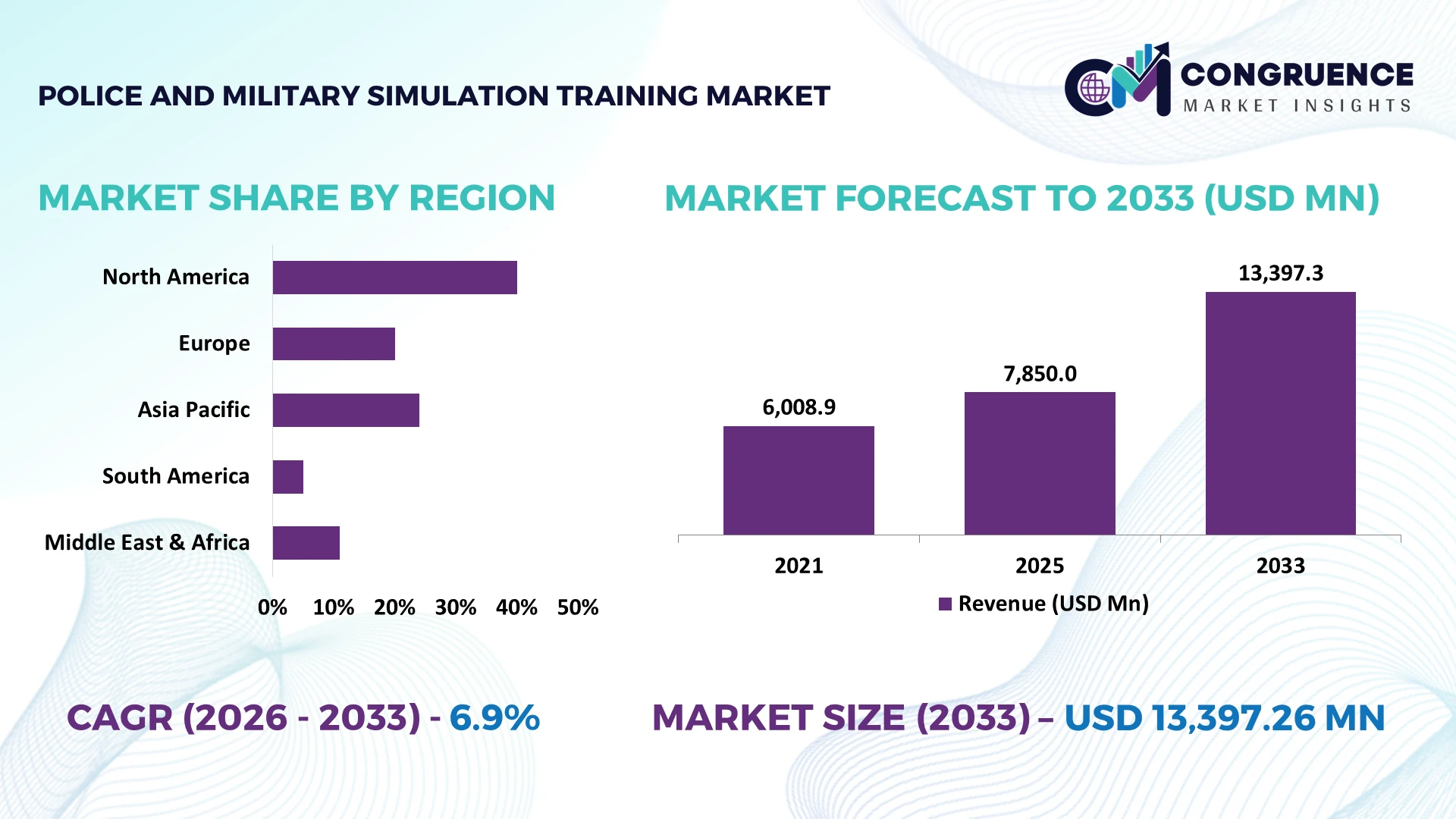
The United States holds the dominant position with approximately 35% market share, supported by defense modernization, advanced military training infrastructure, and high adoption of AI-enabled simulation technologies. Europe accounts for nearly 27%, while Asia Pacific is expanding rapidly through India, China, Japan, and South Korea. U.S. defense organizations allocate more than 60% of advanced simulation capacity to digitally enabled training, compared with about 40% across emerging markets. NATO readiness initiatives and battlefield lessons from the Russia-Ukraine war are accelerating procurement of interoperable training platforms.
Strategically, suppliers offering AI-driven, interoperable, cyber-secure, and rapidly configurable simulation systems are positioned to capture the strongest procurement opportunities.
Market Size & Growth: USD 7,850M in 2025 to USD 13,397.26M by 2033 at 6.91% CAGR, driven by AI-enabled simulation.
Top Growth Drivers: AI adoption 24%; drone training 21%; immersive technologies 18%.
Short-Term Forecast: By 2028, automated scenario generation reduces preparation costs 12% and improves training efficiency 15%.
Emerging Technologies: AI, VR/AR, digital twins, haptics, and LVC architectures are reshaping advanced simulation.
Regional Leaders: North America USD 5.2B; Europe USD 3.6B; Asia Pacific USD 3.0B, with immersive adoption accelerating.
Consumer/End-User Trends: Over 60% of advanced military programs increasingly integrate virtual or synthetic training.
Pilot/Case Example: 2026 drone-focused programs demonstrate approximately 15% faster tactical scenario preparation through reusable digital environments.
Competitive Landscape: CAE leads with approximately 18% share, followed by L3Harris, Lockheed Martin, RTX, Thales, and Rheinmetall.
Regulatory & ESG Impact: Synthetic exercises reduce live-resource consumption by approximately 12%, strengthening safety and ESG compliance.
Investment & Funding: More than USD 10B is directed toward defense digitalization, AI, autonomy, and simulation infrastructure.
Innovation & Future Outlook: AI-generated missions, digital twins, adaptive haptics, and autonomous adversaries are shifting competition toward real-time readiness platforms.
Police and military simulation training is increasingly centered on AI-generated scenarios, mixed-reality mission rehearsal, biometric performance analytics, and cloud-enabled LVC environments. AI-enabled capabilities now represent an estimated 25%–30% of advanced simulation deployments, while drone and counter-drone modules are expanding rapidly following operational lessons from the Russia-Ukraine conflict. In 2026, interoperability, cybersecurity, rapid scenario updates, and supply-chain resilience are becoming decisive procurement criteria, strengthening the strategic value of scalable simulation ecosystems.
Police and military simulation training is becoming strategically important as defense organizations prioritize readiness without proportionally increasing live-exercise costs, while police agencies require repeatable training for complex urban, cyber, and counter-terrorism scenarios. AI-driven synthetic environments are shifting simulation from fixed-courseware systems toward continuously updated mission rehearsal, strengthening procurement value and technology differentiation.
A major market shift is the restructuring of defense training infrastructure around interoperable live-virtual-constructive architectures. Modern digital environments can reduce scenario preparation time by approximately 30% versus manually configured legacy systems, while reusable virtual environments can lower selected exercise-resource requirements by 15%–20%. The United States is advancing high-scale AI and LVC deployment, whereas India is emphasizing indigenous simulation capabilities and localized defense technology integration.
Over the next 2–3 years, AI-generated adversaries, digital twins, extended reality, and cloud-based training platforms are expected to increase automated scenario deployment by 20%–25%. Companies are responding through technology partnerships, localized development, and acquisitions focused on AI, immersive interfaces, and secure simulation networks. Competitive advantage will increasingly depend on interoperability, rapid content refresh, and measurable readiness outcomes rather than hardware scale alone.
AI-enabled scenario generation is accelerating adoption as training organizations seek higher repetition without expanding physical infrastructure. Automated scenario creation can reduce preparation workloads by approximately 25%–30%, while adaptive virtual opponents improve training variability by 20%–25%. In the United States, defense modernization is increasing integration of AI, autonomous systems, and synthetic environments into mission rehearsal. Companies are responding through AI partnerships, simulation-software investment, and modular platform development. A non-obvious advantage is continuous scenario refresh: operators can incorporate emerging drone, electronic-warfare, and urban-combat tactics without rebuilding physical training environments. This shifts simulation from periodic instruction toward continuously updated operational readiness infrastructure.
Interoperability remains a structural restraint because simulation platforms frequently combine legacy radios, weapons databases, visual systems, sensors, and proprietary software. Integration requirements can increase deployment costs by 15%–25%, while customized interfaces can extend implementation timelines by 10%–20%. India and several European procurement programs face additional localization and certification requirements when integrating imported simulation components with domestic systems. Companies are reducing exposure through open architectures, modular middleware, multi-year support contracts, and localized component sourcing. The sharper constraint is not simulator availability but fragmented data architecture; suppliers unable to integrate heterogeneous systems face higher engineering costs and weaker positioning in large multi-platform procurement programs.
Synthetic environments offer an underpenetrated opportunity in high-frequency police and military training, particularly for drone operations, cyber incidents, border surveillance, and urban response. AI-generated scenarios can increase scenario diversity by 30%–40%, while cloud-based content delivery can reduce selected deployment workloads by 20%–25%. India’s expanding indigenous defense-technology ecosystem creates opportunities for localized simulation software, while the United States provides a larger market for advanced AI and LVC integration. Companies are increasing R&D spending, forming defense-technology partnerships, and developing reusable digital-twin libraries. A distinctive opportunity lies in simulation-as-a-service, enabling smaller police departments to access sophisticated training capabilities without funding full physical simulation infrastructure.
Connected simulation ecosystems introduce cybersecurity and integration pressures as training platforms increasingly exchange sensitive operational data across networks. Cybersecurity controls can account for 10%–15% of complex system-development requirements, while interoperability testing can consume 15%–20% of deployment effort. U.S. defense programs face stringent secure-network requirements, whereas emerging-market operators often manage uneven digital infrastructure and technical workforce availability. Companies must strengthen zero-trust architectures, encrypted data environments, automated testing, and specialized simulation engineering teams. The long-term competitive challenge is maintaining realistic training while protecting synthetic operational data; platforms that cannot securely connect AI, sensors, command systems, and immersive interfaces risk fragmented deployment and lower customer retention.
AI Scenario Generation Accelerates: AI-assisted scenario development is reducing manual preparation time by 20%–30%, while adaptive virtual adversaries increase scenario variation by nearly 25%. U.S. defense training programs are shifting toward automated content generation, prompting vendors to expand AI partnerships and reusable scenario libraries.
LVC Networks Expand: Live-virtual-constructive integration is increasing distributed exercise participation by 15%–20% as training organizations connect personnel, platforms, and synthetic assets. U.S. Army modernization is accelerating interoperable architectures, encouraging companies to prioritize open standards, middleware, and multi-platform connectivity over standalone systems.
Immersive Police Training Scales: VR and mixed-reality deployment is improving scenario repetition by approximately 20%–25% while reducing physical setup requirements. U.S. law-enforcement agencies are expanding de-escalation, firearms, and emergency-response modules, pushing vendors toward modular content, analytics, and multi-user training platforms.
Digital Twins Reshape Rehearsal: Geospatial digital twins can reduce environment-configuration workloads by 20%–30%, enabling geographically specific mission rehearsal. UK defense modernization and growing synthetic-training requirements are accelerating investment in secure cloud environments, geospatial datasets, and reusable digital assets, creating a shift from fixed facilities toward continuously configurable training ecosystems.
Virtual Simulation leads the Police and Military Simulation Training Market with an estimated 38% share, supported by scalable deployment, repeatable scenarios, lower physical infrastructure requirements, and easier integration with centralized training networks. Its operating model can reduce selected training-resource requirements by approximately 15%–20% compared with equipment-intensive Live Simulation. Live Simulation remains essential for physical coordination, equipment handling, and high-fidelity field validation, while Constructive Simulation supports command-level exercises, force modeling, and large-scale operational planning with lower resource intensity.
Mixed Reality Simulation represents the fastest-growing type, with adoption increasing approximately 20%–25% as spatial computing, head-mounted displays, haptics, and sensor fusion mature. Companies are shifting investment toward hybrid platforms that combine physical equipment with digital scenarios. Constructive Simulation retains strategic value for complex command environments, while Live Simulation remains critical for validating real-world procedures. This mix is directing procurement toward interoperable platforms rather than isolated simulator products.
Combat Training accounts for an estimated 42% share of Police and Military Simulation Training Market demand, reflecting the complexity of multi-domain operations, mission command, weapons coordination, and adversary replication. Tactical Training follows at approximately 27%, supported by repeated scenario execution and increasing use of virtual environments. Combat applications benefit from simulation’s ability to replicate high-risk conditions without repeatedly committing personnel and equipment to live exercises. Companies are therefore expanding multi-user architectures, battlefield visualization, and automated scenario controls.
Emergency Response Training is the fastest-growing application, with adoption rising approximately 18%–22% as police and military organizations strengthen preparedness for terrorism, mass-casualty events, public disorder, and complex urban incidents. Firearms Training remains a mature application, increasingly enhanced by performance analytics and immersive feedback. Companies are integrating several training workflows into shared platforms, improving infrastructure utilization by approximately 15%–20% and strengthening demand for configurable scenario libraries.
Military organizations represent approximately 55% of Police and Military Simulation Training Market demand because of large-scale procurement programs, extensive training infrastructure, and continuous requirements for individual, crew, command, and multi-domain readiness. Defense Training Centers account for approximately 20%, supported by standardized instruction and high simulator utilization. Military buyers increasingly prioritize interoperable architectures, while companies are responding with modular platforms, customized content, and long-term technology-support agreements. Approximately 60% of advanced military training programs now incorporate some form of virtual or synthetic component, strengthening demand for connected ecosystems.
Law Enforcement is the fastest-growing end-user segment, with adoption expanding approximately 18%–23% as agencies increase VR-based firearms, de-escalation, emergency-response, and decision-making training. Border Security is also gaining importance as agencies seek repeatable surveillance and incident-response scenarios. Companies are targeting these users through modular pricing, localized content, and partnerships that reduce infrastructure requirements by approximately 15%–20%. The competitive shift favors flexible platforms that serve multiple operational roles rather than single-purpose systems.
North America accounted for the largest market share at 35% in 2025 however, Asia-Pacific is expected to register the fastest growth, expanding at a CAGR of 8.2% between 2026 and 2033.
AI-led modernization is shifting procurement toward interoperable synthetic training
North America remains the primary deployment center for advanced police and military simulation training, supported by extensive defense infrastructure, large-scale procurement, and established simulation developers. The United States contributes the majority of regional demand, with military organizations increasingly connecting live, virtual, and constructive environments. AI-enabled scenario generation, digital twins, and extended-reality systems are moving beyond pilot programs into recurring training workflows. Defense agencies are also prioritizing secure cloud architectures and interoperable platforms capable of supporting joint exercises. Approximately 60% of advanced U.S. military training programs incorporate virtual or synthetic elements, strengthening recurring software and content demand. Companies are responding through defense contracts, technology partnerships, acquisitions, and expanded AI development, while police departments increasingly adopt immersive systems for firearms, tactical, and emergency-response training.
United States Market Outlook: The United States remains the strongest national market because of its defense technology ecosystem, extensive simulation infrastructure, and high training expenditure. The country operates large distributed training networks and continues integrating AI, autonomous systems, digital twins, and synthetic environments. More than 60% adoption across advanced training programs supports recurring demand for software, simulation content, interoperability solutions, and platform modernization.
NATO readiness is accelerating interoperable synthetic training infrastructure
Europe is shifting from fragmented national simulation systems toward interoperable training architectures driven by NATO readiness requirements, defense modernization, and cross-border exercises. Germany, the United Kingdom, France, and Poland represent important deployment centers, with demand concentrated around combat readiness, mission rehearsal, and multi-domain command training. NATO interoperability requirements are increasing the importance of common data standards, secure connectivity, and reusable simulation environments. Digital and virtual training can reduce selected physical exercise-resource requirements by approximately 15%–20%, supporting procurement efficiency alongside operational readiness. European suppliers are strengthening partnerships and localized production to address sovereignty requirements and reduce dependence on non-European technology. Sustainability considerations are also increasing interest in synthetic exercises that reduce fuel use, equipment wear, and live-range requirements while maintaining training frequency.
Germany Market Outlook: Germany combines a substantial defense industrial base with growing requirements for digitally connected training infrastructure. Modernization of military readiness programs is increasing demand for virtual mission rehearsal, command simulation, and interoperable training platforms. German suppliers are emphasizing secure architecture, localization, and integration with European defense ecosystems, while procurement priorities increasingly favor scalable systems that support multinational exercises and standardized training environments.
Defense modernization and indigenous technology are reshaping deployment scale
Asia-Pacific is becoming a major expansion zone as China, India, Japan, South Korea, and Australia modernize military training infrastructure and increase adoption of advanced simulation technologies. India is strengthening domestic defense technology capabilities, while Japan and South Korea emphasize high-fidelity digital training for technologically intensive operations. China maintains significant domestic simulation development capacity and large-scale military training requirements. Adoption of VR, AI-enabled scenario generation, and LVC platforms is increasing by an estimated 20%–25% across advanced programs. Companies are responding through localized manufacturing, technology partnerships, joint development, and domestic content strategies. The non-obvious advantage is the region’s ability to combine growing defense demand with expanding electronics, software, display, and sensor manufacturing capabilities, supporting shorter technology supply chains and faster system customization.
India Market Outlook: India is emerging as a strategically important market through indigenous defense manufacturing, military modernization, and expansion of domestic simulation capabilities. Defense technology programs increasingly emphasize locally developed software, immersive training, and secure digital infrastructure. Simulation adoption is expanding across combat, tactical, and emergency-response applications, creating opportunities for domestic technology firms and international companies forming local partnerships, technology-transfer arrangements, and customized training ecosystems.
Urban security requirements are widening demand for modular simulation
South America presents a more cost-sensitive simulation environment, with Brazil representing the principal demand center because of its military scale, police training requirements, and established defense technology base. Brazil and neighboring countries are increasing interest in virtual firearms, tactical response, emergency management, and command training as agencies seek repeatable instruction without excessive live-exercise costs. Virtual systems can reduce selected physical training requirements by approximately 15%–20%, making modular platforms more attractive where infrastructure budgets remain constrained. Companies are adapting through lower-footprint systems, localized support, software-based upgrades, and partnerships with training institutions. Infrastructure unevenness remains important, particularly outside major urban centers, so suppliers offering portable systems and centralized content management gain an operational advantage. Demand is therefore shifting toward affordable platforms capable of serving several training functions.
Brazil Market Outlook: Brazil offers the strongest commercial base in South America because of its large security workforce, military institutions, and domestic aerospace and defense capabilities. Procurement increasingly favors simulation solutions that support firearms, tactical, and emergency-response training without requiring extensive physical infrastructure. Local integration partnerships and adaptable software platforms are strengthening supplier access, while modular deployment models improve feasibility for geographically dispersed training organizations.
Defense investment is accelerating high-fidelity digital readiness
The Middle East & Africa market is increasingly shaped by defense modernization, advanced security infrastructure, and investment in technologically intensive training facilities. Saudi Arabia, the United Arab Emirates, Israel, and selected Gulf states are prioritizing high-fidelity simulation for air, land, border-security, and emergency-response operations. Gulf procurement programs increasingly incorporate VR, AI, digital twins, and networked command training, with advanced simulation deployment rising approximately 18%–22% in targeted programs. Suppliers are establishing local partnerships, regional service centers, and technology-transfer arrangements to meet localization requirements. In Africa, demand remains more price-sensitive, favoring modular and scalable systems. The strongest opportunity is concentrated in well-funded security programs where simulation supports frequent training while reducing equipment wear, fuel consumption, and live-range utilization.
Saudi Arabia Market Outlook: Saudi Arabia is a leading Middle Eastern market because of defense modernization, localization initiatives, and investment in advanced training infrastructure. Simulation procurement increasingly supports military readiness, border security, and emergency-response capabilities. Local-content requirements are encouraging international suppliers to establish partnerships and regional support capabilities, while AI-enabled and immersive systems provide higher training repetition without proportional expansion of physical facilities.
CAE, L3Harris Technologies, Lockheed Martin, RTX, and Thales compete primarily through integrated simulation platforms, defense relationships, and advanced training technologies, while Rheinmetall and specialized regional suppliers compete through customization and localized delivery. The top five players collectively command an estimated 45%–50% of the market, indicating a concentrated technology-led structure. Competition centers on platform interoperability, scenario realism, deployment speed, lifecycle economics, and customization. AI-enabled scenario generation can reduce content-preparation workloads by 20%–30%, while modular architectures can lower selected deployment requirements by 15%–20%. Leading companies are expanding through defense contracts, software partnerships, acquisitions, localized production, and vertical integration of hardware, content, and analytics. The competitive shift is moving from simulator hardware toward AI, secure networking, digital twins, and recurring software capabilities. High certification requirements, defense procurement relationships, cybersecurity compliance, and integration expertise remain significant entry barriers. Winning suppliers combine technology depth, interoperability, rapid customization, secure supply chains, and long-term customer support.
CAE Inc.
L3Harris Technologies, Inc.
Lockheed Martin Corporation
RTX Corporation
Thales Group
Rheinmetall AG
Saab AB
BAE Systems plc
Boeing Defense, Space & Security
Cubic Corporation
Elbit Systems Ltd.
VirTra, Inc.
Kongsberg Defence & Aerospace
Bohemia Interactive Simulations
Current Police and Military Simulation Training increasingly relies on virtual reality, live-virtual-constructive (LVC) integration, digital twins, and high-fidelity visualization. AI-assisted scenario generation can cut scenario-authoring workloads by 20%, while automated after-action analytics can improve assessment speed by 15%. Adoption is strongest in advanced defense programs, where synthetic environments increasingly support recurring mission rehearsal and multi-echelon exercises.
Emerging capabilities include mixed-reality haptics, AI-driven computer-generated forces, cloud simulation, and interoperable terrain databases. Haptic interfaces can improve weapon-handling realism by 10%–15%, while cloud-based deployment can reduce selected infrastructure requirements by 12%. Compared with legacy fixed simulators, modular mixed-reality systems can improve scenario reconfiguration speed by approximately 25%, giving suppliers with open architectures and reusable software libraries a competitive advantage.
From 2026–2028, adoption will shift toward adaptive training ecosystems connecting personnel, sensors, command systems, and synthetic environments. Digital twins and AI-generated adversaries will increase scenario diversity by 20%–30%, while edge computing supports lower-latency distributed exercises. Companies investing now in interoperability, cybersecurity, and data-driven performance analytics will gain stronger procurement positioning, faster deployment cycles, and recurring software opportunities as simulation becomes core readiness infrastructure. This transition also reduces dependence on live-range availability, equipment wear, travel, and instructor-intensive setup, improving training continuity during constrained operational schedules.
October 2025 VirTra validated 20 training simulators for full Royal Canadian Mounted Police deployment after field testing in Regina. The milestone completed certification, enabling Canadian adoption and strengthening VirTra’s law-enforcement expansion pipeline through validated deployment evidence and commercial confidence. Source: VirTra
March 2024 U.S. Army tested its Synthetic Training Environment at Fort Cavazos using immersive virtual systems for Abrams, Stryker, and Bradley crews. The deployment demonstrated indoor collective training and after-action review, reducing dependence on field-only exercises while expanding capacity. Source: Army
August 2026 Skyral won a £2 billion UK Ministry of Defence training contract for detailed digital environments modeling real cities, infrastructure, and populations. The award marks a major shift toward digital twins for consequence-based military decision training and distributed rehearsal. Source: The Guardian
May 2025 Rheinmetall and Singapore’s DSTA signed an MoU covering simulation and training digitalisation, including AI, cloud, and extended reality. The partnership combines technology experimentation with talent development, strengthening Singapore’s advanced training ecosystem and Rheinmetall’s Asia-Pacific positioning. Source: Rheinmetall
The Police and Military Simulation Training Market Report covers Live Simulation, Virtual Simulation, Constructive Simulation, and Mixed Reality Simulation across Combat Training, Tactical Training, Firearms Training, and Emergency Response Training. End-user coverage includes Military, Law Enforcement, Border Security, and Defense Training Centers, with analysis of AI, VR/AR, LVC architectures, digital twins, haptics, cloud simulation, and automated scenario-generation technologies.
Geographic coverage spans North America, Europe, Asia-Pacific, South America, and Middle East & Africa, with country-level assessment of deployment concentration, infrastructure readiness, technology adoption, and procurement priorities. The report evaluates established and emerging simulation applications, including distributed training and AI-enabled mission rehearsal, helping companies assess approximately 15%–30% efficiency opportunities, identify technology investment priorities, optimize expansion plans, strengthen competitive positioning, and anticipate operational shifts shaping market direction between 2026 and 2033.
| Report Attribute/Metric | Report Details |
|---|---|
Market Revenue in 2025 | USD 7850 Million |
Market Revenue in 2033 | USD 13397.26 Million |
CAGR (2026 - 2033) | 6.91% |
Base Year | 2025 |
Forecast Period | 2026 - 2033 |
Historic Period | 2021 - 2025 |
Segments Covered | By Type
By Application
By End-User
|
Key Report Deliverable | Revenue Forecast, Growth Trends, Market Dynamics, Segmental Overview, Regional and Country-wise Analysis, Competition Landscape |
Region Covered | North America, Europe, Asia-Pacific, South America, Middle East, Africa |
Key Players Analyzed | CAE Inc., L3Harris Technologies, Inc., Lockheed Martin Corporation, RTX Corporation, Thales Group, Rheinmetall AG, Saab AB, BAE Systems plc, Boeing Defense, Space & Security, Cubic Corporation, Elbit Systems Ltd., VirTra, Inc., Kongsberg Defence & Aerospace, Bohemia Interactive Simulations |
Customization & Pricing | Available on Request (10% Customization is Free) |




