
Reports
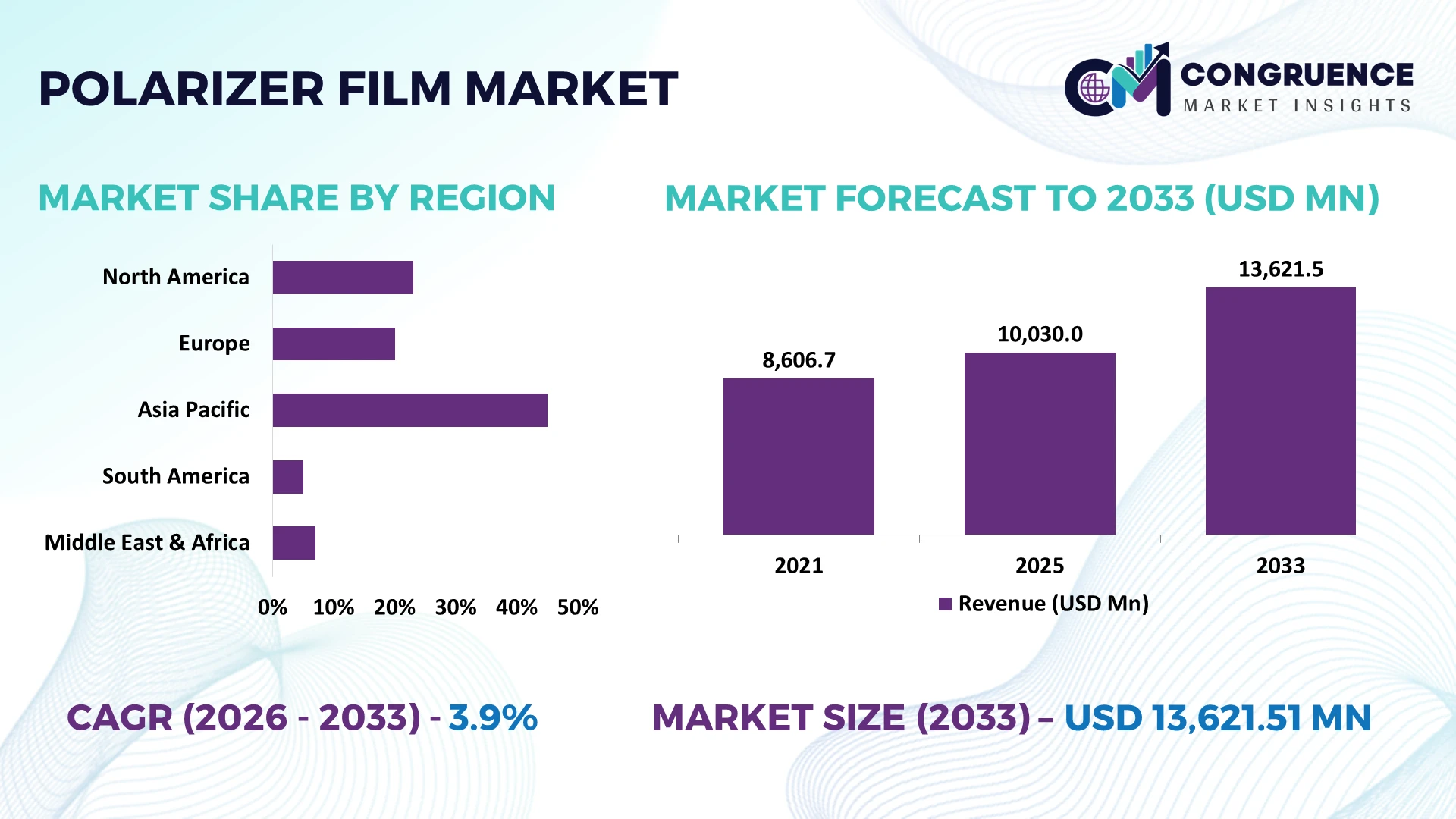
The Global Polarizer Film Market was valued at USD 10030 Million in 2025 and is anticipated to reach a value of USD 13621.51 Million by 2033 expanding at a CAGR of 3.9% between 2026 and 2033. Growth is driven by larger-format LCD televisions, OLED penetration, automotive displays, ultrawide polarizer coating lines, and panel makers’ shift toward localized optical-film supply.
China dominates the global polarizer film market, accounting for about 65% of production capacity in 2024 and moving toward nearly 80% by 2027, supported by Shanjin, HMO, Sunnypol, BOE-linked demand, and more than 70% of global display panel production occurring in China in 2025. By comparison, Japan held a materially smaller manufacturing position but retained strength in high-performance OLED and specialty automotive films. China’s acquisition-led localization, including Korean and Japanese asset transfers, has also become a strategic supply-chain issue amid broader East Asian technology competition.
The strategic implication is clear: suppliers with Chinese scale plus differentiated OLED, automotive, and ultrawide-film capability will hold the strongest negotiating position with global panel manufacturers.
Market Size & Growth: USD 10.03 billion in 2025 is projected to reach USD 13.62 billion by 2033 at 3.9%, driven by larger television panels, OLED migration, and localized display supply chains.
Top Growth Drivers: China controls about 65% of capacity, large-display demand expands roughly 4% by area, and ultrawide-line capacity has increased about 18% over recent deployment cycles.
Short-Term Forecast: By 2027, China’s share of global polarizer production capacity approaches 80%, increasing sourcing concentration and forcing panel makers to diversify qualified sub-film suppliers.
Emerging Technologies: OLED polarizers, ultra-thin retardation films, 2.3-meter-plus coating lines, and low-reflection automotive films are improving optical efficiency, dimensional stability, and large-panel material utilization.
Regional Leaders: Asia-Pacific exceeds USD 7 billion in projected scale, Europe approaches USD 2 billion, and North America exceeds USD 1.5 billion as automotive, OLED, and premium-display adoption strengthens.
Consumer/End-User Trends: Larger television formats are increasing polarizer area consumption, with global demand rising from about 594 million square meters in 2024 toward 682 million square meters by 2027.
Pilot/Case Example: Wide-line adoption allows 2.5-meter film to efficiently serve 65-inch, 75-inch, and 43-inch panels, reducing edge waste and improving cutting utilization versus narrower production formats.
Competitive Landscape: Nitto Denko holds roughly 11% share, while Nitto, HMO, Shanjin, Sumitomo Chemical, and BenQ Materials collectively represent about 48% of the competitive market.
Regulatory & ESG Impact: Wider film formats can reduce trim loss by double-digit percentages, while recycled-content and solvent-reduction initiatives increasingly influence procurement among major display-material customers.
Investment & Funding: Toyobo planned about ¥80 billion of film-related capital and R&D investment through FY2026, with roughly 80% directed toward growth initiatives including high-performance optical-film capacity.
Innovation & Future Outlook: Chinese producers are moving toward nearly 80% capacity control by 2027, while Japanese and Korean suppliers shift toward OLED, automotive, ultra-thin, and high-durability polarizers to protect margins.
The global Polarizer Film Market is increasingly shaped by large-format LCD televisions, OLED smartphones, notebooks, monitors, vehicle displays, and industrial screens requiring tighter optical uniformity and thinner film stacks. China already controls about 65% of production capacity, while wide-width coating and ultra-thin OLED polarizer technologies are improving material utilization and display integration. Ongoing supply-chain localization across China, Japan, South Korea, and Taiwan is simultaneously increasing concentration risk and encouraging panel manufacturers to qualify alternative specialty-film suppliers, setting up a more technology-driven strategic environment.
Polarizer film is becoming strategically important because display-panel leadership is increasingly tied to control of optical-film capacity, ultrawide coating technology, and upstream sub-film supply. China already controls about 65% of global polarizer capacity and more than 70% of display-panel production, pushing the industry toward localized sourcing. At the same time, Japanese and Korean suppliers are restructuring legacy capacity and concentrating on premium OLED and automotive-grade applications.
Technology is also changing the competitive equation. Ultrawide 2,500 mm production lines improve material utilization on 65-inch, 75-inch, and higher-generation panels versus narrower legacy lines, reducing trim loss and increasing throughput. Polarizer-less OLED architectures remove a layer that can absorb roughly 50% of emitted brightness, creating major efficiency advantages, although reflectivity and process complexity remain barriers. China leads scale, while Japan and South Korea retain stronger positioning in differentiated optical materials.
Between 2026 and 2028, supply-chain consolidation, OLED redesign, and advanced automotive displays will redirect investment toward specialty films and wider coating assets. DNP’s 2,500 mm optical-film line illustrates this shift toward generation-matched production. Companies are prioritizing asset transfers, ultrawide capacity, and high-value product development. Competitive advantage will depend on upstream material security, yield efficiency, and differentiated optical performance.
China’s concentration of display-panel manufacturing is the strongest structural driver of polarizer film demand. More than 70% of global display panels are produced in China, while domestic polarizer capacity has reached about 65% of worldwide output and LCD-TV polarizer localization exceeds 90%. This proximity reduces lead times, inventory exposure, and qualification complexity for BOE, TCL CSOT, and other panel makers. The shift toward larger 65-inch, 75-inch, and 85-inch televisions further increases polarizer consumption by surface area rather than unit volume. Chinese manufacturers are responding with 2,000–2,500 mm ultrawide lines and upstream material partnerships. The operational implication is significant: suppliers positioned near high-generation fabs gain better line utilization and lower logistics costs, while offshore producers must compete through specialty performance rather than scale.
Polarizer manufacturing is highly localized in China, but upstream raw-material security remains structurally weaker. Mainland China accounts for roughly 71% of global polarizer capacity, yet domestic capacity for key upstream polarizer materials remains near 17%, with actual supply contribution below 10% for several critical sub-films. This imbalance exposes producers to imported PVA, TAC alternatives, retardation films, and specialty coatings. Oil-price volatility and geopolitical supply disruptions directly affect resin, solvent, and optical-film costs, while intense panel-maker pricing pressure limits pass-through. Producers are responding by qualifying domestic substrates, diversifying Japanese and Taiwanese suppliers, and integrating film-conversion operations. The sharp strategic issue is not finished-film capacity but upstream dependency: manufacturers with secure sub-film contracts and localized chemistry gain superior cost stability during supply disruptions.
Polarizer-less OLED technology creates a high-value opportunity by addressing the efficiency penalty of conventional circular polarizers. Traditional OLED polarizers can absorb around 50% of emitted brightness, while color-filter-on-encapsulation and related architectures improve light transmission and enable thinner display stacks. Shipments of polarizer-less OLED displays are moving from premium foldables toward broader smartphone and IT applications, while automotive OLED adoption adds another specialty-film pathway. Suppliers can reposition from conventional polarizer volume toward retardation films, optical compensation layers, low-reflection coatings, and encapsulation-compatible materials. Japanese and Korean manufacturers are increasing R&D around OLED and automotive grades, while Chinese producers scale complementary materials. The non-obvious opportunity lies in component substitution: even when conventional polarizer content declines, suppliers with adjacent optical-film portfolios can capture greater value per display.
The market faces a dual execution challenge: rapid capacity additions and simultaneous reduction of polarizer content in advanced OLED architectures. Chinese manufacturers accounted for about 65% of global production capacity in 2024 and are positioned to approach 80% by 2027, while delayed factories restarting from late 2026 risk restoring oversupply. At the same time, polarizer-less OLED adoption threatens demand in premium mobile displays, forcing producers to balance legacy LCD assets against next-generation optical-film investment. Early-2025 shortages also showed that aggregate capacity does not guarantee reliable supply when acquisitions disrupt sub-film procurement. Companies must rationalize older lines, improve utilization, secure upstream inputs, and develop OLED-compatible products. Long-term competitiveness therefore depends on avoiding stranded capacity while shifting engineering resources toward applications where optical complexity, not production volume, determines supplier value.
Chinese Capacity Consolidation Accelerates: Chinese manufacturers controlled about 65% of global polarizer capacity in 2024 and are positioned near 80% by 2027, while China already produces more than 70% of display panels. Acquisitions and local supply-chain integration are concentrating procurement around domestic suppliers. Producers are adding wide-width lines, absorbing upstream assets, and tightening panel-maker partnerships to improve utilization and shorten qualification cycles.
Automotive Display Area Expands Rapidly: Total automotive center-display area increased 19% in 2025 as 10–15-inch displays reached 60% of installations, up from 54% in 2024. Chinese automakers are leading adoption of displays above 20 inches. Polarizer suppliers are qualifying higher-durability, low-reflection, temperature-resistant products while expanding automotive-grade coating capability to capture higher material consumption per vehicle.
Premium OLED Requirements Reshape Portfolios: OLED represented about 57% of smartphone panel shipments in 2025 but less than 2% of automotive center-display area, creating sharply different polarizer requirements by application. Suppliers are separating high-volume LCD portfolios from thinner OLED and specialty optical films. Japanese and Korean producers are concentrating investment on premium OLED, retardation, and automotive products rather than competing solely on commodity film capacity.
Supply Disruption Changes Procurement Models: Despite adequate global nameplate capacity, several panel manufacturers experienced polarizer shortages in early 2025 after acquisitions disrupted access to critical sub-films. China’s capacity concentration is therefore pushing buyers toward dual sourcing and tighter inventory controls. Suppliers are vertically integrating PVA, TAC-alternative, coating, and converting operations, making upstream material ownership increasingly as important as finished polarizer capacity.
TAC Polarizers account for approximately 42–46% of type demand, supported by mature integration with TFT-LCD manufacturing, dimensional stability, optical clarity, and established high-volume coating infrastructure. Their position remains strongest in television, monitor, notebook, and mainstream automotive LCD production. PVA Polarizers remain essential as the functional light-polarizing layer across display architectures, while their commercial relevance is tied closely to protective-film combinations. Mature TAC-PVA structures continue benefiting from high manufacturing yields and extensive qualification across Chinese panel fabs.
COP Polarizers are the fastest-growing type as thinner OLED, flexible displays, and automotive applications demand improved moisture resistance, dimensional stability, and low birefringence. Coated Polarizers are also gaining importance where anti-glare, hard-coat, low-reflection, or compensation functions are integrated into fewer layers. Reflective Polarizers serve more specialized brightness-enhancement applications. With China controlling roughly 65% of overall polarizer capacity and ultrawide lines increasingly exceeding 2,000 mm, producers are shifting investment toward differentiated COP and coated architectures while retaining TAC capacity for cost-efficient LCD volume.
LCD Displays represent approximately 55–60% of polarizer film application demand because every transmissive LCD requires front and rear polarization layers, creating substantially greater film-area consumption than many competing architectures. Television Displays remain the largest individual area-consuming application within LCDs as migration toward 65-inch, 75-inch, and larger formats increases polarizer usage even when television unit shipments remain relatively stable. Mobile Displays remain significant, although OLED penetration is reducing conventional polarizer intensity in selected premium smartphones.
Automotive Displays are the fastest-growing application by material area as cockpit digitalization increases screen count and dimensions. Total automotive center-display area expanded 19% in 2025, while 10–15-inch screens reached 60% of installations. OLED Displays require increasingly specialized ultra-thin and compensation structures, with polarizer-free designs creating substitution pressure at the premium end. Suppliers are therefore expanding automotive-grade durability testing, ultrawide LCD production, and thin optical-stack engineering rather than pursuing uniform capacity growth across applications.
Display Manufacturers account for approximately 40–45% of polarizer film procurement because panel fabs integrate polarizers directly into LCD and OLED module production and require tightly specified optical uniformity, thickness, compensation, and adhesion performance. China’s more than 70% share of global panel production concentrates purchasing power among BOE, TCL CSOT, Tianma, and other major manufacturers. Television Manufacturers remain substantial indirect consumers because large-screen migration increases square-meter demand, while Consumer Electronics companies influence specification through brightness, thickness, and power-efficiency targets.
Automotive OEMs are the fastest-growing end-user group as cockpit displays become larger and more numerous. China-based panel manufacturers are expected to capture about 65% of global automotive display shipments during the second half of 2026, strengthening local sourcing of automotive-grade polarizers. Mobile Device Manufacturers increasingly require ultra-thin, low-reflection, and OLED-compatible structures rather than standard LCD films. Suppliers are responding with direct qualification programs, application-specific coatings, long-term panel partnerships, and premium product portfolios designed around automotive reliability and advanced mobile form factors.
Asia-Pacific accounted for the largest market share at 72.4% in 2025 however, Middle East & Africa is expected to register the fastest growth, expanding at a CAGR of 5.2% between 2026 and 2033.

Premium Displays Shift Demand Toward Specialization
North America accounted for approximately 10.8% of global polarizer film demand in 2025, driven primarily by premium consumer electronics, automotive displays, professional monitors, aerospace interfaces, and industrial visualization systems. The region imports substantial finished polarizer supply from East Asia because domestic high-volume LCD panel manufacturing remains limited. U.S. demand is consequently specification-led rather than production-led, favoring high-transmittance, anti-reflective, temperature-resistant, and OLED-compatible optical films. Automotive digitalization is particularly important as 10–15-inch center displays represented about 60% of global installations in 2025. Apple’s migration toward OLED across additional devices is also tightening optical performance requirements. Suppliers are responding through qualification partnerships, customized film stacks, localized converting operations, and inventory positioning rather than constructing commodity-scale coating capacity, giving technically differentiated manufacturers greater leverage over volume-focused suppliers.
United States Market Outlook: The United States represents the region’s strongest demand center through its concentration of consumer-device brands, automotive engineering, professional-display applications, and technology procurement. OLED penetration exceeded 50% of global smartphone panel shipments during 2025, increasing U.S. brand requirements for thinner optical stacks and high-performance compensation materials. Suppliers increasingly compete through application engineering, rapid qualification, and customized optical characteristics rather than domestic mass-production scale.
Automotive Cockpits Reshape Optical Requirements
Europe represented approximately 9.1% of global polarizer film demand in 2025, with Germany, France, Italy, and the United Kingdom supporting consumption through automotive displays, premium televisions, industrial controls, medical equipment, and professional visualization. Automotive applications provide the strongest structural differentiation because European OEMs increasingly deploy panoramic dashboards, digital clusters, head-up displays, and passenger screens requiring low-reflection and temperature-stable optical materials. Automotive center-display area expanded about 19% globally during 2025, increasing film consumption even without equivalent vehicle-production growth. European procurement also emphasizes durability, chemical compliance, and energy-efficient displays, favoring premium polarizer architectures over commodity grades. Suppliers are responding with automotive-qualified coated films, higher heat resistance, reduced-thickness stacks, and closer Tier-1 integration. Europe therefore remains strategically attractive for specialty products despite limited regional polarizer manufacturing compared with East Asia.
Germany Market Outlook: Germany leads European demand because Volkswagen Group, Mercedes-Benz, BMW, automotive Tier-1 suppliers, and industrial-display manufacturers maintain intensive requirements for cockpit visualization. Premium vehicles increasingly incorporate multiple large screens, creating more polarizer area per vehicle. German qualification standards favor optical films engineered for extended temperature ranges, low reflectivity, dimensional stability, and long service life, supporting higher-value supplier positioning.
China Consolidates Manufacturing Scale Advantage
Asia-Pacific accounted for approximately 72.4% of global polarizer film demand in 2025, reflecting its concentration of LCD and OLED panel fabrication, television manufacturing, smartphone assembly, and upstream optical-material production. China alone controls about 65% of global polarizer production capacity and more than 70% of display-panel output, while South Korea, Japan, and Taiwan retain substantial technology positions in OLED and specialty films. Manufacturing concentration enables shorter qualification cycles and lower logistics costs between polarizer lines and high-generation panel fabs. Wide-width production exceeding 2,000 mm is increasingly aligned with 65-inch and larger televisions, improving cutting efficiency. Chinese suppliers are expanding through acquisitions and capacity localization, while Japanese and Korean companies redirect portfolios toward OLED, automotive, retardation, and high-durability products. The region’s advantage increasingly combines production scale with upstream optical-material integration.
China Market Outlook: China is the decisive global production hub, with domestic manufacturers positioned to approach 80% of worldwide polarizer capacity by 2027. Companies including Shanjin Optoelectronics, HMO and Sunnypol are expanding alongside BOE and TCL CSOT’s panel ecosystems. Domestic LCD-TV polarizer localization already exceeds 90%, shifting competitive pressure toward upstream PVA, protective films, compensation materials, and advanced OLED-compatible products.
Device Assembly Sustains Import-Led Demand
South America accounted for approximately 3.2% of global polarizer film demand in 2025, with consumption concentrated in Brazil’s television, monitor, smartphone, automotive electronics, and appliance manufacturing ecosystem. The region has limited upstream optical-film and display-panel capacity, making converters and electronics assemblers dependent on Asian material and module imports. Brazil’s Manaus Free Trade Zone remains the principal electronics manufacturing cluster, supporting large-scale television and consumer-device assembly. More than 90% of Brazilian households have televisions, sustaining replacement-driven display demand, while increasing vehicle digitalization supports higher-specification polarizers. Currency volatility, import lead times, and limited local coating infrastructure constrain supply-chain flexibility. Manufacturers are therefore prioritizing inventory management, regional converting, supplier diversification, and longer procurement agreements. The strongest opportunity lies in downstream customization and rapid supply rather than capital-intensive upstream polarizer production.
Brazil Market Outlook: Brazil dominates South American consumption through the Manaus electronics cluster and its large consumer-device base. Television penetration above 90% of households creates a substantial installed replacement market, while domestic automotive manufacturing increasingly incorporates digital instrument clusters and larger center displays. Local assemblers benefit from regional converting and inventory operations that reduce dependence on long Asian replenishment cycles without duplicating expensive coating infrastructure.
Digital Infrastructure Expands Display Deployment
Middle East & Africa accounted for approximately 4.5% of global polarizer film demand in 2025, with consumption concentrated in imported televisions, smartphones, automotive displays, digital signage, industrial screens, and commercial visualization systems. Saudi Arabia and the UAE are expanding smart-city infrastructure, retail digitization, transportation displays, and premium automotive adoption, while African demand remains concentrated in consumer electronics and mobile devices. Saudi Arabia’s Vision 2030 projects and the UAE’s digital infrastructure programs are increasing deployment of large-format information displays and interactive interfaces. The region lacks significant polarizer coating and panel fabrication capacity, leaving demand structurally import-dependent. Distributors and manufacturers are responding through regional warehousing, display-module assembly, and partnerships with Asian suppliers. The operational advantage therefore lies in supply responsiveness and application customization rather than upstream manufacturing scale.
Saudi Arabia Market Outlook: Saudi Arabia provides the strongest strategic demand platform through smart-city development, transportation modernization, entertainment infrastructure, and expanding digital retail. NEOM alone covers approximately 26,500 square kilometers and incorporates extensive digitally enabled infrastructure. These projects strengthen requirements for outdoor-readable, heat-resistant, high-contrast displays, creating demand for specialized polarizers capable of maintaining optical performance under high-temperature operating conditions.
Nitto Denko, Sumitomo Chemical, Shanjin Optoelectronics, HMO, and BenQ Materials compete across premium optical performance, manufacturing scale, panel integration, and cost leadership. The top five suppliers control approximately 48% of global polarizer film demand, although Chinese capacity expansion is rapidly changing concentration. Nitto and Sumitomo defend OLED, automotive, and specialty applications through advanced materials, while Shanjin and HMO leverage proximity to Chinese panel fabs and lower conversion costs. Advanced wide-width lines can improve cutting utilization by 10–15%, while thinner optical stacks reduce display thickness by approximately 10% and specialized coatings can improve usable transmittance by 5–10%. Suppliers are expanding ultrawide capacity, acquiring production assets, localizing upstream materials, and establishing panel-maker qualification partnerships. Competition is shifting from finished-film scale toward control of PVA, protective films, compensation layers, and OLED-compatible technologies. High qualification costs and optical-yield requirements restrict entry. Winning requires upstream security, consistent yields, application engineering, and generation-matched coating capacity.
Nitto Denko Corporation
Sumitomo Chemical Co., Ltd.
Shanjin Optoelectronics
Hengmei Optoelectronic Corporation
Sunnypol Optoelectronics
BenQ Materials Corporation
Optimax Technology Corporation
SAPO Corporation
Shenzhen Textile Holdings Co., Ltd.
Polatechno Co., Ltd.
Nippon Kayaku Co., Ltd.
Shinwha Intertek Corporation
MNTech Co., Ltd.
DNP (Dai Nippon Printing Co., Ltd.)
Current polarizer manufacturing centers on high-speed roll-to-roll PVA stretching, iodine dyeing, lamination, and automated optical inspection. Modern inline defect detection improves usable yield by roughly 5–10%, while 2,500 mm coating platforms raise production capacity about 15% by efficiently serving 65-inch and larger panels. High-durability automotive polarizers can reach 99.99% polarizing efficiency, giving suppliers stronger qualification performance in heat-intensive cockpit applications and reducing rejection risk.
Emerging technology is shifting toward coated polarizers, ultra-thin retardation layers, COP protection films, and multifunctional optical stacks for OLED and flexible displays. Compared with conventional multi-film assemblies, integrated coating architectures can reduce layer count by 10–20% and improve optical transmission by 5–10%. Adoption is strongest in premium smartphones, foldables, automotive displays, and high-end televisions, where suppliers combine anti-reflection, compensation, hard-coat, and low-moisture functions within fewer processing steps.
Disruptive polarizer-less OLED architectures matter because conventional circular polarizers can absorb nearly 50% of emitted light. Between 2026 and 2028, wider coating lines, solvent-free processing, AI inspection, and flexible coated polarizers will reshape capital allocation. Nitto, Sumitomo Chemical, and advanced Chinese producers benefit most from scale plus application engineering. Acting now matters because next-generation display qualification cycles reward suppliers securing yield, width capability, and OLED-compatible portfolios before specifications lock.
September 2024 Samsung SDI agreed to sell its polarizing-film business to Wuxi Hengxin for KRW 1.121 trillion, transferring Korean manufacturing, sales operations, and its Wuxi subsidiary. The divestment accelerated Chinese capacity consolidation while redirecting investment toward OLED materials. Source: Reuters
November 2024 Shanjin Optoelectronics, Sunnypol, and HMO postponed polarizer capacity expansions by one to two years as projected oversupply widened from 10% in 2024 toward 19.5% by 2027, protecting utilization while slowing planned future Chinese supply additions further. Source: Omdia
June 2025 DNP launched a 2,500 mm-wide coating line for high-function optical films, increasing production capacity by 15% and cutting annual CO2 emissions about 30%. The line improves supply efficiency for 65-inch displays and advanced multilayer polarizer-related films. Source: DNP
December 2025 Nitto announced a JPY 39 billion Toyohashi factory for next-generation high-end device materials, its largest-ever investment, with solvent-free coating equipment designed to reduce CO2 emissions 11%. Completion in 2028 will strengthen advanced optical-film supply capacity globally. Source: Nitto
The Polarizer Film Market Report covers TAC Polarizers, PVA Polarizers, COP Polarizers, Coated Polarizers, and Reflective Polarizers across LCD Displays, OLED Displays, Automotive Displays, Mobile Displays, and Television Displays. End-user analysis evaluates Display Manufacturers, Consumer Electronics, Automotive OEMs, Television Manufacturers, and Mobile Device Manufacturers. China’s approximately 65% share of global polarizer production capacity makes manufacturing localization, upstream film availability, and panel-fab integration central analytical themes.
Regional assessment spans North America, Europe, Asia-Pacific, South America, and Middle East & Africa, with country-level examination of display manufacturing, optical-film infrastructure, sourcing patterns, and application demand. Technology coverage includes 2,500 mm coating lines, automated inspection, COP structures, ultra-thin retardation films, coated polarizers, automotive-grade films, and polarizer-less OLED architectures. The report supports capacity investment, sourcing diversification, partnership strategy, product positioning, and competitive planning between 2026 and 2033.
| Report Attribute/Metric | Report Details |
|---|---|
Market Revenue in 2025 | USD 10030 Million |
Market Revenue in 2033 | USD 13621.51 Million |
CAGR (2026 - 2033) | 3.9% |
Base Year | 2025 |
Forecast Period | 2026 - 2033 |
Historic Period | 2021 - 2025 |
Segments Covered | By Type
By Application
By End-User
|
Key Report Deliverable | Revenue Forecast, Growth Trends, Market Dynamics, Segmental Overview, Regional and Country-wise Analysis, Competition Landscape |
Region Covered | North America, Europe, Asia-Pacific, South America, Middle East, Africa |
Key Players Analyzed | Nitto Denko Corporation, Sumitomo Chemical Co., Ltd., Shanjin Optoelectronics, Hengmei Optoelectronic Corporation, Sunnypol Optoelectronics, BenQ Materials Corporation, Optimax Technology Corporation, SAPO Corporation, Shenzhen Textile Holdings Co., Ltd., Polatechno Co., Ltd., Nippon Kayaku Co., Ltd., Shinwha Intertek Corporation, MNTech Co., Ltd., DNP (Dai Nippon Printing Co., Ltd.) |
Customization & Pricing | Available on Request (10% Customization is Free) |




