
Reports
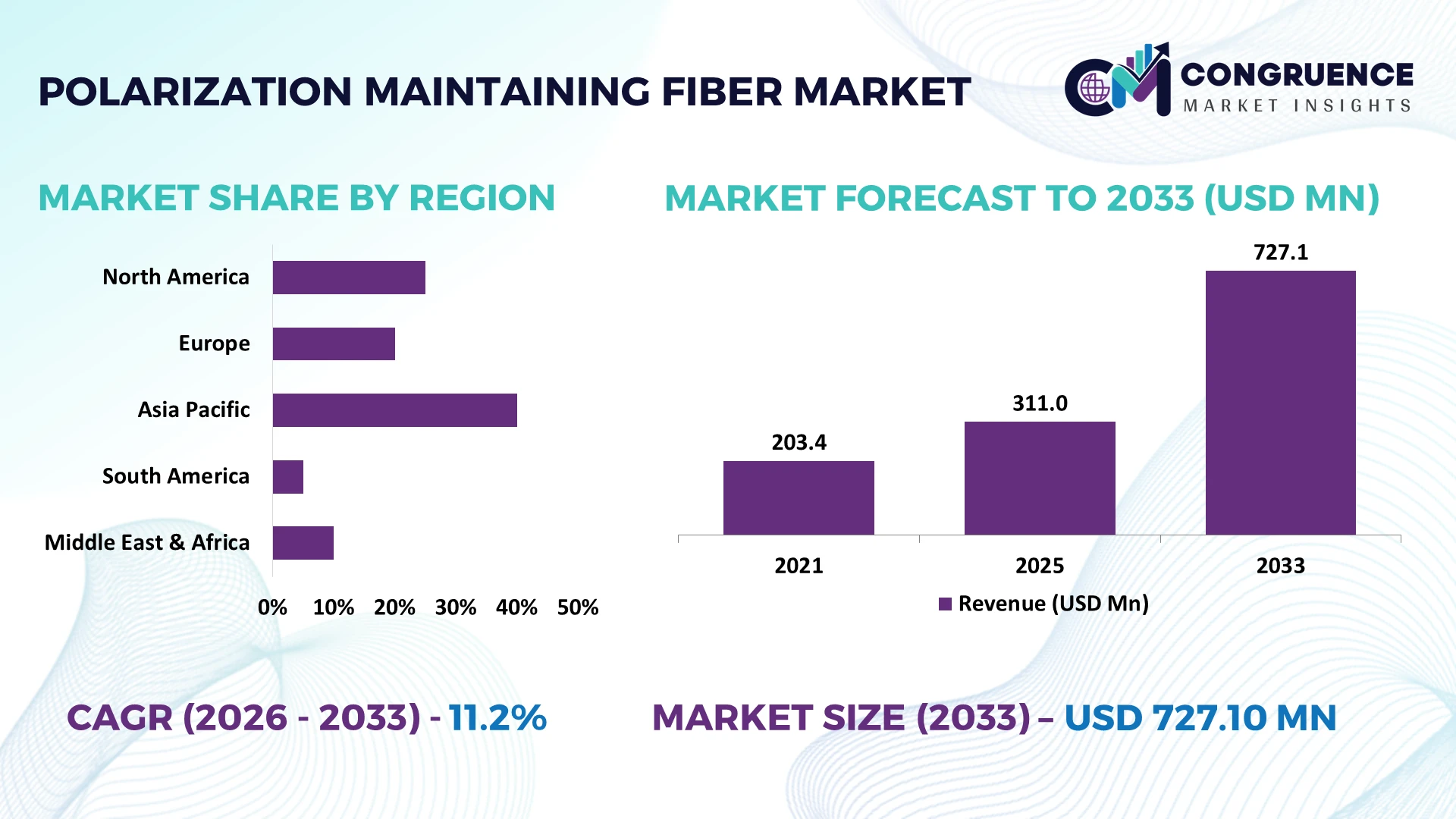
The Global Polarization Maintaining Fiber Market was valued at USD 311 Million in 2025 and is anticipated to reach a value of USD 727.1 Million by 2033 expanding at a CAGR of 11.2% between 2026 and 2033. Growth is driven by fiber optic gyroscope integration, coherent optical communication, quantum photonics research, and precision laser systems requiring stable polarisation transmission.
The United States represents a major high-value market for polarization maintaining fiber, supported by aerospace navigation, defense photonics, and advanced optical instrumentation. The country's CHIPS and Science Act provides approximately USD 52.7 billion for semiconductor-related manufacturing and research initiatives, strengthening the broader photonics ecosystem. Domestic suppliers specialise in PANDA-type fibers, polarisation-maintaining assemblies, and precision optical components. Compared with China, which emphasises manufacturing scale and integrated optical component production, the United States maintains advantages in defence-qualified photonics and specialized fiber engineering. Polarization extinction ratios exceeding 20 dB remain important for demanding optical applications.
Manufacturers investing in low-crosstalk fiber designs, specialised coating technologies, and vertically integrated photonics production are positioned to secure higher-value aerospace, sensing, and quantum technology contracts.
Market Size & Growth: Valued at USD 311 Million in 2025, projected to USD 727.1 Million by 2033 at 11.2% CAGR, driven by fiber optic gyroscope deployment and coherent optical communication infrastructure.
Top Growth Drivers: Fiber optic gyroscope applications commanding 51% downstream share, PANDA fiber architecture dominance at 56% product share, and quantum photonics research expansion.
Short-Term Forecast: By 2027, reduced-cladding PANDA fiber adoption accelerates as 80μm and 60μm configurations enable higher fiber lengths within compact gyroscope coil volumes.
Emerging Technologies: Nanostructured circular-core PM fiber eliminating stress-applying parts for multicore architectures, hollow-core anti-resonant PM fiber achieving 7.2×10⁻⁴ birefringence, and bend-insensitive designs for co-packaged optics.
Regional Leaders: United States at 33% market share with Corning PANDA portfolio, Europe at 28% with Germany leading industrial photonics, and China at 20% with YOFC and Changfei expanding domestic supply.
Consumer/End-User Trends: Fiber optic gyroscopes command 51% of downstream demand; telecom components and precision sensors represent fastest-growing application segments.
Pilot/Case Example: AIP Advances published 27.5 fs pulses at 10 GHz using fully PM all-fiber EOM comb architecture, demonstrating compression factor exceeding 100 for spectroscopy applications.
Competitive Landscape: Corning, Fujikura, and YOFC lead with 42% combined share; Coherent (NuPANDA), Exail, Fibercore, and Thorlabs compete on application-specific variants.
Regulatory & ESG Impact: EU import dependence at 70–75% for PM fiber with anti-dumping monitoring on Asian imports; defense applications require stringent qualification evidence.
Investment & Funding: European production capacity limited to 6–10 drawing towers satisfying only 25–30% of regional demand, with potential 3–5 additional lines by 2030.
Innovation & Future Outlook: Nanostructured circular-core PM fiber enables multicore architectures incompatible with traditional stress-applying parts; hollow-core designs target ultra-low-loss quantum photonics.
The Polarization Maintaining Fiber Market serves precision optical systems where preserving the input polarization state is essential for measurement accuracy, coherent signal processing, and laser stability. PANDA and bow-tie fiber architectures remain important in interferometric sensing, fiber optic gyroscopes, and high-performance laser assemblies. Specialized products operate across common wavelength bands, including 780 nm, 1,310 nm, and 1,550 nm, supporting different photonics applications. Increasing investment in quantum computing and secure optical communication is encouraging tighter control of birefringence, insertion loss, and connector alignment. These technical requirements are shifting competitive priorities toward specialized manufacturing capabilities, component qualification, and integrated optical system design.
Polarization maintaining fiber is becoming strategically important as aerospace navigation, quantum computing, and precision laser manufacturing demand increasingly stable optical signal transmission. Procurement is shifting from standalone specialty fibers toward qualified photonic assemblies incorporating aligned connectors, couplers, and integrated sensing components. United States export controls on advanced technologies are also encouraging manufacturers to strengthen domestic photonics capabilities and diversify specialized optical component sourcing, making supply-chain reliability a competitive differentiator.
PANDA and bow-tie fiber architectures preserve defined polarization states through engineered birefringence, unlike conventional single-mode fibers that permit uncontrolled polarization rotation. A 20 dB polarization extinction ratio corresponds to approximately 99% of optical power occupying the preferred polarization state, improving measurement consistency in polarization-sensitive systems. China emphasizes scalable optical component production, while Germany and the United States concentrate on high-precision sensing, industrial lasers, and specialized photonic engineering. Between 2026 and 2028, automated alignment, low-loss splicing, and photonic integration will influence manufacturing qualification and assembly productivity.
Fiber optic gyroscopes provide a practical deployment example, using polarization maintaining fiber coils to reduce polarization-related measurement errors in inertial navigation. Manufacturers are strengthening relationships with aerospace integrators, investing in precision fiber drawing, and expanding customized optical assemblies. Competitive advantage increasingly depends on repeatable optical performance, qualified manufacturing processes, and reliable integration with advanced photonic systems.
Increasing adoption of fiber optic gyroscopes and coherent optical sensing is strengthening demand for polarization maintaining fiber with controlled birefringence and stable optical transmission. Fiber designs delivering 20–30 dB polarization extinction ratios suppress unwanted polarization components, while a 30 dB ratio corresponds to approximately 99.9% power concentration in the preferred polarization state. Aerospace navigation programs increasingly prioritize reliable inertial sensing where satellite positioning becomes unavailable. The United States is strengthening domestic photonics manufacturing capabilities through defense technology initiatives and advanced component procurement. Manufacturers are expanding specialty fiber drawing capacity, developing low-loss fiber coils, and partnering with inertial sensor integrators. Precise polarization control supports navigation accuracy while reducing system calibration requirements.
Polarization maintaining fiber production requires precision preform fabrication, controlled stress-applying structures, specialized coatings, and tightly regulated drawing conditions. A 1% variation in critical geometric parameters can affect birefringence consistency, while optical connector misalignment of 1° introduces approximately 0.03% polarization power leakage under idealized conditions. Maintaining extinction ratios above 20 dB also increases requirements for quality inspection and component handling. Manufacturers in Japan and the United States depend on specialized fabrication equipment, high-purity silica materials, and qualified optical component suppliers. Limited interchangeability between customized fiber geometries complicates procurement and inventory management. Companies are reducing exposure through alternative material qualification, long-term supply agreements, automated inspection, and localized precision component manufacturing.
Quantum sensing and integrated photonic systems are creating opportunities for polarization maintaining fibers optimized for narrow wavelength bands and compact optical architectures. At 1,550 nm, polarization-sensitive systems benefit from established telecommunications component ecosystems, while 780 nm and 850 nm designs support specialized atomic physics and laboratory applications. A 20 dB extinction ratio limits unwanted polarization power to approximately 1%, making polarization stability commercially important for precision optical assemblies. Germany's quantum technology initiatives and expanding photonics research infrastructure are supporting collaboration between universities, component manufacturers, and industrial integrators. Suppliers are investing in polarization maintaining couplers, fiber arrays, and low-loss packaged assemblies. Providing qualified integrated components rather than individual fiber lengths strengthens customer retention and captures greater engineering value.
Scaling polarization maintaining fiber assemblies while preserving optical performance presents significant engineering challenges. A 2° angular alignment error produces approximately 0.12% polarization power leakage under ideal conditions, compared with approximately 0.03% at 1°, demonstrating the sensitivity of precision optical assembly. Temperature fluctuations, mechanical stress, and coating deformation also influence birefringence stability during extended operation. In aerospace applications, equipment must withstand vibration and temperature cycling without compromising sensor calibration. Manufacturers face additional pressure to integrate specialty fibers with photonic chips, compact connectors, and automated packaging processes. Companies must strengthen environmental qualification, develop active alignment systems, and improve process traceability. Long-term competitiveness depends on translating laboratory-level optical performance into repeatable industrial manufacturing and reliable field operation.
• Automated Fiber Alignment Gains Industrial Adoption: Specialty fiber manufacturers are integrating machine vision, rotational alignment, and programmable fusion splicing into assembly workflows. Precision splicers support angular alignment near 0.1°, while qualified connections target insertion losses below 0.1 dB. Japanese equipment manufacturers are improving automated inspection and calibration capabilities, reducing operator dependency and strengthening production consistency for high-volume photonic component assembly.
• High-Power Laser Compatibility Drives Redesign: Industrial laser manufacturers are refining polarization maintaining fiber coatings and thermal management for demanding optical environments. Products operating around 1,064 nm and 1,550 nm require wavelength-specific designs, while polarization extinction ratios above 20 dB support stable linear polarization. Suppliers are improving coating durability, mode-field compatibility, and connector thermal performance to reduce assembly failures and strengthen equipment reliability.
• Compact Photonic Packaging Reshapes Procurement: Integrated photonic modules increasingly combine polarization maintaining pigtails, miniature couplers, and precision fiber arrays. Standardized 127 µm and 250 µm fiber-array pitches support compact optical packaging, while alignment accuracy near 1 µm becomes important for efficient coupling. Manufacturers are collaborating with photonic chip packaging specialists to reduce assembly complexity and provide qualified optical interfaces rather than individual components.
• Specialty Fiber Qualification Standards Tighten: Aerospace and medical photonics customers are strengthening environmental qualification and component traceability requirements. Common operating wavelength bands include 780 nm, 1,310 nm, and 1,550 nm, with qualification extending across thermal cycling, mechanical stress, and optical stability testing. United States suppliers are expanding automated test documentation and controlled manufacturing workflows to improve acceptance consistency and support regulated equipment procurement.
PANDA Fiber represents a leading commercial configuration within the polarization maintaining fiber market, supported by established manufacturing processes, broad wavelength availability, and compatibility with precision optical components. Its stress-applying rods generate controlled birefringence, allowing stable polarization transmission across sensing, navigation, and laser applications. Commercial PANDA products commonly deliver polarization extinction ratios exceeding 20 dB, while specialized configurations achieve 25–30 dB under defined testing conditions. Bow-Tie Fiber remains important for precision interferometric systems because its stress geometry supports strong birefringence. Stress-Rod Fiber provides additional design flexibility for application-specific mechanical and optical requirements. Manufacturers prioritize repeatable preform geometry, drawing stability, and connector compatibility to protect established production advantages.
Photonic Crystal Fiber represents an emerging high-performance category, offering engineered microstructures for specialized dispersion, confinement, and polarization characteristics. Elliptical-Core Fiber achieves birefringence through core geometry, while Elliptical-Cladding Fiber employs structural asymmetry to influence polarization behavior. These configurations address applications requiring optical properties beyond conventional stress-induced designs. Suppliers are strengthening fabrication capabilities, developing customized fiber profiles, and collaborating with photonics laboratories. Investment priorities increasingly favor specialized optical performance, reliable fabrication yields, and compatibility with integrated optical assemblies.
Fiber Optic Gyroscopes represent a major established application for polarization maintaining fiber because accurate angular-rate measurement depends on stable optical interference and controlled polarization behavior. Navigation-grade fiber coils require tightly managed birefringence, low attenuation, and consistent winding characteristics. Polarization extinction ratios of 20–30 dB are commonly relevant to precision optical assemblies, while operating wavelengths around 1,310 nm and 1,550 nm support different system architectures. Fiber Optic Sensors also account for significant utilization through distributed measurement and industrial monitoring. Interferometry Systems and Precision Measurement Systems require stable optical paths to reduce polarization-related measurement errors. Manufacturers are strengthening fiber coil processing, optical characterization, and customized assembly capabilities.
Quantum Communication is emerging as a technologically significant application through polarization-sensitive photonic interfaces and specialized optical links. Coherent Optical Communication employs polarization management for signal processing, although conventional transmission networks predominantly use standard single-mode fiber. Fiber Lasers require polarization maintaining designs for stable beam characteristics and efficient polarized output. Suppliers are developing low-loss optical assemblies, wavelength-specific fibers, and integrated component solutions. Competitive positioning increasingly depends on application engineering and compatibility with specialized optical architectures.
Aerospace and Defense represents a major high-value end-user category for polarization maintaining fiber, supported by inertial navigation, aerospace sensing, and mission-critical optical instrumentation. Navigation System Manufacturers require qualified fiber coils and polarization-stable components for gyroscopes and precision positioning equipment. Optical assemblies with extinction ratios exceeding 20 dB are important for controlling unwanted polarization components, while specialized designs support operating wavelengths near 1,550 nm. Telecommunications purchases polarization maintaining components for coherent optical subsystems and specialized signal-processing equipment rather than conventional transmission cabling. Industrial Manufacturing utilizes these fibers in precision lasers, inspection systems, and optical measurement equipment. Suppliers compete through qualification support, customized assemblies, and dependable production traceability.
Research Institutions represent an important emerging customer group as quantum photonics, advanced interferometry, and optical computing experiments require specialized fiber characteristics. Healthcare and Medical Devices manufacturers use polarization-sensitive optical components in diagnostic instrumentation and imaging systems, while Oil and Gas operators employ optical sensing technologies for demanding monitoring applications. Manufacturers are expanding application engineering services, supporting small-batch customization, and collaborating with research laboratories. Long-term competitive advantage increasingly depends on transitioning specialized laboratory requirements into repeatable commercial manufacturing.
North America accounted for the largest market share at an estimated 35% in 2025 however, Asia-Pacific is expected to register the fastest growth, expanding at an estimated CAGR of 12.8% between 2026 and 2033.
Advanced Optical Fiber Engineering and Aerospace Sensing Leadership
North America holds an estimated 35% market share, supported by aerospace navigation, precision laser systems, and specialized photonics manufacturing. The United States hosts established suppliers including Coherent and Corning, whose technologies support polarization-sensitive sensing and advanced optical communication. In October 2025, Coherent introduced its next-generation polarization maintaining optical fiber for narrow-linewidth 1,550 nm amplifiers, targeting improved power scalability and laser stability. Its specialized gyroscope fibers offer cladding diameters of 40–80 µm, continuous lengths up to 5 km, and operating capabilities across temperatures from −55°C to 105°C. These specifications support compact inertial navigation assemblies and demanding aerospace environments. Manufacturers are strengthening application-specific engineering, optical component qualification, and integrated fiber assembly capabilities to serve customers requiring consistent polarization performance and reliable environmental durability.
United States Market Outlook: The United States benefits from established photonics manufacturing facilities, defense technology procurement, and advanced optical instrumentation development. Coherent's specialty fiber portfolio includes radiation-resistant designs and coating tolerances as low as 2 µm. Such capabilities support repeatable fiber winding, precise optical alignment, and compact gyroscope construction, strengthening domestic suppliers' positioning in high-reliability navigation and sensing equipment.
Quantum Photonics Investment and Precision Component Integration
Europe represents an estimated 24% of the global polarization maintaining fiber market, supported by established optical engineering capabilities in Germany, France, and the United Kingdom. Demand concentrates on industrial laser systems, quantum instrumentation, precision interferometry, and specialized sensing assemblies. European manufacturers emphasize low-crosstalk fiber configurations, optical packaging reliability, and integration with advanced photonic components. Germany's applied photonics research infrastructure supports collaboration between optical component suppliers and industrial equipment manufacturers. In December 2025, the United Kingdom and Germany announced £14 million in quantum-related research and technology cooperation, including £8 million for Fraunhofer's applied photonics center in Glasgow. This investment strengthens the broader component development ecosystem and supports commercialization of advanced optical systems. Manufacturers are expanding research partnerships and precision assembly capabilities to address increasingly specialized customer specifications.
Germany Market Outlook: Germany combines established laser engineering expertise with precision optical component development. The Fraunhofer research network supports applied photonics manufacturing, optical metrology, and industrial technology commercialization. A £6 million joint quantum research funding initiative with the United Kingdom, announced in 2025, strengthens cross-border development opportunities for optical sensing, quantum instrumentation, and related photonic technologies.
High-Volume Fiber Manufacturing and Miniaturized Optical Components
Asia-Pacific accounts for an estimated 33% market share, supported by Japan's precision optical manufacturing, China's integrated photonics supply chain, and South Korea's advanced electronics ecosystem. Japan maintains particular strength in polarization maintaining PANDA fiber engineering and specialized optical component production. In March 2025, Fujikura announced sample shipments of TitaniaBend PANDA PM Fiber, jointly developed with Corning for next-generation optical transceivers operating at 800 Gbit/s or higher. The design reduces bending loss by up to 90% compared with conventional products under specified tight-bending conditions and supports bending radii of 5 mm or less. This development improves the suitability of polarization maintaining fiber for compact optical modules. Manufacturers are prioritizing advanced glass compositions, precision drawing, and production-ready designs that reduce packaging constraints.
Japan Market Outlook: Japan maintains a competitive advantage through Fujikura's established specialty fiber manufacturing and optical engineering capabilities. Its polarization maintaining fiber portfolio covers operating wavelengths from approximately 400 nm to 1,550 nm. Advanced PANDA configurations, bend-insensitive designs, and reduced-cladding products support industrial lasers, precision sensors, and miniaturized photonic assemblies requiring reliable polarization control.
Scientific Instrumentation and Industrial Optical Sensing Development
South America represents an estimated 4% of global polarization maintaining fiber demand, concentrated in specialized scientific equipment, industrial sensing, and precision optical instrumentation. Brazil provides the strongest regional research and industrial engineering base, while Chile contributes applications involving mining measurement systems and optical monitoring technologies. Polarization maintaining fibers operating around 1,310 nm and 1,550 nm support interferometric instrumentation and coherent sensing applications. Regional procurement remains dependent on specialized imported optical components, making technical distribution and local integration capabilities commercially important. Research institutions and industrial equipment integrators are central purchasing channels for custom fiber assemblies. Manufacturers serving the region prioritize application engineering, optical connector compatibility, and qualified component distribution rather than large-scale commodity fiber supply, supporting higher-value specialized equipment projects.
Brazil Market Outlook: Brazil benefits from established optical research capabilities and advanced scientific infrastructure, particularly around Campinas and São Paulo. The Sirius synchrotron facility operates with a 3 GeV electron storage ring, supporting sophisticated measurement and instrumentation research. This scientific ecosystem creates opportunities for specialized optical suppliers serving precision laboratories, industrial photonics developers, and advanced measurement equipment manufacturers.
Research Infrastructure and Specialized Photonics Procurement
The Middle East & Africa accounts for an estimated 4% of the polarization maintaining fiber market, with demand concentrated in advanced research institutions, defense-related instrumentation, and specialized industrial optical systems. Israel maintains established electro-optics expertise, while the United Arab Emirates and Saudi Arabia are expanding advanced technology research capabilities. South Africa contributes academic photonics research and industrial measurement applications. Regional opportunities include optical systems operating at 780 nm, 1,064 nm, and 1,550 nm, depending on sensing, laser, and scientific instrumentation requirements. Research programs increasingly emphasize optical component integration and reliable polarization-sensitive measurement. Manufacturers are strengthening specialized distribution arrangements, technical partnerships, and application engineering support. The principal commercial advantage lies in delivering qualified optical assemblies compatible with imported scientific equipment and advanced sensing platforms.
United Arab Emirates Market Outlook: The United Arab Emirates is strengthening advanced technology research through Abu Dhabi's Technology Innovation Institute and related scientific programs. The institute's superconducting quantum computing research includes a 5-qubit system announced in 2021. While this does not directly measure fiber consumption, expanding optical laboratories and precision instrumentation capabilities provide a relevant customer ecosystem for specialized photonic components.
The global Polarization Maintaining Fiber Market features competition between established specialty fiber manufacturers, including Coherent, Fujikura, Corning, YOFC, and Fibercore, and specialized photonics suppliers targeting customized optical assemblies. The leading five manufacturers collectively hold an estimated 45–50% market share, reflecting concentrated manufacturing expertise and established aerospace and sensing relationships. Premium suppliers compete through polarization extinction performance, precision fiber geometry, and application engineering, while Asian manufacturers emphasize production scalability and cost efficiency. Advanced fiber designs achieve polarization extinction ratios exceeding 25 dB, while automated alignment technologies target assembly loss reductions of 10–15%. Fujikura and Corning collaborate on bend-insensitive fiber innovation, whereas Coherent strengthens specialized photonics integration. Competition increasingly favors compact optical packaging, vertically integrated production, and qualified supply chains. Precision preform fabrication, specialized drawing equipment, and customer certification requirements constrain entry. Winning requires consistent optical performance, competitive manufacturing yields, customized engineering, and dependable component delivery worldwide.
Corning
Fujikura
YOFC
Coherent
Exail
Fibercore
Thorlabs
Changfei Optical Fibre
iXblue
OFS Fitel
Nufern
Schäfter + Kirchhoff
OZ Optics
Preciseley Microtechnology
Current polarization maintaining fiber technology relies on PANDA and bow-tie geometries that generate controlled birefringence through engineered stress profiles. Commercial fibers achieve polarization extinction ratios of 20–30 dB, corresponding to 99–99.9% optical power retention in the preferred polarization state under specified conditions. Precision drawing, low-loss coatings, and automated rotational alignment improve manufacturing repeatability. Compared with conventional fiber designs, Fujikura's advanced bend-insensitive PANDA technology reduces bending loss by up to 90%, supporting tighter optical packaging without sacrificing signal stability.
Emerging technologies combine specialty glass compositions, photonic crystal structures, and integrated photonic packaging. Automated fusion splicing enables angular alignment approaching 0.1°, while optimized connections target insertion losses below 0.1 dB. Compact fiber arrays and polarization maintaining pigtails support photonic chips, coherent laser assemblies, and precision instrumentation. Japanese manufacturers benefit from advanced fabrication capabilities, while specialized European suppliers compete through customized optical integration and application engineering.
Between 2026 and 2028, disruptive developments will emphasize hollow-core architectures, miniature polarization-stable assemblies, and automated optical qualification. Specialized designs supporting 780 nm, 1,064 nm, and 1,550 nm wavelengths will address increasingly differentiated applications. Manufacturers investing in scalable fabrication, precision packaging, and validated environmental performance will strengthen customer retention, reduce integration complexity, and secure higher-value equipment qualifications.
October 2025: YOFC launched its radiation-resistant polarization-maintaining Er/Yb co-doped fiber, offering high pump-to-signal conversion efficiency and excellent radiation resistance for space optical amplifiers. This expands China’s domestic capability in space-grade PM fiber, reducing dependence on imported radiation-hardened fibers for satellite communication systems. Source: yofc.com
March 2026: Coherent showcased its InP technology portfolio at OFC 2026, including PM fiber components for co-packaged optics and silicon photonics pluggables, with 6-inch InP production ramping across Sweden, US, and Switzerland fabs. This vertical integration strengthens Coherent’s supply position for AI datacenter optical interconnect applications. Source: coherent.com
October 2025: Fujikura’s radiation-resistant PM Er/Yb co-doped fiber achieved 30W output power with 37dB signal-to-ASE ratio and stable 400-hour operation under temperature cycling from 25°C to 45°C for space communications. This validates PM fiber performance for high-power space-based optical amplifiers, enabling satellite laser communication deployment. Source: ieeexplore.ieee.org
June 2026: Exail reported 47% growth in photonics orders for Q2 2026, driven by navigation systems and PM fiber demand for defense and aerospace applications. The growth reflects expanding fiber optic gyroscope deployment in autonomous underwater vehicles and naval navigation systems. Source: exail-technologies.com
The Polarization Maintaining Fiber Market Report examines industry structure, technology evolution, and competitive positioning between 2026 and 2033. Type segmentation covers PANDA Fiber, Bow-Tie Fiber, Elliptical-Cladding Fiber, Elliptical-Core Fiber, Stress-Rod Fiber, and Photonic Crystal Fiber. Application analysis evaluates fiber optic gyroscopes, optical sensors, interferometry, coherent communication, fiber lasers, quantum communication, and precision measurement. End-user coverage includes telecommunications, aerospace and defense, industrial manufacturing, healthcare, research institutions, oil and gas, and navigation equipment manufacturers.
Regional analysis encompasses North America, Europe, Asia-Pacific, South America, and the Middle East & Africa, examining manufacturing specialization, technology investment, and procurement dynamics. Technical assessment considers polarization extinction ratios above 20 dB, bend-insensitive designs, wavelength optimization, and photonic packaging. The report supports capacity investment, supplier selection, product development, and market entry decisions across emerging precision photonics applications.
| Report Attribute/Metric | Report Details |
|---|---|
Market Revenue in 2025 | USD 311 Million |
Market Revenue in 2033 | USD 727.1 Million |
CAGR (2026 - 2033) | 11.2% |
Base Year | 2025 |
Forecast Period | 2026 - 2033 |
Historic Period | 2021 - 2025 |
Segments Covered | By Type
By Application
By End-User
|
Key Report Deliverable | Revenue Forecast, Growth Trends, Market Dynamics, Segmental Overview, Regional and Country-wise Analysis, Competition Landscape |
Region Covered | North America, Europe, Asia-Pacific, South America, Middle East, Africa |
Key Players Analyzed | Corning, Fujikura, YOFC, Coherent, Exail, Fibercore, Thorlabs, Changfei Optical Fibre, iXblue, OFS Fitel, Nufern, Schäfter + Kirchhoff, OZ Optics, Preciseley Microtechnology |
Customization & Pricing | Available on Request (10% Customization is Free) |




