
Reports
The Global Pneumatic Tube Transport Systems Market was valued at USD 2345.01 Million in 2025 and is anticipated to reach a value of USD 3464.65 Million by 2033 expanding at a CAGR of 5% between 2026 and 2033. Hospital logistics automation, centralized laboratory workflows, secure medication distribution, and replacement of manual courier movement with digitally tracked pneumatic networks are driving system deployment.
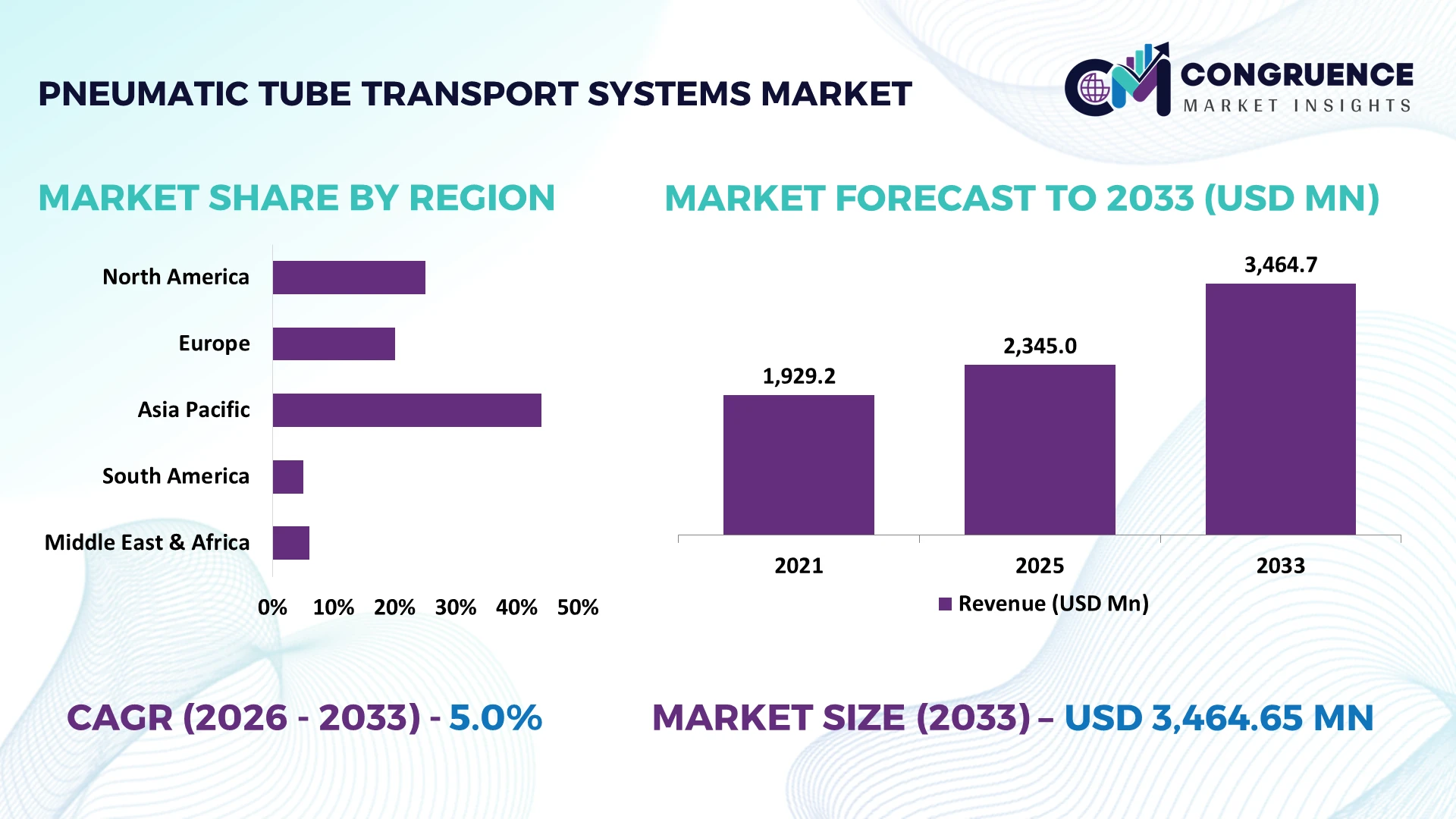
The United States anchors global adoption within North America, which represented approximately 40% of market demand in 2025, supported by hospitals, laboratories, pharmacies, banks, and commercial facilities. Advanced hospital installations can process more than 8,000 carrier transactions daily, while complex multipoint configurations represent approximately 55% of system demand. Germany maintains stronger penetration across established healthcare infrastructure, whereas China is accelerating deployment through hospital construction and modernization. Healthcare supply chain disruption following the pandemic has reinforced investment in resilient internal logistics and automated specimen movement.
Strategically, suppliers should prioritize high volume healthcare networks where intelligent routing, digital tracking, scalable stations, and lifecycle services generate measurable workflow advantages.
Market Size & Growth: USD 2,345.01 million in 2025 reaches USD 3,464.65 million by 2033 at 5% CAGR, driven by hospital logistics automation and laboratory workflow modernization.
Top Growth Drivers: North America contributes approximately 40%, complex multipoint systems represent around 55%, and healthcare facilities account for the dominant deployment base.
Short Term Forecast: By 2028, intelligent routing, automatic receiving, and workflow integration are positioned to reduce specimen transport time by approximately 30% to 50% in advanced hospitals.
Emerging Technologies: RFID tracking, IoT sensors, intelligent routing, and automated unloading can deliver more than 95% carrier traceability across digitally integrated hospital networks.
Regional Leaders: North America represents approximately USD 938 million, Europe about USD 704 million, and Asia Pacific roughly USD 516 million based on indicative 2025 regional distribution.
Consumer and End User Trends: Fully automated hospital configurations account for approximately 66% of advanced deployments, demonstrating buyer preference for reduced manual handling and continuous material movement.
Pilot and Case Example: One hospital workflow deployment reduced carrier transit from 92 seconds to 15 seconds, returning more than 10 staff hours of productive time daily.
Competitive Landscape: Swisslog Healthcare holds approximately 20% share, with Aerocom near 15%; Pevco, Sumetzberger, and Eagle Pneumatic compete through healthcare specialization, routing software, and service capabilities.
Regulatory and ESG Impact: Pneumatic networks handling more than 2,000 transactions daily reduce repetitive staff movement while strengthening specimen traceability, controlled handling, and standardized hospital logistics.
Investment and Funding: Hospital modernization programs increasingly allocate USD 1 million plus budgets to integrated logistics infrastructure combining pneumatic transport, laboratory automation, digital tracking, and pharmacy workflows.
Innovation and Future Outlook: Next generation systems integrate 24 hour monitoring, predictive maintenance, RFID identification, and automated receiving, shifting competition from physical tube infrastructure toward intelligent logistics platforms.
Pneumatic Tube Transport Systems Market demand is concentrated in hospitals, diagnostic laboratories, pharmacies, banks, industrial plants, and large commercial facilities where rapid internal movement directly affects workflow performance. Healthcare installations increasingly combine RFID identification, intelligent routing, automatic receiving, and centralized monitoring, enabling carrier traceability above 95% in advanced networks. Hospital staffing pressure is accelerating automated specimen and medication movement as operators reduce repetitive manual transport. An emerging trend is integration with laboratory and pharmacy software, transforming pneumatic infrastructure from point transport equipment into a connected intralogistics platform and establishing the foundation for strategic market assessment.
Pneumatic tube transport systems are becoming strategic hospital infrastructure as laboratories, pharmacies, blood banks, and emergency departments automate time sensitive internal logistics. Large healthcare networks can process more than 8,000 carrier movements daily, making transport reliability directly relevant to clinical throughput. Digital hospital modernization is shifting procurement from basic point transport toward centrally monitored networks integrating carrier identification, routing intelligence, and workflow software.
Modern automated systems can reduce specimen transport from several minutes to under 2 minutes on optimized routes, delivering more than 50% improvement versus manual courier workflows. North America leads large hospital deployment, while Germany maintains deep installed infrastructure and China emphasizes new hospital integration. Through 2028, RFID tracking, automated receiving, and predictive maintenance will increasingly become standard specifications, pushing traceability toward 95% across digitally connected installations.
A major hospital network can connect laboratories, pharmacies, nursing stations, operating rooms, and emergency departments through hundreds of stations operating continuously. Suppliers are responding by investing in software controls, cybersecurity, remote diagnostics, and hospital information system integration. Competitive positioning increasingly depends on workflow intelligence, uptime, and integration capability rather than tube hardware alone.
Hospital logistics automation is the primary structural driver as healthcare providers replace staff intensive specimen and medication movement with continuous pneumatic transport. Healthcare represents more than 50% of system deployment, while advanced automated configurations account for approximately 60% to 65% of installations. Digitally routed networks can reduce internal transport times by more than 50% compared with walking based delivery. United States hospitals are accelerating laboratory and pharmacy automation as staffing shortages increase pressure on clinical productivity. This shift moves nurses and technicians away from repetitive transport tasks toward patient and diagnostic workflows. Suppliers are responding through automatic unloading, RFID carrier identification, intelligent routing, and software integration. The strategic advantage extends beyond speed because automated transport converts internal logistics into measurable infrastructure with trackable utilization and service performance.
Retrofitting pneumatic networks into operating hospitals remains structurally difficult because tubes must navigate walls, ceilings, fire compartments, elevators, clinical zones, and existing utilities. Installation can represent approximately 30% to 40% of total project expenditure in complex retrofit environments, while construction constraints can extend implementation schedules by 20% or more compared with new buildings. Older hospitals in the United States, United Kingdom, and Germany face particularly dense mechanical infrastructure and limited ceiling space. Infection control requirements also restrict construction activity around active clinical areas. Operators are reducing disruption through phased installation, modular stations, reusable routing infrastructure, and scheduled construction windows. Suppliers increasingly conduct digital route modelling before deployment. The critical purchasing issue is therefore building compatibility because installation complexity can outweigh equipment economics in established facilities.
Connected pneumatic infrastructure creates an opportunity to transform physical transport into a measurable hospital logistics platform. RFID enabled carriers can provide more than 95% transaction traceability, while predictive diagnostics can reduce unexpected equipment interruptions by approximately 15% to 25% in mature installations. Automated receiving also eliminates manual carrier retrieval at high volume laboratory stations. China and India offer particularly attractive deployment potential because new hospitals can integrate tubes during construction rather than absorb expensive retrofit work later. Through 2028, integration with laboratory information systems, pharmacy automation, and building management platforms will expand the value of each installed network. Suppliers are investing in analytics, intelligent routing, remote monitoring, and software partnerships. The non obvious opportunity is recurring digital service income generated after the physical network has already been installed.
Large pneumatic networks become operationally complex as station counts, routing intersections, carrier volumes, and software connections increase. Advanced hospitals can exceed 100 stations and process several thousand transactions daily, meaning even 1% routing disruption can affect dozens of time sensitive movements. Integration with laboratory, pharmacy, access control, and hospital information systems also expands cybersecurity and interoperability requirements. United States healthcare providers increasingly scrutinize connected infrastructure because operational technology now shares data with wider hospital networks. Equipment suppliers must therefore maintain reliable controls while supporting software updates without interrupting continuous clinical operations. Companies are investing in network segmentation, redundant controllers, remote diagnostics, predictive servicing, and technician training. Long term competitiveness depends on maintaining near continuous availability while expanding digital functionality, making software reliability as important as mechanical transport performance.
Laboratory Receiving Becomes Fully Automated: High volume hospitals are replacing manual carrier collection with automatic receiving stations that open, unload, and return carriers without technician intervention. Advanced installations handle more than 1,000 transactions daily, while automated receiving can reduce handling time by 30% to 50%. United States laboratories facing technician shortages are prioritizing these configurations. Suppliers are expanding receiving modules and laboratory interfaces, turning terminal automation into a measurable productivity tool.
Carrier Speed Control Protects Samples: Hospitals are adopting controlled acceleration and braking as specimen integrity becomes a procurement priority. Conventional systems can operate near 6 meters per second, while sensitive blood specimens require smoother velocity profiles to limit mechanical stress. Smart controls can reduce excessive acceleration by more than 30%. German and United States healthcare operators are refining routing protocols, prompting manufacturers to integrate adjustable speed profiles and soft arrival technology.
Network Modernization Replaces Full Reconstruction: Established hospitals are increasingly upgrading controls while retaining usable tube infrastructure. Replacing routing software, diverters, stations, and monitoring equipment can preserve more than 70% of existing physical networks while extending operational life by 10 years or longer. Construction disruption and restricted clinical access reinforce this approach. Equipment companies are expanding retrofit portfolios, creating service opportunities without requiring complete infrastructure replacement.
Cybersecurity Enters Procurement Specifications: Connected stations, monitoring platforms, and hospital interfaces are expanding the digital attack surface. Large networks can exceed 100 stations and process 5,000 plus transactions daily, increasing operational dependence on centralized controls. Hospitals are introducing segmented networks, authentication, and monitored remote access. Suppliers are strengthening software maintenance and secure diagnostics, making cybersecurity capability increasingly relevant to equipment qualification.
Automated Systems represent the leading type with an estimated 35% to 40% share, supported by hospitals requiring centralized routing, automatic carrier management, continuous monitoring, and integration across multiple departments. Their scalability makes them more operationally valuable than Single Tube Systems, which remain suited to predictable point connections with lower traffic intensity. Multi Tube Systems serve larger facilities requiring simultaneous carrier movement across several routes, reducing congestion where transaction volumes exceed 1,000 movements daily.
Hybrid Systems represent the fastest advancing type as operators combine existing pneumatic infrastructure with intelligent controls, automated stations, and software integration. These configurations can retain more than 70% of usable physical tubing during modernization, materially reducing installation disruption. Carrier Based Systems remain essential across all complex deployments because specialized carriers protect blood, medication, specimens, and documents during transport. Suppliers are consequently directing development toward modular automation, backward compatible controls, smart carriers, and scalable routing software, shifting investment from isolated transport hardware toward configurable network architecture.
Specimen Transport represents the leading application with an estimated 35% to 40% share because laboratory turnaround depends directly on rapid movement of blood tubes, urine samples, and other diagnostic material from collection points. Large hospital networks can process several thousand specimen movements daily, making transport time an operational laboratory metric. Sample Transport provides broader movement across research and diagnostic environments, while Document Transport retains relevance in banks and facilities where physical records remain operationally necessary.
Medication Transport is emerging as the fastest advancing application as pharmacies automate distribution between central stores, nursing units, emergency departments, and treatment areas. Automated movement can reduce delivery time by more than 50% compared with staff based transport in large facilities. Blood Transport requires controlled acceleration and validated carrier handling because sample quality directly affects testing accuracy. Suppliers are adapting through specialized carriers, secure access, automatic receiving, speed control, and laboratory integration. Investment is therefore shifting toward clinically sensitive applications where transport performance influences downstream diagnostic or treatment workflows.
Hospitals dominate end user demand with an estimated 60% to 65% share because emergency departments, laboratories, pharmacies, operating rooms, blood banks, and nursing stations require continuous internal transport. Large medical campuses can operate more than 100 stations and process above 5,000 carrier transactions daily, creating substantially greater infrastructure intensity than Banks or Manufacturing Plants. Laboratories remain important users where rapid sample movement directly influences analytical turnaround and staff productivity.
Pharmacies represent the fastest advancing end user segment as hospital medication workflows become more automated and centralized. Pneumatic distribution can reduce internal delivery time by more than 50% where nursing units are geographically separated from central pharmacies. Banks continue using simpler networks for cash and document handling, while Manufacturing Plants deploy systems for samples, components, paperwork, and quality control material. Suppliers are targeting hospitals and pharmacies through workflow specific stations, secure carriers, software integration, and service contracts, while industrial customers receive more ruggedized configurations optimized for continuous operating environments.
North America accounted for the largest market share at 40% in 2025 however, Asia Pacific is expected to register the fastest growth, expanding at a CAGR of 6.2% between 2026 and 2033.
Hospital Automation Shifts Toward Integrated Logistics
North America accounted for approximately 40% of global demand in 2025, supported by extensive hospital networks, centralized laboratories, pharmacy automation, and established pneumatic infrastructure. The United States concentrates deployment across large medical campuses where systems can exceed 100 stations and process more than 5,000 carrier movements daily. Procurement is shifting toward automatic receiving, controlled carrier velocity, centralized monitoring, and software integration rather than basic tube expansion. Canada shows comparatively selective deployment, concentrated around major urban healthcare facilities. Clinical staffing pressure is strengthening the economic case for automated internal transport because nurses and laboratory personnel can remain focused on patient and analytical tasks. Suppliers are responding with modernization programs that retain usable tubing while replacing controls, stations, diverters, and monitoring platforms, reducing construction disruption within continuously operating hospitals.
United States Market Outlook: The United States leads deployment through large hospital campuses requiring continuous specimen, medication, and blood transport. Advanced installations can process more than 8,000 transactions daily. Hospital modernization increasingly links pneumatic networks with laboratory and pharmacy workflows, strengthening demand for automated receiving, secure carrier identification, intelligent routing, remote diagnostics, and software based performance monitoring.
Installed Networks Enter Digital Modernization Cycle
Europe represented approximately 30% of global demand in 2025, with Germany, France, the United Kingdom, Austria, and Nordic countries maintaining substantial installed healthcare infrastructure. Germany combines strong hospital adoption with domestic engineering expertise in pneumatic logistics and control systems. Modernization increasingly focuses on preserving existing tubes while replacing routing controllers, stations, communication architecture, and carrier tracking technology. Suitable retrofit programs can retain more than 70% of physical network infrastructure, materially reducing construction requirements. European healthcare operators also emphasize energy efficiency, controlled specimen handling, cybersecurity, and equipment lifecycle management. Hospital renovation projects are therefore creating demand for modular equipment capable of interfacing with older networks. Suppliers are strengthening software platforms, automatic receiving systems, preventive maintenance capabilities, and interoperability with laboratory infrastructure rather than relying primarily on greenfield system construction.
Germany Market Outlook: Germany remains Europe's principal technology and deployment center, supported by established hospital infrastructure and specialist pneumatic system manufacturers. Large medical campuses increasingly use networks containing dozens of stations across laboratories, pharmacies, wards, and surgical departments. Modernization spending prioritizes backward compatible controls, energy efficient blowers, carrier tracking, and service support capable of extending infrastructure life beyond 10 years.
Hospital Construction Accelerates Integrated Deployment
Asia Pacific represented approximately 22% of global demand in 2025, with China, Japan, India, South Korea, and Australia generating healthcare infrastructure requirements. China combines hospital construction scale with growing adoption of automated laboratories and smart hospital infrastructure, while Japan emphasizes reliability and compact system engineering. India is increasingly integrating pneumatic transport into large private hospitals and newly developed medical campuses where installation during construction eliminates many retrofit constraints. Advanced hospital networks can connect more than 50 stations across laboratories, pharmacies, blood banks, emergency departments, and wards. Rising diagnostic volumes are making rapid specimen movement particularly valuable. Suppliers are expanding through local engineering partnerships, hospital automation integration, and modular product configurations. The strongest commercial positioning increasingly comes from incorporating pneumatic routing during hospital design rather than adding systems after commissioning.
China Market Outlook: China provides substantial deployment potential through large hospital construction programs and digital healthcare infrastructure. Major tertiary hospitals can exceed 1,000 beds, creating sufficient internal traffic to justify automated specimen and medication transport. Smart hospital programs are strengthening integration between pneumatic networks, laboratory automation, pharmacy systems, digital tracking, and centralized facilities management.
Private Healthcare Modernization Concentrates Demand
South America accounts for approximately 4% of global demand, with Brazil representing the principal deployment center followed by selective installations in Argentina, Chile, and Colombia. Brazilian demand concentrates around private hospital networks, diagnostic centers, laboratories, and larger public medical facilities where dispersed departments create internal transport bottlenecks. Facilities exceeding 500 beds provide particularly relevant operating environments because laboratory specimens and medications require frequent movement across multiple floors. Adoption remains constrained by imported equipment costs, specialist maintenance availability, and integration requirements within older buildings. Consequently, modernization frequently favors targeted routes connecting emergency departments, laboratories, pharmacies, and intensive care areas rather than extensive campus networks. Suppliers are addressing these conditions through modular configurations, local technical partnerships, preventive maintenance agreements, and phased installations aligned with hospital renovation schedules.
Brazil Market Outlook: Brazil offers the region's strongest commercial base through its extensive private healthcare network, diagnostic sector, and concentration of large urban hospitals. Systems connecting 20 or more stations provide a practical entry point for complex facilities. Vendors combining modular deployment with local maintenance capabilities gain an operational advantage because service availability directly influences system uptime and hospital procurement decisions.
New Medical Infrastructure Enables Native Automation
Middle East and Africa represents approximately 4% of global demand, led by healthcare infrastructure investment in Saudi Arabia, the United Arab Emirates, Qatar, and South Africa. New hospital construction provides an important deployment advantage because tube routing, stations, blower rooms, and control infrastructure can be incorporated before building completion. Saudi Arabia is expanding hospital capacity under broader healthcare transformation programs, while the United Arab Emirates emphasizes digitally connected premium medical facilities. Large new hospitals containing 300 or more beds increasingly evaluate automated logistics during facility planning. African deployment remains concentrated in major private and tertiary institutions where capital availability and maintenance capability support sophisticated systems. Vendors are pursuing engineering partnerships, integrated hospital technology packages, and local service arrangements, recognizing that dependable commissioning and maintenance capacity strongly influence procurement across developing healthcare infrastructure.
Saudi Arabia Market Outlook: Saudi Arabia provides the strongest regional investment environment as healthcare transformation combines new medical cities, hospital modernization, and greater private sector participation. Large facilities designed around hundreds of beds create natural demand for integrated specimen and medication logistics. Suppliers positioned during hospital planning can optimize routing while avoiding the installation constraints associated with retrospective deployment.
Swisslog Healthcare, Aerocom, Pevco, Sumetzberger, and Eagle Pneumatic compete through hospital specialization, network intelligence, lifecycle service, and installation capability, while smaller regional suppliers emphasize customization and pricing. The top five players collectively represent approximately 55% of market activity, leaving meaningful space for specialized engineering providers. Swisslog Healthcare holds roughly 20%, while Aerocom approaches 15% through diversified healthcare and industrial deployments. Automated receiving can reduce manual handling by 30% to 50%, while intelligent routing supports carrier traceability above 95%, shifting competition toward software controlled workflow performance. Leading suppliers expand through hospital partnerships, retrofit programs, digital monitoring, and integrated laboratory solutions. Competitive differentiation is moving from physical tube infrastructure toward routing software, cybersecurity, analytics, and remote maintenance. Building integration expertise, regulatory compliance, and installed service capability create substantial entry barriers. Winning requires dependable uptime, scalable controls, clinical workflow integration, and responsive lifecycle support across complex hospital networks.
Swisslog Healthcare
Aerocom
Pevco
Sumetzberger
Eagle Pneumatic
Air Log International
Hanter Ingenjörsteknik
Telecom Bedrijfscommunicatie
KellyTube Systems
Air Link International
Lamson Group
Thalmayr
Oppent
Quirepace
Current pneumatic tube technology centers on intelligent routing, RFID carrier identification, automated receiving, speed control, and centralized monitoring. Hospital systems can manage 10,000 transactions daily, while automatic laboratory unloading can reduce manual handling by approximately 30%. Adoption is strongest across large hospitals where specimen, medication, and blood movements make transport visibility operationally critical.
Emerging platforms combine cloud monitoring, predictive diagnostics, secure remote access, and laboratory or pharmacy software integration. Real time monitoring can cut issue identification from hours to seconds, while smart routing can improve throughput by approximately 15%. Compared with legacy manually monitored systems, digitally managed networks can deliver roughly 20% better operational efficiency through faster fault detection and traffic balancing. Complex hospital campuses benefit most because software optimization postpones network expansion.
Disruptive development is shifting toward autonomous material flow connecting pneumatic tubes with robotic pharmacy systems, automated laboratories, and digital hospital infrastructure. From 2026 through 2028, cloud connected monitoring, cybersecurity controls, smart carriers, and automated receiving will penetrate modernization projects, with transaction traceability approaching 100% in advanced deployments. Suppliers combining interoperable software with retrofit capability gain the strongest competitive position. Investment matters now because hospitals increasingly evaluate transport systems as integrated clinical infrastructure rather than standalone mechanical equipment.
April 2024 Baylor St. Luke's Medical Center began a USD 350,000 pneumatic tube renovation covering 1,431 square feet of laboratory and pharmacy space in Houston. The project modernized transport stations within an operating hospital, strengthening clinical logistics infrastructure.
July 2025 TransLogic showcased pneumatic tube modernization at a conference attended by 3,000 healthcare professionals, reporting that systems in 300 bed hospitals can save approximately USD 1.3 million annually in courier labor, strengthening the business case for automation.
January 2026 Swisslog Healthcare announced expansion into India from a Gurugram headquarters, adding the country to an Asia Pacific footprint already spanning 3 markets: Singapore, Malaysia, and Thailand. TranspoNet transport automation strengthens access to integrated hospital logistics.
February 2026 AIIMS New Delhi issued procurement for pneumatic tube system installation at JPNATC, with bidding scheduled through March 2026. The institutional project advances automated hospital transport infrastructure at a major Indian trauma center, supporting faster internal clinical logistics.
The Pneumatic Tube Transport Systems Market report evaluates Single Tube Systems, Multi Tube Systems, Carrier Based Systems, Automated Systems, and Hybrid Systems across Sample Transport, Document Transport, Medication Transport, Blood Transport, and Specimen Transport. End user coverage includes Hospitals, Laboratories, Pharmacies, Banks, and Manufacturing Plants. Hospitals account for approximately 60% to 65% of deployment, while advanced medical networks can process more than 10,000 transactions daily.
Regional analysis covers North America, Europe, Asia Pacific, South America, and Middle East and Africa, including established installations and emerging hospital infrastructure. Technology assessment covers RFID identification, intelligent routing, automatic receiving, cloud monitoring, cybersecurity, predictive diagnostics, and workflow integration. The report evaluates modernization, retrofit potential, clinical automation, competitive positioning, and deployment priorities, supporting investment planning, geographic expansion, partnership decisions, and technology strategies through 2033.
| Report Attribute/Metric | Report Details |
|---|---|
Market Revenue in 2025 | USD 2345.01 Million |
Market Revenue in 2033 | USD 3464.65 Million |
CAGR (2026 - 2033) | 5% |
Base Year | 2025 |
Forecast Period | 2026 - 2033 |
Historic Period | 2021 - 2025 |
Segments Covered | By Type
By Application
By End-User
s |
Key Report Deliverable | Revenue Forecast, Growth Trends, Market Dynamics, Segmental Overview, Regional and Country-wise Analysis, Competition Landscape |
Region Covered | North America, Europe, Asia-Pacific, South America, Middle East, Africa |
Key Players Analyzed | Swisslog Healthcare, Aerocom, Pevco, Sumetzberger, Eagle Pneumatic, Air Log International, Hanter Ingenjörsteknik, Telecom Bedrijfscommunicatie, KellyTube Systems, Air Link International, Lamson Group, Thalmayr, Oppent, Quirepace |
Customization & Pricing | Available on Request (10% Customization is Free) |




